

EN 14825:2013
(Main)Air conditioners, liquid chilling packages and heat pumps, with electrically driven compressors, for space heating and cooling - Testing and rating at part load conditions and calculation of seasonal performance
- Abstract
This European Standard covers air conditioners, heat pumps and liquid chilling packages. It applies to factory made units defined in EN 14511-1, except single duct, control cabinet and close control units.
This European Standard gives the calculation methods for the determination of reference seasonal energy efficiency SEER and SEERon and reference seasonal coefficient of performance SCOP, SCOPon and SCOPnet.
Such calculation methods may be based on calculated or measured values.
In case of measured values, this European Standard covers the test methods for determination of capacities, EER and COP values during active mode at part load conditions. It also covers test methods for electric power consumption during thermostat-off mode, standby mode, off-mode and crankcase heater mode.
This European Standard serves as an input for the calculation of the system energy efficiency in heating mode of specific heat pump systems in buildings, as stipulated in the standard EN 15316-4-2.
- Status
- Withdrawn
- Publication Date
- 03-Sep-2013
- Withdrawal Date
- 06-Oct-2026
- Technical Committee
- CEN/TC 113 - Heat pumps and air conditioning units
- Current Stage
- 9960 - Withdrawal effective - Withdrawal
- Start Date
- 23-Mar-2016
- Completion Date
- 07-Oct-2026


Relations
- Effective Date
- 08-Jun-2022
- Effective Date
- 08-Jun-2022
- Effective Date
- 28-Jan-2026
- Effective Date
- 28-Jan-2026
- Effective Date
- 28-Jan-2026
Get Certified
Connect with accredited certification bodies for this standard

DNV
DNV is an independent assurance and risk management provider.

Lloyd's Register
Lloyd's Register is a global professional services organisation specialising in engineering and technology.

DIBt (Deutsches Institut für Bautechnik)
German Institute for Building Technology.
Sponsored listings
Frequently Asked Questions
EN 14825:2013 is a standard published by the European Committee for Standardization (CEN). Its full title is "Air conditioners, liquid chilling packages and heat pumps, with electrically driven compressors, for space heating and cooling - Testing and rating at part load conditions and calculation of seasonal performance". This standard covers: This European Standard covers air conditioners, heat pumps and liquid chilling packages. It applies to factory made units defined in EN 14511-1, except single duct, control cabinet and close control units. This European Standard gives the calculation methods for the determination of reference seasonal energy efficiency SEER and SEERon and reference seasonal coefficient of performance SCOP, SCOPon and SCOPnet. Such calculation methods may be based on calculated or measured values. In case of measured values, this European Standard covers the test methods for determination of capacities, EER and COP values during active mode at part load conditions. It also covers test methods for electric power consumption during thermostat-off mode, standby mode, off-mode and crankcase heater mode. This European Standard serves as an input for the calculation of the system energy efficiency in heating mode of specific heat pump systems in buildings, as stipulated in the standard EN 15316-4-2.
This European Standard covers air conditioners, heat pumps and liquid chilling packages. It applies to factory made units defined in EN 14511-1, except single duct, control cabinet and close control units. This European Standard gives the calculation methods for the determination of reference seasonal energy efficiency SEER and SEERon and reference seasonal coefficient of performance SCOP, SCOPon and SCOPnet. Such calculation methods may be based on calculated or measured values. In case of measured values, this European Standard covers the test methods for determination of capacities, EER and COP values during active mode at part load conditions. It also covers test methods for electric power consumption during thermostat-off mode, standby mode, off-mode and crankcase heater mode. This European Standard serves as an input for the calculation of the system energy efficiency in heating mode of specific heat pump systems in buildings, as stipulated in the standard EN 15316-4-2.
EN 14825:2013 is classified under the following ICS (International Classification for Standards) categories: 27.080 - Heat pumps; 91.140.30 - Ventilation and air-conditioning systems. The ICS classification helps identify the subject area and facilitates finding related standards.
EN 14825:2013 has the following relationships with other standards: It is inter standard links to EN 14825:2012, EN 14825:2016, EN 14511-3:2011, EN 14511-4:2022, EN 14511-1:2022. Understanding these relationships helps ensure you are using the most current and applicable version of the standard.
EN 14825:2013 is associated with the following European legislation: EU Directives/Regulations: 2009/125/EC, 206/2012; Standardization Mandates: M/488, M/495. When a standard is cited in the Official Journal of the European Union, products manufactured in conformity with it benefit from a presumption of conformity with the essential requirements of the corresponding EU directive or regulation.
EN 14825:2013 is available in PDF format for immediate download after purchase. The document can be added to your cart and obtained through the secure checkout process. Digital delivery ensures instant access to the complete standard document.
Standards Content (Sample)
2003-01.Slovenski inštitut za standardizacijo. Razmnoževanje celote ali delov tega standarda ni dovoljeno.Luftkonditionierer, Flüssigkeitskühlsätze und Wärmepumpen mit elektrisch angetriebenen Verdichtern zur Raumbeheizung und -kühlung - Prüfung und Leistungsbemessung unter Teillastbedingungen und Berechnung der saisonalen ArbeitszahlClimatiseurs, groupes refroidisseurs de liquide et pompes à chaleur avec compresseur entraîné par moteur électrique pour le chauffage et la réfrigération des locaux - Essais et détermination des caractéristiques à charge partielle et calcul de performance saisonnièreAir conditioners, liquid chilling packages and heat pumps, with electrically driven compressors, for space heating and cooling - Testing and rating at part load conditions and calculation of seasonal performance91.140.30VLVWHPLVentilation and air-conditioning27.080Heat pumps23.120QDSUDYHVentilators. Fans. Air-conditionersICS:Ta slovenski standard je istoveten z:EN 14825:2013SIST EN 14825:2014en,fr,de01-januar-2014SIST EN 14825:2014SLOVENSKI
STANDARDSIST EN 14825:20121DGRPHãþD
EUROPEAN STANDARD NORME EUROPÉENNE EUROPÄISCHE NORM
EN 14825
September 2013 ICS 27.080; 91.140.30 Supersedes EN 14825:2012English Version
Air conditioners, liquid chilling packages and heat pumps, with electrically driven compressors, for space heating and cooling - Testing and rating at part load conditions and calculation of seasonal performance
Climatiseurs, groupes refroidisseurs de liquide et pompes à chaleur avec compresseur entraîné par moteur électrique pour le chauffage et la réfrigération des locaux - Essais et détermination des caractéristiques à charge partielle et calcul de performance saisonnière
Luftkonditionierer, Flüssigkeitskühlsätze und Wärmepumpen mit elektrisch angetriebenen Verdichtern zur Raumbeheizung und -kühlung - Prüfung und Leistungsbemessung unter Teillastbedingungen und Berechnung der saisonalen Arbeitszahl This European Standard was approved by CEN on 18 July 2013.
CEN members are bound to comply with the CEN/CENELEC Internal Regulations which stipulate the conditions for giving this European Standard the status of a national standard without any alteration. Up-to-date lists and bibliographical references concerning such national standards may be obtained on application to the CEN-CENELEC Management Centre or to any CEN member.
This European Standard exists in three official versions (English, French, German). A version in any other language made by translation under the responsibility of a CEN member into its own language and notified to the CEN-CENELEC Management Centre has the same status as the official versions.
CEN members are the national standards bodies of Austria, Belgium, Bulgaria, Croatia, Cyprus, Czech Republic, Denmark, Estonia, Finland, Former Yugoslav Republic of Macedonia, France, Germany, Greece, Hungary, Iceland, Ireland, Italy, Latvia, Lithuania, Luxembourg, Malta, Netherlands, Norway, Poland, Portugal, Romania, Slovakia, Slovenia, Spain, Sweden, Switzerland, Turkey and United Kingdom.
EUROPEAN COMMITTEE FOR STANDARDIZATION
COMITÉ EUROPÉEN DE NORMALISATION EUROPÄISCHES KOMITEE FÜR NORMUNG
Management Centre:
Avenue Marnix 17,
B-1000 Brussels © 2013 CEN All rights of exploitation in any form and by any means reserved worldwide for CEN national Members. Ref. No. EN 14825:2013: ESIST EN 14825:2014
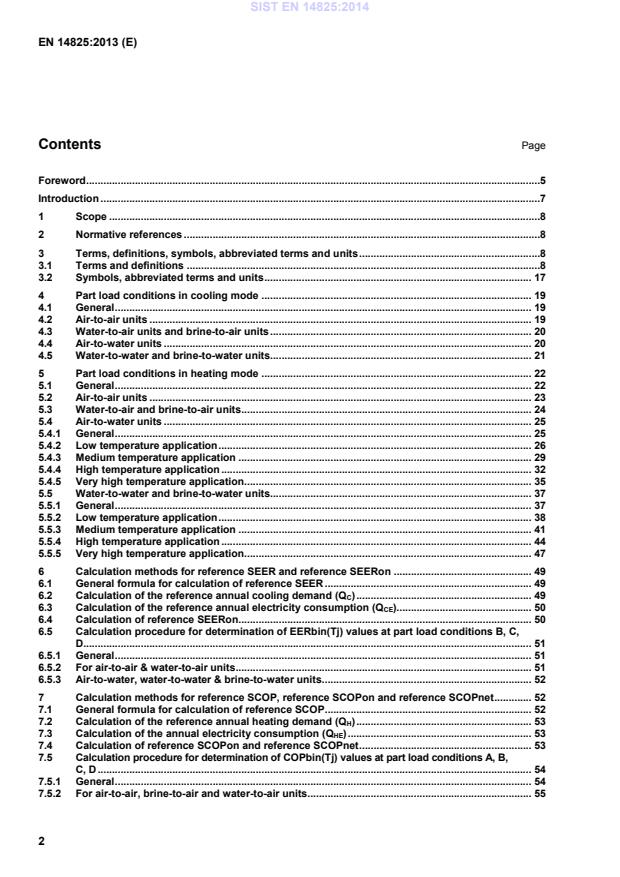
Applicable climate bin hours and hours for active mode, thermostat-off, standby, off mode for air conditioners below and equal to 12 kW. 63 A.1 Climate bins . 63 A.1.1 Bin limit temperature . 63 A.1.2 Cooling . 63 A.1.3 Heating. 63 A.2 Hours for active mode, thermostat-off, standby, off mode . 65 A.2.1 Cooling . 65 A.2.2 Heating. 65 A.3 Hours used for crankcase heater mode . 65 A.3.1 Cooling . 65 A.3.2 Heating. 66 Annex B (informative)
Calculation example for reference SEERon and reference SEER –Application to a reverse cycle air-to-air unit with variable capacity . 67 B.1 Calculation of SEERon . 67 B.2 Calculation of SEER . 68 B.2.1 Calculation of reference annual cooling demand (QC) according to Formula (2) . 68 B.2.2 Calculation of reference SEER according to Formula (1) . 69 Annex C (informative)
Calculation example for reference SCOPon and reference SCOPnet of a fixed capacity air-to-water heat pump used for floor heating. 70 Annex D (informative)
Adaption of water temperature for fixed capacity units . 74 Annex E (informative)
Determination of reference annual cooling/heating demands and determination of hours for active mode, thermostat-off, standby, off mode and crankcase heater mode . 77 E.1 General . 77 E.2 Determination of reference annual cooling/heating demands and hours for active mode, thermostat-off, standby, off mode . 77 E.3 Hours used for crankcase heater mode . 79 Annex F (informative)
Compensation method for air-to-water and water/brine-to-water units . 80 F.1 General . 80 F.2 Compensation system for reduced capacity test in cooling mode . 80 F.3 Compensation system for reduced capacity test in heating mode . 80 SIST EN 14825:2014
Template for technical data sheet . 82 Annex ZA (informative)
Relationship between this European Standard and the requirements of Commission Regulation (EC) No 206/2012 . 85 Bibliography . 86
Although this document be prepared in the frame of the Commission Regulation (EU) No 206/2012 implementing Directive 2009/125/EC with regard to ecodesign requirements for air conditioners and comfort fans, it may also be used to show compliance with the requirements of the European Directive 2010/30/EU and Commission Delegated Regulation (EU) No 626/2011. According to the CEN-CENELEC Internal Regulations, the national standards organizations of the following countries are bound to implement this European Standard: Austria, Belgium, Bulgaria, Croatia, Cyprus, Czech Republic, Denmark, Estonia, Finland, Former Yugoslav Republic of Macedonia, France, Germany, Greece, Hungary, Iceland, Ireland, Italy, Latvia, Lithuania, Luxembourg, Malta, Netherlands, Norway, Poland, Portugal, Romania, Slovakia, Slovenia, Spain, Sweden, Switzerland, Turkey and the United Kingdom. SIST EN 14825:2014
EN 14511-2, Air conditioners, liquid chilling packages and heat pumps with electrically driven compressors for
EN 14511-3:2011, Air conditioners, liquid chilling packages and heat pumps with electrically driven
EN 14511-4, Air conditioners, liquid chilling packages and heat pumps with electrically driven compressors for art 4: lperating requirements, marking and instructions 3 Terms, definitions, symbols, abbreviated terms and units 3.1 Terms and definitions For the purposes of this document, the terms and definitions given in EN 14511-1 (unless otherwise stated) and the following apply. 3.1.1 active mode mode corresponding to the hours with a cooling or heating load of the building and whereby the cooling or heating function of the unit is activated Note 1 to entry:
This condition may involve on/off-cycling of the unit in order to reach or maintain a required indoor air temperature. SIST EN 14825:2014
For calculation of SCOPon, the power consumption during thermostat-off mode, standby mode, off mode or that of the crankcase heater are excluded. The power consumption of an electric back up heater is added for the part load conditions where the declared capacity of the unit is lower than the heating load, regardless whether this back up heater is included in the unit or not. Note 2 to entry:
Expressed in kWh/kWh. 3.1.3 active mode seasonal energy efficiency ratio SEERon average energy efficiency ratio of the unit in active mode for the cooling function, constructed from part load and bin-specific energy efficiency ratio's (EERbin(Tj)) and weighted by the bin hours the bin condition occurs Note 1 to entry:
For calculation of SEERon, power consumption during thermostat-off mode, standby mode or that of the crankcase heater are excluded. Note 2 to entry:
Expressed in kWh/kWh. 3.1.4 annual electricity consumption for cooling QCE electricity consumption [kWh/a] required to meet the reference annual cooling demand and calculated as the reference annual cooling demand divided by the active mode seasonal energy efficiency ratio (SEERon) and the electricity consumption of the unit for thermostat-off-, standby-, off- and crankcase heater-mode during the cooling season 3.1.5 annual electricity consumption for heating QHE electricity consumption [kWh/a] which is required to meet the indicated reference annual heating demand, which pertains to a designated heating season and which is calculated as the Reference annual heating demand divided by the active mode seasonal coefficient of performance (SCOPon) and the electricity consumption of the unit for thermostat-off-, standby-, off- and crankcase heater-mode during the heating season 3.1.6 application SCOP, application SCOPon and SCOPnet SCOP and SCOPon/SCOPnet that takes into account the specific application and the specific location of the unit, which are different from the ones used for determining the reference SCOP and reference SCOPon/SCOPnet given in this European Standard Note 1 to entry:
The calculation procedures used to determine the application SCOPon/SCOPnet, if required, are those in this European Standard for reference SCOPon/SCOPnet. However, the heating bins used in the calculations will be those of the actual location of the building. The heating loads as well as the hours of use will be those of the actual building. 3.1.7 application SEER and application SEERon SEER and SEERon that takes into account the specific application and the specific location of the unit, which are different from the ones used for determining the reference SEER and reference SEERon given in this European Standard SIST EN 14825:2014
The calculation procedures used to determine the application SEERon, if required, are those in this European Standard for reference SEERon. However, the cooling bins used in the calculations will be those of the actual location of the building. The cooling loads as well as the hours of use will be those of the actual building. 3.1.8 bin hours hj sum of all hours occurring at a given temperature for a specific location Note 1 to entry:
The number is rounded to a whole number and is derived from representative weather data over the 1982-1999 period. Note 2 to entry:
For the reference heating seasons the specific locations are Strasbourg (average), Helsinki (colder) and Athens (warmer). 3.1.9 bin limit temperature temperature in the bin for which no more heating or cooling is required Note 1 to entry:
The bin limit temperature equals 16 °C for all climates in cooling and heating applications. 3.1.10 bin-specific coefficient of performance COPbin(Tj) coefficient of performance specific for every bin j with outdoor temperature Tj in a season 3.1.11 bin-specific energy efficiency ratio EERbin(Tj) energy efficiency ratio specific for every bin j with outdoor temperature Tj in a season 3.1.12 bivalent temperature Tbivalent lowest outdoor temperature point at which the unit is declared to have a capacity able to meet 100 % of the heating load Note 1 to entry:
Below this point, the unit may still deliver capacity, but additional back up heating is necessary to fulfil the full heating load.
3.1.13 capacity control ability of the unit to change its capacity by changing the volumetric flow rate of the refrigerant Note 1 to entry: Units are indicated as ‘fixed’ if the unit cannot change its volumetric flow rate, 'staged' if the volumetric flow rate is changed or varied in series of not more than two steps, or 'variable' if the volumetric flow rate is changed or varied in series of three or more steps. 3.1.14 capacity ratio CRu cooling (or heating) part load or full load divided by the declared cooling (or heating) capacity of the unit at the same temperature conditions 3.1.15 coefficient of performance at declared capacity COPd declared heating capacity of the unit divided by the effective power input of a unit at specific temperature conditions, A, B, C, D, E, F and G, where applicable SIST EN 14825:2014
Expressed in kW/kW. 3.1.16 coefficient of performance at part load COPPL heating capacity at part load or full load divided by the effective power input of a unit at specific temperature conditions
Note 1 to entry:
When the declared capacity of the unit is higher than the heating demand, the COP includes degradation losses. When the declared capacity of the unit is lower than the heating demand (i.e. below the bivalent temperature condition), the COP of the declared capacity is used. Note 2 to entry:
Expressed in kW/kW. 3.1.17 compensation load heating or cooling load imposed by the test apparatus on the test object 3.1.18 crankcase heater mode operating hours HCK
annual number of hours the unit is considered to be in crankcase heater mode, the value of which depends on the designated season and function Note 1 to entry:
Expressed in h/annum. 3.1.19 crankcase heater mode power consumption PCK
power consumption of the unit while in crankcase heater operation mode Note 1 to entry:
Expressed in W. 3.1.20 crankcase heater operation mode condition where the unit has activated a heating device to avoid the refrigerant migrating to the compressor in order to limit the refrigerant concentration in oil at compressor start Note 1 to entry:
The function of the crankcase heater is to avoid refrigerant to migrate to the compressor to limit refrigerant concentration in oil at compressor start. 3.1.21 cycling interval capacity for cooling Pcycc
(time-weighted) average cooling capacity output over the cycling test interval (active + off mode) Note 1 to entry: Expressed in kW. 3.1.22 cycling interval capacity for heating Pcych (time-weighted) average heating capacity output over the cycling test interval (active + off mode) Note 1 to entry: Expressed in kW. 3.1.23 cycling interval efficiency for cooling EERcyc average energy efficiency ratio over the cycling test interval (compressor switching on and off)
The cycling interval efficiency for heating calculated as the integrated heating capacity over the interval [kWh] divided by the integrated electric power input over that same interval [kWh]. 3.1.25 declared capacity Pd cooling (Pdc) or heating (Pdh) capacity of the vapour compression cycle a unit can deliver at any temperature condition A, B, C, D, E, F or G, as declared by the manufacturer Note 1 to entry:
This is the capacity delivered by the refrigerant cycle of the unit without supplementary electric heaters, even if those are integrated in the unit. Note 2 to entry:
The temperature conditions for part load conditions A, B, C, D, E, F or G are explained in the tables. 3.1.26 degradation coefficient Cc measure of efficiency loss due to the cycling of air-to-water or water/brine-to-water units 3.1.27 degradation coefficient Cd measure of efficiency loss due to the cycling of air-to-air or water/brine-to-air units Note 1 to entry:
If the degradation coefficient is different for cooling and heating mode, then Cdc is used for cooling and Cdh is used for heating. 3.1.28 electric back up heater supplementary electric heater, with a COP of 1, considered in the calculation of SCOP and SCOPon, regardless of whether this is supplied together with the unit 3.1.29 electric back up heater capacity elbu heating capacity of a real or assumed back up heater supplementing the declared capacity for heating when the capacity of the unit is lower than the heat demand Note 1 to entry:
Expressed in kW. 3.1.30 energy efficiency ratio at declared capacity EERd declared cooling capacity of the unit divided by the effective power input of a unit at specific temperature conditions A, B, C, D
Note 1 to entry:
Expressed in kW/kW. SIST EN 14825:2014
Note 1 to entry:
The EER includes degradation losses when the declared capacity of the unit is higher than the cooling capacity demand. Note 2 to entry:
Expressed in kW/kW. 3.1.32 equivalent active mode hours for cooling HCE assumed annual number of hours [h/year] while the unit is assumed to operate at the design load for cooling (Pdesignc) in order to satisfy the reference annual cooling demand 3.1.33 equivalent active mode hours for heating HHE assumed annual number of hours [hrs/a] while the unit is assumed to operate at the design load for heating (Pdesignh) in order to satisfy the reference annual heating demand 3.1.34 fixed outlet control of the heat pump has no means to vary the water flow temperature with the outdoor air temperature 3.1.35 forced convection air-cooled liquid cooler “dry cooler” self-contained system that cools a single-phase liquid by rejecting sensible heat via a heat exchanger to air that is mechanically circulated by integral fan(s) 3.1.36 full load design load Pdesign cooling (Pdesignc) or heating (Pdesignh) load declared by the manufacturer at Tdesign conditions Note 1 to entry:
It is possible to calculate the SEER/SEERon or SCOP/SCOPon/SCOPnet of a unit for more than one Pdesign value. Note 2 to entry:
Expressed in kW. 3.1.37 information or status display continuous function providing information or indicating the status of the equipment on a display, including clocks 3.1.38 net seasonal coefficient of performance SCOPnet seasonal efficiency of a unit in active heating mode without supplementary electric heaters which is determined from mandatory conditions given in this European Standard Note 1 to entry:
For calculation of SCOPnet, the electricity consumption during active mode is used. This excludes the power consumption during thermostat-off mode, standby mode, off mode or that of the crankcase heater. For the part load conditions where the declared capacity of the unit is lower than the heating load, the power consumption of a back up heater is not included.
Expressed in kWh/kWh. 3.1.39 off mode mode wherein the unit is completely switched off and can be reactivated neither by control device nor by timer Note 1 to entry:
Off mode means a condition in which the equipment is connected to the mains power source and is not providing any function. The following will also be considered as off mode: conditions providing only an indication of off mode condition; conditions providing only functionalities intended to ensure electromagnetic compatibility. 3.1.40 off mode operating hours HOFF
annual number of hours the unit is considered to be in off mode, the value of which depends on the designated season and function Note 1 to entry:
Expressed in h/annum. 3.1.41 off mode power consumption POFF
power consumption of the unit while in off mode Note 1 to entry:
Expressed in W. 3.1.42 operation limit temperature TOL lowest outdoor temperature at which the unit can still deliver heating capacity, as declared by the manufacturer Note 1 to entry:
Below this temperature the heat pump will not be able to deliver any heating capacity. 3.1.43 part load cooling load (Pc(Tj)) or heating load (Ph(Tj)) at a specific outdoor temperature Tj, calculated as the design load multiplied by the part load ratio Note 1 to entry:
Expressed in kW. 3.1.44 part load ratio outdoor temperature minus the bin limit temperature, divided by the reference design temperature minus the bin limit temperature, for either cooling or heating Note 1 to entry:
If 100 % part load ratio is mentioned, this equals full load. 3.1.45 reactivation function function facilitating the activation of other modes, including active mode, by remote switch including remote control, internal sensor, timer to a condition providing additional functions, including the main function, excluding thermostats 3.1.46 reference annual cooling demand QC representative annual cooling demand which is used for the calculation of reference SEER Note 1 to entry:
For certain types of units, QC is calculated by multiplying the full load value in cooling (Pdesignc) by the number of equivalent cooling hours. This is explained in Annex D. SIST EN 14825:2014
The representative annual cooling demand is obtained by statistical measurement of cooling load per floor area, to be used as a basis for calculation of SEER. This is explained in Annex D.
Note 3 to entry:
Expressed in kWh. 3.1.47 reference annual heating demand(s) QH representative annual heating demand(s) which are used for the calculation of reference SCOP Note 1 to entry:
There are three reference heating demands: “A” average, “C” colder and “W” warmer, corresponding to the three reference heating seasons. Note 2 to entry:
For certain types of units, QH is calculated by multiplying the full load value in heating (Pdesignh) by the number of equivalent heating hours. This is explained in Annex D. Note 3 to entry: The representative annual heating demand is obtained by statistical measurement of heating load per floor area, to be used as basis for calculation of SCOP. This is explained in Annex D of this standard
Note 4 to entry: Expressed in kWh. 3.1.48 reference cooling season representative climate profile by outdoor temperature bins and the number of hours these temperatures occur in for cooling Note 1 to entry:
The climate profile for cooling is explained in Annex A. 3.1.49 reference design conditions for cooling Tdesignc temperature conditions at 35 ºC dry bulb (24 ºC wet bulb) outdoor temperature and 27 ºC dry bulb (19 ºC wet bulb) indoor temperature 3.1.50 reference design conditions for heating Tdesignh temperature conditions for average, colder and warmer climates Note 1 to entry: Average = -10 ˚C (-11°C wet bulb), colder = -22 ˚C (-23°C wet bulb), warmer = 2 ˚C (1°C wet bulb). 3.1.51 reference heating season(s) representative climate profile(s) by outdoor temperature bins and the number of hours these temperatures occur in for heating Note 1 to entry:
There are three reference heating seasons: “A” average, “C” colder and “W” warmer. The climate profiles for heating are explained in Annex A. 3.1.52 seasonal coefficient of performance SCOP overall coefficient of performance of the unit, representative for the whole designated heating season Note 1 to entry:
The value of SCOP pertains to a designated heating season. SCOP is calculated as the reference annual heating demand divided by the annual electricity consumption for heating. Note 2 to entry:
Expressed in kWh/kWh. SIST EN 14825:2014
The seasonal energy efficiency ratio is calculated as the Reference annual cooling demand divided by the annual electricity consumption for cooling. Note 2 to entry:
Expressed in kWh/kWh. 3.1.54 standby mode mode wherein the unit is switched off partially and can be reactivated by a control device or timer Note 1 to entry:
The unit is connected to the mains power source, depends on signal input to work as intended and provides only the following functions, which may persist for an indefinite time: reactivation function, or reactivation function and only an indication of enabled reactivation function, and/or information or status display. 3.1.55 standby mode operating hours HSB
annual number of hours the unit is considered to be in standby mode, the value of which depends on the designated season and function Note 1 to entry:
Expressed in h/annum. 3.1.56 standby mode power consumption PSB
power consumption of the unit while in standby mode Note 1 to entry:
Expressed in W. 3.1.57 thermostat-off mode mode corresponding to the hours with no cooling or heating load of the building, whereby the cooling or heating function of the unit is switched on, but is not operational, as there is no cooling or heating load Note 1 to entry:
This condition is therefore related to outdoor temperatures and not to indoor loads. Note 2 to entry:
Cycling on / off in active mode is not considered as thermostat-off. 3.1.58 thermostat-off mode operating hours HTO annual number of hours the unit is considered to be in thermostat-off mode, the value of which depends on the designated season and function Note 1 to entry: Expressed in h/annum. 3.1.59 thermostat-off mode power consumption PTO
power consumption of the unit while in thermostat-off mode Note 1 to entry: Expressed in W. 3.1.60 variable outlet control of the heat pump has means to vary the water flow temperature with the outdoor air temperature SIST EN 14825:2014
Symbol and abbreviated terms Denomination Units A Average Climate
C Colder Climate
Cc Degradation Coefficient for air-to-water or water/brine units
Cd Degradation Coefficient for air-to-air or water/brine-to-air units
Cdc Degradation Coefficient for air-to-air or water/brine-to-air units in cooling mode
Cdh Degradation Coefficient for air-to-air or water/brine-to-air units in heating mode
COPd Coefficient of Performance at the declared capacity kW/kW COPPL Coefficient of Performance at Part Load kW/kW COP(Tj) Coefficient of Performance at the corresponding Bin Temperature kW/kW COPbin(Tj)
bin-specific Coefficient of Performance
COPcyc Cycling interval efficiency for heating
CRu Capacity Ratio kW/kW ER Energy Ratio
EERd Energy Efficiency Ratio at the Declared Capacity kW/kW EERPL Energy Efficiency Ratio at Part Load kW/kW EERbin(Tj) bin-specific Energy Efficiency Ratio
EERcyc Cycling interval efficiency for cooling
EER(Tj) Energy Efficiency Ratio at the corresponding Bin Temperature kW/kW EERbin(Tj) bin-specific Energy Efficiency Ratio
elbu Electric Back Up Heater capacity kW hj Bin Hours h HCE Equivalent active mode hours for cooling h SIST EN
...