

EN 14511-3:2022
(Main)Air conditioners, liquid chilling packages and heat pumps for space heating and cooling and process chillers, with electrically driven compressors - Part 3: Test methods
- Abstract
1.1 The scope of EN 14511-1:2022 is applicable.
1.2 This document specifies the test methods for the rating and performance of air conditioners, liquid chilling packages and heat pumps using either air, water or brine as heat transfer media, with electrically driven compressors when used for space heating and cooling. These test methods also apply for the rating and performance of process chillers.
It also specifies the method of testing and reporting for heat recovery capacities, system reduced capacities and the capacity of individual indoor units of multisplit systems, where applicable.
This document also makes possible to rate multisplit and modular heat recovery multisplit systems by rating separately the indoor and outdoor units.
- Status
- Published
- Publication Date
- 06-Sep-2022
- Technical Committee
- CEN/TC 113 - Heat pumps and air conditioning units
- Drafting Committee
- CEN/TC 113/WG 8 - Revision of existing standards
- Current Stage
- 6060 - Definitive text made available (DAV) - Publishing
- Start Date
- 07-Sep-2022
- Due Date
- 11-Jan-2022
- Completion Date
- 07-Sep-2022


Overview
EN 14511-3:2022 (equivalent to EN 14511-3:2022) defines standardized test methods for rating and determining the performance of air conditioners, liquid chilling packages, heat pumps for space heating/cooling and process chillers with electrically driven compressors. It complements EN 14511-1:2022 by specifying how to measure capacities, power input and energy performance metrics, and it replaces the 2018 edition.
Key technical topics and requirements
This part of EN 14511 focuses on test procedure details and measurement methods, including:
- Capacity determination for air-to-air, air-to-water (or brine), water/brine-to-air and water/brine-to-water units.
- Measurement and correction methods (capacity correction, effective power input) to ensure repeatable, comparable ratings.
- Energy performance calculations such as EER (Energy Efficiency Ratio) and COP (Coefficient of Performance).
- Electrical consumption testing for standby and off-modes, and total electricity consumption.
- Air flow rate measurement methods for ducted units.
- Heat recovery testing for air‑cooled multisplit and modular heat recovery multisplit systems (three-room and two-room methods, enthalpy approaches).
- Test methods by calorimeter, indoor air enthalpy method and liquid enthalpy method (normative annexes).
- Uncertainty estimation, permissible deviations and detailed test-reporting requirements.
- Ancillary tests including liquid pump efficiency, pressure and temperature measurement points, and recommendations to reduce method uncertainty.
Key test apparatus and installation requirements, plus normative annexes (calorimeter details, duct/room arrangements and calculation formulas), are provided to ensure consistent laboratory and factory testing.
Practical applications and users
This standard is essential for professionals who need objective, repeatable performance data for HVACR equipment:
- Manufacturers: for product development, factory testing and performance declarations.
- Independent test laboratories: to perform standardized ratings and certification testing.
- Certification and compliance bodies: for regulatory verification and product conformity assessment.
- HVAC system designers and specifiers: to compare equipment performance (cooling/heating capacities, COP/EER, heat recovery).
- Energy auditors and consultants: to evaluate field performance against declared ratings.
Using EN 14511-3 ensures comparable, traceable performance data for procurement, efficiency labeling and system design decisions.
Related standards
- EN 14511-1:2022 (referenced in the scope) - overall scope and definitions for rating air conditioners, heat pumps and chillers.
- Other parts of EN 14511 series (equipment categories and rating conditions) - for a complete compliance and rating framework.
Relations
- Effective Date
- 31-Jul-2019
- Effective Date
- 28-Jan-2026
- Effective Date
- 28-Jan-2026
- Effective Date
- 09-Feb-2026
- Effective Date
- 09-Feb-2026
- Effective Date
- 09-Feb-2026
- Effective Date
- 28-Jan-2026
- Effective Date
- 28-Jan-2026
- Effective Date
- 28-Jan-2026
- Effective Date
- 28-Jan-2026
- Effective Date
- 28-Jan-2026
- Effective Date
- 28-Jan-2026
- Effective Date
- 28-Jan-2026
- Effective Date
- 28-Jan-2026
- Effective Date
- 28-Jan-2026
Get Certified
Connect with accredited certification bodies for this standard

DNV
DNV is an independent assurance and risk management provider.

Lloyd's Register
Lloyd's Register is a global professional services organisation specialising in engineering and technology.

DIBt (Deutsches Institut für Bautechnik)
German Institute for Building Technology.
Sponsored listings
Frequently Asked Questions
EN 14511-3:2022 is a standard published by the European Committee for Standardization (CEN). Its full title is "Air conditioners, liquid chilling packages and heat pumps for space heating and cooling and process chillers, with electrically driven compressors - Part 3: Test methods". This standard covers: 1.1 The scope of EN 14511-1:2022 is applicable. 1.2 This document specifies the test methods for the rating and performance of air conditioners, liquid chilling packages and heat pumps using either air, water or brine as heat transfer media, with electrically driven compressors when used for space heating and cooling. These test methods also apply for the rating and performance of process chillers. It also specifies the method of testing and reporting for heat recovery capacities, system reduced capacities and the capacity of individual indoor units of multisplit systems, where applicable. This document also makes possible to rate multisplit and modular heat recovery multisplit systems by rating separately the indoor and outdoor units.
1.1 The scope of EN 14511-1:2022 is applicable. 1.2 This document specifies the test methods for the rating and performance of air conditioners, liquid chilling packages and heat pumps using either air, water or brine as heat transfer media, with electrically driven compressors when used for space heating and cooling. These test methods also apply for the rating and performance of process chillers. It also specifies the method of testing and reporting for heat recovery capacities, system reduced capacities and the capacity of individual indoor units of multisplit systems, where applicable. This document also makes possible to rate multisplit and modular heat recovery multisplit systems by rating separately the indoor and outdoor units.
EN 14511-3:2022 is classified under the following ICS (International Classification for Standards) categories: 27.080 - Heat pumps; 91.140.30 - Ventilation and air-conditioning systems. The ICS classification helps identify the subject area and facilitates finding related standards.
EN 14511-3:2022 has the following relationships with other standards: It is inter standard links to EN 14511-3:2018, EN 14511-1:2022, EN 14825:2018, CLC/TS 50600-5-1:2023, CLC/TR 50600-99-1:2021, CLC/TR 50600-99-1:2020, EN 15316-4-2:2008, CEN/TR 16798-14:2017, EN 15316-4-2:2017, EN 16798-13:2017, EN 16573:2017, EN 14511-4:2022, EN 17625:2025, EN 12102-1:2022, EN 13141-7:2010. Understanding these relationships helps ensure you are using the most current and applicable version of the standard.
EN 14511-3:2022 is associated with the following European legislation: EU Directives/Regulations: 2015/1095, 2016/2281, 206/2012, 626/2011; Standardization Mandates: M/488, M/495, M/495_AM1, M/560. When a standard is cited in the Official Journal of the European Union, products manufactured in conformity with it benefit from a presumption of conformity with the essential requirements of the corresponding EU directive or regulation.
EN 14511-3:2022 is available in PDF format for immediate download after purchase. The document can be added to your cart and obtained through the secure checkout process. Digital delivery ensures instant access to the complete standard document.
Standards Content (Sample)
SLOVENSKI STANDARD
01-november-2022
Nadomešča:
SIST EN 14511-3:2018
Klimatske naprave, enote za hlajenje kapljevine, toplotne črpalke za ogrevanje in
hlajenje prostora ter procesne hladilne naprave z električnimi kompresorji - 3. del:
Preskusne metode
Air conditioners, liquid chilling packages and heat pumps for space heating and cooling
and process chillers, with electrically driven compressors - Part 3: Test methods
Luftkonditionierer, Flüssigkeitskühlsätze und Wärmepumpen für die Raumbeheizung und
-kühlung und Prozess-Kühler mit elektrisch angetriebenen Verdichtern - Teil 3:
Prüfverfahren
Climatiseurs, groupes refroidisseurs de liquide et pompes à chaleur pour le chauffage et
le refroidissement des locaux et refroidisseurs industriels avec compresseur entraîné par
moteur électrique - Partie 3 : Méthodes d'essai
Ta slovenski standard je istoveten z: EN 14511-3:2022
ICS:
23.120 Zračniki. Vetrniki. Klimatske Ventilators. Fans. Air-
naprave conditioners
27.080 Toplotne črpalke Heat pumps
91.140.30 Prezračevalni in klimatski Ventilation and air-
sistemi conditioning systems
2003-01.Slovenski inštitut za standardizacijo. Razmnoževanje celote ali delov tega standarda ni dovoljeno.
EN 14511-3
EUROPEAN STANDARD
NORME EUROPÉENNE
September 2022
EUROPÄISCHE NORM
ICS 27.080; 91.140.30 Supersedes EN 14511-3:2018
English Version
Air conditioners, liquid chilling packages and heat pumps
for space heating and cooling and process chillers, with
electrically driven compressors - Part 3: Test methods
Climatiseurs, groupes refroidisseurs de liquide et Luftkonditionierer, Flüssigkeitskühlsätze und
pompes à chaleur pour le chauffage et le Wärmepumpen für die Raumbeheizung und -kühlung
refroidissement des locaux et refroidisseurs industriels und Prozess-Kühler mit elektrisch angetriebenen
avec compresseur entraîné par moteur électrique - Verdichtern - Teil 3: Prüfverfahren
Partie 3 : Méthodes d'essai
This European Standard was approved by CEN on 10 July 2022.
CEN members are bound to comply with the CEN/CENELEC Internal Regulations which stipulate the conditions for giving this
European Standard the status of a national standard without any alteration. Up-to-date lists and bibliographical references
concerning such national standards may be obtained on application to the CEN-CENELEC Management Centre or to any CEN
member.
This European Standard exists in three official versions (English, French, German). A version in any other language made by
translation under the responsibility of a CEN member into its own language and notified to the CEN-CENELEC Management
Centre has the same status as the official versions.
CEN members are the national standards bodies of Austria, Belgium, Bulgaria, Croatia, Cyprus, Czech Republic, Denmark, Estonia,
Finland, France, Germany, Greece, Hungary, Iceland, Ireland, Italy, Latvia, Lithuania, Luxembourg, Malta, Netherlands, Norway,
Poland, Portugal, Republic of North Macedonia, Romania, Serbia, Slovakia, Slovenia, Spain, Sweden, Switzerland, Türkiye and
United Kingdom.
EUROPEAN COMMITTEE FOR STANDARDIZATION
COMITÉ EUROPÉEN DE NORMALISATION
EUROPÄISCHES KOMITEE FÜR NORMUNG
CEN-CENELEC Management Centre: Rue de la Science 23, B-1040 Brussels
© 2022 CEN All rights of exploitation in any form and by any means reserved Ref. No. EN 14511-3:2022 E
worldwide for CEN national Members.
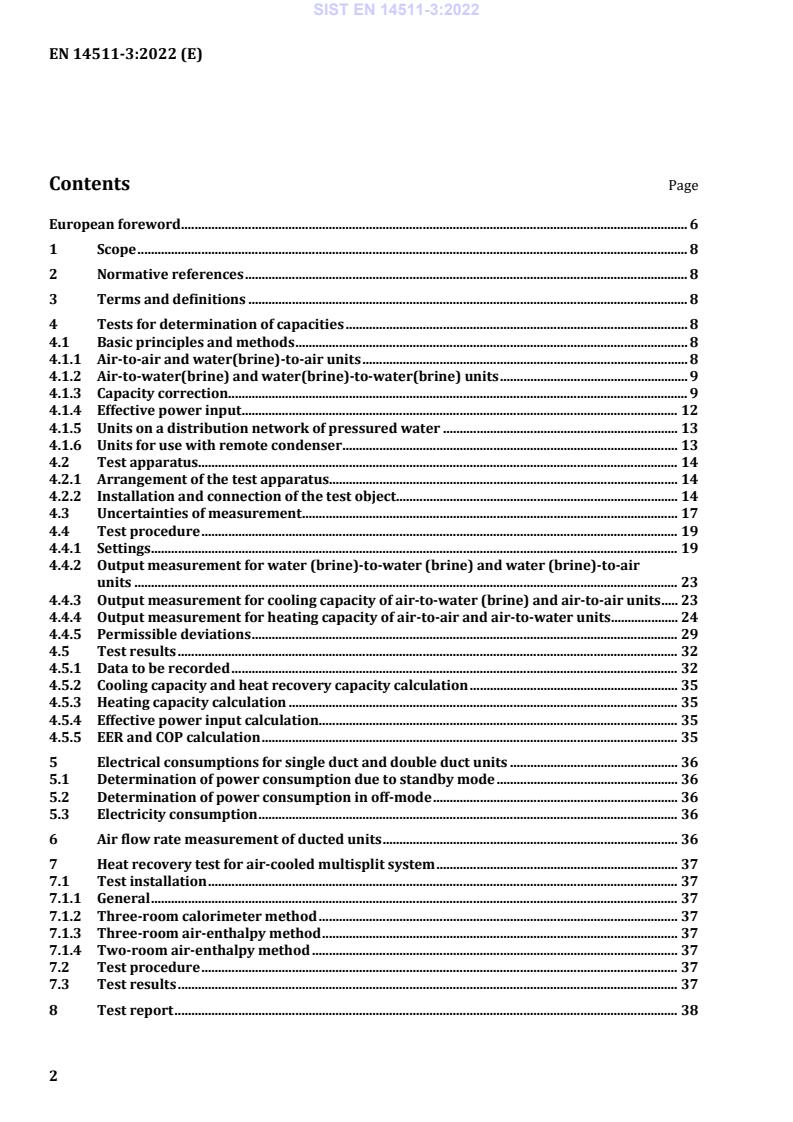
Contents Page
European foreword . 6
1 Scope . 8
2 Normative references . 8
3 Terms and definitions . 8
4 Tests for determination of capacities . 8
4.1 Basic principles and methods . 8
4.1.1 Air-to-air and water(brine)-to-air units . 8
4.1.2 Air-to-water(brine) and water(brine)-to-water(brine) units . 9
4.1.3 Capacity correction. 9
4.1.4 Effective power input . 12
4.1.5 Units on a distribution network of pressured water . 13
4.1.6 Units for use with remote condenser . 13
4.2 Test apparatus. 14
4.2.1 Arrangement of the test apparatus. 14
4.2.2 Installation and connection of the test object. 14
4.3 Uncertainties of measurement . 17
4.4 Test procedure . 19
4.4.1 Settings . 19
4.4.2 Output measurement for water (brine)-to-water (brine) and water (brine)-to-air
units . 23
4.4.3 Output measurement for cooling capacity of air-to-water (brine) and air-to-air units . 23
4.4.4 Output measurement for heating capacity of air-to-air and air-to-water units . 24
4.4.5 Permissible deviations . 29
4.5 Test results . 32
4.5.1 Data to be recorded . 32
4.5.2 Cooling capacity and heat recovery capacity calculation . 35
4.5.3 Heating capacity calculation . 35
4.5.4 Effective power input calculation. 35
4.5.5 EER and COP calculation . 35
5 Electrical consumptions for single duct and double duct units . 36
5.1 Determination of power consumption due to standby mode . 36
5.2 Determination of power consumption in off-mode . 36
5.3 Electricity consumption . 36
6 Air flow rate measurement of ducted units . 36
7 Heat recovery test for air-cooled multisplit system . 37
7.1 Test installation . 37
7.1.1 General . 37
7.1.2 Three-room calorimeter method . 37
7.1.3 Three-room air-enthalpy method . 37
7.1.4 Two-room air-enthalpy method . 37
7.2 Test procedure . 37
7.3 Test results . 37
8 Test report . 38
8.1 General information . 38
8.2 Additional information . 38
8.3 Rating test results . 38
Annex A (normative) Calorimeter test method . 40
A.1 General . 40
A.2 Calibrated room-type calorimeter . 42
A.3 Balanced ambient room-type calorimeter . 43
A.4 Calculations-cooling capacities . 43
A.4.1 General . 43
A.4.2 Total cooling capacity on the indoor-side . 44
A.4.3 Total cooling capacity of liquid (water)-cooled equipment deducted from the
condenser side . 45
A.4.4 Latent cooling capacity (room dehumidifying capacity) . 45
A.4.5 Sensible cooling capacity . 45
A.4.6 Sensible heat ratio . 45
A.5 Calculation-heating capacities . 46
A.5.1 General . 46
A.5.2 Determination of the heating capacity by measurements in the indoor-side room . 46
A.5.3 Determination of the heating capacity by measurements in the outdoor-side room . 46
A.5.4 Total heating capacity of liquid (water)-to-air unit deducted from the water side . 47
Annex B (normative) Indoor air enthalpy method . 48
B.1 General . 48
B.2 Test installation . 48
B.2.1 General . 48
B.2.2 Air outlet section . 49
B.2.3 Air inlet section . 49
B.2.4 Discharge chamber design for non-ducted units . 49
B.2.5 Duct requirements for ducted units . 54
B.2.5.1 Air outlet duct . 54
B.2.5.2 Air inlet duct . 55
B.3 Calculations-cooling capacities . 55
B.4 Calculations-heating capacities . 56
Annex C (informative) Recommendations for reducing the indoor air enthalpy method
uncertainty . 57
C.1 General . 57
C.2 Uncertainty of measurement . 57
C.2.1 General . 57
C.2.2 Guidance on temperature measurement . 57
C.3 Air leakage tests . 62
C.4 Zero latent capacity confirmation . 64
C.5 Thermal loses from ducts, chambers and plenums . 64
Annex D (normative) Liquid enthalpy test method . 65
D.1 General . 65
D.2 Calculations-heating capacities . 65
D.3 Calculations-cooling capacities . 65
Annex E (informative) Test installation and measurements for the liquid enthalpy method . 66
E.1 General . 66
E.2 Connecting the unit . 66
E.3 Liquid temperature measuring points . 66
E.4 Pressure measuring points . 68
E.5 Liquid flow rate measurement . 69
Annex F (normative) Determination of the liquid pump efficiency . 70
F.1 General . 70
F.2 Hydraulic power of the liquid pump . 70
F.2.1 The liquid pump is an integral part of the unit . 70
F.2.2 The liquid pump is not an integral part of the unit . 70
F.3 Efficiency of integrated pumps . 70
F.3.1 Glandless circulators . 70
F.3.2 Dry motor pumps . 71
F.4 Efficiency of non-integrated pumps . 73
Annex G (informative) Rating of indoor and outdoor units of multisplit and modular heat
recovery multisplit systems . 74
G.1 General . 74
G.2 Terms and definitions . 74
G.3 Rating of indoor units . 75
G.3.1 General . 75
G.3.2 Air flow rate measurement . 75
G.3.3 Measurement of the power input of indoor units . 75
G.4 Rating of outdoor units . 75
G.4.1 General . 75
G.4.2 Test procedure . 75
Annex H (informative) Symbols used in annexes . 77
Annex I (normative) Air flow rate measurement . 79
I.1 General . 79
I.2 Test installation . 79
I.3 Test conditions . 79
I.4 Air flow measurement . 79
Annex J (informative) Conformance criteria . 80
J.1 Water(brine)-to-water(brine) units . 80
J.2 Calorimeter room method . 80
J.3 Heat recovery of multisplit systems . 80
Annex K (informative) Individual unit tests . 81
K.1 General . 81
K.1.1 Methods . 81
K.1.2 Calorimeter method. 81
K.1.3 Air-enthalpy method . 81
K.2 Test results . 81
K.3 Published results . 81
Annex ZA (informative) Relationship between this European Standard and the ecodesign
requirements of Commission Regulation (EU) No 206/2012 [OJEU L 72/7-27,
10.3.2012] aimed to be covered . 82
Annex ZB (informative) Relationship between this European Standard and the energy
labelling requirements of Commission Delegated Regulation (EU) No 626/2011
[OJEU L 178/1-72, 6.7.2011] aimed to be covered . 85
Annex ZC (informative) Relationship between this European Standard and the ecodesign
requirements of Commission Regulation (EU) No 2016/2281 [OJEU L346/1-50,
20.12.2016] aimed to be covered . 87
Bibliography . 88
European foreword
This document (EN 14511-3:2022) has been prepared by Technical Committee CEN/TC 113 “Heat
pumps and air conditioning units”, the secretariat of which is held by UNE.
This European Standard shall be given the status of a national standard, either by publication of an
identical text or by endorsement, at the latest by March 2023, and conflicting national standards shall be
withdrawn at the latest by March 2023.
Attention is drawn to the possibility that some of the elements of this document may be the subject of
patent rights. CEN shall not be held responsible for identifying any or all such patent rights.
This document supersedes EN 14511-3:2018.
The main changes compared with EN 14511-3:2018 are as follows:
— update of the flowchart with steps procedure;
— addition of new annexes for the liquid enthalpy test method;
— addition of a new Annex ZC on the relationship with Commission Regulation (EU) No 2016/2281.
This document has been prepared in the frame of:
— Commission Regulation (EU) No 206/2012 of 6 March 2012 implementing Directive 2009/125/EC
of the European Parliament and of the Council with regard to ecodesign requirements for air
conditioners and comfort fans;
— Commission Delegated Regulation (EU) No 626/2011 of 4 May 2011 supplementing Directive
2010/30/EU of the European Parliament and of the Council with regard to energy labelling of air
conditioners;
— Commission Regulation (EU) No 813/2013 of 2 August 2013 implementing Directive 2009/125/EC
of the European Parliament and of the Council with regard to ecodesign requirements for space
heaters and combination heaters;
— Commission Delegated Regulation (EU) No 811/2013 of 18 February 2013 supplementing Directive
2010/30/EU of the European Parliament and of the Council with regard to the energy labelling of
space heaters, combination heaters, packages of space heater, temperature control and solar device
and packages of combination heater, temperature control and solar device;
— Commission Regulation (EU) 2015/1095 of 5 May 2015 implementing Directive 2009/125/EC of the
European Parliament and of the Council with regard to ecodesign requirements for professional
refrigerated storage cabinets, blast cabinets, condensing units and process chillers;
— Commission Regulation (EU) 2016/2281 of 30 November 2016 implementing Directive
2009/125/EC of the European Parliament and of the Council establishing a framework for the setting
of ecodesign requirements for energy-related products, with regard to ecodesign requirements for
air heating products, cooling products, high temperature process chillers and fan coil units.
This document has been prepared under a Standardization Request given to CEN by the European
Commission and the European Free Trade Association, and supports essential requirements of EU
Regulation(s).
For relationship with EU Regulation(s), see informative Annex ZA, ZB or ZC, which is an integral part of
this document.
EN 14511, Air conditioners, liquid chilling packages and heat pumps for space heating and cooling and
process chillers, with electrically driven compressors, currently comprises the following parts:
— Part 1: Terms and definitions;
— Part 2: Test conditions;
— Part 3: Test methods;
— Part 4: Requirements.
Any feedback and questions on this document should be directed to the users’ national standards body.
A complete listing of these bodies can be found on the CEN website.
According to the CEN-CENELEC Internal Regulations, the national standards organisations of the
following countries are bound to implement this European Standard: Austria, Belgium, Bulgaria, Croatia,
Cyprus, Czech Republic, Denmark, Estonia, Finland, France, Germany, Greece, Hungary, Iceland, Ireland,
Italy, Latvia, Lithuania, Luxembourg, Malta, Netherlands, Norway, Poland, Portugal, Republic of North
Macedonia, Romania, Serbia, Slovakia, Slovenia, Spain, Sweden, Switzerland, Türkiye and the United
Kingdom.
1 Scope
1.1 The scope of EN 14511-1:2022 is applicable.
1.2 This document specifies the test methods for the rating and performance of air conditioners, liquid
chilling packages and heat pumps using either air, water or brine as heat transfer media, with electrically
driven compressors when used for space heating and cooling. These test methods also apply for the rating
and performance of process chillers.
It also specifies the method of testing and reporting for heat recovery capacities, system reduced
capacities and the capacity of individual indoor units of multisplit systems, where applicable.
This document also makes possible to rate multisplit and modular heat recovery multisplit systems by
rating separately the indoor and outdoor units.
2 Normative references
The following documents are referred to in the text in such a way that some or all of their content
constitutes requirements of this document. For dated references, only the edition cited applies. For
undated references, the latest edition of the referenced document (including any amendments) applies.
EN 14511-1:2022, Air conditioners, liquid chilling packages and heat pumps for space heating and cooling
and process chillers, with electrically driven compressors — Part 1: Terms and definitions
EN 14825:2018, Air conditioners, liquid chilling packages and heat pumps, with electrically driven
compressors, for space heating and cooling — Testing and rating at part load conditions and calculation of
seasonal performance
3 Terms and definitions
For the purposes of this document, the terms and definitions given in EN 14511-1:2022 apply.
ISO and IEC maintain terminological databases for use in standardization at the following addresses:
— ISO Online browsing platform: available at https://www.iso.org/obp
— IEC Electropedia: available at https://www.electropedia.org/
4 Tests for determination of capacities
4.1 Basic principles and methods
4.1.1 Air-to-air and water(brine)-to-air units
Heating and/or cooling capacity of air-to-air or water(brine)-to-air units shall be determined from
measurements in a calorimeter room (see Annex A) or by the air enthalpy method (see Annex B).
NOTE 1 Annex C (informative) provides additional information to Annex B for reducing uncertainties of
measurement of capacities.
The measured heating capacity Φ shall be corrected for the heat from the indoor fan as specified in
thi
4.1.3.2 or 4.1.3.3 to obtain the heating capacity P .
H
The measured cooling capacity Φ shall be corrected for the heat from the indoor fan as specified in
tci
4.1.3.2 or 4.1.3.3 to obtain the cooling capacity P .
C
NOTE 2 For rating indoor units and/or outdoor units separately, Annex G can be used.
4.1.2 Air-to-water(brine) and water(brine)-to-water(brine) units
The heating and/or cooling capacity of air-to-water(brine) and water(brine)-to-water(brine) units shall
be determined in accordance with the liquid enthalpy test method at the liquid indoor heat exchanger
(see Annex D).
The heat recovery capacity of air-to-water(brine) and water(brine)-to-water(brine) units shall be
determined in accordance with the liquid enthalpy test method at the liquid heat recovery heat exchanger
(see Annex D).
NOTE Annex E (informative) provides additional information to Annex D regarding the test installation and
measurements.
The measured heating capacity Φ shall be corrected for the heat from the indoor liquid pump as
thi
specified in 4.1.3.4 to obtain the heating capacity P .
H
The measured cooling capacity Φ shall be corrected for the heat from the indoor liquid pump as
tci
specified in 4.1.3.4 to obtain the cooling capacity P .
C
The measured heat recovery capacity Φ shall be corrected for the heat from the heat recovery liquid
hr
pump as specified in 4.1.3.4 to obtain the heating recovery capacity P .
HR
4.1.3 Capacity correction
4.1.3.1 General
The capacity shall include the correction due to the heat output of the indoor fan or pump, integrated into
the unit or not as follows.
4.1.3.2 Capacity correction due to indoor fan for non-ducted units
In the case of units which are not designed for duct connection, i.e. which do not permit any external
pressure difference, and which are equipped with an integral fan, no capacity correction due to heat
provided by the fan shall apply.
4.1.3.3 Capacity correction due to indoor fan for ducted units
4.1.3.3.1 Units with integrated indoor fan
If the fan at the indoor heat exchanger is an integral part of the unit, the power input correction of the
fan, as calculated with Formula (5) (see 4.1.4.3.1) shall be:
— subtracted from the measured heating capacity;
— added to the measured cooling capacity.
4.1.3.3.2 Units with non-integrated indoor fan
If the fan at the indoor heat exchanger is not an integral part of the unit, the power input correction as
calculated with Formula (6) (see 4.1.4.3.2) shall be:
— added to the measured heating capacity;
— subtracted from the measured cooling capacity.
4.1.3.4 Capacity correction due to indoor liquid pump
4.1.3.4.1 Units with integrated liquid pump
If the liquid pump is an integrated part of the unit, the capacity correction as specified in 4.1.3.4.3 or
4.1.3.4.4 shall be:
— subtracted from the measured heating capacity;
— added to the measured cooling capacity;
— subtracted from the measured heat recovery capacity.
In case, the integrated liquid pump does not provide any available external static pressure difference, no
capacity correction applies.
4.1.3.4.2 Units with non-integrated liquid pump
If the liquid pump is not an integral part of the unit, the capacity correction as specified in 4.1.3.4.5 shall
be:
— added to the measured heating capacity;
— subtracted from the measured cooling capacity;
— added to the measured heat recovery capacity.
4.1.3.4.3 Capacity correction for integrated glandless circulator
If the unit is equipped with a glandless circulator, the capacity correction, expressed in W, is calculated
using Formula (1).
1 − η
q ××∆ (1)
( )
pe
η
where
q
is the measured liquid flow rate, expressed in m /s.
Δp is the measured available external static pressure difference, expressed in Pa, as defined in
e
EN 14511-1:2022, 3.3;
η is the global efficiency of the pump calculated according to Annex F.
4.1.3.4.4 Capacity correction for integrated dry motor pump
If the unit is equipped with a dry-motor pump, the capacity correction, expressed in W, shall be calculated
using Formula (2).
IE − η
q ××∆ (2)
( )
pe
η
where
q
is the measured liquid volume flow rate, expressed in m /s;
Δp is the measured available external static pressure difference, expressed in Pa, as defined in
e
EN 14511-1:2022, 3.3;
IE is the motor efficiency as specified in the EC 2019/1781 regulation;
η is the global efficiency of the pump calculated according to Annex F.
4.1.3.4.5 Capacity correction for non-integrated liquid pump
If the measured hydraulic power according to Annex F is ≤ 300 W, the liquid pump is considered as a
glandless circulator. The capacity correction, expressed in W, is calculated using Formula (3).
1 − η
q ×−∆ × (3)
( )
pi
η
where
q
is the measured liquid flow rate, expressed in m /s;
Δp is the measured internal static pressure difference, expressed in Pa, as defined in EN 14511-
i
1:2022, 3.30;
η is the global efficiency of the pump calculated according to Annex F.
If the measured hydraulic power according to Annex F is > 300 W, the liquid pump is considered as a dry-
motor pump. The capacity correction, expressed in W, is calculated using Formula (4).
IE − η
q ×−∆ × (4)
( )
pi
η
where
q
is the liquid volume flow rate, expressed in m /s;
Δp is the measured internal static pressure difference, expressed in Pa, as defined in EN 14511-
i
1:2022, 3.30;
IE is equal to 0,88 (average motor nominal efficiency specified in the EC 2019/1781 regulation for
IE3 efficiency level);
η is the global efficiency of the pump calculated according to Annex F.
4.1.4 Effective power input
4.1.4.1 General
The effective power input shall include the correction due to power input of indoor and/or outdoor fans
and/or pumps, integrated into the unit or not as follows.
4.1.4.2 Power input correction due to fans for non-ducted units
In the case of units which are not designed for duct connection, i.e. which do not permit any external
pressure difference, and which are equipped with an integral fan, the power absorbed by the fan shall be
included in the effective power absorbed by the unit.
4.1.4.3 Power input correction due to fans for ducted units
4.1.4.3.1 Power input correction of integrated fans
If a fan is an integral part of the unit, only a fraction of the power input of the fan motor shall be included
in the effective power absorbed by the unit. The fraction that is to be excluded from the total power
absorbed by the unit, expressed in W, shall be calculated using Formula (5):
qp× ∆
e()corr
(5)
η
where
q
is the air volume flow rate, expressed in m /s and set according to 4.4.1.3 (q ) or 4.4.1.4
v,lab
(q );
v,outdoor,lab
is the available external static pressure difference, expressed in Pa, as defined in EN 14511-
Δp
e (corr)
1:2022, 3.3 and set according to 4.4.1.3 (Δp ) or 4.4.1.4 (Δp );
e,lab e,outdoor,lab
η is equal to η as declared by the fan manufacturer according to the ecodesign
target
regulation (EU) No 327/2011 for fans driven by motors between 125 W and 500 kW;
otherwise is equal to 0,3 by convention.
4.1.4.3.2 Power input correction of non-integrated fans
If no fan is provided with the unit, the proportional power input which is to be included in the effective
power absorbed by the unit, expressed in W, shall be calculated using the Formula (6):
qp×−∆
( )
i
(6)
η
where
q
is the air volume flow rate, expressed in m /s and set according to 4.4.1.3 or 4.4.1.4;
Δp is the measured internal static pressure difference, expressed in Pa, as defined in EN 14511-
i
1:2022, 3.30;
η is 0,3 by convention.
4.1.4.4 Power input correction due to liquid pumps
4.1.4.4.1 Power input correction of integrated liquid pumps
When the liquid pump is integrated into the unit, it shall be connected for operation. When the liquid
pump is delivered by the manufacturer apart from the unit, it shall be connected for operation according
to the manufacturer’s instructions and be then considered as an integral part of the unit.
For an integrated liquid pump, only a fraction of the input to the pump motor shall be included in the
effective power absorbed by the unit. The fraction which is to be excluded from the total power absorbed
by the unit, expressed in W, shall be calculated using Formula (7):
qp× ∆
e
(7)
η
where
q
is the measured liquid flow rate, expressed in m /s;
Δp is the measured available external static pressure difference, expressed in Pa, as defined in
e
EN 14511-1:2022, 3.3;
η is the efficiency of the pump calculated according to Annex F.
In case the liquid pump is not able to provide any external static pressure difference, then this correction
does not apply but the correction shall be made according to 4.1.4.4.2.
4.1.4.4.2 Power input correction of non-integrated liquid pumps
If no liquid pump is provided with the unit, the proportional power input which is to be included in the
effective power absorbed by the unit, expressed in W, shall be calculated using Formula (8):
qp×−∆
( )
i
(8)
η
where
q
is the measured liquid flow rate, expressed in m /s;
is the measured internal static pressure difference, expressed in Pa, as defined in EN 14511-
Δp
i
1:2022, 3.30;
η is the efficiency of the pump calculated according to Annex F.
4.1.5 Units on a distribution network of pressured water
In the case of appliances designed specially to operate on a distributing network of pressurized water
without water-pump, no correction shall be applied to the power input.
4.1.6 Units for use with remote condenser
The power from the auxiliary liquid pump of the remote condenser shall not be taken into account in the
effective power input.
4.2 Test apparatus
4.2.1 Arrangement of the test apparatus
4.2.1.1 General requirements
The test apparatus shall be designed in such a way that all requirements on adjustment of set values,
stability criteria and uncertainties of measurement according to this document can be fulfilled.
4.2.1.2 Test room for the air side
The size of the test room shall be selected such that any resistance to air flow at the air inlet and air outlet
orifices of the test object is avoided.
The air flow through the room shall not be capable of initiating any short circuit between these two
orifices, and therefore the velocity of the air flows through the room at these two locations shall not
exceed 1,5 m/s when the test object is switched off.
The air velocity in the room shall also not be greater than the mean velocity through the unit inlet. Unless
otherwise stated by the manufacturer, the air inlet or air outlet orifices shall be not less than 1 m distant
from the surfaces of the test room.
Any direct heat radiation by heating units in the test room onto the unit or onto the temperature
measuring points shall be avoided.
4.2.1.3 Appliances with duct connection
The connections of a ducted air unit to the test facility shall be sufficiently air tight to ensure that the
measured results are not significantly influenced by exchange of air with the surroundings.
If defrost controls on the heat pump provide means for stopping the indoor air flow, provision shall be
made to stop the test apparatus air flow to the equipment on both the indoor and outdoor-sides during
such a defrost period.
4.2.1.4 Appliances with integrated pumps
For appliances with integrated and adjustable water or brine pumps, the pump speed shall be set at the
same time as the temperature difference.
In case of a liquid pump with several fixed speeds or with variable speed, the manufacturer shall provide
information on the settings of pump (speed or external static pressure to achieve).
If defrost controls on the heat pump provide means for stopping the indoor water flow rate, provision
shall be made to stop the test apparatus water flow rate to the equipment during such a defrost period.
4.2.1.5 Liquid chilling package for use with remote condenser
Units for use with remote condenser are tested by using a water (brine)-cooled condenser, the
characteristics of which shall enable the intended operating conditions to be achieved.
4.2.2 Installation and connection of the test object
4.2.2.1 General
The test object shall be installed and connected for the test as recommended by the manufacturer in the
installation and operation manual. The accessories provided by option are not included in the test. If a
back-up heater is provided in option or not, it shall be switched off or disconnected to be excluded from
the testing.
SIST EN 1451
...