


EN 10278:2023
(Main)Dimensions and tolerances of bright steel products of stainless and other special steels
Dimensions and tolerances of bright steel products of stainless and other special steels
This document applies to bright steel products in the drawn, turned or ground condition delivered in straight lengths. This document is mainly applied to stainless steels of EN 10088-3 and other product standards, e.g. tool steels, roller bearing steels.
This document can also be used for cold heading steels in the form of bars and wire; in case of wire, the thickness and tolerances apply but not the length and the straightness.
The non-alloy and alloy steels of EN 10277 are no longer included.
This document does not cover cold rolled products and cut lengths produced from strip or sheet by cutting.
Maße und Grenzabmaße von Blankstahlerzeugnissen aus nichtrostenden und anderen Stahlerzeugnissen
Dieses Dokument ist anwendbar für Blankstahlerzeugnisse in Form gerader Stäbe im gezogenen, geschälten oder geschliffenen Zustand. Dieses Dokument ist hauptsächlich anwendbar auf die nichtrostenden Stähle nach EN 10088-3 und andere Erzeugnisnormen, z. B.: Werkzeugstähle und Wälzlagerstähle.
Dieses Dokument kann auch für Kaltstauchstähle sowohl in der Form von Stäben als auch in der Form von Draht verwendet werden. Bei Drähten gelten die Dicke und die Toleranzen, nicht aber die Länge und die Geradheit.
Die unlegierten und legierten Stähle der EN 10277 sind nicht länger Bestandteil dieser Norm.
Dieses Dokument ist nicht anwendbar für kaltgewalzte Erzeugnisse und für aus Band oder Blech geschnittene Stäbe.
Dimensions et tolérances des produits en acier transformés à froid à partir d’acier inoxydable et autres aciers spéciaux
Le présent document s'applique aux aciers transformés à froid, à l'état étiré, galeté ou rectifié, livrés sous formes de barres droites. Le présent document est principalement applicable aux aciers inoxydables de l'EN 10088-3 et à d'autres normes de produits, par exemple, les aciers à outils, les aciers à roulement, etc.
Le présent document peut être également utilisé pour les aciers obtenus par frappe à froid, à la fois sous forme de barre et de fil ; dans le cas des fils, l’épaisseur et les tolérances s’appliquent mais pas la longueur ni la rectitude.
Les aciers non alliés et alliés de l'EN 10277 ne sont désormais plus couverts.
Le présent document ne couvre pas les produits laminés à froid et les longueurs produites à partir de bandes ou de tôles par découpe.
Mere in mejni odstopki mer svetlih jeklenih izdelkov iz nerjavnih in drugih posebnih jekel
Ta dokument se uporablja za svetle jeklene izdelke v vlečenem, struženem ali mletem stanju, dobavljene v ravnih odsekih. Ta dokument se zlasti uporablja za nerjavna jekla iz standarda EN 10088-3 in drugih standardov za izdelke (npr. orodna jekla, jekla za valjčne ležaje). Ta dokument je mogoče uporabiti tudi za jekla, namenjena za hladno nakrčevanje, tako v obliki palic kot žic.
Nelegirana in legirana jekla iz standarda EN 10277 niso več vključena.
Ta dokument ne zajema hladno valjanih izdelkov in rezanih dolžin iz trakov ali plošč.
General Information
- Status
- Published
- Publication Date
- 07-Nov-2023
- Technical Committee
- SC 13 - Stainless steels
- Current Stage
- 6060 - Definitive text made available (DAV) - Publishing
- Start Date
- 08-Nov-2023
- Due Date
- 21-Jun-2023
- Completion Date
- 08-Nov-2023
Relations
- Effective Date
- 18-Jan-2023
- Effective Date
- 09-Feb-2026
- Effective Date
- 09-Feb-2026
- Effective Date
- 28-Jan-2026
- Effective Date
- 28-Jan-2026
- Effective Date
- 28-Jan-2026
- Effective Date
- 28-Jan-2026
- Effective Date
- 28-Jan-2026
- Effective Date
- 28-Jan-2026
- Effective Date
- 28-Jan-2026
- Effective Date
- 28-Jan-2026
- Referred By
EN 10277-1:2008 - Bright steel products - Technical delivery conditions - Part 1: General - Effective Date
- 28-Jan-2026
- Effective Date
- 28-Jan-2026
- Effective Date
- 28-Jan-2026
- Effective Date
- 28-Jan-2026
Overview
EN 10278:2023 - published by CEN - defines dimensions and tolerances for bright steel products (drawn, turned or ground) delivered in straight lengths. It is primarily aimed at stainless steels (referencing EN 10088-3) and other special steels used as bright bars and wire (e.g., tool steels, roller bearing steels). The standard replaces EN 10278:1999 and clarifies surface condition, tolerance classes, straightness evaluation and delivery/inspection requirements.
Key topics and technical requirements
- Scope and exclusions
- Applies to bright products delivered in straight lengths in drawn, turned or ground condition.
- Includes cold heading steels (bars and wire - for wire thickness/tolerances apply but not length/straightness).
- Excludes cold rolled products, cut lengths from strip/sheet, and the non-alloy/alloy steels previously covered by EN 10277.
- Tolerance and surface classes
- Tolerances referenced to ISO 286-2 (tolerance classes h6–h12 are used).
- Surface/finish classes (examples: 2H, 2B, 2G, 2P) determine default tolerance class and surface condition at delivery.
- Separate tables provide tolerances for rounds, squares, hexagons and drawn flats (thickness, width and ovality limits).
- Straightness and length
- Straightness tolerances are specified and may be required by purchaser; methods for evaluating straightness are given in Annex A.
- Types of length (manufacturing/stock/cut-to-length) and length tolerances are defined, including allowances for short bars.
- Ordering and inspection
- Purchaser must supply mandatory info: quantity, shape, EN 10278 reference, nominal dimensions and tolerances, material standard and steel grade, finished condition, and surface quality class where applicable.
- Options include straightness requirements, bar-end condition, disposition of tolerances (positive or centred), and inspection document type (EN 10204/ISO 10474).
- Visual and dimensional inspection rules and sample locations are specified.
Applications and users
- Who uses EN 10278:2023:
- Steel manufacturers and mill product planners producing bright bars and wire
- Buyers, procurement teams and specification writers creating purchase orders
- Quality engineers and inspectors checking dimensional compliance, straightness and surface class
- Machine shops, fastener/cold-heading suppliers, bearing and tool-steel component makers who require precise tolerances
- Typical applications:
- Supply and specification of stainless bright bars for precision machining, fasteners, bearings, and cold-heading processes
- Defining acceptance criteria for stock lengths, cut-to-length bars, and wire used in secondary manufacturing
Related standards
- EN 10088-3 (stainless steels - delivery conditions)
- EN 10079 (definition of steel products)
- EN 10204 / ISO 10474 (inspection documents)
- EN ISO 9443 (surface quality classes)
- ISO 286-2 (tolerance classes for linear sizes)
Keywords: EN 10278:2023, bright steel products, stainless steel tolerances, dimensions, straightness tolerance, surface quality classes, EN 10088-3, CEN.


Get Certified
Connect with accredited certification bodies for this standard

Element Materials Technology
Materials testing and product certification.

Inštitut za kovinske materiale in tehnologije
Institute of Metals and Technology. Materials testing, metallurgical analysis, NDT.
Sponsored listings
Frequently Asked Questions
EN 10278:2023 is a standard published by the European Committee for Standardization (CEN). Its full title is "Dimensions and tolerances of bright steel products of stainless and other special steels". This standard covers: This document applies to bright steel products in the drawn, turned or ground condition delivered in straight lengths. This document is mainly applied to stainless steels of EN 10088-3 and other product standards, e.g. tool steels, roller bearing steels. This document can also be used for cold heading steels in the form of bars and wire; in case of wire, the thickness and tolerances apply but not the length and the straightness. The non-alloy and alloy steels of EN 10277 are no longer included. This document does not cover cold rolled products and cut lengths produced from strip or sheet by cutting.
This document applies to bright steel products in the drawn, turned or ground condition delivered in straight lengths. This document is mainly applied to stainless steels of EN 10088-3 and other product standards, e.g. tool steels, roller bearing steels. This document can also be used for cold heading steels in the form of bars and wire; in case of wire, the thickness and tolerances apply but not the length and the straightness. The non-alloy and alloy steels of EN 10277 are no longer included. This document does not cover cold rolled products and cut lengths produced from strip or sheet by cutting.
EN 10278:2023 is classified under the following ICS (International Classification for Standards) categories: 77.140.60 - Steel bars and rods. The ICS classification helps identify the subject area and facilitates finding related standards.
EN 10278:2023 has the following relationships with other standards: It is inter standard links to EN 10278:1999, ISO 286-2:2010, ISO 10474:2013, EN 10079:2007, EN ISO 9443:2018, EN 10088-3:2023, EN 10204:2004, EN 10272:2007, EN 353-2:2024, EN 10269:2013, EN 10272:2016, EN 10277-1:2008, EN 10263-1:2017, EN 10090:1998, EN ISO 17652-2:2003. Understanding these relationships helps ensure you are using the most current and applicable version of the standard.
EN 10278:2023 is available in PDF format for immediate download after purchase. The document can be added to your cart and obtained through the secure checkout process. Digital delivery ensures instant access to the complete standard document.
Standards Content (Sample)
SLOVENSKI STANDARD
01-januar-2024
Mere in mejni odstopki mer svetlih jeklenih izdelkov iz nerjavnih in drugih
posebnih jekel
Dimensions and tolerances of bright steel products of stainless and other special steels
Maße und Grenzabmaße von Blankstahlerzeugnissen aus nichtrostenden und anderen
Stahlerzeugnissen
Dimensions et tolérances des produits en acier transformés à froid à partir d’acier
inoxydable et autres aciers spéciaux
Ta slovenski standard je istoveten z: EN 10278:2023
ICS:
77.140.01 Železni in jekleni izdelki na Iron and steel products in
splošno general
2003-01.Slovenski inštitut za standardizacijo. Razmnoževanje celote ali delov tega standarda ni dovoljeno.
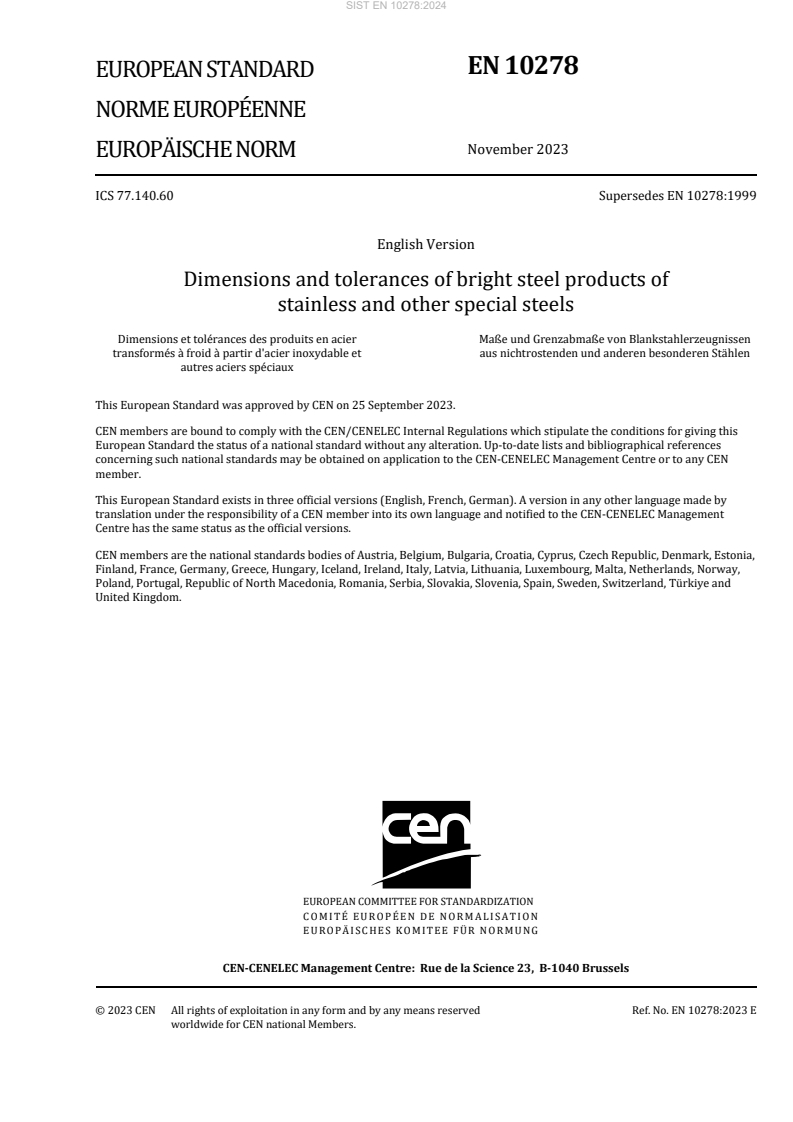
EN 10278
EUROPEAN STANDARD
NORME EUROPÉENNE
November 2023
EUROPÄISCHE NORM
ICS 77.140.60 Supersedes EN 10278:1999
English Version
Dimensions and tolerances of bright steel products of
stainless and other special steels
Dimensions et tolérances des produits en acier Maße und Grenzabmaße von Blankstahlerzeugnissen
transformés à froid à partir d'acier inoxydable et aus nichtrostenden und anderen besonderen Stählen
autres aciers spéciaux
This European Standard was approved by CEN on 25 September 2023.
CEN members are bound to comply with the CEN/CENELEC Internal Regulations which stipulate the conditions for giving this
European Standard the status of a national standard without any alteration. Up-to-date lists and bibliographical references
concerning such national standards may be obtained on application to the CEN-CENELEC Management Centre or to any CEN
member.
This European Standard exists in three official versions (English, French, German). A version in any other language made by
translation under the responsibility of a CEN member into its own language and notified to the CEN-CENELEC Management
Centre has the same status as the official versions.
CEN members are the national standards bodies of Austria, Belgium, Bulgaria, Croatia, Cyprus, Czech Republic, Denmark, Estonia,
Finland, France, Germany, Greece, Hungary, Iceland, Ireland, Italy, Latvia, Lithuania, Luxembourg, Malta, Netherlands, Norway,
Poland, Portugal, Republic of North Macedonia, Romania, Serbia, Slovakia, Slovenia, Spain, Sweden, Switzerland, Türkiye and
United Kingdom.
EUROPEAN COMMITTEE FOR STANDARDIZATION
COMITÉ EUROPÉEN DE NORMALISATION
EUROPÄISCHES KOMITEE FÜR NORMUNG
CEN-CENELEC Management Centre: Rue de la Science 23, B-1040 Brussels
© 2023 CEN All rights of exploitation in any form and by any means reserved Ref. No. EN 10278:2023 E
worldwide for CEN national Members.
Contents Page
European foreword . 3
1 Scope . 4
2 Normative references . 4
3 Terms and definitions . 4
4 Information to be supplied by the purchaser . 5
4.1 Mandatory information . 5
4.2 Options . 5
4.3 Examples . 5
5 Requirements . 6
5.1 Shape, dimensions and tolerances . 6
5.2 Straightness tolerance . 6
5.3 Condition of bar ends . 6
5.4 Disposition of tolerances . 7
6 Visual and dimensional inspection . 7
Annex A (normative) Methods for evaluating straightness .13
A.1 Scope .13
A.2 Recommended method .13
A.3 Alternative method for round bars (effective for diameters ≥ 10 mm) .13
European foreword
This document (EN 10278:2023) has been prepared by Technical Committee CEN/TC 459/SC 5 “Steels
for heat treatment, alloy steels, free-cutting steels and stainless steels”, the secretariat of which is held by
DIN.
This European Standard shall be given the status of a national standard, either by publication of an
identical text or by endorsement, at the latest by May 2024, and conflicting national standards shall be
withdrawn at the latest by May 2024.
Attention is drawn to the possibility that some of the elements of this document may be the subject of
patent rights. CEN shall not be held responsible for identifying any or all such patent rights.
This document supersedes EN 10278:1999.
The main changes compared to the previous edition EN 10278:1999 are listed below:
— bright steels of EN 10277 are excluded from the scope of this document and its application is
restricted to stainless steels and special steels which can be delivered as bright products, e.g. tool
steels, roller bearing steels, etc.;
— surface condition and tolerance classes revised;
— this document can now also be used for cold heading steels both in form of bars and wire (for wire
not concerning length and straightness);
— deviation from straightness revised;
— editorially revised.
Any feedback and questions on this document should be directed to the users’ national standards body.
A complete listing of these bodies can be found on the CEN website.
According to the CEN-CENELEC Internal Regulations, the national standards organisations of the
following countries are bound to implement this European Standard: Austria, Belgium, Bulgaria, Croatia,
Cyprus, Czech Republic, Denmark, Estonia, Finland, France, Germany, Greece, Hungary, Iceland, Ireland,
Italy, Latvia, Lithuania, Luxembourg, Malta, Netherlands, Norway, Poland, Portugal, Republic of North
Macedonia, Romania, Serbia, Slovakia, Slovenia, Spain, Sweden, Switzerland, Türkiye and the United
Kingdom.
1 Scope
This document applies to bright steel products in the drawn, turned or ground condition delivered in
straight lengths. This document is mainly applied to stainless steels of EN 10088-3 and other product
standards, e.g. tool steels, roller bearing steels.
This document can also be used for cold heading steels in the form of bars and wire; in case of wire, the
thickness and tolerances apply but not the length and the straightness.
The non-alloy and alloy steels of EN 10277 are no longer included.
This document does not cover cold rolled products and cut lengths produced from strip or sheet by
cutting.
2 Normative references
The following documents are referred to in the text in such a way that some or all of their content
constitutes requirements of this document. For dated references, only the edition cited applies. For
undated references, the latest edition of the referenced document (including any amendments) applies.
EN 10079, Definition of steel products
EN 10088-3, Stainless steels — Part 3: Technical delivery conditions for semi-finished products, bars, rods,
wire, sections and bright products of corrosion resisting steels for general purposes
EN 10204, Metallic products — Types of inspection documents
EN ISO 9443, Surface quality classes for hot-rolled bars and wire rod (ISO 9443)
ISO 286-2, Geometrical product specifications (GPS) — ISO code system for tolerances on linear sizes —
Part 2: Tables of standard tolerance classes and limit deviations for holes and shafts
ISO 10474, Steel and steel products — Inspection documents
3 Terms and definitions
For the purposes of this document, the terms and definitions given in EN 10079 (for drawn products)
and the following apply.
ISO and IEC maintain terminology databases for use in standardization at the following addresses:
— IEC Electropedia: available at https://www.electropedia.org/
— ISO Online browsing platform: available at https://www.iso.org/obp
3.1
thickness
nominal dimension of the product
Note 1 to entry: This means:
a) the diameter in the case of rounds;
b) the lateral length in the case of squares;
c) the width over flats in the case of hexagons;
d) the shorter lateral length in the case of flats (rectangular bars) and wide-flats.
For special sections, 'thickness' shall be specified at the time of enquiry and order.
3.2
ovality
difference between the smallest and largest dimension measured across the pairs of opposing points at a
common cross-section
3.3
out-of shape
special tolerances and their deviations from the nominal section profile
4 Information to be supplied by the purchaser
4.1 Mandatory information
The following information shall be supplied by the purchaser at the time of enquiry and order:
a) quantity (mass, number of bars) to be delivered;
b) shape of the product (e.g. round, hexagon, square, flat);
c) reference to this document, i.e. EN 10278;
d) the nominal dimensions and tolerances on dimensions and shape;
e) reference to the material standard including the number of the part (e.g. EN 10088-3);
f) steel name or steel number;
g) the finished condition (see 5.1);
h) the class of surface quality (see EN ISO 9443) where appropriate (not for EN 10088-3).
4.2 Options
Several options are specified in this document and listed below. If the purchaser does not indicate any of
these options, the products will be supplied in accordance with the basic specifications (see 4.1).
1) Straightness (see 5.2);
2) Condition of bar ends (see 5.3);
3) Disposition of tolerances (see 5.4);
4) The type of inspection
...
Questions, Comments and Discussion
Ask us and Technical Secretary will try to provide an answer. You can facilitate discussion about the standard in here.
Loading comments...