

EN 692:2005+A1:2009
(Main + Amendment)Machine tools - Mechanical presses - Safety
- Abstract
1.1 This European Standard specifies technical safety requirements and measures to be adopted by persons undertaking the design, manufacture and supply of mechanical presses with part revolution clutch hereinafter called presses which are intended to work cold metal or material partly of cold metal.
NOTE The design of a machine includes the study of the machine itself, taking into account all phases of its “life”, i.e. construction, transport and commission (including assembly, installation and adjustment), use (including setting, teaching/programming or process changeover, operation, cleaning, fault finding and maintenance) and de-commissioning, dismantling and, as far as safety is concerned, disposal, and the drafting of the instructions related to all above-mentioned phases of the “life” of the machine (except construction), dealt with it in 6.5 of EN ISO 12100-2:2003.
1.2 This European Standard also covers presses, whose primary intended use is to work cold metal, which are to be used in the same way to work other sheet materials (such as cardboard, plastic, rubber or leather), and metal powder.
1.3 The requirements in this standard take account of intended use, as defined in 3.22 of EN ISO 12100-1:2003. This standard presumes access to the press from all directions, deals with the hazards during the various phases of the life of the machine described in clause 4, and specifies the safety measures for both the operator and other exposed persons.
1.4 This European Standard also applies to ancillary devices which are an integral part of the press. This standard also applies to machines which are integrated into an automatic production line where the hazards and risk arising are comparable to those of machines working separately.
1.5 This European Standard does not cover mechanical presses with full revolution clutch.
1.6 This European Standard does not cover machines whose principal designed purpose is:
a) sheet metal cutting by guillotine;
b) attaching a
- Status
- Withdrawn
- Publication Date
- 10-Feb-2009
- Withdrawal Date
- 06-Oct-2026
- Technical Committee
- CEN/TC 143 - Machine tools - Safety
- Drafting Committee
- CEN/TC 143/WG 1 - Metal forming machine tools - Safety
- Current Stage
- 9960 - Withdrawal effective - Withdrawal
- Start Date
- 07-Feb-2018
- Completion Date
- 07-Oct-2026
- Directive
- 2006/42/EC - Directive 2006/42/EC of the European Parliament and of the Council of 17 May 2006 on machinery, and amending Directive 95/16/EC (recast)OJ Ref: C, C 214 OJ Date: 08-Sep-2009


Relations
- Effective Date
- 22-Dec-2008
- Effective Date
- 08-Jun-2022
- Effective Date
- 08-Jun-2022
- Effective Date
- 25-Aug-2026
- Effective Date
- 09-Feb-2026
- Effective Date
- 09-Feb-2026
- Effective Date
- 09-Feb-2026
- Effective Date
- 09-Feb-2026
- Effective Date
- 28-Jan-2026
- Effective Date
- 28-Jan-2026
- Effective Date
- 28-Jan-2026
- Effective Date
- 28-Jan-2026
- Effective Date
- 28-Jan-2026
- Effective Date
- 28-Jan-2026
- Effective Date
- 28-Jan-2026
Get Certified
Connect with accredited certification bodies for this standard

DVS-ZERT GmbH
German welding certification society.
CARES (UK Certification Authority for Reinforcing Steels)
UK certification for reinforcing steels and construction.
EWF/IIW (European/International Welding Federation)
International welding personnel certification.
Sponsored listings
Frequently Asked Questions
EN 692:2005+A1:2009 is a standard published by the European Committee for Standardization (CEN). Its full title is "Machine tools - Mechanical presses - Safety". This standard covers: 1.1 This European Standard specifies technical safety requirements and measures to be adopted by persons undertaking the design, manufacture and supply of mechanical presses with part revolution clutch hereinafter called presses which are intended to work cold metal or material partly of cold metal. NOTE The design of a machine includes the study of the machine itself, taking into account all phases of its “life”, i.e. construction, transport and commission (including assembly, installation and adjustment), use (including setting, teaching/programming or process changeover, operation, cleaning, fault finding and maintenance) and de-commissioning, dismantling and, as far as safety is concerned, disposal, and the drafting of the instructions related to all above-mentioned phases of the “life” of the machine (except construction), dealt with it in 6.5 of EN ISO 12100-2:2003. 1.2 This European Standard also covers presses, whose primary intended use is to work cold metal, which are to be used in the same way to work other sheet materials (such as cardboard, plastic, rubber or leather), and metal powder. 1.3 The requirements in this standard take account of intended use, as defined in 3.22 of EN ISO 12100-1:2003. This standard presumes access to the press from all directions, deals with the hazards during the various phases of the life of the machine described in clause 4, and specifies the safety measures for both the operator and other exposed persons. 1.4 This European Standard also applies to ancillary devices which are an integral part of the press. This standard also applies to machines which are integrated into an automatic production line where the hazards and risk arising are comparable to those of machines working separately. 1.5 This European Standard does not cover mechanical presses with full revolution clutch. 1.6 This European Standard does not cover machines whose principal designed purpose is: a) sheet metal cutting by guillotine; b) attaching a
1.1 This European Standard specifies technical safety requirements and measures to be adopted by persons undertaking the design, manufacture and supply of mechanical presses with part revolution clutch hereinafter called presses which are intended to work cold metal or material partly of cold metal. NOTE The design of a machine includes the study of the machine itself, taking into account all phases of its “life”, i.e. construction, transport and commission (including assembly, installation and adjustment), use (including setting, teaching/programming or process changeover, operation, cleaning, fault finding and maintenance) and de-commissioning, dismantling and, as far as safety is concerned, disposal, and the drafting of the instructions related to all above-mentioned phases of the “life” of the machine (except construction), dealt with it in 6.5 of EN ISO 12100-2:2003. 1.2 This European Standard also covers presses, whose primary intended use is to work cold metal, which are to be used in the same way to work other sheet materials (such as cardboard, plastic, rubber or leather), and metal powder. 1.3 The requirements in this standard take account of intended use, as defined in 3.22 of EN ISO 12100-1:2003. This standard presumes access to the press from all directions, deals with the hazards during the various phases of the life of the machine described in clause 4, and specifies the safety measures for both the operator and other exposed persons. 1.4 This European Standard also applies to ancillary devices which are an integral part of the press. This standard also applies to machines which are integrated into an automatic production line where the hazards and risk arising are comparable to those of machines working separately. 1.5 This European Standard does not cover mechanical presses with full revolution clutch. 1.6 This European Standard does not cover machines whose principal designed purpose is: a) sheet metal cutting by guillotine; b) attaching a
EN 692:2005+A1:2009 is classified under the following ICS (International Classification for Standards) categories: 25.120.10 - Forging equipment. Presses. Shears. The ICS classification helps identify the subject area and facilitates finding related standards.
EN 692:2005+A1:2009 has the following relationships with other standards: It is inter standard links to EN 692:2005, EN ISO 16092-1:2018, EN ISO 16092-2:2020, ISO 8540:1993, ISO 3287:1999, CLC/TS 61496-2:2003, EN 60204-1:1997, EN 61496-1:2004, EN 894-2:1997, EN 999:1998, EN 349:1993, EN 1088:1995, EN 418:1992, EN ISO 12100-2:2003, EN 982:1996. Understanding these relationships helps ensure you are using the most current and applicable version of the standard.
EN 692:2005+A1:2009 is associated with the following European legislation: EU Directives/Regulations: 2006/42/EC, 98/37/EC; Standardization Mandates: M/079, M/396. When a standard is cited in the Official Journal of the European Union, products manufactured in conformity with it benefit from a presumption of conformity with the essential requirements of the corresponding EU directive or regulation.
EN 692:2005+A1:2009 is available in PDF format for immediate download after purchase. The document can be added to your cart and obtained through the secure checkout process. Digital delivery ensures instant access to the complete standard document.
Standards Content (Sample)
SLOVENSKI STANDARD
01-maj-2009
Obdelovalni stroji - Mehanske stiskalnice - Varnost
Machine tools - Mechanical presses - Safety
Werkzeugmaschinen - Mechanische Pressen - Sicherheit
Machines-outils - Presses mécaniques - Sécurité
Ta slovenski standard je istoveten z: EN 692:2005+A1:2009
ICS:
25.120.10 Kovaški stroji. Stiskalnice. Forging equipment. Presses.
Škarje Shears
2003-01.Slovenski inštitut za standardizacijo. Razmnoževanje celote ali delov tega standarda ni dovoljeno.
EUROPEAN STANDARD
EN 692:2005+A1
NORME EUROPÉENNE
EUROPÄISCHE NORM
February 2009
ICS 25.120.10 Supersedes EN 692:2005
English Version
Machine tools - Mechanical presses - Safety
Machines-outils - Presses mécaniques - Sécurité Werkzeugmaschinen - Mechanische Pressen - Sicherheit
This European Standard was approved by CEN on 22 July 2004 and includes Amendment 1 approved by CEN on 29 December 2008.
CEN members are bound to comply with the CEN/CENELEC Internal Regulations which stipulate the conditions for giving this European
Standard the status of a national standard without any alteration. Up-to-date lists and bibliographical references concerning such national
standards may be obtained on application to the CEN Management Centre or to any CEN member.
This European Standard exists in three official versions (English, French, German). A version in any other language made by translation
under the responsibility of a CEN member into its own language and notified to the CEN Management Centre has the same status as the
official versions.
CEN members are the national standards bodies of Austria, Belgium, Bulgaria, Cyprus, Czech Republic, Denmark, Estonia, Finland,
France, Germany, Greece, Hungary, Iceland, Ireland, Italy, Latvia, Lithuania, Luxembourg, Malta, Netherlands, Norway, Poland, Portugal,
Romania, Slovakia, Slovenia, Spain, Sweden, Switzerland and United Kingdom.
EUROPEAN COMMITTEE FOR STANDARDIZATION
COMITÉ EUROPÉEN DE NORMALISATION
EUROPÄISCHES KOMITEE FÜR NORMUNG
Management Centre: rue de Stassart, 36 B-1050 Brussels
© 2009 CEN All rights of exploitation in any form and by any means reserved Ref. No. EN 692:2005+A1:2009: E
worldwide for CEN national Members.
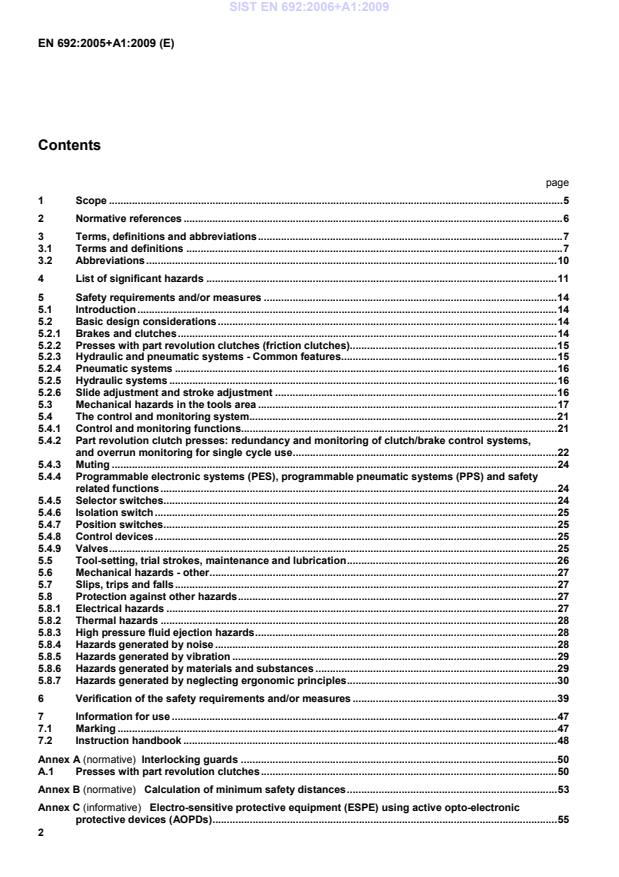
Contents
page
1 Scope . 5
2 Normative references . 6
3 Terms, definitions and abbreviations . 7
3.1 Terms and definitions . 7
3.2 Abbreviations . 10
4 List of significant hazards . 11
5 Safety requirements and/or measures . 14
5.1 Introduction . 14
5.2 Basic design considerations . 14
5.2.1 Brakes and clutches . 14
5.2.2 Presses with part revolution clutches (friction clutches). 15
5.2.3 Hydraulic and pneumatic systems - Common features. 15
5.2.4 Pneumatic systems . 16
5.2.5 Hydraulic systems . 16
5.2.6 Slide adjustment and stroke adjustment . 16
5.3 Mechanical hazards in the tools area . 17
5.4 The control and monitoring system. 21
5.4.1 Control and monitoring functions . 21
5.4.2 Part revolution clutch presses: redundancy and monitoring of clutch/brake control systems,
and overrun monitoring for single cycle use . 22
5.4.3 Muting . 24
5.4.4 Programmable electronic systems (PES), programmable pneumatic systems (PPS) and safety
related functions . 24
5.4.5 Selector switches. 24
5.4.6 Isolation switch . 25
5.4.7 Position switches. 25
5.4.8 Control devices . 25
5.4.9 Valves . 25
5.5 Tool-setting, trial strokes, maintenance and lubrication . 26
5.6 Mechanical hazards - other . 27
5.7 Slips, trips and falls . 27
5.8 Protection against other hazards . 27
5.8.1 Electrical hazards . 27
5.8.2 Thermal hazards . 28
5.8.3 High pressure fluid ejection hazards . 28
5.8.4 Hazards generated by noise . 28
5.8.5 Hazards generated by vibration . 29
5.8.6 Hazards generated by materials and substances . 29
5.8.7 Hazards generated by neglecting ergonomic principles . 30
6 Verification of the safety requirements and/or measures . 39
7 Information for use . 47
7.1 Marking . 47
7.2 Instruction handbook . 48
Annex A (normative) Interlocking guards . 50
A.1 Presses with part revolution clutches . 50
Annex B (normative) Calculation of minimum safety distances . 53
Annex C (informative) Electro-sensitive protective equipment (ESPE) using active opto-electronic
protective devices (AOPDs) . 55
Annex D (informative) Closed tools . 56
Annex E (informative) The setting of the rotary cam arrangement . 57
E.1 Basic features of the eccentric adjustment and rotary cam arrangement . 57
E.2 Determination of the position where muting begins . 63
Annex F (informative) Determination of the overall response time T . 66
Annex G (normative) Conditions for noise measurement of mechanical presses . 70
Annex ZA (informative) Relationship between this European Standard and the Essential
Requirements of EU Directive 98/37/EC, amended by Directive 98/79 EC . 72
Annex ZB (informative) !!!!Relationship between this European Standard and the Essential
Requirements of EU Directive 2006/42/EC"""" . 73
Foreword
This document (EN 692:2005+A1:2009) has been prepared by Technical Committee CEN/TC 143 “Machine tools -
Safety”, the secretariat of which is held by SNV.
This European Standard shall be given the status of a national standard, either by publication of an identical text or
by endorsement, at the latest by August 2009, and conflicting national standards shall be withdrawn at the latest by
December 2009.
This document includes Amendment 1, approved by CEN on 2008-12-29.
This document supersedes !692:2005".
The start and finish of text introduced or altered by amendment is indicated in the text by tags ! ".
This document has been prepared under a mandate given to CEN by the European Commission and the European
Free Trade Association, and supports essential requirements of EU Directive(s).
!For relationship with EU Directive(s), see informative Annexes ZA and ZB, which are integral parts of this
document."
!Annexes A, B and G to this standard are normative, whereas Annexes C, D, E, F, ZA and ZB are informative.
"
Organisation contributing to the preparation of this European Standard include the European Manufacturer
Association CECIMO.
NOTE The safety requirements related to the use of PES or PPS will be dealt with at its next revision.
The European Standards produced by CEN/TC 143 are particular to machine-tools and complement the relevant A
and B standards on the subject of general safety (see introduction of EN 292-1:1991 for a description of A, B and C
standards).
!deleted text"
!EN 692:2005" constitutes a revision of EN 692:1996 for which it has been technically revised : the main
modifications are listed below :
Withdrawal of mechanical presses with full revolution clutches,
Tacking into account of some additive requirements about the use of closed tools and fixed' enclosing guard(s)
as protective devices (sub clauses 5.3.4, 5.3.9, 5.3.10 and 5.4.5.3),
Addition of requirements on the implementation of protective devices for powering on the machine,
Redrafting in order to ensure the coherence with the requirements of EN 693.
According to the CEN/CENELEC Internal Regulations, the national standards organizations of the following
countries are bound to implement this European Standard: Austria, Belgium, Bulgaria, Cyprus, Czech Republic,
Denmark, Estonia, Finland, France, Germany, Greece, Hungary, Iceland, Ireland, Italy, Latvia, Lithuania,
Luxembourg, Malta, Netherlands, Norway, Poland, Portugal, Romania, Slovakia, Slovenia, Spain, Sweden,
Switzerland and United Kingdom.
Introduction
This standard has been prepared to be a harmonised standard to provide one means of conforming with the
essential safety requirements of the Machinery Directive and associated EFTA Regulations.
This document is a C-type standard as stated in EN ISO 12100-1.
The machinery concerned and the extent to which hazards, hazardous situations and events are covered are
indicated in the scope of this standard.
When provisions of this C type standard are different from those which are stated in A or B standards, the provision
of this C type standard take precedence over the provisions of the other standards for machines that have been
designed and built according to the provisions of this C type standard.
Complementary guidance is given in the A and B standards to which reference is made in the text (see clause 2).
The figures are intended to be examples only and not to give the only interpretation of the text.
The requirements of this European Standard concern designers, manufacturers, suppliers and importers of
machines described in the scope.
This standard also includes information to be provided by the manufacturer to the user.
1 Scope
1.1 This European Standard specifies technical safety requirements and measures to be adopted by persons
undertaking the design, manufacture and supply of mechanical presses with part revolution clutch hereinafter
called presses which are intended to work cold metal or material partly of cold metal.
NOTE The design of a machine includes the study of the machine itself, taking into account all phases of its “life”,
i.e. construction, transport and commission (including assembly, installation and adjustment), use (including setting,
teaching/programming or process changeover, operation, cleaning, fault finding and maintenance) and de-
commissioning, dismantling and, as far as safety is concerned, disposal, and the drafting of the instructions related
to all above-mentioned phases of the “life” of the machine (except construction), dealt with it in 6.5 of EN ISO
12100-2:2003.
1.2 This European Standard also covers presses, whose primary intended use is to work cold metal, which are
to be used in the same way to work other sheet materials (such as cardboard, plastic, rubber or leather), and metal
powder.
1.3 The requirements in this standard take account of intended use, as defined in 3.22 of EN ISO 12100-1:2003.
This standard presumes access to the press from all directions, deals with the hazards during the various phases
of the life of the machine described in clause 4, and specifies the safety measures for both the operator and other
exposed persons.
1.4 This European Standard also applies to ancillary devices which are an integral part of the press. This
standard also applies to machines which are integrated into an automatic production line where the hazards and
risk arising are comparable to those of machines working separately.
1.5 This European Standard does not cover mechanical presses with full revolution clutch.
1.6 This European Standard does not cover machines whose principal designed purpose is:
a) sheet metal cutting by guillotine;
b) attaching a fastener, e.g. riveting, stapling or stitching;
c) bending or folding;
d) straightening;
e) turret punch pressing;
f) extruding;
g) drop forging or drop stamping;
h) compaction of metal powder;
i) single purpose punching machines designed exclusively for profiles, e.g. for the construction industry.
1.7 This European Standard is not applicable to machines which are manufactured before the date of publication
of this document by CEN.
2 Normative references
The following referenced documents are indispensable for the application of this document. For dated references,
only the edition cited applies. For undated references, the latest edition of the referenced document (including any
amendments) applies.
EN 294:1992, Safety of machinery - Safety distances to prevent danger zones being reached by the upper limbs.
EN 349:1993, Safety of machinery - Minimum gaps to avoid crushing of parts of the human body.
EN 418:1992, Safety of machinery - Emergency stop equipment, functional aspects - Principles for design.
EN 563:1994, Safety of machinery - Temperatures of touchable surfaces - Ergonomics data to establish
temperature limit values for hot surfaces.
EN 574:1996, Safety of machinery - Two-hand control devices - Functional aspects - Principles for design.
EN 626-1:1994, Safety of machinery - Reduction of risks to health from hazardous substances emitted by
machinery - Part 1: Principles and specifications for machinery manufacturers.
EN 842:1996, Safety of machinery - Visual danger signals - General requirements, design and testing.
EN 953:1997, Safety of machinery - Guards - General requirements for the design and construction of fixed and
movable guards.
EN 954-1:1996, Safety of machinery - Safety related parts of control systems - Part 1: General principles for
design.
EN 982:1996, Safety of machinery - Safety requirements for fluid power systems and their components -
Hydraulics.
EN 983:1996, Safety of machinery - Safety requirements for fluid power systems and their components -
Pneumatics.
EN 999:1998, Safety of machinery - The positioning of protective equipment in respect of approach speeds of parts
of the human body.
EN 1005-2:2003, Safety of machinery - Human physical performance - Part 2: Manual handling of machinery and
component parts of machinery.
EN 1037:1995, Safety of machinery - Prevention of unexpected start-up.
EN 1050:1996, Safety of machinery - Principles for risk assessment.
EN 1088:1995, Safety of machinery - Interlocking devices associated with guards -Principles for design and
selection.
EN 1127-1:1997, Explosive atmospheres - Explosion prevention and protection - Part 1: Basic concepts and
methodology.
EN 1299:1997, Mechanical vibration and shock - Vibration isolation of machines - Information for the application or
source isolation.
EN 60204-1:1997, Safety of machinery - Electrical equipment of machines - Part 1: General requirements (IEC
60204-1:1997).
EN 61310-2:1995, Safety of machinery - Indication, marking and actuation - Part 2: Requirements for marking
(IEC 1310-2:1995).
EN 61496-1:2004, Safety of machinery - Electro-sensitive protective equipment - Part 1: General requirements and
tests (IEC 61496-1:2004, modified).
CLC/TS 61496-2:2003, Safety of machinery - Electrosensitive protective equipment - Part 2: Particular
requirements for equipment using active opto-electronic protective devices (AOPDs) (IEC 61496-2:1997).
EN ISO 3746:1995, Acoustics - Determination of sound power levels of noise sources using sound pressure -
Survey method using an enveloping measurement surface over a reflecting plane (ISO 3746:1995).
! EN ISO 4871:1996, Acoustics - Declaration and verification of noise emission values of machinery and
equipment (ISO 4871:1996)"
EN ISO 11202:1995, Acoustics - Noise emitted by machinery and equipment - Measurement of emission sound
pressure levels at work station and at other specified positions - Survey method in situ (ISO 11202:1995).
EN ISO 12100-1:2003, Safety of machinery - Basic concepts, general principles for design - Part 1: Basic
terminology, methodology (ISO 12100-1:2003)
EN ISO 12100-2:2003, Safety of machinery - Basic concepts, general principles for design - Part 2: Technical
principles (ISO 12100-2:2003)
ISO 8540:1993, Open front mechanical power presses - Vocabulary.
3 Terms, definitions and abbreviations
For the purposes of this European Standard, the terms and definitions given in EN ISO 12100-1:2003 and
EN ISO 12100-2:2003 and in relevant type A and type B standards, and the following apply.
3.1 Terms and definitions
3.1.1
band brake
brake (see 3.1.2) where a flexible band lined with friction material is arranged around the circumference of a drum
3.1.2
brake
mechanism (usually friction) intended to stop and hold the slide when the clutch, if provided, is disengaged
3.1.3
clutch
mechanism used to impart the movement of the flywheel to the slide
3.1.4
clutch - full revolution
type of clutch that, when tripped or actuated, cannot be disengaged until the slide has completed a complete
stroke, e.g. most positive key clutches. It also includes clutches which can only be disengaged at certain positions
in the operating cycle
3.1.5
clutch - part revolution
type of clutch that can be engaged or disengaged at any point in the stroke of the slide, e.g. most friction clutches
3.1.6
cycle - automatic
operating mode where the slide repeats continuously or intermittently, all functions achieved without manual
intervention into the danger zone after initiation
3.1.7
cycle - operating
movement of the slide from the cycle start position (normally the top dead centre) to the bottom dead centre and
back to the cycle stop position (normally the top dead centre). The operating cycle includes all operations carried
out during this movement
3.1.8
cycle - single
operating mode where each operating cycle of the slide has to be positively actuated by the operator
3.1.9
dead centres
points at which the tool, during its travel, is
either nearest/closest to the die (generally it corresponds to the end of the closing stroke), known as the
bottom dead centre (BDC),
or furthest from the die (generally it corresponds to the end of the opening stroke), known as the top dead
centre (TDC)
3.1.10
die
fixed part of the tools used in a press
3.1.11
die cushion
accessory for a die which accumulates and releases, or absorbs, force as required in some press operations
3.1.12
direct drive
type of driving arrangement wherein no clutch is used: movement of the slide is accomplished by energising and
de-energising the motor, possibly in conjunction with a brake
3.1.13
early opening interlocking guard
guard associated with an interlocking device which, if opened when any dangerous movement in the tools area has
ceased, does not interrupt the operating cycle
3.1.14
guard locking device
mechanical device to maintain an interlocking guard gate in the closed and locked position until the risk of injury
from the hazardous machine functions has passed
3.1.15
limited movement control device; inching device
control device, a single actuation of which, together with the control system of the machine, permits only a limited
amount of travel of a machine element
[3.26.9 of EN ISO 12100-1:2003]
3.1.16
mechanical press
machine designed or intended to transmit energy from a prime mover to a tool by mechanical means for the
purpose of the working (e.g. forming or shaping) of cold metal or material partly of cold metal between the tools.
Such energy is transmitted by a flywheel and part revolution clutch or by means of a direct drive mechanism (see
Figure 1)
3.1.17
monitoring (M)
safety function which ensures that a safety measure is initiated if the ability of a component or an element to
perform its function is diminished, or if the process conditions are changed in such a way that hazards are
generated
3.1.18
muting
temporary automatic suspension of a safety function(s) by safety related parts of the control system during
otherwise safe conditions in the operation of a machine
[3.7 of EN 954-1:1996]
3.1.19
overall system stopping performance; overall response time
time occurring from actuating the protective device to the cessation of hazardous motion, or to the machine
assuming a safe condition
3.1.20
overrun
movement of the crankshaft past a defined stopping point, e.g. TDC
3.1.21
overrun monitoring device
device which provides a signal to inhibit further machine initiation when the overrun exceeds the pre-set limit(s)
3.1.22
position switch
switch which is operated by a moving part of the machine when this part reaches or leaves a predetermined
position
3.1.23
redundancy (R)
application of more than one device or system, or part of a device or a system, with the objective of ensuring that,
in the event of one failing to perform its function, another is available to perform that function
[3.47 of EN 60204-1:1997]
3.1.24
shut height
distance from the bed-plate surface to the slide surface measured with the maximum variable stroke, stroke down
and slide adjustment up
[3.12 of ISO 8540:1993]
3.1.25
single stroke function
feature used to limit the motion of the tool to one operating cycle at each engagement of the clutch even if the
stroke initiating means (e.g. a pedal) is held in the operating position
3.1.26
slide
main reciprocating press member which holds the tool
3.1.27
tool
moving part of the tools
3.1.28
tools
term for the combination of tool and die
3.1.29
tools - closed
tools designed and constructed to be inherently safe (see Figure D.1)
3.2 Abbreviations
M Monitoring (see 3.1.17)
R Redundancy (see 3.1.23)
S Single channel
BDC Bottom dead centre (see 3.1.9)
TDC Top dead centre (see 3.1.9)
PES Programmable electronic system PPS Programmable pneumatic system
AOPD Active opto-electronic protective device
ESPE Electro-sensitive protective equipment
Key
1 Flywheel guard 6 Slide
2 Clutch/brake 7 Slide flange, tool holder
3 Flywheel 8 Bed-plate/bolster
4 Motor pulley 9 Bed
5 Belt 10 Pedal
Figure 1 — Example of mechanical power press (tools area safeguards not shown)
4 List of significant hazards
4.1 The list of hazards contained in Table 1 is the result of a risk assessment, carried out as required by
EN 1050, for all mechanical presses covered by the scope of this standard. The technical measures and
information for use contained in Clauses 5 and 7 and Annexes A, B, C, E and F are based on the risk assessment,
and deal with the identified hazards by either eliminating them or reducing the effects of the risks they generate.
4.2 Risk assessment assumes foreseeable access from all directions, as well as overruns, unexpected and
unintended strokes or gravity falls. Risks to both the operators and other persons who can have access to the
danger zones are identified, taking into account all hazards which can occur during the life of the press. The
assessment includes an analysis of the effect of failure in the control system.
4.3 In addition, the user of this standard, i.e. the designer, manufacturer or supplier, shall conduct a risk
assessment in accordance with EN 1050 with particular attention to:
the intended use of the press including maintenance, tool-setting and cleaning, and its reasonably foreseeable
misuse;
the identification of the significant hazards associated with the press (see 4.4).
4.4 Table 1 of this standard is a list of significant hazards and their related danger zones normally associated
with a mechanical power press. As part of the risk assessment, the designer shall verify whether the list of hazards
in Table 1 is exhaustive and applicable to the press under consideration.
Table 1 — Significant hazards, danger zones, preventive measures
Preventive Relevant
Hazards Danger zone measures: relevant clauses of
clauses of this EN ISO 12100-
standard 1:2003
Mechanical hazards
Crushing hazard Tools area: 5.3 to 5.5 4.2.1
Shearing hazard - between moving tools Annexes A, B, C, D
Cutting or severing hazard - moving slide and E
Entanglement hazard - moving die cushions
Drawing-in or trapping hazard - work-piece ejectors
- guards
Impact hazard Moving parts of electrical, 4.2.1
hydraulic and pneumatic
equipment
Motor and drive machinery 5.6.1 to 5.6.3
Mechanical handling device 5.6.1 to 5.6.4
During installation, setting
operation , maintenance.
Ejection hazard Machine components 5.6.5
Work-pieces and tools 7.2.2 i)
High pressure fluid ejection Hydraulic systems 5.8.3 4.2.1
hazard
Slip, trip and fall hazards All work at heights 5.7 4.10
Floor area around the press
Electrical hazards
Direct contact hazard Electrical equipment 5.8.1 4.3
Indirect contact hazard Electrical equipment 5.8.1 4.3
Parts made live by electrical
equipment under fault conditions
Thermal radiation hazard (burns)
Thermal hazards resulting in Brakes, clutches, parts of the 5.8.2 4.4
burns and scalds, by a possible hydraulic system
contact of persons
Hazards generated by noise Any area at the press where 5.8.4 4.5
resulting in hearing losses (deaf- there is a risk to hearing
ness)
Hazards generated by vibra- Parts of the press where the risk 5.8.5 4.6
tion occurs, e.g. the workstation(s)
Hazards generated by mate-
rials and substances proces-
sed, used or exhausted by
machinery, for example:
Hazards resulting from contact Hydraulic systems; pneumatic 5.8.6.1 to 5.8.6.4 4.8
with or inhalation of harmful systems and their controls; toxic
fluids, gases, mists, fumes and work materials
dusts
Fire or explosion hazards Exhaust ventilation and dust 5.8.6.5 4.8
collection equipment
Hazards generated by neglect- The working position and 5.8.7 4.9
ing ergonomic principles in controls for operators and
machine design (mismatch of maintenance staff handling tools
machinery with human characte-
ristics and abilities) caused, for
example, by unhealthy postures
or excessive efforts
5 Safety requirements and/or measures
5.1 Introduction
Mechanical presses covered by this standard range in size from small high speed machines with a single operator
producing small work-pieces to large relatively slow speed machines with several operators and large complex
work-pieces.
The methods or measures to be implemented to eliminate the significant hazards are specified in Table 1. The
methods and measures for reducing associated risks are as follows:
basic design considerations for major press components or systems (see 5.2);
safeguarding against mechanical hazards in the tools and associated area under different modes of production
(see 5.3 and Tables 2, 3 and 4);
protection against hazards due to control system or control component failures (see 5.4);
safeguarding against hazards which can occur during tool-setting, trial strokes, maintenance and lubrication
(see 5.5);
safeguarding against other hazards (see 5.6 to 5.8).
Presses shall comply with the safety requirements and/ or measures of this clause. In addition, the machine shall
be designed according to the principles of EN ISO 12100-1 for hazards relevant but not significant which are not
dealt with by this standard (e.g. sharp edges).
5.2 Basic design considerations
5.2.1 Brakes and clutches
5.2.1.1 Fluid or air pressure shall not be used to apply a brake unless means are provided to ensure that, in
the event of loss of fluid or air pressure, the integrity of the brake is maintained and the clutch is disengaged.
Diaphragms shall not be used to apply a brake.
5.2.1.2 The designer shall ensure that:
a) the springs used for applying the brake or disengaging the clutch are of compression type;
b) multiple spring assemblies are used;
c) all the springs are closely uniform in dimension, quality and rating;
d) the means of loading the springs are such that, when adjusted, the spring anchorages can be locked to
prevent slackening back;
e) the arrangements for spring housing and guiding, and of guide pins, are such as to minimize binding;
f) the brake can function even if 50 % of the spring assembly has failed.
5.2.1.3 The engagement and disengagement of the clutch and brake shall not affect their safe function.
NOTE Combined clutch and brake units are recommended so as to reduce the possibility of the overlapping of their
engagement.
5.2.1.4 The brake and the clutch shall be designed so that failure of component e.g. for power transmission or
screws do not stress other components in such a way that rapid consequential dangerous failure is possible.
5.2.1.5 Any heat generated which can cause a hazardous situation shall be dissipated.
5.2.1.6 Effective arrangements shall be made to prevent penetration of lubricants to the brake friction
surfaces, when this is not intended by the brake design.
5.2.1.7 The clutch and brake shall be designed in such a way that any moisture, dust or lubricating oil, which
breaks or corrodes packing material (e.g. gaskets and seals), cannot influence the required function adversely, e.g.
by obstructing an air channel or otherwise affecting their efficiency.
5.2.1.8 The design shall be such that the accumulation of dust, fluid or debris is minimized in areas likely to
give rise to inefficient brake performance and broken or loose components shall not cause brake failure.
5.2.1.9 Band brakes shall not be used on mechanical presses for the purpose of stopping the slide.
5.2.2 Presses with part revolution clutches (friction clutches)
5.2.2.1 Clutches shall be of a capacity capable of engaging and disengaging the stroke in the correct position,
without excessive temperature rise, under conditions of maximum use of the clutch.
5.2.2.2 Sufficient working clearances shall be provided so as to ensure that, under the severest conditions of
operation, friction drag leading to undesired movement of the driven members will not take place.
5.2.2.3 Arrangements shall be made to prevent the accumulation of debris evolved from frictional surfaces in
places where it can give rise to inefficient clutch performance, and for its effective dispersal.
5.2.2.4 The clutch and its control system shall be designed so that, in the event of failure of pneumatic,
hydraulic or electrical supply, the clutch is disengaged and the brake is immediately applied.
5.2.2.5 If diaphragms are used in a clutch system, measures shall be taken to avoid damage by the cutting
effect of sharp edges or wearing by rough surfaces. Evacuation of air shall not be prevented due to slackening of
the diaphragm, e.g. due to material fatigue.
5.2.3 Hydraulic and pneumatic systems - Common features
5.2.3.1 The requirements in EN 982 and EN 983 shall be taken into consideration in designing hydraulic and
pneumatic systems, which shall comply with the particular requirements in 5.2.3, 5.2.4 and 5.2.5.
5.2.3.2 Filters, pressure regulators and low pressure cut-off arrangements shall be provided.
5.2.3.3 Devices shall be provided to ensure that the permitted range of working pressure is maintained.
5.2.3.4 Bowls of glass and plastic shall be protected to prevent injury from flying particles without affecting
visibility.
5.2.3.5 All piping, pipe fittings, passages, surge or storage tanks and cored or drilled holes, shall be free from
burrs or foreign matter which can cause damage to valves or clutch and brake operating parts. See 5.3.4.2 of
EN 982:1996 and 5.5.3.2 of EN 983:1996.
5.2.3.6 Each run of piping shall, where practicable, be continuous from one piece of apparatus to another.
Precautions shall be taken to prevent damage by thermal expansion. Rigid piping shall be securely supported at
frequent intervals to avoid vibration or movement. Care shall be taken to avoid kinking of flexible pipes used to
carry fluids. Such kinking can cause traps which prevent the fluid exhausting. This applies particularly to piping
feeding the running joint of the clutch and brake.
5.2.3.7 Where a drop in pressure can lead to unintended dangerous motion of the slide, flexible piping shall
not be used, pipes and pipe connections shall be chosen to prevent such a loss of pressure. Such pipe
connections shall not be made with compression fittings, glued rings or similar devices. They shall be made by
means of positive connecting joints or by the welding of two fitted surfaces.
5.2.3.8 Operating valves shall not depend on connected piping for support. This is to avoid undesirable effects
from vibration which can affect both valves and piping.
5.2.3.9 Operating valves shall be so designed as to ensure that, when in the non-operating position, leakage
past the inlet valve will escape sufficiently freely to prevent build-up of pressure in the clutch operating cylinder.
5.2.3.10 Operating valves shall be so designed that it is not possible for both the inlet port and the exhaust
ports to remain closed at the same time.
5.2.3.11 Exhaust ports and piping between clutch operating cylinders and valves shall be of sufficient capacity
to ensure prompt release of fluid from clutch operating cylinders. Precautions shall be taken to ensure that the
exhaust ports of operating valves are of adequate size to prevent residual pressure in the cylinder. The valve shall
be selected so that the pressure ratio between clutch and brake is such that the residual pressure in the cylinder
will not become excessive in the event of a valve fault.
NOTE Normally, a ratio of at least 3,5 to 1 between spring pressure in the brake and residual pressure in the cylinder is
satisfactory.
5.2.3.12 Control valves and other control components (e.g. regulators and manometers) shall be mounted in
positions which provide adequate accessibility and avoid damage (see 5.2.1 of EN 982:1996).
5.2.3.13 Where valves are manually or mechanically (as distinct from electrically) operated, the arrangements
for restoring the valves to the position of clutch disengagement at the end of the cycle shall be positive in character
(i.e. when the actuator of the valve is released the valve shall automatically move to the safe position). See also
5.4.9.
5.2.4 Pneumatic systems
5.2.4.1 Where valves or other parts of the press control system require lubrication, visible automatic means of
lubrication shall be provided to introduce the oil into the air line in suitable form.
5.2.4.2 Where silencing systems are fitted, they shall be provided and installed in accordance with the valve
manufacturer's instructions for use in safety systems, shall not affect safety function and their effect on braking
performance shall be taken into account. Only non-clogging direct to atmosphere silencers are permissible.
5.2.4.3 Water separators shall be provided.
5.2.5 Hydraulic systems
5.2.5.1 Suitable pressure relief valve(s) shall be provided in hydraulic systems having a hydraulic pumped
supply. Means shall be provided to release trapped air either by a bleed device or a self-evacuating system.
5.2.5.2 Hydraulic systems shall be designed so that escaping fluid shall not cause injury.
5.2.5.3 Hydraulic systems which include accumulators shall allow the fluid pressure to fall when the pressure
generating unit is stopped. If this is impossible, the parts of the circuit which are maintained under pressure shall be
supplied with a manual discharge valve in addition to the other devices required by standards or rules concerning
accumulators (relief valves, pneumatic gauges, etc.) and bear a very clear indication (by means of a descriptive
plate) of the hazard.
5.2.6 Slide adjustment and stroke adjustment
5.2.6.1 Provision shall be made to ensure that a slide adjustment motor cannot be set in motion while the
clutch control circuit is energised. This requirement shall not apply when the slide adjustment motor is operable in
presses for automatic cycle and programmable control systems to compensate, for example, for wear of the tools
during the press operation.
5.2.6.2 The means of controlling the slide adjustment shall be clearly identified.
5.2.6.3 The slide adjustment shall be limited by suitable means.
5.2.6.4 Means shall be provided for securing, e.g. by locking, the slide adjustment and the stroke adjustment
in the set position during production.
5.2.6.5 Securing means shall be provided to prevent a stroke being made while the powered stroke
adjustment motor is in operation.
5.3 Mechanical hazards in the tools area
5.3.1 The major danger zone at mechanical presses is the tools area and preventive measures shall be taken to
deal with the relevant hazards. This standard indicates in 5.3 to 5.5 how the danger zone at the tools and
associated areas, such as moving die cushions and work-piece ejectors, shall be safeguarded. Tables 2, 3 and 4
list the safeguarding methods including mode of production/mode of operation and the requirements for the design
of the control and monitoring system:
single cycle: manual feed or removal (Table 2);
automatic cycle: manual feed or removal (Table 3);
automatic cycle: solely automatic feed and removal (Table 4).
5.3.2 Designers, manufacturers and suppliers shall select the safeguarding methods which reduce the risks as
far as possible, considering the significant hazards (see Table 1) and the mode of production (see Tables 2, 3 and
4). Safeguarding measures described in EN ISO 12100-1 and EN ISO 12100-2 which are appropriate for the
protection of any operator at the tools are listed below:
a) closed tools (see EN 294, EN 349, 5.3.9 and Annex D);
b) fixed enclosing guards (see EN 294, EN 953 and 5.3.10);
c) interlocking guards with guard locking (see EN 953, EN 954-1, EN 1088, 5.3.11 and Annex A);
d) control guards with guard locking (see 5.3.2.5 of EN ISO 12100-2:2003, EN 953, EN 954-1, EN 1088 and
5.3.11);
e) early opening interlocking guards (see EN 953, EN 954-1, EN 999, EN 1088, 5.3.11, 5.3.15 and Annex A);
f) electro-sensitive protective equipment (ESPE) using active opto-electronic protective devices (AOPDs) (see
EN 999, EN 61496-1, CLC/TS 61496-2, 5.3.13, 5.3.15 and Annex C);
g) two-hand control devices (see EN 574, EN 999, 5.3.14 and 5.3.15);
h) hold-to-run control devices (see 3.26.3
...