

EN 14765:2005+A1:2008
(Main + Amendment)Bicycles for young children - Safety requirements and test methods
- Abstract
This European Standard specifies safety and performance requirements and test methods for bicycles for young children, in respect of the design, assembly and testing of bicycles and sub-assemblies. Guidelines for instructions on the use and care of bicycles are also provided.
This European Standard applies to bicycles with a maximum saddle height of more than 435 mm and less than
635 mm (typical rider weight of 30 kg), and propelled by a transmitted drive to the rear wheel.
This European Standard does not apply to special bicycles intended for stunting (e.g. BMX bicycles).
NOTE For bicycles with a maximum saddle height of 435 mm see EN 71 and for bicycles with a saddle height of 635 mm or more see prEN 14764.
- Status
- Withdrawn
- Publication Date
- 26-Feb-2008
- Withdrawal Date
- 06-Oct-2026
- Technical Committee
- CEN/TC 333 - Cycles
- Drafting Committee
- CEN/TC 333/WG 4 - Accessories
- Current Stage
- 9960 - Withdrawal effective - Withdrawal
- Start Date
- 18-Jun-2014
- Completion Date
- 07-Oct-2026

Relations
- Effective Date
- 19-Jan-2023
- Merged From
EN 14765:2005/AC:2006 - Bicycles for young children - Safety requirements and test methods - Effective Date
- 22-Dec-2008
- Replaced By
EN ISO 8098:2014 - Cycles - Safety requirements for bicycles for young children (ISO 8098:2014) - Effective Date
- 25-Jun-2014
- Effective Date
- 25-Aug-2026
- Effective Date
- 25-Aug-2026
- Effective Date
- 25-Aug-2026
- Effective Date
- 09-Feb-2026
- Effective Date
- 28-Jan-2026
- Effective Date
- 28-Jan-2026
- Effective Date
- 28-Jan-2026
- Effective Date
- 28-Jan-2026
- Effective Date
- 28-Jan-2026
Get Certified
Connect with accredited certification bodies for this standard

TÜV Rheinland
TÜV Rheinland is a leading international provider of technical services.

TÜV SÜD
TÜV SÜD is a trusted partner of choice for safety, security and sustainability solutions.

DEKRA Certification Inc.
DEKRA US certification services.
Sponsored listings
Frequently Asked Questions
EN 14765:2005+A1:2008 is a standard published by the European Committee for Standardization (CEN). Its full title is "Bicycles for young children - Safety requirements and test methods". This standard covers: This European Standard specifies safety and performance requirements and test methods for bicycles for young children, in respect of the design, assembly and testing of bicycles and sub-assemblies. Guidelines for instructions on the use and care of bicycles are also provided. This European Standard applies to bicycles with a maximum saddle height of more than 435 mm and less than 635 mm (typical rider weight of 30 kg), and propelled by a transmitted drive to the rear wheel. This European Standard does not apply to special bicycles intended for stunting (e.g. BMX bicycles). NOTE For bicycles with a maximum saddle height of 435 mm see EN 71 and for bicycles with a saddle height of 635 mm or more see prEN 14764.
This European Standard specifies safety and performance requirements and test methods for bicycles for young children, in respect of the design, assembly and testing of bicycles and sub-assemblies. Guidelines for instructions on the use and care of bicycles are also provided. This European Standard applies to bicycles with a maximum saddle height of more than 435 mm and less than 635 mm (typical rider weight of 30 kg), and propelled by a transmitted drive to the rear wheel. This European Standard does not apply to special bicycles intended for stunting (e.g. BMX bicycles). NOTE For bicycles with a maximum saddle height of 435 mm see EN 71 and for bicycles with a saddle height of 635 mm or more see prEN 14764.
EN 14765:2005+A1:2008 is classified under the following ICS (International Classification for Standards) categories: 43.150 - Cycles; 97.190 - Equipment for children. The ICS classification helps identify the subject area and facilitates finding related standards.
EN 14765:2005+A1:2008 has the following relationships with other standards: It is inter standard links to EN 14765:2005, EN 14765:2005/AC:2006, EN ISO 8098:2014, ISO 5775-1:1997, ISO 5775-2:1996, ISO 1101:2004, ISO 7636:1984, EN 4615:2005, EN ISO 2818:1996, EN ISO 11243:2023, EN 71-3:2019+A2:2024, CEN/TR 16042:2010. Understanding these relationships helps ensure you are using the most current and applicable version of the standard.
EN 14765:2005+A1:2008 is available in PDF format for immediate download after purchase. The document can be added to your cart and obtained through the secure checkout process. Digital delivery ensures instant access to the complete standard document.
Standards Content (Sample)
2003-01.Slovenski inštitut za standardizacijo. Razmnoževanje celote ali delov tega standarda ni dovoljeno.Bicycles for young children - Safety requirements and test methodsKolesa za otroke - Varnostne zahteve in preskusne metodeBicyclettes pour jeunes enfants - Exigences de sécurité et méthodes d'essaiKinderfahrräder - Sicherheitstechnische Anforderungen und PrüfverfahrenTa slovenski standard je istoveten z:EN 14765:2005+A1:2008SIST EN 14765:2006+A1:2008en,fr,de97.19043.150ICS:SLOVENSKI
STANDARDSIST EN 14765:2006+A1:200801-maj-2008
EUROPEAN STANDARD NORME EUROPÉENNE EUROPÄISCHE NORM
EN 14765:2005+A1
February 2008 ICS 43.150; 97.190 Supersedes EN 14765:2005 English Version
Bicycles for young children - Safety requirements and test methods
Bicyclettes pour jeunes enfants - Exigences de sécurité et méthodes d'essai
Kinderfahrräder -Sicherheitstechnische Anforderungen und Prüfverfahren This European Standard was approved by CEN on 7 October 2005 and includes Amendment 1 approved by CEN on 26 December 2007
and Corrigendum 1 issued by CEN on 3 May 2006.
CEN members are bound to comply with the CEN/CENELEC Internal Regulations which stipulate the conditions for giving this European Standard the status of a national standard without any alteration. Up-to-date lists and bibliographical references concerning such national standards may be obtained on application to the CEN Management Centre or to any CEN member.
This European Standard exists in three official versions (English, French, German). A version in any other language made by translation under the responsibility of a CEN member into its own language and notified to the CEN Management Centre has the same status as the official versions.
CEN members are the national standards bodies of Austria, Belgium, Bulgaria, Cyprus, Czech Republic, Denmark, Estonia, Finland, France, Germany, Greece, Hungary, Iceland, Ireland, Italy, Latvia, Lithuania, Luxembourg, Malta, Netherlands, Norway, Poland, Portugal, Romania, Slovakia, Slovenia, Spain, Sweden, Switzerland and United Kingdom.
EUROPEAN COMMITTEE FOR STANDARDIZATION
COMITÉ EUROPÉEN DE NORMALISATION EUROPÄISCHES KOMITEE FÜR NORMUNG
Management Centre: rue de Stassart, 36
B-1050 Brussels © 2008 CEN All rights of exploitation in any form and by any means reserved worldwide for CEN national Members. Ref. No. EN 14765:2005+A1:2008: E
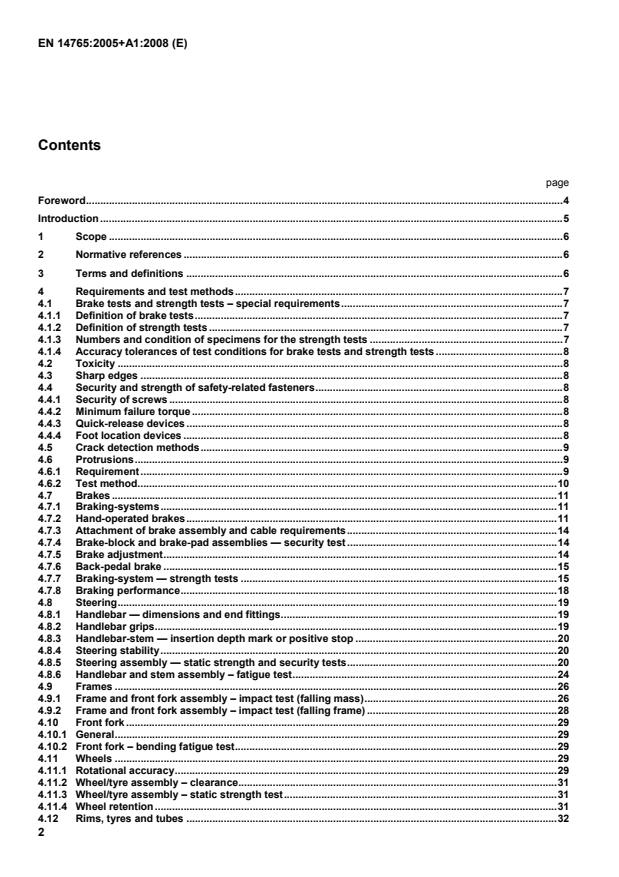
Steering geometry.47 Bibliography.48
635 mm (typical rider weight of 30 kg), and propelled by a transmitted drive to the rear wheel. This European Standard does not apply to special bicycles intended for stunting (e.g. BMX bicycles). NOTE For bicycles with a maximum saddle height of 435 mm see EN 71 and for bicycles with a saddle height of 635 mm or more see prEN 14764. 2 Normative references The following referenced documents are indispensable for the application of this European Standard. For dated references, only the edition cited applies. For undated references, the latest edition of the referenced document (including any amendments) applies. EN 71-3, Safety of toys — Part 3: Migration of certain elements !EN 14872", Bicycles — Accessories for bicycles — Luggage carriers ISO 1101, Geometrical Product Specifications (GPS) — Geometrical tolerancing — Tolerances of form, orientation, location and run-out ISO 5775-1, Bicycle tyres and rims — Part 1: Tyre designations and dimensions ISO 5775-2, Bicycle tyres and rims — Part 2: Rims ISO 7636, Bells for bicycles and mopeds — Technical specifications 3 Terms and definitions For the purposes of this document, the following terms and definitions apply. 3.1 cycle any vehicle that has at least two wheels and is propelled solely or mainly by the muscular energy of the person on that vehicle, in particular by means of pedals 3.2 bicycle two-wheeled cycle 3.3 maximum saddle height vertical distance from the ground to the top of the seat surface, measured with the seat in a horizontal position with the seat pillar set to the minimum insertion depth [EN 71] 3.4 braking force tangential rearward force between the tyre and the ground or the tyre and the drum or belt of the test machine
In all strength tests, specimens shall be in the fully finished condition. 4.1.4 Accuracy tolerances of test conditions for brake tests and strength tests Unless stated otherwise, accuracy tolerances based on the nominal values shall be as follows: Forces and torques
0/+5 % Masses and weights
± 1 % Dimensions
± 1 mm Angles
± 1° Time duration
± 5 s Temperatures
± 2 °C Pressures
± 5 %
4.2 Toxicity The following items which come into intimate contact with the rider (i.e. causing any hazard due to sucking or licking) shall comply with the requirements of EN 71-3: - all paints; - handlebar handgrips; - surface of the saddle. 4.3 Sharp edges Exposed edges that could come into contact with the rider's hands, legs etc., during normal riding or normal handling and normal maintenance shall not be sharp. 4.4 Security and strength of safety-related fasteners 4.4.1 Security of screws Any screws used in the assembly of suspension systems or screws used to attach e.g. generators, brake-mechanisms and mud-guards to the frame or fork or handlebar shall be provided with suitable locking devices, e.g., lock-washers, lock-nuts, or stiff nuts. 4.4.2 Minimum failure torque The minimum failure torque of bolted joints for the fastening of handlebars, handlebar-stems, bar-ends, seats and seat-pillars shall be at least 50 % greater than the manufacturer's recommended tightening torque. 4.4.3 Quick-release devices No quick-release devices of any type shall be used. 4.4.4 Foot location devices Toe-straps and toe-clips shall not be fitted.
Dimensions in millimetres
R ≥ 6,3
A ≥ 12,7
B ≥ 3,2 Figure 1 — Examples of minimum dimensions of exposed protrusions 4.6.1.2 Exclusion zone, protective devices and screw threads There shall be no protrusions on the top tube of a bicycle frame between the saddle and a point 300 mm forward of the saddle, with the exception that control cables no greater than 6,4 mm in diameter and cable clamps made from material no thicker than 4,8 mm may be attached to the top tube.
Figure 2 — Exposed protrusion test cylinder Manoeuvre the test cylinder in all possible attitudes towards any rigid protrusion on the bicycle. If the central 50 mm long section of the cylinder contacts the protrusion, that protrusion shall be considered to be an exposed protrusion and it shall comply with 4.6.1.1. Examples of protrusions that need and do not need to comply with the requirements are shown in Figure 3.
a) needs to comply
b) does not need to comply
Key 1 Test cylinder Figure 3 — Examples of protrusions 4.7 Brakes 4.7.1 Braking-systems !Bicycles, whether or not fitted with a fixed transmitted drive, shall be equipped with at least two independent braking systems, one system operating on the front wheel and one on the rear. The decision on whether the rear braking system is operated by the rider’s hand or foot should be made in accordance with the legislation, custom or preference of the country to which the bicycle is to be supplied. Brake-blocks containing asbestos shall not be permitted." 4.7.2 Hand-operated brakes 4.7.2.1 Brake-lever position The hand-brake levers for front and rear brakes shall be positioned according to the legislation or custom and practice of the country in which the bicycle is to be sold, and the bicycle manufacturer shall state in the users instruction manual which lever operates the front brake and which operates the rear brake (see also Clause 5 k)). 4.7.2.2 Brake-lever grip dimensions 4.7.2.2.1 Requirement The maximum grip dimension, d, measured between the outer surfaces of the brake-lever and the handlebar, or the handlebar-grip or any other covering where present, shall not exceed 75 mm over a distance of 40 mm as shown in Figure 4. For dimension a see 4.7.2.2.2. NOTE The range of adjustment on the brake-lever should permit these dimensions to be obtained.
Key a Distance between the last part of the lever intended for contact with the rider's fingers and the end of the lever d Maximum grip dimension Figure 4 — Handbrake-lever grip dimensions 4.7.2.2.2 Test method Fit the gauge illustrated in Figure 5 over the handlebar and handlebar-grip and the brake-lever as shown in
Figure 6 so that the face A is in contact with the handlebar grip and the side of the brake-lever. Ensure that the
face B is in uninterrupted contact with the part of the brake-lever which is intended for contact with the rider's fingers and that the gauge does not cause any movement of the brake-lever towards the handlebar or handlebar-grip. Measure the distance a, the distance between the last part of the lever intended for contact with the rider's fingers and the end of the lever (see 4.7.2.2.1 and 4.7.2.3).
Key A = Face A B = Face B C = Rod Figure 5 — Handbrake-lever grip dimension gauge
Figure 6 — Method of fitting the gauge to the handbrake-lever and handlebar (minimum grip length is shown)
4.7.2.3 Handbrake levers — position of applied force For the purposes of all braking tests in this European Standard the test force shall be applied at a distance, b, which is equal to either dimension a as determined in 4.7.2.2.2 or 25 mm from the free end of the brake-lever, whichever is the greater (see Figure 7).
Key F Applied force b ≥ 25 mm Figure 7 — Position of applied force on handbrake-lever 4.7.3 Attachment of brake assembly and cable requirements Cable pinch-bolts shall not sever any of the cable strands when assembled to the manufacturer's instructions. In the event of a cable failing, no part of the brake mechanism shall inadvertently inhibit the rotation of the wheel. The cable end shall either be protected with a cap that shall withstand a removal force of 20 N or be otherwise treated to prevent unravelling. The inner cable shall be protected from corrosion, e.g., by a suitable impervious liner to the outer casing. Also, either the inner cable shall have a low-friction coating or the outer casing shall have a low-friction lining. NOTE See 4.4 in relation to fasteners. 4.7.4 Brake-block and brake-pad assemblies — security test 4.7.4.1 Requirement The friction material shall be securely attached to the holder, backing-plate, or shoe and there shall be no failure of the assembly when tested by the method specified in 4.7.4.2. The brake system shall be capable of meeting the strength test specified in 4.7.7 and the braking performance specified in 4.7.8. 4.7.4.2 Test method Conduct the test on a fully assembled bicycle with the brakes adjusted to a correct position with a rider or equivalent mass on the saddle. The combined mass of the bicycle and rider (or equivalent mass) shall be 30 kg. Actuate each brake-lever with a force of 130 N applied at the point as specified in 4.7.2.2.3 or a force sufficient to bring the brake-lever into contact with the handlebar grip, whichever is the lesser. Maintain this force whilst subjecting the bicycle to five forward and five rearward movements, each of which is not less than 75 mm distance. 4.7.5 Brake adjustment Each brake shall be capable of adjustment without the use of a tool to an efficient operating position until the friction material has worn to the point of requiring replacement as recommended in the manufacturer's instructions. Also, when correctly adjusted, the friction material shall not contact anything other than the intended braking surface.
Figure 7. The force shall be 300 N, or such lesser force as is required to bring as is required to bring a) a cable-brake lever into contact with the handlebar grip or the handlebar where the manufacturer does not fit a grip, or b) a rod-operated brake lever level with the upper handlebar grip surface. Repeat the test for a total of 10 times on each handbrake lever. 4.7.7.3 Back-pedal brake — requirement When tested by the method described in 4.7.7.4, there shall be no failure of the back pedal braking system or any component thereof. 4.7.7.4 Back-pedal brake — test method Conduct this test on a fully assembled bicycle. Ensure that the braking system is adjusted according to the recommendations in the manufacturer's instructions, and that a pedal crank is in a horizontal position (see Figure 8 a) and b)). Gradually apply a vertical force of 600 N. Gradually apply a vertical force of 600 N to the centre of the pedal axe, and maintain for one minute. Perform the test ten times.
Key 1 Applied force on wheel (braking force) 2 Force measuring device 3 Suitable webbing wrapped around wheel circumference 4 Right hand crank 5 Direction of applied force on pedal (see 4.7.7.4 and 4.7.8.4) Figure 8 a) — Measurement of braking force from back-pedal brake
Key 1 Chain 2 Hub sprocket 3 Left crank 4 Cycle chain-wheel and pedal crank 5 Point of force application 6 Pedal
Figure 8 b) — Back pedal brake test
Key 1 Force measuring device 2 Suitable webbing around wheel circumference 3 Fixture 4 Applied force Figure 8 c) — Measurement of braking force from hand-operated brake (typical arrangement)
4.7.8 Braking performance 4.7.8.1 Hand-operated brake performance test — requirement When tested in accordance with 4.7.8.2, the average braking force of hand operated braking systems shall increase progressively as the lever force is increased in steps of 10 N from 40 N to 80 N. For front brakes, with the appropriate lever forces, the minimum and maximum braking forces shall conform to Table 1. For rear brakes, with the appropriate lever forces, the minimum braking forces shall conform to Table 1.
Table 1 — Brake lever input forces and braking forces at the tyre Brake lever input force Braking force at the tyre N min. N max. (front brake only) N 40 40 100 ˜60™ 50 140 80 60 180
Key 1 Clamping fixture 2 Permanent set 3 Stem centreline 4 Deflected shape 5 Free stem length 6 Limit mark 7 Minimum insertion depth Figure 9 — Handlebar and stem assembly — lateral bending test 4.8.5.2 Handlebar and stem assembly — forward bending test 4.8.5.2.1 Requirement When tested by the method described in 4.8.5.2.2, there shall be no cracking or fracture of the handlebar or stem and the permanent set measurement at the point of application of the test force shall not exceed 20 mm per
100 mm of free stem length. 4.8.5.2.2 Test method With the handlebar stem securely clamped to the minimum insertion depth, apply a force of 500 N through the handlebar attachment point in the forward and downward direction at 45° to the axis of the stem shank, in plane A-A (see Figure 10). Maintain this force for 1 min.
Key 1 Force applied in plane A-A 2 Axis of stem shank 3 Applied force 4 Free stem length 5 Permanent set 6 Minimum insertion depth 7 Limit mark 8 Clamping fixture Figure 10 — Handlebar and stem assembly – forward bending test
4.8.5.3 Handlebar to handlebar stem – torsional security test 4.8.5.3.1 Requirement The handlebar shall not move in relation to the stem when tested in accordance with 4.8.5.3.2. 4.8.5.3.2 Test method With the stem of the handlebar assembly securely clamped to the minimum insertion depth, apply a force of 130 N simultaneously to each side of the handlebar, in a direction and at a point giving maximum torque at the junction of the handlebar and stem. If the point of application is at the end of the handlebar, apply the force as near to the end as practicable, but no more than 15 mm from the end (see Figure 11). Maintain this force for 1 min. Depending on the shape of the handlebar, the forces may be applied in a different direction from those illustrated in Figure 11. If the handlebar/stem assembly uses a clamp, the torque applied to the fastener shall not exceed the manufacturer's recommended minimum torque.
Key 1 Applied force 2 Minimum insertion depth 3 Clamping block Figure 11 — Handlebar to handlebar stem — torsional security test
4.8.5.4 Handlebar stem to fork stem — torsional security test 4.8.5.4.1 Requirement The handlebar shall not move in relation to the fork stem when tested in accordance with 4.8.5.4.2. 4.8.5.4.2 Test method With the handlebar stem correctly assembled in the frame and fork stem, and the clamping device tightened to the manufacturer's recommended minimum torque, apply a torque of 15 Nm to the handlebar/fork clamping device, as shown in Figure 12. Maintain this torque for 1 min.
™ Key 1 Applied torque 2 Frame and fork assembly Figure 12 — Handlebar stem to fork stem – torsional security test
4.8.6 Handlebar and stem assembly – fatigue test 4.8.6.1 General Handlebar-stems can influence test failure of handlebars and for this reason, a handlebar and stem is always to be tested as an assembly. Conduct the test in two stages on the same assembly as follows. 4.8.6.2 Requirement for stage 1 When tested by the method described in 4.8.6.3, there shall be no visible cracks or fractures in any part of the handlebar and stem assembly. 4.8.6.3 Test method for stage 1 Unless the handlebar and stem are permanently connected, e.g. by welding or brazing, align the grip of portions of the handlebar in a plane perpendicular to the stem axis (see Figure 13), and secure the handlebar to the stem according to the manufacturer's recommendations. Clamp the handlebar stem securely in a fixture to the minimum insertion depth. Apply fully-reversed forces of 115 N at a position 50 mm from the free end each side of the handlebar and in a plane parallel to the stem axis for 100 000 cycles, with the forces at each end of the handlebar being out of phase with each other and parallel to the axis of the handlebar stem as shown in Figure 14 a). The maximum test frequency shall be 25 Hz.
Figure 13 — Adjustable han
...