

EN 1417:2014
(Main)Plastics and rubber machines - Two-roll mills - Safety requirements
General Information
- Abstract
This European Standard deals with all significant hazards, hazardous situations and events relevant to two-roll mills for the processing of rubber and/or plastics, when they are used as intended and under conditions of misuse which are reasonably foreseeable by the manufacturer (see Clause 4).
This European Standard covers two-roll mills as defined in 3.1.
This European Standard does not deal with the design of a local exhaust ventilation system that may be necessary in specific applications of the machine not known by the manufacturer.
This European Standard is not applicable to two-roll mills manufactured before the date of its publication as an European Standard.
- Status
- Withdrawn
- Publication Date
- 16-Dec-2014
- Withdrawal Date
- 29-Sep-2026
- Technical Committee
- CEN/TC 145 - Rubber and plastics machines - Safety
- Drafting Committee
- CEN/TC 145 - Rubber and plastics machines - Safety
- Current Stage
- 9960 - Withdrawal effective - Withdrawal
- Start Date
- 15-Nov-2023
- Completion Date
- 30-Sep-2026
- Directive
- 2006/42/EC - Directive 2006/42/EC of the European Parliament and of the Council of 17 May 2006 on machinery, and amending Directive 95/16/EC (recast)OJ Ref: C, C 14 OJ Date: 15-Jan-2016

Relations
- Replaces
EN 1417:1996+A1:2008/AC:2009 - Plastics and rubber machines - Two roll mills - Safety requirements - Effective Date
- 24-Dec-2014
- Effective Date
- 14-May-2011
- Effective Date
- 19-Jan-2023
- Effective Date
- 25-Aug-2026
- Effective Date
- 09-Feb-2026
- Effective Date
- 09-Feb-2026
- Effective Date
- 09-Feb-2026
- Effective Date
- 09-Feb-2026
- Effective Date
- 28-Jan-2026
- Effective Date
- 28-Jan-2026
- Effective Date
- 28-Jan-2026
- Effective Date
- 28-Jan-2026
- Effective Date
- 28-Jan-2026
- Effective Date
- 28-Jan-2026
- Effective Date
- 28-Jan-2026
Get Certified
Connect with accredited certification bodies for this standard

DIN CERTCO
DIN Group product certification.

Smithers Quality Assessments
US management systems and product certification.
Sponsored listings
Frequently Asked Questions
EN 1417:2014 is a standard published by the European Committee for Standardization (CEN). Its full title is "Plastics and rubber machines - Two-roll mills - Safety requirements". This standard covers: This European Standard deals with all significant hazards, hazardous situations and events relevant to two-roll mills for the processing of rubber and/or plastics, when they are used as intended and under conditions of misuse which are reasonably foreseeable by the manufacturer (see Clause 4). This European Standard covers two-roll mills as defined in 3.1. This European Standard does not deal with the design of a local exhaust ventilation system that may be necessary in specific applications of the machine not known by the manufacturer. This European Standard is not applicable to two-roll mills manufactured before the date of its publication as an European Standard.
This European Standard deals with all significant hazards, hazardous situations and events relevant to two-roll mills for the processing of rubber and/or plastics, when they are used as intended and under conditions of misuse which are reasonably foreseeable by the manufacturer (see Clause 4). This European Standard covers two-roll mills as defined in 3.1. This European Standard does not deal with the design of a local exhaust ventilation system that may be necessary in specific applications of the machine not known by the manufacturer. This European Standard is not applicable to two-roll mills manufactured before the date of its publication as an European Standard.
EN 1417:2014 is classified under the following ICS (International Classification for Standards) categories: 83.200 - Equipment for the rubber and plastics industries. The ICS classification helps identify the subject area and facilitates finding related standards.
EN 1417:2014 has the following relationships with other standards: It is inter standard links to EN 1417:1996+A1:2008/AC:2009, EN 1417:1996+A1:2008, EN 1417:2023, ISO 8598:1996, EN 61000-6-2:2005, EN 61496-1:2013, EN 61496-2:2013, EN 61000-6-4:2007, EN 953:1997+A1:2009, EN 349:1993+A1:2008, EN 2286:1989, EN ISO 13849-1:2008, EN ISO 14119:2013, EN ISO 13732-1:2008, EN ISO 9614-2:1996. Understanding these relationships helps ensure you are using the most current and applicable version of the standard.
EN 1417:2014 is associated with the following European legislation: EU Directives/Regulations: 2006/42/EC; Standardization Mandates: M/BC/CEN/88/13. When a standard is cited in the Official Journal of the European Union, products manufactured in conformity with it benefit from a presumption of conformity with the essential requirements of the corresponding EU directive or regulation.
EN 1417:2014 is available in PDF format for immediate download after purchase. The document can be added to your cart and obtained through the secure checkout process. Digital delivery ensures instant access to the complete standard document.
Standards Content (Sample)
2003-01.Slovenski inštitut za standardizacijo. Razmnoževanje celote ali delov tega standarda ni dovoljeno.Stroji za predelavo gume in plastike - Dvovaljni gnetilniki - Varnostne zahteveKunststoff- und Gummimaschinen - Walzwerke - SicherheitsanforderungenMachines pour les matiéres plastiques et le caoutchouc - Mélangeurs à cylindres - Prescriptions de sécuritéPlastics and rubber machines - Two roll mills - Safety requirements83.200Oprema za gumarsko industrijo in industrijo polimernih materialovEquipment for the rubber and plastics industriesICS:Ta slovenski standard je istoveten z:EN 1417:2014SIST EN 1417:2015en,fr,de01-marec-2015SIST EN 1417:2015SLOVENSKI
STANDARDSIST EN 1417:2000+A1:2008/AC:2009SIST EN 1417:2000+A1:20081DGRPHãþD
EUROPEAN STANDARD NORME EUROPÉENNE EUROPÄISCHE NORM
EN 1417
December 2014 ICS 83.200 Supersedes EN 1417:1996+A1:2008English Version
Plastics and rubber machines - Two-roll mills - Safety requirements
Machines pour les matières plastiques et le caoutchouc - Mélangeurs à cylindres - Prescriptions de sécurité
Kunststoff- und Gummimaschinen - Walzwerke - Sicherheitsanforderungen This European Standard was approved by CEN on 7 November 2014.
CEN members are bound to comply with the CEN/CENELEC Internal Regulations which stipulate the conditions for giving this European Standard the status of a national standard without any alteration. Up-to-date lists and bibliographical references concerning such national standards may be obtained on application to the CEN-CENELEC Management Centre or to any CEN member.
This European Standard exists in three official versions (English, French, German). A version in any other language made by translation under the responsibility of a CEN member into its own language and notified to the CEN-CENELEC Management Centre has the same status as the official versions.
CEN members are the national standards bodies of Austria, Belgium, Bulgaria, Croatia, Cyprus, Czech Republic, Denmark, Estonia, Finland, Former Yugoslav Republic of Macedonia, France, Germany, Greece, Hungary, Iceland, Ireland, Italy, Latvia, Lithuania, Luxembourg, Malta, Netherlands, Norway, Poland, Portugal, Romania, Slovakia, Slovenia, Spain, Sweden, Switzerland, Turkey and United Kingdom.
EUROPEAN COMMITTEE FOR STANDARDIZATION
COMITÉ EUROPÉEN DE NORMALISATION EUROPÄISCHES KOMITEE FÜR NORMUNG
CEN-CENELEC Management Centre:
Avenue Marnix 17,
B-1000 Brussels © 2014 CEN All rights of exploitation in any form and by any means reserved worldwide for CEN national Members. Ref. No. EN 1417:2014 ESIST EN 1417:2015
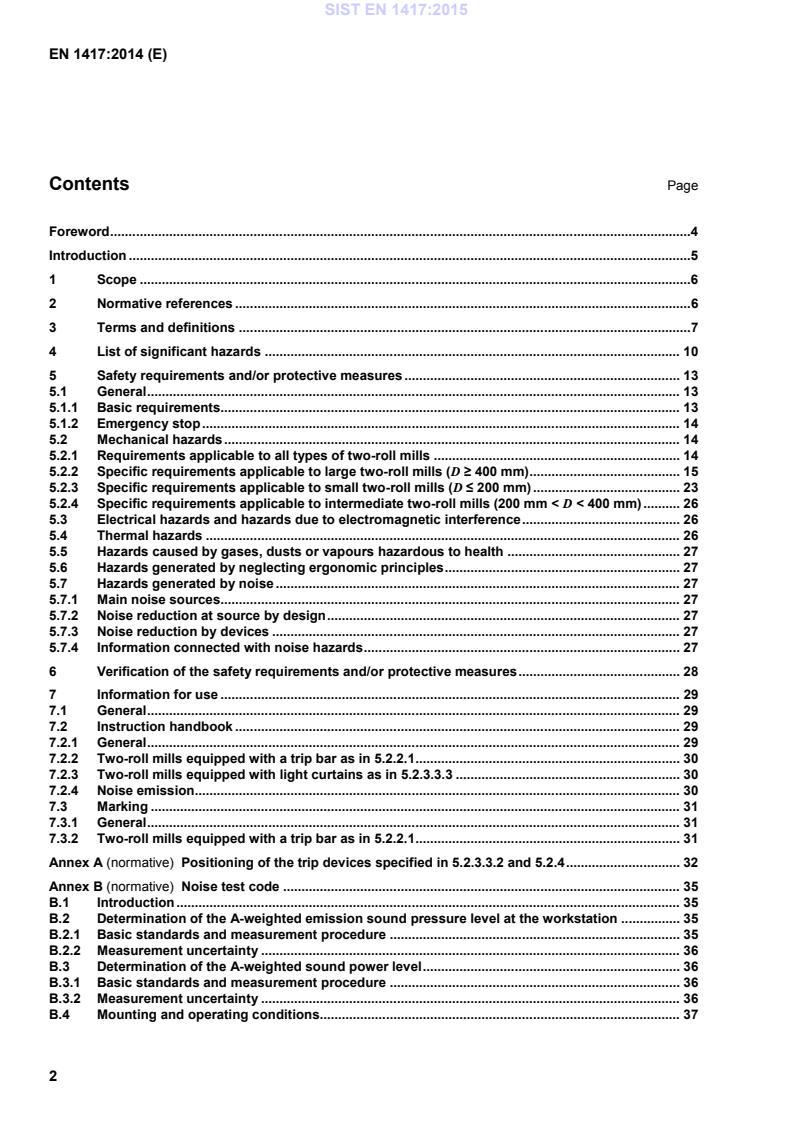
Positioning of the trip devices specified in 5.2.3.3.2 and 5.2.4 . 32 Annex B (normative)
Noise test code . 35 B.1 Introduction . 35 B.2 Determination of the A-weighted emission sound pressure level at the workstation . 35 B.2.1 Basic standards and measurement procedure . 35 B.2.2 Measurement uncertainty . 36 B.3 Determination of the A-weighted sound power level . 36 B.3.1 Basic standards and measurement procedure . 36 B.3.2 Measurement uncertainty . 36 B.4 Mounting and operating conditions. 37 SIST EN 1417:2015
Relationship between this European Standard and the Essential Requirements of EU Directive 2006/42/EC . 39 Bibliography . 40
Note 1 to entry: See Figure 1: SIST EN 1417:2015
Key 1 frame 6 stock blender 2 mill roll 6.1 stock blender rolls 3 drive and transmission unit 6.2 stock blender carriage 4 stock guide 7 mill tray 5 strip cutting device
Figure 1 — Principal parts of a two-roll mill 3.1.1 large two-roll mill two-roll mill with a mill roll diameter D ≥ 400 mm 3.1.2 small two-roll mill two-roll mill with a mill roll diameter D ≤ 200 mm 3.1.3 intermediate two-roll mill two-roll mill with a mill roll diameter 200 mm < D < 400 mm SIST EN 1417:2015
Figure 2 — mrincipal crushing zone s, safety limits p and stopping angle . 3.3 stopping angle . angle through which the mill rolls rotate from the stop signal triggered by a protective device until the mill rolls have come to rest with the machine unloaded, and running at maximum rated speed 3.4 safety limit vertical plane indicated by Line S in Figure 2 demarcating the zone which is unsafe for operators who can reach into it without actuating the trip bar 3.5 stock guide (also known as “ear”) part which prevents material being processed from going beyond the mill roll end
Note 1 to entry: See Figure 1, Location 4. 3.6 strip cutting device device equipped with rotating discs or stationary blades to cut off strips of processed material from a mill roll
Note 1 to entry: See Figure 1, Location 5. SIST EN 1417:2015
Note 1 to entry: See Figure 1, Location 6. 3.8 mill tray equipment for catching material which falls under the mill rolls
Note 1 to entry: See Figure 1, Location 7. 3.9 recovery conveyor belt equipment for recirculating material which falls under the mill rolls
Note 1 to entry: See Figure 5. 3.10 retractable plough equipment which can be moved towards the mill roll in order to cut and turn over the material, and which can be retracted
Note 1 to entry: See Figure 4. 4 List of significant hazards This clause contains all the hazards, hazardous situations and events identified by risk assessment as significant for this type of machinery. Where appropriate, the locations of the hazards listed in Table 1 are shown in Figures 3, 4 and 5. SIST EN 1417:2015
Figure 3 — Location of mechanical hazards on a two-roll mill shown with a strip cutting device and a stock blender
Figure 4 — Location of mechanical hazards on a two-roll mill with retractable ploughs
Figure 5 — Location of mechanical hazards on a two-roll mill with a recovery conveyor belt SIST EN 1417:2015
Significant hazards Applicable subclauses in Clause 5 4 General hazards 5.1 4.1 Mechanical hazards related to the mill rolls:
4.1.1 4.1.2 Hazards of drawing-in and crushing between the mills rolls during normal (forward and reverse) operation 5.2.1.1 5.2.1.5 5.2.2.1 5.2.2.2 5.2.3.2 5.2.3.3 5.2.3.4 5.2.4 4.1.3 Hazard of drawing-in and crushing between the stock guides and the mill rolls 5.2.1.4 4.1.4 Hazards resulting from reduction of braking performance 5.2.1.2 4.1.5 Hazards of drawing-in and crushing in the drive mechanism of the mill rolls 5.2.1.3 4.2 Mechanical hazards related to other equipment on large two-roll mills:
4.2.1 Hazard created by the strip cutting device: — cutting hazards due to involuntary contact with the cutting edges of blades or rotating discs; — cutting, shearing and crushing hazards caused by movements of the strip cutting devices (with cutting or non-cutting edges) and their actuating mechanisms 5.2.2.4 4.2.2 Hazard of crushing between the stock blender carriage and the machine frame 5.2.2.5 4.2.3 Hazard of drawing-in and crushing between the stock blender rolls and hazard of trapping between the rubber strip and the blender rolls 5.2.2.6 4.2.4 Hazard of drawing-in and crushing between the recovery conveyor belt and the mill roll, when the mill rolls are in reverse motion 5.2.2.7 4.2.5 Hazard of impact due to the forward movement of the mill tray 5.2.2.8 4.2.6 Hazard of drawing-in and crushing between the retractable ploughs and the mill roll 5.2.2.9 4.2.7 Hazard of crushing between powered stock guides and fixed parts 5.2.2.3 SIST EN 1417:2015
Significant hazards Applicable subclauses in Clause 5 4.3 Hazards due to failure of the control system 5.1.1 4.4 Electrical hazards and hazards due to electromagnetic interference: Electrical shock or burns caused by direct or indirect contact with live conductive parts Malfunction of the control circuits due to electromagnetic interference with the electrical equipment Electrical shock or fire due to electrostatic discharge 5.3 4.5 Thermal hazards: Burns and/or scalds caused by: — unintentional contact with hot machine parts or hot material; — fluids released from the heat conditioning system 5.4 4.6 Hazards caused by gases, dusts or vapours hazardous to health: Contact with and/or inhalation of harmful substances which may be released from the materials processed 5.5 4.7 Hazards generated by neglecting ergonomic principles 5.6 4.8 Hazards generated by noise: Hazards from high noise levels resulting for example in hearing impairment, tinnitus, tiredness, stress, loss of balance or awareness, interference with speech communications or with the perception of acoustic signals 5.7
5 Safety requirements and/or protective measures 5.1 General 5.1.1 Basic requirements Machinery shall comply with the safety requirements and/or protective measures of this clause. In addition, the machine shall be designed according to the principles of EN ISO 12100:2010 for relevant but not significant hazards, which are not dealt with by this document. The electrical part of the control system shall be designed in accordance with EN 60204-1:2006, Clause 9 and in addition with the specific requirements given in this standard. The safety related parts of the control system (SRP/CS) shall be designed in accordance with EN ISO 13849-1:2008. The required performance level (PLr) for each safety function is specified in the relevant subclauses. The hydraulic equipment and its components shall be designed in accordance with EN ISO 4413:2010. The pneumatic equipment and its components shall be designed in accordance with EN ISO 4414:2010. SIST EN 1417:2015
cos 60arccos8[
8)202(]DDDb−+=−°+ where D is the diameter of the mill rolls in mm. The resulting dimension c (see Figure 6) shall not be less than 300 mm. For dimensions greater than 400 mm, see 5.2.2.1.7. SIST EN 1417:2015
Key A trip bar B complementary guard C electro-sensitive protective equipment (ESPE) a height of the trip bar b horizontal distance between the nip and the trip bar in its switching position c gap between the trip bar and the mill roll d horizontal distance between the trip bar and the mill tray Figure 6 — Positioning of the trip bar (example) 5.2.2.1.4 Actuation of the trip bar The trip bar, designed for involuntary actuation by the upper body, shall meet the minimum following requirements: — it shall be actuated by a displacement not exceeding 10 mm both towards the mill roll and away from it; — actuation of the bar shall not require a force greater than 200 N; — the bar shall be equipped with at least one position sensor at each end. Actuation of the trip bar shall stop the movement of the mill rolls according to category 0 or 1 of EN 60204-1:2006, 9.2.2, whichever provides the best stopping performance. The safety function shall be in accordance with PLr = d, category 3 of EN ISO 13849-1:2008. The return of the trip bar to its rest position shall not cause restarting. A separate manual reset shall be installed in a position giving full view of the danger zone. Actuating the reset shall not restart the machine. 5.2.2.1.5 Effects on the movement of the mill rolls Actuation of the trip bar shall, whenever the mill rolls are in motion, cause the mill rolls to stop in an angle not greater than 60° even with the machine unloaded and running at maximum rated speed. SIST EN 1417:2015
Key 1 mill rolls 2 stock blender rolls 3 trip bar 4 trapping point between the rubber strip and the blender roll a corresponds to dimension b of EN ISO 13857:2008, Table 1 x corresponds to dimension c of EN ISO 13857:2008, Table 1 y corresponds to dimension a of EN ISO 13857:2008, Table 1 Figure 7 — Example for the positioning of the stock blender rolls 5.2.2.7 Recovery conveyor belt For two-roll mills equipped with automatic and/or intentional mill roll reversal, the distance between the mill roll and the recovery conveyor belt shall be at least 120 mm (Figure 8). SIST EN 1417:2015
Figure 8 — Recovery conveyor belt 5.2.2.8 Mill tray If the tray is moveable it shall be equipped with a mechanical self-acting device to lock it in the working position. The mill tray shall be designed to prevent footholds. Therefore dimension d in Figure 6 shall not be less than 300 mm or a complementary guard shall be installed to prevent footholds (see 5.2.2.1.7). 5.2.2.9 Retractable ploughs Two-roll mills fitted with retractable ploughs shall be installed within an enclosing guard. Doors in the enclosing guard shall be interlocked with the movement of the ploughs towards the mill rolls according to PLr = c of EN ISO 13849-1:2008 and shall be equipped with guard locking so as to allow access only when the ploughs have retracted by at least 120 mm as indicated in Figure 9. Movement of the ploughs due to gravity shall be prevented using pneumatic or hydraulic restraint devices connected directly to the cylinder. SIST EN 1417:2015
Figure 9 — Retractable ploughs 5.2.3 Specific requirements applicable to small two-roll mills (D ≤ 200 mm) 5.2.3.1 Installation of the machine The top of the mill rolls shall be at a height of not less than 1 100 mm above the normal standing level of the operator. 5.2.3.2 Prevention of access to the principal crushing zone by guards Access to the principal crushing zone at small two-roll mills shall be prevented by fixed guards or interlocking guards with or without guard locking. These guards shall be fully enclosing guards (see example Figure 10) or positioned over the full width of the mill rolls at a maximum distance of 4 mm above the surface of the mill rolls (see example Figure 11).
Key 1 fixed guards Figure 10 — Example of an enclosing guard SIST EN 1417:2015
Key 1 fixed guards Figure 11 — Example of a guard above the mill rolls Interlocking guards shall be positioned in accordance with EN ISO 13855:2010, taking into account the braking performance achieved by either a spring operated brake or a braking system, excluding electronic braking, with an equivalent braking performance when operating without a power supply. The overall system stopping performance (see EN ISO 13855:2010, 3.1.2) shall be calculated taking power failure into account. The safety function shall be in accordance with PLr = d, category 3 of EN ISO 13849-1:2008. If EN ISO 13855:2010 cannot be respected, interlocking guards with guard locking shall be adopted. The unlocking signal for the guard locking shall be i
...