

EN 13870:2005+A1:2010
(Main + Amendment)Food processing machinery - Chop cutting machines - Safety and hygiene requirements
- Abstract
This document covers chop cutting machines and accessories.
The extent, to which hazards are covered, is indicated in this document.
1.1 This document specifies requirements for design and manufacture of chop cutting machines.
The machines covered by this document are used for continuous portioning of fresh, smoked or frozen meat with and without bones or of similar products by separation by means of a blade.
This document deals with all significant hazards, hazardous situations and events relevant to machines, appliances and machinery, when they are used !as intended and under conditions of misuse which are reasonably foreseeable by the manufacturer (see Clause 4)".
This document deals with the hazards which can arise during commissioning, operation, maintenance and de-commissioning of the machine.
The document is not dealing with the specific hazards of loading devices.
This document is not applicable to chop cutting machines which are manufactured before the date of publication of this document by CEN.
1.2 This document covers the following types of machines:
- chop cutting machines with a discharge chute (Figure 1);
- chop cutting machines with a discharge trough (Figure 2).
Machine construction
Chop cutting machines are constructed of a machine frame, a feed trough with an automatic forward feed device, a blade housing, a blade, a removal unit, associated drives, electrical, hydraulic and pneumatic components, depending on machine type.
Chop cutting machines in the scope of this document may be equipped with:
- a feed conveyor belt in longitudinal- and lateral axis;
- a removal conveyor belt;
- a transfer trolley for the blade.
1.4 Intended use
The intended use (as defined in EN 12100-1:2003, 3.22) of chop cutting machines as dealt with in this document is described in 1.1.
The material to be cut is fed either manually or by means of a loading device into the feed trough. The material to be cut is fed to the blade by means of the automatic
- Status
- Withdrawn
- Publication Date
- 22-Jun-2010
- Withdrawal Date
- 06-Oct-2026
- Technical Committee
- CEN/TC 153 - Food processing machinery - Safety and hygiene specifications
- Drafting Committee
- CEN/TC 153/WG 2 - Meat processing machinery
- Current Stage
- 9960 - Withdrawal effective - Withdrawal
- Start Date
- 09-Sep-2015
- Completion Date
- 07-Oct-2026
- Directive
- 2006/42/EC - Directive 2006/42/EC of the European Parliament and of the Council of 17 May 2006 on machinery, and amending Directive 95/16/EC (recast)OJ Ref: C, C 284 OJ Date: 20-Oct-2010

Relations
- Merged From
EN 13870:2005 - Food processing machinery - Chop cutting machines - Safety and hygiene requirements - Effective Date
- 19-Jan-2023
- Effective Date
- 28-Dec-2011
- Effective Date
- 25-Aug-2026
- Effective Date
- 09-Feb-2026
- Effective Date
- 28-Jan-2026
- Effective Date
- 28-Jan-2026
- Effective Date
- 28-Jan-2026
- Effective Date
- 28-Jan-2026
- Effective Date
- 28-Jan-2026
- Effective Date
- 28-Jan-2026
- Effective Date
- 28-Jan-2026
- Effective Date
- 28-Jan-2026
- Effective Date
- 28-Jan-2026
- Effective Date
- 28-Jan-2026
- Effective Date
- 28-Jan-2026
Get Certified
Connect with accredited certification bodies for this standard

BSI Group
BSI (British Standards Institution) is the business standards company that helps organizations make excellence a habit.

Bureau Veritas
Bureau Veritas is a world leader in laboratory testing, inspection and certification services.

DNV
DNV is an independent assurance and risk management provider.
Sponsored listings
Frequently Asked Questions
EN 13870:2005+A1:2010 is a standard published by the European Committee for Standardization (CEN). Its full title is "Food processing machinery - Chop cutting machines - Safety and hygiene requirements". This standard covers: This document covers chop cutting machines and accessories. The extent, to which hazards are covered, is indicated in this document. 1.1 This document specifies requirements for design and manufacture of chop cutting machines. The machines covered by this document are used for continuous portioning of fresh, smoked or frozen meat with and without bones or of similar products by separation by means of a blade. This document deals with all significant hazards, hazardous situations and events relevant to machines, appliances and machinery, when they are used !as intended and under conditions of misuse which are reasonably foreseeable by the manufacturer (see Clause 4)". This document deals with the hazards which can arise during commissioning, operation, maintenance and de-commissioning of the machine. The document is not dealing with the specific hazards of loading devices. This document is not applicable to chop cutting machines which are manufactured before the date of publication of this document by CEN. 1.2 This document covers the following types of machines: - chop cutting machines with a discharge chute (Figure 1); - chop cutting machines with a discharge trough (Figure 2). Machine construction Chop cutting machines are constructed of a machine frame, a feed trough with an automatic forward feed device, a blade housing, a blade, a removal unit, associated drives, electrical, hydraulic and pneumatic components, depending on machine type. Chop cutting machines in the scope of this document may be equipped with: - a feed conveyor belt in longitudinal- and lateral axis; - a removal conveyor belt; - a transfer trolley for the blade. 1.4 Intended use The intended use (as defined in EN 12100-1:2003, 3.22) of chop cutting machines as dealt with in this document is described in 1.1. The material to be cut is fed either manually or by means of a loading device into the feed trough. The material to be cut is fed to the blade by means of the automatic
This document covers chop cutting machines and accessories. The extent, to which hazards are covered, is indicated in this document. 1.1 This document specifies requirements for design and manufacture of chop cutting machines. The machines covered by this document are used for continuous portioning of fresh, smoked or frozen meat with and without bones or of similar products by separation by means of a blade. This document deals with all significant hazards, hazardous situations and events relevant to machines, appliances and machinery, when they are used !as intended and under conditions of misuse which are reasonably foreseeable by the manufacturer (see Clause 4)". This document deals with the hazards which can arise during commissioning, operation, maintenance and de-commissioning of the machine. The document is not dealing with the specific hazards of loading devices. This document is not applicable to chop cutting machines which are manufactured before the date of publication of this document by CEN. 1.2 This document covers the following types of machines: - chop cutting machines with a discharge chute (Figure 1); - chop cutting machines with a discharge trough (Figure 2). Machine construction Chop cutting machines are constructed of a machine frame, a feed trough with an automatic forward feed device, a blade housing, a blade, a removal unit, associated drives, electrical, hydraulic and pneumatic components, depending on machine type. Chop cutting machines in the scope of this document may be equipped with: - a feed conveyor belt in longitudinal- and lateral axis; - a removal conveyor belt; - a transfer trolley for the blade. 1.4 Intended use The intended use (as defined in EN 12100-1:2003, 3.22) of chop cutting machines as dealt with in this document is described in 1.1. The material to be cut is fed either manually or by means of a loading device into the feed trough. The material to be cut is fed to the blade by means of the automatic
EN 13870:2005+A1:2010 is classified under the following ICS (International Classification for Standards) categories: 67.260 - Plants and equipment for the food industry. The ICS classification helps identify the subject area and facilitates finding related standards.
EN 13870:2005+A1:2010 has the following relationships with other standards: It is inter standard links to EN 13870:2005, EN 13870:2015, ISO 8598:1996, EN 60529:1991, EN 1672-2:2005, EN 2286:1989, EN 1088:1995, EN ISO 12100-2:2003, EN 1005-2:2003+A1:2008, EN ISO 11688-1:2009, EN ISO 4871:2009, EN 1005-1:2001+A1:2008, EN ISO 3744:1995, EN ISO 13857:2008, EN ISO 4413:2010. Understanding these relationships helps ensure you are using the most current and applicable version of the standard.
EN 13870:2005+A1:2010 is associated with the following European legislation: EU Directives/Regulations: 2006/42/EC, 98/37/EC; Standardization Mandates: M/079, M/396. When a standard is cited in the Official Journal of the European Union, products manufactured in conformity with it benefit from a presumption of conformity with the essential requirements of the corresponding EU directive or regulation.
EN 13870:2005+A1:2010 is available in PDF format for immediate download after purchase. The document can be added to your cart and obtained through the secure checkout process. Digital delivery ensures instant access to the complete standard document.
Standards Content (Sample)
2003-01.Slovenski inštitut za standardizacijo. Razmnoževanje celote ali delov tega standarda ni dovoljeno.DNahrungsmittelmaschinen - Kotelettschneidemaschinen - Sicherheits- und HygieneanforderungenMachines pour les produits alimentaires - Machines à couper les côtelettes - Prescriptions relatives à la sécurité et à l'hygièneFood processing machinery - Chop cutting machines - Safety and hygiene requirements67.260Tovarne in oprema za živilsko industrijoPlants and equipment for the food industryICS:Ta slovenski standard je istoveten z:EN 13870:2005+A1:2010SIST EN 13870:2005+A1:2010en,fr,de01-oktober-2010SIST EN 13870:2005+A1:2010SLOVENSKI
STANDARD
EUROPEAN STANDARD NORME EUROPÉENNE EUROPÄISCHE NORM
EN 13870:2005+A1
June 2010 ICS 67.260 Supersedes EN 13870:2005English Version
Food processing machinery - Chop cutting machines - Safety and hygiene requirements
Machines pour les produits alimentaires - Machines à couper les côtelettes - Prescriptions relatives à la sécurité et à l'hygiène
Nahrungsmittelmaschinen - Kotelettschneidemaschinen - Sicherheits- und Hygieneanforderungen This European Standard was approved by CEN on 14 October 2004 and includes Amendment 1 approved by CEN on 20 May 2010.
CEN members are bound to comply with the CEN/CENELEC Internal Regulations which stipulate the conditions for giving this European Standard the status of a national standard without any alteration. Up-to-date lists and bibliographical references concerning such national standards may be obtained on application to the CEN Management Centre or to any CEN member.
This European Standard exists in three official versions (English, French, German). A version in any other language made by translation under the responsibility of a CEN member into its own language and notified to the CEN Management Centre has the same status as the official versions.
CEN members are the national standards bodies of Austria, Belgium, Bulgaria, Croatia, Cyprus, Czech Republic, Denmark, Estonia, Finland, France, Germany, Greece, Hungary, Iceland, Ireland, Italy, Latvia, Lithuania, Luxembourg, Malta, Netherlands, Norway, Poland, Portugal, Romania, Slovakia, Slovenia, Spain, Sweden, Switzerland and United Kingdom.
EUROPEAN COMMITTEE FOR STANDARDIZATION
COMITÉ EUROPÉEN DE NORMALISATION EUROPÄISCHES KOMITEE FÜR NORMUNG
Management Centre:
Avenue Marnix 17,
B-1000 Brussels © 2010 CEN All rights of exploitation in any form and by any means reserved worldwide for CEN national Members. Ref. No. EN 13870:2005+A1:2010: ESIST EN 13870:2005+A1:2010
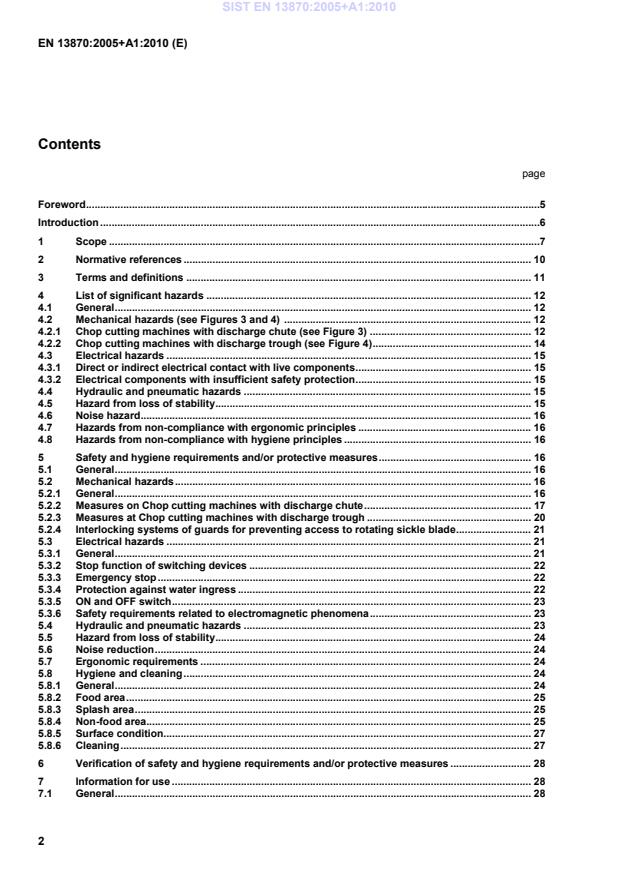
...................................................................................... 124.2.1Chop cutting machines with discharge chute (see Figure 3) ........................................................ 124.2.2Chop cutting machines with discharge trough (see Figure 4) ....................................................... 144.3Electrical hazards ............................................................................................................................... 154.3.1Direct or indirect electrical contact with live components ............................................................. 154.3.2Electrical components with insufficient safety protection ............................................................. 154.4Hydraulic and pneumatic hazards .................................................................................................... 154.5Hazard from loss of stability .............................................................................................................. 154.6Noise hazard ........................................................................................................................................ 164.7Hazards from non-compliance with ergonomic principles ............................................................ 164.8Hazards from non-compliance with hygiene principles ................................................................. 165Safety and hygiene requirements and/or protective measures ..................................................... 165.1General ................................................................................................................................................. 165.2Mechanical hazards ............................................................................................................................ 165.2.1General ................................................................................................................................................. 165.2.2Measures on Chop cutting machines with discharge chute .......................................................... 175.2.3Measures at Chop cutting machines with discharge trough ......................................................... 205.2.4Interlocking systems of guards for preventing access to rotating sickle blade .......................... 215.3Electrical hazards ............................................................................................................................... 215.3.1General ................................................................................................................................................. 215.3.2Stop function of switching devices .................................................................................................. 225.3.3Emergency stop .................................................................................................................................. 225.3.4Protection against water ingress ...................................................................................................... 225.3.5ON and OFF switch ............................................................................................................................. 235.3.6Safety requirements related to electromagnetic phenomena ........................................................ 235.4Hydraulic and pneumatic hazards .................................................................................................... 235.5Hazard from loss of stability .............................................................................................................. 245.6Noise reduction ................................................................................................................................... 245.7Ergonomic requirements ................................................................................................................... 245.8Hygiene and cleaning ......................................................................................................................... 245.8.1General ................................................................................................................................................. 245.8.2Food area ............................................................................................................................................. 255.8.3Splash area .......................................................................................................................................... 255.8.4Non-food area ...................................................................................................................................... 255.8.5Surface condition................................................................................................................................ 275.8.6Cleaning ............................................................................................................................................... 276Verification of safety and hygiene requirements and/or protective measures ............................ 287Information for use ............................................................................................................................. 287.1General ................................................................................................................................................. 28SIST EN 13870:2005+A1:2010
Noise test code for chop cutting machines (grade 2) . 32Annex B (normative)
Design principles to ensure cleanability of chop cutting machines . 34Annex C (normative)
Common hazards for food processing machines and reduction requirements applicable to chop cutting machines . 39Annex ZA (informative)
!Relationship between this European Standard and the Essential Requirements of EU Directive 2006/42/EC" . 41Bibliography . 42 SIST EN 13870:2005+A1:2010
1 Scope This document covers chop cutting machines and accessories. The extent, to which hazards are covered, is indicated in this document. 1.1 This document specifies requirements for design and manufacture of chop cutting machines. The machines covered by this document are used for continuous portioning of fresh, smoked or frozen meat with and without bones or of similar products by separation by means of a blade. This document deals with all significant hazards, hazardous situations and events relevant to machines, appliances and machinery, when they are used !as intended and under conditions of misuse which are reasonably foreseeable by the manufacturer (see Clause 4)". This document deals with the hazards which can arise during commissioning, operation, maintenance and de-commissioning of the machine. The document is not dealing with the specific hazards of loading devices. This document is not applicable to chop cutting machines which are manufactured before the date of publication of this document by CEN. 1.2 This document covers the following types of machines: chop cutting machines with a discharge chute (Figure 1); chop cutting machines with a discharge trough (Figure 2). SIST EN 13870:2005+A1:2010
Key a Blade housing/cutting chamber
f Conveyor bin, container for completing the enclosing guard
b Discharge chute
g Feed trough/cutting trough
c Material holder/forward feed device
h Active range of the blade
d Cover over feed trough/cutting trough
i Cutting zone e Frame/housing
k Collector bin Figure 1 — Chop cutting machine with discharge chute SIST EN 13870:2005+A1:2010
Key a Blade housing/cutting chamber
f Cover over discharge trough
b Discharge
trough
g Feed trough c Material holder/forward feed device
h Active range of
blade
d Cover over feed trough/material trough
i Cutting zone
e Frame/housing
k Collector bin
m Outfeed Figure 2 — Chop cutting machine with discharge trough 1.3 Machine construction Chop cutting machines are constructed of a machine frame, a feed trough with an automatic forward feed device, a blade housing, a blade, a removal unit, associated drives, electrical, hydraulic and pneumatic components, depending on machine type. Chop cutting machines in the scope of this document may be equipped with: a feed conveyor belt in longitudinal- and lateral axis; a removal conveyor belt; a transfer trolley for the blade. 1.4 Intended use The intended use (as defined in EN 12100-1:2003, 3.22) of chop cutting machines as dealt with in this document is described in 1.1. The material to be cut is fed either manually or by means of a loading device into the feed trough. The material to be cut is fed to the blade by means of the automatic forward feed device. The product falls via the discharge chute into a trolley or into a discharge trough which may be equipped with a removal conveyor belt. SIST EN 13870:2005+A1:2010
1) Letters for the machine parts refer to Figures 1 and 2. SIST EN 13870:2005+A1:2010
Key 1 Zone 1
5 Zone 5 2 Zone 2
6 Zone 6 4 Zone 4
7 Zone 7" Figure 3 — Danger zones on chop cutting machine with discharge chute Zone 1 Returning forward feed device (c) in feed through (g). Crushing or shearing hazard to fingers or hand. Zone 2 Blade (h) in cutting chamber (i), access from feed trough (g). Severing hazard to fingers or hand. Zone 4 Blade (h) in cutting chamber (i), access via discharge chute (b). Severing hazard to fingers or hand. Zone 5 Blade (h) in blade housing (a). Severing hazard to fingers or hand. Breakage of blade/detachment of blade mounting. Hazard caused by ejected parts. Stationary blade during installation and removal and during cleaning. SIST EN 13870:2005+A1:2010
" Key 1 Zone 1
5 Zone 5 2 Zone 2
7 Zone 7 3 Zone 3 Figure 4 — Danger zones on chop cutting machine with discharge trough Zone 1 Returning forward feed device (c) in feed trough (g). Crushing or shearing hazard to fingers or hand. Zone 2 Blade (h) in cutting chamber (a), access from feed trough (g). Severing hazard to fingers or hand. SIST EN 13870:2005+A1:2010
EN ISO 13857, the manufacturer shall carry out a risk assessment to establish the requirements of the type
B-standard. This specific risk assessment shall be part of the general risk assessment of the machine." Where the means of reducing the risk is by the physical arrangement or positioning of the machine the manufacturer shall include in the Information for use a reference to these means, and to any limiting value of the requirement, and, if appropriate, to the means of verification. Where the means of reducing the risk is by a safe system of work, the manufacturer shall include in the Information for use details of the system and of the elements of training required by the operating personnel. 5.2 Mechanical hazards 5.2.1 General Chop cutting machines shall be designed and constructed in accordance with Annex C and the conditions mentioned below. SIST EN 13870:2005+A1:2010
L1, ≥ 850 mm safety distance if the material trough is not closed at the end Figure 5 — Chop cutting machines – safety dimensions Zone 4 Access to blade in cutting area via discharge chute Access shall be prevented at least by one of the following possibilities: cutting chamber door, without container (see Figure 7); combination of cutting chamber door and container; combination of cutting chamber door and transport trolley (see Figure 6). The cutting chamber door shall be interlocked according to 5.2. SIST EN 13870:2005+A1:2010
Key 1 Container for receiving product 2 Position switches 3 Discharge chute Figure 6 — Chop cutting machine with discharge chute – Safety measures Figure 7 — Chop cutting machine with discharge chute – Safety distances Zone 5 Access to the blade in fixed blade housing Blade Access into the active blade range shall be prevented by a fixed blade housing. Doors of the blade housing shall be designed as interlocking guards. For requirements relating to the interlocking system of doors of the blade housing, see 5.2.4. Breakage of blade The blade housing shall be designed to prevent penetration of ejected parts (e. g. blade or parts thereof). Stationary blade If the housing is open, the blade shall be prevented from any unintentional movement by a brake system. It shall be indicated in the instruction handbook that gloves protecting against cuts shall be worn during installation and removal as well as during cleaning of the blade. Zone 6 Access to the blade in fixed blade housing SIST EN 13870:2005+A1:2010
Key 1 OFF 2 ON 3 Protection hood (OFF) Figure 8 — ON/OFF switch with hood 5.3.5 ON and OFF switch On chop cutting machines, ON and OFF switches shall be provided. The switches shall be arranged on the operator side of machines. The ON switch shall be protected against unintentional start-up (e. g. by means of a protective collar). No ON switch is required if the cover over the feed trough is designed as a control guard. 5.3.6 Safety requirements related to electromagnetic phenomena
The machines shall have sufficient immunity to electromagnetic disturbances to enable them to operate safely as intended and not fail to danger when exposed to the levels and types of disturbances intended by the manufacturer. The manufacturer of the machines shall design, install and wire the equipment and sub-assemblies taking into account the recommendations of the suppliers of these sub assemblies. 5.4 Hydraulic and pneumatic hazards The hydraulic and pneumatic equipment shall comply with standards: EN ISO 12100-2:2003, 4.10; EN 982; SIST EN 13870:2005+A1:2010
Key
Figure 9 — Hygiene areas on chop cutting machine with discharge chute SIST EN 13870:2005+A1:2010
Key
Figure 10 — Hygiene areas on chop cutting machine with discharge trough 5.8.5 Surface condition The surface design shall comply with the requirements of EN 1672-2. The maximum surface roughness values shall comply with the requirements of Annex B. 5.8.6 Cleaning All surfaces in the food area shall be easy to clean and disinfect. They shall be designed such that cleaning liquids can run off freely. Information shall be included in the Instructions for use on the methods recommended for cleaning surfaces in the food areas, particularly for the sickle blade. Information shall also be given on general cleaning methods and the adequate removal of cleaning and disinfecting agents and of any cleaning materials that are unsuitable. NOTE Cleaning by pressurized water can contaminate the surroundings. SIST EN 13870:2005+A1:2010
Clause Test method 5.2.2 Measurement of dimensions (type) Verification of electrical circuit diagram (type) Visual inspection especially of the interlocking device, the sickle blade mounting and the condition of the cutting chamber door (individual) 5.2.3 Measurement of dimensions (type) Verification of electrical circuit diagram (type) Visual inspection especially of the interlock
...