

EN 13288:2025
(Main)Food processing machinery - Bowl lifting and tilting machines - Safety and hygiene requirements
- Abstract
1.1 This document specifies safety and hygiene requirements for the design and manufacture of bowl lifting and tilting machines (see description in Annex A) which:
a) are intended to be used in bakeries and pastry shops for discharging masses of dough and/or ingredients for bakery and/or pastry products all at once or progressively tipping a container or a machine with non-removable container by lifting and/or tilting it according to a guided path;
b) are intended to be used with manual inlet and outlet of the bowl.
NOTE b) does not refer to machines with integrated mixing machine with non-removable bowl.
The lifting and tilting machines can be equipped with a scraper (optional) for removing the rests of dough from the bowl after the dough has been discharged.
1.2 The following relevant hazards are not covered by this document:
- hazards due to the mixing process (for dough mixers see EN 453:2014 and for planetary mixers see EN 454:2014);
- hazards associated to the properties of the content of the bowl (except the mass);
- hazards due to operational stop;
- hazards due to failure of the power supply;
- hazards due to laser radiation;
- hazards due to machinery maintenance;
- hazards due to information and information devices;
- hazards due to materials and products;
- hazards due to lack of design of the machine to facilitate its handling;
- hazards due to lack of stability during transport, assembly and disassembly;
- hazards due to pulleys, drums, wheels, ropes and chains.
This document does not deal with any specific requirements on noise emitted from bowl lifting and tilting machines as the generated noise does not cause a relevant hazard.
The significant hazards covered by this document are described in Annex B.
1.3 The following machines are excluded from the scope of this document:
a) experimental and testing machines under development by the manufacturer;
b) self-propelled movable bowl lifting and tilting machines;
c) lift trucks;
d) bowl lifting and tilting machines working in automatic production lines where the initiation of the movement is not due to a human voluntary action;
e) domestic appliances.
In case of a movable machine, this document does not deal with:
- hazards due to transportation of bowls with the machine;
- hazards due to the displacement of the machine on its own wheels;
- powered equipment that may be provided to assist the mobility of mobile bowl lifting and tilting machine.
When drafting this document, it has been assumed that the machines are not intended to be cleaned with water and steam jets.
1.4 This document is not applicable to machines which are manufactured before the date of publication of this document.
This document is not applicable to machines which have been manufactured before the date of publication of this document by CEN.
- Status
- Published
- Publication Date
- 11-Nov-2025
- Technical Committee
- CEN/TC 153 - Food processing machinery - Safety and hygiene specifications
- Drafting Committee
- CEN/TC 153/WG 1 - Bakery equipment
- Current Stage
- 6060 - Definitive text made available (DAV) - Publishing
- Start Date
- 12-Nov-2025
- Due Date
- 06-Jul-2022
- Completion Date
- 12-Nov-2025
- Directive
- 2006/42/EC - Directive 2006/42/EC of the European Parliament and of the Council of 17 May 2006 on machinery, and amending Directive 95/16/EC (recast)OJ Ref: OJ L, 2026/2015 OJ Date: 07-Sep-2026

Overview
EN 13288:2025 - Food processing machinery: Bowl lifting and tilting machines - Safety and hygiene requirements (CEN) defines safety and hygienic design requirements for bowl lifting and tilting machines used in bakeries and pastry shops. The standard applies to machines that lift and/or tilt a bowl or a machine with a non‑removable bowl for discharging dough masses or ingredients, with manual inlet and outlet. It covers stationary and movable equipment (excluding fully automated line units, self‑propelled machines, experimental machines, lift trucks and domestic appliances) and assumes machines are not cleaned with water/steam jets.
Key topics and technical requirements
- Scope & exclusions: Focuses on design and manufacture risks specific to lifting/tilting operations; excludes hazards from the mixing process (see EN 453:2014, EN 454:2014), power failures, laser radiation, maintenance activities and several transport/handling hazards.
- Mechanical hazards: Detailed treatment of risk zones (impact, crushing, entanglement, overstroke, stability and falling contents) and protective measures for moving parts and bowl transmission mechanisms.
- Electrical safety: Requirements for emergency stop, start/restart functions, prevention of unexpected start, remote control safety and motor enclosures.
- Hygiene design: Zoning into food area, splash area and non‑food area with material, surface finish and cleanability guidance (see normative Annex A for principles of hygienic design, fasteners, ventilation openings and control panel placement).
- Pneumatic/hydraulic equipment: Requirements to prevent hazards from stored energy and failures.
- Verification & information: Test/inspection provisions, marking, signal/warning devices and required instruction handbook content for safe use, maintenance and cleaning.
- Compliance linkage: The standard is a Type‑C standard (EN ISO 12100) and supports essential requirements of the EU Machinery Directive (2006/42/EC).
Applications and who uses it
- Machine manufacturers: for design, risk assessment, CE‑marking documentation and product specifications for bakery equipment.
- Buyers and specifiers: bakery and pastry businesses procuring safe, hygienic bowl lifting/tilting machines.
- Safety regulators & market surveillance: to assess conformity with European safety and hygiene expectations.
- Maintenance and service providers: to plan safe servicing, verification and user information.
- Design engineers and consultants: to integrate cleanability and ergonomic requirements into equipment design.
Related standards
- EN 453:2014 (dough mixers)
- EN 454:2014 (planetary mixers)
- EN ISO 12100 (general risk assessment / type‑C standard)
- EU Machinery Directive 2006/42/EC (essential requirements)
Keywords: EN 13288:2025, bowl lifting and tilting machines, food processing machinery safety, hygiene requirements, bakery machinery safety, cleanability, CEN standard.
Relations
- Effective Date
- 19-Jan-2023
- Effective Date
- 09-Feb-2026
- Effective Date
- 09-Feb-2026
- Effective Date
- 09-Feb-2026
- Effective Date
- 28-Jan-2026
- Effective Date
- 28-Jan-2026
- Effective Date
- 28-Jan-2026
- Effective Date
- 28-Jan-2026
- Effective Date
- 28-Jan-2026
- Effective Date
- 28-Jan-2026
- Effective Date
- 28-Jan-2026
- Effective Date
- 28-Jan-2026
- Effective Date
- 28-Jan-2026
- Effective Date
- 28-Jan-2026
- Effective Date
- 28-Jan-2026
Get Certified
Connect with accredited certification bodies for this standard

BSI Group
BSI (British Standards Institution) is the business standards company that helps organizations make excellence a habit.

Bureau Veritas
Bureau Veritas is a world leader in laboratory testing, inspection and certification services.

DNV
DNV is an independent assurance and risk management provider.
Sponsored listings
Frequently Asked Questions
EN 13288:2025 is a standard published by the European Committee for Standardization (CEN). Its full title is "Food processing machinery - Bowl lifting and tilting machines - Safety and hygiene requirements". This standard covers: 1.1 This document specifies safety and hygiene requirements for the design and manufacture of bowl lifting and tilting machines (see description in Annex A) which: a) are intended to be used in bakeries and pastry shops for discharging masses of dough and/or ingredients for bakery and/or pastry products all at once or progressively tipping a container or a machine with non-removable container by lifting and/or tilting it according to a guided path; b) are intended to be used with manual inlet and outlet of the bowl. NOTE b) does not refer to machines with integrated mixing machine with non-removable bowl. The lifting and tilting machines can be equipped with a scraper (optional) for removing the rests of dough from the bowl after the dough has been discharged. 1.2 The following relevant hazards are not covered by this document: - hazards due to the mixing process (for dough mixers see EN 453:2014 and for planetary mixers see EN 454:2014); - hazards associated to the properties of the content of the bowl (except the mass); - hazards due to operational stop; - hazards due to failure of the power supply; - hazards due to laser radiation; - hazards due to machinery maintenance; - hazards due to information and information devices; - hazards due to materials and products; - hazards due to lack of design of the machine to facilitate its handling; - hazards due to lack of stability during transport, assembly and disassembly; - hazards due to pulleys, drums, wheels, ropes and chains. This document does not deal with any specific requirements on noise emitted from bowl lifting and tilting machines as the generated noise does not cause a relevant hazard. The significant hazards covered by this document are described in Annex B. 1.3 The following machines are excluded from the scope of this document: a) experimental and testing machines under development by the manufacturer; b) self-propelled movable bowl lifting and tilting machines; c) lift trucks; d) bowl lifting and tilting machines working in automatic production lines where the initiation of the movement is not due to a human voluntary action; e) domestic appliances. In case of a movable machine, this document does not deal with: - hazards due to transportation of bowls with the machine; - hazards due to the displacement of the machine on its own wheels; - powered equipment that may be provided to assist the mobility of mobile bowl lifting and tilting machine. When drafting this document, it has been assumed that the machines are not intended to be cleaned with water and steam jets. 1.4 This document is not applicable to machines which are manufactured before the date of publication of this document. This document is not applicable to machines which have been manufactured before the date of publication of this document by CEN.
1.1 This document specifies safety and hygiene requirements for the design and manufacture of bowl lifting and tilting machines (see description in Annex A) which: a) are intended to be used in bakeries and pastry shops for discharging masses of dough and/or ingredients for bakery and/or pastry products all at once or progressively tipping a container or a machine with non-removable container by lifting and/or tilting it according to a guided path; b) are intended to be used with manual inlet and outlet of the bowl. NOTE b) does not refer to machines with integrated mixing machine with non-removable bowl. The lifting and tilting machines can be equipped with a scraper (optional) for removing the rests of dough from the bowl after the dough has been discharged. 1.2 The following relevant hazards are not covered by this document: - hazards due to the mixing process (for dough mixers see EN 453:2014 and for planetary mixers see EN 454:2014); - hazards associated to the properties of the content of the bowl (except the mass); - hazards due to operational stop; - hazards due to failure of the power supply; - hazards due to laser radiation; - hazards due to machinery maintenance; - hazards due to information and information devices; - hazards due to materials and products; - hazards due to lack of design of the machine to facilitate its handling; - hazards due to lack of stability during transport, assembly and disassembly; - hazards due to pulleys, drums, wheels, ropes and chains. This document does not deal with any specific requirements on noise emitted from bowl lifting and tilting machines as the generated noise does not cause a relevant hazard. The significant hazards covered by this document are described in Annex B. 1.3 The following machines are excluded from the scope of this document: a) experimental and testing machines under development by the manufacturer; b) self-propelled movable bowl lifting and tilting machines; c) lift trucks; d) bowl lifting and tilting machines working in automatic production lines where the initiation of the movement is not due to a human voluntary action; e) domestic appliances. In case of a movable machine, this document does not deal with: - hazards due to transportation of bowls with the machine; - hazards due to the displacement of the machine on its own wheels; - powered equipment that may be provided to assist the mobility of mobile bowl lifting and tilting machine. When drafting this document, it has been assumed that the machines are not intended to be cleaned with water and steam jets. 1.4 This document is not applicable to machines which are manufactured before the date of publication of this document. This document is not applicable to machines which have been manufactured before the date of publication of this document by CEN.
EN 13288:2025 is classified under the following ICS (International Classification for Standards) categories: 67.260 - Plants and equipment for the food industry. The ICS classification helps identify the subject area and facilitates finding related standards.
EN 13288:2025 has the following relationships with other standards: It is inter standard links to EN 13288:2005+A1:2009, EN 60529:1991, EN 60204-1:2018, EN 61310-1:2008, EN ISO 13855:2010, EN ISO 7731:2008, EN ISO 7010:2020, EN ISO 13857:2019, EN ISO 13851:2019, EN ISO 14119:2013, EN ISO 14118:2018, EN 1672-2:2020, EN ISO 4414:2010, EN ISO 13849-1:2023, EN ISO 13854:2019. Understanding these relationships helps ensure you are using the most current and applicable version of the standard.
EN 13288:2025 is associated with the following European legislation: EU Directives/Regulations: 2006/42/EC; Standardization Mandates: M/396. When a standard is cited in the Official Journal of the European Union, products manufactured in conformity with it benefit from a presumption of conformity with the essential requirements of the corresponding EU directive or regulation.
EN 13288:2025 is available in PDF format for immediate download after purchase. The document can be added to your cart and obtained through the secure checkout process. Digital delivery ensures instant access to the complete standard document.
Standards Content (Sample)
SLOVENSKI STANDARD
01-februar-2026
Nadomešča:
SIST EN 13288:2006+A1:2010
Stroji za predelavo hrane - Dvigalniki in zvračalniki za posode - Varnostne in
higienske zahteve
Food processing machinery - Bowl lifting and tilting machines - Safety and hygiene
requirements
Nahrungsmittelmaschinen - Hub- und Kippeinrichtungen für Bottiche - Sicherheits- und
Hygieneanforderungen
Machines pour les produits alimentaires - Élévateurs/basculeurs de cuve - Prescriptions
relatives à la sécurité et à l'hygiène
Ta slovenski standard je istoveten z: EN 13288:2025
ICS:
67.260 Tovarne in oprema za Plants and equipment for the
živilsko industrijo food industry
2003-01.Slovenski inštitut za standardizacijo. Razmnoževanje celote ali delov tega standarda ni dovoljeno.
EN 13288
EUROPEAN STANDARD
NORME EUROPÉENNE
November 2025
EUROPÄISCHE NORM
ICS 67.260 Supersedes EN 13288:2005+A1:2009
English Version
Food processing machinery - Bowl lifting and tilting
machines - Safety and hygiene requirements
Machines pour les produits alimentaires - Nahrungsmittelmaschinen - Hub- und
Élévateurs/basculeurs de cuve - Exigences relatives à Kippeinrichtungen für Bottiche - Sicherheits- und
la sécurité et à l'hygiène Hygieneanforderungen
This European Standard was approved by CEN on 29 September 2025.
CEN members are bound to comply with the CEN/CENELEC Internal Regulations which stipulate the conditions for giving this
European Standard the status of a national standard without any alteration. Up-to-date lists and bibliographical references
concerning such national standards may be obtained on application to the CEN-CENELEC Management Centre or to any CEN
member.
This European Standard exists in three official versions (English, French, German). A version in any other language made by
translation under the responsibility of a CEN member into its own language and notified to the CEN-CENELEC Management
Centre has the same status as the official versions.
CEN members are the national standards bodies of Austria, Belgium, Bulgaria, Croatia, Cyprus, Czech Republic, Denmark, Estonia,
Finland, France, Germany, Greece, Hungary, Iceland, Ireland, Italy, Latvia, Lithuania, Luxembourg, Malta, Netherlands, Norway,
Poland, Portugal, Republic of North Macedonia, Romania, Serbia, Slovakia, Slovenia, Spain, Sweden, Switzerland, Türkiye and
United Kingdom.
EUROPEAN COMMITTEE FOR STANDARDIZATION
COMITÉ EUROPÉEN DE NORMALISATION
EUROPÄISCHES KOMITEE FÜR NORMUNG
CEN-CENELEC Management Centre: Rue de la Science 23, B-1040 Brussels
© 2025 CEN All rights of exploitation in any form and by any means reserved Ref. No. EN 13288:2025 E
worldwide for CEN national Members.
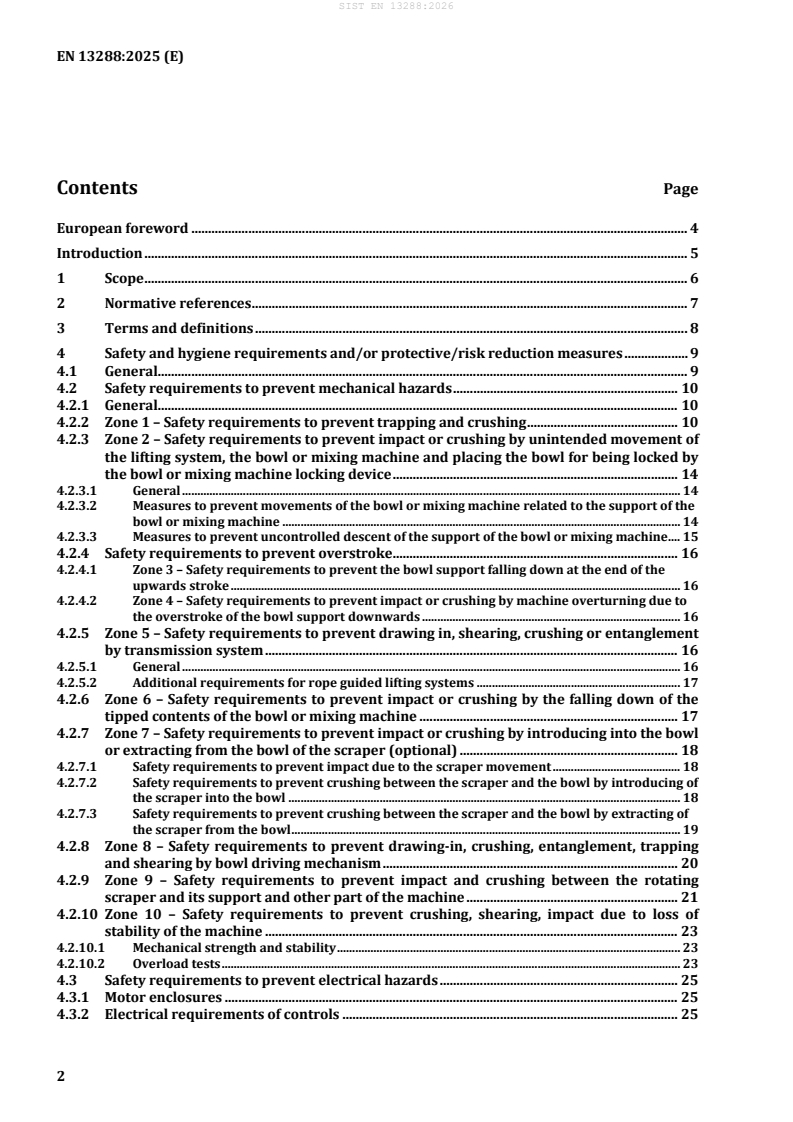
Contents Page
European foreword . 4
Introduction . 5
1 Scope . 6
2 Normative references . 7
3 Terms and definitions . 8
4 Safety and hygiene requirements and/or protective/risk reduction measures . 9
4.1 General. 9
4.2 Safety requirements to prevent mechanical hazards . 10
4.2.1 General. 10
4.2.2 Zone 1 – Safety requirements to prevent trapping and crushing . 10
4.2.3 Zone 2 – Safety requirements to prevent impact or crushing by unintended movement of
the lifting system, the bowl or mixing machine and placing the bowl for being locked by
the bowl or mixing machine locking device . 14
4.2.3.1 General . 14
4.2.3.2 Measures to prevent movements of the bowl or mixing machine related to the support of the
bowl or mixing machine . 14
4.2.3.3 Measures to prevent uncontrolled descent of the support of the bowl or mixing machine. 15
4.2.4 Safety requirements to prevent overstroke . 16
4.2.4.1 Zone 3 – Safety requirements to prevent the bowl support falling down at the end of the
upwards stroke . 16
4.2.4.2 Zone 4 – Safety requirements to prevent impact or crushing by machine overturning due to
the overstroke of the bowl support downwards . 16
4.2.5 Zone 5 – Safety requirements to prevent drawing in, shearing, crushing or entanglement
by transmission system . 16
4.2.5.1 General . 16
4.2.5.2 Additional requirements for rope guided lifting systems . 17
4.2.6 Zone 6 – Safety requirements to prevent impact or crushing by the falling down of the
tipped contents of the bowl or mixing machine . 17
4.2.7 Zone 7 – Safety requirements to prevent impact or crushing by introducing into the bowl
or extracting from the bowl of the scraper (optional) . 18
4.2.7.1 Safety requirements to prevent impact due to the scraper movement . 18
4.2.7.2 Safety requirements to prevent crushing between the scraper and the bowl by introducing of
the scraper into the bowl . 18
4.2.7.3 Safety requirements to prevent crushing between the scraper and the bowl by extracting of
the scraper from the bowl . 19
4.2.8 Zone 8 – Safety requirements to prevent drawing-in, crushing, entanglement, trapping
and shearing by bowl driving mechanism . 20
4.2.9 Zone 9 – Safety requirements to prevent impact and crushing between the rotating
scraper and its support and other part of the machine . 21
4.2.10 Zone 10 – Safety requirements to prevent crushing, shearing, impact due to loss of
stability of the machine . 23
4.2.10.1 Mechanical strength and stability . 23
4.2.10.2 Overload tests . 23
4.3 Safety requirements to prevent electrical hazards . 25
4.3.1 Motor enclosures . 25
4.3.2 Electrical requirements of controls . 25
4.4 Safety requirements for the control system . 25
4.4.1 Emergency stop . 25
4.4.2 Safety requirements to prevent automatic start and/or unexpected start and restart . 25
4.4.3 Safety requirements for machines with remote control . 26
4.5 Hygiene requirements . 26
4.5.1 Food area . 26
4.5.2 Splash area . 27
4.5.3 Non-food area . 27
4.6 Safety requirements with regard to ergonomic principles . 27
4.7 Safety requirements for pneumatic and hydraulic equipment . 27
5 Verification of safety and hygiene requirements and/or protective/risk reduction
measures . 27
6 Information for use . 29
6.1 General . 29
6.2 Signal and warning devices . 29
6.3 Instruction handbook . 31
6.4 Marking . 33
Annex A (informative) Description . 34
Annex B (informative) List of significant hazards . 36
Annex ZA (informative) Relationship between this European Standard and the Essential
Requirements of Directive 2006/42/EC aimed to be covered . 39
Bibliography . 42
European foreword
This document (EN 13288:2025) has been prepared by Technical Committee CEN/TC 153 “Machinery
intended for use with foodstuffs and feed”, the secretariat of which is held by DIN.
This European Standard shall be given the status of a national standard, either by publication of an
identical text or by endorsement, at the latest by May 2026, and conflicting national standards shall be
withdrawn at the latest by May 2026.
Attention is drawn to the possibility that some of the elements of this document may be the subject of
patent rights. CEN shall not be held responsible for identifying any or all such patent rights.
This document supersedes EN 13288:2005+A1:2009.
EN 13288:2005+A1:2009:
— normative references were updated;
— new informative annex relating to updated list of significant hazards;
— all safety requirements were updated;
— list of verification was updated;
— Annex ZA was updated regarding requests of the European Commission on Machinery Directive
(2006/42/EC).
This document has been prepared under a standardization request addressed to CEN by the European
Commission. The Standing Committee of the EFTA States subsequently approves these requests for its
Member States.
For the relationship with EU Legislation, see informative Annex ZA, which is an integral part of this
document.
Any feedback and questions on this document should be directed to the users’ national standards body.
A complete listing of these bodies can be found on the CEN website.
According to the CEN-CENELEC Internal Regulations, the national standards organisations of the
following countries are bound to implement this European Standard: Austria, Belgium, Bulgaria,
Croatia, Cyprus, Czech Republic, Denmark, Estonia, Finland, France, Germany, Greece, Hungary, Iceland,
Ireland, Italy, Latvia, Lithuania, Luxembourg, Malta, Netherlands, Norway, Poland, Portugal, Republic of
North Macedonia, Romania, Serbia, Slovakia, Slovenia, Spain, Sweden, Switzerland, Türkiye and the
United Kingdom.
Introduction
This document is a type-C standard as stated in EN ISO 12100:2010.
This document is of relevance, in particular, for the following stakeholder groups representing the
market players with regard to machinery safety:
— machine manufacturers (small, medium and large enterprises);
— health and safety bodies (regulators, accident prevention organizations, market surveillance etc.).
Others can be affected by the level of machinery safety achieved – with the means of the document – by
the above-mentioned stakeholder groups:
— machine users/employers (small enterprises);
— machine users/employees (e.g. trade unions, organizations for people with special needs);
— service providers, e.g. for maintenance (small, medium and large enterprises).
The above-mentioned stakeholder groups have been given the possibility to participate at the drafting
process of this document. The machinery concerned and the extent to which hazards, hazardous
situations or hazardous events are covered are indicated in the scope of this document.
When requirements of this type-C standard are different from those which are stated in type-A- or type-
B-standards, the requirements of this type-C-standard take precedence over the requirements of the
other standards for machines that have been designed and built according to the requirements of this
type-C-standard.
1 Scope
1.1 This document specifies safety and hygiene requirements for the design and manufacture of bowl
lifting and tilting machines (see description in Annex A) which:
a) are intended to be used in bakeries and pastry shops for discharging masses of dough and/or
ingredients for bakery and/or pastry products all at once or progressively tipping a container or a
machine with non-removable container by lifting and/or tilting it according to a guided path;
b) are intended to be used with manual inlet and outlet of the bowl.
NOTE b) does not refer to machines with integrated mixing machine with non-removable bowl.
The lifting and tilting machines can be equipped with a scraper (optional) for removing the rests of
dough from the bowl after the dough has been discharged.
1.2 The following relevant hazards are not covered by this document:
— hazards due to the mixing process (for dough mixers see EN 453:2014 and for planetary mixers see
EN 454:2014);
— hazards associated to the properties of the content of the bowl (except the mass);
— hazards due to operational stop;
— hazards due to failure of the power supply;
— hazards due to laser radiation;
— hazards due to machinery maintenance;
— hazards due to information and information devices;
— hazards due to materials and products;
— hazards due to lack of design of the machine to facilitate its handling;
— hazards due to lack of stability during transport, assembly and disassembly;
— hazards due to pulleys, drums, wheels, ropes and chains.
This document does not deal with any specific requirements on noise emitted from bowl lifting and
tilting machines as the generated noise does not cause a relevant hazard.
The significant hazards covered by this document are described in Annex B.
1.3 The following machines are excluded from the scope of this document:
a) experimental and testing machines under development by the manufacturer;
b) self-propelled movable bowl lifting and tilting machines;
c) lift trucks;
d) bowl lifting and tilting machines working in automatic production lines where the initiation of the
movement is not due to a human voluntary action;
e) domestic appliances.
In case of a movable machine, this document does not deal with:
— hazards due to transportation of bowls with the machine;
— hazards due to the displacement of the machine on its own wheels;
— powered equipment that may be provided to assist the mobility of mobile bowl lifting and tilting
machine.
When drafting this document, it has been assumed that the machines are not intended to be cleaned
with water and steam jets.
1.4 This document is not applicable to machines which are manufactured before the date of
publication of this document.
2 Normative references
The following documents are referred to in the text in such a way that some or all of their content
constitutes requirements of this document. For dated references, only the edition cited applies. For
undated references, the latest edition of the referenced document (including any amendments) applies.
EN 1672-2:2020, Food processing machinery — Basic concepts — Part 2: Hygiene and cleanability
requirements
EN 60204-1:2018, Safety of machinery — Electrical equipment of machines — Part 1: General
requirements (IEC 60204:2016)
EN 60529:1991, Degrees of protection provided by enclosures (IP code) (IEC 60529:1989)
EN 61310-1:2008, Safety of machinery — Indication, marking and actuation — Part 1: Requirements for
visual, acoustic and tactile signals (IEC 61310-1:2007)
EN ISO 4413:2010, Hydraulic fluid power — General rules and safety requirements for systems and their
components (ISO 4413:2010)
EN ISO 4414:2010, Pneumatic fluid power — General rules and safety requirements for systems and their
components (ISO 4414:2010)
EN ISO 7010:2020, Graphical symbols — Safety colours and safety signs — Registered safety signs
(ISO 7010:2019, Corrected version 2020-06)
EN ISO 7731:2008, Ergonomics — Danger signals for public and work areas — Auditory danger signals
(ISO 7731:2003)
EN ISO 12100:2010, Safety of machinery — General principles for design — Risk assessment and risk
reduction (ISO 12100:2010)
EN ISO 13849-1:2023, Safety of machinery — Safety-related parts of control systems — Part 1: General
principles for design (ISO 13849-1:2023)
EN ISO 13851:2019, Safety of machinery — Two-hand control devices — Principles for design and
selection (ISO 13851:2019)
EN ISO 13854:2019, Safety of machinery — Minimum gaps to avoid crushing of parts of the human body
(ISO 13854:2017)
EN ISO 13855:2010, Safety of machinery — Positioning of safeguards with respect to the approach speeds
of parts of the human body (ISO 13855:2010)
EN ISO 13857:2019, Safety of machinery — Safety distances to prevent hazard zones being reached by
upper and lower limbs (ISO 13857:2019)
EN ISO 14118:2018, Safety of machinery — Prevention of unexpected start-up (ISO 14118:2017)
EN ISO 14119:2013, Safety of machinery — Interlocking devices associated with guards — Principles for
design and selection (ISO 14119:2013)
EN ISO 14120:2015, Safety of machinery — Guards — General requirements for the design and
construction of fixed and movable guards (ISO 14120:2015)
3 Terms and definitions
For the purposes of this document, the terms and definitions given in EN ISO 12100:2010 and the
following apply.
ISO and IEC maintain terminology databases for use in standardization at the following addresses:
— ISO Online browsing platform: available at https://www.iso.org/obp/
— IEC Electropedia: available at https://www.electropedia.org/
3.1
bowl
any container and its trolley (if applicable)
3.2
lifting system
device for the ascending, tilting and descending of the bowl
Note 1 to entry: The lifting and the tilting movement can be done by two different systems.
3.3
bowl locking device
grip and hold device which keeps the bowl in position before lifting and during lifting, tilting and
descending of the bowl
3.4
distance guard
guard which does not completely enclose a hazard zone, but which prevents or reduces access by virtue
of its dimensions and its distance from the hazard zone, for example perimeter fence or tunnel guard
Note 1 to entry: A distance guard can be partially or fully surrounding.
[SOURCE: EN ISO 14120:2015, 3.2.2]
3.5
functional stop
command for stopping a movement according to the process requirements
Note 1 to entry: The functional stop can be automatic (e.g. functional control position device) or manual (e.g.
pushing a button of the control panel)
3.6
mechanical stop
mechanical obstacle (e.g. wedge, spindle, strut, scotch) which prevents by virtue of its own strength a
further movement
3.7
safety-related automatic stop control device
safety-related device providing a stop command
Note 1 to entry: E.g. over travel limit switch
3.8
stopping time
time interval between the actuation of the sensing function and the termination of the hazardous
machine function
3.9
positive mechanical action
action achieved when a moving mechanical component inevitably moves another component along
with it, by means of rigid elements which are connected together mechanically
3.10
scraper
device for scraping out the dough having remained after pouring out the content through the movement
of the bowl and/or the device itself
4 Safety and hygiene requirements and/or protective/risk reduction measures
4.1 General
Machinery shall comply with the safety and hygiene requirements and/or protective measures of this
clause.
In addition, the machine shall be designed according to the principles of EN ISO 12100:2010 for hazards
relevant but not significant which are not dealt with by this document.
When fixed guards, or parts of the machine acting as such, are not permanently fixed, e.g. by welding,
their fixing systems shall remain attached to the guards or to the machinery when the guards are
removed.
A normal stop control device shall be provided; it shall stop all moving parts of the machine, and it shall
initiate a stop of category 0 or 1 according to EN 60204-1:2018, 9.2.2.
4.2 Safety requirements to prevent mechanical hazards
4.2.1 General
Interlocking guards shall comply with EN ISO 14119:2013, Clauses 5 and 6.
Fixed guards shall comply with EN ISO 14120:2015.
4.2.2 Zone 1 – Safety requirements to prevent trapping and crushing
Hazards of trapping and crushing between moving parts of the machine and fixed parts of the building
(floor, walls, columns, ceiling) as well as fixed parts of the machine shall be prevented by one or a
combination of the following:
a) fixed enclosing guards according to EN ISO 14120:2015, 5.2.4, 5.3.7, 5.3.9 and 5.3.10 and/or fixed
distance guards according to EN ISO 14120:2015, 5.2.4, 5.3.7, 5.3.9 and 5.3.10 and
EN ISO 13857:2019, Table 1 and Table B.1.
If there are openings in the guard, they shall comply with EN ISO 13857:2019, Table 3, Table 4 and
Table 6.
The distance between lower side of the guard and the floor shall be ≥ 100 mm and ≤ 120 mm;
b) interlocking guards according to EN ISO 14119:2013, Clauses 5 and 6 and EN ISO 14120:2015, 5.2.4,
5.3.7, 5.3.12 and 5.3.13. The stopping time shall be ≤ 1 s.
If there are openings in the guard, they shall comply with EN ISO 13857:2019, Table 3, Table 4,
Table 6 and Table B.1.
The safety-related parts of the control system and the combination of these parts which performs
the safety function shall meet at least a performance level “c” specified in accordance with
EN ISO 13849-1:2023.
The interlocking guard shall open outside the protected area and their height shall comply with
EN ISO 13857:2019, Table 1.
The distance between lower side of the guard and the floor shall be ≥ 100 mm and ≤ 120 mm.
Opening an interlocking guard shall activate the stop of every moving part of the machine before
the clearance between the interlocking guard and fixed parts exceeds 20 mm;
c) multi-beam AOPD – Active Opto-electronic Protective Device – (light curtain / light grid) as defined
in EN ISO 12100:2010, 3.28.6 and according to EN ISO 13855:2010, with the following exceptions:
1) if a multi-beam AOPD with a detection zone orthogonal to direction of approach to the danger
zone (according to EN ISO 13855:2010, 6.2) is used, all following requirements shall be
applied:
i. the AOPD detection capability shall be ≤ 14 mm;
ii. the distance from AOPD and hazardous zone shall be ≥ 300 mm for the bowl or the mixing
machine and related support, and this distance shall be ≥ 800 mm for the other moving
parts;
iii. the distance between the lower part of AOPD detection zone and the floor shall be
≤ 100 mm;
iv. the height of the AOPD detection zone shall be ≥ 1,6 m;
v. the stopping time shall be ≤ 0,5 s;
vi. the speed of the descending parts shall comply with the values given in Table 1;
2) if a multi-beam AOPD with a detection zone parallel to the direction of approach to the danger
zone (according to EN ISO 13855:2010, 6.3) is used, all following requirements shall be
applied:
i. the AOPD shall be positioned in compliance with the requirement of EN ISO 13855:2010,
depending on its height and detection capacity and on the stopping time of the dangerous
parts after it has been activated;
ii. the AOPD detection height from the floor shall be ≤ 300 mm;
iii. the descending movement through the area below the AOPD detection plane shall be
possible only by operating a hold-to-run control in accordance with 4.2.2 d) or with two-
hand control in accordance with 4.2.2 e);
iv. the stopping time shall be ≤ 0,5 s;
v. the speed of the descending parts shall comply with the values given in Table 1.
The activation of AOPD shall control the stop of every moving part of the machine.
The safety-related parts of the control system and the combination of these parts which
performs the safety function shall meet at least a performance level “c” specified in accordance
with EN ISO 13849-1:2023;
d) hold-to-run control, for descending movement of the bowl; the related control device shall be
located at a minimum distance of 1,5 m from any hazardous zone where the operator could be
struck by the descending bowl or mixing machine.
The release of the hold-to-run control device shall stop every moving part of the machine.
The stopping time shall be ≤ 0,5 s.
The descending speed of the moving parts shall be in compliance with Table 1.
A separate normal stop control device shall be provided according to EN ISO 12100:2010,
6.2.11.8 b); it shall stop all moving parts of the machine, and it shall initiate a stop of category 0 or 1
according to EN 60204-1:2018, 9.2.2;
e) two-hand control in accordance with at least type 2 of EN ISO 13851:2019 for descending
movement.
The two-hand control shall be located at a minimum distance of 0,5 m from any hazardous zone
where the operator could be struck by the descending bowl or mixing machine.
The release of the two-hand control device shall stop every moving part of the machine.
The stopping time shall be ≤ 0,5 s.
The descending speed of the moving parts shall be in compliance with the Table 1.
In case of two-hand control or hold-to-run control:
— the movement of the bowl or mixing machine, including the discharge area shall be completely
visible from the position where these control devices are located. A zone is completely visible if it
does not even partially fall within a non-visible zone (see Figure 1).
— if there are zones around the machine which are non-visible (see Figure 1) from the position where
these control devices are located, due to the machine itself, means shall be provided to make them
visible (e.g. mirror, camera, transparent guards or impeding devices).
— if hold-to-run control device or two-hand-control devices are also used for controlling other
movements, functions, etc. (i.e. for controlling the entering movement of the scraper into the bowl),
the control circuit shall be independent and which one to use shall be decided by means of a
selection system. If the selection is carried out with control devices which could be operated
unintentionally (e.g. touch screen, membrane panel) it shall be done by pushing a defined key
sequence, or in case of a single key by pushing it for at least 0,5 s. The selected operating mode shall
be clearly signalized close to the control devices by one of the following:
— the turning on of a white lamp;
— a label which identifies the position of the selector;
— a wording indicating the selected operation mode (e.g. by means of a label directly on the
position of an electromechanical selector, a wording on a screen etc.).
A zone is considered as non-visible from the position where these control devices are located when (see
Figure 1):
— it is behind non-transparent parts;
— (L) > 400 mm;
— non-transparent parts are higher than 1,3 m from the floor;
— it is located at a distance (D) ≤ 1,2 m from any hazardous zone.
Key
a horizontal widest section of the obstacle watching from W
b hazard zone
c non-visible zone
W projection of the centre of the control board on the horizontal plane of a
P1, P2 outermost points of the wider horizontal section of the obstacle visible from W
A1 straight line between W and P1
A2 straight line between W and P2
α angle between A1 and A2
K bisecting line of α
K1 straight line parallel to B passing through P1
K2 straight line parallel to B passing through P2
L shortest distance between K1 and K2
D shortest distance between the non-visible zone and b
Figure 1 — Example of non-visible area
Table 1 — Descending speed of the moving parts related to their height from the floor
Height of the lower descending part from the Vertical component of the descending speed
floor
H
(m/s)
(m)
H > 2,7 No requirement
0,5 < H ≤ 2,7 ≤ 0,35
H ≤ 0,5 ≤ 0,2
NOTE This table is only applicable to 4.2.2 c) to e).
The manufacturer shall provide information about:
— the maximum overall dimensions of the volume occupied by the machine considering the
movements of its parts including the bowl or mixing machine, see 6.3 c);
— the distances to respect between the maximum volume occupied by the machine and fixed parts of
the place where the machine will be used, see 6.3 d).
A warning for the hazard due to the descending bowl or mixing machine shall provided according to 6.2.
4.2.3 Zone 2 – Safety requirements to prevent impact or crushing by unintended movement of
the lifting system, the bowl or mixing machine and placing the bowl for being locked by the bowl
or mixing machine locking device
4.2.3.1 General
Uncontrolled movement of the bowl or mixing machine related to the support of the bowl or mixing
machine shall be prevented; this shall be carried out complying with the requirements given in 4.2.3.2.
Uncontrolled descent of the support of the bowl or mixing machine shall be prevented; this shall be
carried out complying with the requirements given in 4.2.3.3.
4.2.3.2 Measures to prevent movements of the bowl or mixing machine related to the support of
the bowl or mixing machine
All the following measures shall be provided:
a) a bowl locking device with positive mechanical action shall be provided (see EN ISO 12100:2010,
6.2.5). It shall be automatically detected that the bowl or mixing machine is in the right position for
being locked and that it is locked. If it is not in the right position and not locked, it shall not be
possible to start the machine. Unlocking shall only be possible in the lowest position of the bowl or
mixing machine. A movement for hooking the bowl or mixing machine ≤ 200 mm is permitted.
If the bowl or mixing machine is automatically locked by placing it in the machine, the following
requirements shall be applied:
1) no vertical movement of the bowl or mixing machine shall be possible before being locked;
2) in the instruction handbook shall be provided a warning that no other person than the operator
shall be present within 2 m around the bowl or mixing machine, see 6.3 bb);
3) the safety-related parts of the control system and the combination of these parts which
performs the safety function shall meet at least a performance level “d” specified in accordance
with EN ISO 13849-1:2023;
b) the bowl or mixing machine support shall be mechanically connected with positive mechanical
action (see 3.9) with the motion transmission parts of the machine or it shall be detected that the
load is continuously resting on the part which sustains the load during the descending movement
and the detection system shall control the stop of the movement as soon as the force of the load on
the part which sustains is 10 % lower than the one generated by the gravity force due to the mass of
the bowl or mixing machine support.
After the force detection device has controlled the stop, a further descending movement ≤ 200 mm
of the part which sustains the bowl or mixing machine, and the related supports is permitted.
No performance level is required for the force/pressure detecting and the stop controlling system.
The manufacturer shall provide in the instructions detailed information about the procedure for
checking that the detecting and stop controlling system functions correctly and the frequency of the
checks to be carried out (at least weekly), see 6.3, dd);
c) the nominal pressure declared by the manufacturer of the pneumatic and hydraulic components
shall be ≥ 1,6 times the maximum operation pressure as declared by the manufacturer of the
machine.
4.2.3.3 Measures to prevent uncontrolled descent of the support of the bowl or mixing machine
4.2.3.3.1 Ascending and/or descending movement driven by mechanical devices
A mechanical system shall be provided to prevent the falling down of the support of the bowl or mixing
machine. It shall comply with all following requirements without any permanent deformation:
a) it shall withstand the force of 1,5 times the weight of the support with the bowl or mixing machine
completely filled with water;
b) it shall withstand 1,25 times the energy of a falling stroke of 500 mm of the support with the bowl
or mixing machine completely filled with water;
c) it shall maintain the load in the position it is, in the event of a rupture of a mechanical component; a
downstroke ≤ 100 mm is allowed before the movement stops.
4.2.3.3.2 Ascending and/or descending movement driven by oleo-hydraulic or pneumatic energy
A relief valve shall be provided to prevent the escape of oil from the actuator cylinder chamber in which
the oleo-hydraulic pressure acts to provide the pushing force for the upward motion and the pressure
for braking the downward motion (e.g. by passing oil through a diaphragm).
The relief valve shall meet all the following requirements:
a) it shall withstand an oil pressure of at least 1,5 times the constant pressure generated by the
resulting load bearing on the cylinder;
b) it shall withstand an oil pressure of at least 1,25 times the pressure shock generated by the energy
due to the falling down of the load from a height = 500 mm;
c) it shall maintain the load bearing on the cylinder in the position it is, in the event of a rupture of a
component in the oleo-hydraulic circuit; a downstroke ≤ 100 mm is allowed before the movement
stops and a displacement ≤ 1 mm/h thereafter;
d) it shall be connected to the oleo-hydraulic cylinder by rigid metal piping or shall be installed
attached to the cylinder; neither flexible piping nor non-metal rigid piping is allowed for connecting
the relief valve to the cylinder.
The hydraulic or pneumatic cylinder and the rigid metal piping connecting the relief valve, and the
cylinder shall withstand the pressure given in a) and the pressure shock given in b).
4.2.4 Safety requirements to prevent overstroke
4.2.4.1 Zone 3 – Safety requirements to prevent the bowl support falling down at the end of the
upwards stroke
The bowl lifting and tilting machine shall be equipped with:
— an automatic control device which stops the movement automatically at the end of the tilting
stroke;
— a safety-related control device which stops the movement automatically in case the functional stop
would not operate; the stopping time shall be ≤ 1 s;
— a mechanical stop designed for withstanding 1,5 times the impact energy of the moving mass at
maximum speed without undergoing any permanent deformation. It shall be placed after the safety
related stop control device in the direction of the tilting movement.
The safety related parts of the control system and the combination of these parts which performs the
safety function shall meet at least a performance level “c” specified in accordance with
EN ISO 13849-1:2023.
4.2.4.2 Zone 4 – Safety requirements to prevent impact or crushing by machine overturning due
to the overstroke of the bowl support downwards
To prevent the overturning of the machine, in case it is not fixed to fixing points (e.g. the floor), a safety-
related automatic stop control device shall be provided.
The stopping time shall be less than or equal to the time after which the overturning movement would
begin with refer to the maximum speed of the descending movement.
The safety-related automatic stop control device shall not be used as a functional stop.
The safety related parts of the control system and the combination of these parts which performs the
safety function shall meet at least a performance level “c” specified in accordance with
EN ISO 13849-1:2023.
4.2.5 Zone 5 – Safety requirements to prevent drawing in, shearing, crushing or entanglement by
transmission system
4.2.5.1 General
Access to the transmission system shall be prevented by one of the following measures or a
combination of them:
— fixed enclosing guards according to EN ISO 14120:2015, 5.2.4, 5.3.7, 5.3.9 and 5.3.10;
— distance guards according to EN ISO 13857:2019, Table 2, and EN ISO 14120:2015, 5.2.4, 5.3.7, 5.3.9
and 5.3.10.
If there are openings in the guard, they shall comply with EN ISO 13857:2019, Table 3, Table 4 and
Table 6.
4.2.5.2 Additional requirements for rope guided lifting systems
The diameter of the drum on which a rope is wound up shall be at least the biggest between 25 times
the diameter of the rope and 300 times the diameter or thickness of a single wire which composes the
rope.
For the return pulleys, the diameter shall be not less than 20 times the diameter of the ropes or
250 times the diameter of the wire component.
4.2.6 Zone 6 – Safety requirements to prevent impact or crushing by the falling down of the
tipped contents of the bowl or mixing machine
An acoustic and visual warning signal shall be provided, and they shall comply with the following
requirements:
— the signals shall be intermittent;
— the signals shall start at the latest 3 seconds before the tilting movement begins and last at least
5 seconds;
— the acoustic warning signal shall have an emission sound pressure level ≥ 80 dB(A) with the volume
to be adapted adequately to comply with the requirements of EN ISO 7731:2008. The emission
sound pressure level of the acoustic warning signal shall be measured at 1,5 m above the floor and
on the circumference of the circle defining the risk area;
NOTE The emission sound pressure level value is based on experience of machinery bakery manufacturer.
— the warning visual signal shall:
— be a red lighting;
— be placed at a height ≥ 1,5 m and ≤ 2,5 m;
— ensure a lighting level ≥ 5 lux at a height = 1,5 m from the floor and at a distance = 3 m from the
hazard zone.
If the tilting movement is intended to be carried out step by step, the following additional requirements
shall apply:
— if the step-by-step tilting movement is done automatically (e.g. by executing a process program) the
signals shall operate for every step of the movement;
— If the step-by-step tilting movement is controlled directly by the operator (e.g. with hold-to-run
control, two hands control), the signals shall operate at least for the first step.
The control devices shall be positioned in such way that the visibility of the volume through which the
dough moves falling down is safeguarded for the operator.
The instruction handbook (6.3 h)) shall specify that if the user puts anything between the control panel
and the dough discharge zone which reduces the visibility, he has to provide further measures for
ensuring the visibility of the volume through which the dough moves falling down.
A warning for the hazard due to falling down of the tipped contents of the bowl or mixing machine shall
be provided according to 6.2.
4.2.7 Zone 7 – Safety requirements to prevent impact or crushing by introducing into the bowl or
extracting from the bowl of the scraper (optional)
4.2.7.1 Safety requirements to prevent impact due to the scraper movement
It is possible to consider the movement of the scraper safe by design only if the vertical distance
between the hazard zone and the floor or any surface on which the person could stand is > 2 700 mm.
For reducing the risk of impact by introducing the scraper into the bowl and extracting the scraper from
the bowl by design, the linear relative speed between the scraper and the bowl shall be ≤ 200 mm/s.
4.2.7.2 Safety requirements to prevent crushing between the scraper and the bowl by
introducing of the scraper into the bowl
It is possible to consider the movement of the scraper safe b
...