

EN 13870:2005
(Main)Food processing machinery - Chop cutting machines - Safety and hygiene requirements
- Abstract
This document covers chop cutting machines and accessories.
The extent, to which hazards are covered, is indicated in this document.
1.1 This document specifies requirements for design and manufacture of chop cutting machines.
The machines covered by this document are used for continuous portioning of fresh, smoked or frozen meat with and without bones or of similar products by separation by means of a blade.
This document deals with all significant hazards, hazardous situations and events relevant to machines, appliances and machinery, when they are used as intended and under the conditions foreseen by the manufacturer (see Clause 4).
This document deals with the hazards which can arise during commissioning, operation, maintenance and de-commissioning of the machine.
The document is not dealing with the specific hazards of loading devices.
This document is not applicable to chop cutting machines which are manufactured before the date of publication of this document by CEN.
1.2 This document covers the following types of machines:
- chop cutting machines with a discharge chute (Figure 1);
- chop cutting machines with a discharge trough (Figure 2).
- Status
- Withdrawn
- Publication Date
- 22-Feb-2005
- Withdrawal Date
- 22-Jun-2010
- Technical Committee
- CEN/TC 153 - Food processing machinery - Safety and hygiene specifications
- Drafting Committee
- CEN/TC 153/WG 2 - Meat processing machinery
- Current Stage
- 9960 - Withdrawal effective - Withdrawal
- Start Date
- 23-Jun-2010
- Completion Date
- 23-Jun-2010
- Directive
- 98/37/EC - MachineryOJ Ref: C, C 336 OJ Date: 31-Dec-2005

Relations
- Effective Date
- 19-Jan-2023
Get Certified
Connect with accredited certification bodies for this standard

BSI Group
BSI (British Standards Institution) is the business standards company that helps organizations make excellence a habit.

Bureau Veritas
Bureau Veritas is a world leader in laboratory testing, inspection and certification services.

DNV
DNV is an independent assurance and risk management provider.
Sponsored listings
Frequently Asked Questions
EN 13870:2005 is a standard published by the European Committee for Standardization (CEN). Its full title is "Food processing machinery - Chop cutting machines - Safety and hygiene requirements". This standard covers: This document covers chop cutting machines and accessories. The extent, to which hazards are covered, is indicated in this document. 1.1 This document specifies requirements for design and manufacture of chop cutting machines. The machines covered by this document are used for continuous portioning of fresh, smoked or frozen meat with and without bones or of similar products by separation by means of a blade. This document deals with all significant hazards, hazardous situations and events relevant to machines, appliances and machinery, when they are used as intended and under the conditions foreseen by the manufacturer (see Clause 4). This document deals with the hazards which can arise during commissioning, operation, maintenance and de-commissioning of the machine. The document is not dealing with the specific hazards of loading devices. This document is not applicable to chop cutting machines which are manufactured before the date of publication of this document by CEN. 1.2 This document covers the following types of machines: - chop cutting machines with a discharge chute (Figure 1); - chop cutting machines with a discharge trough (Figure 2).
This document covers chop cutting machines and accessories. The extent, to which hazards are covered, is indicated in this document. 1.1 This document specifies requirements for design and manufacture of chop cutting machines. The machines covered by this document are used for continuous portioning of fresh, smoked or frozen meat with and without bones or of similar products by separation by means of a blade. This document deals with all significant hazards, hazardous situations and events relevant to machines, appliances and machinery, when they are used as intended and under the conditions foreseen by the manufacturer (see Clause 4). This document deals with the hazards which can arise during commissioning, operation, maintenance and de-commissioning of the machine. The document is not dealing with the specific hazards of loading devices. This document is not applicable to chop cutting machines which are manufactured before the date of publication of this document by CEN. 1.2 This document covers the following types of machines: - chop cutting machines with a discharge chute (Figure 1); - chop cutting machines with a discharge trough (Figure 2).
EN 13870:2005 is classified under the following ICS (International Classification for Standards) categories: 67.260 - Plants and equipment for the food industry. The ICS classification helps identify the subject area and facilitates finding related standards.
EN 13870:2005 has the following relationships with other standards: It is inter standard links to EN 13870:2005+A1:2010. Understanding these relationships helps ensure you are using the most current and applicable version of the standard.
EN 13870:2005 is associated with the following European legislation: EU Directives/Regulations: 98/37/EC; Standardization Mandates: M/079. When a standard is cited in the Official Journal of the European Union, products manufactured in conformity with it benefit from a presumption of conformity with the essential requirements of the corresponding EU directive or regulation.
EN 13870:2005 is available in PDF format for immediate download after purchase. The document can be added to your cart and obtained through the secure checkout process. Digital delivery ensures instant access to the complete standard document.
Standards Content (Sample)
SLOVENSKI STANDARD
01-maj-2005
Strojna predelava hrane - Stroji za razrezovanje - Varnostne in higienske zahteve
Food processing machinery - Chop cutting machines - Safety and hygiene requirements
Nahrungsmittelmaschinen - Kotelettschneidemaschinen - Sicherheits- und
Hygieneanforderungen
Machines pour les produits alimentaires - Machines a couper les côteletts - Prescriptions
relatives a la sécurité et a l'hygiene
Ta slovenski standard je istoveten z: EN 13870:2005
ICS:
67.260 Tovarne in oprema za Plants and equipment for the
živilsko industrijo food industry
2003-01.Slovenski inštitut za standardizacijo. Razmnoževanje celote ali delov tega standarda ni dovoljeno.
EUROPEAN STANDARD
EN 13870
NORME EUROPÉENNE
EUROPÄISCHE NORM
February 2005
ICS 67.260
English version
Food processing machinery - Chop cutting machines - Safety
and hygiene requirements
Machines pour les produits alimentaires - Machines à Nahrungsmittelmaschinen - Kotelettschneidemaschinen -
couper des côteletts - Prescriptions relatives à la sécurité Sicherheits- und Hygieneanforderungen
et à l'hygiène
This European Standard was approved by CEN on 14 October 2004.
CEN members are bound to comply with the CEN/CENELEC Internal Regulations which stipulate the conditions for giving this European
Standard the status of a national standard without any alteration. Up-to-date lists and bibliographical references concerning such national
standards may be obtained on application to the Central Secretariat or to any CEN member.
This European Standard exists in three official versions (English, French, German). A version in any other language made by translation
under the responsibility of a CEN member into its own language and notified to the Central Secretariat has the same status as the official
versions.
CEN members are the national standards bodies of Austria, Belgium, Cyprus, Czech Republic, Denmark, Estonia, Finland, France,
Germany, Greece, Hungary, Iceland, Ireland, Italy, Latvia, Lithuania, Luxembourg, Malta, Netherlands, Norway, Poland, Portugal, Slovakia,
Slovenia, Spain, Sweden, Switzerland and United Kingdom.
EUROPEAN COMMITTEE FOR STANDARDIZATION
COMITÉ EUROPÉEN DE NORMALISATION
EUROPÄISCHES KOMITEE FÜR NORMUNG
Management Centre: rue de Stassart, 36 B-1050 Brussels
© 2005 CEN All rights of exploitation in any form and by any means reserved Ref. No. EN 13870:2005: E
worldwide for CEN national Members.
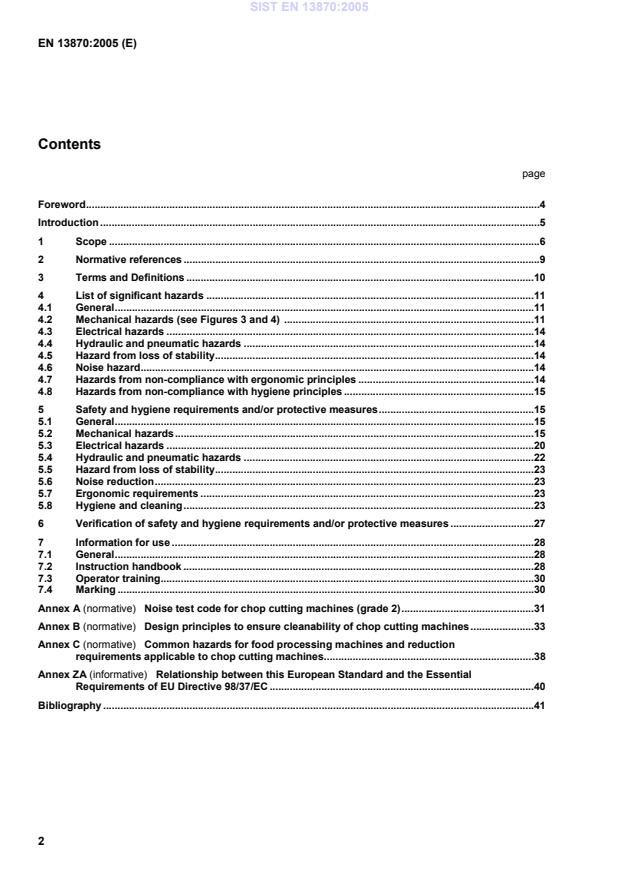
Contents
page
Foreword.4
Introduction .5
1 Scope.6
2 Normative references.9
3 Terms and Definitions .10
4 List of significant hazards .11
4.1 General.11
4.2 Mechanical hazards (see Figures 3 and 4) .11
4.3 Electrical hazards.14
4.4 Hydraulic and pneumatic hazards .14
4.5 Hazard from loss of stability.14
4.6 Noise hazard.14
4.7 Hazards from non-compliance with ergonomic principles .14
4.8 Hazards from non-compliance with hygiene principles .15
5 Safety and hygiene requirements and/or protective measures.15
5.1 General.15
5.2 Mechanical hazards.15
5.3 Electrical hazards.20
5.4 Hydraulic and pneumatic hazards .22
5.5 Hazard from loss of stability.23
5.6 Noise reduction.23
5.7 Ergonomic requirements.23
5.8 Hygiene and cleaning.23
6 Verification of safety and hygiene requirements and/or protective measures .27
7 Information for use .28
7.1 General.28
7.2 Instruction handbook.28
7.3 Operator training.30
7.4 Marking.30
Annex A (normative) Noise test code for chop cutting machines (grade 2).31
Annex B (normative) Design principles to ensure cleanability of chop cutting machines.33
Annex C (normative) Common hazards for food processing machines and reduction
requirements applicable to chop cutting machines.38
Annex ZA (informative) Relationship between this European Standard and the Essential
Requirements of EU Directive 98/37/EC .40
Bibliography .41
Figures
Figure 1 — Chop cutting machine with discharge chute.7
Figure 2 — Chop cutting machine with discharge trough .8
Figure 3 — Danger zones on chop cutting machine with discharge chute .12
Figure 4 — Danger zones on chop cutting machine with discharge trough.13
Figure 5 —Chop cutting machines – safety dimensions .16
Figure 6 — Chop cutting machine with discharge chute – Safety measures.18
Figure 7 — Chop cutting machine with discharge chute – Safety distances .18
Figure 8 — ON/OFF switch with hood.22
Figure 9 — Hygiene areas on chop cutting machine with discharge chute .25
Figure B.1 — Smooth surfaces - Food area.33
Figure B.2 — Angles and radii in food area .34
Figure B.3 — Angle in food area .35
Figure B.4 — Adjoining surfaces in food area.35
Figure B.5 — Admissible joining elements - head profiles.37
Figure B.6 — Dimensional examples .37
Foreword
This document (EN 13870:2005) has been prepared by Technical Committee CEN/TC 153 “Food processing
machinery — Safety and hygiene requirements”, the secretariat of which is held by DIN.
This European Standard shall be given the status of a national standard, either by publication of an identical
text or by endorsement, at the latest by August 2005, and conflicting national standards shall be withdrawn at
the latest by August 2005.
This document has been prepared under a mandate given to CEN by the European Commission and the
European Free Trade Association, and supports essential requirements of EU Directive(s).
For relationship with EU Directive(s), see informative Annex ZA, which is an integral part of this document.
According to the CEN/CENELEC Internal Regulations, the national standards organizations of the following
countries are bound to implement this European Standard: Austria, Belgium, Czech Republic, Cyprus,
Denmark, Estonia, Finland, France, Germany, Greece, Hungary, Iceland, Ireland, Italy, Latvia, Lithuania,
Luxembourg, Malta, Netherlands, Norway, Poland, Portugal, Slovakia, Slovenia, Spain, Sweden, Switzerland
and the United Kingdom.
Introduction
This document is a type C standard as stated in EN ISO 12100-1.
The machinery concerned and the extent to which hazards, hazardous situations and events are covered are
indicated in the scope of this document.
When provisions of this type C standard are different from those which are stated in type A or B standards, the
provisions of this type C standard take precedence over the provisions of the other standards, for machines
that have been designed and built according to the provisions of this type C standard.
1 Scope
This document covers chop cutting machines and accessories.
The extent, to which hazards are covered, is indicated in this document.
1.1 This document specifies requirements for design and manufacture of chop cutting machines.
The machines covered by this document are used for continuous portioning of fresh, smoked or frozen meat
with and without bones or of similar products by separation by means of a blade.
This document deals with all significant hazards, hazardous situations and events relevant to machines,
appliances and machinery, when they are used as intended and under the conditions foreseen by the
manufacturer (see Clause 4).
This document deals with the hazards which can arise during commissioning, operation, maintenance and de-
commissioning of the machine.
The document is not dealing with the specific hazards of loading devices.
This document is not applicable to chop cutting machines which are manufactured before the date of
publication of this document by CEN.
1.2 This document covers the following types of machines:
chop cutting machines with a discharge chute (Figure 1);
chop cutting machines with a discharge trough (Figure 2).
Key
a Blade housing/cutting chamber f Conveyor bin, container for completing the enclosing guard
b Discharge chute g Feed trough/cutting trough
c Material holder/forward feed device h Active range of the blade
d Cover over feed trough/cutting trough i Cutting zone
e Frame/housing k Collector bin
Figure 1 — Chop cutting machine with discharge chute
Key
a Blade housing/cutting chamber f Cover over discharge trough
b Discharge trough g Feed trough
c Material holder/forward feed device h Active range of blade
d Cover over feed trough/material trough i Cutting zone
e Frame/housing k Collector bin
m Outfeed
Figure 2 — Chop cutting machine with discharge trough
1.3 Machine construction
Chop cutting machines are constructed of a machine frame, a feed trough with an automatic forward feed
device, a blade housing, a blade, a removal unit, associated drives, electrical, hydraulic and pneumatic
components, depending on machine type.
Chop cutting machines in the scope of this document may be equipped with:
a feed conveyor belt in longitudinal- and lateral axis;
a removal conveyor belt;
a transfer trolley for the blade.
1.4 Intended use
The intended use (as defined in EN 12100-1:2003, 3.22) of chop cutting machines as dealt with in this
document is described in 1.1.
The material to be cut is fed either manually or by means of a loading device into the feed trough. The
material to be cut is fed to the blade by means of the automatic forward feed device. The product falls via the
discharge chute into a trolley or into a discharge trough which may be equipped with a removal conveyor belt.
Although it should be advised against, the standard, taking into account practice, deals with the hazards due
to cleaning with pressurised water.
2 Normative references
The following referenced documents are indispensable for the application of this document. For dated
references, only the edition cited applies. For undated references, the latest edition of the referenced
document (including any amendments) applies.
EN 294:1992, Safety of machinery — Safety distances to prevent danger zones being reached by the upper
limbs.
EN 614-1, Safety of machinery — Ergonomic principles for design — Part 1: Terms and general principles.
EN 953:1997, Safety of machinery — Guards — General requirements for design and construction of fixed
and movable guards.
EN 954-1, Safety of machinery — Safety related parts of control systems — Part 1: General principles for
design.
EN 982, Safety of machinery — Safety requirements for fluid power systems and components — Hydraulics.
EN 983, Safety of machinery — Safety requirements for fluid power systems and components — Pneumatics.
EN 1005-1, Safety of machinery — Human physical performance — Part 1: Terms and definitions.
EN 1005-2, Safety of machinery — Human physical performance — Part 2: Manual handling of machinery
and component parts of machinery.
EN 1005-3, Safety of machinery — Human physical performance — Part 3: Recommended force limits for
machine operation.
EN 1088:1995, Safety of machinery — Interlocking devices associated with guards — General principles for
design and selection.
EN 1672-2:1997, Food processing machinery — Basic concepts — Part 2: Hygiene requirements.
EN 60204-1:1997, Safety of machinery — Electrical equipment of machinery — Part 1: General requirements
(IEC 60204-1:1997).
EN 60529, Degrees of protection provided by enclosures (IP Code) (IEC 60529:1989).
EN ISO 3744:1995, Acoustics — Determination of sound power levels of noise sources using sound
pressure — Engineering method in an essentially free field over a reflecting plane (ISO 3744:1994).
EN ISO 4871, Acoustics — Declaration and verification of noise emission values of machinery and equipment
(ISO 4871:1996).
EN ISO 11201:1995, Acoustics — Noise emitted by machinery and equipment — Measurement of emission
sound pressure levels at a work station and at other specified positions — Engineering method in an
essentially free field over a reflecting plane (ISO 11201:1995).
EN ISO 11688-1, Acoustics — Recommended practice for the design of low-noise machinery and equipment
— Part 1: Planning (ISO/TR 11688-1:1995).
EN ISO 12100-1:2003, Safety of machinery — Basic concepts, general principles for design — Part 1: Basic
terminology, methodology (ISO 12100-1:2003).
EN ISO 12100-2:2003, Safety of machinery — Basic concepts, general principles for design — Part 2:
Technical principles (ISO 12100-2:2003).
3 Terms and Definitions
For the purposes of this document, the terms and definitions given in EN ISO 12100-1:2003 and given in the
documents which are listed in Clause 2 and the following apply.
3.1
removal conveyor belt
transport belt for removing the product
3.2
discharge trough
trough for discharging the product
3.3
discharge chute
slanted plane for removing the product
3.4
discharge protection
guard at the discharge side
3.5
feed trough/cutting trough
trough for feeding the material to be cut (before cutting)
3.6
wheeled container
wheel-mounted unit for carrying products
3.7
frame/housing
basic construction for carrying machine components
3.8
blade housing
part of the housing for accommodation of the sickle blade
3.9
door of the blade housing
movable device with safety function at the blade housing
3.10
product
processed material
3.11
material to be cut
material to be processed before cutting
3.12
cutting zone
zone for cutting the product
3.13
protective gloves
gloves of cut resistant and nonslip material
3.14
protection cover
movable device with safety function at the infeed/outfeed trough
3.15
collector bin
container for holding residues of the material to be cut
3.16
feed conveyor belt
conveyor belt for feeding the machine with material to be cut
3.17
forward feed device with material holder
conveyor unit for feeding the material to be cut into the cutting chamber
4 List of significant hazards
4.1 General
This clause and Annex C contain the hazards and hazardous situations which may arise during operation of
chop cutting machines as far as they are dealt with in this document, identified by a risk assessment
significant for this type of machinery and which require action identified to eliminate or reduce risk.
Before using this document it is important to carry out a risk assessment of the chop cutting machine to check
that it has the hazards identified in this clause.
1)
4.2 Mechanical hazards (see Figures 3 and 4)
4.2.1 Chop cutting machines with discharge chute (see Figure 3)
1) Letters for the machine parts refer to Figures 1 and 2.
Key
1 Zone 1 5 Zone 5
2 Zone 2 6 Zone 6
4 Zone 4
Figure 3 — Danger zones on chop cutting machine with discharge chute
Zone 1
Returning forward feed device (c) in feed through (g).
Crushing or shearing hazard to fingers or hand.
Zone 2
Blade (h) in cutting chamber (i), access from feed trough (g).
Severing hazard to fingers or hand.
Zone 4
Blade (h) in cutting chamber (i), access via discharge chute (b).
Severing hazard to fingers or hand.
Zone 5
Blade (h) in blade housing (a).
Severing hazard to fingers or hand.
Breakage of blade/detachment of blade mounting.
Hazard caused by ejected parts.
Stationary blade during installation and removal and during cleaning.
Cutting hazard.
Zone 6
Blade (h) in the area of the collector bin (k).
Cutting or severing hazard to fingers or hand.
Zone 7
Unintentional slamming shut of closing and intentional closing of machine parts (d).
Crushing hazard to fingers or hand.
4.2.2 Chop cutting machines with discharge trough (see Figure 4)
Key
1 Zone 1 5 Zone 5
2 Zone 2 7 Zone 7
3 Zone 3
Figure 4 — Danger zones on chop cutting machine with discharge trough
Zone 1
Returning forward feed device (c) in feed trough (g).
Crushing or shearing hazard to fingers or hand.
Zone 2
Blade (h) in cutting chamber (a), access from feed trough (g).
Severing hazard to fingers or hand.
Zone 3
Blade (h) in cutting chamber (i), access via discharge trough (b).
Severing hazard to fingers or hand.
Zone 5
Blade (h) in blade housing (a).
Severing hazard to fingers or hand.
Breakage of blade or detachment of blade mounting.
Hazard caused by ejected parts.
Stationary blade during installation and removal and during cleaning.
Cutting hazard.
Zone 6
Blade (h) in the area of the collector bin (k).
Cutting or severing hazard to fingers or hand.
Zone 7
Unintentional slamming shut of closing and intentional closing of machine parts (d and f).
Crushing hazard to fingers or hand.
4.3 Electrical hazards
4.3.1 Direct or indirect electrical contact with live components
Hazard from contact with electricity.
4.3.2 Electrical components with insufficient safety protection
Hazard from mechanical impact on the body due to malfunction.
4.4 Hydraulic and pneumatic hazards
Hazard to operator from contact with hydraulic fluid.
Contamination of the product by hydraulic fluid.
Hazard to the body by mechanical injury due to malfunction.
4.5 Hazard from loss of stability
Impact or crushing hazard if machine topples over.
4.6 Noise hazard
Chop cutting machines generate noise which can result in hearing damage, in accidents due to interference
with speech communication and interference with the perception of acoustic signals.
4.7 Hazards from non-compliance with ergonomic principles
Unhealthy posture or excessive physical effort.
Inadequate consideration of human anatomy in designing the machine.
Hazard of physical damage to the body.
4.8 Hazards from non-compliance with hygiene principles
Microbial causes
Spoilage of foodstuff
Hazard to health of the consumer/operator from food poisoning.
Chemical causes
Contamination of foodstuff from residues of cleaning and disinfecting agents.
Hazard to health of the consumer from acid burns.
5 Safety and hygiene requirements and/or protective measures
5.1 General
Chop cutting machines shall comply with the safety requirements and/or protective measures of this clause
and Annex C of this document. In addition, they shall be designed according to the principles of
EN ISO 12100 for hazards relevant but not significant, which are not dealt with by this document (e. g. sharp
edges).
NOTE For hazards which are to be reduced by the application of a B-standard such as EN 294, EN 953, EN 1672-2,
EN 60204-1 etc., the manufacturer should carry out a risk assessment to establish the requirements of that standard
which are to be applied. This specific risk assessment is part of the general risk assessment of the machine.
Where the means of reducing the risk is by the physical arrangement or positioning of the machine the
manufacturer shall include in the Information for use a reference to these means, and to any limiting value of
the requirement, and, if appropriate, to the means of verification.
Where the means of reducing the risk is by a safe system of work, the manufacturer shall include in the
Information for use details of the system and of the elements of training required by the operating personnel.
5.2 Mechanical hazards
5.2.1 General
Chop cutting machines shall be designed and constructed in accordance with Annex C and the conditions
mentioned below.
The guards shall comply with EN 953.
Unless otherwise stipulated in other sub-clauses, the interlocking systems of guards shall comply with 4.2.1 of
EN 1088:1995 (interlocking without guard locking) and the safety related components of the control system
shall comply with at least category 1 of EN 954-1.
The interlocking devices shall be incorporated in the machine housing and correspond to 5.7 of EN 1088:1995.
NOTE This is required to:
fulfil hygienic requirements;
protect against mechanical damages;
protect against the effects of cleaning and disinfecting materials;
protect against the effects of cleaning fluids (water);
protect against tampering by simple methods.
5.2.2 Measures on Chop cutting machines with discharge chute
Zone 1 Access between returning forward feed device, drive mechanism and housing
As far as crushing hazards cannot be eliminated by design, the access shall be prevented by guarding.
Taking into account the specific technical constraints (high loading frequencies), the guard(cover), if movable,
can be designed as a control guard according to EN ISO 12100-1:2003, 3.25.
If it is necessary to dismantle guards frequently for changing the process or for cleaning, they shall be
movable and interlocked.
Zone 2 Access to the blade in cutting area of feed trough
Access into the danger zones in the cutting area shall be prevented by a cover over the feed trough (see 5.2).
Movable guards shall be interlocked with dangerous movements.
For requirements relating to the interlocking system of the cover with the sickle blade drive, see 5.2.4.
The movable cover may also be designed as a control guard according to EN 292-1:1991, 3.22.6.
Nevertheless the machine shall have only one control guard (see also zone 1)
If the material holder and forward feed device do not prevent access, or if the end of the protective device
opposite the blade is open, the length L of the feed trough and the cover shall be at least 850 mm according
to EN 294:1992, Table 6 (see Figure 5).
L ≥ 850 mm safety distance if the material trough is not closed at the end
1,
Figure 5 —Chop cutting machines – safety dimensions
Zone 4 Access to blade in cutting area via discharge chute
Access shall be prevented at least by one of the following possibilities:
cutting chamber door, without container (see Figure 7);
combination of cutting chamber door and container;
combination of cutting chamber door and transport trolley (see Figure 6).
The cutting chamber door shall be interlocked according to 5.2.
Key
1 Container for receiving product
2 Position switches
3 Discharge chute
Figure 6 — Chop cutting machine with discharge Figure 7 — Chop cutting machine with discharge
chute – Safety measures chute – Safety distances
Zone 5 Access to the blade in fixed blade housing
Blade
Access into the active blade range shall be prevented by a fixed blade housing. Doors of the blade housing
shall be designed as interlocking guards.
For requirements relating to the interlocking system of doors of the blade housing, see 5.2.4.
Breakage of blade
The blade housing shall be designed to prevent penetration of ejected parts (e. g. blade or parts thereof).
Stationary blade
If the housing is open, the blade shall be prevented from any unintentional movement by a brake system.
It shall be indicated in the instruction handbook that gloves protecting against cuts shall be worn during
installation and removal as well as during cleaning of the blade.
Zone 6 Access to the blade in fixed blade housing
Blade
Access into the active blade range shall be prevented by a fixed blade housing. Doors of the blade housing
shall be designed as interlocking guards.
For requirements relating to the interlocking system of doors of the blade housing, see 5.2.4.
Stationary blade
If the housing is open, the blade shall be prevented from any unintentional movement by a brake system.
Zone 7 Slamming shut of closing machine parts
Movable machine components (e. g. hoods or covers) shall be prevented from slamming shut. The following
measures are required:
On non-powered protective hoods, a counterweight and/or a spring shall be provided if, when open, they do
not swing back sufficiently to a position behind their dead centre. The protective hood shall be provided with a
grab handle. Manual moving see 5.7.
5.2.3 Measures at Chop cutting machines with discharge trough
Zone 1 Access between forward feed device and housing
Measures see zone 1, 5.2.2
Zone 2 Access to the blade in cutting zone via the feed trough
Measures see zone 2, 5.2.2
Zone 3 Access to the blade in cutting zone via discharge trough
Access shall be prevented by the use of a guard (cover) according to 5.2.
The aperture on the discharge side shall be designed according to EN 294:1992, 4.5.
The cover, if movable, can be designed as a control guard according to EN ISO 12100-1:2003, 3.25.6.
Nevertheless the machine shall have only one control guard (see zone 1 and 2)
If there is a rigid connection between the movable guard over the feed trough and that over the discharge
trough, only one interlock is required.
Zone 5 Access to the blade in the blade housing
Measures see zone 5, 5.2.2
Zone 6 Access to the blade in fixed blade housing
Blade
Access into the active blade range shall be prevented by a fixed blade housing. Doors of the blade
housing shall be designed as interlocking guards.
For requirements relating to the interlocking system of doors of the blade housing, see 5.2.4.
Stationary blade
If the housing is open, the blade shall be prevented from any unintentional movement by a brake system.
Zone 7 Slamming shut of closing and intentional closing of machine parts
Measures see zone 7, 5.3.2
5.2.4 Interlocking systems of guards for preventing access to rotating sickle blade
5.2.4.1 General
Movable guards preventing access to the blade shall be either interlocking guards as defined in 3.5 of
EN 953:1997 or interlocking guards with guard locking as defined in 3.6 of EN 953:1997.
The guards and their interlocking and locking shall comply with 5.2 and the following sub-clauses.
When stopping the machine with the normal stopping device, the blade shall come to a standstill in such a
position, that the cutting edge of the blade is not in the cutting zone.
5.2.4.2 Interlocking devices without guard locking
If interlocking devices without guards locking are provided, the following conditions shall be fulfill
...