


prEN 1090-4
(Main)Execution of steel structures and aluminium structures - Part 4: Technical requirements for cold-formed structural steel elements and cold-formed structures for roof, ceiling, floor and wall applications
Execution of steel structures and aluminium structures - Part 4: Technical requirements for cold-formed structural steel elements and cold-formed structures for roof, ceiling, floor and wall applications
This document specifies requirements for the execution, i.e. the manufacture and the installation, of cold-formed structural steel members and profiled sheeting and cold-formed structures for roof, ceiling, floor, wall and cladding applications.
This document applies to structures designed according to the EN 1993 series.
This document applies to structural members and profiled sheeting designed according to EN 1993 1 3.
This document can be used for structures designed according to other design rules provided that conditions for execution comply with them and any necessary additional requirements are specified.
This document also specifies requirements for the execution i.e. the manufacture and the installation of structures made from cold-formed profiled sheeting for roof, ceiling, floor and wall applications under predominately static loading or seismic loading conditions and their documentation.
This document covers structural profiled sheeting of Structural Class I and II and structural profiled sheeting in Structural Class III according to EN 1993 1 3 used in structures.
NOTE 1 In National Annexes of EN 1993 1 3 specifications can be given regarding the use of the Structural Classes.
This document covers structural members of all structural classes according to EN 1993 1 3.
Structural profiled sheeting is understood here to be:
- profiled sheet, such as trapezoidal, sinusoidal or liner trays (Figure 1).
Structural members are understood here to be:
- members (linear profiled cross sections) that are produced by cold forming (Figure 2).
This document also covers:
- not welded built-up sections (Figure 2d);
- cold-formed closed and hollow sections including the welding of the longitudinal seam (Figure 2b and Figure 2c), not covered by EN 10219 1;
— perforated, punctured and micro profiled sheeting and members;
The welding of built-up sections are not covered. The welding provisions are given in EN 1090 2.
This document also covers spacer constructions between the outer and inner or upper and lower skins for roofs, walls and ceilings made from cold-formed profiled sheeting and the connections and attachments of the afore mentioned elements as long as all has a structural purpose.
This document covers steel profiled sheeting for composite floors, e.g. during installation and in stage of pouring concrete.
This document also covers the deconstruction of structures made from cold-formed profiled sheeting and structural members for roof, ceiling, floor and wall applications.
Composite structural members where the interaction between dissimilar materials are an integral part of the structural behaviour such as sandwich panels and composite floors are not covered by this document.
This document does not cover the necessary analyses and detailing and execution rules for thermal insulation, moisture protection, noise control and fire protection.
This document does not cover regulations of roof cladding and wall cladding, produced by traditional plumber methods or tinsmith methods.
This document does not cover detailed requirements for water tightness or air permeability resistance and thermal aspects of profiled sheeting.
NOTE 2 The structures covered in this document can be for example.
- single- or multi-skin roofs, whereby the load-bearing structure (lower skin) or the actual roof covering (upper skin) or both consist of cold-formed structural members and profiled sheeting;
- single- or multi-skin walls whereby the load-bearing structure (inner skin), the actual cladding (outer skin) or both consist of cold-formed structural members and profiled sheeting, or
- trusses from cold-formed members.
NOTE 3 Structures can consist of an assembly of structural members and profiled sheeting made of steel according to EN 1090 4 and of aluminium according to EN 1090 5.
Ausführung von Stahltragwerken und Aluminiumtragwerken - Teil 4: Technische Anforderungen an tragende, kaltgeformte Bauelemente aus Stahl und tragende, kaltgeformte Bauteile für Dach-, Decken-, Boden- und Wandanwendungen
Dieses Dokument legt die Anforderungen an die Ausführung, d. h. Herstellung und Montage, von kaltgeformten, tragenden Bauteilen und Profiltafeln aus Stahl und kaltgeformten Tragwerken für Dach-, Decken-, Boden-, Wand- und Bekleidungsanwendungen fest.
Dieses Dokument gilt für Tragwerke, die nach der Normenreihe EN 1993 bemessen sind.
Dieses Dokument gilt für tragende Bauteile und Profiltafeln, die nach EN 1993 1 3 gestaltet sind.
Dieses Dokument darf bei Tragwerken, die nach anderen Bemessungsregeln bemessen wurden, angewendet werden, vorausgesetzt, die Bedingungen für die Ausführung stimmen mit diesen überein und erforderliche zusätzliche Anforderungen sind festgelegt.
Dieses Dokument legt außerdem die Anforderungen an die Ausführung, d. h. Herstellung und Montage, von Tragwerken aus kaltgeformten Profiltafeln für Dach-, Decken-, Boden- und Wandanwendungen unter vorwiegend ruhenden oder seismischen Lastbedingungen und deren Dokumentation fest.
Dieses Dokument behandelt tragende Profiltafeln der Konstruktionsklasse I und II sowie tragende Profiltafeln der Konstruktionsklasse III nach EN 1993 1 3, die in Bauwerken verwendet werden.
ANMERKUNG 1 Die nationalen Anhänge von EN 1993 1 3 können Spezifikationen hinsichtlich der Verwendung von Konstruktionsklassen enthalten.
Dieses Dokument gilt für tragende Bauteile aller Konstruktionsklassen nach EN 1993 1 3.
Als tragende Profiltafeln gelten an dieser Stelle:
- Profiltafeln, z. B. Trapez-, Well-, oder Kassettenprofile (Bild 1).
Als tragende Bauteile gelten an dieser Stelle:
- Bauteile (Querschnitte mit tragendem Profil), die durch Kaltumformen hergestellt werden (Bild 2).
Dieses Dokument behandelt außerdem Folgendes:
- nicht geschweißte, zusammengesetzte Querschnitte [Bild 2 d)];
- kaltgeformte geschlossene und Hohlprofile, einschließlich Schweißung der Längsnaht [Bild 2 b) und Bild 2 c)], die nicht in EN 10219 1 behandelt sind;
- perforierte, gelochte und mikroprofilierte Profiltafeln und Bauteile;
Das Schweißen von zusammengesetzten Querschnitten wird nicht behandelt. Die Bestimmungen für das Schweißen sind in EN 1090 2.angegeben.
Dieses Dokument umfasst außerdem Abstandhalterkonstruktionen zwischen Außen- und Innenschale oder Ober- und Unterschale für Dächer, Wände und Decken, die aus kaltgeformten Profiltafeln hergestellt wurden sowie die Verbindungen und Befestigungen der zuvor aufgeführten Bauteile, sofern diese einen tragenden Zweck haben.
Dieses Dokument umfasst auch Stahlprofiltafeln für Verbunddecken, z. B. in deren Montage- und Betonagezustand.
Dieses Dokument behandelt außerdem den Rückbau von Bauwerken aus kaltgeformte Profiltafeln und tragenden Bauteilen für Dächer, Decken, Böden und Wandanwendungen.
Dieses Dokument umfasst keine Verbundkonstruktionen, bei denen die Wechselwirkung unterschiedlicher Werkstoffe integraler Bestandteil des Tragwerksverhaltens ist, z. B. Sandwich-Elemente und Verbunddecken.
Dieses Dokument umfasst keine erforderlichen Nachweise und Ausführungsregeln für Wärme-, Feuchtigkeits-, Schall- und Brandschutz.
Dieses Dokument beinhaltet keine Bestimmungen hinsichtlich Dachdeckung und Wandbekleidung, die durch herkömmliche Klempner- oder andere handwerkliche Verfahren hergestellt wurden.
Dieses Dokument behandelt keine detaillierten Anforderungen an Wasser- oder Luftundurchlässigkeit und thermische Aspekte von Profiltafeln.
ANMERKUNG 2 Konstruktionen, die in diesem Dokument behandelt werden, können beispielsweise sein.
- einschalige- oder mehrschalige Dächer, wobei die tragende Konstruktion (Unterschale) oder die tatsächliche Dachdeckung (Oberschale) oder beide aus kaltgeformten Bauteilen und Profiltafeln bestehen;
- einschalige- oder mehrschalige Wände, wobei die tragende Konstruktion (Innenschale) oder die tatsächliche Bekleidung (Außenschale) oder beide aus kaltgeformten Bauteilen und Profiltafeln bestehen; oder
- Träger aus kaltgeformten Bauteilen.
(...)
Exécution des structures en acier et des structures en aluminium - Partie 4 : Exigences techniques pour éléments et structures en acier formés à froid pour applications structurales en toiture, couverture, plafond, paroi verticale et plancher
Izvedba jeklenih in aluminijastih konstrukcij - 4. del: Tehnične zahteve za hladno oblikovane konstrukcijske jeklene elemente in hladno oblikovane konstrukcijske elemente za strešne, stropne, talne in stenske konstrukcije
General Information
- Status
- Not Published
- Publication Date
- 11-Nov-2026
- Technical Committee
- CEN/TC 135 - Execution of steel structures
- Current Stage
- 4599 - Dispatch of FV draft to CMC - Finalization for Vote
- Start Date
- 15-May-2026
- Due Date
- 09-Aug-2025
- Completion Date
- 15-May-2026
Relations
- Effective Date
- 14-Sep-2022
Overview
prEN 1090-4 (CEN) defines the execution requirements for cold-formed structural steel members and profiled sheeting used in roof, ceiling, floor and wall applications. It covers both manufacture and installation (execution) of cold-formed structural elements designed to EN 1993 (Eurocode 3) and EN 1993-1-3 rules. The standard addresses production, traceability, installation documentation, quality control and deconstruction for structures under predominately static or seismic loading. It complements other EN 1090 parts and can be applied together with alternative design rules when execution conditions are adapted.
Key topics and technical requirements
- Scope of application: cold-formed members (linear profiled cross-sections), profiled sheeting (trapezoidal, sinusoidal, liner trays), spacer constructions and not-welded built-up sections; includes perforated, punctured and micro-profiled products.
- Design linkage: applies to structures designed to the EN 1993 series and specifically to elements designed per EN 1993-1-3.
- Execution documentation: execution specification, installation quality documentation, layout drawings, traceability and detailed manufacturing records.
- Manufacturing controls: cold forming, cutting (shearing, thermal), holing/punching, thickness and geometrical tolerances and minimum nominal thickness requirements for sheets and members.
- Connections and fastening: mechanical fastening rules (self-tapping/self-drilling screws, blind rivets, cartridge-fired pins), edge distances, spacing, and attachment to supporting members (metal, timber, concrete).
- Welding: welding of longitudinal seam for closed/hollow cold-formed sections covered; welding provisions for built-up sections are excluded (see EN 1090-2).
- Surface and fire aspects: surface protection, corrosion protection and basic reaction/resistance to fire requirements for profiled sheeting as outer layers; note that detailed waterproofing, air permeability, thermal insulation and noise control requirements are excluded.
- Installation practice: site conditions, storage, lifting, laying direction, inspection after installation and safety during installation.
- Deconstruction: requirements for removal/deconstruction of cold-formed profiled sheeting and members.
Applications
- Cold-formed roofing, wall and ceiling systems for industrial, commercial and residential buildings
- Profiled sheeting used as temporary or permanent decking for composite floors during concrete pouring
- Trusses and structural framing manufactured from cold-formed sections
- Retrofit and replacement works where execution and traceability are required
Who should use this standard
- Structural engineers and designers using EN 1993 rules
- Manufacturers and fabricators of cold‑formed structural steel and profiled sheeting
- Site installers, contractors and cladding specialists
- Certifying bodies, inspectors and quality managers responsible for execution and documentation
Related standards
- EN 1993 series (Eurocode 3) and EN 1993-1-3 (cold-formed steel)
- EN 1090-2 (welding execution rules)
- EN 1090-5 (aluminium cold-formed elements)
- EN 10219-1 (cold-formed hollow sections - limited overlap)
Keywords: prEN 1090-4, cold-formed structural steel, profiled sheeting, execution of steel structures, installation documentation, EN 1993.
Get Certified
Connect with accredited certification bodies for this standard

DIBt (Deutsches Institut für Bautechnik)
German Institute for Building Technology.
DIN CERTCO
DIN Group product certification.

Aboma Certification B.V.
Specialized in construction, metal, and transport sectors.
Sponsored listings
Frequently Asked Questions
prEN 1090-4 is a draft published by the European Committee for Standardization (CEN). Its full title is "Execution of steel structures and aluminium structures - Part 4: Technical requirements for cold-formed structural steel elements and cold-formed structures for roof, ceiling, floor and wall applications". This standard covers: This document specifies requirements for the execution, i.e. the manufacture and the installation, of cold-formed structural steel members and profiled sheeting and cold-formed structures for roof, ceiling, floor, wall and cladding applications. This document applies to structures designed according to the EN 1993 series. This document applies to structural members and profiled sheeting designed according to EN 1993 1 3. This document can be used for structures designed according to other design rules provided that conditions for execution comply with them and any necessary additional requirements are specified. This document also specifies requirements for the execution i.e. the manufacture and the installation of structures made from cold-formed profiled sheeting for roof, ceiling, floor and wall applications under predominately static loading or seismic loading conditions and their documentation. This document covers structural profiled sheeting of Structural Class I and II and structural profiled sheeting in Structural Class III according to EN 1993 1 3 used in structures. NOTE 1 In National Annexes of EN 1993 1 3 specifications can be given regarding the use of the Structural Classes. This document covers structural members of all structural classes according to EN 1993 1 3. Structural profiled sheeting is understood here to be: - profiled sheet, such as trapezoidal, sinusoidal or liner trays (Figure 1). Structural members are understood here to be: - members (linear profiled cross sections) that are produced by cold forming (Figure 2). This document also covers: - not welded built-up sections (Figure 2d); - cold-formed closed and hollow sections including the welding of the longitudinal seam (Figure 2b and Figure 2c), not covered by EN 10219 1; — perforated, punctured and micro profiled sheeting and members; The welding of built-up sections are not covered. The welding provisions are given in EN 1090 2. This document also covers spacer constructions between the outer and inner or upper and lower skins for roofs, walls and ceilings made from cold-formed profiled sheeting and the connections and attachments of the afore mentioned elements as long as all has a structural purpose. This document covers steel profiled sheeting for composite floors, e.g. during installation and in stage of pouring concrete. This document also covers the deconstruction of structures made from cold-formed profiled sheeting and structural members for roof, ceiling, floor and wall applications. Composite structural members where the interaction between dissimilar materials are an integral part of the structural behaviour such as sandwich panels and composite floors are not covered by this document. This document does not cover the necessary analyses and detailing and execution rules for thermal insulation, moisture protection, noise control and fire protection. This document does not cover regulations of roof cladding and wall cladding, produced by traditional plumber methods or tinsmith methods. This document does not cover detailed requirements for water tightness or air permeability resistance and thermal aspects of profiled sheeting. NOTE 2 The structures covered in this document can be for example. - single- or multi-skin roofs, whereby the load-bearing structure (lower skin) or the actual roof covering (upper skin) or both consist of cold-formed structural members and profiled sheeting; - single- or multi-skin walls whereby the load-bearing structure (inner skin), the actual cladding (outer skin) or both consist of cold-formed structural members and profiled sheeting, or - trusses from cold-formed members. NOTE 3 Structures can consist of an assembly of structural members and profiled sheeting made of steel according to EN 1090 4 and of aluminium according to EN 1090 5.
This document specifies requirements for the execution, i.e. the manufacture and the installation, of cold-formed structural steel members and profiled sheeting and cold-formed structures for roof, ceiling, floor, wall and cladding applications. This document applies to structures designed according to the EN 1993 series. This document applies to structural members and profiled sheeting designed according to EN 1993 1 3. This document can be used for structures designed according to other design rules provided that conditions for execution comply with them and any necessary additional requirements are specified. This document also specifies requirements for the execution i.e. the manufacture and the installation of structures made from cold-formed profiled sheeting for roof, ceiling, floor and wall applications under predominately static loading or seismic loading conditions and their documentation. This document covers structural profiled sheeting of Structural Class I and II and structural profiled sheeting in Structural Class III according to EN 1993 1 3 used in structures. NOTE 1 In National Annexes of EN 1993 1 3 specifications can be given regarding the use of the Structural Classes. This document covers structural members of all structural classes according to EN 1993 1 3. Structural profiled sheeting is understood here to be: - profiled sheet, such as trapezoidal, sinusoidal or liner trays (Figure 1). Structural members are understood here to be: - members (linear profiled cross sections) that are produced by cold forming (Figure 2). This document also covers: - not welded built-up sections (Figure 2d); - cold-formed closed and hollow sections including the welding of the longitudinal seam (Figure 2b and Figure 2c), not covered by EN 10219 1; — perforated, punctured and micro profiled sheeting and members; The welding of built-up sections are not covered. The welding provisions are given in EN 1090 2. This document also covers spacer constructions between the outer and inner or upper and lower skins for roofs, walls and ceilings made from cold-formed profiled sheeting and the connections and attachments of the afore mentioned elements as long as all has a structural purpose. This document covers steel profiled sheeting for composite floors, e.g. during installation and in stage of pouring concrete. This document also covers the deconstruction of structures made from cold-formed profiled sheeting and structural members for roof, ceiling, floor and wall applications. Composite structural members where the interaction between dissimilar materials are an integral part of the structural behaviour such as sandwich panels and composite floors are not covered by this document. This document does not cover the necessary analyses and detailing and execution rules for thermal insulation, moisture protection, noise control and fire protection. This document does not cover regulations of roof cladding and wall cladding, produced by traditional plumber methods or tinsmith methods. This document does not cover detailed requirements for water tightness or air permeability resistance and thermal aspects of profiled sheeting. NOTE 2 The structures covered in this document can be for example. - single- or multi-skin roofs, whereby the load-bearing structure (lower skin) or the actual roof covering (upper skin) or both consist of cold-formed structural members and profiled sheeting; - single- or multi-skin walls whereby the load-bearing structure (inner skin), the actual cladding (outer skin) or both consist of cold-formed structural members and profiled sheeting, or - trusses from cold-formed members. NOTE 3 Structures can consist of an assembly of structural members and profiled sheeting made of steel according to EN 1090 4 and of aluminium according to EN 1090 5.
prEN 1090-4 is classified under the following ICS (International Classification for Standards) categories: 91.010.30 - Technical aspects; 91.080.13 - Steel structures; 91.080.17 - Aluminium structures. The ICS classification helps identify the subject area and facilitates finding related standards.
prEN 1090-4 has the following relationships with other standards: It is inter standard links to EN 1090-4:2018. Understanding these relationships helps ensure you are using the most current and applicable version of the standard.
prEN 1090-4 is available in PDF format for immediate download after purchase. The document can be added to your cart and obtained through the secure checkout process. Digital delivery ensures instant access to the complete standard document.
Standards Content (Sample)
SLOVENSKI STANDARD
01-marec-2025
Izvedba jeklenih in aluminijastih konstrukcij - 4. del: Tehnične zahteve za hladno
oblikovane konstrukcijske jeklene elemente in hladno oblikovane konstrukcijske
elemente za strešne, stropne, talne in stenske konstrukcije
Execution of steel structures and aluminium structures - Part 4: Technical requirements
for cold-formed structural steel elements and cold-formed structures for roof, ceiling, floor
and wall applications
Ausführung von Stahltragwerken und Aluminiumtragwerken - Teil 4: Technische
Anforderungen an tragende, kaltgeformte Bauelemente aus Stahl und tragende,
kaltgeformte Bauteile für Dach-, Decken-, Boden- und Wandanwendungen
Exécution des structures en acier et des structures en aluminium - Partie 4 : Exigences
techniques pour éléments et structures en acier formés à froid pour applications
structurales en toiture, couverture, plafond, paroi verticale et plancher
Ta slovenski standard je istoveten z: prEN 1090-4
ICS:
91.010.30 Tehnični vidiki Technical aspects
91.080.13 Jeklene konstrukcije Steel structures
91.080.17 Aluminijaste konstrukcije Aluminium structures
2003-01.Slovenski inštitut za standardizacijo. Razmnoževanje celote ali delov tega standarda ni dovoljeno.
DRAFT
EUROPEAN STANDARD
NORME EUROPÉENNE
EUROPÄISCHE NORM
January 2025
ICS 91.010.30; 91.080.13; 91.080.17 Will supersede EN 1090-4:2018
English Version
Execution of steel structures and aluminium structures -
Part 4: Technical requirements for cold-formed structural
steel elements and cold-formed structures for roof, ceiling,
floor and wall applications
Exécution des structures en acier et des structures en Ausführung von Stahltragwerken und
aluminium - Partie 4 : Exigences techniques pour Aluminiumtragwerken - Teil 4: Technische
éléments et structures en acier formés à froid pour Anforderungen an tragende, kaltgeformte Bauelemente
applications en toiture, plafond, paroi verticale et aus Stahl und tragende, kaltgeformte Bauteile für Dach-
plancher , Decken-, Boden- und Wandanwendungen
This draft European Standard is submitted to CEN members for enquiry. It has been drawn up by the Technical Committee
CEN/TC 135.
If this draft becomes a European Standard, CEN members are bound to comply with the CEN/CENELEC Internal Regulations
which stipulate the conditions for giving this European Standard the status of a national standard without any alteration.
This draft European Standard was established by CEN in three official versions (English, French, German). A version in any other
language made by translation under the responsibility of a CEN member into its own language and notified to the CEN-CENELEC
Management Centre has the same status as the official versions.
CEN members are the national standards bodies of Austria, Belgium, Bulgaria, Croatia, Cyprus, Czech Republic, Denmark, Estonia,
Finland, France, Germany, Greece, Hungary, Iceland, Ireland, Italy, Latvia, Lithuania, Luxembourg, Malta, Netherlands, Norway,
Poland, Portugal, Republic of North Macedonia, Romania, Serbia, Slovakia, Slovenia, Spain, Sweden, Switzerland, Türkiye and
United Kingdom.
Recipients of this draft are invited to submit, with their comments, notification of any relevant patent rights of which they are
aware and to provide supporting documentation.
Warning : This document is not a European Standard. It is distributed for review and comments. It is subject to change without
notice and shall not be referred to as a European Standard.
EUROPEAN COMMITTEE FOR STANDARDIZATION
COMITÉ EUROPÉEN DE NORMALISATION
EUROPÄISCHES KOMITEE FÜR NORMUNG
CEN-CENELEC Management Centre: Rue de la Science 23, B-1040 Brussels
© 2025 CEN All rights of exploitation in any form and by any means reserved Ref. No. prEN 1090-4:2025 E
worldwide for CEN national Members.
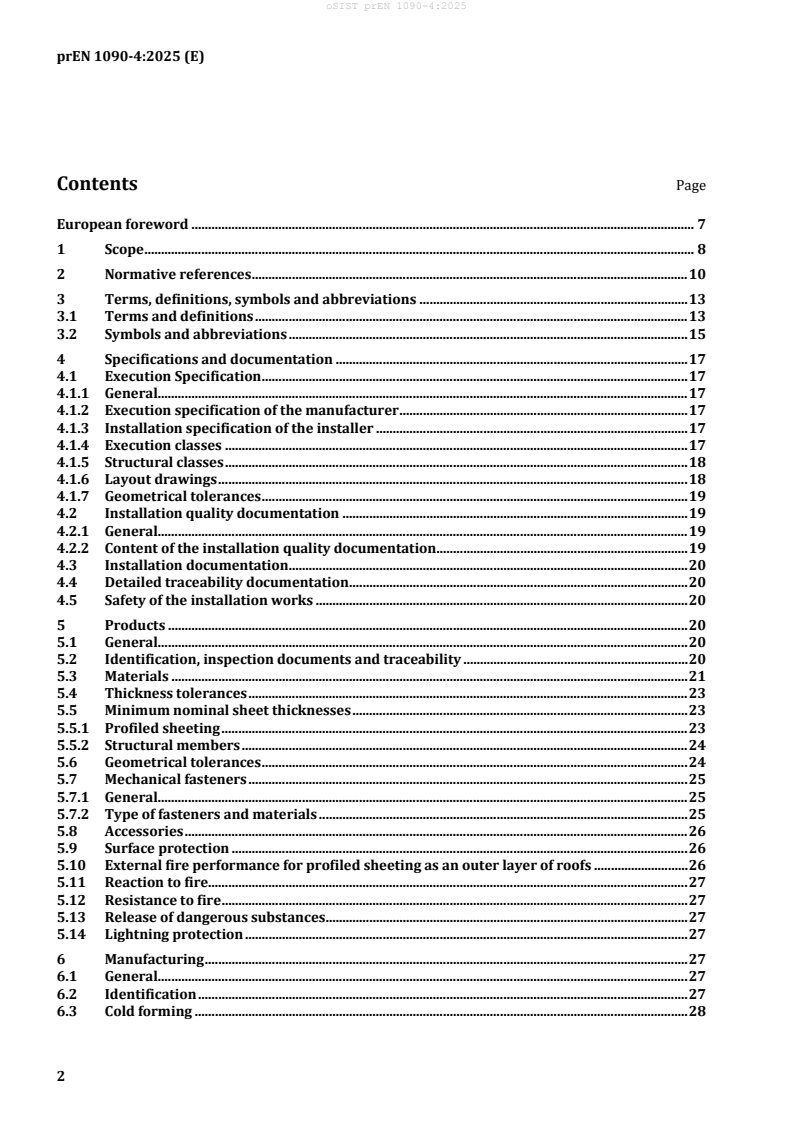
Contents Page
European foreword . 7
1 Scope . 8
2 Normative references . 10
3 Terms, definitions, symbols and abbreviations . 13
3.1 Terms and definitions . 13
3.2 Symbols and abbreviations . 15
4 Specifications and documentation . 17
4.1 Execution Specification . 17
4.1.1 General. 17
4.1.2 Execution specification of the manufacturer . 17
4.1.3 Installation specification of the installer . 17
4.1.4 Execution classes . 17
4.1.5 Structural classes . 18
4.1.6 Layout drawings . 18
4.1.7 Geometrical tolerances . 19
4.2 Installation quality documentation . 19
4.2.1 General. 19
4.2.2 Content of the installation quality documentation. 19
4.3 Installation documentation . 20
4.4 Detailed traceability documentation . 20
4.5 Safety of the installation works . 20
5 Products . 20
5.1 General. 20
5.2 Identification, inspection documents and traceability . 20
5.3 Materials . 21
5.4 Thickness tolerances . 23
5.5 Minimum nominal sheet thicknesses . 23
5.5.1 Profiled sheeting . 23
5.5.2 Structural members . 24
5.6 Geometrical tolerances . 24
5.7 Mechanical fasteners . 25
5.7.1 General. 25
5.7.2 Type of fasteners and materials . 25
5.8 Accessories . 26
5.9 Surface protection . 26
5.10 External fire performance for profiled sheeting as an outer layer of roofs . 26
5.11 Reaction to fire. 27
5.12 Resistance to fire . 27
5.13 Release of dangerous substances . 27
5.14 Lightning protection . 27
6 Manufacturing . 27
6.1 General. 27
6.2 Identification . 27
6.3 Cold forming . 28
6.4 Cutting. 28
6.4.1 General . 28
6.4.2 Shearing and nibbling . 28
6.4.3 Thermal cutting . 28
6.5 Holing . 28
6.5.1 General . 28
6.5.2 Execution of punching . 28
7 Welding . 29
7.1 General . 29
7.2 Welding of the longitudinal weld seam of cold-formed closed and hollow sections . 29
7.3 Welding at the construction site . 30
8 Mechanical fastening . 30
8.1 General . 30
8.2 Use of self-tapping and self-drilling screws . 31
8.3 Use of blind rivets . 31
8.4 Use of cartridge fired pins . 32
8.5 Attachment of cold-formed structural members and profiled sheeting to the supporting
member . 32
8.5.1 Types of connections and attachments. 32
8.5.2 Attachment of profiled sheets to the supporting member transverse to the direction of span
............................................................................................................................................................................. 32
8.5.3 Attachment of profiled sheeting to supports parallel to the direction of profiled sheeting’s
span. 34
8.5.4 Supporting member made of metal . 34
8.5.5 Supporting member made of timber or other wood-based materials . 34
8.5.6 Supporting member made of concrete or masonry . 34
8.6 Connecting profiled sheeting . 35
8.7 Edge distances and spacing of fasteners for profiled sheeting . 35
8.7.1 General . 35
8.7.2 Edge spacings of webs of trapezoidal profiled sheeting and liner tray profiles . 35
9 Installation . 36
9.1 General . 36
9.2 Site conditions . 36
9.3 Training/instruction of installation personnel . 36
9.4 Inspection of preceding works . 37
9.5 Layout drawing . 37
9.6 Tools required . 37
9.7 Safety on site. 37
9.8 Inspection of packaging and contents . 37
9.9 Storage . 37
9.10 Damaged structural members and profiled sheeting and connecting devices . 38
9.11 Unloading, lifting gear/slings/straps . 38
9.12 Laying . 39
9.13 Direction of lay . 39
9.14 Maintaining the cover width during installation . 39
9.15 Condition after installation (swarf from drilling, fouling of surface, protective film wrap)39
9.16 Inspection after installation . 39
9.17 Diaphragms . 39
9.18 Protection against lightning . 40
10 Surface protection . 40
10.1 Corrosion protection . 40
10.1.1 General. 40
10.1.2 Carbon steels . 41
10.1.3 Stainless steels . 41
10.1.4 Combination of metallic materials . 41
10.2 Cleaning and maintenance . 42
10.2.1 Organic coated products . 42
10.2.2 Metallic coated products . 42
10.2.3 Stainless steel . 42
11 Geometrical tolerances . 42
11.1 General. 42
11.2 Tolerance types . 43
11.3 Essential tolerances . 43
11.3.1 General. 43
11.3.2 Manufacturing tolerances . 43
11.3.3 Installation tolerances . 44
11.4 Functional tolerances . 44
12 Inspection, testing and correction . 44
12.1 General. 44
12.2 Structural members, profiled sheeting and fasteners . 44
12.2.1 General. 44
12.2.2 Non-conforming products . 44
12.3 Manufacturing: geometrical dimensions of manufactured structural members and profiled
sheeting . 44
12.3.1 General. 44
12.3.2 Profiled sheeting . 45
12.3.3 Members. 45
12.4 Inspection of the installed structure. 46
12.5 Inspection of fastening . 46
12.5.1 Self-tapping and self-drilling screws . 46
12.5.2 Blind rivets . 46
12.5.3 Cartridge fired pins . 46
12.5.4 Bolted Connections . 46
13 Deconstruction . 47
13.1 General. 47
13.2 Deconstruction process . 47
Annex A (normative) Basic requirements for profiled sheeting . 49
A.1 General. 49
A.2 Supporting members . 51
A.2.1 Materials . 51
A.2.2 Shear forces/fixed points . 52
A.3 Edges of laying area. 52
A.3.1 Longitudinal decking edge trims . 52
A.3.2 Weakening of the cross section . 53
A.3.3 Reinforcements and double layers . 53
A.3.4 Avoidance of ice damming . 54
A.4 Building physics requirements . 54
A.4.1 General . 54
A.4.2 Water permeability . 54
A.4.3 Thermal insulation . 55
A.4.4 Avoidance of condensation/moisture protection. 55
A.4.5 Airborne sound insulation (R ) . 55
w
A.4.6 Sound absorption (α ) . 56
w
A.4.7 Protection against lightning . 56
A.5 Roof drainage . 56
Annex B (normative) Additional design requirements for profiled sheeting . 58
B.1 General . 58
B.2 Serviceability . 58
B.3 Widths of supports . 58
B.4 Supports made of concrete or masonry . 59
B.5 Walkability . 61
B.5.1 Walkability during installation . 61
B.5.2 Walkability and access after installation . 61
B.6 Cantilevers . 61
B.7 Effective load width . 62
B.7.1 Effective load width for non-composite slabs under point or line loads . 62
B.7.2 Load dispersal by means of other structural members . 62
Annex C (normative) Installation records . 63
Annex D (normative) Geometrical tolerances . 64
D.1 General . 64
D.2 Essential and functional manufacturing tolerances – Cold-formed profiled sheeting . 64
D.3 Essential and functional manufacturing tolerances – Cold-formed members including
custom cold rolled closed and hollow sections. 70
D.3.1 Press braked or folded members. 70
D.3.2 Roll-formed members . 71
D.4 Essential manufacturing tolerances – Punched holes . 71
Annex E (normative) Corrosion protection by metallic coating with or without organic coatings72
E.1 Corrosion protection . 72
E.2 Suitability of corrosion protection . 76
E.2.1 Selection . 76
E.2.2 Examination of suitability (initial inspection) . 82
E.2.3 Monitoring. 84
E.2.4 Galvanic corrosion . 85
Annex F (normative) Additional information . 88
F.1 List of required additional information . 88
F.2 List of additional information if not otherwise specified . 89
Bibliography . 90
European foreword
This document (prEN 1090-4:2025) has been prepared by Technical Committee CEN/TC 135 “Execution
of steel structures and aluminium structures”, the secretariat of which is held by SN.
This document is currently submitted to the CEN Enquiry.
This document will supersede EN 1090-4:2018.
This document includes the following significant technical changes with respect to EN 1090-4:2018:
— Fundamental revision of the standard and adaptation to the current state of science and technology.
This document is part of the EN 1090 series, which comprises the following parts:
— EN 1090-1, Execution of steel structures and aluminium structures — Part 1: Assessment and
verification of constancy of performance for structural components
— EN 1090-2, Execution of steel structures and aluminium structures — Part 2: Technical requirements
for steel structures
— EN 1090-3, Execution of steel structures and aluminium structures — Part 3: Technical requirements
for aluminium structures
— EN 1090-4, Execution of steel structures and aluminium structures — Part 4: Technical requirements
for cold-formed structural steel elements and cold-formed structures for roof, ceiling, floor and wall
applications
— EN 1090-5, Execution of steel structures and aluminium structures — Part 5: Technical requirements
for cold-formed structural aluminium elements and cold-formed structures for roof, ceiling, floor and
wall applications
1 Scope
This document specifies requirements for the execution, i.e. the manufacture and the installation, of cold-
formed structural steel members and profiled sheeting and cold-formed structures for roof, ceiling, floor,
wall and cladding applications.
This document applies to structures designed according to the EN 1993 series.
This document applies to structural members and profiled sheeting designed according to EN 1993-1-3.
This document can be used for structures designed according to other design rules provided that
conditions for execution comply with them and any necessary additional requirements are specified.
This document also specifies requirements for the execution i.e. the manufacture and the installation of
structures made from cold-formed profiled sheeting for roof, ceiling, floor and wall applications under
predominately static loading or seismic loading conditions and their documentation.
This document covers structural profiled sheeting of Structural Class I and II and structural profiled
sheeting in Structural Class III according to EN 1993-1-3 used in structures.
NOTE 1 In National Annexes of EN 1993-1-3 specifications can be given regarding the use of the Structural
Classes.
This document covers structural members of all structural classes according to EN 1993-1-3.
Structural profiled sheeting is understood here to be:
— profiled sheet, such as trapezoidal, sinusoidal or liner trays (Figure 1).
Structural members are understood here to be:
— members (linear profiled cross sections) that are produced by cold forming (Figure 2).
This document also covers:
— not welded built-up sections (Figure 2d);
— cold-formed closed and hollow sections including the welding of the longitudinal seam (Figure 2b and
Figure 2c), not covered by EN 10219-1;
— perforated, punctured and micro profiled sheeting and members;
The welding of built-up sections are not covered. The welding provisions are given in EN 1090-2.
This document also covers spacer constructions between the outer and inner or upper and lower skins
for roofs, walls and ceilings made from cold-formed profiled sheeting and the connections and
attachments of the afore mentioned elements as long as all has a structural purpose.
This document covers steel profiled sheeting for composite floors, e.g. during installation and in stage of
pouring concrete.
This document also covers the deconstruction of structures made from cold-formed profiled sheeting and
structural members for roof, ceiling, floor and wall applications.
Composite structural members where the interaction between dissimilar materials are an integral part
of the structural behaviour such as sandwich panels and composite floors are not covered by this
document.
This document does not cover the necessary analyses and detailing and execution rules for thermal
insulation, moisture protection, noise control and fire protection.
This document does not cover regulations of roof cladding and wall cladding, produced by traditional
plumber methods or tinsmith methods.
This document does not cover detailed requirements for water tightness or air permeability resistance
and thermal aspects of profiled sheeting.
NOTE 2 The structures covered in this document can be for example.
— single- or multi-skin roofs, whereby the load-bearing structure (lower skin) or the actual roof covering (upper
skin) or both consist of cold-formed structural members and profiled sheeting;
— single- or multi-skin walls whereby the load-bearing structure (inner skin), the actual cladding (outer skin) or
both consist of cold-formed structural members and profiled sheeting, or
— trusses from cold-formed members.
NOTE 3 Structures can consist of an assembly of structural members and profiled sheeting made of steel
according to EN 1090-4 and of aluminium according to EN 1090-5.
Figure 1 — Examples of profiled sheeting
b) closed cross sections
a) single open cross sections c) hollow sections
d) built-up sections
Figure 2 — Examples of members
2 Normative references
The following documents are referred to in the text in such a way that some or all of their content
constitutes requirements of this document. For dated references, only the edition cited applies. For
undated references, the latest edition of the referenced document (including any amendments) applies.
CEN/TS 1187, Test methods for external fire exposure to roofs
EN 508-3, Roofing and cladding products from metal sheet — Specification for self-supporting products of
steel, aluminium or stainless steel sheet — Part 3: Stainless steel
EN 1090-1, Execution of steel structures and aluminium structures — Part 1: Requirements for conformity
assessment of structural elements
EN 1090-2:2018+A1:2014, Execution of steel structures and aluminium structures — Part 2: Technical
requirements for steel structures
EN 1990, Eurocode - Basis of structural and geotechnical design
EN 1993-1-3:2024, Eurocode 3 — Design of steel structures — Part 1-3: General rules — Supplementary
rules for cold-formed members and sheeting
EN 1995-1-1, Eurocode 5: Design of timber structures - Part 1-1: General - Common rules and rules for
buildings
EN 10143, Continuously hot-dip coated steel sheet and strip - Tolerances on dimensions and shape
EN 10152, Electrolytically zinc coated cold rolled steel flat products for cold forming - Technical delivery
conditions
EN 10162:2003, Cold rolled steel sections — Technical delivery conditions — Dimensional and cross-
sectional tolerances
EN 10169:2022, Continuously organic coated (coil coated) steel flat products — Technical delivery
conditions
EN 10204, Metallic products — Types of inspection documents
EN 10346, Continuously hot-dip coated steel flat products for cold forming — Technical delivery conditions
EN 13501-5, Fire classification of construction products and building elements - Part 5: Classification using
data from external fire exposure to roofs tests
EN 13523-1, Coil coated metals - Test methods - Part 1: Film thickness
EN 13523-6, Coil coated metals - Test methods - Part 6: Adhesion after indentation (cupping test)
EN 13523-7:2021, Coil coated metals — Test methods — Part 7: Resistance to cracking on bending (T-bend
test)
EN 13523-8, Coil coated metals - Test methods - Part 8: Resistance to salt spray (fog)
EN 13523-10, Coil coated metals - Test methods - Part 10: Resistance to fluorescent UV radiation and water
condensation
EN 13523-19, Coil coated metals - Test methods - Part 19: Panel design and method of atmospheric exposure
testing
EN 13523-21, Coil coated metals - Test methods - Part 21: Evaluation of outdoor exposed panels
EN 13523-26, Coil coated metals - Test methods - Part 26: Resistance to condensation of water
EN 15048-1:2016, Non-preloaded structural bolting assemblies - Part 1: General requirements
EN 62305-3:2011, Protection against lightning - Part 3: Physical damage to structures and life hazard (IEC
62305-3)
EN 62561-1, Lightning Protection System Components (LPSC) - Part 1: Requirements for connection
components (IEC 62561 1)
EN ISO 717-1, Acoustics - Rating of sound insulation in buildings and of building elements - Part 1: Airborne
sound insulation (ISO 717-1)
EN ISO 1461, Hot dip galvanized coatings on fabricated iron and steel articles - Specifications and test
methods (ISO 1461)
EN ISO 2081, Metallic and other inorganic coatings - Electroplated coatings of zinc with supplementary
treatments on iron or steel (ISO 2081)
EN ISO 2409, Paints and varnishes - Cross-cut test (ISO 2409)
EN ISO 2808, Paints and varnishes - Determination of film thickness (ISO 2808)
EN ISO 2810, Paints and varnishes - Natural weathering of coatings - Exposure and assessment (ISO 2810)
EN ISO 4042, Fasteners - Electroplated coating systems (ISO 4042)
EN ISO 4136, Destructive tests on welds in metallic materials - Transverse tensile test (ISO 4136)
EN ISO 4628-2, Paints and varnishes - Evaluation of degradation of coatings - Designation of quantity and
size of defects, and of intensity of uniform changes in appearance - Part 2: Assessment of degree of blistering
(ISO 4628-2)
EN ISO 4628-3, Paints and varnishes - Evaluation of degradation of coatings - Designation of quantity and
size of defects, and of intensity of uniform changes in appearance - Part 3: Assessment of degree of rusting
(ISO 4628-3)
EN ISO 4628-4, Paints and varnishes - Evaluation of degradation of coatings - Designation of quantity and
size of defects, and of intensity of uniform changes in appearance - Part 4: Assessment of degree of cracking
(ISO 4628-4)
EN ISO 4628-5, Paints and varnishes - Evaluation of quantity and size of defects, and of intensity of uniform
changes in appearance - Part 5: Assessment of degree of flaking (ISO 4628-5)
EN ISO 4628-8, Paints and varnishes - Evaluation of degradation of coatings - Designation of quantity and
size of defects, and of intensity of uniform changes in appearance - Part 8: Assessment of degree of
delamination and corrosion around a scribe or other artificial defect (ISO 4628-8)
EN ISO 5173, Destructive tests on welds in metallic materials - Bend tests (ISO 5173)
EN ISO 6270-1, Paints and varnishes - Determination of resistance to humidity - Part 1: Condensation
(single-sided exposure) (ISO 6270-1)
EN ISO 6507 (all parts), Metallic materials — Vickers hardness test (ISO 6507)
EN ISO 8492, Metallic materials - Tube - Flattening test (ISO 8492)
EN ISO 8493, Metallic materials - Tube - Drift-expanding test (ISO 8493)
EN ISO 9227, Corrosion tests in artificial atmospheres - Salt spray tests (ISO 9227)
EN ISO 11654, Acoustics - Sound absorbers for use in buildings - Rating of sound absorption (ISO
11654:1997)
EN ISO 12944-2, Paints and varnishes - Corrosion protection of steel structures by protective paint systems
- Part 2: Classification of environments (ISO 12944-2)
EN ISO 12944-4, Paints and varnishes - Corrosion protection of steel structures by protective paint systems
- Part 4: Types of surface and surface
...