

EN 13673-1:2003
(Main)Determination of the maximum explosion pressure and the maximum rate of pressure rise of gases and vapours - Part 1: Determination of the maximum explosion pressure
- Abstract
The standard test method is designed to determine the explosion pressure and the maximum explosion pressure of a flammable gas/air/inert mixture at ambient temperature and pressure. In this standard, "gas" also includes vapours but not mists. Detonation phenomena are not considered in this standard.
- Status
- Withdrawn
- Publication Date
- 01-Apr-2003
- Withdrawal Date
- 02-Aug-2011
- Current Stage
- 9960 - Withdrawal effective - Withdrawal
- Start Date
- 03-Aug-2011
- Completion Date
- 03-Aug-2011
- Directive
- 94/9/EC - Equipment and protective systems intended for use in potentially explosive atmospheres (ATEX)OJ Ref: C 192, C 20, C 204, C 300, C 57 OJ Date: 14-Aug-2003

Relations
- Effective Date
- 08-Jun-2022
- Effective Date
- 28-Jan-2026
Get Certified
Connect with accredited certification bodies for this standard

Element Materials Technology
Materials testing and product certification.

Kiwa BDA Testing
Building and construction product certification.

ABS Group Brazil
ABS Group certification services in Brazil.
Sponsored listings
Frequently Asked Questions
EN 13673-1:2003 is a standard published by the European Committee for Standardization (CEN). Its full title is "Determination of the maximum explosion pressure and the maximum rate of pressure rise of gases and vapours - Part 1: Determination of the maximum explosion pressure". This standard covers: The standard test method is designed to determine the explosion pressure and the maximum explosion pressure of a flammable gas/air/inert mixture at ambient temperature and pressure. In this standard, "gas" also includes vapours but not mists. Detonation phenomena are not considered in this standard.
The standard test method is designed to determine the explosion pressure and the maximum explosion pressure of a flammable gas/air/inert mixture at ambient temperature and pressure. In this standard, "gas" also includes vapours but not mists. Detonation phenomena are not considered in this standard.
EN 13673-1:2003 is classified under the following ICS (International Classification for Standards) categories: 13.230 - Explosion protection; 75.160.30 - Gaseous fuels. The ICS classification helps identify the subject area and facilitates finding related standards.
EN 13673-1:2003 has the following relationships with other standards: It is inter standard links to EN 15967:2011, EN 14373:2005. Understanding these relationships helps ensure you are using the most current and applicable version of the standard.
EN 13673-1:2003 is associated with the following European legislation: EU Directives/Regulations: 94/9/EC, 98/37/EC; Standardization Mandates: M/079, M/BC/CEN/92/46. When a standard is cited in the Official Journal of the European Union, products manufactured in conformity with it benefit from a presumption of conformity with the essential requirements of the corresponding EU directive or regulation.
EN 13673-1:2003 is available in PDF format for immediate download after purchase. The document can be added to your cart and obtained through the secure checkout process. Digital delivery ensures instant access to the complete standard document.
Standards Content (Sample)
2003-01.Slovenski inštitut za standardizacijo. Razmnoževanje celote ali delov tega standarda ni dovoljeno.Verfahren zur Bestimmung des maximalen Explosionsdruckes und des maximalen zeitlichen Druckanstieges für Gase und Dämpfe - Teil 1: Bestimmungsverfahren für den maximalen ExplosionsdruckDétermination de la pression maximale d'explosion et de la vitesse maximale de montée en pression des gaz et vapeurs - Partie 1: Détermination de la pression maximale d'explosionDetermination of the maximum explosion pressure and the maximum rate of pressure rise of gases and vapours - Part 1: Determination of the maximum explosion pressure13.230Varstvo pred eksplozijoExplosion protectionICS:Ta slovenski standard je istoveten z:EN 13673-1:2003SIST EN 13673-1:2003en,fr,de01-junij-2003SIST EN 13673-1:2003SLOVENSKI
STANDARD
EUROPEAN STANDARDNORME EUROPÉENNEEUROPÄISCHE NORMEN 13673-1April 2003ICS 13.230; 75.160.30English versionDetermination of the maximum explosion pressure and themaximum rate of pressure rise of gases and vapours - Part 1:Determination of the maximum explosion pressureDétermination de la pression maximale d'explosion et de lavitesse maximale de montée en pression des gaz etvapeurs - Partie 1: Détermination de la pression maximaled'explosionVerfahren zur Bestimmung des maximalenExplosionsdruckes und des maximalen zeitlichenDruckanstieges für Gase und Dämpfe - Teil 1:Bestimmungsverfahren für den maximalen ExplosionsdruckThis European Standard was approved by CEN on 2 January 2003.CEN members are bound to comply with the CEN/CENELEC Internal Regulations which stipulate the conditions for giving this EuropeanStandard the status of a national standard without any alteration. Up-to-date lists and bibliographical references concerning such nationalstandards may be obtained on application to the Management Centre or to any CEN member.This European Standard exists in three official versions (English, French, German). A version in any other language made by translationunder the responsibility of a CEN member into its own language and notified to the Management Centre has the same status as the officialversions.CEN members are the national standards bodies of Austria, Belgium, Czech Republic, Denmark, Finland, France, Germany, Greece,Hungary, Iceland, Ireland, Italy, Luxembourg, Malta, Netherlands, Norway, Portugal, Slovakia, Spain, Sweden, Switzerland and UnitedKingdom.EUROPEAN COMMITTEE FOR STANDARDIZATIONCOMITÉ EUROPÉEN DE NORMALISATIONEUROPÄISCHES KOMITEE FÜR NORMUNGManagement Centre: rue de Stassart, 36
B-1050 Brussels© 2003 CENAll rights of exploitation in any form and by any means reservedworldwide for CEN national Members.Ref. No. EN 13673-1:2003 ESIST EN 13673-1:2003
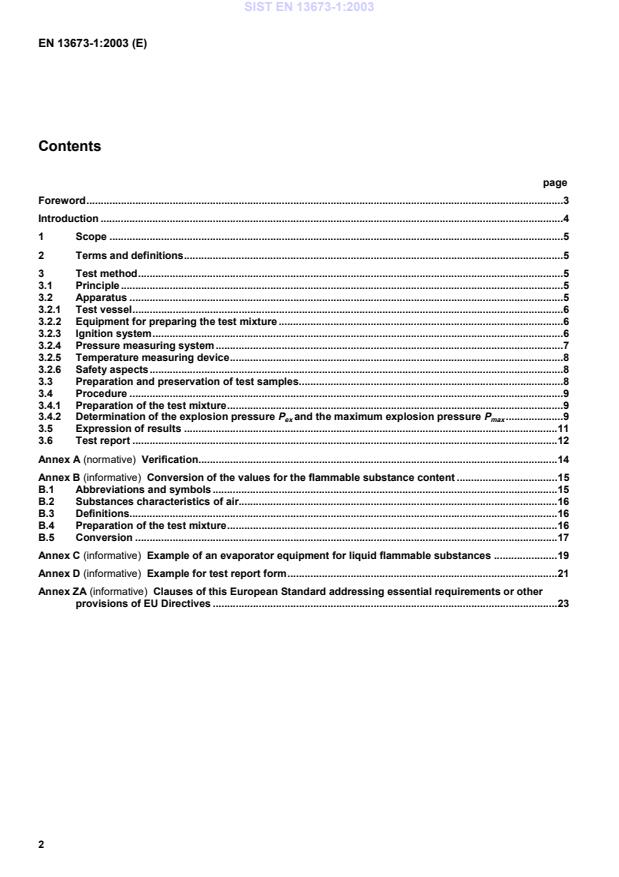
Verification.14Annex B (informative)
Conversion of the values for the flammable substance content.15B.1Abbreviations and symbols.15B.2Substances characteristics of air.16B.3Definitions.16B.4Preparation of the test mixture.16B.5Conversion.17Annex C (informative)
Example of an evaporator equipment for liquid flammable substances.19Annex D (informative)
Example for test report form.21Annex ZA (informative)
Clauses of this European Standard addressing essential requirements or otherprovisions of EU Directives.23SIST EN 13673-1:2003
Evenin an enclosure of relatively simple geometry the disposition of the internal components can lead to explosionpressures significantly higher than those measured using this European Standard.
Flameproof enclosures shouldbe constructed and tested in accordance with the requirements contained in EN 50018 for electrical equipment andprEN 13463-3 for non-electrical equipment.2 Terms and definitionsFor the purposes of this European Standard, the following terms and definitions apply.2.1explosion pressure, Pexhighest pressure occurring in a closed vessel during the explosion of a specific mixture of flammable gases with airor air and inert gases determined under specified test conditions2.2maximum explosion pressure, Pmaxmaximum value measured in the tests for explosion pressure when the content of the flammable gas in the mixtureis variedNOTEFor the purpose of this European Standard, all pressures are expressed in bar absolute.3 Test method3.1 PrincipleAn explosive test mixture is ignited by a defined ignition source which is positioned in the centre of a test vessel. Bymeans of a pressure measuring system, the highest pressure Pex developed following the ignition of the testmixture is measured.The maximum explosion pressure Pmax is determined during measurements of the explosion pressure Pex byvarying stepwise the content of flammable gas in the mixture, until the maximum value of Pex is found.3.2 Apparatus3.2.1 GeneralThe test apparatus consists of :¾ a test vessel;¾ equipment for preparing the test mixture;¾ an ignition system;¾ a pressure measuring system;SIST EN 13673-1:2003
The test report shall state which ignition source was used.For some special mixtures it may be necessary to use a different ignition system in order to achieve ignition of themixture. If an alternative ignition source is used it shall be fully described in the test report. It is also recommendedthat specialist advice is sought on the interpretation of the results.3.2.4.2 Induction sparkA series of induction sparks between two electrodes is used as the ignition source.SIST EN 13673-1:2003
the risk of a fire is minimised;¾ the handling of gas cylinders shall be carried out in such a manner that the risk of an explosion is minimised.3.3 Preparation and preservation of test samplesThe components of the test mixture shall fulfil the following requirements :Air: the air shall be free of water and oil. If synthetic air is used, it shall to be stated in the report.Inert: the purity of the inert, or the mixture of inerts, shall be 99,8 % mol or better. If a mixture of inerts is used, thecomposition of the mixture shall be stated in the test report.Flammable gas: the flammable gas may be derived from:a) a single substance or a mixture of substances,b) a process sample (of known or unknown composition).When a single substance or a mixture of substances is used, the purity of each substance shall be 99,8 % mol orbetter. In the case of a mixture of substances or a process sample of known composition, the precision of theSIST EN 13673-1:2003
...