

EN 15192:2006
(Main)Characterisation of waste and soil - Determination of Chromium(VI) in solid material by alkaline digestion and ion chromatography with spectrophotometric detection
- Abstract
This standard describes the determination of Cr(VI) in solid waste material and soil by alkaline digestion and ion chromatography with spectrophotometric detection. This method can be used to determine Cr(VI)-mass fractions in solids higher than 0,1 mg/kg.
- Status
- Withdrawn
- Publication Date
- 14-Nov-2006
- Withdrawal Date
- 06-Oct-2026
- Technical Committee
- CEN/TC 444 - Environmental characterization
- Drafting Committee
- CEN/TC 444/WG 3 - Inorganic analysis
- Current Stage
- 9960 - Withdrawal effective - Withdrawal
- Start Date
- 07-Jul-2021
- Completion Date
- 07-Oct-2026

Relations
- Effective Date
- 12-Feb-2026
- Effective Date
- 14-Jul-2021
- Effective Date
- 25-Aug-2026
- Refers
EN 15002:2015 - Characterization of waste - Preparation of test portions from the laboratory sample - Effective Date
- 28-Jan-2026
- Effective Date
- 28-Jan-2026
- Effective Date
- 28-Jan-2026
- Effective Date
- 28-Jan-2026
- Effective Date
- 28-Jan-2026
- Effective Date
- 28-Jan-2026
Get Certified
Connect with accredited certification bodies for this standard

CIS Institut d.o.o.
Personal Protective Equipment (PPE) certification body. Notified Body NB-2890 for EU Regulation 2016/425 PPE.

Kiwa BDA Testing
Building and construction product certification.
Kmetijski inštitut Slovenije
Agricultural Institute of Slovenia. Soil testing, plant health, agricultural product analysis.
Sponsored listings
Frequently Asked Questions
EN 15192:2006 is a standard published by the European Committee for Standardization (CEN). Its full title is "Characterisation of waste and soil - Determination of Chromium(VI) in solid material by alkaline digestion and ion chromatography with spectrophotometric detection". This standard covers: This standard describes the determination of Cr(VI) in solid waste material and soil by alkaline digestion and ion chromatography with spectrophotometric detection. This method can be used to determine Cr(VI)-mass fractions in solids higher than 0,1 mg/kg.
This standard describes the determination of Cr(VI) in solid waste material and soil by alkaline digestion and ion chromatography with spectrophotometric detection. This method can be used to determine Cr(VI)-mass fractions in solids higher than 0,1 mg/kg.
EN 15192:2006 is classified under the following ICS (International Classification for Standards) categories: 13.030.10 - Solid wastes; 13.080.10 - Chemical characteristics of soils. The ICS classification helps identify the subject area and facilitates finding related standards.
EN 15192:2006 has the following relationships with other standards: It is inter standard links to ISO 15192:2010, EN ISO 15192:2021, ISO 11464:2006, EN 15002:2015, EN ISO 3696:1995, EN 4681-002:2012, EN 16318:2013+A1:2016, CEN/TS 16318:2012, EN 16318:2013. Understanding these relationships helps ensure you are using the most current and applicable version of the standard.
EN 15192:2006 is available in PDF format for immediate download after purchase. The document can be added to your cart and obtained through the secure checkout process. Digital delivery ensures instant access to the complete standard document.
Standards Content (Sample)
2003-01.Slovenski inštitut za standardizacijo. Razmnoževanje celote ali delov tega standarda ni dovoljeno.Characterisation of waste and soil - Determination of Chromium(VI) in solid material by alkaline digestion and ion chromatography with spectrophotometric detectionCaractérisation des déchets et des sols - Dosage du chrome (VI) dans les matériaux solides par digestion alcaline et chromatographie ionique avec détection spectrophotométriqueCharakterisierung von Abfällen und Boden - Bestimmung von sechswertigem Chrom in Feststoffen durch alkalischen Aufschluss und lonenchromatographie mit photometrischer DetektionTa slovenski standard je istoveten z:EN 15192:2006SIST EN 15192:2007en13.080.10Chemical characteristics of soils13.030.10Trdni odpadkiSolid wastesICS:SLOVENSKI
STANDARDSIST EN 15192:200701-april-2007
EUROPEAN STANDARDNORME EUROPÉENNEEUROPÄISCHE NORMEN 15192November 2006ICS 13.030.10; 13.080.10 English VersionCharacterisation of waste and soil - Determination ofChromium(VI) in solid material by alkaline digestion and ionchromatography with spectrophotometric detectionCaractérisation des déchets et des sols - Dosage duchrome VI dans les matériaux solides par digestion alcalineet chromatographie ionique avec détectionspectrophotométriqueCharakterisierung von Abfällen und Boden - Bestimmungvon sechswertigem Chrom in Feststoffen durch alkalischenAufschluss und lonenchromatographie mit photometrischerDetektionThis European Standard was approved by CEN on 6 October 2006.CEN members are bound to comply with the CEN/CENELEC Internal Regulations which stipulate the conditions for giving this EuropeanStandard the status of a national standard without any alteration. Up-to-date lists and bibliographical references concerning such nationalstandards may be obtained on application to the Central Secretariat or to any CEN member.This European Standard exists in three official versions (English, French, German). A version in any other language made by translationunder the responsibility of a CEN member into its own language and notified to the Central Secretariat has the same status as the officialversions.CEN members are the national standards bodies of Austria, Belgium, Cyprus, Czech Republic, Denmark, Estonia, Finland, France,Germany, Greece, Hungary, Iceland, Ireland, Italy, Latvia, Lithuania, Luxembourg, Malta, Netherlands, Norway, Poland, Portugal, Romania,Slovakia, Slovenia, Spain, Sweden, Switzerland and United Kingdom.EUROPEAN COMMITTEE FOR STANDARDIZATIONCOMITÉ EUROPÉEN DE NORMALISATIONEUROPÄISCHES KOMITEE FÜR NORMUNGManagement Centre: rue de Stassart, 36
B-1050 Brussels© 2006 CENAll rights of exploitation in any form and by any means reservedworldwide for CEN national Members.Ref. No. EN 15192:2006: E
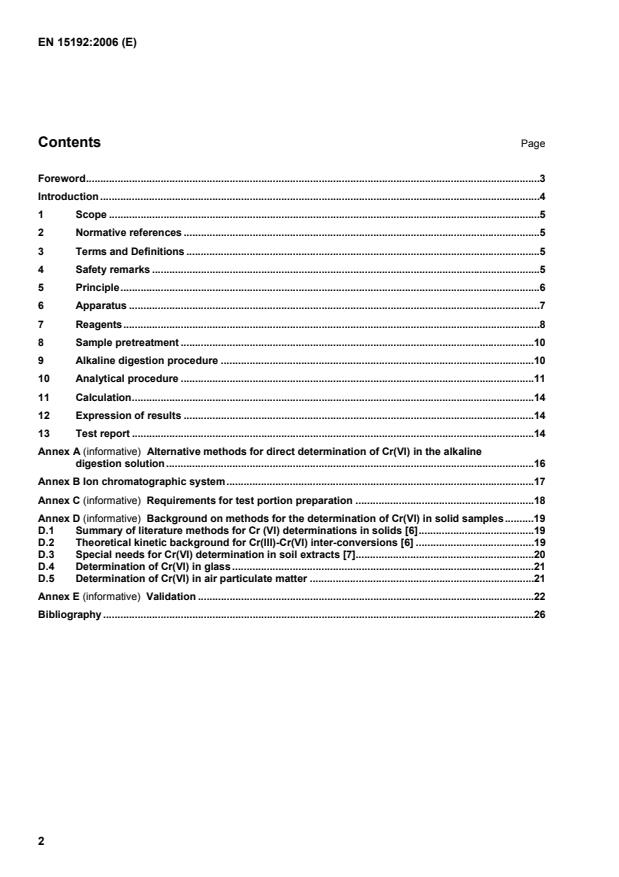
Alternative methods for direct determination of Cr(VI) in the alkaline digestion solution.16 Annex B Ion chromatographic system.17 Annex C (informative)
Requirements for test portion preparation.18 Annex D (informative)
Background on methods for the determination of Cr(VI) in solid samples.19 D.1 Summary of literature methods for Cr (VI) determinations in solids [6].19 D.2 Theoretical kinetic background for Cr(III)-Cr(VI) inter-conversions [6].19 D.3 Special needs for Cr(VI) determination in soil extracts [7].20 D.4 Determination of Cr(VI) in glass.21 D.5 Determination of Cr(VI) in air particulate matter.21 Annex E (informative)
Validation.22 Bibliography.26
3 Terms and Definitions For the purposes of this European Standard, the following terms and definitions apply. 3.1 alkaline digestion process of obtaining a solution containing the analyte of interest from a sample under alkaline conditions. Alkaline digestion may or may not involve complete dissolution of the sample 3.2 speciation analysis activities of measuring the quantity of one or more individual chemical species in a sample, e.g. Cr(VI) in a particular sample or matrix 4 Safety remarks Anyone dealing with waste and soil analysis has to be aware of the typical risks of the material irrespective of the parameters determined. Waste and soil samples may contain hazardous (e.g. toxic, reactive, flammable, infectious) substances, which can be liable to biological and/or chemical reaction. Consequently, it is recommended that these samples should be handled with special care. The gases which may be produced by microbiological or chemical activity are potentially flammable and can pressurise sealed bottles. Bursting bottles are likely to result in hazardous shrapnel, dust and/or aerosol. National regulations should be followed with respect to all hazards associated with this method. Avoid any contact with the skin, ingestion or inhalation of Cr(VI) compounds. Cr(VI) compounds are genotoxic and potentially carcinogenic to humans.
3) method must not cause oxidation of native Cr(III) contained in the sample to Cr(VI).
The alkaline digestion described in this standard meets these criteria for a wide spectrum of solid matrices. Under the alkaline conditions of the digestion, neglectable reduction of Cr(VI) or oxidation of native Cr(III) is expected. The additon of Mg2+ in a phosphate buffer to the alkaline solution prevents air oxidation of trivalent chromium [1], [6], [32]. NOTE Background on methods for the determination of Cr(VI) in solid samples is given in Annex D and [4], [5], [6]. 5.2 Determination Quantification of Cr(VI) in the alkaline digestion solution should be performed using a suitable technique with appropriate accuracy. For this purpose ion chromatography is used to separate Cr(VI) from interferences. Following this ion chromatographic separation, Cr(VI) is measured spectrophotometrically either at 365 nm (direct UV detection) or after post-column derivatisation with 1,5-diphenylcarbazide in acid solution at 540 nm. Post-column derivatisation involves reaction of 1,5-diphenylcarbazide with Cr(VI) to produce trivalent chromium and diphenylcarbazone. These then combine to form a trivalent chromium-diphenylcarbazone complex containing the characteristic magenta chromagen (λmax= 540 nm). NOTE 1 The choice of detection method is based upon the required sensitivity. Direct UV detection is less sensitive than detection after post-column derivatisation with 1,5-diphenylcarbazide. NOTE 2 Hyphenated methods with ion chromatographic separation and detection techniques, such as inductively coupled plasma mass spectrometry (ICP-MS) or inductively coupled plasma atomic emission spectroscopy (ICP-AES), may be used once validation of the chosen analytical method has been performed. 5.3 Interferences and sources of error Use of ion chromatography is necessary for the separation of Cr(VI) from possible interferences in the alkaline digestion solution from solid material [7] (see also Annex D.3). For waste materials or soils, where the Cr(III)/Cr(VI) ratio is expected to be high, Cr(VI) results may be biased due to method induced oxidation. This can be particularly expected in soils high in Mn content and amended with soluble Cr(III) salts or freshly precipitated Cr(OH)3 [4] (see also Annex D.2).
Cr(VI) can be reduced to Cr(III) during digestion from the sample due to reaction with reducing agents such as e.g. divalent iron. This problem is minimised in the described procedure using alkaline digestion solution [6] (see also Annex D.2). Cr(III) can be oxidised to Cr(VI) in hot alkaline solutions. This problem is minimised in the described procedure by adding magnesium to the alkaline digestion solution [3], [4], [6], [32] (see also Annex D.2).
Overloading the analytical column capacity with high concentrations of anionic species (e.g. chloride) may cause underestimation of Cr(VI) [43].
suitable for using 0,45-µm membrane filters. 6.3 Membrane filters, 0,45 µm pore size, chemically inert. 6.4 Ion chromatographic system,
all components which come into contact with the sample or eluent stream shall be comprised of inert materials, e.g. polyetherether ketone (PEEK), as shall all connecting tubing (see Annex B). 6.5 Ion chromatographic column, suitable for chromate separation with a sufficient ion exchange capacity. 6.6 Detection system UV-VIS spectrophotometer at 365 nm; or VIS spectrophotometer at 540 nm after post column derivatisation.
0,18 MΩ m (usually expressed by manufacturers of water purification systems as 18 MΩ cm). 7.2 Sulphuric acid (H2SO4), concentrated, ρ(H2SO4) ~ 1,84 g/ml, w(H2SO4) ~ 98 % 7.3 Sodium carbonate (Na2CO3), anhydrous, w(Na2CO3) >
99,9 % 7.4 1,5-Diphenylcarbazide ((C6H5.NH.NH)2CO), w((C6H5.NH.NH)2CO) > 98% 7.5 Acetone (C3H6O) 7.6 Methanol (CH4O) 7.7 Potassium dichromate (K2Cr2O7), w(K2Cr2O7) > 99,9 % Dry to constant weight at 110 °C, cool and store in a dessiccator. 7.8 Sodium hydroxide (NaOH), w(NaOH) > 99 % 7.9 Magnesium chloride hexahydrate (MgCl2.6H2O), w(MgCl2.6H2O) > 99 % 7.10 Dipotassium hydrogenphosphate (K2HPO4), w(K2HPO4) > 99 % 7.11 Potassium dihydrogenphosphate (KH2PO4), w(KH2PO4) > 99 % 7.12 Lead chromate (PbCrO4), w(PbCrO4) > 99 % 7.13 Diphenylcarbazide reagent solution Dissolve 0,125 g of 1,5-diphenylcarbazide (7.4) in 25 ml of acetone (7.5) or methanol (7.6) in a 250 ml volumetric flask. Fill 125 ml of water into a separate container, slowly add 7 ml of concentrated sulphuric acid (7.2), swirl to mix and allow to cool. Degass with e.g. helium or argon for 5 min to 10 min prior to adding to the 1,5-diphenylcarbazide solution. After combining the solutions, fill up to the mark with water and degass additionally for 5 min to 10 min. The reagent solution is stable for 5 days. 7.14 Eluent solution
Use an eluent solution appropriate to separate chromate over the ion chromatographic column (6.5). 7.15 Alkaline digestion solution, 0,5 mol/l sodium hydroxide (NaOH) / 0,28 mol/l sodium carbonate (Na2CO3) Dissolve 20,0 g of sodium hydroxide (7.8) in approximately 500 ml of water (7.1). Add 30,0 g of sodium carbonate (7.3) and swirl to mix. Quantitatively transfer the solution into a 1 l volumetric flask. Dilute to the
7.16.1 Cr(VI) standard stock solution, 1 000 mg/l Cr(VI) Dissolve 0,282 9 g of potassium dichromate (7.7) in 75 ml of water (7.1) in a 100 ml volumetric flask. Dilute to the mark with water (7.1), close and mix thoroughly. Store the solution in a polypropylene bottle for a maximum period of 1 year. Alternatively a commercial standard solution with a certified Cr(VI) concentration traceable to national standards can be used. Observe the manufacturer's expiration date or recommended shelf life. 7.16.2 Cr(VI) working standard solution, 10 mg/l Cr(VI) Accurately pipette 10,0 ml of the Cr(VI) standard stock solution (7.16.1) into a 1 l volumetric flask, dilute to the mark with water (7.1), close and mix thoroughly. Prepare this solution fresh monthly.
7.16.3 Cr(VI) calibration solutions Prepare a set of at least 5 calibration solutions by diluting the Cr(VI) working standard solution with a 1 + 1 diluted alkaline digestion solution (7.15). Add 25 ml of the alkaline digestion solution (7.15) into a 50 ml volumetric flask, pipette accurately the appropriate volume of Cr(VI) working standard solution (7.16.2) into the volumetric flask and dilute to the mark with water (7.1), close and mix thoroughly. Prepare these calibration solutions fresh daily. 7.16.4 Cr(VI) spiking solutions The Cr(VI) working standard solution (7.16.2) can be used to spike samples. 7.17 Phosphate buffer solution, 0,5 mol/l dipotassiumhydrogenphosphate (K2HPO4)/0,5 mol/l potassiumdihydrogenphosphate (KH2PO4), pH 7. Dissolve 87,09 g K2HPO4 (7.10) and 68,04 g of KH2PO4 (7.11) in approximately 700 ml of water and swirl to mix. Transfer the solution into a 1 l volumetric flask. Dilute to the mark with water. 7.18 Magnesium chloride solution Dissolve 85,4 g MgCl2.6H2O (7.9) in a 100 ml volumetric flask, dilute to the mark with water (7.1), close and mix thoroughly. 7.19 Chromium chloride hexahydrate (CrCl3.6H2O), w(CrCl3.6H2O) > 96 %
7.20 Cr(III) spiking solution
Use a commercial standard solution with a certified Cr(III) concentration, e.g 1 000 mg/l Cr (III) traceable to national standards. Observe the manufacturer's expiration date or recommended shelf life.
Alternatively dissolve an appropriate known amount of chromium chloride hexahydrate (7.19) in water (7.1) in a 100 ml volumetric flask, dilute to the mark with water (7.1), close and mix thoroughly. Store the solution in a polypropylene bottle for a maximum period of 1 year. Before using, determine the Cr concentration of the spiking solution.
9.2 Preparation of test solutions using a hotplate or heating block 9.2.1 Adjust the temperature setting by preparing and monitoring a temperature blank (a 250 ml vessel filled with 50 ml digestion solution). Maintain a digestion solution temperature of (92,5 ± 2,5) °C. Do not allow the solution to boil or evaporate to dryness. 9.2.2 Transfer (2,5 ± 0,1) g of the test portion weighed to the nearest 0,1 mg into a clean 250 ml digestion vessel. NOTE For very high expected concentrations of Cr(VI) a smaller representative test portion can be used. 9.2.3 Add (50 ± 1) ml of the alkaline digestion solution (7.15) to each sample using a graduated cylinder, and also add 1 ml of magnesium chloride solution (7.18) containing approximately 400 mg of MgCl2 and
0,5 ml of phosphate buffer solution (7.17). Cover all digestion vessels. If using a heating block, reflux condensers can be used.
9.2.4 Heat the samples to (92,5 ± 2,5) °C with continuous stirring, then maintain the samples at (92,5 ± 2,5) °C for at least 60 min with stirring continuously. 9.2.5 Cool each solution to room temperature. Transfer the contents quantitatively to the filtration equipment (6.2), rinsing the digestion vessel three times with small portions of water (7.1). Filter through a 0,45 µm membrane filter (6.3). Rinse the filtration equipment (6.2) with water (7.1) and transfer the filtrate to a 100 ml volumetric flask and fill up to the mark with water (7.1). NOTE Alternatively the sample may be centrifuged or allowed to settle.
10.2 Instrumental set-up 10.2.1 Set up the ion chromatograph in accordance with manufacturer’s instructions. 10.2.2 Adjust the flow rate of the eluent solution (7.14) to a value that is compatible with the columns used (typically 0,3 ml/min to 1 ml/min). 10.2.3 If post column derivatisation, optimise the ratio of eluent solution and reagent flow rates or adjust the sulphuric acid concentration of the diphenylcarbazide reagent solution (7.13) to obtain the best signal to background ratio. It is important that the ratio between the eluent solution and reagent flow rates is kept constant, that the total flow rate does not exceed the maximum flow rate for the detector and the diphenylcarbazide reagent is present in excess. A typical value for the ratio between the eluent solution and reagent flow rates is 3:1. After the flow rates are adjusted, allow the system to equilibrate for 15 min. 10.2.4 In case of direct detection, adjust the UV-VIS detector to measure within a range of 355 nm to 375 nm, preferably at 365 nm.
In case of measuring after post-column derivatisation with 1,5-diphenylcarbazide, adjust the VIS detector to measure within a range of 530 nm to 550 nm, preferably at 540 nm. 10.3 Calibration 10.3.1 Inject a suitable volume (20 µl to 250 µl), e.g. 50 µl, of each calibration solution (7.16.3) into the ion chromatographic system (6.4). 10.3.2 Determine the absorbance for each of the calibration solutions using either peak height or peak area mode. 10.3.3 Prepare a calibration graph using a linear plot of the peak height or peak area as a function of calibration solution concentration by least squares regression analysis using suitable software. 10.4 Test solution measurement 10.4.1 Inject a suitable volume, e.g. 50 µl, of filtered sample solutions (9.2) into the ion chromatographic system. 10.4.2 Determine the concentrations of Cr(VI) in the test solutions (9.2) by comparison with the calibration graph (10.3.3). 10.4.3 If concentrations of Cr(VI) are found to be above the upper calibration solution, dilute the extract with a 1 + 1 diluted alkaline digestion solution (7.15) in order to bring them within the linear range and repeat the analysis. Take note of the dilution when calculating the mass concentration of Cr(VI) in the material under investigation. NOTE For samples expected to have very high concentrations of Cr(VI), it might be necessary to dilute the test solutions before they are first analysed. Otherwise, swamping of the diphenylcarbazide reagent can occur and no colour will develop.
Analyse the blank solutions according to a frequency of 1 blank per 20 test portions or at least once in each series of measurement.
10.5.3 Verification of method Prepare a Cr(VI) standard solution from a stock standard solution from a different source than that used for preparing the calibration solutions. In parallel with processing the test samples, prepare a blank solution spiked with this Cr(VI) standard solution following the same digestion procedure as applied to the test samples but omitting the test portion.
Process this QC sample within each batch.
Prepare a Cr(III) standard solution from the Cr(III) spiking solution (7.20). In parallel with processing the test samples prepare a blank solution spiked with this Cr(III) standard solution following the same digestion procedure as applied to the test samples but omitting the test portion.
Process this QC sample within each batch.
10.5.4 Duplicate samples Process duplicate samples to estimate the method accuracy according to a frequency of at least 1 duplicate sample per 20 test portions or minimum of 1 per batch. 10.5.5 Cr(VI) spiked samples
Process soluble spikes (e.g. K2Cr2O7, (7.16.4)) on a routine basis to estimate the method accuracy in relation to possible reduction processes. Spiked samples consist of solid material to which known amounts of Cr(VI) have been added.
Soluble pre-digestion matrix spikes should be analyzed at a frequency of at least 1 spike sample per 20 test portions or 1 per batch. The matrix spike is then carried through the digestion process. More frequent matrix spikes should be analysed if the sample characteristics within the analytical batch appear to have significant variability based on visual observation.
To evaluate the dissolution of all Cr(VI) species during the digestion process, an insoluble spike (e.g. PbCrO4, (7.12)) may be used. The recovery of the Cr(VI) spike can be used to assess the following criteria (5.1):
digestion solution must solubilise all species of Cr(VI); conditions of the digestion must not induce reduction of native Cr(VI) to Cr(III). 10.5.6 Cr(III) spiked samples Process the Cr(III) spiking solution (7.20) on a routine basis to estimate the method accuracy in relation to the possible oxidation processes, expressed as a percent Cr(VI) recovery relative to the spiked amount of Cr(III). Spiked samples consist of solid material to which known amounts of Cr(III) have been added.
10.5.7 Interpretation of Quality Control data If the verification procedure performed in 10.5.3 and the recoveries from the spiked samples performed in 10.5.5 and 10.5.6 meet laboratory criteria, the analytical result can be judged to be valid.
NOTE 1 An acceptable range for Cr(VI) spike recoveries is 75 % to 125 % in soil, sludge, sediments and similar waste materials according to EPA-method 3060 A [20].
If the verification procedure performed in 10.5.3 meets the laboratory criteria, but the recoveries from the spiked samples performed in 10.5.5 and 10.5.6 do not meet the laboratory criteria, it is appropriate to determine the reducing/oxidising tendency of the sample matrix. NOTE 2 This can be accomplished by characterisation of each sample for additional analytical parameters, such as pH, ferrous iron (Fe II), sulfides, organic carbon content and the oxidation potential. Analysis of these additional parameters establishes the tendency of Cr(VI) to exist or not exist in the unspiked samples and assists in interpreting QC data for matrix spike recoveries outside conventionally accepted criteria for total metals.
(1) where w(Cr(VI)) is the mass fraction of Cr(VI) in the solid material, expressed in mg/kg dry matter; d is the concentration of Cr(VI) in the alkaline digested test solution, expressed in µg/l; m is the weight of the test portion, expressed in g, nominally 2,5 g; wdm is the dry matter content of the test portion, expressed as a percentage for soil based on ISO 11465, for waste based on prEN 14346; F is the dilution factor (F = 1 if the alkaline digestion solution of nominally 100 ml has not been diluted prior to analysis). 12 Expression of results Values should be rounded to 0,01 mg/kg, only three significant figures should be expressed. Example:
w(Cr(VI)) = 0,15 mg/kg
w(Cr(VI)) = 15,3 mg/kg 13 Test report Work carried out by the testing laboratory shall be covered by a report which accurately, clearly and unambiguously presents the test results and all other relevant information as specified in EN ISO/IEC 17025. In addition to test results the test report shall include at least the following information: a) reference to this European Standard; b) name and address of the testing laboratory and the location where the test was carried out if different from the address of the testing laboratory; c) unique identification of the report (such as serial number) and of each page, and total number of pages of the report; d) identification and description of the laboratory sample(s); e) quantity and receipt date of the laboratory sample(s) and date(s) the test was performed; f) relevant information about the alkaline digestion procedure and the sample(s): quantity of each test portion; sample(s) pre-treatment (e.g. milling); reference to the actual digestion method (e.g. digestion equipment, reagents);
...