


EN 16318:2013
(Main)Fertilizers - Determination of trace elements - Determination of chromium(VI) by photometry (method A) and by ion chromatography with spectrophotometric detection (method B)
Fertilizers - Determination of trace elements - Determination of chromium(VI) by photometry (method A) and by ion chromatography with spectrophotometric detection (method B)
This European Standard specifies two methods for the determination of the content of soluble chromate in fertilizers.
Method A specifies the determination of chromate after extraction with water by photometry. This method can be used to determine Cr(VI)-mass fractions in solids higher than 1 mg/kg.
Method B specifies the determination of chromate by alkaline digestion and ion chromatography with spectrophotometric detection. This method can be used to determine Cr(VI)-mass fractions in solids higher than 0,1 mg/kg.
NOTE In case of reducing or oxidizing fertilizer matrix, no valid Cr(VI) content can be reported.
Düngemittel - Bestimmung von Elementspuren - Bestimmung von Chrom(VI) mit Photometrie (Verfahren A) und mit Ionenchromatographie mit spektrometrischer Detektion (Verfahren B)
Diese Europäische Norm legt zwei Verfahren zur Bestimmung des Gehalts an löslichem Chromat in Düngemitteln fest.
Verfahren A legt die Bestimmung von Chromat nach Extraktion mit Wasser durch Photometrie fest. Dieses Verfahren ist anwendbar für die Bestimmung von Chrom(VI)-Massenanteilen von mehr als 1 mg/kg in Feststoffen.
Verfahren B legt die Bestimmung von Chromat durch alkalischen Aufschluss und Ionenchromatographie mit spektrometrischer Detektion fest. Dieses Verfahren ist anwendbar für die Bestimmung von Chrom(VI)-Massenanteilen von mehr als 0,1 mg/kg in Feststoffen.
ANMERKUNG Bei Vorliegen einer reduzierenden oder oxidierenden Düngemittelmatrix kann der Chrom(VI)-Gehalt nicht zuverlässig ermittelt werden.
Engrais - Dosage des éléments traces - Dosage du chrome (VI) par spectrophotométrie (méthode A) et chromatographie ionique avec détection spectrophotométrique (méthode B)
Cette norme européenne spécifie deux méthodes de détermination de la teneur en chromate soluble dans les engrais.
La méthode A présente la détermination du chromate après extraction avec de l’eau par spectrophotométrie. Cette méthode peut être utilisée afin de déterminer les fractions massiques de Cr(VI) supérieures à 1 mg/kg dans les solides.
La méthode B présente la détermination du chromate par digestion alcaline et chromatographie ionique avec détection spectrophotométrique. Cette méthode peut être utilisée afin de déterminer les fractions massiques de Cr(VI) supérieures à 0,1 mg/kg dans les solides.
NOTE En cas de matrice d’engrais oxydante ou réductrice, aucune teneur en Cr(VI) valide ne peut être énoncée.
Gnojila - Določevanje elementov v sledovih - Določevanje kroma (VI) s fotometrijo (metoda A) in z ionsko kromatografijo s spektrofotometrijsko detekcijo (metoda B)
Ta evropski standard določa dve metodi za določevanje vsebnosti topnega kromata v gnojilih. Metoda A določa določevanje kromata po vodni ekstrakciji s fotometrijo. Ta metoda se lahko uporablja za določevanje masnih deležev Cr(VI), višjih od 1 mg/kg, v trdnih snoveh. Metoda B določa določevanje kromata z alkalnim razklopom in ionsko kromatografijo s spektrofotometrijsko detekcijo. Ta metoda se lahko uporablja za določevanje masnih deležev Cr(VI), višjih od 0,1 mg/kg, v trdnih snoveh.
General Information
- Status
- Withdrawn
- Publication Date
- 22-Oct-2013
- Withdrawal Date
- 23-Feb-2016
- Technical Committee
- CEN/TC 260 - Fertilizers and liming materials
- Drafting Committee
- CEN/TC 260/WG 7 - Chemical analysis
- Current Stage
- 9960 - Withdrawal effective - Withdrawal
- Start Date
- 24-Feb-2016
- Completion Date
- 24-Feb-2016
Relations
- Effective Date
- 30-Oct-2013
- Effective Date
- 18-Jan-2023
- Effective Date
- 28-Jan-2026
- Effective Date
- 28-Jan-2026
- Effective Date
- 28-Jan-2026
- Effective Date
- 28-Jan-2026
- Effective Date
- 28-Jan-2026
- Effective Date
- 18-Sep-2013



Get Certified
Connect with accredited certification bodies for this standard

Control Union Certifications
Global certification for agriculture and sustainability.

ECOCERT
Organic and sustainability certification.

Rainforest Alliance Certification
Sustainable agriculture and forestry certification.
Sponsored listings
Frequently Asked Questions
EN 16318:2013 is a standard published by the European Committee for Standardization (CEN). Its full title is "Fertilizers - Determination of trace elements - Determination of chromium(VI) by photometry (method A) and by ion chromatography with spectrophotometric detection (method B)". This standard covers: This European Standard specifies two methods for the determination of the content of soluble chromate in fertilizers. Method A specifies the determination of chromate after extraction with water by photometry. This method can be used to determine Cr(VI)-mass fractions in solids higher than 1 mg/kg. Method B specifies the determination of chromate by alkaline digestion and ion chromatography with spectrophotometric detection. This method can be used to determine Cr(VI)-mass fractions in solids higher than 0,1 mg/kg. NOTE In case of reducing or oxidizing fertilizer matrix, no valid Cr(VI) content can be reported.
This European Standard specifies two methods for the determination of the content of soluble chromate in fertilizers. Method A specifies the determination of chromate after extraction with water by photometry. This method can be used to determine Cr(VI)-mass fractions in solids higher than 1 mg/kg. Method B specifies the determination of chromate by alkaline digestion and ion chromatography with spectrophotometric detection. This method can be used to determine Cr(VI)-mass fractions in solids higher than 0,1 mg/kg. NOTE In case of reducing or oxidizing fertilizer matrix, no valid Cr(VI) content can be reported.
EN 16318:2013 is classified under the following ICS (International Classification for Standards) categories: 65.080 - Fertilizers. The ICS classification helps identify the subject area and facilitates finding related standards.
EN 16318:2013 has the following relationships with other standards: It is inter standard links to CEN/TS 16318:2012, EN 16318:2013+A1:2016, EN 12944-1:1999, EN 15192:2006, EN ISO 3696:1995, EN 12944-2:1999, EN 1482-2:2024, EN 16318:2013/prA1. Understanding these relationships helps ensure you are using the most current and applicable version of the standard.
EN 16318:2013 is associated with the following European legislation: EU Directives/Regulations: 2003/2003, 2019/1009; Standardization Mandates: M/418. When a standard is cited in the Official Journal of the European Union, products manufactured in conformity with it benefit from a presumption of conformity with the essential requirements of the corresponding EU directive or regulation.
EN 16318:2013 is available in PDF format for immediate download after purchase. The document can be added to your cart and obtained through the secure checkout process. Digital delivery ensures instant access to the complete standard document.
Standards Content (Sample)
2003-01.Slovenski inštitut za standardizacijo. Razmnoževanje celote ali delov tega standarda ni dovoljeno.Düngemittel - Bestimmung von Elementspuren - Bestimmung von Chrom(VI) mit Photometrie (Verfahren A) und mit Ionenchromatographie mit spektrometrischer Detektion (Verfahren B)Engrais - Dosage des éléments traces - Dosage du chrome (VI) par spectrophotométrie (méthode A) et chromatographie ionique avec détection spectrophotométrique (méthode B)Fertilisers - Determination of trace elements - Determination of chromium(VI) by photometry (method A) and by ion chromatography with spectrophotometric detection (method B)71.040.50Fizikalnokemijske analitske metodePhysicochemical methods of analysis65.080GnojilaFertilizersICS:Ta slovenski standard je istoveten z:EN 16318:2013SIST EN 16318:2013en,fr,de01-december-2013SIST EN 16318:2013SLOVENSKI
STANDARDSIST-TS CEN/TS 16318:20121DGRPHãþD
EUROPEAN STANDARD NORME EUROPÉENNE EUROPÄISCHE NORM
EN 16318
October 2013 ICS 65.080 Supersedes CEN/TS 16318:2012English Version
Fertilizers - Determination of trace elements - Determination of chromium(VI) by photometry (method A) and by ion chromatography with spectrophotometric detection (method B) Engrais - Dosage des éléments traces - Dosage du chrome (VI) par spectrophotométrie (méthode A) et chromatographie ionique avec détection spectrophotométrique (méthode B)
Düngemittel - Bestimmung von Elementspuren - Bestimmung von Chrom(VI) mit Photometrie (Verfahren A) und mit Ionenchromatographie mit spektrometrischer Detektion (Verfahren B) This European Standard was approved by CEN on 15 September 2013.
CEN members are bound to comply with the CEN/CENELEC Internal Regulations which stipulate the conditions for giving this European Standard the status of a national standard without any alteration. Up-to-date lists and bibliographical references concerning such national standards may be obtained on application to the CEN-CENELEC Management Centre or to any CEN member.
This European Standard exists in three official versions (English, French, German). A version in any other language made by translation under the responsibility of a CEN member into its own language and notified to the CEN-CENELEC Management Centre has the same status as the official versions.
CEN members are the national standards bodies of Austria, Belgium, Bulgaria, Croatia, Cyprus, Czech Republic, Denmark, Estonia, Finland, Former Yugoslav Republic of Macedonia, France, Germany, Greece, Hungary, Iceland, Ireland, Italy, Latvia, Lithuania, Luxembourg, Malta, Netherlands, Norway, Poland, Portugal, Romania, Slovakia, Slovenia, Spain, Sweden, Switzerland, Turkey and United Kingdom.
EUROPEAN COMMITTEE FOR STANDARDIZATION
COMITÉ EUROPÉEN DE NORMALISATION EUROPÄISCHES KOMITEE FÜR NORMUNG
CEN-CENELEC Management Centre:
Avenue Marnix 17,
B-1000 Brussels © 2013 CEN All rights of exploitation in any form and by any means reserved worldwide for CEN national Members. Ref. No. EN 16318:2013: ESIST EN 16318:2013
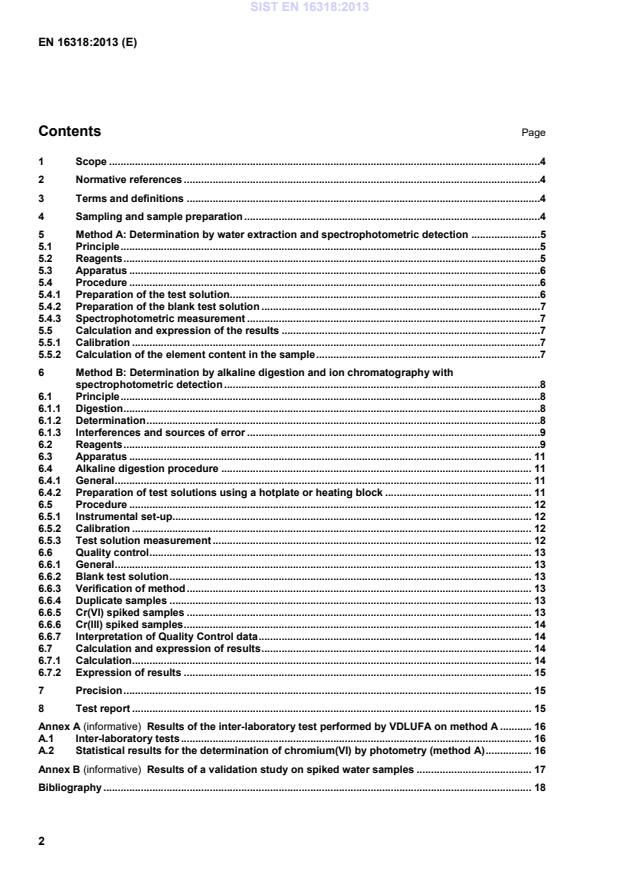
Results of the inter-laboratory test performed by VDLUFA on method A . 16 A.1 Inter-laboratory tests . 16 A.2 Statistical results for the determination of chromium(VI) by photometry (method A) . 16 Annex B (informative)
Results of a validation study on spiked water samples . 17 Bibliography . 18 SIST EN 16318:2013
Method A specifies the determination of chromate after extraction with water by photometry. This method can be used to determine Cr(VI)-mass fractions in solids higher than 1 mg/kg. Method B specifies the determination of chromate by alkaline digestion and ion chromatography with spectrophotometric detection. This method can be used to determine Cr(VI)-mass fractions in solids higher than 0,1 mg/kg. NOTE In case of reducing or oxidizing fertilizer matrix, no valid Cr(VI) content can be reported. 2 Normative references The following documents, in whole or in part, are normatively referenced in this document and are indispensable for its application. For dated references, only the edition cited applies. For undated references, the latest edition of the referenced document (including any amendments) applies. EN 1482-2, Fertilizers and liming materials — Sampling and sample preparation — Part 2: Sample preparation EN 12944-1:1999, Fertilizers and liming materials and soil improvers — Vocabulary — Part 1: General terms EN 12944-2:1999, Fertilizers and liming materials and soil improvers — Vocabulary — Part 2: Terms relating to fertilizers EN 15192:2006, Characterisation of waste and soil — Determination of Chromium(VI) in solid material by alkaline digestion and ion chromatography with spectrophotometric detection EN ISO 3696, Water for analytical laboratory use — Specification and test methods (ISO 3696) 3 Terms and definitions For the purposes of this document, the terms and definitions given in EN 12944-1:1999 and EN 12944-2:1999 apply. 4 Sampling and sample preparation Sampling is not part of the methods specified in this European Standard. A recommended sampling method is given in EN 1482-1 [2]. Sample preparation shall be carried out in accordance with EN 1482-2. Reasonable precautions have to be taken to prevent oxidation of chromate present in the sample. Samples shall be taken using appropriate devices and placed in containers that do not contain stainless steel (e.g. plastic, glass). After digestion, the sample shall be analyzed as soon as possible. SIST EN 16318:2013
When chromate reduces the 1,5-diphenylcarbazide a magenta coloured complex of 1,5-diphenylcarbazone and chromium is formed which can be measured colorimetrically at 540 nm. 5.2 Reagents Use only reagents of recognized analytical grade and water conforming to 5.2.1. 5.2.1 Water, according to EN ISO 3696, grade 2 (electrical conductivity max. 0,1 mS × m-1 equivalent to resistivity greater than 0,01 MΩ⋅m at 25 °C). It is recommended that the water used is obtained from a purification system that delivers ultrapure water having a resistivity greater than 0,18 MΩ⋅m. 5.2.2 Hydrochloric acid, c(HCl) = 12 mol/l; 37 % volume fraction,
≈ 1,18 g/ml. 5.2.3 Hydrochloric acid, diluted, c(HCl) approximately 6 mol/l. Mix equal volumes of hydrochloric acid (5.2.2) and water (5.2.1). 5.2.4 Diphenylcarbazide solution. Dissolve 1,0 g Diphenylcarbazide [CO(NHNHC6H5)2] in 100 ml acetone and add one drop of acetic acid. If this solution is stored in a glass bottle in the dark at 4 °C, it may be used for approximately two weeks. This solution shall be clear without colour. If the diphenylcarbazide solution has become coloured, it shall be discarded and freshly prepared before use. 5.2.5 Chromate standard stock solution, (chromate) = 1 000 mg/l. Dissolve 2 829 mg potassium dichromate (K2Cr2O7) in 1 000 ml water (5.2.1) using a volumetric flask. This solution may be used for two weeks if stored in the dark at 4 °C. 5.2.6 Chromate standard stock solution, (chromate) = 50 mg/l. Dilute 5 ml chromate stock solution (5.2.5) to 100 ml with water (5.2.1) using a volumetric flask. This solution shall be freshly prepared on the day of use. 5.2.7 Standard solutions. Prepare the standard solutions by diluting aliquots of the 50 mg/l chromate standard stock solution (5.2.6) with water (5.2.1) in 100 ml volumetric flasks. The aliquots and final concentrations of chromate are given in Table 1. Other volumes and concentrations may be used for the preparation of standard solutions if appropriate. See 5.4.3 for further instructions on how to prepare the standard solutions. SIST EN 16318:2013
0 (calibration blank) 0,05 0,025 0,20 0,10 0,50 0,25 1,00 0,50 1,50 0,75
A blank solution shall be prepared in a separate volumetric flask by adding water (5.2.1) only. The standard solutions shall be prepared freshly on the day of use. 5.3 Apparatus 5.3.1 Common laboratory glassware. 5.3.2 Analytical balance, capable of weighing to an accuracy of 1 mg. 5.3.3 Membrane filters and vacuum filtration apparatus.
The filters should be made of cellulose nitrate, pore size 5 µm and fit into the vacuum filtration apparatus. 5.3.4 Mechanical shaker. 5.3.5 Pipettes and/or dilutor, pipettes with fixed or variable volume and volumetric glassware to perform dilutions.
Alternatively, a dilutor may be used, which is an instrument used for automated volumetric dilutions. The precision and accuracy of this equipment for volumetric dilutions shall be proved, controlled, and documented regularly.
5.3.6 Spectrophotometer, capable to measure transmitted light at 540 nm. 5.3.7 100 ml bottles, made from PE or PP, equipped with watertight caps. 5.4 Procedure 5.4.1 Preparation of the test solution Weigh approximately 10 g, to the nearest 0,01 g, of the prepared sample and transfer to a suitable extraction vessel (5.3.7). Add 40 ml of water (5.2.1). If the sample material (e.g. organic material) absorbs a high amount of water, add additionally water (5.2.1) to obtain a fluid suspension. Record the amount of additional water added. It may be necessary to use larger extraction vessels in such cases. Close the cap tightly and shake vigorously for 15 min on a mechanical shaker (5.3.4). Filter the suspension immediately through membrane filters with 5 µm pore size using the vacuum filtration apparatus (5.3.3). SIST EN 16318:2013
5.4.3 Spectrophotometric measurement Add approximately 40 ml of water (5.2.1) to all volumetric flasks containing the standard solutions (5.2.7), the blank test solution (5.4.2) and the sample test solutions (5.4.1). Then add 2 ml diluted hydrochloric acid (5.2.3). The pH-value of the resulting solution should be between pH 1 and pH 2. Add more diluted hydrochloric acid (5.2.3) if the pH-value is higher until a pH-value between pH 1 and pH 2 is reached.
Add 2 ml diphenylcarbazide solution (5.2.4) to each volumetric flask and fill up to the mark with water (5.2.1). Wait 15 min and measure the extinction of the solutions on a spectrophotometer at 540 nm. 5.5 Calculation and expression of the results 5.5.1 Calibration In the case of a linear calibration curve, the calibration function can be described according to Formula (1). abcS+×= (1) where
S is the net signal for Cr(VI) in a solution;
c is the concentration of Cr(VI) in this solution, in milligrams per litre or in micrograms per litre;
b is the slope of the linear calibration function;
a is the intersection of the linear calibration function. Calculate the analyte concentration, cf, in the filtrate of the test portion using the slope b and the intersection a according to Formula (2): =baSc−=ff (2) where
Sf
is the net signal of the test solution. 5.5.2 Calculation of the element content in the sample Calculate the analyte concentration in the sample or the mass fraction of the analyte, wE, expressed in milligrams of analyte per kilogram of fertilizer according to Formula (3). ()1000tblfE××−=Vmccw (3) SIST EN 16318:2013
To quantify the content of Cr(VI) in a solid matrix, the following three criteria shall be satisfied: a) the digestion solution shall solubilize all species of Cr(VI); b) the conditions of the digestion shall not induce reduction of native Cr(VI) to Cr(III); c) the method shall not cause oxidation of native Cr(III) contained in the sample to Cr(VI). The alkaline digestion described in this document meets these criteria for a wide spectrum of solid matrices. Under the alkaline conditions, neglect able reduction of Cr(VI) or oxidation of native Cr(III) is expected. The addition of Mg2+ in a phosphate buffer to the alkaline solution prevents air oxidation of trivalent chromium (see [7], [8] and [9]). NOTE Background on methods for the determination of Cr(VI) in solid samples is given in EN 15192:2006, Annex D and [10], [11], [8]. 6.1.2 Determination The quantification of Cr(VI) in the alkaline digestion solution should be performed using a suitable technique with appropriate accuracy. For this purpose, ion chromatography is used to separate Cr(VI) from interferences. Following this ion chromatographic separation, Cr(VI) is measured spectrophotometrically either at 365 nm (direct UV detection) or after post-column derivatization with 1,5-diphenylcarbazide in acid solution at 540 nm. Post-column derivatization involves reaction of 1,5-diph
...
Questions, Comments and Discussion
Ask us and Technical Secretary will try to provide an answer. You can facilitate discussion about the standard in here.
Loading comments...