Fertilizers, liming materials and inhibitors - Determination of the quantity (declared by mass or volume)

This document specifies methods for the determination of quantity of the following solid and liquid fertilizing products: organic fertilizers, organo-mineral fertilizers, inorganic fertilizers, liming materials and inhibitors in packages, containers or in bulk.
This document is applicable to fertilizing products blends where organic fertilizers, organo-mineral fertilizers, inorganic fertilizers, liming materials and inhibitors are the highest % of the blend by mass or volume, or in the case of liquid form by dry mass. If organic fertilizers, organo-mineral fertilizers, inorganic fertilizers, liming materials and inhibitors are not the highest % of the blend, the European Standard for the highest % of the blend applies. In case a fertilizing product blend is made up of components in equal quantity, the user decides which standard to apply.
This document is not applicable to the quantity determination of: growing media, soil improvers and plant biostimulants.

Düngemittel, Kalkdünger und Hemmstoffe - Bestimmung der Menge (durch Angabe der Masse oder des Volumens)

Dieses Dokument legt Verfahren zur Bestimmung der Menge der folgenden festen und flüssigen Düngeprodukte fest: organische Düngemittel, organisch-mineralische Düngemittel, anorganische Düngemittel, Kalkdünger und Hemmstoffe in Packungen, Behältern oder in loser Form.
Dieses Dokument ist anwendbar auf Mischungen von Düngeprodukten, in denen organische Düngemittel, organisch-mineralische Düngemittel, anorganische Düngemittel, Kalkdünger und Hemmstoffe den höchsten prozentualen Anteil in der Mischung nach Masse oder Volumen oder, im Fall von flüssigen Formen, nach Trockenmasse ausmachen. Wenn organische Düngemittel, organisch-mineralische Düngemittel, anorganische Düngemittel, Kalkdünger und Hemmstoffe nicht den höchsten prozentualen Anteil in der Mischung ausmachen, ist die für den höchsten prozentualen Anteil geltende Europäische Norm anwendbar. Falls eine Düngeproduktmischung aus Bestandteilen gleicher Menge besteht, entscheidet der Anwender, welche Norm angewendet wird.
Dieses Dokument ist nicht anwendbar für die Bestimmung der Menge von: Kultursubstraten, Bodenverbesserungsmitteln und Pflanzen-Biostimulanzien.

Engrais, amendements minéraux basiques et inhibiteurs - Détermination de la quantité (déclarée en masse ou en volume)

Le présent document spécifie les méthodes à utiliser pour la détermination de la quantité de fertilisants suivants sous forme solide et liquide : engrais organiques, engrais organo-minéraux, engrais inorganiques, amendements minéraux basiques et inhibiteurs, dans des emballages, des conteneurs ou en vrac.
Le présent document est applicable aux mélanges de fertilisants dans lesquels les engrais organiques, les engrais organo-minéraux, les engrais inorganiques, les amendements minéraux basiques et les inhibiteurs représentent le % le plus élevé du mélange en masse ou en volume ou, pour les liquides, en masse sèche. Si les engrais organiques, les engrais organo-minéraux, les engrais inorganiques, les amendements minéraux basiques et les inhibiteurs ne représentent pas le % le plus élevé du mélange, la Norme européenne du composant représentant le % le plus élevé du mélange s’applique. Dans le cas où le mélange de fertilisants est constitué de composants en quantités égales, l’utilisateur décide quelle norme appliquer.
Le présent document ne s’applique pas à la détermination de la quantité des supports de culture, des amendements du sol et des biostimulants des végétaux.

Sredstva za gnojenje, sredstva za apnjenje in inhibitorji - Določanje količine (izražene kot masa ali prostornina)

Ta dokument določa metode za določanje količine naslednjih trdnih in tekočih sredstev za gnojenje: organskih gnojil, organsko-mineralnih gnojil, anorganskih gnojil, sredstev za apnenje in inhibitorjev v pakiranjih, posodah ali v razsutem stanju.
Ta dokument se uporablja za mešanice sredstev za gnojenje, pri katerih organska gnojila, organsko-mineralna gnojila, anorganska gnojila, sredstva za apnenje in inhibitorji predstavljajo največji masni ali prostorninski odstotek mešanice ali, v primeru tekoče oblike, odstotek suhe mase. Če organska gnojila, organsko-mineralna gnojila, anorganska gnojila, sredstva za apnenje in inhibitorji ne predstavljajo največjega odstotka mešanice, se uporablja evropski standard za najvišji odstotek mešanice. Če vsebuje mešanica sredstva za gnojenje komponente v enakih količinah, standard za uporabo izbere uporabnik.
Ta dokument se ne uporablja za določanje količine rastnih substratov, izboljševalcev tal in rastlinskih biostimulantov.

General Information

Status
Published
Publication Date
19-Dec-2023
Drafting Committee
CEN/TC 260/WG 1 - Sampling
Current Stage
6060 - Definitive text made available (DAV) - Publishing
Start Date
20-Dec-2023
Due Date
11-Sep-2023
Completion Date
20-Dec-2023

Overview

EN 17817:2023 (CEN) - Fertilizers, liming materials and inhibitors - Determination of the quantity (declared by mass or volume) - specifies harmonized methods to determine the quantity of solid and liquid fertilizing products: organic fertilizers, organo‑mineral fertilizers, inorganic fertilizers, liming materials and inhibitors. The standard covers products in packages, containers or bulk, and applies to blends where these product types represent the highest proportion by mass or volume (or by dry mass for liquids). It excludes growing media, soil improvers and plant biostimulants.

Key topics and technical requirements

  • Scope and definitions: clear definitions for product categories (organic, organo‑mineral, inorganic, liming materials, inhibitors), forms (solid, liquid, suspension, solution), and packaging terms (package, container, bulk).
  • Destructive vs non‑destructive testing: non‑destructive preferred for economic/practical reasons; destructive testing permitted when necessary.
  • Solid products declared by mass:
    • Use a non‑automatic weighing instrument compliant with EN 45501:2015.
    • Scale interval (sensitivity) must be no more than one fifth of the tolerable error permitted by Regulation (EU) 2019/1009 for the nominal quantity.
    • Example procedure for packages up to 25 kg: record gross mass (x), determine mean empty container mass from 10 samples (y), then net mass z = x − y.
  • Liquid products and volume declarations:
    • Procedures include volume measurement and density determination (methods specified in the standard) for conversions between mass and volume.
    • Apparatus checks and calibration steps are defined.
  • Equipment checks: weighing instruments shall be checked using weights complying with OIML R111‑1, with test weight error not exceeding one third of the instrument’s maximum error.
  • Test reporting: required documentation of methods, apparatus, calibration checks and results; Annex ZA links conformity assessment to Regulation (EU) 2019/1009.

Applications and users

EN 17817:2023 is used for:

  • Manufacturers, packers and importers to verify declared mass/volume for compliance with EU labelling and Regulation (EU) 2019/1009.
  • Quality control laboratories and conformity assessment bodies performing batch testing and verification of net quantities.
  • Market surveillance authorities and dispute resolution when declared contents are contested.
  • Practical settings include packaged bags, bottles, intermediate bulk containers, road tankers and bulk shipments.

Related Standards

  • EN 1482‑1 (sampling), EN 12580, EN 15238, EN 15761, EN 45501:2015 (non‑automatic weighing instruments)
  • OIML R111‑1 (calibration weights)
  • Annex ZA in EN 17817:2023 relates the methods to Regulation (EU) 2019/1009 on fertilizing products.

Keywords: EN 17817:2023, quantity determination, fertilizers, liming materials, inhibitors, declared by mass or volume, non‑destructive testing, weighing instrument, density determination, CEN.

Frequently Asked Questions

EN 17817:2023 is a standard published by the European Committee for Standardization (CEN). Its full title is "Fertilizers, liming materials and inhibitors - Determination of the quantity (declared by mass or volume)". This standard covers: This document specifies methods for the determination of quantity of the following solid and liquid fertilizing products: organic fertilizers, organo-mineral fertilizers, inorganic fertilizers, liming materials and inhibitors in packages, containers or in bulk. This document is applicable to fertilizing products blends where organic fertilizers, organo-mineral fertilizers, inorganic fertilizers, liming materials and inhibitors are the highest % of the blend by mass or volume, or in the case of liquid form by dry mass. If organic fertilizers, organo-mineral fertilizers, inorganic fertilizers, liming materials and inhibitors are not the highest % of the blend, the European Standard for the highest % of the blend applies. In case a fertilizing product blend is made up of components in equal quantity, the user decides which standard to apply. This document is not applicable to the quantity determination of: growing media, soil improvers and plant biostimulants.

This document specifies methods for the determination of quantity of the following solid and liquid fertilizing products: organic fertilizers, organo-mineral fertilizers, inorganic fertilizers, liming materials and inhibitors in packages, containers or in bulk. This document is applicable to fertilizing products blends where organic fertilizers, organo-mineral fertilizers, inorganic fertilizers, liming materials and inhibitors are the highest % of the blend by mass or volume, or in the case of liquid form by dry mass. If organic fertilizers, organo-mineral fertilizers, inorganic fertilizers, liming materials and inhibitors are not the highest % of the blend, the European Standard for the highest % of the blend applies. In case a fertilizing product blend is made up of components in equal quantity, the user decides which standard to apply. This document is not applicable to the quantity determination of: growing media, soil improvers and plant biostimulants.

EN 17817:2023 is classified under the following ICS (International Classification for Standards) categories: 65.080 - Fertilizers. The ICS classification helps identify the subject area and facilitates finding related standards.

EN 17817:2023 is associated with the following European legislation: EU Directives/Regulations: 2019/1009; Standardization Mandates: M/564, M/564 AMD 1, M/XXX. When a standard is cited in the Official Journal of the European Union, products manufactured in conformity with it benefit from a presumption of conformity with the essential requirements of the corresponding EU directive or regulation.

You can purchase EN 17817:2023 directly from iTeh Standards. The document is available in PDF format and is delivered instantly after payment. Add the standard to your cart and complete the secure checkout process. iTeh Standards is an authorized distributor of CEN standards.

Standards Content (Sample)


SLOVENSKI STANDARD
01-junij-2024
Sredstva za gnojenje, sredstva za apnjenje in inhibitorji - Določanje količine
(upoštevajoč maso ali prostornino)
Fertilizers, liming materials and inhibitors - Determination of the quantity (declared by
mass or volume)
Düngemittel, Kalkdünger und Hemmstoffe - Bestimmung der Menge (durch Angabe der
Masse oder des Volumens)
Engrais, amendements minéraux basiques et inhibiteurs - Détermination de la quantité
(déclarée en masse ou en volume)
Ta slovenski standard je istoveten z: EN 17817:2023
ICS:
65.080 Gnojila Fertilizers
2003-01.Slovenski inštitut za standardizacijo. Razmnoževanje celote ali delov tega standarda ni dovoljeno.

EN 17817
EUROPEAN STANDARD
NORME EUROPÉENNE
December 2023
EUROPÄISCHE NORM
ICS 65.080
English Version
Fertilizers, liming materials and inhibitors - Determination
of the quantity (declared by mass or volume)
Engrais, amendements minéraux basiques et Düngemittel, Kalkdünger und Hemmstoffe -
inhibiteurs - Détermination de la quantité (déclarée en Bestimmung der Menge (durch Angabe der Masse oder
masse ou en volume) des Volumens)
This European Standard was approved by CEN on 20 November 2023.

CEN members are bound to comply with the CEN/CENELEC Internal Regulations which stipulate the conditions for giving this
European Standard the status of a national standard without any alteration. Up-to-date lists and bibliographical references
concerning such national standards may be obtained on application to the CEN-CENELEC Management Centre or to any CEN
member.
This European Standard exists in three official versions (English, French, German). A version in any other language made by
translation under the responsibility of a CEN member into its own language and notified to the CEN-CENELEC Management
Centre has the same status as the official versions.

CEN members are the national standards bodies of Austria, Belgium, Bulgaria, Croatia, Cyprus, Czech Republic, Denmark, Estonia,
Finland, France, Germany, Greece, Hungary, Iceland, Ireland, Italy, Latvia, Lithuania, Luxembourg, Malta, Netherlands, Norway,
Poland, Portugal, Republic of North Macedonia, Romania, Serbia, Slovakia, Slovenia, Spain, Sweden, Switzerland, Türkiye and
United Kingdom.
EUROPEAN COMMITTEE FOR STANDARDIZATION
COMITÉ EUROPÉEN DE NORMALISATION

EUROPÄISCHES KOMITEE FÜR NORMUNG

CEN-CENELEC Management Centre: Rue de la Science 23, B-1040 Brussels
© 2023 CEN All rights of exploitation in any form and by any means reserved Ref. No. EN 17817:2023 E
worldwide for CEN national Members.

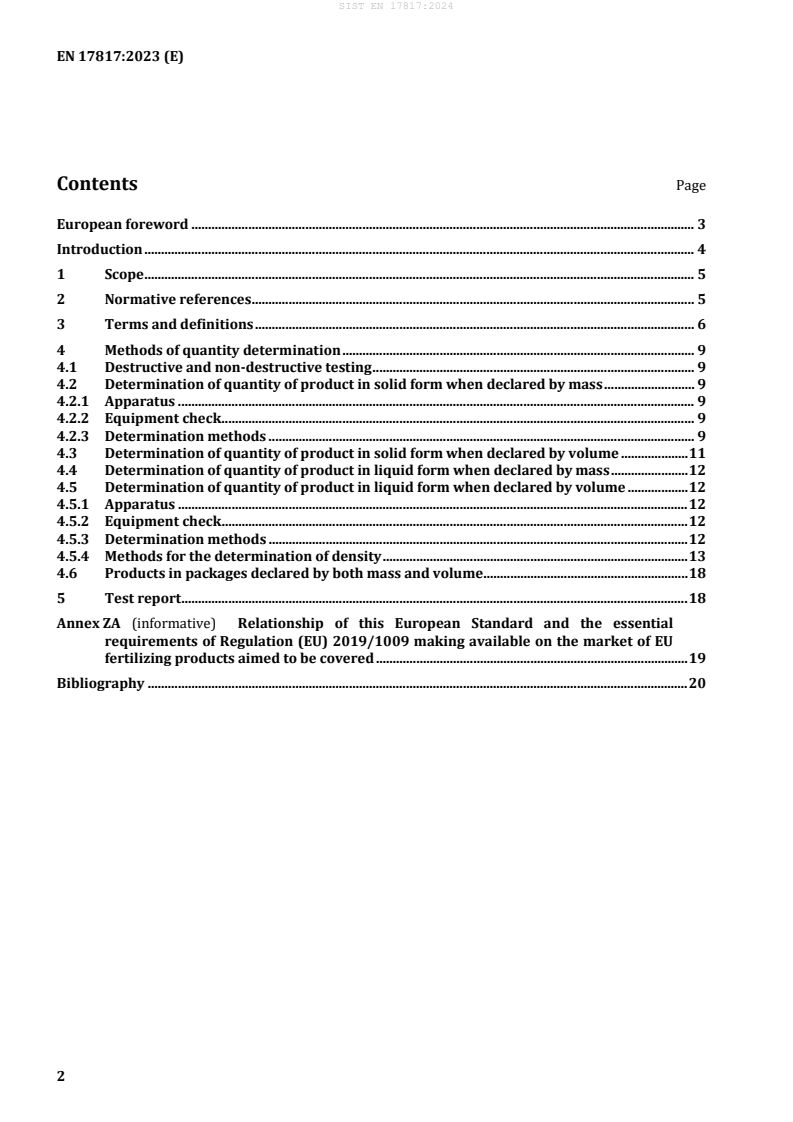
Contents Page
European foreword . 3
Introduction . 4
1 Scope . 5
2 Normative references . 5
3 Terms and definitions . 6
4 Methods of quantity determination . 9
4.1 Destructive and non-destructive testing . 9
4.2 Determination of quantity of product in solid form when declared by mass . 9
4.2.1 Apparatus . 9
4.2.2 Equipment check . 9
4.2.3 Determination methods . 9
4.3 Determination of quantity of product in solid form when declared by volume . 11
4.4 Determination of quantity of product in liquid form when declared by mass . 12
4.5 Determination of quantity of product in liquid form when declared by volume . 12
4.5.1 Apparatus . 12
4.5.2 Equipment check . 12
4.5.3 Determination methods . 12
4.5.4 Methods for the determination of density . 13
4.6 Products in packages declared by both mass and volume . 18
5 Test report . 18
Annex ZA (informative) Relationship of this European Standard and the essential
requirements of Regulation (EU) 2019/1009 making available on the market of EU
fertilizing products aimed to be covered . 19
Bibliography . 20
European foreword
This document (EN 17817:2023) has been prepared by Technical Committee CEN/TC 260 “Fertilizers
and liming materials”, the secretariat of which is held by DIN.
This European Standard shall be given the status of a national standard, either by publication of an
identical text or by endorsement, at the latest by June 2024, and conflicting national standards shall be
withdrawn at the latest by June 2024.
Attention is drawn to the possibility that some of the elements of this document may be the subject of
patent rights. CEN shall not be held responsible for identifying any or all such patent rights.
This document has been prepared under a standardization request addressed to CEN by the European
Commission. The Standing Committee of the EFTA States subsequently approves these requests for its
Member States.
For the relationship with EU Legislation, see informative Annex ZA, which is an integral part of this
document.
Any feedback and questions on this document should be directed to the users’ national standards body.
A complete listing of these bodies can be found on the CEN website.
According to the CEN-CENELEC Internal Regulations, the national standards organisations of the
following countries are bound to implement this European Standard: Austria, Belgium, Bulgaria,
Croatia, Cyprus, Czech Republic, Denmark, Estonia, Finland, France, Germany, Greece, Hungary, Iceland,
Ireland, Italy, Latvia, Lithuania, Luxembourg, Malta, Netherlands, Norway, Poland, Portugal, Republic of
North Macedonia, Romania, Serbia, Slovakia, Slovenia, Spain, Sweden, Switzerland, Türkiye and the
United Kingdom.
Introduction
In order to measure compliance with the related requirements of the Regulation (EU) 2019/1009 [4]
relevant test methods have to be specified in harmonized standards. In this document the
determination of the quantity of organic, organo-mineral and inorganic fertilizers, liming materials,
inhibitors and blends containing these fertilizing products is specified.
In this document, the term “product” is used as the generic term for the above-mentioned groups of
products.
1 Scope
This document specifies methods for the determination of quantity of the following solid and liquid
fertilizing products: organic fertilizers, organo-mineral fertilizers, inorganic fertilizers, liming materials
and inhibitors in packages, containers or in bulk.
This document is applicable to fertilizing products blends where organic fertilizers, organo-mineral
fertilizers, inorganic fertilizers, liming materials and inhibitors are the highest % of the blend by mass
or volume, or in the case of liquid form by dry mass. If organic fertilizers, organo-mineral fertilizers,
inorganic fertilizers, liming materials and inhibitors are not the highest % of the blend, the European
Standard for the highest % of the blend applies. In case a fertilizing product blend is made up of
components in equal quantity, the user decides which standard to apply.
This document is not applicable to the quantity determination of: growing media, soil improvers and
plant biostimulants.
2 Normative references
The following documents are referred to in the text in such a way that some or all of their content
constitutes requirements of this document. For dated references, only the edition cited applies. For
undated references, the latest edition of the referenced document (including any amendments) applies.
EN 1482-1:2007, Fertilizers and liming materials — Sampling and sample preparation — Part 1:
Sampling
EN 12580:2022, Soil improvers and growing media — Determination of a quantity
EN 12944-1:1999, Fertilizers and liming materials — Vocabulary — Part 1: General terms
EN 15238:2022, Soil improvers and growing media — Determination of quantity for materials with
particle size greater than 60 mm
EN 15761:2009, Pre-shaped growing media — Determination of length, width, height, volume and bulk
density
EN 45501:2015, Metrological aspects of non-automatic weighing instruments
OIML R 111-1:2004, Weights of classes E , E , F , F , M , M , M , M and M — Part 1: Metrological and
1 2 1 2 1 1–2 2 2–3 3
technical requirements
As impacted by EN 12944-1:1999/AC:2000.
3 Terms and definitions
For the purposes of this document, the terms and definitions given in EN 12944-1:1999, and the
following apply.
ISO and IEC maintain terminological databases for use in standardization at the following addresses:
— ISO Online browsing platform: available at https://www.iso.org/obp
— IEC Electropedia: available at https://www.electropedia.org/
3.1
fertilizing product
substance, mixture, micro-organism or any other material, applied or intended to be applied on plants
or their rhizosphere or on mushrooms or their mycosphere, or intended to constitute the rhizosphere
or mycosphere, either on its own or mixed with other material, for the purpose of providing the plants
or mushrooms with nutrient or improving their nutrition efficiency
Note 1 to entry: Based on Regulation (EU) 2019/1009 [4], Chapter 1, Article 2, (1).
3.2
organic fertilizer
fertilizer containing organic carbon and nutrients of solely biological origin
Note 1 to entry: An organic fertilizer may contain peat, leonardite and lignite, but no other material, which is
fossilized or embedded in geological formations.
Note 2 to entry: Based on Regulation (EU) 2019/1009 [4], Annex I, Part II, PFC 1(A), point 1.
3.3
organo-mineral fertilizer
fertilizer, which is a co-formulation of one or more inorganic fertilizers, and one or more materials
containing organic carbon and nutrients of solely biological origin
Note 1 to entry: An organo-mineral fertilizer may contain peat, leonardite and lignite, but no other material,
which is fossilized or embedded in geological formations.
Note 2 to entry: Based on Regulation (EU) 2019/1009 [4], Annex I, Part II, PFC 1(B), point 1.
3.4
inorganic fertilizer
fertilizer containing or releasing nutrients in a mineral form, other than an organic or organo-mineral
fertilizer
Note 1 to entry: Based on Regulation (EU) 2019/1009 [4], Annex I, Part II, PFC 1(C), point 1.
3.5
liming material
fertilizing product correcting soil acidity and containing oxides, hydroxides, carbonates or silicates of
the nutrients calcium or magnesium
Note 1 to entry: Based on Regulation (EU) 2019/1009 [4], Annex I, Part II, PFC 2, point 1.
3.6
inhibitor
fertilizing product improving the nutrient release patterns of a product providing plants with nutrients
by delaying or stopping the activity of specific groups of micro-organisms or enzymes
Note 1 to entry: Based on Regulation (EU) 2019/1009 [4], Annex I, Part II, PFC 5.
3.7
soil improver
fertilizing product, which maintains, improves or protects the physical or chemical properties, the
structure or the biological activity of the soil to which it is added
Note 1 to entry: Based on Regulation (EU) 2019/1009 [4], Annex I, Part II, PFC 3.
3.8
growing medium
fertilizing product, other than soil in situ, for plants or mushrooms to grow in
Note 1 to entry: Based on Regulation (EU) 2019/1009 [4], Annex I, Part II, PFC 4, point 1.
3.9
plant biostimulant
fertilizing product, which stimulates plant nutrition processes independently of the product’s nutrient
content with the sole aim of improving nutrient use efficiency, and/or tolerance to abiotic stress,
and/or quality traits, and/or availability of confined nutrients in the soil or rhizosphere
Note 1 to entry: Based on Regulation (EU) 2019/1009 [4], Annex I, Part II, PFC 6, point 1.
3.10
liquid form
suspension or solution
Note 1 to entry: Based on Regulation (EU) 2019/1009 [4], Chapter 1, Article 2, (6).
3.11
suspension
two-phase dispersion in which solid particles are maintained in suspension in the liquid phase
Note 1 to entry: Based on Regulation (EU) 2019/1009 [4], Chapter 1, Article 2, (6).
3.12
solution
liquid or gel or paste that is free of solid particles
Note 1 to entry: Based on Regulation (EU) 2019/1009 [4], Chapter 1, Article 2, (6).
3.13
solid form
form characterised by structural rigidity and resistance to changes of shape or volume and in which
atoms are tightly bound to each other, either in a regular geometric lattice (crystalline solids) or in an
irregular manner (an amorphous solid)
Note 1 to entry: Based on Regulation (EU) 2019/1009 [4], Chapter 1, Article 2, (7).
3.14
destructive testing
testing which involves opening or destroying of the package
Note 1 to entry: Based on Council Directive 76/211/EEC [1], Annex II, 2.
3.15
non-destructive testing
testing which does not involve the opening or destroying of the package
Note 1 to entry: Based on Council Directive 76/211/EEC [1], Annex II, 2.
3.16
weighing instrument
measuring instrument serving to determine the mass of a body by using the action of gravity on that
body
Note 1 to entry: Based on Directive 2014/31/EU [2], Chapter 1, Article 2, (1).
3.17
non-automatic weighing instrument
weighing instrument requiring the intervention of an operator during the weighing process to decide
that the weighing result is acceptable
Note 1 to entry: Based on Directive 2014/31/EU [2], Chapter 1, Article 2, (2).
3.18
nominal quantity
declared mass or volume of the contents of a package or container indicated on or with the package or
in documentation associated with the contents
3.19
net quantity
actual mass or volume of the contents of a package
3.20
gross quantity
mass or volume of package
3.21
package
container and product contained therein which is ready for delivery or delivered and where the
packaging remains with the material after delivery
3.22
container
object in which a product is delivered
EXAMPLE Bottle, box, bag, intermediate bulk container, road tanker, lorry.
3.23
bulk product
product that is not in a package
4 Methods of quantity determination
4.1 Destructive and non-destructive testing
For economic and practical reasons destructive testing should be used only when non-destructive
testing is impractical.
4.2 Determination of quantity of product in solid form when declared by mass
4.2.1 Apparatus
Weighing instrument, shall be of a suitable type and sufficiently accurate to determine the gross
quantity of the package and mass of the container used so that a net quantity of the contents can be
determined.
“Suitable type” means a non-automatic weighing instrument that complies with the requirements of
EN 45501:2015.
“Sufficiently accurate” means that the scale intervals or sensitivity of the non-automatic weighing
instrument shall be no more than one fifth of the tolerable error permitted by the Regulation (EU)
2019/1009 [4] in relation to the nominal quantity being weighed.
Since half a graduation can be read on an analogue indicator non-automatic weighing instrument mass
display, digital display instruments will need to indicate 50 % of the minimum required for an analogue
indicator instrument.
4.2.2 Equipment check
Before using the non-automatic weighing instrument to establish the quantity, it shall be checked with
weights which comply with OIML R111-1 and have a measurement error of no more than one third of
the maximum error for the non-automatic weighing instrument under test. The tests shall be performed
according to EN 45501:2015.
A record should be kept of the results of the tests.
4.2.3 Determination methods
4.2.3.1 Packages up to 25 kg
The net quantity of material in any individual package is obtained by the difference between the gross
quantity and the mass of an empty container.
Place each package under test on the weighing plate of the non-automatic weighing instrument and
record the gross quantity (x).
Determine the mass of each of 10 randomly selected empty containers, record the masses and obtain a
mean mass of the containers (y). Record the calculation and result (non-destructive testing).
If empty containers are not available, empty and weigh 10 containers randomly selected from those
already weighed gross after ensuring no product remains in or on the containers. Obtain a mean mass
for the containers as above (y) (destructive testing).
If less than 10 packages are being tested, and empty containers are not available, destructive testing
should be carried out on all packages under test.
Subtract the mean mass of the containers from the gross quantity of each packed product and calculate
and record each net quantity (z) using Formula (1).
z xy− (1)
where
z is the net quantity by mass of the contents of an individual package in g;
x is the gross quantity by mass of an individual package in g;
y is the mean mass of the empty containers in g.
4.2.3.2 Packages more than 25 kg
These are packages which cannot be manually handled and require larger capacity non-automatic
weighing instruments to ascertain their gross mass.
The non-automatic weighing instrument used shall be of a suitable type and sufficiently accurate for the
net quantity in the package (see 4.2.1).
The procedure detailed in 4.2.3.1 shall be followed except that the number of empty containers to be
weighed may be reduced to 5 or all under test if less than 5.
4.2.3.3 Product sold in bulk
4.2.3.3.1 Product to be delivered in transport containers
This product will need to be loaded into some type of transport container (vehicle, large container or
other suitable method of containing the product). Use a non-automatic weighing instrument suitable for
the quantity of product in the container/consignment (see 4.2.1). The transport container shall be
weighed empty and the mass (m ) recorded. The product shall then be placed in the transport container
t
and the gross quantity (m ) recorded. Calculate the net quantity (m ) of the product using Formula (2).
g n
m mm− (2)
n gt
where
m is the net quantity of the product in kg;
n
m is the gross quantity of the product and transport container in kg;
g
m is the mass of the transport container empty in kg.
t
NOTE It is equally acceptable to weigh the gross quantity first and then empty the transport container and
determine the mass empty.
4.2.3.3.2 Product to be delivered in large quantities
One of the following methods shall be used.
Met
...


SLOVENSKI STANDARD
01-junij-2024
Sredstva za gnojenje, sredstva za apnjenje in inhibitorji - Določanje količine
(izražene kot masa ali prostornina)
Fertilizers, liming materials and inhibitors - Determination of the quantity (declared by
mass or volume)
Düngemittel, Kalkdünger und Hemmstoffe - Bestimmung der Menge (durch Angabe der
Masse oder des Volumens)
Engrais, amendements minéraux basiques et inhibiteurs - Détermination de la quantité
(déclarée en masse ou en volume)
Ta slovenski standard je istoveten z: EN 17817:2023
ICS:
65.080 Gnojila Fertilizers
2003-01.Slovenski inštitut za standardizacijo. Razmnoževanje celote ali delov tega standarda ni dovoljeno.

EN 17817
EUROPEAN STANDARD
NORME EUROPÉENNE
December 2023
EUROPÄISCHE NORM
ICS 65.080
English Version
Fertilizers, liming materials and inhibitors - Determination
of the quantity (declared by mass or volume)
Engrais, amendements minéraux basiques et Düngemittel, Kalkdünger und Hemmstoffe -
inhibiteurs - Détermination de la quantité (déclarée en Bestimmung der Menge (durch Angabe der Masse oder
masse ou en volume) des Volumens)
This European Standard was approved by CEN on 20 November 2023.

CEN members are bound to comply with the CEN/CENELEC Internal Regulations which stipulate the conditions for giving this
European Standard the status of a national standard without any alteration. Up-to-date lists and bibliographical references
concerning such national standards may be obtained on application to the CEN-CENELEC Management Centre or to any CEN
member.
This European Standard exists in three official versions (English, French, German). A version in any other language made by
translation under the responsibility of a CEN member into its own language and notified to the CEN-CENELEC Management
Centre has the same status as the official versions.

CEN members are the national standards bodies of Austria, Belgium, Bulgaria, Croatia, Cyprus, Czech Republic, Denmark, Estonia,
Finland, France, Germany, Greece, Hungary, Iceland, Ireland, Italy, Latvia, Lithuania, Luxembourg, Malta, Netherlands, Norway,
Poland, Portugal, Republic of North Macedonia, Romania, Serbia, Slovakia, Slovenia, Spain, Sweden, Switzerland, Türkiye and
United Kingdom.
EUROPEAN COMMITTEE FOR STANDARDIZATION
COMITÉ EUROPÉEN DE NORMALISATION

EUROPÄISCHES KOMITEE FÜR NORMUNG

CEN-CENELEC Management Centre: Rue de la Science 23, B-1040 Brussels
© 2023 CEN All rights of exploitation in any form and by any means reserved Ref. No. EN 17817:2023 E
worldwide for CEN national Members.

Contents Page
European foreword . 3
Introduction . 4
1 Scope . 5
2 Normative references . 5
3 Terms and definitions . 6
4 Methods of quantity determination . 9
4.1 Destructive and non-destructive testing . 9
4.2 Determination of quantity of product in solid form when declared by mass . 9
4.2.1 Apparatus . 9
4.2.2 Equipment check . 9
4.2.3 Determination methods . 9
4.3 Determination of quantity of product in solid form when declared by volume . 11
4.4 Determination of quantity of product in liquid form when declared by mass . 12
4.5 Determination of quantity of product in liquid form when declared by volume . 12
4.5.1 Apparatus . 12
4.5.2 Equipment check . 12
4.5.3 Determination methods . 12
4.5.4 Methods for the determination of density . 13
4.6 Products in packages declared by both mass and volume . 18
5 Test report . 18
Annex ZA (informative) Relationship of this European Standard and the essential
requirements of Regulation (EU) 2019/1009 making available on the market of EU
fertilizing products aimed to be covered . 19
Bibliography . 20
European foreword
This document (EN 17817:2023) has been prepared by Technical Committee CEN/TC 260 “Fertilizers
and liming materials”, the secretariat of which is held by DIN.
This European Standard shall be given the status of a national standard, either by publication of an
identical text or by endorsement, at the latest by June 2024, and conflicting national standards shall be
withdrawn at the latest by June 2024.
Attention is drawn to the possibility that some of the elements of this document may be the subject of
patent rights. CEN shall not be held responsible for identifying any or all such patent rights.
This document has been prepared under a standardization request addressed to CEN by the European
Commission. The Standing Committee of the EFTA States subsequently approves these requests for its
Member States.
For the relationship with EU Legislation, see informative Annex ZA, which is an integral part of this
document.
Any feedback and questions on this document should be directed to the users’ national standards body.
A complete listing of these bodies can be found on the CEN website.
According to the CEN-CENELEC Internal Regulations, the national standards organisations of the
following countries are bound to implement this European Standard: Austria, Belgium, Bulgaria,
Croatia, Cyprus, Czech Republic, Denmark, Estonia, Finland, France, Germany, Greece, Hungary, Iceland,
Ireland, Italy, Latvia, Lithuania, Luxembourg, Malta, Netherlands, Norway, Poland, Portugal, Republic of
North Macedonia, Romania, Serbia, Slovakia, Slovenia, Spain, Sweden, Switzerland, Türkiye and the
United Kingdom.
Introduction
In order to measure compliance with the related requirements of the Regulation (EU) 2019/1009 [4]
relevant test methods have to be specified in harmonized standards. In this document the
determination of the quantity of organic, organo-mineral and inorganic fertilizers, liming materials,
inhibitors and blends containing these fertilizing products is specified.
In this document, the term “product” is used as the generic term for the above-mentioned groups of
products.
1 Scope
This document specifies methods for the determination of quantity of the following solid and liquid
fertilizing products: organic fertilizers, organo-mineral fertilizers, inorganic fertilizers, liming materials
and inhibitors in packages, containers or in bulk.
This document is applicable to fertilizing products blends where organic fertilizers, organo-mineral
fertilizers, inorganic fertilizers, liming materials and inhibitors are the highest % of the blend by mass
or volume, or in the case of liquid form by dry mass. If organic fertilizers, organo-mineral fertilizers,
inorganic fertilizers, liming materials and inhibitors are not the highest % of the blend, the European
Standard for the highest % of the blend applies. In case a fertilizing product blend is made up of
components in equal quantity, the user decides which standard to apply.
This document is not applicable to the quantity determination of: growing media, soil improvers and
plant biostimulants.
2 Normative references
The following documents are referred to in the text in such a way that some or all of their content
constitutes requirements of this document. For dated references, only the edition cited applies. For
undated references, the latest edition of the referenced document (including any amendments) applies.
EN 1482-1:2007, Fertilizers and liming materials — Sampling and sample preparation — Part 1:
Sampling
EN 12580:2022, Soil improvers and growing media — Determination of a quantity
EN 12944-1:1999, Fertilizers and liming materials — Vocabulary — Part 1: General terms
EN 15238:2022, Soil improvers and growing media — Determination of quantity for materials with
particle size greater than 60 mm
EN 15761:2009, Pre-shaped growing media — Determination of length, width, height, volume and bulk
density
EN 45501:2015, Metrological aspects of non-automatic weighing instruments
OIML R 111-1:2004, Weights of classes E , E , F , F , M , M , M , M and M — Part 1: Metrological and
1 2 1 2 1 1–2 2 2–3 3
technical requirements
As impacted by EN 12944-1:1999/AC:2000.
3 Terms and definitions
For the purposes of this document, the terms and definitions given in EN 12944-1:1999, and the
following apply.
ISO and IEC maintain terminological databases for use in standardization at the following addresses:
— ISO Online browsing platform: available at https://www.iso.org/obp
— IEC Electropedia: available at https://www.electropedia.org/
3.1
fertilizing product
substance, mixture, micro-organism or any other material, applied or intended to be applied on plants
or their rhizosphere or on mushrooms or their mycosphere, or intended to constitute the rhizosphere
or mycosphere, either on its own or mixed with other material, for the purpose of providing the plants
or mushrooms with nutrient or improving their nutrition efficiency
Note 1 to entry: Based on Regulation (EU) 2019/1009 [4], Chapter 1, Article 2, (1).
3.2
organic fertilizer
fertilizer containing organic carbon and nutrients of solely biological origin
Note 1 to entry: An organic fertilizer may contain peat, leonardite and lignite, but no other material, which is
fossilized or embedded in geological formations.
Note 2 to entry: Based on Regulation (EU) 2019/1009 [4], Annex I, Part II, PFC 1(A), point 1.
3.3
organo-mineral fertilizer
fertilizer, which is a co-formulation of one or more inorganic fertilizers, and one or more materials
containing organic carbon and nutrients of solely biological origin
Note 1 to entry: An organo-mineral fertilizer may contain peat, leonardite and lignite, but no other material,
which is fossilized or embedded in geological formations.
Note 2 to entry: Based on Regulation (EU) 2019/1009 [4], Annex I, Part II, PFC 1(B), point 1.
3.4
inorganic fertilizer
fertilizer containing or releasing nutrients in a mineral form, other than an organic or organo-mineral
fertilizer
Note 1 to entry: Based on Regulation (EU) 2019/1009 [4], Annex I, Part II, PFC 1(C), point 1.
3.5
liming material
fertilizing product correcting soil acidity and containing oxides, hydroxides, carbonates or silicates of
the nutrients calcium or magnesium
Note 1 to entry: Based on Regulation (EU) 2019/1009 [4], Annex I, Part II, PFC 2, point 1.
3.6
inhibitor
fertilizing product improving the nutrient release patterns of a product providing plants with nutrients
by delaying or stopping the activity of specific groups of micro-organisms or enzymes
Note 1 to entry: Based on Regulation (EU) 2019/1009 [4], Annex I, Part II, PFC 5.
3.7
soil improver
fertilizing product, which maintains, improves or protects the physical or chemical properties, the
structure or the biological activity of the soil to which it is added
Note 1 to entry: Based on Regulation (EU) 2019/1009 [4], Annex I, Part II, PFC 3.
3.8
growing medium
fertilizing product, other than soil in situ, for plants or mushrooms to grow in
Note 1 to entry: Based on Regulation (EU) 2019/1009 [4], Annex I, Part II, PFC 4, point 1.
3.9
plant biostimulant
fertilizing product, which stimulates plant nutrition processes independently of the product’s nutrient
content with the sole aim of improving nutrient use efficiency, and/or tolerance to abiotic stress,
and/or quality traits, and/or availability of confined nutrients in the soil or rhizosphere
Note 1 to entry: Based on Regulation (EU) 2019/1009 [4], Annex I, Part II, PFC 6, point 1.
3.10
liquid form
suspension or solution
Note 1 to entry: Based on Regulation (EU) 2019/1009 [4], Chapter 1, Article 2, (6).
3.11
suspension
two-phase dispersion in which solid particles are maintained in suspension in the liquid phase
Note 1 to entry: Based on Regulation (EU) 2019/1009 [4], Chapter 1, Article 2, (6).
3.12
solution
liquid or gel or paste that is free of solid particles
Note 1 to entry: Based on Regulation (EU) 2019/1009 [4], Chapter 1, Article 2, (6).
3.13
solid form
form characterised by structural rigidity and resistance to changes of shape or volume and in which
atoms are tightly bound to each other, either in a regular geometric lattice (crystalline solids) or in an
irregular manner (an amorphous solid)
Note 1 to entry: Based on Regulation (EU) 2019/1009 [4], Chapter 1, Article 2, (7).
3.14
destructive testing
testing which involves opening or destroying of the package
Note 1 to entry: Based on Council Directive 76/211/EEC [1], Annex II, 2.
3.15
non-destructive testing
testing which does not involve the opening or destroying of the package
Note 1 to entry: Based on Council Directive 76/211/EEC [1], Annex II, 2.
3.16
weighing instrument
measuring instrument serving to determine the mass of a body by using the action of gravity on that
body
Note 1 to entry: Based on Directive 2014/31/EU [2], Chapter 1, Article 2, (1).
3.17
non-automatic weighing instrument
weighing instrument requiring the intervention of an operator during the weighing process to decide
that the weighing result is acceptable
Note 1 to entry: Based on Directive 2014/31/EU [2], Chapter 1, Article 2, (2).
3.18
nominal quantity
declared mass or volume of the contents of a package or container indicated on or with the package or
in documentation associated with the contents
3.19
net quantity
actual mass or volume of the contents of a package
3.20
gross quantity
mass or volume of package
3.21
package
container and product contained therein which is ready for delivery or delivered and where the
packaging remains with the material after delivery
3.22
container
object in which a product is delivered
EXAMPLE Bottle, box, bag, intermediate bulk container, road tanker, lorry.
3.23
bulk product
product that is not in a package
4 Methods of quantity determination
4.1 Destructive and non-destructive testing
For economic and practical reasons destructive testing should be used only when non-destructive
testing is impractical.
4.2 Determination of quantity of product in solid form when declared by mass
4.2.1 Apparatus
Weighing instrument, shall be of a suitable type and sufficiently accurate to determine the gross
quantity of the package and mass of the container used so that a net quantity of the contents can be
determined.
“Suitable type” means a non-automatic weighing instrument that complies with the requirements of
EN 45501:2015.
“Sufficiently accurate” means that the scale intervals or sensitivity of the non-automatic weighing
instrument shall be no more than one fifth of the tolerable error permitted by the Regulation (EU)
2019/1009 [4] in relation to the nominal quantity being weighed.
Since half a graduation can be read on an analogue indicator non-automatic weighing instrument mass
display, digital display instruments will need to indicate 50 % of the minimum required for an analogue
indicator instrument.
4.2.2 Equipment check
Before using the non-automatic weighing instrument to establish the quantity, it shall be checked with
weights which comply with OIML R111-1 and have a measurement error of no more than one third of
the maximum error for the non-automatic weighing instrument under test. The tests shall be performed
according to EN 45501:2015.
A record should be kept of the results of the tests.
4.2.3 Determination methods
4.2.3.1 Packages up to 25 kg
The net quantity of material in any individual package is obtained by the difference between the gross
quantity and the mass of an empty container.
Place each package under test on the weighing plate of the non-automatic weighing instrument and
record the gross quantity (x).
Determine the mass of each of 10 randomly selected empty containers, record the masses and obtain a
mean mass of the containers (y). Record the calculation and result (non-destructive testing).
If empty containers are not available, empty and weigh 10 containers randomly selected from those
already weighed gross after ensuring no product remains in or on the containers. Obtain a mean mass
for the containers as above (y) (destructive testing).
If less than 10 packages are being tested, and empty containers are not available, destructive testing
should be carried out on all packages under test.
Subtract the mean mass of the containers from the gross quantity of each packed product and calculate
and record each net quantity (z) using Formula (1).
z xy− (1)
where
z is the net quantity by mass of the contents of an individual package in g;
x is the gross quantity by mass of an individual package in g;
y is the mean mass of the empty containers in g.
4.2.3.2 Packages more than 25 kg
These are packages which cannot be manually handled and require larger capacity non-automatic
weighing instruments to ascertain their gross mass.
The non-automatic weighing instrument used shall be of a suitable type and sufficiently accurate for the
net quantity in the package (see 4.2.1).
The procedure detailed in 4.2.3.1 shall be followed except that the number of empty containers to be
weighed may be reduced to 5 or all under test if less than 5.
4.2.3.3 Product sold in bulk
4.2.3.3.1 Product to be delivered in transport containers
This product will need to be loaded into some type of transport container (vehicle, large container or
other suitable method of containing the product). Use a non-automatic weighing instrument suitable for
the quantity of product in the container/consignment (see 4.2.1). The transport container shall be
weighed empty and the mass (m ) recorded. The product shall then be placed in the transport container
t
and the gross quantity (m ) recorded. Calculate the net quantity (m ) of the product using Formula (2).
g n
m mm− (2)
n gt
where
m is the net quantity of the product in kg;
n
m is the gross quantity of the product and transport container in kg;
g
m is the mass of the transport container empty in kg.
t
NOTE It is equally acceptable to weigh the gross quantity first and then empty the transport container and
determine the mass empty.
4.2.3.3.2 Product to be delivered in large quantities
One of the following methods shall be used.
Me
...

Questions, Comments and Discussion

Ask us and Technical Secretary will try to provide an answer. You can facilitate discussion about the standard in here.

Loading comments...

Die Norm EN 17817:2023 behandelt die Bestimmung der Menge von Düngemitteln, Kalkungsmaterialien und Inhibitoren. Sie legt spezielle Methoden fest zur Ermittlung der Mengen von festen und flüssigen Düngemittelprodukten, einschließlich organischer Düngemittel, organo-mineraler Düngemittel, anorganischer Düngemittel, Kalkungsmaterialien und Inhibitoren, die in Verpackungen, Behältern oder in loser Form vorliegen. Der umfassende Anwendungsbereich dieser Norm gewährleistet eine präzise Quantifizierung der relevanten Düngemittelprodukte und bietet somit eine essentielle Grundlage für die Landwirtschaft und den Gartenbau. Ein herausragendes Merkmal der EN 17817:2023 ist ihre Anwendbarkeit auf Düngemittelmischungen, in denen die oben genannten Produkte den höchsten prozentualen Anteil an der Mischung nach Masse oder Volumen ausmachen. Diese Festlegung erleichtert die Konformität und Einheitlichkeit in der Anwendung der Standards. Somit wird sichergestellt, dass die Nutzer wissen, welche Methode zur Mengenbestimmung bei ihren spezifischen Produkten anzuwenden ist. Die Regelung, dass im Falle von gleichen Mengen bei den Komponenten der Mischungen der Anwender entscheidet, welcher Standard anzuwenden ist, fördert zudem die Flexibilität und Anpassungsfähigkeit in der industriellen Praxis. Ein weiterer wichtiger Aspekt dieser Norm ist die klare Abgrenzung von ihrem Anwendungsbereich. Die Norm ist nicht auf die Mengenbestimmung von Wachstumsmedien, Bodenverbesserern und Pflanzenbiostimulanzien anwendbar, was die Nutzer davor schützt, fehlerhafte Standards auf nicht relevante Produkte anzuwenden. Dies verringert Missverständnisse und potenzielle Fehlerquellen in der Anwendung, was die Relevanz der Norm in der Praxis unterstreicht. Die Norm EN 17817:2023 ist somit eine unverzichtbare Richtlinie für die Bestimmung der Menge von Düngemitteln, Kalkungsmaterialien und Inhibitoren, die durch ihre klare Struktur und spezifischen Anwendungshinweise nicht nur die Qualitätssicherung in der Landwirtschaft unterstützt, sondern auch zur nachhaltigen Nutzung von Düngemitteln beiträgt.

La norme EN 17817:2023 a pour objectif l'harmonisation des méthodes de détermination de la quantité des produits de fertilisation solides et liquides tels que les engrais organiques, organo-minéraux, inorganiques, ainsi que les matériaux de calcaire et les inhibiteurs, que ce soit en paquets, en conteneurs ou en vrac. Le champ d'application de ce document est particulièrement pertinent pour les blends de produits fertilisants où les engrais organiques, organo-minéraux, inorganiques, matériaux de calcaire et inhibiteurs constituent la plus grande proportion, que ce soit par masse ou volume, ou dans le cas des formats liquides par masse sèche. Un des points forts de cette norme réside dans sa capacité à fournir des méthodes précises et fiables pour la quantification des produits fertilisants, permettant aux utilisateurs de garantir la conformité et la qualité de leurs matières premières. Cette norme assure également que, lors de la composition de blends, les utilisateurs aient la flexibilité nécessaire pour choisir la norme appropriée lorsque les composants sont en quantités égales, rendant ainsi le cadre d'application plus adaptable aux différentes situations. Par ailleurs, il convient de noter que la norme exclut spécifiquement la détermination de la quantité des milieux de culture, des améliorants de sols et des biostimulants végétaux. Cela permet de se concentrer uniquement sur les systèmes d'engrais traditionnels et d'inhibiteurs, renforçant ainsi la précision des applications de la norme et son importance dans un secteur en constante évolution. En somme, le document SIST EN 17817:2024 se révèle essentiel pour tous les acteurs de l'industrie des fertilisants, étant donné son approche systématique et rigoureuse, ainsi que sa pertinence face aux exigences croissantes en matière de qualité et de durabilité des produits agricoles.

The EN 17817:2023 standard provides a comprehensive framework for determining the quantity of various solid and liquid fertilizing products, including organic fertilizers, organo-mineral fertilizers, inorganic fertilizers, liming materials, and inhibitors. With a focus on ensuring accuracy in measurement, this standard is essential for manufacturers and suppliers in the agricultural industry who need to declare quantities with confidence. One of the key strengths of this standard is its clear delineation of applicability, which allows users to understand when and how to apply the standard based on the composition of the fertilizing products. By specifying that the methods outlined are applicable only when the pollutants such as organic fertilizers or other specified types constitute the highest percentage by mass or volume in a blend, it effectively narrows the scope to relevant scenarios. This targeted approach enhances the usefulness of the standard, ensuring that it aligns with practical applications in the field. Additionally, the exclusion of certain products such as growing media and soil improvers from the standard's scope provides clarity and prevents ambiguity regarding its application. This specificity ensures that users are not misled and can focus on the appropriate guidelines for fertilizers, liming materials, and inhibitors. The standard's relevance in today's context is underscored by the increasing demand for standardized practices in the agricultural sector, particularly as it relates to sustainability and environmental responsibility. By providing robust methods for quantity determination, EN 17817:2023 aids in compliance with regulatory requirements while promoting transparency in product listings. In conclusion, the standardization document SIST EN 17817:2024 is a significant addition to the existing guidelines for fertilizing products, reinforcing the importance of accurate quantity determination within the agriculture supply chain. Its scope, strengths, and practical relevance make it a crucial resource for anyone involved in the production, distribution, or regulation of fertilizers and related materials.

EN 17817:2023は、肥料、石灰材料、および抑制剤の質量または体積により宣言された量の測定に関する標準化文書です。この標準は、固体および液体肥料製品の量を測定するための方法を明確に定義しており、具体的には有機肥料、オルガノミネラル肥料、無機肥料、石灰材料、及び抑制剤が含まれます。これにより、肥料製品の正確な量を確保するための基本的な枠組みが提供されています。 この標準の強みは、肥料製品のブレンドにおける有機肥料、オルガノミネラル肥料、無機肥料、石灰材料、及び抑制剤の割合が最も高い場合に適用され、販売されるパッケージやコンテナ、バルクの状態でこれらの肥料を正確に評価できる点にあります。また、液体形式の製品においても、乾燥質量に基づいて適切に対応します。これにより、さまざまな状態での肥料製品の公正な評価が強調されています。 さらに、同標準の適用範囲は、肥料製品のブレンドが成分ごとに均等である場合、ユーザーが適用する標準を選択できる柔軟性も提供しています。これにより、多様な肥料市場に対応したニーズを満たすことができます。 ただし、EN 17817:2023は、成長媒体、土壌改良材、植物バイオスティミュラントの量の測定には適用されないため、これらの製品に関する別の基準が必要となります。これにより、特定の製品群についての明確なガイダンスが保たれています。 以上の点から、EN 17817:2023は、肥料や関連製品の市場において、精度と透明性を促進する重要な標準であるといえます。肥料の量に関する正確な評価を可能にし、規制の遵守を助けるため、業界にとっての重要性は非常に高いです。

표준 EN 17817:2023은 비료, 석회질 물질 및 억제제의 질량 또는 부피에 의해 표시된 양의 결정을 위한 방법을 구체적으로 제시합니다. 이 문서는 유기 비료, 유기-무기 혼합 비료, 무기 비료, 석회질 물질 및 억제제와 같은 고형 및 액체 비료 제품의 양을 측정하는 데 필요한 표준화된 방법을 제공합니다. 특히, 이 표준은 비료 제품 혼합체에서 유기 비료, 유기-무기 비료, 무기 비료, 석회질 물질 및 억제제가 혼합물의 질량 또는 부피 기준으로 가장 높은 비율을 차지하는 경우에 적용됩니다. 이러한 기준은 비료 제품의 신뢰성을 높이는 데 기여하며, 사용자가 이를 통해 적절한 품질의 비료를 선택할 수 있도록 지원합니다. 이 표준의 강점은 명확한 규정을 바탕으로 다양한 유형의 비료 제품에 대한 정확한 양의 결정을 가능하게 한다는 점입니다. 이는 농업 분야에서 비료의 효과를 극대화하고, 자원의 효율적인 사용을 도모하는 데 매우 중요한 요소입니다. 또한, 액체 형태의 경우, 건조 질량에 따라 양을 결정하는 방식을 명시함으로써 다양한 형태의 비료에 대한 철저한 평가가 이루어질 수 있게 합니다. EN 17817:2023은 비료와 관련된 제품의 포장이나 벌크 상태에서의 측정 방법에 중점을 두며, 사용자에게 혼합물의 조성에 따라 적합한 표준을 선택할 수 있는 유연성을 제공합니다. 다만, 이 문서는 재배 매체, 토양 개량재 및 식물 생장 촉진제의 양 결정에는 적용되지 않음을 명시하고 있습니다. 따라서 특정 비료 제품에 대한 정확하고 표준화된 평가를 원하는 사용자에게 필수적인 참고 자료가 됩니다. 결국, EN 17817:2023은 비료의 질량 및 부피에 대한 검증 방법을 통해 성농업 및 관련 산업에서의 품질 확보와 신뢰성 증대에 기여하는 중요한 기준이라고 할 수 있습니다.