


EN 13501-1:2002
(Main)Fire classification of construction products and building elements - Part 1: Classification using test data from reaction to fire tests
Fire classification of construction products and building elements - Part 1: Classification using test data from reaction to fire tests
This European Standard provides the reaction to fire classification procedure for all construction products, including products incorporated within building elements.
Products are considered in relation to their end use application.
This document applies to two categories, which are treated separately in this European Standard:
construction products, excluding floorings;
floorings.
NOTE The treatment of some families of products is still under review and can necessitate amendments to this standard (see European Decision 2000/147/EC).
Klassifizierung von Bauprodukten und Bauarten zu ihrem Brandverhalten - Teil 1: Klassifizierung mit den Ergebnissen aus den Prüfungen zum Brandverhalten von Bauprodukten
Diese Europäische Norm legt die Verfahren zur Klassifizierung des Brandverhaltens von Bauprodukten einschließlich der Produkte innerhalb von Bauteilen fest.
Bauprodukte werden unter Berücksichtigung ihrer praktischen Anwendung betrachtet.
Diese Europäische Norm wird auf zwei Kategorien von Bauprodukten angewendet, die getrennt behandelt werden.
¾ Bauprodukte, mit Ausnahme von Bodenbelägen;
¾ Bodenbeläge.
ANMERKUNG Die Behandlung einiger Gruppen von Bauprodukten ist noch nicht abgeschlossen und kann Ergänzungen zu dieser Europäischen Norm erfordern (siehe die Entscheidung der Kommission (2000/147/EG).
Classement au feu des produits et éléments de construction - Partie 1: Classement à partir des données d'essais de réaction au feu
La présente Norme européenne fournit la procédure de classement en réaction au feu de tous les produits de construction , y compris les produits contenus dans les éléments de construction.
Les produits sont considérés en fonction de leur utilisation finale
Le présent document s'applique à deux catégories de produits qui sont traitées séparément dans la présente norme :
produits de construction, hormis les revêtements de sols ;
revêtements de sols.
NOTE Le traitement de certaines familles de produits est toujours en révision et peut nécessiter des amendements à cette norme (voir la Décision européenne 2000/147/CE).
Požarna klasifikacija gradbenih proizvodov in elementov stavb - 1. del: Klasifikacija po podatkih iz preskusov odziva na ogenj
General Information
- Status
- Withdrawn
- Publication Date
- 05-Feb-2002
- Withdrawal Date
- 27-Feb-2007
- Technical Committee
- CEN/TC 127 - Fire safety in buildings
- Drafting Committee
- CEN/TC 127 - Fire safety in buildings
- Current Stage
- 9960 - Withdrawal effective - Withdrawal
- Start Date
- 28-Feb-2007
- Completion Date
- 28-Feb-2007
- Directive
- 89/106/EEC - Construction products
Relations
- Effective Date
- 22-Dec-2008
- Effective Date
- 28-Jan-2026
- Referred By
EN 14964:2006 - Rigid underlays for discontinuous roofing - Definitions and characteristics - Effective Date
- 28-Jan-2026
- Effective Date
- 28-Jan-2026
- Referred By
EN 14471:2005 - Chimneys - System chimneys with plastic flue liners - Requirements and test methods - Effective Date
- 28-Jan-2026
- Referred By
EN 14041:2004 - Resilient, textile and laminate floor coverings - Essential characteristics - Effective Date
- 28-Jan-2026
- Effective Date
- 28-Jan-2026
- Effective Date
- 28-Jan-2026
- Effective Date
- 28-Jan-2026
- Effective Date
- 28-Jan-2026
- Effective Date
- 28-Jan-2026
- Effective Date
- 28-Jan-2026
- Effective Date
- 28-Jan-2026
- Effective Date
- 22-Dec-2008

Get Certified
Connect with accredited certification bodies for this standard

NSF International
Global independent organization facilitating standards development and certification.

CIS Institut d.o.o.
Personal Protective Equipment (PPE) certification body. Notified Body NB-2890 for EU Regulation 2016/425 PPE.

Kiwa BDA Testing
Building and construction product certification.
Sponsored listings
Frequently Asked Questions
EN 13501-1:2002 is a standard published by the European Committee for Standardization (CEN). Its full title is "Fire classification of construction products and building elements - Part 1: Classification using test data from reaction to fire tests". This standard covers: This European Standard provides the reaction to fire classification procedure for all construction products, including products incorporated within building elements. Products are considered in relation to their end use application. This document applies to two categories, which are treated separately in this European Standard: construction products, excluding floorings; floorings. NOTE The treatment of some families of products is still under review and can necessitate amendments to this standard (see European Decision 2000/147/EC).
This European Standard provides the reaction to fire classification procedure for all construction products, including products incorporated within building elements. Products are considered in relation to their end use application. This document applies to two categories, which are treated separately in this European Standard: construction products, excluding floorings; floorings. NOTE The treatment of some families of products is still under review and can necessitate amendments to this standard (see European Decision 2000/147/EC).
EN 13501-1:2002 is classified under the following ICS (International Classification for Standards) categories: 13.220.50 - Fire-resistance of building materials and elements. The ICS classification helps identify the subject area and facilitates finding related standards.
EN 13501-1:2002 has the following relationships with other standards: It is inter standard links to EN 13501-1:2007, EN 13970:2004, EN 14964:2006, EN 14390:2007, EN 14471:2005, EN 14041:2004, EN 13969:2004, EN 12860:2001, EN 14967:2006, EN 13956:2005, EN 15266:2007, EN 13707:2004+A2:2009, EN 13984:2004; is excused to EN 13501-2:2003. Understanding these relationships helps ensure you are using the most current and applicable version of the standard.
EN 13501-1:2002 is associated with the following European legislation: EU Directives/Regulations: 305/2011, 89/106/EEC, TRRTP121; Standardization Mandates: M/088, M/103, M/106, M/112, M/113, M/116, M/121, M/122. When a standard is cited in the Official Journal of the European Union, products manufactured in conformity with it benefit from a presumption of conformity with the essential requirements of the corresponding EU directive or regulation.
EN 13501-1:2002 is available in PDF format for immediate download after purchase. The document can be added to your cart and obtained through the secure checkout process. Digital delivery ensures instant access to the complete standard document.
Standards Content (Sample)
2003-01.Slovenski inštitut za standardizacijo. Razmnoževanje celote ali delov tega standarda ni dovoljeno.Fire classification of construction products and building elements - Part 1: Classification using test data from reaction to fire testsPožarna klasifikacija gradbenih proizvodov in elementov stavb - 1. del: Klasifikacija po podatkih iz preskusov odziva na ogenjClassement au feu des produits et éléments de construction - Partie 1: Classement a partir des données d'essais de réaction au feuKlassifizierung von Bauprodukten und Bauarten zu ihrem Brandverhalten - Teil 1: Klassifizierung mit den Ergebnissen aus den Prüfungen zum Brandverhalten von BauproduktenTa slovenski standard je istoveten z:EN 13501-1:2002SIST EN 13501-1:2002en13.220.50Požarna odpornost gradbenih materialov in elementovFire-resistance of building materials and elementsICS:SLOVENSKI
STANDARDSIST EN 13501-1:200201-september-2002
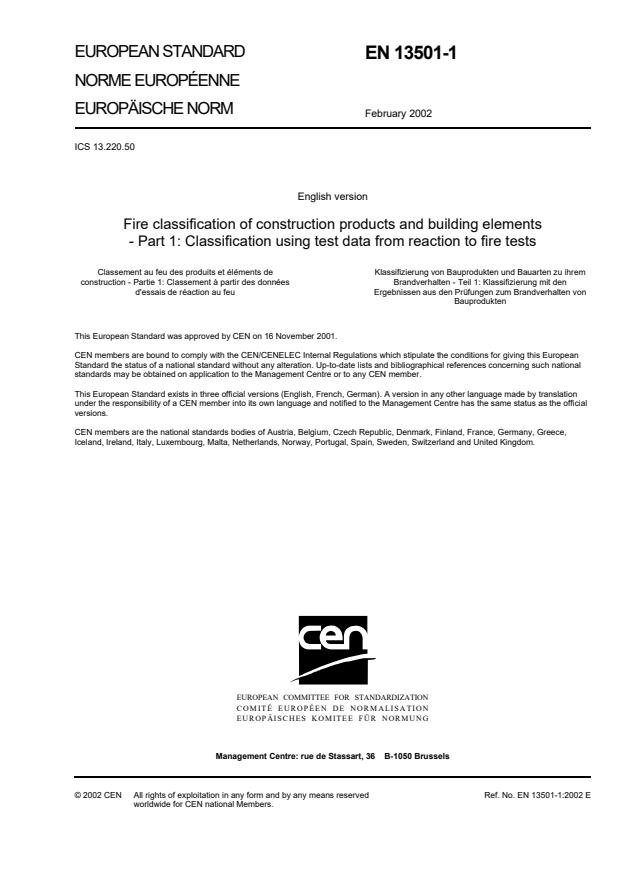
EUROPEAN STANDARDNORME EUROPÉENNEEUROPÄISCHE NORMEN 13501-1February 2002ICS 13.220.50English versionFire classification of construction products and building elements- Part 1: Classification using test data from reaction to fire testsClassement au feu des produits et éléments deconstruction - Partie 1: Classement à partir des donnéesd'essais de réaction au feuKlassifizierung von Bauprodukten und Bauarten zu ihremBrandverhalten - Teil 1: Klassifizierung mit denErgebnissen aus den Prüfungen zum Brandverhalten vonBauproduktenThis European Standard was approved by CEN on 16 November 2001.CEN members are bound to comply with the CEN/CENELEC Internal Regulations which stipulate the conditions for giving this EuropeanStandard the status of a national standard without any alteration. Up-to-date lists and bibliographical references concerning such nationalstandards may be obtained on application to the Management Centre or to any CEN member.This European Standard exists in three official versions (English, French, German). A version in any other language made by translationunder the responsibility of a CEN member into its own language and notified to the Management Centre has the same status as the officialversions.CEN members are the national standards bodies of Austria, Belgium, Czech Republic, Denmark, Finland, France, Germany, Greece,Iceland, Ireland, Italy, Luxembourg, Malta, Netherlands, Norway, Portugal, Spain, Sweden, Switzerland and United Kingdom.EUROPEAN COMMITTEE FOR STANDARDIZATIONCOMITÉ EUROPÉEN DE NORMALISATIONEUROPÄISCHES KOMITEE FÜR NORMUNGManagement Centre: rue de Stassart, 36
B-1050 Brussels© 2002 CENAll rights of exploitation in any form and by any means reservedworldwide for CEN national Members.Ref. No. EN 13501-1:2002 E
Background information for the application of the Commission Decision of 8 February2000 implementing Council Directive 89/106/EEC as regards the classification of the reaction to fireperformance of construction products.30A.1General.30A.2Assumptions.30A.3Reference fire situations.31A.3.1Reference fire situations for construction products except floorings.31A.3.2Reference fire situations for floorings.31A.4Relationship between classes and reference fire situations.32A.4.1General.32A.4.2For all construction products excluding floorings.32A.4.3For floorings.33Annex B (normative)
Reaction to fire classification report.36B.1General layout.36B.2Introduction.36B.3Details of classified product.36B.3.1Nature and end use application.36B.3.2Description.36B.4Test reports and test results in support of this classification.37B.4.1Test reports.37B.4.2Test results for construction products except floorings.38
If the classification based on the tests and criteria given in Tables 1 and 2 is not appropriate, one or more referencescenarios (representative scale tests typifying agreed hazard scenarios) can be called upon within the context of a definedprocedure. This procedure is intended to be the subject of a future European Standard or Commission Decision, on the basis of anagreement between the Commission and the Member States, in consultation with CEN/CENELEC and EOTA.1 ScopeThis European Standard provides the reaction to fire classification procedure for all construction products, includingproducts incorporated within building elements.Products are considered in relation to their end use application.This document applies to two categories, which are treated separately in this European Standard:-
construction products, excluding floorings;-
floorings.NOTEThe treatment of some families of products is still under review and can necessitate amendments to this standard(see European Decision 2000/147/EC).2 Normative referencesThis European Standard incorporates by dated or undated reference, provisions from other publications. Thesenormative references are cited at the appropriate places in the text, and the publications are listed hereafter. Fordated references, subsequent amendments to or revisions of any of these publications apply to this EuropeanStandard only when incorporated in it by amendment or revision. For undated references the latest edition of thepublication referred to applies (including amendments).prEN ISO 1182, Reaction to fire tests for building products - Non-combustibility test (ISO/FDIS 1182:2000).prEN ISO 1716:1998, Reaction to fire tests for building products - Determination of the gross calorific value(ISO/DIS 1716:1998).
1,0 kg/m2 ora thickness
1,0 mm is considered to be a substantial component3.1.6non-substantial componentmaterial that does not constitute a significant part of a non-homogeneous product. A layer with a mass/unit area < 1,0kg/m2 and a thickness < 1,0 mm is considered to be a non-substantial componentTwo or more non-substantial layers that are adjacent to each other (i.e. with no substantial component(s) in betweenthe layers) are regarded as one non-substantial component when they collectively comply with the requirements for alayer being a non-substantial component.3.1.7internal non-substantial componentnon-substantial component that is covered on both sides by at least one substantial component
- Table 1 for construction products excluding floorings;
- Table 2 for floorings.Products classified in a given class are deemed to satisfy all the requirements of any lower class.5 Test methodsThe following test methods are specified in relation to the envisaged reaction to fire classification. The relevantclassification parameters are given in Tables 1 and 2.5.1 Non-combustibility test (prEN ISO 1182)This test identifies products that will not, or not significantly, contribute to a fire, regardless of their end use.The test is relevant for the classes A1, A2, A1fl and A2fl.5.2 Calorific potential test (prEN ISO 1716)This test determines the potential maximum total heat release of a product when completely burning, regardless of itsend use.The test is relevant for the classes A1, A2, A1fl and A2fl.It allows the determination of both the gross calorific potential (PCS) and the net calorific potential (PCI).5.3 Single burning item test (EN 13823)This test evaluates the potential contribution of a product to the development of a fire, under a fire situation simulating asingle burning item in a room corner near to that product. The test is relevant for the classes A2, B, C and D. Under theconditions specified in 8.3.2 the test is also relevant for the class A1.5.4 Ignitability test (prEN ISO 11925-2)This test evaluates the ignitability of a product under exposure to a small flame. The test is relevant for the classes B,C, D, E, Bfl’, Cfl, Dfl and Efl.
For suchapplications, asymmetrical products may be tested and classified for each side separately.In order to reduce the amount of testing, a series of standard substrates is given in EN 13238 and a set ofrepresentative mounting conditions is given in the relevant test method or product specification. A sponsor, however,may choose none of the standard substrates or the representative mounting conditions, although this will limit the fieldof application of the test results and classifications obtained.In the ignitability test (prEN ISO 11925-2), products are tested with surface flame attack only if in the envisaged enduse application direct flame attack on the edge cannot occur. This is the case for floorings. If edges can be exposedunder end use conditions, both surface and edge flame attacks are applied.7 Number of tests for classification7.1The minimum number of tests is given in the appropriate test method.7.2For a product to claim a particular classification all the relevant criteria, given in Table 1 or 2, shall complywith the stated requirements.7.3For each continuous parameter (T, m, tf, PCS, PCI, FIGRA0,2MJ, FIGRA0,4MJ ,THR600s, SMOGRA, TSP600s,critical heat flux) the selection of the class is based on the mean value (m) of the set of results of this parameter,determined in accordance with the relevant test method, using the following procedure:a) Calculate the mean value (m’) of the set of results for this parameter using the minimum number of tests.b) If m’ lies within the limits for an envisaged class, the value m used for classification is m’.c) If m’ does not lie within the limits for an envisaged class, two additional tests may be carried out.d) If two additional tests are carried out, the results for each parameter in these two tests shall be added to theset of results obtained in the minimum number of tests. Next, the two extremes (highest and lowest) for eachparameter individually shall be excluded. The value m, used for classification, shall then be calculated usingthe remaining set of results for each parameter.7.4For the compliance parameters LFS, Fs and flaming droplets/particles, the selection of the class is based onthe presence of a non-compliance in the set of results of this parameter, determined in accordance with therelevant test method, using the following procedure:a) If the set of results for this parameter does not contain a non-compliance, the result “compliant” shall be usedfor classification.
2,0 MJ/m², shall be tested in accordance with EN 13823 (seeTable 1 – note 2a – FIGRA in this case means FIGRA 0,2MJ).Each substantial component of a non-homogeneous product applying for class A2 shall be tested separately inaccordance with either prEN ISO 1182 or prEN ISO 1716. The non-substantial components of a non-homogeneousproduct shall be tested separately in accordance with prEN ISO 1716 only.8.3.3 Class A2 productsAdditionally, all products applying for class A2 shall be tested in accordance with EN 13823.
...
Questions, Comments and Discussion
Ask us and Technical Secretary will try to provide an answer. You can facilitate discussion about the standard in here.
Loading comments...