

EN 14041:2004
(Main)Resilient, textile and laminate floor coverings - Essential characteristics
- Abstract
This European Standard specifies the health, safety and energy saving requirements for:
· resilient floor coverings manufactured from plastics, linoleum, cork or rubber, excluding loose-laid mats;
· textile floor coverings, excluding loose-laid mats and rugs;
· laminate floor coverings;
· floor panels for loose-laying.
It also specifies procedures for testing for the evaluation of conformity of the products and the requirements for marking and labelling.
The products are intended for use as floor coverings within a building or externally, according to the manufacturers' specifications.
The European Standard does not apply to floor coverings containing asbestos.
This European Standard does not specify requirements unrelated to health, safety and energy saving, which are covered in the separate European Standards for these products, listed in annex A. To perform correctly, products covered by this standard require correct installation and maintenance. This standard does not, however, cover installation or maintenance, but does give advice on minimising slip hazards.
- Status
- Withdrawn
- Publication Date
- 03-Aug-2004
- Withdrawal Date
- 06-Oct-2026
- Technical Committee
- CEN/TC 134 - Resilient and textile floor coverings
- Drafting Committee
- CEN/TC 134/WG 6 - Harmonization
- Current Stage
- 9960 - Withdrawal effective - Withdrawal
- Start Date
- 17-Jan-2018
- Completion Date
- 07-Oct-2026
- Directive
- 305/2011 - Regulation (eu) No 305/2011 of the European Parliament and of the Council of 9 march 2011 laying down harmonised conditions for the marketing of construction products and repealing council directive 89/106/eecOJ Ref: C, C 259 OJ Date: 08-Aug-2014
89/106/EEC - Construction productsOJ Ref: C, C 139, C 319 OJ Date: 08-Jun-2005

Relations
- Effective Date
- 24-Jan-2018
- Effective Date
- 17-Sep-2026
- Effective Date
- 25-Aug-2026
- Refers
ISO 11379:1997 - Textile floor coverings — Laboratory cleaning procedure using spray extraction - Effective Date
- 25-Aug-2026
- Effective Date
- 25-Aug-2026
- Effective Date
- 25-Aug-2026
- Refers
ISO 6356:2000 - Textile floor coverings — Assessment of static electrical propensity — Walking test - Effective Date
- 25-Aug-2026
- Effective Date
- 28-Jan-2026
- Effective Date
- 28-Jan-2026
- Effective Date
- 28-Jan-2026
- Effective Date
- 28-Jan-2026
- Effective Date
- 28-Jan-2026
- Effective Date
- 28-Jan-2026
- Effective Date
- 28-Jan-2026
- Effective Date
- 28-Jan-2026
Get Certified
Connect with accredited certification bodies for this standard

Control Union Certifications
Global certification for agriculture and sustainability.

Hohenstein Institut
Textile testing and certification.

Bureau Veritas Bangladesh
Bureau Veritas certification services in Bangladesh.
Sponsored listings
Frequently Asked Questions
EN 14041:2004 is a standard published by the European Committee for Standardization (CEN). Its full title is "Resilient, textile and laminate floor coverings - Essential characteristics". This standard covers: This European Standard specifies the health, safety and energy saving requirements for: · resilient floor coverings manufactured from plastics, linoleum, cork or rubber, excluding loose-laid mats; · textile floor coverings, excluding loose-laid mats and rugs; · laminate floor coverings; · floor panels for loose-laying. It also specifies procedures for testing for the evaluation of conformity of the products and the requirements for marking and labelling. The products are intended for use as floor coverings within a building or externally, according to the manufacturers' specifications. The European Standard does not apply to floor coverings containing asbestos. This European Standard does not specify requirements unrelated to health, safety and energy saving, which are covered in the separate European Standards for these products, listed in annex A. To perform correctly, products covered by this standard require correct installation and maintenance. This standard does not, however, cover installation or maintenance, but does give advice on minimising slip hazards.
This European Standard specifies the health, safety and energy saving requirements for: · resilient floor coverings manufactured from plastics, linoleum, cork or rubber, excluding loose-laid mats; · textile floor coverings, excluding loose-laid mats and rugs; · laminate floor coverings; · floor panels for loose-laying. It also specifies procedures for testing for the evaluation of conformity of the products and the requirements for marking and labelling. The products are intended for use as floor coverings within a building or externally, according to the manufacturers' specifications. The European Standard does not apply to floor coverings containing asbestos. This European Standard does not specify requirements unrelated to health, safety and energy saving, which are covered in the separate European Standards for these products, listed in annex A. To perform correctly, products covered by this standard require correct installation and maintenance. This standard does not, however, cover installation or maintenance, but does give advice on minimising slip hazards.
EN 14041:2004 is classified under the following ICS (International Classification for Standards) categories: 59.080.60 - Textile floor coverings; 97.150 - Floor coverings. The ICS classification helps identify the subject area and facilitates finding related standards.
EN 14041:2004 has the following relationships with other standards: It is inter standard links to EN 14041:2018, EN ISO 9001:2026, ISO 1957:2000, ISO 11379:1997, ISO 10965:1998, ISO 2424:1992, ISO 6356:2000, EN 687:2019, EN 717-1:2004, EN ISO 10595:2012, EN 12199:2020, EN ISO 9239-1:2002, EN 1400-1:2002, EN 1816:2020, EN 13553:2017. Understanding these relationships helps ensure you are using the most current and applicable version of the standard.
EN 14041:2004 is associated with the following European legislation: EU Directives/Regulations: 305/2011, 89/106/EEC; Standardization Mandates: M/119. When a standard is cited in the Official Journal of the European Union, products manufactured in conformity with it benefit from a presumption of conformity with the essential requirements of the corresponding EU directive or regulation.
EN 14041:2004 is available in PDF format for immediate download after purchase. The document can be added to your cart and obtained through the secure checkout process. Digital delivery ensures instant access to the complete standard document.
Standards Content (Sample)
2003-01.Slovenski inštitut za standardizacijo. Razmnoževanje celote ali delov tega standarda ni dovoljeno.Resilient, textile and laminate floor coverings - Essential characteristicsRevetements de sol résilients, textiles et stratifiés - Caractéristiques essentiellesElastische, textile und Laminat-Bodenbeläge - Wesentliche Eigenschaften97.150Netekstilne talne oblogeNon-textile floor coverings59.080.60Tekstilne talne oblogeTextile floor coveringsICS:SIST EN 14041:2005enTa slovenski standard je istoveten z:EN 14041:200401-marec-2005SIST EN 14041:2005SLOVENSKI
STANDARD
EUROPEAN STANDARDNORME EUROPÉENNEEUROPÄISCHE NORMEN 14041August 2004ICS 59.080.60; 97.150English versionResilient, textile and laminate floor coverings - EssentialcharacteristicsRevêtements de sol résilients, textiles et stratifiés -Caractéristiques essentiellesElastische, textile Bodenbeläge und Laminatböden -Wesentliche EigenschaftenThis European Standard was approved by CEN on 2 February 2004.CEN members are bound to comply with the CEN/CENELEC Internal Regulations which stipulate the conditions for giving this EuropeanStandard the status of a national standard without any alteration. Up-to-date lists and bibliographical references concerning such nationalstandards may be obtained on application to the Central Secretariat or to any CEN member.This European Standard exists in three official versions (English, French, German). A version in any other language made by translationunder the responsibility of a CEN member into its own language and notified to the Central Secretariat has the same status as the officialversions.CEN members are the national standards bodies of Austria, Belgium, Cyprus, Czech Republic, Denmark, Estonia, Finland, France,Germany, Greece, Hungary, Iceland, Ireland, Italy, Latvia, Lithuania, Luxembourg, Malta, Netherlands, Norway, Poland, Portugal, Slovakia,Slovenia, Spain, Sweden, Switzerland and United Kingdom.EUROPEAN COMMITTEE FOR STANDARDIZATIONCOMITÉ EUROPÉEN DE NORMALISATIONEUROPÄISCHES KOMITEE FÜR NORMUNGManagement Centre: rue de Stassart, 36
B-1050 Brussels© 2004 CENAll rights of exploitation in any form and by any means reservedworldwide for CEN national Members.Ref. No. EN 14041:2004: E
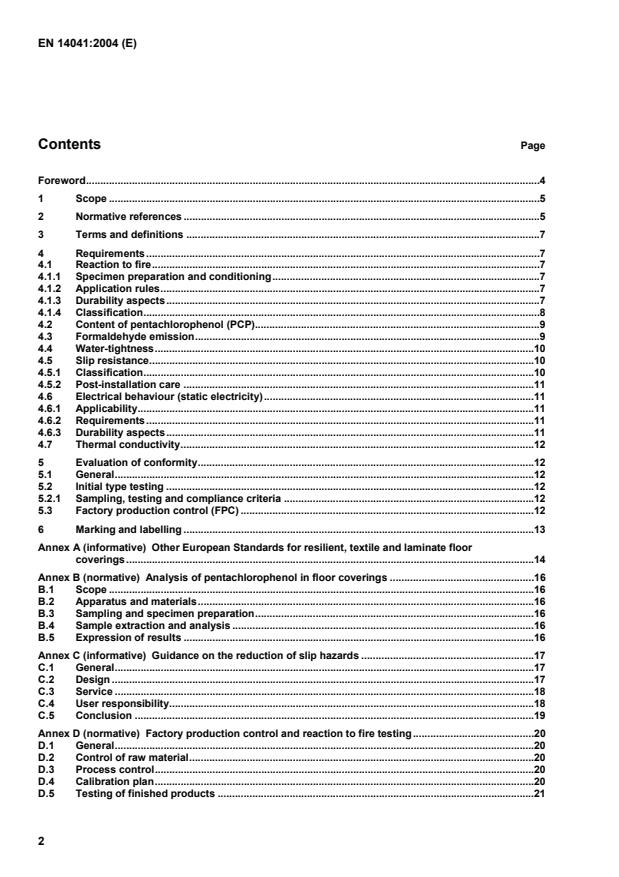
Other European Standards for resilient, textile and laminate floor coverings.14 Annex B (normative)
Analysis of pentachlorophenol in floor coverings.16 B.1 Scope.16 B.2 Apparatus and materials.16 B.3 Sampling and specimen preparation.16 B.4 Sample extraction and analysis.16 B.5 Expression of results.16 Annex C (informative)
Guidance on the reduction of slip hazards.17 C.1 General.17 C.2 Design.17 C.3 Service.18 C.4 User responsibility.18 C.5 Conclusion.19 Annex D (normative)
Factory production control and reaction to fire testing.20 D.1 General.20 D.2 Control of raw material.20 D.3 Process control.20 D.4 Calibration plan.20 D.5 Testing of finished products.21
Clauses of this European Standard addressing essential requirements or other provisions of EU Directives.23 ZA.1 Scope and relevant clauses.23 ZA.2 Procedure for the attestation of conformity of products.25 ZA.3 CE Marking and labelling – Information to accompany the CE marking.28 Bibliography.30
with foam backing. EN 1817, Resilient floor coverings – Specification for homogeneous and heterogeneous smooth rubber floor coverings. EN 12199, Resilient floor coverings – Specifications for homogeneous and heterogeneous relief rubber floor coverings. EN 12466:1998, Resilient floor coverings – Vocabulary. EN 12524, Building materials and products – Hygrothermal properties – Tabulated design values. EN 12673, Water quality – Gas chromatographic determination of some selected chlorophenols in water. EN 13238:2001, Reaction to fire tests for building products – Conditioning procedures and general rules for selection of substrates. EN 13329, Laminate floor coverings – Specifications, requirements and test methods. EN 13501-1:2002, Fire classification of construction products and building elements – Part 1: Classification using test data from reaction to fire tests. EN 13553, Resilient floor coverings – Polyvinyl chloride floor coverings for use in special wet areas – Specification. EN 13893, Resilient, laminate and textile floor coverings – Measurement of dynamic coefficient of friction on dry floor surfaces. EN ISO 9001, Quality management systems – Requirements. EN ISO 9239-1:2002, Reaction to fire tests for floorings – Part 1: Determination of the burning behaviour using a radiant heat source (ISO 9239-1:2002). EN ISO 11925-2:2002, Reaction to fire tests - Ignitability of building products subjected to direct impingement of flame - Part 2: Single-flame source test (ISO 11925-2:2002). ISO 1957, Machine-made textile floor coverings – Selection and cutting of specimens for physical tests. ISO 2424:1992, Textile floor coverings – Vocabulary. ISO 6356, Textile floor coverings – Assessment of static electrical propensity – Walking test. ISO 10965, Textile floor coverings – Determination of electrical resistance. ISO 11379, Textile floor coverings – Laboratory cleaning procedure using spray extraction.
Table 2 – Classes of reaction to fire for textile floor coverings, classified without further testing Floor covering type1 EN product standard Class3 Floorings Non-FR machine-made wall-to-wall pile carpets and pile carpet tiles2 EN 1307 EfL Non-FR needled textile floor coverings without pile2 EN 1470 EfL Non-FR needled textile floor coverings with pile2 EN 13297 EfL 1) Floor covering glued or loose laid over a Class A2-s1,d0 substrate. 2) Textile floor coverings having a total mass of max. 4,8 kg/m², a minimum pile thickness of 1,8 mm (ISO 1766) and: -
a surface of 100% wool, -
a surface of
80% wool or more - 20% polyamide or less, -
a surface of
80% wool or more - 20% polyamide/polyester or less, -
a surface of 100% polyamide, -
a surface of 100% polypropylene and if with SBR-foam backing, a total mass of > 0,780 kg/m². All polypropylene carpets with other foam backings are excluded. 3) Class as provided for in Table 2 in the Annex to Decision 2000/147/EC.
EN 1816 3,4 4,3 4 EfL Homogeneous and heterogeneous smooth rubber floor coverings EN 1817 3,0 6,0 1,8 EfL Homogeneous and heterogeneous
relief rubber floor coverings EN 12199 4,6 6,7 2,5 EfL 1 Floor covering loose laid over any wood based substrate of at least Class D-s2,d0 or any substrate of at least Class A2-s1,d0. 2 Class as provided for in Table 2 in the Annex to Decision 2000/147/EC.
4.2 Content of pentachlorophenol (PCP)1 Resilient, textile and laminate floor coverings shall not contain PCP or a derivative thereof as a component in the production process of the product or of its raw materials. In cases where verification is required, if the content is less than 0,1 % by mass by the method of Annex B, this requirement shall be considered to be met. 4.3 Formaldehyde emission When formaldehyde-containing materials have been added to the product as a part of the production process, the product shall be tested and classified into one of two classes: E1 or E2, as specified in Table 4 and Table 5. NOTE Products of class E1 can be used without causing an indoor air concentration greater than 0,1 × 10⁻⁶
(0,1 ppm) of formaldehyde.
1 Attention is drawn to Commission Directive 1999/51/EC that covers restrictions on the marketing and use of certain dangerous substances including PCP and is reflected in national regulations.
Test method Requirement Initial type testing a ENV 717-1 Release ≤ 0,124 mg/m3
ENV 717-1 Release ≤ 0,124 mg/m3
Factory production control EN 717-2 Release ≤ 3,5 mg/m2h a For established products, initial type testing may also be done on the basis of existing data with EN 717-2 testing, either from factory production control or from external inspection.
Table 5 – Formaldehyde class E2
Test method Requirement ENV 717-1 Release > 0,124 mg/m3
Initial type testing EN 717-2 Release > 3,5 mg/m2h to ≤ 8 mg/m2h ENV 717-1 Release > 0,124 mg/m3
Factory production control EN 717-2 Release > 3,5 mg/m2h to ≤ 8 mg/m2h
4.4 Water-tightness Where required, resilient floor coverings shall meet the requirements of EN 13553. 4.5 Slip resistance 4.5.1 Classification If a claim for slip resistance is made, the floor covering intended to be used in dry and non-contaminated conditions shall have a dynamic coefficient of friction of ≥ 0,30 when tested ex-factory under dry conditions in accordance with EN 13893 and shall be declared as technical class DS. Although such floors may be subjected to occasional spillage and wet cleaning, the manufacturer does not guarantee the performance under these conditions. If no claim for slip resistance is made, the floor coverings for which no performance has been determined shall be declared as technical class NPD.
Clean the test specimens three times, with an interval of 2 h ± 15 min between cycles, each cleaning cycle consisting of two strokes:
– for the first stroke use the spray extraction machine with simultaneous spray and extraction;
– for the second stroke operate the machine only as an extraction machine. Carry out the first cleaning cycle using the reference cleaning solution at ambient temperature 25 °C ± 10 °C and the second and third cleaning cycle with water at ambient temperature without any addition of chemicals. After this, the test of 4.6.2 shall be repeated and the requirements met. NOTE Dirt and application of polymers can affect the antistatic and electrical properties of resilient and laminate floor coverings.
Other European Standards for resilient, textile and laminate floor coverings The following published or draft standards specify the general requirements and the requirements relating to the classification schem
...