

EN 717-1:2004
(Main)Wood-based panels - Determination of formaldehyde release - Part 1: Formaldehyde emission by the chamber method
- Abstract
This European Standard specifies a chamber method with three options of test chambers for the determination of the formaldehyde emission from wood-based panels in terms of the steady-state concentration in a climate chamber under defined conditions, which relate to typical conditions in real-life. This chamber method can also be applied to the estimation of formaldehyde concentrations under various conditions in practice, by the use of mathematical models.
- Status
- Published
- Publication Date
- 05-Oct-2004
- Technical Committee
- CEN/TC 112 - Woodbased panels
- Drafting Committee
- CEN/TC 112/WG 5 - Regulated dangerous substances
- Current Stage
- 9092 - Decision on results of review/2YR ENQ - revise - Review Enquiry
- Start Date
- 03-Dec-2025
- Completion Date
- 14-Oct-2026

Overview
EN 717-1:2004 - "Wood-based panels - Determination of formaldehyde release - Part 1: Formaldehyde emission by the chamber method" (CEN) specifies a standardized chamber method to measure formaldehyde emissions from wood‑based panels in terms of the steady‑state concentration in a climate-controlled test chamber. The method relates to typical real‑life conditions and can be used with mathematical models to estimate indoor formaldehyde concentrations under various practical scenarios. The standard also applies to products other than wood‑based panels.
Key topics and technical requirements
- Test principle: Place test pieces of known surface area in a sealed climate chamber; control temperature, relative humidity, air velocity and air‑exchange rate; periodically sample chamber air and absorb formaldehyde in water for chemical analysis.
- Defined test conditions: Typical reference conditions are 23 ± 0.5 °C and 45 ± 3 % RH; air velocity at the specimen surface of 0.1–0.3 m/s; monitoring instruments with specified accuracies for temperature, humidity, air velocity and air‑exchange rate.
- Chamber specifications: The standard contains three options for test chambers (see Annex A). Chamber materials should be inert/non‑absorptive (examples: stainless steel, aluminium, glass, certain plastics). Chambers must be air‑tight with controlled clean‑air supply (max formaldehyde ~0.006 mg/m3).
- Sampling & analysis: Air is drawn through gas‑washing bottles; formaldehyde is quantified chemically (acetylacetone reagent / spectrophotometric measurement at 412 nm is described). Calculation steps cover absorbed mass, chamber concentration and steady‑state emission value.
- Accuracy & verification: Requirements and procedures for verifying air exchange rate, loading factor (surface area/volume), and achieving steady‑state are included. The standard specifies reporting and test duration rules (including reduced test period conditions).
Applications and users
- Manufacturers of wood‑based panels, flooring, cabinetry and other composite products use EN 717-1 to demonstrate product performance for market access and labeling.
- Accredited testing laboratories implement the chamber method for certification, quality control and regulatory compliance.
- Regulators, specifiers and indoor air quality (IAQ) consultants use results to assess exposure risk, set limits, and model indoor concentrations.
- Product developers and R&D teams use the method to compare formulations, surface treatments or mitigation strategies to reduce formaldehyde emissions.
Related standards
- EN 717-2 - Gas analysis method for formaldehyde release.
- EN 717-3 - Flask method for formaldehyde release.
- EN 120 - Perforator extraction method for formaldehyde content.
- Conversion reference: at 23 °C and 1013 hPa, 1 ppm = 1.24 mg/m3 (formaldehyde).
EN 717-1:2004 is a widely recognized European standard for reliable, reproducible measurement of formaldehyde emission by chamber testing and is essential for anyone evaluating product emissions or indoor air impacts.
Relations
- Effective Date
- 22-Dec-2008
- Effective Date
- 28-Jan-2026
- Effective Date
- 28-Jan-2026
- Effective Date
- 28-Jan-2026
- Effective Date
- 28-Jan-2026
- Effective Date
- 28-Jan-2026
- Effective Date
- 28-Jan-2026
- Referred By
EN 300:2006 - Oriented Strand Boards (OSB) - Definitions, classification and specifications - Effective Date
- 28-Jan-2026
- Effective Date
- 28-Jan-2026
- Effective Date
- 28-Jan-2026
- Referred By
EN 14080:2013 - Timber structures - Glued laminated timber and glued solid timber - Requirements - Effective Date
- 28-Jan-2026
- Effective Date
- 28-Jan-2026
- Effective Date
- 28-Jan-2026
- Effective Date
- 28-Jan-2026
- Effective Date
- 28-Jan-2026
Get Certified
Connect with accredited certification bodies for this standard

Gozdarski inštitut Slovenije
Slovenian Forestry Institute. Forest management certification support, timber testing.
Sponsored listings
Frequently Asked Questions
EN 717-1:2004 is a standard published by the European Committee for Standardization (CEN). Its full title is "Wood-based panels - Determination of formaldehyde release - Part 1: Formaldehyde emission by the chamber method". This standard covers: This European Standard specifies a chamber method with three options of test chambers for the determination of the formaldehyde emission from wood-based panels in terms of the steady-state concentration in a climate chamber under defined conditions, which relate to typical conditions in real-life. This chamber method can also be applied to the estimation of formaldehyde concentrations under various conditions in practice, by the use of mathematical models.
This European Standard specifies a chamber method with three options of test chambers for the determination of the formaldehyde emission from wood-based panels in terms of the steady-state concentration in a climate chamber under defined conditions, which relate to typical conditions in real-life. This chamber method can also be applied to the estimation of formaldehyde concentrations under various conditions in practice, by the use of mathematical models.
EN 717-1:2004 is classified under the following ICS (International Classification for Standards) categories: 79.060.01 - Wood-based panels in general. The ICS classification helps identify the subject area and facilitates finding related standards.
EN 717-1:2004 has the following relationships with other standards: It is inter standard links to ENV 717-1:1998, EN 326-1:1994, EN 14915:2013, EN 438-7:2005, EN 14322:2017, EN 14374:2004, CEN/TS 16354:2013, EN 300:2006, EN 14915:2013+A1:2017, EN 13698-1:2003, EN 14080:2013, EN 13986:2004+A1:2015, EN 15497:2014, EN 14041:2018, EN 14915:2006. Understanding these relationships helps ensure you are using the most current and applicable version of the standard.
EN 717-1:2004 is associated with the following European legislation: EU Directives/Regulations: 305/2011, 89/106/EEC; Standardization Mandates: M/113. When a standard is cited in the Official Journal of the European Union, products manufactured in conformity with it benefit from a presumption of conformity with the essential requirements of the corresponding EU directive or regulation.
EN 717-1:2004 is available in PDF format for immediate download after purchase. The document can be added to your cart and obtained through the secure checkout process. Digital delivery ensures instant access to the complete standard document.
Standards Content (Sample)
2003-01.Slovenski inštitut za standardizacijo. Razmnoževanje celote ali delov tega standarda ni dovoljeno.RãþDQMHHolzwerkstoffe - Bestimmung der Formaldehydabgabe - Teil 1: Formaldehydabgabe nach der Prüfkammer-MethodePanneaux a base de bois - Détermination du dégagement de formaldéhyde - Partie 1 : Emission de for-maldéhyde par la méthode a la chambreWood-based panels - Determination of formaldehyde release - Part 1: Formaldehyde emission by the chamber method79.060.01Wood-based panels in generalICS:Ta slovenski standard je istoveten z:EN 717-1:2004SIST EN 717-1:2005en01-januar-2005SIST EN 717-1:2005SLOVENSKI
STANDARDSIST ENV 717-1:20001DGRPHãþD
EUROPEAN STANDARDNORME EUROPÉENNEEUROPÄISCHE NORMEN 717-1October 2004ICS 79.060.01Supersedes ENV 717-1:1998
English versionWood-based panels - Determination of formaldehyde release -Part 1: Formaldehyde emission by the chamber methodPanneaux à base de bois - Détermination du dégagementde formaldéhyde - Partie 1 : Emission de for-maldéhydepar la méthode à la chambreHolzwerkstoffe - Bestimmung der Formaldehydabgabe -Teil 1: Formaldehydabgabe nach der Prüfkammer-MethodeThis European Standard was approved by CEN on 16 August 2004.CEN members are bound to comply with the CEN/CENELEC Internal Regulations which stipulate the conditions for giving this EuropeanStandard the status of a national standard without any alteration. Up-to-date lists and bibliographical references concerning such nationalstandards may be obtained on application to the Central Secretariat or to any CEN member.This European Standard exists in three official versions (English, French, German). A version in any other language made by translationunder the responsibility of a CEN member into its own language and notified to the Central Secretariat has the same status as the officialversions.CEN members are the national standards bodies of Austria, Belgium, Cyprus, Czech Republic, Denmark, Estonia, Finland, France,Germany, Greece, Hungary, Iceland, Ireland, Italy, Latvia, Lithuania, Luxembourg, Malta, Netherlands, Norway, Poland, Portugal, Slovakia,Slovenia, Spain, Sweden, Switzerland and United Kingdom.EUROPEAN COMMITTEE FOR STANDARDIZATIONCOMITÉ EUROPÉEN DE NORMALISATIONEUROPÄISCHES KOMITEE FÜR NORMUNGManagement Centre: rue de Stassart, 36
B-1050 Brussels© 2004 CENAll rights of exploitation in any form and by any means reservedworldwide for CEN national Members.Ref. No. EN 717-1:2004: ESIST EN 717-1:2005
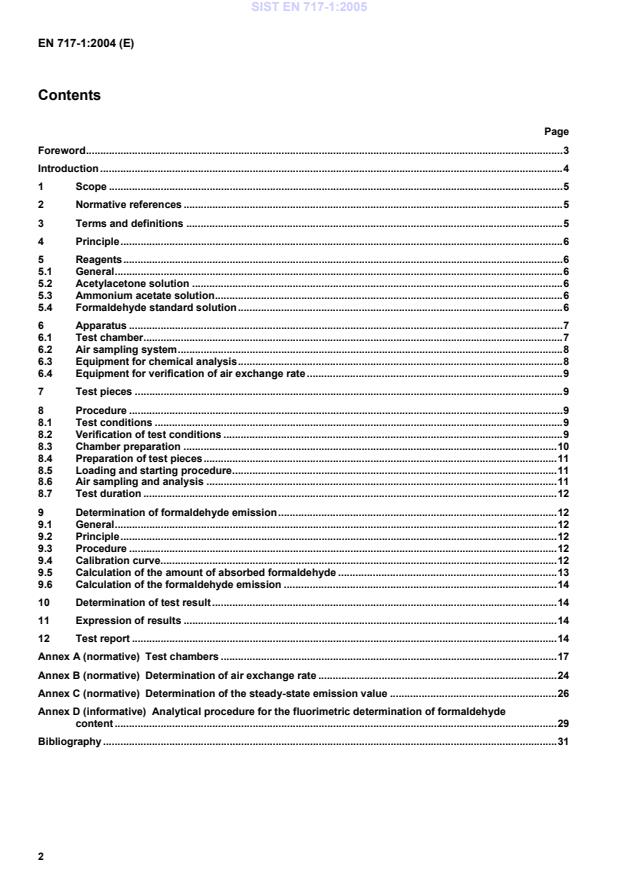
Test chambers.17 Annex B (normative)
Determination of air exchange rate.24 Annex C (normative)
Determination of the steady-state emission value.26 Annex D (informative)
Analytical procedure for the fluorimetric determination of formaldehyde
content.29 Bibliography.31
results, it is recommended to participate in a round-robin test for calibration at least once a year. SIST EN 717-1:2005
panels. 2 Normative references The following referenced documents are indispensable for the application of this document. For dated references, only the edition cited applies. For undated references, the latest edition of the referenced document (including any amendments) applies. EN 326-1, Wood-based panels — Sampling, cutting and inspection — Part 1: Sampling and cutting of test pieces and expression of test results. 3 Terms and definitions For the purposes of this European Standard, the following terms and definitions apply. 3.1 volume of the chamber total air volume of the unloaded chamber, including recirculating ventilation ducts, expressed in cubic metres (m3) 3.2 loading factor ratio of the total surface area of the test piece, excluding the area of the edges, to the volume of the chamber, ex-pressed in square metres per cubic metre (m2/m3) 3.3 air exchange rate quotient of air volume passing through the chamber per hour (m3/h) and the chamber volume (m3) 3.4 air velocity velocity of the air near the surface of test pieces in the chamber in metres per second (m/s) 3.5 steady-state state when the formaldehyde emission of the wood-based panels is quasi constant under the test conditions, this means that the formaldehyde concentration in the chamber remains constant NOTE In practice, a true steady-state is not achievable because formaldehyde is emitted irreversibly. This standard defines a steady-state condition for the purpose of the test (see Clause 10). SIST EN 717-1:2005
1 ppm (parts per million) = 1,24 mg/m3
1 mg/m³ = 0,81 ppm (parts per million) 4 Principle Test pieces of known surface area, are placed in a chamber, in which the temperature, relative humidity, air velo-city and exchange rate are controlled at defined values. Formaldehyde emitted from the test pieces mixes with the air in the chamber. The air in the chamber is sampled periodically. The formaldehyde concentration is determined by drawing air from the chamber through gas washing bottles containing water, which absorbs the formaldehyde. The formaldehyde concentration in the water is determined. The concentration of formaldehyde in the chamber at-mosphere is calculated from the concentration in the water in the gas washing bottles and the volume of the sam-pled air. It is expressed in milligrams per cubic metre (mg/m3). Sampling is periodically continued until the formal-dehyde concentration in the chamber has reached a steady-state. NOTE The influences of temperature, relative humidity, loading factor and air exchange rate on the formaldehyde concen-tration in the chamber atmosphere can be described by formulas (e.g. Andersen formula). An interrelation between the structure of the test pieces, especially of their surfaces and the air velocity is also apparent but cannot be exactly described by a formula. 5 Reagents 5.1 General Reagents and water of recognised analytical purity shall be used for the analysis. 5.2 Acetylacetone solution 4 ml acetylacetone are added to a 1 000 ml volumetric flask and made up to the mark with water. 5.3 Ammonium acetate solution 200 g ammonium acetate are dissolved in water in a 1 000 ml volumetric flask and made up to the mark. NOTE Commercially prepared solutions may be used. 5.4 Formaldehyde standard solution Standard iodine solution c(l2) = 0,05 mol/l Standard sodium thiosulphate solution c(Na2S2O3) = 0,1 mol/l Standard sodium hydroxide solution c(NaOH) = 1 mol/l Standard sulphuric acid solution c(H2SO4) = 1 mol/l SIST EN 717-1:2005
The positions of the measuring points depend upon the volume of chamber and the type of air flow. Air velocity shall be measured at a minimum of 4 positions in large chambers (≥ 12 m3) and at a minimum of 2 positions in small chambers (1 m³ or 0,225 m³). 8.2.6 Performance of the chamber The performance of the test chamber can be tested by a procedure described by [7]. 8.3 Chamber preparation Set the chamber to the conditions given in 8.1. The determination (see 8.6) of the formaldehyde concentration in the empty chamber (“background-level”) shall be carried out not less than 1 h after establishing the test conditions according to 8.1. SIST EN 717-1:2005
8.4.2 Large chambers (see A.1) Edge sealing shall not be done for the 1 m × 2 m test pieces tested in large chambers (≥ 12 m3). The perimeter, i. e the length of open (unsealed) edges U for 1 m × 2 m pieces is 6 m and the surface area A is 4 m2. Thus the ratio of U/A is 1,5 m/m2. 8.4.3 Small chambers (see A.2 and A.3) In order to obtain the same ratio of U/A = 1,5 m/m2 for smaller test pieces in small chambers, partial edge sealing is necessary. This sealing should be done using self-adhesive aluminium tape. NOTE The length of edges to be sealed is given in A.2.3 for 1 m3 chambers and in A.3.3 for 0,225 m3 chambers. 8.5 Loading and starting procedure Place the test pieces in the test chamber. They shall be vertical and approximately in the centre of the chamber, with their surfaces parallel to the direction of the air flow, and separated by not less than 200 mm (see Figures A.1 to A.5 and A.7). The first air sampling shall be made not less than 3 h after loading the chamber and starting the test procedure. 8.6 Air sampling and analysis Add at least 25 ml of water to each of the two gas washing bottles and connect them to the apparatus (see 6.2 and Figure 1). Sample the air from the chamber periodically by passing a minimum of 120 l, at a rate of approximately 2 l/min, through the gas washing bottles. Pipette 10 ml of each of the absorption solutions into a 50 ml flask and add 10 ml acetylacetone solution (see 5.2) and 10 ml of ammonium acetate solution (see 5.3). Stopper the flasks and determine the formaldehyde content of the solutions according to Clause 9. NOTE The volume of air to be sampled depends on its formaldehyde concentration. With photometric determination the procedure described above is suitable for concentrations higher than 0,005 mg/m3. For determination of lower concentrations, the volume of the sampled air should be increased and/or the volume of the air sample solution reduced. The sensitivity of the analysis can also be increased by using a fluorimetric determination of the reaction product (diacetyldihydrolutidine) instead of a photometric determination.
...