

EN 13956:2005
(Main)Flexible sheet for waterproofing - Plastic and rubber sheets for roof waterproofing - Definitions and characteristics
- Abstract
This European Standard specifies the definitions and characteristics of plastic and rubber sheets including sheets made out of their blends and alloys (thermoplastic rubber) for which the intended use is roof waterproofing. It specifies the requirements and test methods and provides for the evaluation of conformity of the products with the requirements of this European Standard.
NOTE For typical materials and applications, see Annex E.
- Status
- Withdrawn
- Publication Date
- 06-Sep-2005
- Withdrawal Date
- 18-Dec-2012
- Technical Committee
- CEN/TC 254 - Flexible sheets for water proofing
- Drafting Committee
- CEN/TC 254/SC 2 - Synthetic sheets
- Current Stage
- 9960 - Withdrawal effective - Withdrawal
- Start Date
- 19-Dec-2012
- Completion Date
- 19-Dec-2012
89/106/EEC - Construction productsOJ Ref: C, C 319 OJ Date: 14-Dec-2005

Relations
- Effective Date
- 26-Dec-2012
- Effective Date
- 28-Jan-2026
- Effective Date
- 28-Jan-2026
- Effective Date
- 28-Jan-2026
- Effective Date
- 28-Jan-2026
- Effective Date
- 28-Jan-2026
- Effective Date
- 28-Jan-2026
- Effective Date
- 28-Jan-2026
- Effective Date
- 28-Jan-2026
- Effective Date
- 28-Jan-2026
- Effective Date
- 28-Jan-2026
- Effective Date
- 28-Jan-2026
- Effective Date
- 28-Jan-2026
- Effective Date
- 28-Jan-2026
- Effective Date
- 28-Jan-2026
Get Certified
Connect with accredited certification bodies for this standard

DIBt (Deutsches Institut für Bautechnik)
German Institute for Building Technology.
DIN CERTCO
DIN Group product certification.

Aboma Certification B.V.
Specialized in construction, metal, and transport sectors.
Sponsored listings
Frequently Asked Questions
EN 13956:2005 is a standard published by the European Committee for Standardization (CEN). Its full title is "Flexible sheet for waterproofing - Plastic and rubber sheets for roof waterproofing - Definitions and characteristics". This standard covers: This European Standard specifies the definitions and characteristics of plastic and rubber sheets including sheets made out of their blends and alloys (thermoplastic rubber) for which the intended use is roof waterproofing. It specifies the requirements and test methods and provides for the evaluation of conformity of the products with the requirements of this European Standard. NOTE For typical materials and applications, see Annex E.
This European Standard specifies the definitions and characteristics of plastic and rubber sheets including sheets made out of their blends and alloys (thermoplastic rubber) for which the intended use is roof waterproofing. It specifies the requirements and test methods and provides for the evaluation of conformity of the products with the requirements of this European Standard. NOTE For typical materials and applications, see Annex E.
EN 13956:2005 is classified under the following ICS (International Classification for Standards) categories: 01.040.91 - Construction materials and building (Vocabularies); 91.100.50 - Binders. Sealing materials. The ICS classification helps identify the subject area and facilitates finding related standards.
EN 13956:2005 has the following relationships with other standards: It is inter standard links to EN 13956:2012, EN 1848-2:2001, EN 12691:2018, EN 13583:2012, EN 13501-5:2016, EN 1548:2007, EN 1931:2000, EN 1847:2009, EN 12317-2:2010, EN ISO 11925-2:2002, EN 12316-2:2013, EN 1928:2000, EN 13501-1:2002, EN 1850-2:2001, EN 1844:2013. Understanding these relationships helps ensure you are using the most current and applicable version of the standard.
EN 13956:2005 is associated with the following European legislation: EU Directives/Regulations: 305/2011, 89/106/EEC; Standardization Mandates: M/102. When a standard is cited in the Official Journal of the European Union, products manufactured in conformity with it benefit from a presumption of conformity with the essential requirements of the corresponding EU directive or regulation.
EN 13956:2005 is available in PDF format for immediate download after purchase. The document can be added to your cart and obtained through the secure checkout process. Digital delivery ensures instant access to the complete standard document.
Standards Content (Sample)
2003-01.Slovenski inštitut za standardizacijo. Razmnoževanje celote ali delov tega standarda ni dovoljeno.Hidroizolacijski trakovi – Polimerni in elastomerni trakovi za tesnjenje streh – Definicije in lastnostiAbdichtungsbahnen - Kunststoff- und Elastomerbahnen für Dachabdichtungen - Definitionen und EigenschaftenFeuilles souples d'étanchéité - Feuilles d'étanchéité de toiture plastique et élastomere - Définitions et caractéristiquesFlexible sheet for waterproofing - Plastic and rubber sheets for roof waterproofing - Definitions and characteristics91.100.50Veziva. Tesnilni materialiBinders. Sealing materials91.060.20StreheRoofs01.040.91Gradbeni materiali in gradnja (Slovarji)Construction materials and building (Vocabularies)ICS:Ta slovenski standard je istoveten z:EN 13956:2005SIST EN 13956:2005en01-november-2005SIST EN 13956:2005SLOVENSKI
STANDARD
EUROPEAN STANDARDNORME EUROPÉENNEEUROPÄISCHE NORMEN 13956September 2005ICS 01.040.91; 91.100.50 English VersionFlexible sheet for waterproofing - Plastic and rubber sheets forroof waterproofing - Definitions and characteristicsFeuilles souples d'étanchéité - Feuilles d'étanchéité detoiture plastique et caoutchouc - Définitions etcaractéristiquesAbdichtungsbahnen - Kunststoff- und Elastomerbahnen fürDachabdichtung - Definitionen und EigenschaftenThis European Standard was approved by CEN on 22 July 2005.CEN members are bound to comply with the CEN/CENELEC Internal Regulations which stipulate the conditions for giving this EuropeanStandard the status of a national standard without any alteration. Up-to-date lists and bibliographical references concerning such nationalstandards may be obtained on application to the Central Secretariat or to any CEN member.This European Standard exists in three official versions (English, French, German). A version in any other language made by translationunder the responsibility of a CEN member into its own language and notified to the Central Secretariat has the same status as the officialversions.CEN members are the national standards bodies of Austria, Belgium, Cyprus, Czech Republic, Denmark, Estonia, Finland, France,Germany, Greece, Hungary, Iceland, Ireland, Italy, Latvia, Lithuania, Luxembourg, Malta, Netherlands, Norway, Poland, Portugal, Slovakia,Slovenia, Spain, Sweden, Switzerland and United Kingdom.EUROPEAN COMMITTEE FOR STANDARDIZATIONCOMITÉ EUROPÉEN DE NORMALISATIONEUROPÄISCHES KOMITEE FÜR NORMUNGManagement Centre: rue de Stassart, 36
B-1050 Brussels© 2005 CENAll rights of exploitation in any form and by any means reservedworldwide for CEN national Members.Ref. No. EN 13956:2005: ESIST EN 13956:2005
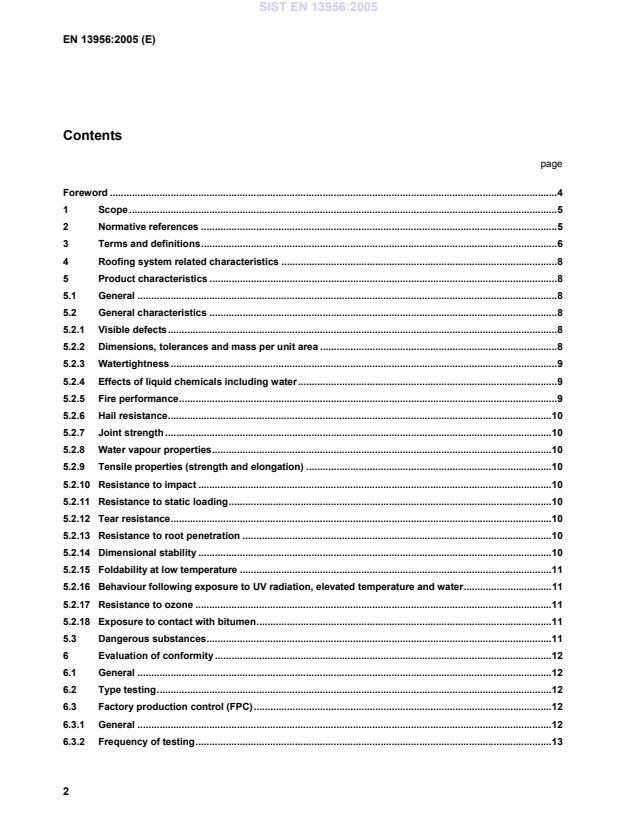
Applicability of characteristics.14 Annex B (normative)
Initial type test and frequencies of testing for factory production control.16 B.1 Type testing.16 B.2 Testing for factory production control (FPC).16 Annex C (informative)
Information about chemical resistance.17 Annex D (informative)
Example of a product data sheet.19 Annex E (informative)
Typical materials, structure of sheets and roofing systems.21 E.1 Typical materials.21 E.1.1 General.21 E.1.2 Plastics.21 E.1.3 Rubbers.21 E.1.4 Thermoplastic rubbers.22 E.2 Installation.22 E.3 Typical roofing systems.23 Annex ZA (informative)
Clauses of this European Standard addressing the provisions of the EU Construction Products Directive.25 ZA.1 Scope and relevant characteristics.25 ZA.2 Procedure for attestation of conformity of plastic and rubber sheets.26 ZA.2.1 Systems of attestation of conformity.26 ZA.2.2 EC Certificate and declaration of conformity.29 ZA.3 CE marking and labelling.29 Bibliography.32
3.10 surface profile (surface structure) raised area on the surface of the sheet creating a difference between the effective and overall thickness exceeding 0,1 mm or a backing exceeding 80 g/m2 3.11 internal fabric layer of woven or non-woven fabric of synthetic or mineral fibres incorporated in the sheet. This layer may or may not constitute reinforcement 3.12 backing layer of woven or non-woven fabric of synthetic or mineral fibres or other material fixed to the bottom of the sheet. This layer may or may not constitute reinforcement 3.13
overall thickness (e) thickness of the sheet excluding any surface profile 3.14 effective thickness (eeff) thickness of the sheet providing the waterproofing function including any surface texture or backing equal to or less than 80 g/m2 but excluding any surface profile and backing greater than 80g/m2 3.15 welding process of jointing by softening the surfaces to be united, either by heat or with the aid of a solvent (solvent welding, solvent bonding), and then pressing the softened surfaces together 3.16 adhesive bonding process of jointing by applying adhesives to the surfaces to be united or by applying an adhesive tape, and then applying pressure 3.17 hot bonding process of bonding by vulcanising a non vulcanised rubber tape between the two sheets to be jointed by means of heat and pressure SIST EN 13956:2005
Thickness and mass per unit area shall be determined in accordance with EN 1849-2, except that where the surface structure is caused by the inner layer, the mechanical thickness measurement method shall be applied and the result shall meet the requirements given in Table 2.
Terms and definitions of this European Standard shall have priority over those given in EN 1849-2. SIST EN 13956:2005
Table 2 — Thickness and mass per unit area requirements Effective thickness: Thickness of the sheet providing the waterproofing function including any surface texture but excluding any surface profile and backing shall be greater than 80 g/m2. The measured effective thickness shall lie within the declared tolerance of the MDV. The tolerance of the MDV shall lie within –5 % and +10 %. Single measurement: Each single measurement value shall lie within the declared tolerance of the MDV. The tolerance of the MDV shall lie within ±10 %. Mass: The mass per unit area shall lie within the declared tolerance of the MDV. The tolerance of the MDV shall lie within –5 % and +10 %.
5.2.3 Watertightness The watertightness shall be determined in accordance with EN 1928 using method B at an applied water pressure of 10 kPa (0,1 bar) and shall give a pass result. 5.2.4 Effects of liquid chemicals including water Information on the effect of liquid chemicals on plastics and rubber is given in Annex C. When further information on resistance to liquid chemicals is required, tests shall be conducted according to EN 1847 at a temperature of 23 °C for 28 days. 5.2.5 Fire performance 5.2.5.1 External fire performance Where the manufacturer wishes to declare external fire performance (e.g. when subject to regulatory requirements), the product shall be tested and classified in accordance with prEN 13501-5. Where the defined system meets the deemed to satisfy criteria1 no testing is required. 5.2.5.2 Reaction to fire Where required, the product shall be tested and classified in accordance with EN 13501-1:2002, Table 1. When tested according to EN ISO 11925-2, the products shall be tested under conditions of surface flame attack. NOTE It is currently considered that the Euroclasses Classification system at Classes D and above requires investigation to determine its appropriateness to the products covered by this European Standard (the SBI test may be inappropriate for products covered by the European Standard). Pending results of such an investigation and discussions in the Fire Regulators Group, products covered by this European Standard are tested to EN ISO 11925-2. If and when a new fire test scenario and test method are developed for the products, this European Standard will be amended to refer to them.
1 See Commission Decision 2000/553/EC [5]. SIST EN 13956:2005
Surface cracks according to EN 1297:2004, Table B.1, Grades 0, 1 and 2 will give a pass result for the visual examination. Grade 3 will give a fail result. NOTE 1 The purpose of testing in accordance to EN 1297 is to characterize the long-term ageing behaviour of plastic and rubber sheets. The test does not give results corresponding to the service conditions in practice. Results should only be used to compare products of similar thickness, construction and composition, and they cannot be used for general durability classification. The chosen exposure duration for artificial ageing in accordance to EN 1297 has no relevance to a real product lifetime. NOTE 2 Sheets passing ETAG 006 requirements are considered to comply with the criteria for behaviour following exposure to UV radiation, elevated temperature and water. 5.2.17 Resistance to ozone Where required, the sheet shall be tested according to EN 1844 and the sheet shall show no cracks. This test is only required for sheets made of rubber materials. 5.2.18 Exposure to contact with bitumen Where required, the behaviour of the sheet where it may come in contact with bitumen shall be determined in accordance with prEN 1548. The sheet is compatible with bitumen if: a) for sheets with an inner layer or backing, the percentage loss in mass is less than or equal to 5 %; b) for sheets without an inner layer or backing, the change in Young's Modulus is less than or equal to 50 %. Results obtained by this test method from sheets without an inner layer or backing can be applied to sheets manufactured with same chemical formulation but having inner reinforcement layers or backing. The results obtained on a given thickness apply to any product of the same formulation with greater thickness.
By experience, sheets with a non-woven backing of at least 150 g/m2 or equivalent, which prevents any contact of the waterproofing membrane with bitumen, are considered as bitumen compatible. 5.3 Dangerous substances For products placed on the market within the European Economic Area see ZA.1. Outside the EEA products shall conform to any applicable provisions related to dangerous substances valid in the place of use. NOTE See also [3] and [4]. SIST EN 13956:2005
...