

EN 13956:2012
(Main)Flexible sheets for waterproofing - Plastic and rubber sheets for roof waterproofing - Definitions and characteristics
- Abstract
This European Standard specifies the definitions and characteristics of plastic and rubber sheets including sheets made out of their blends and alloys (thermoplastic rubber) for which the intended use is roof waterproofing. It specifies the requirements and test methods and provides for the evaluation of conformity of the products with the requirements of this European Standard.
NOTE For typical materials and applications, see Annex E.
- Status
- Published
- Publication Date
- 18-Dec-2012
- Technical Committee
- CEN/TC 254 - Flexible sheets for water proofing
- Drafting Committee
- CEN/TC 254/SC 2 - Synthetic sheets
- Current Stage
- 9093 - Decision to confirm - Review Enquiry
- Start Date
- 14-Jan-2025
- Completion Date
- 07-Oct-2026
- Directive
- 305/2011 - Regulation (eu) No 305/2011 of the European Parliament and of the Council of 9 march 2011 laying down harmonised conditions for the marketing of construction products and repealing council directive 89/106/eecOJ Ref: C, C 259 OJ Date: 08-Aug-2014
89/106/EEC - Construction productsOJ Ref: C, C 59 OJ Date: 28-Feb-2013



Overview
EN 13956:2012 is a key European Standard developed by CEN for flexible sheets used in roof waterproofing applications. This standard establishes important definitions and characteristics for plastic and rubber sheets, including those made from blends and thermoplastic rubber alloys, intended to ensure effective and durable roof waterproofing. EN 13956:2012 sets out requirements, test methods, conformity assessment processes, and guidance for product documentation, assisting manufacturers, designers, and installers in delivering high-quality waterproofing solutions for roofing systems across Europe.
Key Topics
Scope and Definitions
EN 13956:2012 precisely defines terms such as “roof waterproofing system,” “flexible sheet,” and relevant product characteristics, ensuring a shared understanding across the construction and waterproofing industry.Product Characteristics
The standard identifies and describes crucial performance aspects for waterproofing sheets such as:- Watertightness
- Dimensional stability
- Tensile and tear resistance
- Water vapour permeability
- Resistance to root penetration (for garden roofs)
- Foldability at low temperatures
- Behaviour after exposure to UV, heat, and chemicals
- Fire and hail resistance
Test Methods and Performance Requirements
EN 13956:2012 references harmonized European testing standards for evaluating the durability, safety, and mechanical properties of plastic and rubber sheets, supporting product reliability and consistency.Evaluation of Conformity
The standard outlines the procedures for initial type testing and ongoing factory production control. This ensures products consistently meet the minimum performance standards, as required under the EU Construction Products Regulation.Product Data and Marking
Requirements include the provision of comprehensive product data sheets, clear product marking, labelling, and packaging information-facilitating traceability and responsible market placement.
Applications
Flexible plastic and rubber sheets standardized by EN 13956:2012 are widely used for:
- Flat and Low-Slope Roofing
Providing reliable waterproofing in commercial, industrial, and residential buildings. - Roof Gardens and Green Roofs
Certain sheets are specifically tested for resistance to root penetration, making them suitable for landscaped or garden roofs. - Parking Decks and Podiums
Designed sheets can be applied in situations where additional mechanical robustness and chemical resistance are required. - Exposed and Ballasted Roof Systems
Applicable in both adhered and mechanically fastened roofing systems; performance criteria are defined for visible, covered, and protected applications. - Renovation and New Construction
Suitable for both replacement and installation in new building projects, owing to their flexibility, ease of transport, and versatility.
Related Standards
EN 13956:2012 is closely linked with a range of European standards relevant to waterproofing materials and system performance, such as:
- EN 1928 - Watertightness testing methods
- EN 1107-2 - Dimensional stability assessment
- EN 12311-2 - Tensile properties of plastic and rubber sheets
- EN 1297 - UV and weathering resistance via artificial ageing
- EN 13948 - Resistance to root penetration
- EN 1847, EN 1849-2, EN 1850-2 - Chemical resistance, thickness, mass, and visible defect determination
- EN 13501-1 and EN 13501-5 - Fire performance classification
Conclusion
Implementing EN 13956:2012 in roof waterproofing sheet selection and system design delivers assurance of product quality and fitness for purpose. By complying with this waterproofing materials standard, manufacturers and specifiers help ensure robust, safe, and durable roofing solutions across diverse building applications, supporting regulatory compliance and market confidence in Europe.
Keywords: EN 13956:2012, roof waterproofing, plastic sheets, rubber sheets, waterproofing standard, CEN, roofing membranes, performance requirements, test methods, conformity evaluation, green roofs, fire resistance, construction materials, CE marking, factory production control.
Relations
- Effective Date
- 26-Dec-2012
- Effective Date
- 26-Dec-2012
- Effective Date
- 04-Feb-2026
- Effective Date
- 28-Jan-2026
- Effective Date
- 28-Jan-2026
- Effective Date
- 28-Jan-2026
- Effective Date
- 28-Jan-2026
- Effective Date
- 28-Jan-2026
- Effective Date
- 28-Jan-2026
- Effective Date
- 28-Jan-2026
- Effective Date
- 28-Jan-2026
- Effective Date
- 28-Jan-2026
- Effective Date
- 28-Jan-2026
- Effective Date
- 28-Jan-2026
- Effective Date
- 28-Jan-2026
Get Certified
Connect with accredited certification bodies for this standard

DIBt (Deutsches Institut für Bautechnik)
German Institute for Building Technology.
DIN CERTCO
DIN Group product certification.

Aboma Certification B.V.
Specialized in construction, metal, and transport sectors.
Sponsored listings
Frequently Asked Questions
EN 13956:2012 is a standard published by the European Committee for Standardization (CEN). Its full title is "Flexible sheets for waterproofing - Plastic and rubber sheets for roof waterproofing - Definitions and characteristics". This standard covers: This European Standard specifies the definitions and characteristics of plastic and rubber sheets including sheets made out of their blends and alloys (thermoplastic rubber) for which the intended use is roof waterproofing. It specifies the requirements and test methods and provides for the evaluation of conformity of the products with the requirements of this European Standard. NOTE For typical materials and applications, see Annex E.
This European Standard specifies the definitions and characteristics of plastic and rubber sheets including sheets made out of their blends and alloys (thermoplastic rubber) for which the intended use is roof waterproofing. It specifies the requirements and test methods and provides for the evaluation of conformity of the products with the requirements of this European Standard. NOTE For typical materials and applications, see Annex E.
EN 13956:2012 is classified under the following ICS (International Classification for Standards) categories: 01.040.91 - Construction materials and building (Vocabularies); 91.100.50 - Binders. Sealing materials. The ICS classification helps identify the subject area and facilitates finding related standards.
EN 13956:2012 has the following relationships with other standards: It is inter standard links to EN 13956:2005, EN 13956:2005/AC:2006, EN ISO 11925-2:2026, EN 1928:2000, EN 12311-2:2013, EN 12316-2:2013, EN 12691:2018, EN ISO 11925-2:2020, EN 13948:2007, EN 13583:2012, EN 13501-5:2016, EN 1548:2007, EN 1931:2000, EN 1847:2009, EN 1848-2:2001. Understanding these relationships helps ensure you are using the most current and applicable version of the standard.
EN 13956:2012 is associated with the following European legislation: EU Directives/Regulations: 305/2011, 89/106/EEC; Standardization Mandates: M/102. When a standard is cited in the Official Journal of the European Union, products manufactured in conformity with it benefit from a presumption of conformity with the essential requirements of the corresponding EU directive or regulation.
EN 13956:2012 is available in PDF format for immediate download after purchase. The document can be added to your cart and obtained through the secure checkout process. Digital delivery ensures instant access to the complete standard document.
Standards Content (Sample)
2003-01.Slovenski inštitut za standardizacijo. Razmnoževanje celote ali delov tega standarda ni dovoljeno.Hidroizolacijski trakovi - Polimerni in elastomerni trakovi za tesnjenje streh - Definicije in lastnostiAbdichtungsbahnen - Kunststoff- und Elastomerbahnen für Dachabdichtungen - Definitionen und EigenschaftenFeuilles souples d'étanchéité - Feuilles d'étanchéité de toiture plastiques et élastomères - Définitions et caractéristiquesFlexible sheets for waterproofing - Plastic and rubber sheets for roof waterproofing - Definitions and characteristics91.100.50Veziva. Tesnilni materialiBinders. Sealing materials91.060.20StreheRoofs01.040.91Gradbeni materiali in gradnja (Slovarji)Construction materials and building (Vocabularies)ICS:Ta slovenski standard je istoveten z:EN 13956:2012SIST EN 13956:2013en,fr,de01-februar-2013SIST EN 13956:2013SLOVENSKI
STANDARDSIST EN 13956:2005/AC:2006SIST EN 13956:20051DGRPHãþD
EUROPEAN STANDARD NORME EUROPÉENNE EUROPÄISCHE NORM
EN 13956
December 2012 ICS 01.040.91; 91.100.50 Supersedes EN 13956:2005English Version
Flexible sheets for waterproofing - Plastic and rubber sheets for roof waterproofing - Definitions and characteristics
Feuilles souples d'étanchéité - Feuilles d'étanchéité de toiture plastiques et élastomères - Définitions et caractéristiques
Abdichtungsbahnen - Kunststoff- und Elastomerbahnen für Dachabdichtungen - Definitionen und Eigenschaften This European Standard was approved by CEN on 27 October 2012.
CEN members are bound to comply with the CEN/CENELEC Internal Regulations which stipulate the conditions for giving this European Standard the status of a national standard without any alteration. Up-to-date lists and bibliographical references concerning such national standards may be obtained on application to the CEN-CENELEC Management Centre or to any CEN member.
This European Standard exists in three official versions (English, French, German). A version in any other language made by translation under the responsibility of a CEN member into its own language and notified to the CEN-CENELEC Management Centre has the same status as the official versions.
CEN members are the national standards bodies of Austria, Belgium, Bulgaria, Croatia, Cyprus, Czech Republic, Denmark, Estonia, Finland, Former Yugoslav Republic of Macedonia, France, Germany, Greece, Hungary, Iceland, Ireland, Italy, Latvia, Lithuania, Luxembourg, Malta, Netherlands, Norway, Poland, Portugal, Romania, Slovakia, Slovenia, Spain, Sweden, Switzerland, Turkey and United Kingdom.
EUROPEAN COMMITTEE FOR STANDARDIZATION
COMITÉ EUROPÉEN DE NORMALISATION EUROPÄISCHES KOMITEE FÜR NORMUNG
Management Centre:
Avenue Marnix 17,
B-1000 Brussels © 2012 CEN All rights of exploitation in any form and by any means reserved worldwide for CEN national Members. Ref. No. EN 13956:2012: ESIST EN 13956:2013
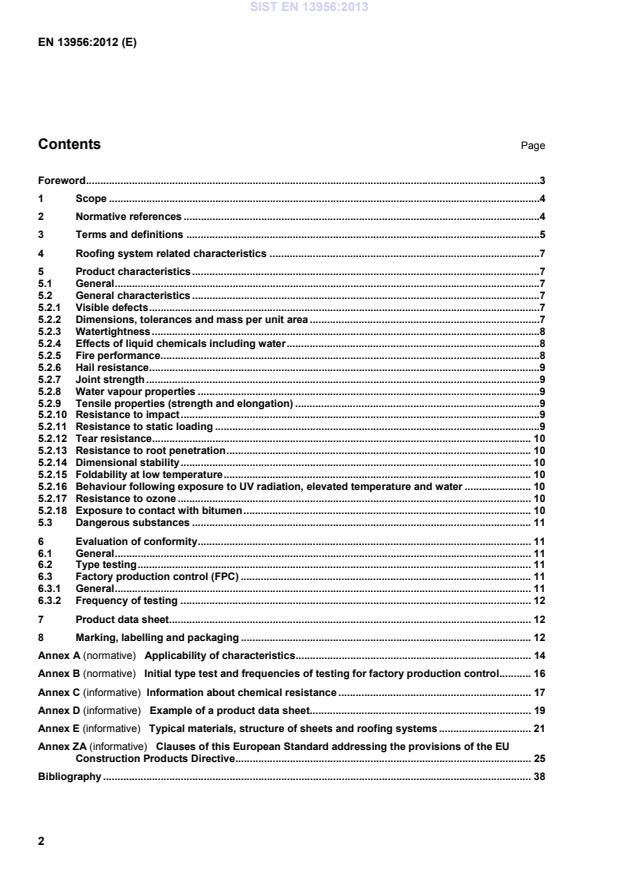
Applicability of characteristics . 14Annex B (normative)
Initial type test and frequencies of testing for factory production control. 16Annex C (informative)
Information about chemical resistance . 17Annex D (informative)
Example of a product data sheet. 19Annex E (informative)
Typical materials, structure of sheets and roofing systems . 21Annex ZA (informative)
Clauses of this European Standard addressing the provisions of the EU Construction Products Directive . 25Bibliography . 38 SIST EN 13956:2013
new extended mounting and fixing rules;
introduction of indirect testing for factory production control. According to the CEN/CENELEC Internal Regulations, the national standards organisations of the following countries are bound to implement this European Standard: Austria, Belgium, Bulgaria, Croatia, Cyprus, Czech Republic, Denmark, Estonia, Finland, Former Yugoslav Republic of Macedonia, France, Germany, Greece, Hungary, Iceland, Ireland, Italy, Latvia, Lithuania, Luxembourg, Malta, Netherlands, Norway, Poland, Portugal, Romania, Slovakia, Slovenia, Spain, Sweden, Switzerland, Turkey and the United Kingdom.
EN 1850-2, Flexible sheets for waterproofing — Determination of visible defects — Part 2: Plastic and rubber sheets for roof waterproofing EN 1928, Flexible sheets for waterproofing — Bitumen, plastic and rubber sheets for roof waterproofing — Determination of watertightness EN 1931, Flexible sheets for waterproofing — Bitumen, plastic and rubber sheets for roof waterproofing — Determination of water vapour transmission properties EN 12310-2, Flexible sheets for waterproofing — Determination of resistance to tearing — Part 2: Plastic and rubber sheets for roof waterproofing EN 12311-2, Flexible sheets for waterproofing — Determination of tensile properties — Part 2: Plastic and rubber sheets for roof waterproofing SIST EN 13956:2013
3.10 surface profile (surface structure) raised area on the surface of the sheet creating a difference between the effective and overall thickness exceeding 0,1 mm or a backing exceeding 80 g/m2 3.11 internal fabric layer of woven or non-woven fabric of synthetic or mineral fibres incorporated in the sheet Note 1 to entry: This layer may or may not constitute reinforcement. 3.12 backing layer of woven or non-woven fabric of synthetic or mineral fibres or other material fixed to the bottom of the sheet Note 1 to entry: This layer may or may not constitute reinforcement. 3.13
overall thickness d thickness of the sheet excluding any surface profile 3.14 effective thickness
deff thickness of the sheet providing the waterproofing function including any surface texture or backing equal to or less than 80 g/m2 but excluding any surface profile and backing greater than 80g/m2 3.15 welding process of jointing by softening the surfaces to be united, either by heat or with the aid of a solvent (solvent welding, solvent bonding), and then pressing the softened surfaces together 3.16 adhesive bonding process of jointing by applying adhesives to the surfaces to be united or by applying an adhesive tape, and then applying pressure SIST EN 13956:2013
4 Roofing system related characteristics Testing shall be carried out according to Table A.1. 5 Product characteristics 5.1 General 5.1.1 Where a tolerance is limited by this European Standard it does not have to be declared by the manufacturer. 5.1.2 When tested for purposes other than initial type testing or factory production control, the tests to determine product characteristics indicated in this European Standard shall be started within 1 month of delivery from the manufacturer. 5.2 General characteristics 5.2.1 Visible defects The product shall be free of visible defects in accordance with EN 1850-2. 5.2.2 Dimensions, tolerances and mass per unit area The length, width, straightness and flatness shall be determined in accordance with EN 1848-2 and shall meet the requirements given in Table 1. The values for straightness and flatness only apply to sheets supplied in the form of rolls. The values for straightness and flatness do not apply to folded sheets. SIST EN 13956:2013
Thickness and mass per unit area shall be determined in accordance with EN 1849-2, except that where the surface structure is caused by the inner layer, the mechanical thickness measurement method shall be applied and the result shall meet the requirements given in Table 2. Terms and definitions of this European Standard shall have priority over those given in EN 1849-2. Table 2 — Thickness and mass per unit area requirements Effective thickness: Thickness of the sheet providing the waterproofing function including any surface texture but excluding any surface profile and backing greater than 80 g/m2. The measured effective thickness shall lie within the declared tolerance of the MDV. The tolerance of the MDV shall lie within – 5 % and + 10 %. Single measurement: Each single measurement value shall lie within the declared tolerance of the MDV. The tolerance of the MDV shall lie within ± 10 %. Mass: The mass per unit area shall lie within the declared tolerance of the MDV. The tolerance of the MDV shall lie within – 5 % and + 10 %.
5.2.3 Watertightness The watertightness shall be determined in accordance with EN 1928 using method B at an applied water pressure of 10 kPa (0,1 bar) and shall give a pass result. 5.2.4 Effects of liquid chemicals including water Information on the effect of liquid chemicals on plastics and rubber is given in Annex C. When further information on resistance to liquid chemicals is required, tests shall be conducted according to EN 1847 at a temperature of 23 °C for 28 days. 5.2.5 Fire performance 5.2.5.1 External fire performance The classification of the product in accordance with EN 13501-5 is limited to class F. NOTE It is currently considered that there are no national requirements specific to flexible sheets for roof waterproofing alone on external fire performance. The external fire performance of a roof is dominated by its build up. 5.2.5.2 Reaction to fire Where required, the product shall be tested and classified in accordance with EN 13501-1, Table 1. According to EN ISO 11925-2, the test is required to be undertaken on the exposed surface of the delivered flexible sheet (surface or edge exposure) free hanging without any substrate in one direction only, and the reinforcement shall be stated by the manufacturer as “organic” or “inorganic”. a) Test results from EN ISO 11925-2 for a given product shall apply to all colours (including black, white). SIST EN 13956:2013
Surface cracks according to EN 1297:2004, Table B.1, Grades 0, 1 and 2 will give a pass result for the visual examination. Grade 3 will give a fail result. The purpose of testing in accordance to EN 1297 is to characterise the long-term ageing behaviour of plastic and rubber sheets. The test does not give results corresponding to the service conditions in practice. Results should only be used to compare products of similar thickness, construction and composition, and they cannot be used for general durability classification. The chosen exposure duration for artificial ageing in accordance to EN 1297 has no relevance to a real product lifetime. NOTE Sheets passing ETAG 006 requirements are considered to comply with the criteria for behaviour following exposure to UV radiation, elevated temperature and water. 5.2.17 Resistance to ozone Where required, the sheet shall be tested according to EN 1844 and the sheet shall show no cracks. This test is only required for sheets made of rubber materials. 5.2.18 Exposure to contact with bitumen Where required, the behaviour of the sheet where it may come in contact with bitumen shall be determined in accordance with EN 1548. The sheet is compatible with bitumen if: a) for sheets with an inner layer, the percentage loss in mass is less than or equal to 5 %; b) for sheets without an inner layer or backing, the change in Young's Modulus is less than or equal to 50 %. Results obtained by this test method from sheets without an inner layer or backing can be applied to sheets manufactured with same chemical formulation but having inner reinforcement layers or backing. The results obtained on a given thickness apply to any product of the same formulation with greater thickness. By SIST EN 13956:2013
The characteristics of the product, determined in accordance with the test methods specified in this European Standard, shall be listed in a technical data sheet. The technical data sheet shall give the following information: a) product trade name and manufacturer's name;
b) origin/source of manufacture or traceable code;
c) type of application and roofing system (see also Table A.1); d) results of tests (see also Table A.1) according to intended end use system where relevant; e) certification mark, if any; f) consumer information, e.g.
1) restrictions concerning use
where the product is not suitable for all installation conditions, it is essential that the manufacturer declare those installation conditions for which the product is suitable; 2) restrictions storage; 3) safety precautions during installation and disposal; g) description of the product (e.g. type of base material, type of reinforcement, mass or thickness, type of surfaces). An example of a product data sheet is shown in Annex D. 8 Marking, labelling and packaging The following information shall be indicated on each roll and/or in the accompanying technical or commercial documentation: a) production date or identification number; SIST EN 13956:2013
(normative)
Applicability of characteristics Table A.1 gives the relevant characteristics depending on the roofing system and/or regulatory requirements. Table A.1 — Roofing system-related characteristics (1 of 2)
Clause
Testing for Type of application/roofing system Exposed sheets Covered sheets Adhered Mechanically fastened Gravel ballasted Roof gardens, park decks or similar 5.2.1 Visible defects + + + + 5.2.2 Length + + + + 5.2.2 Width + + + + 5.2.2 Straightness ± ± ± ± 5.2.2 Flatness ± ± ± ± 5.2.2 Mass per unit area + + + + 5.2.2 Effective thickness + + + + 5.2.3 Water tightness + + + + 5.2.5.1 External fire performance - - - - 5.2.5.2 Reaction to fire ± ± ± ± 5.2.7 Joint peel resistance ± + - - 5.2.7 Joint shear resistance + + + + 5.2.9 Tensile strength + + + + 5.2.9 Elongation + + + + 5.2.10 Resistance to impact + + + + 5.2.11 Resistance to static loading - - + + 5.2.12 Tear resistance - + - - 5.2.13 Resistance to root penetration
- - - + a 5.2.14 Dimensional stability + + + + 5.2.15 Foldability at low
temperature + + + + 5.2.16 UV exposure (1 000 h) + + - - 5.2.4 Effects of liquid chemicals, including water
± ± ± ± 5.2.6 Hail resistance
± ± - -
+ b + b + b - 5.2.18 Exposure to bitumen ± ± ± ± Key + Relevant. - Not relevant. ± Dependant on roofing system, material, climatic condition or regulatory requirement. a For sheets used as root barriers in roof gardens only. b For rubber sheets only.
(normative)
Initial type test and frequencies of testing for factory production control B.1 Type testing Initial type testing is necessary for all characteristics, which are relevant in relation to the roofing system, material, climatic condition or regulatory requirement. Initial type testing does not need to be repeated as long as the stated product properties remain valid.
For characteristics under 5.2.5.1 External fire performance and 5.2.13 Resistance to root penetration the type testing is a system test. B.2 Testing for factory production control (FPC) The minimum frequencies of testing for factory production control are given in Table B.1. All other relevant characteristics shall be controlled indirectly (e.g. by control of product composition). Table B.1 — Frequencies of testing for FPC
Clause
Characteristic Minimum frequencies of testing per batch week month year 5.2.1 Visible defects 1
5.2.2 Width 1
5.2.2 Straightness
5.2.2 Flatness
5.2.2 Effective thickness or mass per unit area 1
5.2.9 Tensile strength
1 a
5.2.9 Elongation
1 a
5.2.12 Tear resistance
1 a 5.2.15 Dimensional stability
2 b a Where a manufacturer is continuously producing numerous different sheets, which contain the same core (type and mass) and the same type of coating, the frequency of these tests, which relate essentially to the core, may be considered on the total number of these different sheets. b Not necessary for sheets with non-woven glass mat carrier or composite reinforcement containing glass. SIST EN 13956:2013
(informative)
Information about chemical resistance The best judgement about the long-term fitness for purpose of membranes under chemical environments is based on practical experience. Table C.1 describes the chemical resistance concerning common substances (where the behaviour of all synthetic membranes in the market is assumed to be equal). The judgement is based on the changes of mechanical performance but note that changes in colour are not considered. The statements are valid for room temperature (23 °C) with a typical test period of 28 days. It is the responsibility of the manufacturer to inform the customer about chemical resistance. It is recognised that a large amount of data concerning the chemical resistance is available. The table shown here is based on: – Kunststoff Handbuch Band II Polyvinylchlorid, Krekeler/Wick (Hsg.), Carl Hanser Verlag München, 1963, – Kunststoff-Tabellen, Carlowitz, 4. Auflage, Carl Hanser Verlag München, 1995. If detailed information or the behaviour concerning further substances is required, please refer to the original literature. Table C.1 — Chemical resistance of plastic and rubber sheets (1 of 2) Substance Concentration % Resistance Inorganic acids Sulphuric acid ≤ 25+ > 25 and ≤ 98∆ > 98- Sulphurous acid≤ 6+ Oleum
- Nitric acid ≤ 5+ > 5 and ≤ 50∆ > 50- Hydrochloric acid ≤ 10+ > 10∆
+ Butyric acid
∆ Acetic acid ≤ 10 + > 10 ∆ Oleic acid
∆ Oxalic acid
+ Phenols
∆ Phthalic acid
+ Tartaric acid, aqueous
+ Citric acid, aqueous
+ Inorganic bases Ammonium hydroxide, aqueous
∆ Potassium hydroxide, aqueous
∆ Sodium hydroxide ≤ 10 + > 10 and ≤ 50 ∆ > 50 - Organic bases Pyridine and derivates
∆ Triethanolamin
∆ Salt solutions Chlorides
+ Nitrates
+ Sulphates
+ Different substances Drinking water
+ Beer
+ Glycol
∆ Soap solution
+ Liquid manure
∆ Key +
All polymeric materials are resistant. ∆ Not stable in all cases (see literature or to be checked). - None of the polymeric materials are resistant.
(informative)
Example of a product data sheet Date and reference of this technical data sheet. Product trade name. Manufacturer/supplier. Origin /source of manufacturing. Type of application and roofing system (see Annex A). Product performance, see Table D.11). Certification mark where relevant. Consumer information2). Description of product (e.g. type of base material, type of reinforcement, thickness). Table D.1 — Information from testing (where relevant according to
roofing system, see Table A.1) (1 of 2) Clause Characteristic Test method Unit Tolerance Expression of results Value or statement 5.2.1 Visible defects EN 1850-2
Pass
5.2.2 Length EN 1848-2 m -0 % and +5 % MDV
5.2.2 Width EN 1848-2 m -0,5 % and +1 % MDV
5.2.2 Straightness EN 1848-2 mm
MLV ≤ 5.2.2 Flatness EN 1848-2 mm
MLV ≤ 5.2.2 Mass per unit area EN 1849-2 kg/m2 -5% and +10 % MDV
5.2.2 Effective thickness EN 1849-2 mm -5 % and +10 %a MDV
5.2.3 Water tightness EN 1928 Method B kPa
Pass ≥ 5.2.5.1 External fire performance CEN/TS 1187
In accordance with EN 13501-5 F
1) See ZA.3, which limits information to be given in association with CE marking. 2) For example, restrictions concerning use and storage and safety precaution during installation and disposal. SIST EN 13956:2013
EN 13501-1 (see Note in 5.2.5.2)
5.2.7 Joint peel resistance EN 12316-2 N/50 mm
MLV ≥ 5.2.7 Joint shear resistance EN 12317-2 N/50 mm
MLV ≥ 5.2.9 Tensile strength EN 12311-2 N/50 mm or N/mm2
MLV ≥ 5.2.9 Elongation EN 12311-2 %
MLV ≥ 5.2.10 Resistance to impact EN 12691 mm
MLV ≥
5.2.11 Resistance to static load EN 12730 Method B kg
MLV ≥ 5.2.12 Tear resistance EN 12310-2 N
MLV ≥ 5.2.13 Res. to root penetration b EN 13948
Pass
5.2.14 Dimensional stability EN 1107-2 %
MLV ≤ 5.2.15 Foldability at low temp. EN 495-5 ºC
MLV ≤ 5.2.16 UV exposure EN 1297 Visual
Pass
5.2.4 Liquid chem. incl. water c EN 1847
See Annex C
5.2.6 Hail resistance d EN 13583 m/s
MLV ≥ 5.2.8 Water vapour properties EN 1931
±30% MDV
5.2.17 Resistance to ozone e EN 1844
Pass
5.2.18 Exposure to bitumen EN 1548
Pass
Key a Single values within ± 10 % b
For sheets used as root barriers in roof gardens only c On request only d Where required e Rubber materials only
(informative)
Typical materials, structure of sheets and roofing systems E.1 Typical materials E.1.1 General Three groups of synthetic materials are used in the application of flexible sheets for waterproofing: plastics, rubbers and thermoplastic rubbers. Within these three groups, there are various materials, which can be different in their nature and way of manufacturing. In the following there are listed some typical materials for the individual groups. Other materials may be possible, because this European Standard should not hinder further development. For some materials short code designations have been established in the marketplace that differ from normative codes. E.1.2 Plastics CSM or PE-CS Chlorosulfonyl polyethylene EEA Ethylene/ethyl acrylate
Ethylene/ethyl acrylate terpolymer (stated in full in words) EBA Ethylene/butyl acrylate ECB or EBT
Ethylene, copolymer, bitumen EVAC Ethylene/vinyl acetate FPO or PO-F Flexible polyolefin
FPP or PP-F
Flexible polypropylene PE Polyethylene PE-C Chlorinated polyethylene PIB Polyisobutylene PP Polypropylene PVC Polyvinylchloride
E.1.3 Rubbers BR Butadiene rubber CR Chloroprene rubber CSM Chlorosulfonyl polyethylene rubber EPDM Terpolymer of ethylene, propylene and a diene with residual unsaturatedportionofdieneinthesidechainIIR Isobutene-isoprene rubber (butyl rubber) NBR Acrylonitrile-butadiene rubber (nitrile rubber)
Elastomeric alloys MPR Melt processible rubber SEBS Styrene ethylene butylene styrene TPE
Thermoplastic elastomers, not cross-linked TPE-X
Thermoplastic elastomers, cross-linked TPS or TPS-SEBS SEBS-copolymers TPV Thermoplastic rubber vulcanisate
E.2 Installation Plastic and rubber sheets for roof waterproofing are normally installed as a single layer roof waterproofing membrane. The joints between sheets are often welded by the action of heat or solvent but they may also be sealed using adhesive or adhesive tape or in the case of rubber material hot bonded. In all cases, it is important that the sheets are jointed by the method recommended by the manufacturer. The roof waterproofing sheet may be fastened to the substructure with adhesive, be mechanically fastened, or can be ballasted. The sheet has different requirements for each method of application and it is important that the manufacturer’s advice is sought as to the suitability of the sheet for the application. At perimeter details, it is normal to use special trims and these are often made from metal, which can be laminated with a material compatible with the main roof membrane, to enable the trim to be jointed to the main membrane. However when the sheet is applied, it is important that the system can withstand the expected wind uplift forces. With mechanically fastened membranes fastenings can be varied to meet the exposure conditions. With ballasted roofs, the membrane is loose laid, with only the perimeter being fastened, which allows for maximum movement of the substrate. The weight of the ballast (e.g. gravel or paving) has to provide the resistance to wind uplift forces. Separation layers are sometimes needed to prevent reaction between the insul
...