

EN 1434-1:2022
(Main)Thermal energy meters - Part 1: General requirements
- Abstract
This document is applicable for the general requirements for thermal energy meters. Thermal energy meters are instruments intended for measuring the energy which in a heat-exchange circuit is absorbed (cooling) or given up (heating) by a liquid called the heat-conveying liquid. The thermal energy meter indicates the quantity of thermal energy in legal units.
This document covers meters for closed systems only, where the differential pressure over the thermal load is limited.
This document is not applicable to:
- electrical safety requirements;
- pressure safety requirements; and
- surface mounted temperature sensors.
- Status
- Published
- Publication Date
- 06-Sep-2022
- Technical Committee
- CEN/TC 176 - Heat meters
- Current Stage
- 6060 - Definitive text made available (DAV) - Publishing
- Start Date
- 07-Sep-2022
- Due Date
- 22-Nov-2021
- Completion Date
- 07-Sep-2022
- Directive
- 2014/32/EU - Directive 2014/32/EU of the European Parliament and of the Council of 26 February 2014 on the harmonisation of the laws of the Member States relating to the making available on the market of measuring instrumentsOJ Ref: 2025/1939, OJ L, OJ L, 2025/1939 OJ Date: 25-Sep-2025



Overview
EN 1434-1:2022 - published by CEN - defines the general requirements for thermal energy meters used to measure thermal energy transferred by a liquid (the heat‑conveying liquid) in closed heat‑exchange circuits. The standard applies to meters that indicate thermal energy in legal units and covers combined and modular meter designs for closed systems with limited differential pressure over the thermal load. It supersedes EN 1434-1:2015+A1:2018 and is the Part 1 document of the EN 1434 series (constructional requirements, pattern approval, verification, installation and maintenance are covered in other parts).
Key topics and technical requirements
EN 1434-1:2022 addresses fundamental elements and definitions that underpin safe, accurate and compliant thermal energy measurement:
- Types of instruments: definitions for complete, combined and hybrid meters and their sub‑assemblies (flow sensor, temperature sensor pair, calculator).
- Rated operating conditions: required specification of temperature ranges, temperature differences, flow rates, thermal power and working/nominal pressures.
- Technical characteristics: materials, construction, displays, fraud protection, supply voltage, reproducibility, repeatability and software considerations.
- Metrological characteristics (MPE): framework for maximum permissible errors and how they apply to complete meters and sub‑assemblies.
- Specified working range: declared temperature difference and flow rate ranges for accurate operation.
- Environmental and mechanical classification: classes for domestic/industrial use and mechanical stress levels.
- Manufacturer information requirements: installation, parameter setting, adjustment, maintenance and expanded end‑of‑life recycling/disposal instructions.
- Normative annexes: heat coefficient formulae (water and other liquids), flow conditioner package and fast response meter guidance.
- Exclusions: the document does not cover electrical safety, pressure safety or surface‑mounted temperature sensors.
Applications and who uses it
EN 1434-1:2022 is essential for:
- Meter manufacturers designing or certifying thermal energy meters for closed systems.
- Test laboratories and pattern approval bodies conducting type tests and verification per EN 1434 series.
- District heating/cooling utilities and building services engineers specifying meters for billing, energy management and performance monitoring.
- Installers and maintenance teams who require installation, calibration and lifecycle guidance.
- Regulators and procurement teams needing compliance evidence with EU directives (see Annex ZA).
Related standards
- EN 1434-2:2022 (Constructional requirements)
- EN 1434-4:2022 (Pattern approval tests)
- EN 1434-5/6 and additional parts (verification, installation and maintenance)
- Relevant references: EN 60751 (PT100 platinum RTDs), EN 61010-1 (electrical equipment safety - referenced)
This standard provides the baseline metrological and informational requirements necessary for reliable, interoperable thermal energy measurement across Europe and supports compliant product design, testing and procurement.
Relations
- Effective Date
- 14-Sep-2022
- Effective Date
- 09-Feb-2026
- Effective Date
- 09-Feb-2026
- Effective Date
- 09-Feb-2026
- Effective Date
- 28-Jan-2026
- Effective Date
- 28-Jan-2026
- Effective Date
- 28-Jan-2026
- Effective Date
- 28-Jan-2026
- Effective Date
- 28-Jan-2026
- Effective Date
- 28-Jan-2026
- Effective Date
- 28-Jan-2026
- Effective Date
- 28-Jan-2026
Get Certified
Connect with accredited certification bodies for this standard

BSMI (Bureau of Standards, Metrology and Inspection)
Taiwan's standards and inspection authority.
Sponsored listings
Frequently Asked Questions
EN 1434-1:2022 is a standard published by the European Committee for Standardization (CEN). Its full title is "Thermal energy meters - Part 1: General requirements". This standard covers: This document is applicable for the general requirements for thermal energy meters. Thermal energy meters are instruments intended for measuring the energy which in a heat-exchange circuit is absorbed (cooling) or given up (heating) by a liquid called the heat-conveying liquid. The thermal energy meter indicates the quantity of thermal energy in legal units. This document covers meters for closed systems only, where the differential pressure over the thermal load is limited. This document is not applicable to: - electrical safety requirements; - pressure safety requirements; and - surface mounted temperature sensors.
This document is applicable for the general requirements for thermal energy meters. Thermal energy meters are instruments intended for measuring the energy which in a heat-exchange circuit is absorbed (cooling) or given up (heating) by a liquid called the heat-conveying liquid. The thermal energy meter indicates the quantity of thermal energy in legal units. This document covers meters for closed systems only, where the differential pressure over the thermal load is limited. This document is not applicable to: - electrical safety requirements; - pressure safety requirements; and - surface mounted temperature sensors.
EN 1434-1:2022 is classified under the following ICS (International Classification for Standards) categories: 17.200.20 - Temperature-measuring instruments. The ICS classification helps identify the subject area and facilitates finding related standards.
EN 1434-1:2022 has the following relationships with other standards: It is inter standard links to EN 1434-1:2015+A1:2018, EN 60751:2008, EN 61010-1:2010/A1:2019, EN 61010-1:2010, EN 1434-2:2022, EN 1434-5:2022, EN 13757-1:2014, EN 1434-6:2022, EN 1434-4:2022, CEN/TR 13582:2025, EN 13757-1:2002, CEN/TR 13582:2021. Understanding these relationships helps ensure you are using the most current and applicable version of the standard.
EN 1434-1:2022 is associated with the following European legislation: EU Directives/Regulations: 2014/32/EU; Standardization Mandates: M/541. When a standard is cited in the Official Journal of the European Union, products manufactured in conformity with it benefit from a presumption of conformity with the essential requirements of the corresponding EU directive or regulation.
EN 1434-1:2022 is available in PDF format for immediate download after purchase. The document can be added to your cart and obtained through the secure checkout process. Digital delivery ensures instant access to the complete standard document.
Standards Content (Sample)
SLOVENSKI STANDARD
01-november-2022
Nadomešča:
SIST EN 1434-1:2016+A1:2019
Merilniki toplote - 1. del: Splošne zahteve
Thermal energy meters - Part 1: General requirements
Thermische Energiemessgeräte - Teil 1: Allgemeine Anforderungen
Compteurs d'énergie thermique - Partie 1 : Prescriptions générales
Ta slovenski standard je istoveten z: EN 1434-1:2022
ICS:
17.200.20 Instrumenti za merjenje Temperature-measuring
temperature instruments
2003-01.Slovenski inštitut za standardizacijo. Razmnoževanje celote ali delov tega standarda ni dovoljeno.
EN 1434-1
EUROPEAN STANDARD
NORME EUROPÉENNE
September 2022
EUROPÄISCHE NORM
ICS 17.200.20 Supersedes EN 1434-1:2015+A1:2018
English Version
Thermal energy meters - Part 1: General requirements
Compteurs d'énergie thermique - Partie 1 : Thermische Energiemessgeräte - Teil 1: Allgemeine
Prescriptions générales Anforderungen
This European Standard was approved by CEN on 17 July 2022.
CEN members are bound to comply with the CEN/CENELEC Internal Regulations which stipulate the conditions for giving this
European Standard the status of a national standard without any alteration. Up-to-date lists and bibliographical references
concerning such national standards may be obtained on application to the CEN-CENELEC Management Centre or to any CEN
member.
This European Standard exists in three official versions (English, French, German). A version in any other language made by
translation under the responsibility of a CEN member into its own language and notified to the CEN-CENELEC Management
Centre has the same status as the official versions.
CEN members are the national standards bodies of Austria, Belgium, Bulgaria, Croatia, Cyprus, Czech Republic, Denmark, Estonia,
Finland, France, Germany, Greece, Hungary, Iceland, Ireland, Italy, Latvia, Lithuania, Luxembourg, Malta, Netherlands, Norway,
Poland, Portugal, Republic of North Macedonia, Romania, Serbia, Slovakia, Slovenia, Spain, Sweden, Switzerland, Türkiye and
United Kingdom.
EUROPEAN COMMITTEE FOR STANDARDIZATION
COMITÉ EUROPÉEN DE NORMALISATION
EUROPÄISCHES KOMITEE FÜR NORMUNG
CEN-CENELEC Management Centre: Rue de la Science 23, B-1040 Brussels
© 2022 CEN All rights of exploitation in any form and by any means reserved Ref. No. EN 1434-1:2022 E
worldwide for CEN national Members.
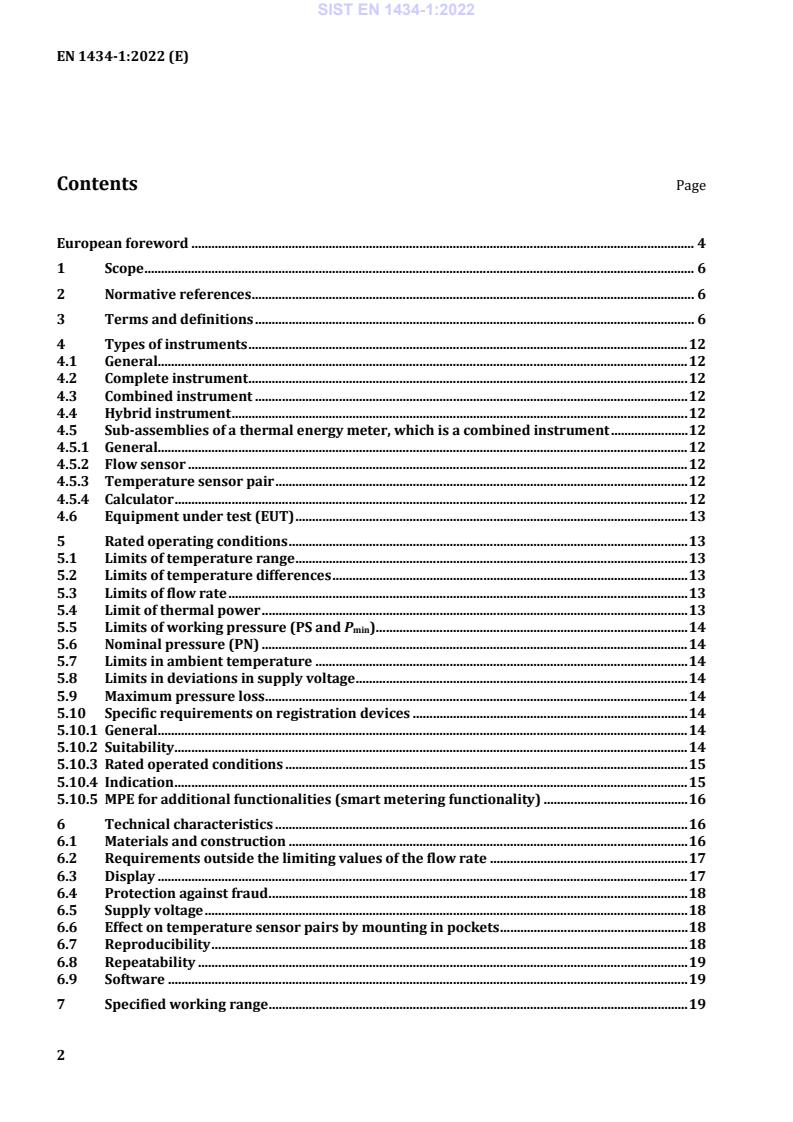
Contents Page
European foreword . 4
1 Scope . 6
2 Normative references . 6
3 Terms and definitions . 6
4 Types of instruments . 12
4.1 General. 12
4.2 Complete instrument . 12
4.3 Combined instrument . 12
4.4 Hybrid instrument . 12
4.5 Sub-assemblies of a thermal energy meter, which is a combined instrument . 12
4.5.1 General. 12
4.5.2 Flow sensor . 12
4.5.3 Temperature sensor pair . 12
4.5.4 Calculator . 12
4.6 Equipment under test (EUT) . 13
5 Rated operating conditions . 13
5.1 Limits of temperature range . 13
5.2 Limits of temperature differences . 13
5.3 Limits of flow rate . 13
5.4 Limit of thermal power . 13
5.5 Limits of working pressure (PS and P ) . 14
min
5.6 Nominal pressure (PN) . 14
5.7 Limits in ambient temperature . 14
5.8 Limits in deviations in supply voltage . 14
5.9 Maximum pressure loss . 14
5.10 Specific requirements on registration devices . 14
5.10.1 General. 14
5.10.2 Suitability . 14
5.10.3 Rated operated conditions . 15
5.10.4 Indication . 15
5.10.5 MPE for additional functionalities (smart metering functionality) . 16
6 Technical characteristics . 16
6.1 Materials and construction . 16
6.2 Requirements outside the limiting values of the flow rate . 17
6.3 Display . 17
6.4 Protection against fraud . 18
6.5 Supply voltage . 18
6.6 Effect on temperature sensor pairs by mounting in pockets . 18
6.7 Reproducibility . 18
6.8 Repeatability . 19
6.9 Software . 19
7 Specified working range . 19
7.1 General . 19
7.2 Temperature difference . 19
7.3 Flow rate . 19
8 Heat transmission formula . 19
9 Metrological characteristics (Maximum Permissible Error, MPE) . 20
9.1 General . 20
9.2 Values of maximum permissible errors . 20
9.2.1 Maximum permissible relative errors of complete thermal energy meters. 20
9.2.2 Maximum permissible relative error of sub-assemblies . 21
9.3 Application of maximum permissible errors . 21
10 Environmental classification . 22
10.1 General . 22
10.2 Environmental class A (Domestic use, indoor installations) . 22
10.3 Environmental class B (Domestic use, outdoor installations) . 22
10.4 Environmental class C (Industrial installations) . 22
10.5 Mechanical classes M1 to M3 . 22
11 Thermal energy meter specification . 23
11.1 General . 23
11.2 Flow sensor . 23
11.3 Temperature sensor pair . 24
11.4 Calculator . 25
11.5 Complete meters . 26
12 Information to be made available by the manufacturer or supplier . 28
12.1 Installation instructions . 28
12.2 Parameter setting instructions. 29
12.3 Adjustment instructions . 30
12.4 Maintenance instructions . 30
12.5 Information required when a thermal energy meter is taken out of service for
recycling and/or disposal . 31
12.5.1 General . 31
12.5.2 Disassembly . 31
12.5.3 Recycling . 31
12.5.4 Disposal . 31
Annex A (normative) Heat coefficient formulae . 32
A.1 Water . 32
A.2 Heat-conveying liquids other than water . 34
Annex B (normative) Flow conditioner package . 35
Annex C (normative) Fast response meters . 37
Annex ZA (informative) Relationship between this European Standard and the essential
requirements of Directive 2014/32/EU aimed to be covered . 38
Bibliography . 42
European foreword
This document (EN 1434-1:2022) has been prepared by Technical Committee CEN/TC 176 “Thermal
energy meters”, the secretariat of which is held by SIS.
This European Standard shall be given the status of a national standard, either by publication of an
identical text or by endorsement, at the latest by March 2023, and conflicting national standards shall
be withdrawn at the latest by March 2023.
Attention is drawn to the possibility that some of the elements of this document may be the subject of
patent rights. CEN shall not be held responsible for identifying any or all such patent rights.
This document supersedes EN 1434-1:2015+A1:2018.
EN 1434, Thermal energy meters, consists of the following parts:
— Part 1: General requirements;
— Part 2: Constructional requirements;
— Part 3: Data exchange and interfaces ;
— Part 4: Pattern approval tests;
— Part 5: Initial verification tests;
— Part 6: Installation, commissioning, operational monitoring and maintenance.
In comparison with EN 1434-1:2015+A1:2018, the following changes have been made:
— the wording “flow straightener” has been changed to “flow conditioner” in the whole document;
— subclause 12.5 “Hints for disposal instructions” has been replaced by the enlarged, new
subclause 12.5 “Information required when a thermal energy meter is taken out of service for
recycling and/or disposal”.
This document has been prepared under a Standardization Request given to CEN by the European
Commission and the European Free Trade Association, and supports essential requirements of EU
Directive(s) / Regulation(s).
For relationship with EU Directive(s) / Regulation(s), see informative Annex ZA, which is an integral
part of this document.
Any feedback and questions on this document should be directed to the users’ national standards body.
A complete listing of these bodies can be found on the CEN website.
According to the CEN-CENELEC Internal Regulations, the national standards organisations of the
following countries are bound to implement this European Standard: Austria, Belgium, Bulgaria,
Croatia, Cyprus, Czech Republic, Denmark, Estonia, Finland, France, Germany, Greece, Hungary, Iceland,
Ireland, Italy, Latvia, Lithuania, Luxembourg, Malta, Netherlands, Norway, Poland, Portugal, Republic of
EN 1434-3 is maintained by CEN/TC 294.
North Macedonia, Romania, Serbia, Slovakia, Slovenia, Spain, Sweden, Switzerland, Türkiye and the
United Kingdom.
1 Scope
This document is applicable for the general requirements for thermal energy meters. Thermal energy
meters are instruments intended for measuring the energy which in a heat-exchange circuit is absorbed
(cooling) or given up (heating) by a liquid called the heat-conveying liquid. The thermal energy meter
indicates the quantity of thermal energy in legal units.
This document covers meters for closed systems only, where the differential pressure over the thermal
load is limited.
This document is not applicable to:
— electrical safety requirements;
— pressure safety requirements; and
— surface mounted temperature sensors.
2 Normative references
The following documents are referred to in the text in such a way that some or all of their content
constitutes requirements of this document. For dated references, only the edition cited applies. For
undated references, the latest edition of the referenced document (including any amendments) applies.
EN 1434-2:2022, Thermal energy meters — Part 2: Constructional requirements
EN 1434-4:2022, Thermal energy meters — Part 4: Pattern approval tests
EN 60751:2008, Industrial platinum resistance thermometers and platinum temperature sensors
(IEC 60751:2008)
EN 61010-1:2010, Safety requirements for electrical equipment for measurement, control and laboratory
use — Part 1: General requirements (IEC 61010-1:2010)
3 Terms and definitions
For the purposes of this document, the following terms and definitions apply.
ISO and IEC maintain terminological databases for use in standardization at the following addresses:
— IEC Electropedia: available at https://www.electropedia.org/
— ISO Online browsing platform: available at https://www.iso.org/obp
3.1
response time
τ
0,5
time interval between the instant when flow or temperature difference is subjected to a specified
abrupt change and the instant when the response reaches 50 % of the step value
3.2
fast response meter
meter suitable for heat exchanging circuits with rapid dynamic variations in the exchanged heat
Note 1 to entry: See also Annex C.
Document is impacted by /A1:2019 and /A1:2019/AC:2019-04.
3.3
rated voltage
U
n
voltage of the external power supply required to operate the thermal energy meter, conventionally the
voltage of the AC mains supply
3.4
rated operating conditions
conditions of use, giving the range of values of influence quantities, for which the metrological
characteristics of the instrument are within the specified maximum permissible errors
3.5
reference conditions
set of specified values of influence factors, fixed to ensure valid inter-comparison of results of
measurements
3.6
influence quantity
quantity, which is not the subject of the measurement, but which influences the value of the
measurement and or the indication of the measuring instrument
3.7
influence factor
influence quantity having a value within the rated operating conditions
3.8
disturbance
influence quantity having a value outside the rated operating conditions
3.9
types of errors
3.9.1
error of indication
indication of the measuring instrument minus the conventional true value of the measurand
3.9.2
intrinsic error
error of a measuring instrument determined under reference conditions
3.9.3
initial intrinsic error
error of a measuring instrument as determined once prior to performance tests and durability tests
3.9.4
durability error
difference between the intrinsic error after a period of use and the initial intrinsic error
3.9.5
maximum permissible error
MPE
highest values of the error (positive or negative) permitted
3.10
types of faults
3.10.1
fault
difference between the error of indication and the intrinsic error of the instrument
3.10.2
transitory fault
momentary variations in the indication, which cannot be interpreted, memorized or transmitted as
measurements
3.10.3
significant fault
fault greater than the absolute value of the MPE and not being a transitory fault
Note 1 to entry: If the MPE is ± 2 % then the significant fault is a fault larger than ± 2 %.
3.11
reference values of the measurand
RVM
specified value of the flow rate, the outlet temperature and the temperature difference, fixed to ensure
valid intercomparison of the results of measurements
3.12
conventional true value
quantity value attributed by agreement to a quantity for a given purpose
Note 1 to entry: A conventional true value is, in general, regarded as sufficiently close to the true value for the
difference to be insignificant for the given purpose.
EXAMPLE A true value is the heat coefficient according to Annex A.
3.13
meter model
different sizes of thermal energy meters or sub-assemblies having a family similarity in the principles of
operation, construction and materials
3.14
electronic device
device employing electronic elements and performing a specific function
3.15
electronic element
smallest physical entity in an electronic device which uses electron hole conduction in semi-conductors,
or electron conduction in gases or in a vacuum
3.16
qualifying immersion depth of a temperature sensor
immersion depth over which the sensor measures with an accurate temperature value
Note 1 to entry: The conditions to define the qualified immersion depth are written in EN 1434-4:2022, 7.4.4.1.
3.17
self-heating effect
increase in temperature signal that is obtained by subjecting each temperature sensor of a pair to a
continuous power dissipation of 5 mW when immersed to the qualifying immersion depth in a water
bath, having a mean water velocity of 0,1 m/s
3.18
thermal energy meter
instrument intended for measuring the energy which in a heat-exchange circuit is absorbed (cooling) or
given up (heating) by a liquid called the heat-conveying liquid
3.19
meters other than for heating
3.19.1
cooling meter
thermal energy meter designed for cooling applications at low temperatures, normally covering the
temperature range 2 °C to 30 °C and ΔΘ up to 20 K
3.19.2
bifunctional meters for change-over systems between heating and cooling
instrument measuring heating and cooling energy in two separate registers
Note 1 to entry: The functionality of the bifunctional meter is described in Figure 1 as an example.
Note 2 to entry: In other directives and requirements, bifunctional meters are called combined meters.
Key
No energy recording
Heating
Cooling
θInlet temperature of the inlet respectively outlet
θ switching temperature for heating/cooling (e.g. 25 °C)
hc
ΔΘ starting temperature difference of energy accumulation (e.g. 0,1 K)
hc
ΔΘmin minimum approved temperature difference (e.g. 3 K)
Figure 1 — Example for function of heating and cooling register
3.20
flow direction
direction of the liquid going through the system from inlet to outlet
Note 1 to entry: The inlet is for the heating case the hot side and for the cooling case the cold side.
Note 2 to entry: In the literature the word “flow” is also being used for “inlet”, and the word “return” is also being
used for “outlet”.
Note 3 to entry: Different temperature values for θ for heating and cooling applications may also occur.
hc
3.21
electrical pulse
electrical signal (voltage, current or change in resistance), that departs from an initial level for a limited
duration of time and ultimately returns to the original level
3.22
pulse output and input devices
3.22.1
pulse output device
functional part of flow sensor, calculator or auxiliary devices
EXAMPLE Remote displays or input devices of control systems.
3.22.2
pulse input device
functional part of flow sensor, calculator or auxiliary devices
EXAMPLE Pulse input for external water meter.
3.23
maximum admissible temperature
maximum temperature of the heat conveying liquid the meter can withstand in combination with the
maximum admissible working pressure and the permanent flow rate for short periods of time
(< 1 h/day; < 200 h/year) without a significant fault after the exposure to this maximum admissible
temperature
3.24
durability
characteristic of a measuring instrument to keep the metrological characteristics over time (e.g. to fulfil
the double of MPE), provided that it is properly installed, maintained and used within the permissible
environmental conditions
3.25
long life flow sensor
flow sensor designed to have a longer lifetime than a normal flow sensor, which typically has a
durability of 5 years under the specified operating conditions
3.26
user interface
interface forming part of the instrument that enables information to be passed between a human user
and the measuring instrument or its components (e.g. display)
3.27
communication interface
electronic, optical, radio or other technical interface that enables information via correct transceiving of
at least thermal energy to be passed between measuring instruments, sub-assemblies or external
devices
3.28
meter for smart metering
thermal energy meter with the capability of data communication and support of smart metering
functionalities
Note 1 to entry: Data could be transmitted via user interface and/ or communication interface in fixed time
intervals and/or on request.
Note 2 to entry: For more information on smart meters, see standard series EN 13757 and
CEN/CLC/ETSI TR 50572.
3.29
registration device
optional additional device fitted to the meter as an integral part or separate device, in order to register
the amount of thermal energy accumulated in additional registers during periods, depending on
conditions, e. g. flow rate, inlet or outlet temperatures, temperature differences or time points
3.30
register
component of a registration device which contains accumulated or actual values e. g. thermal energy,
volume, maximum flow rate, power or temperature
3.31
interval register
register which contains frequently accumulated or copied values used for registration of billing
purposes and/ or for controlling processes
Note 1 to entry: During consecutive time intervals values could be achieved by copying from an accumulating
main register which contains actual values of e.g. thermal energy or volume.
Note 2 to entry: During consecutive time intervals the measured process values of flow rate and/or temperature
could be additionally stored.
3.32
maximum flow
highest rate of flow which is expected at operating conditions
Note 1 to entry: For the limits of flow rates, see 5.3.
3.33
heat-conveying liquids other than water (mixed fluids, e.g. water glycol mixtures)
mixture of water with a defined proportion of another fluid e.g. mono-ethylene or propylene glycol
Note 1 to entry: Typical heat conveying liquids on the market consist of a base liquid (e.g. water with propylene
glycol) and additives to prevent corrosion or counteract chemical reactions like acid formation. The liquids often
differ in their constitution regarding their additives
Note 2 to entry: For many topics within this document the liquids can be classified in liquid categories according
to their base liquid (e.g. mono ethylene-based products, propylene glycol-based products, ethanol-based
products)
4 Types of instruments
4.1 General
For the purposes of this document, thermal energy meters are defined either as complete instruments
or as combined instruments.
4.2 Complete instrument
A thermal energy meter, which does not have separable sub-assemblies as defined in 4.5.
4.3 Combined instrument
A thermal energy meter, which has separable sub-assemblies as defined in 4.5.
4.4 Hybrid instrument
A thermal energy meter, which for the purpose of pattern approval and verification can be treated as a
combined instrument as defined in 4.3 or combinations between sub-assemblies. However, after
verification, its sub-assemblies shall be treated as inseparable.
NOTE Hybrid instruments are often called “compact instruments”.
4.5 Sub-assemblies of a thermal energy meter, which is a combined instrument
4.5.1 General
The flow sensor, the temperature sensor pair and the calculator or a combination of these.
4.5.2 Flow sensor
A sub-assembly through which the heat-conveying liquid flows, at either the inlet or outlet of a heat-
exchange circuit, and which emits a signal, which is a function of the volume or the mass or the
volumetric or mass flow rate.
4.5.3 Temperature sensor pair
A sub-assembly (for mounting with or without pockets), which senses the temperatures of the heat-
conveying liquid at the inlet and outlet of a heat-exchange circuit.
4.5.4 Calculator
A sub-assembly, which receives signals from the flow sensor, and the temperature sensors and
calculates and indicates the quantity of thermal energy exchanged.
4.6 Equipment under test (EUT)
A sub-assembly, a combined sub-assembly or a complete meter subject to a test.
5 Rated operating conditions
5.1 Limits of temperature range
5.1.1 The upper limit of the temperature range, θ , is the highest temperature of the heat conveying
max
liquid, at which the thermal energy meter shall function without the maximum permissible errors being
exceeded.
5.1.2 The lower limit of the temperature range, θ , is the lowest temperature of the heat-conveying
min
liquid, at which the thermal energy meter shall function without the maximum permissible errors being
exceeded.
5.1.3 The optional switching over temperature, θ , is for switching over between heating and cooling
hc
in bifunctional meters.
5.2 Limits of temperature differences
5.2.1 The temperature difference, ΔΘ, is the absolute value of the difference between the
temperatures of the heat-conveying liquid at the inlet and outlet of the heat-exchange circuit.
5.2.2 The upper limit of the temperature difference, ΔΘ , is the highest temperature difference, at
max
which the thermal energy meter shall function within the upper limit of thermal power, without the
maximum permissible errors being exceeded.
5.2.3 The lower limit of the temperature difference, ΔΘ , is the lowest temperature difference, above
min
which the thermal energy meter shall function, without the maximum permissible errors being
exceeded.
5.2.4 The value ΔΘ for switching over between heating and cooling energy and reversed is the
hc
threshold in bifunctional meters for change-over systems between heating and cooling.
5.3 Limits of flow rate
5.3.1 The upper limit of the flow rate, q , is the highest flow rate, at which the thermal energy meter
s
shall function for short periods (<1 h / day; < 200 h / year), without the maximum permissible errors
being exceeded.
5.3.2 The permanent flow rate, q , is the highest flow rate, at which the thermal energy meter shall
p
function continuously without the maximum permissible errors being exceeded.
5.3.3 The lower limit of the flow rate, q, is the lowest flow rate, above which the thermal energy
i
meter shall function without the maximum permissible errors being exceeded.
5.4 Limit of thermal power
The upper limit of the thermal power is the highest power at which the thermal energy meter shall
function without the maximum permissible errors being exceeded.
The lower limit of the thermal power is where the flow sensor is operating at its minimum limit, q ,
i
simultaneously when the temperature difference measured by the temperature sensor pair is at their
minimum limit, ΔΘ , and without the maximum permissible errors being exceeded.
min
5.5 Limits of working pressure (PS and Pmin)
PS is the maximum positive internal pressure that the thermal energy meter can withstand
permanently at the upper limit of the temperature range, expressed in bar. P is the lowest pressure
min
permitted in order to avoid deterioration of its metrological performance, e.g. cavitation.
NOTE P is depending on flow rate and temperature.
min
5.6 Nominal pressure (PN)
A numerical designation, which is a convenient rounded number for reference purposes.
All equipment of the same nominal size (DN) designated by the same PN number shall have compatible
mating dimensions.
5.7 Limits in ambient temperature
The ambient temperature range in which the thermal energy meter shall function without the
maximum permissible errors being exceeded.
5.8 Limits in deviations in supply voltage
The supply voltage range in which the thermal energy meter shall function without the maximum
permissible errors being exceeded.
5.9 Maximum pressure loss
The loss of pressure in the heat conveying liquid passing through the flow sensor, when the flow sensor
is operating at the permanent flow rate q .
p
5.10 Specific requirements on registration devices
5.10.1 General
A registration device is an additional functionality of smart meters outside of the requirements of the
Measuring Instruments Directive (MID). For a registration device, the essential requirements for meters
shall apply, if applicable. In addition, the requirements 5.10.2 to 5.10.5 shall apply.
5.10.2 Suitability
a) The registration device shall register energy in different registers activated by:
1) signals of an internal time switch;
2) signals of an internal quantity dependent threshold indication;
3) remote control signals at peripheral interface terminals; and/or
4) signal of a result or measurement or an internal register.
b) A registration device shall be designed to provide:
1) one or several non-resettable registers counting, e.g. the thermal energy and volume after
activation, starting with the value registered at the last deactivation; and/or
2) a set of interval registers for controlling processes.
c) A registration device shall be able to provide the time and date at which an interval value and/ or
the related error status have been registered.
d) The number of interval registers shall be sufficient to cover sufficient time intervals. If a new
interval value is memorized, the oldest value shall be deleted.
e) Thermal power shall be determined on basis of discrete interval values. Peak values shall be
determined for separate periods, e.g. as a day, or a week, or a month or a year and stored in
particular registers.
f) In addition to the interval values, a registration device can determine and register average values of
quantities, if measured by the meter.
5.10.3 Rated operated conditions
Taking into account the internal resolution of the thermal energy meter and the properties of the used
interface, the manufacturer shall specify the rated operating conditions, in particular the minimum
length of measuring intervals, in order to avoid inadmissible errors for the intended measurement task.
5.10.4 Indication
The registration device shall provide on a legally controlled display:
— the information which register(s) is (are) currently activated;
— the information which register(s) is (are) intended for billing purposes;
— values of registers and / or interval registers;
— the unit of values, which are assigned to the displayed values;
and, if applicable:
— information identifying the direction of thermal energy flow belonging to the values for delivered
and absorbed energy;
— date and time;
— lifetime of internal battery supply;
— list of registers and their definitions;
— the threshold values used for activating registers; and
— parameters and information important for the correct working of the registration device and the
inability of changing legally parameters in use.
The description of the main identifiers shall be on the nameplate or in the documentation
accompanying the instrument.
The registration device itself or an appropriate associated software for use by the consumer shall allow
to verify the correct assignment of single interval values or sums of interval values to rates (like the
maximum consumption or the sum of consumption during daily periods), if such processed values serve
as basis for the price to pay.
And if applicable other registers can also be displayed.
5.10.5 MPE for additional functionalities (smart metering functionality)
5.10.5.1 Clock
If applicable for the instrument:
For frequent time-based tariff switches between registers (e.g. for day and night tariff) within a billing
period, the deviation from legal time shall be one of the following three options:
Option 1: deviation less than 1 h/year
Option 2: deviation less than 6 min from legal time
Option 3: deviation less than 7 s from legal time
NOTE The above chosen maximum time deviations are derived from the physical inertia (thermal capacity to
be heated or cooled) of the heat conveying liquid, within the heat and cooling circuits.
For periodic interval registers for a billing period (e.g. hourly, daily, weekly or monthly registers), the
time deviation shall not be more than 1 % of the length of this period. In this case the deviation of the
internal clock from legal time is the accumulated deviation of all measurement periods.
5.10.5.2 Required accuracy when the measured temperature is used for additional energy
accumulations
1,0 K for temperature measurement in case of a complete meter (calculator with single
temperature sensor); up to 100 °C
0,7 K for temperature measurement in case of a combined meter (single temperature
sensor); up to 100 °C
NOTE In applications of smart metering, one or both single sensors of the pair are used as additional single
sensor. In case of Platinum (Pt) sensors, according to EN 60751:2008, at least class B with 4 wire connections is
recommended.
6 Technical characteristics
6.1 Materials and construction
6.1.1 All the constituent elements of thermal energy meters shall be solidly constructed of materials
having appropriate qualities to resist the various forms of corrosion and wear which occur under rated
operating conditions, especially those due to impurities in the heat conveying liquid. Correctly installed
meters shall also be able to withstand normal external influences. Meters shall, in all circumstances,
withstand the maximum admissible pressure and the temperatures for which they are designed,
without malfunction.
6.1.2 The manufacturer of the thermal energy meter shall declare any limitations with regard to
installation of the thermal energy meter and its orientation.
6.1.3 The casing of a thermal energy meter shall protect the interior parts against water and dust
ingress. The minimum forms of enclosure protection shall be IP54 for heating applications and IP65 for
cooling applications for equipment that is to be installed into pipe work and IP52 for other enclosures,
all in accordance with EN 61010-1:2010.
6.1.4 Thermal energy meters may be fitted with interfaces allowing the connection of supplementary
devices. Such connections shall not modify the metrological qualities of the thermal energy meter.
6.1.5 The maximum pressure loss for water at 15 °C ± 5 °C shall not exceed 0,25 bar at q . For heat-
p
conveying liquids other than water at various temperatures, the pressure loss can differ significantly
due to the properties of the liquid. It is specified in the type examination certificate of the meter or the
partial device for specific liquids or liquid categories.
6.2 Requirements outside the limiting values of the flow rate
When the true value of the flow rate is less than a threshold value declared by the manufacturer, no
registration is allowed.
The flow rate through a “nominally” closed valve or the movement of liquid in the pipe behind a closed
valve caused by thermal expansion and contraction should not be recorded.
For flow rates greater than q , the behaviour of the meter, e.g. by producing spurious or zero signals
s
shall be declared by the manufacturer. Flow rates greater than q until declared maximum flow shall not
s
result in an error greater than 10 % of the actual flow rate.
6.3 Display
6.3.1 The quantity of thermal energy shall be indicated in Joules, Watt-hours or in decimal multiples
of those units. The name or symbol of the unit, in which the quantity of thermal energy is given, shall be
indicated adjacent to the figures of the display.
6.3.2 Thermal energy meters shall be designed that in the event of a failure or interruption of the
external power supply (mains or external DC) the meter indication of energy remains accessible for a
minimum of one year (totally). The manufacturer shall specify how the indication of energy is handled
in case of a failure or interruption in the external power supply (mains or external DC).
NOTE The energy indication can either be stored in a permanent way (memory) at certain intervals, or it may
be stored through a controlled shut-down process (powered from an internal source).
6.3.3 The reading of the indication shall be sure, easy and unambiguous.
6.3.4 The real or apparent height of the figures on the display for energy shall not be less than 4 mm.
6.3.5 The figures indicating decimal fractions of a unit shall be separated from the others, either by a
comma or by a point. In addition, the figures indicating decimal fractions of energy shall be clearly
distinguishable from the others.
6.3.6 Where the display is of the roller-type, the advance of a figure of a particular significance shall
be completed during the time, when the figure of next lower significance changes from 9 to 0. The roller
carrying the figures of lowest significance may have a continuous movement, of which the visible
d
...