

EN 13757-1:2002
(Main)Communication system for meters and remote reading of meters - Part 1: Data exchange
- Abstract
CEN/TC 294 works with the standardization of remote reading of meters. It does not cover electricity metering, as standardization of remote readout of electricity meters is a task for IEC/CENELEC. One of the major activities for CEN/TC 294 is to provide a protocol specification for the Application Layer of the meters. This document does not cover areas like physical properties and safety.
- Status
- Withdrawn
- Publication Date
- 17-Dec-2002
- Withdrawal Date
- 29-Sep-2026
- Technical Committee
- CEN/TC 294 - Communication systems for meters and remote reading of meters
- Current Stage
- 9960 - Withdrawal effective - Withdrawal
- Start Date
- 29-Oct-2014
- Completion Date
- 30-Sep-2026

Relations
- Effective Date
- 05-Nov-2014
- Effective Date
- 25-Aug-2026
- Effective Date
- 25-Aug-2026
- Effective Date
- 25-Aug-2026
- Effective Date
- 25-Aug-2026
- Effective Date
- 25-Aug-2026
- Effective Date
- 25-Aug-2026
- Effective Date
- 25-Aug-2026
- Effective Date
- 25-Aug-2026
- Effective Date
- 09-Feb-2026
- Effective Date
- 09-Feb-2026
- Effective Date
- 09-Feb-2026
- Effective Date
- 09-Feb-2026
- Effective Date
- 09-Feb-2026
- Effective Date
- 09-Feb-2026
Get Certified
Connect with accredited certification bodies for this standard

BSI Group
BSI (British Standards Institution) is the business standards company that helps organizations make excellence a habit.

NYCE
Mexican standards and certification body.

ANCE
Mexican certification and testing association.
Sponsored listings
Frequently Asked Questions
EN 13757-1:2002 is a standard published by the European Committee for Standardization (CEN). Its full title is "Communication system for meters and remote reading of meters - Part 1: Data exchange". This standard covers: CEN/TC 294 works with the standardization of remote reading of meters. It does not cover electricity metering, as standardization of remote readout of electricity meters is a task for IEC/CENELEC. One of the major activities for CEN/TC 294 is to provide a protocol specification for the Application Layer of the meters. This document does not cover areas like physical properties and safety.
CEN/TC 294 works with the standardization of remote reading of meters. It does not cover electricity metering, as standardization of remote readout of electricity meters is a task for IEC/CENELEC. One of the major activities for CEN/TC 294 is to provide a protocol specification for the Application Layer of the meters. This document does not cover areas like physical properties and safety.
EN 13757-1:2002 is classified under the following ICS (International Classification for Standards) categories: 33.200 - Telecontrol. Telemetering; 35.100.70 - Application layer. The ICS classification helps identify the subject area and facilitates finding related standards.
EN 13757-1:2002 has the following relationships with other standards: It is inter standard links to EN 13757-1:2014, IEC 62056-42:2002, ISO/IEC 8824-1:1998, IEC 62056-61:2002, IEC 62056-21:2002, IEC 62056-62:2002, ISO 9506-1:2000, ISO 1155:1978, IEC 62056-46:2002, EN 61334-6:2000, IEC 62056-53:2002, EN 62056-31:2000, EN 60870-5-2:1993, EN 61334-4-1:1996, ISO 1745:1975. Understanding these relationships helps ensure you are using the most current and applicable version of the standard.
EN 13757-1:2002 is associated with the following European legislation: Standardization Mandates: M/490. When a standard is cited in the Official Journal of the European Union, products manufactured in conformity with it benefit from a presumption of conformity with the essential requirements of the corresponding EU directive or regulation.
EN 13757-1:2002 is available in PDF format for immediate download after purchase. The document can be added to your cart and obtained through the secure checkout process. Digital delivery ensures instant access to the complete standard document.
Standards Content (Sample)
2003-01.Slovenski inštitut za standardizacijo. Razmnoževanje celote ali delov tega standarda ni dovoljeno.Communication system for meters and remote reading of meters - Part 1: Data exchangeKommunikationssysteme für Zähler und deren Fernablesung - Teil 1: DatenaustauschSystemes de communication et de télérelevé de compteurs - Partie 1 : Échange de donnéesCommunication system for meters and remote reading of meters - Part 1: Data exchange35.100.70Uporabniški slojApplication layer33.200Daljinsko krmiljenje, daljinske meritve (telemetrija)Telecontrol. TelemeteringICS:Ta slovenski standard je istoveten z:EN 13757-1:2002SIST EN 13757-1:2004en01-januar-2004SIST EN 13757-1:2004SLOVENSKI
STANDARD
EUROPEAN STANDARDNORME EUROPÉENNEEUROPÄISCHE NORMEN 13757-1December 2002ICS 33.200; 35.100.70English versionCommunication system for meters and remote reading of meters- Part 1: Data exchangeSystèmes de communication et de télérelevé de compteurs- Partie 1: Echange de donnéesKommunikationssysteme für Zähler und derenFernablesung - Teil 1: DatenaustauschThis European Standard was approved by CEN on 7 November 2002.CEN members are bound to comply with the CEN/CENELEC Internal Regulations which stipulate the conditions for giving this EuropeanStandard the status of a national standard without any alteration. Up-to-date lists and bibliographical references concerning such nationalstandards may be obtained on application to the Management Centre or to any CEN member.This European Standard exists in three official versions (English, French, German). A version in any other language made by translationunder the responsibility of a CEN member into its own language and notified to the Management Centre has the same status as the officialversions.CEN members are the national standards bodies of Austria, Belgium, Czech Republic, Denmark, Finland, France, Germany, Greece,Iceland, Ireland, Italy, Luxembourg, Malta, Netherlands, Norway, Portugal, Spain, Sweden, Switzerland and United Kingdom.EUROPEAN COMMITTEE FOR STANDARDIZATIONCOMITÉ EUROPÉEN DE NORMALISATIONEUROPÄISCHES KOMITEE FÜR NORMUNGManagement Centre: rue de Stassart, 36
B-1050 Brussels© 2002 CENAll rights of exploitation in any form and by any means reservedworldwide for CEN national Members.Ref. No. EN 13757-1:2002 ESIST EN 13757-1:2004
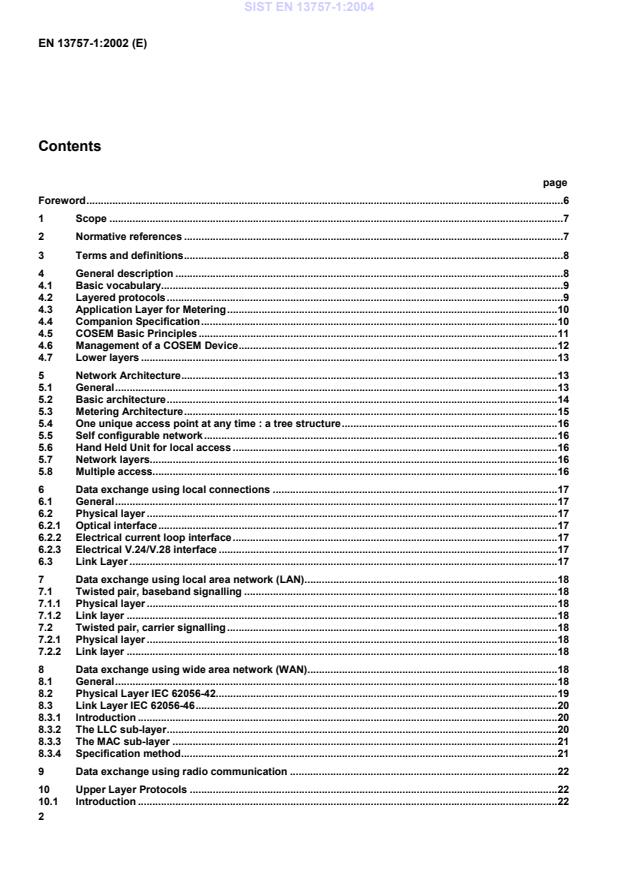
Basic class meters.55A.1Basic requirements for Heat Cost Allocators.55A.2Basic requirements for Heat / Cooling meters.55A.3Basic requirements for Gas meters.56A.4Basic requirements for Cold / Hot water meters.56Annex B (informative) Gas Volume Conversion.57B.1Introduction.57B.2Foreword to abstract data model of gas volume converter.57B.3Abstract data model of gas volume converter.57B.3.1Definitions.57B.3.2Common objects in gas conversion and energy calculation.58B.4Principle of measurement for volume conversion and energy calculation.60B.5Data flow in volume conversion and energy calculation.61Annex C (normative)
Terms and definitions.62C.1Introduction.62C.2Activation mask.62C.3Activity calendar.62C.4Association LN.62C.5Association SN.62C.6Automatic capturing.62C.7Authorised party.63C.8Billing period.63C.9Calendar.63C.10Capture.63C.11Channel.63C.12Clock.63C.13Current and last average value objects.64C.14Date and time.64C.15Daylight saving.64C.16Demand.64C.17Device ID.66C.18Error values.66C.19Extended register interface class.67C.20Hand held terminal.67C.21High level security.67C.22Interface modelling.67C.23I/O Control Signals.67C.24Interoperability.67C.25Logical device.68C.26Logical name referencing.68C.27Low level security.68C.28Manufacturer defined ID-s.68C.29Manufacturer specific abstract objects.68C.30Manufacturer specific class id.68C.31Manufacturer specific data and parameters.69C.32Manufacturer specific OBIS codes.69C.33Maximum and minimum value objects.69C.34Measurement of different media.69C.35Measurement method and tariffs.69C.36Measurement values series.70C.37Missing measurement values.70C.38Password.70C.39Physical device.70SIST EN 13757-1:2004
It is part 1 of the EN 13757 Standard.
Additional parts are:EN 13757 part 2: Physical and link layer, twisted pair baseband (M-Bus)EN 13757 part 3: Dedicated application layer (M-Bus)EN 13757 part 4: Wireless meter readoutThe main use of part 1 is to provide a protocol specification for the Application Layer for meters.Remark: Electricity meters are not covered with this standard, as the standardisation of remote readout of electricitymeters is a task for IEC/CENELEC.2 Normative referencesThis European Standard incorporates by dated or undated reference, provisions from other publications. Thesenormative references are cited at the appropriate places in the text, and the publications are listed hereafter. Fordated references, subsequent amendments to or revisions of any of these publications apply to this EuropeanStandard only when incorporated in it by amendment or revision. For undated references the latest edition of thepublication referred to applies (including amendments).EN 834, Heat cost allocators for the determination of the consumption of room heating radiators - Appliances withelectrical energy supply.EN 1434-1, Heat meters - Part 1 : General requirements.EN 1434-2, Heat meters - Part 2 : Constructional requirements.EN 12405, Gas meters - Gas volume electronic conversion devices.prEN 13757-2:2002, Communication systems for and remote reading of meters - Part 2 : Physical and link layer,twisted pair baseband (M-Bus).EN 60870-5-2, Telecontrol equipment and systems - Part 5 : Transmission protocols - Section 2 : Link transmissionprocedures (IEC 60870-5-2:1992).EN 61334-4-1 Distribution automation using distribution line carrier systems - Part 4 : Data communicationprotocols - Section 1 : Reference model of the communication system (IEC 61334-4-1:1996).EN 61334-4-41Distribution automation using distribution line carrier systems - Part 4 : Data communicationprotocols - Section 41 : Application protocols - Distribution line message specification (IEC 61334-4-41:1996).EN 61334-6, Distribution automation using distribution line carrier systems - Part 6 : A-XDR encoding rule (IEC61334-6:2000)IEC 62056-21: 2000, Electricity metering - Data exchange for meter reading, tariff and load control - Part 21 : Directlocal data exchange.EN 62056-31:2000, Electricity metering - Data exchange for meter reading, tariff and load control - Part 31 : Use oflocal area networks on twisted pair with carrier signalling (IEC 62056-31:1999).SIST EN 13757-1:2004
conflict with the current version of DLMS. Thiscan be viewed as a Companion Specification (CS). The CS can be seen as a set of additional rules to DLMS,which are semantically and syntactically compatible with the DLMS kernel.Extensions can be found in IEC 62056-53 (COSEM Application Layer).A Companion Specification may go beyond pure data communication. It specifies the functionality of anapplication, as seen through the communication system. In the current context, this is the functionality, of the meteror meters, defined in terms of the objects contained within them (e.g. Index, ID, meter type, manufacturer, date andtime, rate and even communication entities such as a phone number). This standard bases its generic functionalapplication requirements on IEC 62056-62 , Companion Specification for Energy Metering, approach. COSEM hasbeen developed by DLMS Users Association.Figure 5 — Companion Specification4.5 COSEM Basic PrinciplesThis section describes the basic principles on which the COSEM interface classes are built. It also gives a shortoverview on how interface objects (instantiations of the interface classes) are used for communication purposes.Meters, support tools and other system components that follow these specifications can communicate with eachother in an interoperable way.Object modelling: For specification purposes this document uses the technique of object modelling. An object is acollection of attributes and methods.The information of an object is organised in attributes. They represent the characteristics of an object by means ofattribute values. The value of an attribute may affect the behaviour of an object. The first attribute in any object isthe “logical_name”. It is one part of the identification of the object.SIST EN 13757-1:2004
...