

EN 1822-1:2009
(Main)High efficiency air filters (EPA, HEPA and ULPA) - Part 1: Classification, performance testing, marking
- Abstract
This European Standard applies to high efficiency particulate and ultra low penetration air filters (EPA, HEPA and ULPA) used in the field of ventilation and air conditioning and for technical processes, e.g. for applications in clean room technology or pharmaceutical industry.
It establishes a procedure for the determination of the efficiency on the basis of a particle counting method using a liquid (or alternatively a solid) test aerosol, and allows a standardized classification of these filters in terms of their efficiency, both local and integral efficiency.
- Status
- Withdrawn
- Publication Date
- 17-Nov-2009
- Withdrawal Date
- 06-Oct-2026
- Technical Committee
- CEN/TC 195 - Air filters for general air cleaning
- Drafting Committee
- CEN/TC 195/WG 2 - HEPA and ULPA filters
- Current Stage
- 9960 - Withdrawal effective - Withdrawal
- Start Date
- 10-Apr-2019
- Completion Date
- 07-Oct-2026


Relations
- Effective Date
- 21-Nov-2009
- Effective Date
- 08-Jun-2022
- Effective Date
- 28-Jan-2026
- Effective Date
- 28-Jan-2026
- Effective Date
- 28-Jan-2026
- Effective Date
- 28-Jan-2026
- Effective Date
- 28-Jan-2026
- Effective Date
- 28-Jan-2026
- Effective Date
- 28-Jan-2026
Get Certified
Connect with accredited certification bodies for this standard

CIS Institut d.o.o.
Personal Protective Equipment (PPE) certification body. Notified Body NB-2890 for EU Regulation 2016/425 PPE.
Institut za varilstvo d.o.o. (Welding Institute)
Slovenia's leading welding institute since 1952. ISO 3834, EN 1090, pressure equipment certification, NDT personnel, welder qualification. Only IIW Au

Kiwa BDA Testing
Building and construction product certification.
Sponsored listings
Frequently Asked Questions
EN 1822-1:2009 is a standard published by the European Committee for Standardization (CEN). Its full title is "High efficiency air filters (EPA, HEPA and ULPA) - Part 1: Classification, performance testing, marking". This standard covers: This European Standard applies to high efficiency particulate and ultra low penetration air filters (EPA, HEPA and ULPA) used in the field of ventilation and air conditioning and for technical processes, e.g. for applications in clean room technology or pharmaceutical industry. It establishes a procedure for the determination of the efficiency on the basis of a particle counting method using a liquid (or alternatively a solid) test aerosol, and allows a standardized classification of these filters in terms of their efficiency, both local and integral efficiency.
This European Standard applies to high efficiency particulate and ultra low penetration air filters (EPA, HEPA and ULPA) used in the field of ventilation and air conditioning and for technical processes, e.g. for applications in clean room technology or pharmaceutical industry. It establishes a procedure for the determination of the efficiency on the basis of a particle counting method using a liquid (or alternatively a solid) test aerosol, and allows a standardized classification of these filters in terms of their efficiency, both local and integral efficiency.
EN 1822-1:2009 is classified under the following ICS (International Classification for Standards) categories: 13.040.40 - Stationary source emissions; 23.120 - Ventilators. Fans. Air-conditioners. The ICS classification helps identify the subject area and facilitates finding related standards.
EN 1822-1:2009 has the following relationships with other standards: It is inter standard links to EN 1822-1:1998, EN 1822-1:2019, EN 1822-4:2009, EN ISO 29463-3:2018, EN ISO 5167-1:2022, EN 1822-5:2009, EN 1822-2:2009, EN 14799:2007, EN 1822-3:2009. Understanding these relationships helps ensure you are using the most current and applicable version of the standard.
EN 1822-1:2009 is available in PDF format for immediate download after purchase. The document can be added to your cart and obtained through the secure checkout process. Digital delivery ensures instant access to the complete standard document.
Standards Content (Sample)
2003-01.Slovenski inštitut za standardizacijo. Razmnoževanje celote ali delov tega standarda ni dovoljeno.VLILNDFLMDSchwebstofffilter (EPA, HEPA und ULPA) - Teil 1: Klassifikation, Leistungsprüfung, KennzeichnungFiltres à air à haute efficacité (EPA, HEPA et ULPA) - Partie 1: Classification, essais de performance et marquageHigh efficiency air filters (EPA, HEPA and ULPA) - Part 1: Classification, performance testing, marking23.120QDSUDYHVentilators. Fans. Air-conditionersICS:Ta slovenski standard je istoveten z:EN 1822-1:2009SIST EN 1822-1:2010en,fr01-januar-2010SIST EN 1822-1:2010SLOVENSKI
STANDARDSIST EN 1822-1:20001DGRPHãþD
EUROPEAN STANDARD NORME EUROPÉENNE EUROPÄISCHE NORM
EN 1822-1
November 2009 ICS 13.040.40 Supersedes EN 1822-1:1998English Version
High efficiency air filters (EPA, HEPA and ULPA) - Part 1: Classification, performance testing, marking
Filtres à air à haute efficacité (EPA, HEPA et ULPA) - Partie 1: Classification, essais de performance et marquage
Schwebstofffilter (EPA, HEPA und ULPA) - Teil 1: Klassifikation, Leistungsprüfung, Kennzeichnung This European Standard was approved by CEN on 17 October 2009.
CEN members are bound to comply with the CEN/CENELEC Internal Regulations which stipulate the conditions for giving this European Standard the status of a national standard without any alteration. Up-to-date lists and bibliographical references concerning such national standards may be obtained on application to the CEN Management Centre or to any CEN member.
This European Standard exists in three official versions (English, French, German). A version in any other language made by translation under the responsibility of a CEN member into its own language and notified to the CEN Management Centre has the same status as the official versions.
CEN members are the national standards bodies of Austria, Belgium, Bulgaria, Cyprus, Czech Republic, Denmark, Estonia, Finland, France, Germany, Greece, Hungary, Iceland, Ireland, Italy, Latvia, Lithuania, Luxembourg, Malta, Netherlands, Norway, Poland, Portugal, Romania, Slovakia, Slovenia, Spain, Sweden, Switzerland and United Kingdom.
EUROPEAN COMMITTEE FOR STANDARDIZATION
COMITÉ EUROPÉEN DE NORMALISATION EUROPÄISCHES KOMITEE FÜR NORMUNG
Management Centre:
Avenue Marnix 17,
B-1000 Brussels © 2009 CEN All rights of exploitation in any form and by any means reserved worldwide for CEN national Members. Ref. No. EN 1822-1:2009: ESIST EN 1822-1:2010
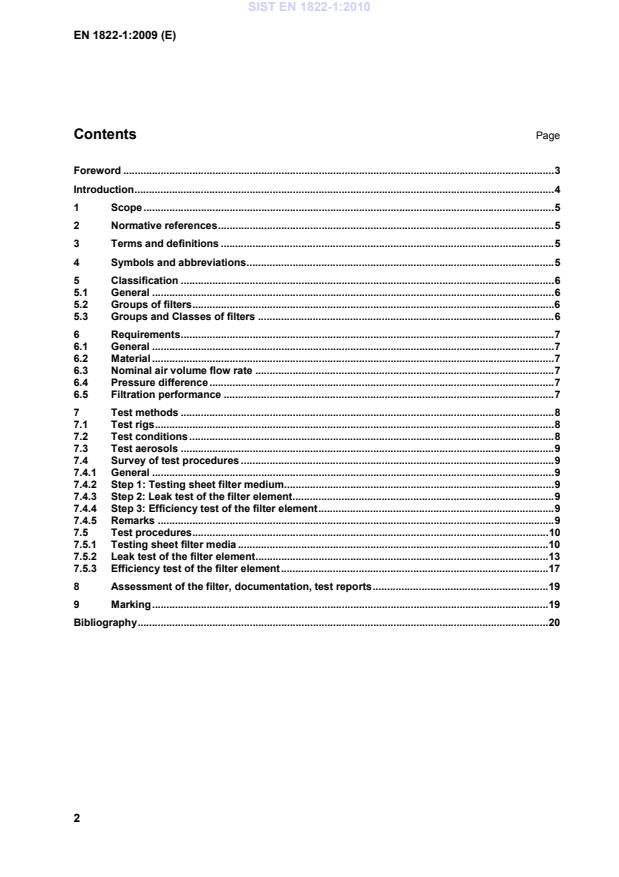
Page Foreword . 3Introduction . 41Scope . 52Normative references . 53Terms and definitions . 54Symbols and abbreviations . 55Classification . 65.1General . 65.2Groups of filters . 65.3Groups and Classes of filters . 66Requirements . 76.1General . 76.2Material . 76.3Nominal air volume flow rate . 76.4Pressure difference . 76.5Filtration performance . 77Test methods . 87.1Test rigs . 87.2Test conditions . 87.3Test aerosols . 97.4Survey of test procedures . 97.4.1General . 97.4.2Step 1: Testing sheet filter medium . 97.4.3Step 2: Leak test of the filter element. 97.4.4Step 3: Efficiency test of the filter element . 97.4.5Remarks . 97.5Test procedures . 107.5.1Testing sheet filter media . 107.5.2Leak test of the filter element . 137.5.3Efficiency test of the filter element . 178Assessment of the filter, documentation, test reports . 199Marking . 19Bibliography . 20SIST EN 1822-1:2010
Beside that, various editorial corrections have been implemented. According to the CEN/CENELEC Internal Regulations, the national standards organizations of the following countries are bound to implement this European Standard: Austria, Belgium, Bulgaria, Cyprus, Czech Republic, Denmark, Estonia, Finland, France, Germany, Greece, Hungary, Iceland, Ireland, Italy, Latvia, Lithuania, Luxembourg, Malta, Netherlands, Norway, Poland, Portugal, Romania, Slovakia, Slovenia, Spain, Sweden, Switzerland and the United Kingdom. SIST EN 1822-1:2010
3.1 nominal air volume flow rate air volume flow rate specified by the manufacturer, at which the filter element has to be tested 3.2 superficial face area cross-sectional area of the filter element which is passed by the air flow 3.3 nominal filter medium face velocity nominal air volume flow rate divided by the effective filter medium area 4 Symbols and abbreviations For the purposes of this document, the following symbols and abbreviations apply: SIST EN 1822-1:2010
Group E:
EPA filters
(Efficient Particulate Air filter);
Group H:
HEPA filters
(High Efficiency Particulate Air filter);
Group U:
ULPA filters
(Ultra Low Penetration Air filter). 5.3 Groups and Classes of filters Filters are classified in Groups and Classes. For each group a slightly different test procedure applies. All filters are classified according to their filtration performance (see 6.5).
Group E filters are subdivided in three Classes:
Class E 10; SIST EN 1822-1:2010
Class E 11;
Class E 12. Group H filters are subdivided in two Classes:
Class H 13;
Class H 14. Group U filters are subdivided in three Classes:
Class U 15;
Class U 16;
Class U 17. 6 Requirements 6.1 General The filter element shall be designed or marked so as to prevent incorrect mounting. The filter element shall be designed so that when correctly mounted in the ventilation duct, no leak occurs along the sealing edge. If, for any reason, dimensions do not allow testing of a filter under standard test conditions, assembly of two or more filters of the same type or model is permitted, provided no leaks occur in the resulting filter. 6.2 Material The filter element shall be made of suitable material to withstand normal usage and exposures to those temperatures, humidities and corrosive environments that are likely to be encountered. The filter element shall be designed so that it will withstand mechanical constraints that are likely to be encountered during normal use. Dust or fibres released from the filter media by the air flow through the filter element shall not constitute a hazard or nuisance for the people (or devices) exposed to filtered air. 6.3 Nominal air volume flow rate The filter element shall be tested at its nominal air volume flow rate for which the filter has been designed by the manufacturer. 6.4 Pressure difference The pressure difference across the filter element is recorded at the nominal air volume flow rate. 6.5 Filtration performance The filtration performance is expressed by the efficiency or the penetration of MPPS particles. SIST EN 1822-1:2010
7 Test methods 7.1
Test rigs The test rigs are described in detail in EN 1822-3, EN 1822-4 and EN 1822-5. The individual methods of measurement and the measuring instruments are described in EN 1822-2. 7.2 Test conditions The air in the test channel used for testing shall comply with the following requirements: Temperature: (23 ± 5) °C; Relative humidity < 75 %. The temperature shall remain constant during the entire test procedure within ± 2 °C the relative humidity within ± 5 %. The cleanliness of the test air shall be ensured by appropriate pre-filtering, so that in operation without addition of aerosol the particle number concentration measured with the particle counting method is less than 350 000 m-3. The test specimen shall have the same temperature as the test air. SIST EN 1822-1:2010
...