

EN 1822-4:2009
(Main)High efficiency air filters (EPA, HEPA and ULPA) - Part 4: Determining leakage of filter elements (scan method)
- Abstract
This European Standard applies to efficient air filters (EPA), high efficiency air filters (HEPA) and ultra low penetration air filters (ULPA-filters) used in the field of ventilation and air conditioning and for technical processes, e.g. for applications in clean room technology or pharmaceutical industry.
It establishes a procedure for the determination of the efficiency on the basis of a particle counting method using an artificial test aerosol, and allows a standardized classification of these filters in terms of their efficiency.
This part of EN 1822 applies to the leak testing of filter elements. The scan method which is described in detail regarding procedure, apparatus and test conditions in the body of this standard is valid for the complete range of group H and U filters and is considered to be the reference test method for leak determination. The 'Oil Thread Leak Test' according to Annex A and the '0,3 µm - 0,5 µm Particle Efficiency Leak Test' according to Annex E may be used alternatively but for defined classes of group H filters only.
- Status
- Withdrawn
- Publication Date
- 17-Nov-2009
- Withdrawal Date
- 06-Oct-2026
- Technical Committee
- CEN/TC 195 - Air filters for general air cleaning
- Drafting Committee
- CEN/TC 195/WG 2 - HEPA and ULPA filters
- Current Stage
- 9960 - Withdrawal effective - Withdrawal
- Start Date
- 10-Oct-2018
- Completion Date
- 07-Oct-2026

Relations
- Effective Date
- 22-Dec-2008
- Effective Date
- 12-Oct-2016
- Effective Date
- 28-Jan-2026
- Effective Date
- 28-Jan-2026
- Effective Date
- 28-Jan-2026
- Effective Date
- 28-Jan-2026
- Effective Date
- 28-Jan-2026
Get Certified
Connect with accredited certification bodies for this standard

CIS Institut d.o.o.
Personal Protective Equipment (PPE) certification body. Notified Body NB-2890 for EU Regulation 2016/425 PPE.
Institut za varilstvo d.o.o. (Welding Institute)
Slovenia's leading welding institute since 1952. ISO 3834, EN 1090, pressure equipment certification, NDT personnel, welder qualification. Only IIW Au

Kiwa BDA Testing
Building and construction product certification.
Sponsored listings
Frequently Asked Questions
EN 1822-4:2009 is a standard published by the European Committee for Standardization (CEN). Its full title is "High efficiency air filters (EPA, HEPA and ULPA) - Part 4: Determining leakage of filter elements (scan method)". This standard covers: This European Standard applies to efficient air filters (EPA), high efficiency air filters (HEPA) and ultra low penetration air filters (ULPA-filters) used in the field of ventilation and air conditioning and for technical processes, e.g. for applications in clean room technology or pharmaceutical industry. It establishes a procedure for the determination of the efficiency on the basis of a particle counting method using an artificial test aerosol, and allows a standardized classification of these filters in terms of their efficiency. This part of EN 1822 applies to the leak testing of filter elements. The scan method which is described in detail regarding procedure, apparatus and test conditions in the body of this standard is valid for the complete range of group H and U filters and is considered to be the reference test method for leak determination. The 'Oil Thread Leak Test' according to Annex A and the '0,3 µm - 0,5 µm Particle Efficiency Leak Test' according to Annex E may be used alternatively but for defined classes of group H filters only.
This European Standard applies to efficient air filters (EPA), high efficiency air filters (HEPA) and ultra low penetration air filters (ULPA-filters) used in the field of ventilation and air conditioning and for technical processes, e.g. for applications in clean room technology or pharmaceutical industry. It establishes a procedure for the determination of the efficiency on the basis of a particle counting method using an artificial test aerosol, and allows a standardized classification of these filters in terms of their efficiency. This part of EN 1822 applies to the leak testing of filter elements. The scan method which is described in detail regarding procedure, apparatus and test conditions in the body of this standard is valid for the complete range of group H and U filters and is considered to be the reference test method for leak determination. The 'Oil Thread Leak Test' according to Annex A and the '0,3 µm - 0,5 µm Particle Efficiency Leak Test' according to Annex E may be used alternatively but for defined classes of group H filters only.
EN 1822-4:2009 is classified under the following ICS (International Classification for Standards) categories: 13.040.40 - Stationary source emissions; 23.120 - Ventilators. Fans. Air-conditioners. The ICS classification helps identify the subject area and facilitates finding related standards.
EN 1822-4:2009 has the following relationships with other standards: It is inter standard links to EN 1822-4:2000, EN ISO 29463-4:2018, EN ISO 29463-2:2018, EN 14799:2007, EN 1822-5:2009, EN ISO 29463-3:2018, EN 1822-1:2009. Understanding these relationships helps ensure you are using the most current and applicable version of the standard.
EN 1822-4:2009 is available in PDF format for immediate download after purchase. The document can be added to your cart and obtained through the secure checkout process. Digital delivery ensures instant access to the complete standard document.
Standards Content (Sample)
2003-01.Slovenski inštitut za standardizacijo. Razmnoževanje celote ali delov tega standarda ni dovoljeno.Schwebstofffilter (EPA, HEPA und ULPA) - Teil 4: Leckprüfung des Filterelementes (Scan-Verfahren)Filtres à air à haute efficacité (EPA, HEPA et ULPA) - Partie 4: Essais d'étanchéité de l'élément filtrant (méthode d'exploration)High efficiency air filters (EPA, HEPA and ULPA) - Part 4: Determining leakage of filter elements (scan method)23.120QDSUDYHVentilators. Fans. Air-conditionersICS:Ta slovenski standard je istoveten z:EN 1822-4:2009SIST EN 1822-4:2010en01-januar-2010SIST EN 1822-4:2010SLOVENSKI
STANDARDSIST EN 1822-4:20011DGRPHãþD
EUROPEAN STANDARD NORME EUROPÉENNE EUROPÄISCHE NORM
EN 1822-4
November 2009 ICS 13.040.40 Supersedes EN 1822-4:2000English Version
High efficiency air filters (EPA, HEPA and ULPA) - Part 4: Determining leakage of filter elements (scan method)
Filtres à air à haute efficacité (EPA, HEPA et ULPA) - Partie 4: Essais d'étanchéité de l'élément filtrant (méthode d'exploration)
Schwebstofffilter (EPA, HEPA und ULPA) - Teil 4: Leckprüfung des Filterelementes (Scan-Verfahren) This European Standard was approved by CEN on 17 October 2009.
CEN members are bound to comply with the CEN/CENELEC Internal Regulations which stipulate the conditions for giving this European Standard the status of a national standard without any alteration. Up-to-date lists and bibliographical references concerning such national standards may be obtained on application to the CEN Management Centre or to any CEN member.
This European Standard exists in three official versions (English, French, German). A version in any other language made by translation under the responsibility of a CEN member into its own language and notified to the CEN Management Centre has the same status as the official versions.
CEN members are the national standards bodies of Austria, Belgium, Bulgaria, Cyprus, Czech Republic, Denmark, Estonia, Finland, France, Germany, Greece, Hungary, Iceland, Ireland, Italy, Latvia, Lithuania, Luxembourg, Malta, Netherlands, Norway, Poland, Portugal, Romania, Slovakia, Slovenia, Spain, Sweden, Switzerland and United Kingdom.
EUROPEAN COMMITTEE FOR STANDARDIZATION
COMITÉ EUROPÉEN DE NORMALISATION EUROPÄISCHES KOMITEE FÜR NORMUNG
Management Centre:
Avenue Marnix 17,
B-1000 Brussels © 2009 CEN All rights of exploitation in any form and by any means reserved worldwide for CEN national Members. Ref. No. EN 1822-4:2009: ESIST EN 1822-4:2010
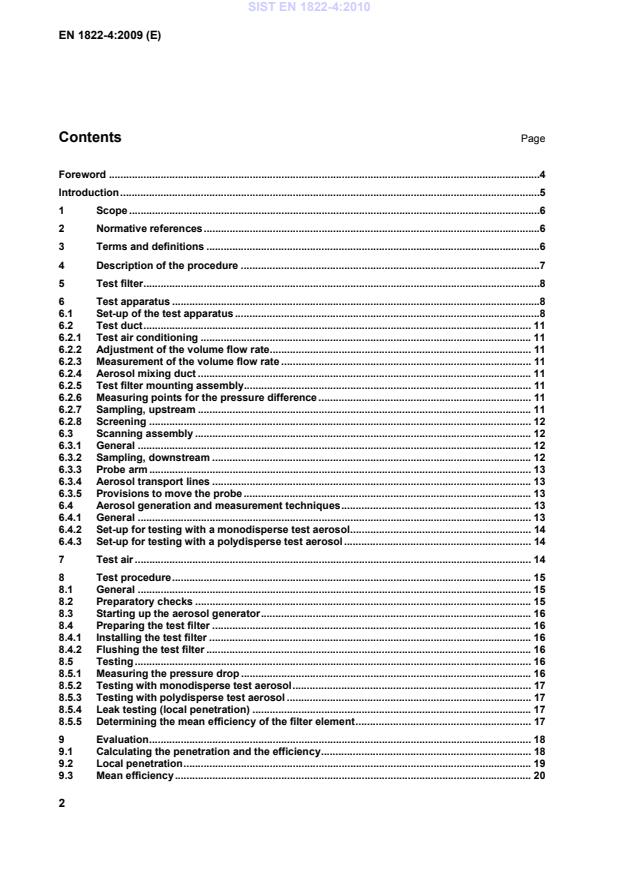
Oil Thread Leak Test . 23Annex B (normative)
Determining the test parameters . 24B.1General . 24B.2Boundary conditions . 24B.3Test filter data . 24B.4Data for the apparatus . 25B.4.1Particle counters . 25B.4.2Downstream sampling probes . 25B.4.3Loss factor . 26B.5Sequence of calculation steps . 26B.6Checking the isokinetic sampling . 27B.7Choosing the probe speed . 28B.8Minimum aerosol concentration . 29B.9Maximum aerosol concentration . 30B.10Leak signal . 31B.10.1Effective value . 31B.10.2Signal difference . 32Annex C (informative)
Example of an application with evaluation . 34Annex D (informative)
Leak Test with solid PSL Aerosol . 37D.1Background . 37D.2General Remarks . 37D.3Test Procedure . 37D.4Test Protocol . 39Annex E (informative)
0,3 µm – 0,5 µm Particle Efficiency Leak Test . 40Bibliography . 42
3.1 total particle count method particle counting method in which the total number of particles in a certain sample volume is determined without classification according to size (e.g. by using a condensation nucleus counter) 3.2 particle counting and sizing method particle counting method which allows both the determination of the number of particles and also the classification of the particles according to size (e.g. by using an optical particle counter) 3.3 particle flow rate number of particles which are measured or which flow past a specified cross section in unit time SIST EN 1822-4:2010
Key 1 Pre-filter for the test air 2 Fan with speed regulator 3 Air heater
4 Aerosol inlet in the duct 5 Aerosol generator with conditioning of supply air and aerosol flow regulator 6 Measurement of atmospheric pressure, temperature and relative humidity 7 Upstream side mixing section 8 Sampling point for upstream particle counting 9 Dilution system (optional) 10 Particle counter, upstream 11 Sheath flow (optional) 12 Test filter 13 Sampling point and partial flow extraction, downstream 14 Traversing system for probe 15 Volume flow rate measurement 16 Particle counter, downstream 17 Computer for control and data storage 18 Measuring system to check the test aerosol 19 Measurement of differential pressure Figure 1 — Diagram of test apparatus SIST EN 1822-4:2010
Key 1 Coarse dust filter 2 Fine dust filter 3 Fan 4 Air heater 5 Dampers to adjust test and sheath air 6 High efficiency air filter for the test air 7 Aerosol inlet in the duct 8 Test air flow 9 Sheath air flow 10 Effective pressure measuring device 11 Differential pressure 12 Atmospheric pressure 13 Temperature measurement 14 Hygrometer 15 Sampling point for particle size analysis 16 Sampling point, upstream 17 High efficiency air filter for the sheath air 18 Measurement of pressure drop 19 Measurement of sheath air speed 20 Test filter 21 Flow equalizer for the sheath air flow 22 Filter mounting assembly 23 Screening (linked to the filter mounting assembly during the testing) 24 Traversing probe arm with downstream sampling probe 25 Probe traversing system 26 Downstream sampling point Figure 2 — Test duct for scan testing The basic details for the generation and neutralization of the aerosol, together with the details of suitable types of equipment and detailed descriptions of measuring instruments needed for the testing, are contained in EN 1822-2. SIST EN 1822-4:2010
These provisions include drive, guidance and control to move the probe arm at right angles to the direction of flow with a constant probe speed. The speed of the probe can be selected, and shall not exceed a maximum of 10 cm/s (see B.7). During a run it shall not deviate from the set value by more than 10 %. Suitable provisions shall also be made to measure the position of the probe in the coordinates X, Y and Z during the probe run, and also to reposition the probe over a leak determined during a run. The accuracy of repositioning to any point in the downstream cross-section of the test filter shall be at least 1 mm. 6.4 Aerosol generation and measurement techniques 6.4.1 General The operating parameters of the aerosol generator shall be adjusted to produce a test aerosol whose median diameter is in the range of the most penetrating particle size (MPPS) for the plane filter medium. The median for a monodisperse test aerosol shall not deviate by more than 10 % from the MPPS. For a polydisperse test aerosol a deviation of up to 50 % is permissible. It shall be possible to set the median value of the number distribution of the test aerosol within ± 10 %. The particle flow rate of the aerosol generator shall be adjusted according to the test volume flow rate and the filter efficiency so that the counting rates on the upstream and downstream sides lie under the coincidence limits of the counters, and significantly above the zero count rate of the instruments. The number distribution of the test aerosol can be determined using a suitable particle size analysis system (e.g. a differential mobility particle sizer - DMPS) or with a laser particle counter suitable for these test purposes. The limit error of the measurement method used to determine the median value shall not exceed ± 10 % (relative to the measured value). The number of particles counted upstream and downstream shall be sufficiently large to provide statistically meaningful results, without the concentration exceeding the measuring range of the upstream particle counter. If the upstream number concentration exceeds the range of the particle counter (in the counting mode) then a dilution system shall be switched between the sampling point and the counter. The maximum measurable concentration can also be limited by the maximum possible processing speed of the evaluation electronics of the test apparatus. The measuring uncertainties involved in determining the sample volume flow rate and the duration of measurement can also influence the concentration measurements. The result for the particle concentration, including all sources of error at the interface of the apparatus responsible for the recording, shall not differ by more than 10 % from the true value. SIST EN 1822-4:2010
Class limit < MPPS x 2 (Range IIb, Figure 4 of EN 1822-5:2009). All classes between these two limits are evaluated to determine the efficiency. There is no requirement for a minimum number of classes in this range, so that in the extreme case the above conditions may be met by only one size class. 7 Test air The test air shall be prepared before mixing it with the test aerosol. The purity of the test air (particle number concentration < 350 000 m-3) shall be ensured by suitable pre-filtering (for example using commercially available coarse and fine dust filters and high-efficiency particulate air filters). SIST EN 1822-4:2010
< 75 %. 8 Test procedure 8.1 General Before beginning the scan test, the test parameters shall be determined or calculated, if this has not already been done for earlier tests, and the appropriate adjustments made. On the basis of the dimensions of the filter and the probe, the parameters for the probe tracking shall be determined. These are: the distance between the probe aperture and the filter element (10 mm to 50 mm; see 6.3.2); the speed of the probe (to be determined in accordance with B.7); the number and position of the probe tracks. The other test parameters shall be determined on the basis of the nominal air volume flow rate and the anticipated penetration for the test filter. Further test parameters are the aerosol concentration on the upstream side, the volume flow rate in the probe, the speed of the probe and the signal value for the counting rate. The parameters shall be determined in accordance with Annex B and the adjustments made to the test apparatus. Before beginning a test with newly determined test parameters, the interaction of the test parameters shall be checked as well as the ability to recognize limit-values for leakages. Reference filters can be used for this purpose for which defined leakages have already been determined. Testing shall not commence until it has been shown that leaks can be detected adequately. 8.2 Preparatory checks After switching on the test apparatus the following parameters shall be checked: Operational readiness of the measuring instruments The warming-up times specified by the instrument makers shall be observed and the condensation nucleus counters shall be filled with operating liquid. If the instrument makers recommend further regular checks before taking measurements then these checks shall also be carried out. Zero count rate of the particle counter The measurement of the zero count rate may be carried out using filtered flushing air. Zero value of the test apparatus The test shall be carried out using a reference filter with the aerosol generator switched off. SIST EN 1822-4:2010
...