

EN 13617-1:2004
(Main)Petrol filling stations - Part 1: Safety requirements for construction and performance of metering pumps, dispensers and remote pumping units
- Abstract
This European Standard applies to metering pumps, dispensers and remote pumping units to be installed at petrol filling stations, designed to dispense liquid fuels into the tanks of motor vehicles, boats and light aircraft and into portable containers at flow rates up to 200 l·min-1, and intended for use and storage at ambient temperatures between -20 °C and +40 °C. Additional measures can be required for use and storage at temperatures outside this range and is to negotiate between the manufacturer and its client.
This European Standard deals with all significant hazards, hazardous situations and events relevant to metering pumps, dispensers and remote pumping units, when they are used as intended and under the conditions foreseen by the manufacturer (see clause 4).
This European Standard specifies selection of equipment and construction and performance requirements for safety aspects.
This European Standard does not deal with noise and with hazards related to transportation and installation.
This European Standard does not include any requirements for metering performance.
Vapour recovery efficiency rates are not considered within this European Standard.
This European Standard is not applicable to metering pumps, dispensers and remote pumping units which are manufactured before the date of publication of this document by CEN.
NOTE Liquefied petroleum gas (LPG) is not a liquid fuel in the sense of this European Standard.
- Status
- Withdrawn
- Publication Date
- 04-May-2004
- Withdrawal Date
- 16-Jun-2009
- Technical Committee
- CEN/TC 393 - Equipment for storage tanks and for service stations
- Current Stage
- 9960 - Withdrawal effective - Withdrawal
- Start Date
- 17-Jun-2009
- Completion Date
- 17-Jun-2009
- Directive
- 94/9/EC - Equipment and protective systems intended for use in potentially explosive atmospheres (ATEX)OJ Ref: C, C 57 OJ Date: 09-Mar-2006
98/37/EC - MachineryOJ Ref: C, C 336 OJ Date: 31-Dec-2005

Relations
- Effective Date
- 19-Jan-2023
- Effective Date
- 28-Jan-2026
- Effective Date
- 22-Dec-2008
- Effective Date
- 22-Dec-2008
Get Certified
Connect with accredited certification bodies for this standard

Element Materials Technology
Materials testing and product certification.

ABS Group Brazil
ABS Group certification services in Brazil.

ABS Quality Evaluations Inc.
American Bureau of Shipping quality certification.
Sponsored listings
Frequently Asked Questions
EN 13617-1:2004 is a standard published by the European Committee for Standardization (CEN). Its full title is "Petrol filling stations - Part 1: Safety requirements for construction and performance of metering pumps, dispensers and remote pumping units". This standard covers: This European Standard applies to metering pumps, dispensers and remote pumping units to be installed at petrol filling stations, designed to dispense liquid fuels into the tanks of motor vehicles, boats and light aircraft and into portable containers at flow rates up to 200 l·min-1, and intended for use and storage at ambient temperatures between -20 °C and +40 °C. Additional measures can be required for use and storage at temperatures outside this range and is to negotiate between the manufacturer and its client. This European Standard deals with all significant hazards, hazardous situations and events relevant to metering pumps, dispensers and remote pumping units, when they are used as intended and under the conditions foreseen by the manufacturer (see clause 4). This European Standard specifies selection of equipment and construction and performance requirements for safety aspects. This European Standard does not deal with noise and with hazards related to transportation and installation. This European Standard does not include any requirements for metering performance. Vapour recovery efficiency rates are not considered within this European Standard. This European Standard is not applicable to metering pumps, dispensers and remote pumping units which are manufactured before the date of publication of this document by CEN. NOTE Liquefied petroleum gas (LPG) is not a liquid fuel in the sense of this European Standard.
This European Standard applies to metering pumps, dispensers and remote pumping units to be installed at petrol filling stations, designed to dispense liquid fuels into the tanks of motor vehicles, boats and light aircraft and into portable containers at flow rates up to 200 l·min-1, and intended for use and storage at ambient temperatures between -20 °C and +40 °C. Additional measures can be required for use and storage at temperatures outside this range and is to negotiate between the manufacturer and its client. This European Standard deals with all significant hazards, hazardous situations and events relevant to metering pumps, dispensers and remote pumping units, when they are used as intended and under the conditions foreseen by the manufacturer (see clause 4). This European Standard specifies selection of equipment and construction and performance requirements for safety aspects. This European Standard does not deal with noise and with hazards related to transportation and installation. This European Standard does not include any requirements for metering performance. Vapour recovery efficiency rates are not considered within this European Standard. This European Standard is not applicable to metering pumps, dispensers and remote pumping units which are manufactured before the date of publication of this document by CEN. NOTE Liquefied petroleum gas (LPG) is not a liquid fuel in the sense of this European Standard.
EN 13617-1:2004 is classified under the following ICS (International Classification for Standards) categories: 01.040.75 - Petroleum and related technologies (Vocabularies); 75.200 - Petroleum products and natural gas handling equipment. The ICS classification helps identify the subject area and facilitates finding related standards.
EN 13617-1:2004 has the following relationships with other standards: It is inter standard links to EN 13617-1:2004+A1:2009, EN 14678-1:2006+A1:2009, EN 13617-1:2004/AC:2006, EN 13617-1:2012. Understanding these relationships helps ensure you are using the most current and applicable version of the standard.
EN 13617-1:2004 is associated with the following European legislation: EU Directives/Regulations: 94/9/EC, 98/37/EC; Standardization Mandates: M/079, M/BC/CEN/92/46. When a standard is cited in the Official Journal of the European Union, products manufactured in conformity with it benefit from a presumption of conformity with the essential requirements of the corresponding EU directive or regulation.
EN 13617-1:2004 is available in PDF format for immediate download after purchase. The document can be added to your cart and obtained through the secure checkout process. Digital delivery ensures instant access to the complete standard document.
Standards Content (Sample)
2003-01.Slovenski inštitut za standardizacijo. Razmnoževanje celote ali delov tega standarda ni dovoljeno.Petrol filling stations - Part 1: Safety requirements for construction and performance of metering pumps, dispensers and remote pumping unitsStations-service - Partie 1: Exigences relatives a la construction et aux performances de sécurité des distributeurs a pompe immergée, distributeurs de carburants et unités de pompage a distanceTankstellen - Teil 1: Sicherheitstechnische Anforderungen an Bau- und Arbeitsweise von Zapfsäulen, druckversorgten Zapfsäulen und Fernpumpen75.200Petroleum products and natural gas handling equipment01.040.75Naftna in sorodna tehnologija (Slovarji)Petroleum and related technologies (Vocabularies)ICS:SIST EN 13617-1:2004enTa slovenski standard je istoveten z:EN 13617-1:200401-september-2004SIST EN 13617-1:2004SLOVENSKI
STANDARD
EUROPEAN STANDARDNORME EUROPÉENNEEUROPÄISCHE NORMEN 13617-1May 2004ICS 01.040.75; 75.200English versionPetrol filling stations - Part 1: Safety requirements forconstruction and performance of metering pumps, dispensersand remote pumping unitsStations-service - Partie 1: Exigences relatives à laconstruction et aux performances de sécurité desdistributeurs de carburants et unités de pompage àdistanceTankstellen - Teil 1: Sicherheitstechnische Anforderungenan Bau- und Arbeitsweise von Zapfsäulen, druckversorgtenZapfsäulen und FernpumpenThis European Standard was approved by CEN on 9 February 2004.CEN members are bound to comply with the CEN/CENELEC Internal Regulations which stipulate the conditions for giving this EuropeanStandard the status of a national standard without any alteration. Up-to-date lists and bibliographical references concerning such nationalstandards may be obtained on application to the Central Secretariat or to any CEN member.This European Standard exists in three official versions (English, French, German). A version in any other language made by translationunder the responsibility of a CEN member into its own language and notified to the Central Secretariat has the same status as the officialversions.CEN members are the national standards bodies of Austria, Belgium, Cyprus, Czech Republic, Denmark, Estonia, Finland, France,Germany, Greece, Hungary, Iceland, Ireland, Italy, Latvia, Lithuania, Luxembourg, Malta, Netherlands, Norway, Poland, Portugal, Slovakia,Slovenia, Spain, Sweden, Switzerland and United Kingdom.EUROPEAN COMMITTEE FOR STANDARDIZATIONCOMITÉ EUROPÉEN DE NORMALISATIONEUROPÄISCHES KOMITEE FÜR NORMUNGManagement Centre: rue de Stassart, 36
B-1050 Brussels© 2004 CENAll rights of exploitation in any form and by any means reservedworldwide for CEN national Members.Ref. No. EN 13617-1:2004: E
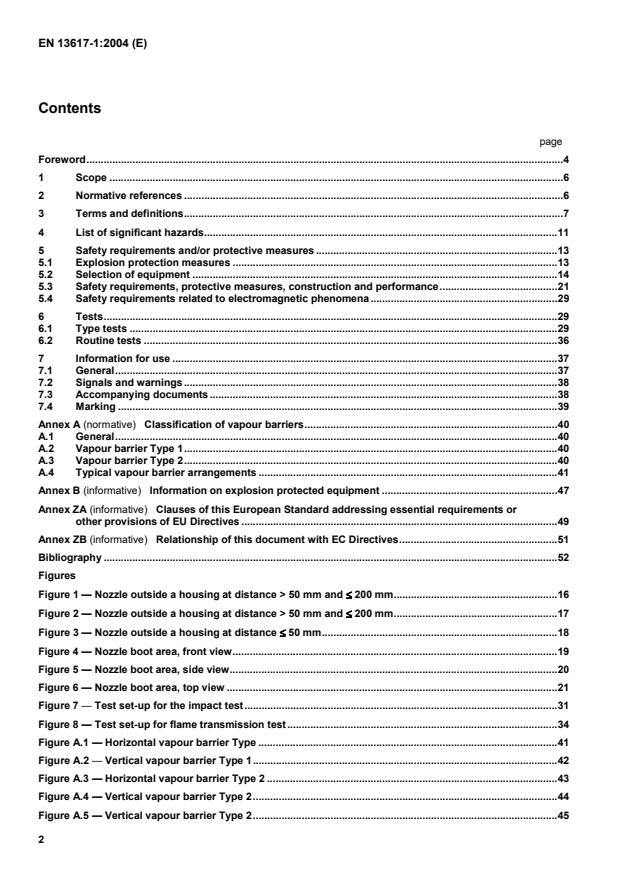
Classification of vapour barriers.40A.1General.40A.2Vapour barrier Type 1.40A.3Vapour barrier Type 2.40A.4Typical vapour barrier arrangements.41Annex B (informative)
Information on explosion protected equipment.47Annex ZA (informative)
Clauses of this European Standard addressing essential requirements orother provisions of EU Directives.49Annex ZB (informative)
Relationship of this document with EC Directives.51Bibliography.52FiguresFigure 1 — Nozzle outside a housing at distance > 50 mm and £ 200 mm.16Figure 2 — Nozzle outside a housing at distance > 50 mm and £ 200 mm.17Figure 3 — Nozzle outside a housing at distance £ 50 mm.18Figure 4 — Nozzle boot area, front view.19Figure 5 — Nozzle boot area, side view.20Figure 6 — Nozzle boot area, top view.21Figure 7 — Test set-up for the impact test.31Figure 8 — Test set-up for flame transmission test.34Figure A.1 — Horizontal vapour barrier Type.41Figure A.2 — Vertical vapour barrier Type 1.42Figure A.3 — Horizontal vapour barrier Type 2.43Figure A.4 — Vertical vapour barrier Type 2.44Figure A.5 — Vertical vapour barrier Type 2.45
1) In course of preparation.
checking that all, or part, of the measuring system is completely filled with liquid3.22vapour recovery systemsystem in and attached to the metering pump/dispenser to feed back the vapours displaced from the fuel tank andled back into the vapour return lines to the storage tank3.23vapour pumppump positioned in the vapour recovery system to supply vacuum for vapour suctioning3.24screenperforated cladding fabrication which may be provided to enhance the visual appearance of a pump or dispenser orto provide another related function3.25vapour pipetubing of the vapour recovery system, excluding the vapour recovery delivery hose assembly and vapour recoverynozzle3.26retraction systemsystem to assist the stowage of delivery hose assembly or vapour recovery delivery hose assembly3.27hose cassetteseparate assembly primarily for the storage of delivery hose assembly(s) or vapour recovery delivery hoseassembly(s)3.28normal operationsituation when the equipment, protective systems, and components perform their intended function within theirdesign parameters (see also 5.2.2.a) of EN ISO 12100-1:2003))NOTEMinor release of flammable material may be part of normal operation. For example, releases of substances fromseals which rely on wetting by the fluid which is being pumped are considered to be minor releases.NOTEFailures (such as a breakdown of pump seals, flange gaskets or releases of substances caused by accidents) whichinvolve repair or shut-down are not considered to be part of normal operation. [see EN 1127–1:1997]
which may move under the effect of gravity);d) mass and velocity (kinetic energy of elements in
controlled or uncontrolled motion);e) inadequacy of mechanical strength.f) moving partsDrive belts and/or shafts5.3.6.2,
7.31.9High pressure fluid injection or ejection hazardFluid in the hose, pipes etc.5.3.1.5,
5.3.1.6,5.3.3.2,
5.3.42Electrical hazards due to——2.1Contact of persons with live parts (direct contact)Electrical components e.g. motors, solenoidvalves, control systems, lighting5.3.22.2Contact of persons with parts which have becomelive under faulty conditions (indirect contact)Electrical components e.g. motors, solenoidvalves, control systems, lighting5.3.22.4Electrostatic phenomenaCharging of
belts, hoses and cladding5.3.4.1,
5.3.3.45.3.4.33Thermal hazards, resulting in:——3.1Burns and other injuries by
possible explosionsIgnition of possible explosive atmosphere byelectrical or non-electrical parts or electricalcharge5.1,
5.2,
5.37Hazards generated by materials and substances(and their constituent elements) processed or usedby the machinery——7.1Hazards from contact with or inhalation of harmfulfluids, gases, mists, fumes, and dustsTightness of components, pipes, hoses5.3.3,
5.3.4,
5.2,
5.310Unexpected start-up, unexpected overrun/overspeed(or any similar malfunction) from:——10.1Failure/disorder of the control systemExplosive atmospheres due to unexpectedliquid flow5.3.1.2,
5.3.4.2,10.2Restoration of energy supply after an interruptionExplosive atmospheres due to unexpectedliquid flow5.3.1.210.3External influences on electrical equipmentExplosive atmospheres due to unexpectedliquid flow5.3.1.2,
5.3.2.110.5Errors in the softwareExplosive atmospheres due to unexpectedliquid flow5.3.1.210.6Errors made by the operator (due to mismatch ofmachinery with human characteristics and abilities)Explosive atmospheres due to unexpectedliquid flow5.3.1.2,
5.3.1.3,7.211Impossibility of stopping the machine in the bestpossible conditionsExplosive atmospheres due to unexpectedliquid flow5.3.1.2,
5.3.1.35.3.4.213Failure of the power supplyExplosive atmospheres due to unexpectedliquid flow5.3.1.214Failure of the control circuitExplosive atmospheres due to unexpectedliquid flow5.3.1.1,
5.3.1.2,5.3.1.35.3.215Errors of fittingLeakage7.316Break-up during operationLeakage5.3.1.1, 5.3.1.4,5.3.1.6,5.3.4.717Falling or ejected objects or fluidsMoving parts and ejected fuel5.3.4
5.3.618Loss of stability / overturning of machineryStability of the dispenser in normal useVehicle movement5.3.1.6
6.1.55.3.4.7
7.35 Safety requirements and/or protective measures5.1 Explosion protection measures5.1.1 Explosion protection measures should be taken in accordance with annex B.5.1.2 Equipment, components and protective systems used within hazardous areas, shall be suitable as aminimum requirement for Explosion Group IIA with temperature class T3 as defined in EN 50014 and EN 13463–1.
...