


EN ISO/IEC 9646-1:1996
(Main)Information technology - Open Systems Interconnection - Conformance testing methodology and framework - Part 1: General concepts (ISO/IEC 9646-1:1994)
Information technology - Open Systems Interconnection - Conformance testing methodology and framework - Part 1: General concepts (ISO/IEC 9646-1:1994)
Informationstechnik - Kommunikation offener Systeme - Methodik der Konformitätsprüfung - Teil 1: Allgemeine Konzepte (ISO/IEC 9646-1:1994)
Technologies de l'information - Interconnexion de systèmes ouverts - Cadre général et méthodologie des tests de conformité OSI - Partie 1: Concepts généraux (ISO/IEC 9646-1:1994)
Information technology - Open Systems Interconnection - Conformance testing methodology and framework - Part 1: General concepts (ISO/IEC 9646-1:1994)
General Information
- Status
- Withdrawn
- Publication Date
- 20-Feb-1996
- Withdrawal Date
- 27-Oct-1998
- Technical Committee
- CEN/SS F12 - Information processing systems
- Drafting Committee
- CEN/SS F12 - Information processing systems
- Current Stage
- 9960 - Withdrawal effective - Withdrawal
- Start Date
- 28-Oct-1998
- Completion Date
- 28-Oct-1998
Relations
- Effective Date
- 09-Feb-2026
- Effective Date
- 09-Feb-2026
- Effective Date
- 09-Feb-2026
- Effective Date
- 09-Feb-2026
- Effective Date
- 09-Feb-2026
- Referred By
EN 61850-10:2005 - Communication networks and systems in substations - Part 10: Conformance testing - Effective Date
- 09-Feb-2026
- Effective Date
- 09-Feb-2026
- Effective Date
- 09-Feb-2026
- Effective Date
- 09-Feb-2026
- Effective Date
- 09-Feb-2026
- Effective Date
- 09-Feb-2026


Get Certified
Connect with accredited certification bodies for this standard

BSI Group
BSI (British Standards Institution) is the business standards company that helps organizations make excellence a habit.

NYCE
Mexican standards and certification body.
Sponsored listings
Frequently Asked Questions
EN ISO/IEC 9646-1:1996 is a standard published by the European Committee for Standardization (CEN). Its full title is "Information technology - Open Systems Interconnection - Conformance testing methodology and framework - Part 1: General concepts (ISO/IEC 9646-1:1994)". This standard covers: Information technology - Open Systems Interconnection - Conformance testing methodology and framework - Part 1: General concepts (ISO/IEC 9646-1:1994)
Information technology - Open Systems Interconnection - Conformance testing methodology and framework - Part 1: General concepts (ISO/IEC 9646-1:1994)
EN ISO/IEC 9646-1:1996 is classified under the following ICS (International Classification for Standards) categories: 35.100.01 - Open systems interconnection in general. The ICS classification helps identify the subject area and facilitates finding related standards.
EN ISO/IEC 9646-1:1996 has the following relationships with other standards: It is inter standard links to EN 61850-10:2013, EN 61400-25-5:2007, EN 61375-3-1:2012, EN 60870-5-6:2009, EN 61375-2-5:2015, EN 61850-10:2005, EN 61375-1:2012, EN 61400-25-5:2017, EN 61375-2-1:2012, EN 61375-2-2:2012, EN 61375-3-2:2012. Understanding these relationships helps ensure you are using the most current and applicable version of the standard.
EN ISO/IEC 9646-1:1996 is available in PDF format for immediate download after purchase. The document can be added to your cart and obtained through the secure checkout process. Digital delivery ensures instant access to the complete standard document.
Standards Content (Sample)
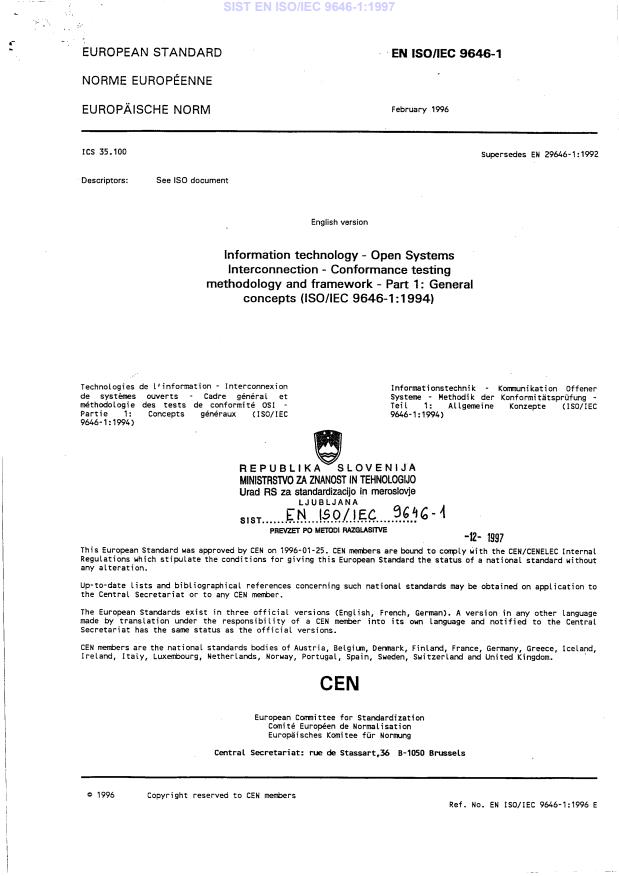
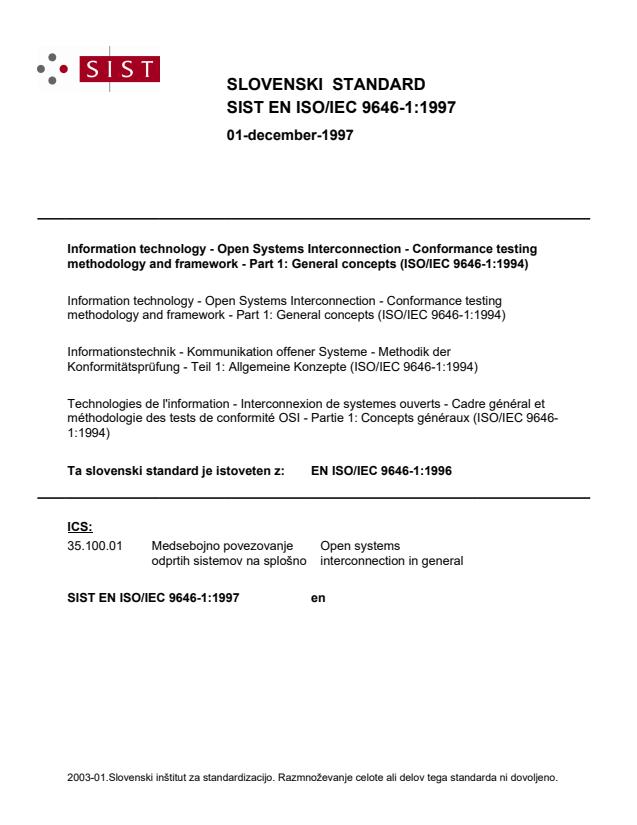
2003-01.Slovenski inštitut za standardizacijo. Razmnoževanje celote ali delov tega standarda ni dovoljeno.Information technology - Open Systems Interconnection - Conformance testing methodology and framework - Part 1: General concepts (ISO/IEC 9646-1:1994)Informationstechnik - Kommunikation offener Systeme - Methodik der Konformitätsprüfung - Teil 1: Allgemeine Konzepte (ISO/IEC 9646-1:1994)Technologies de l'information - Interconnexion de systemes ouverts - Cadre général et méthodologie des tests de conformité OSI - Partie 1: Concepts généraux (ISO/IEC 9646-1:1994)Information technology - Open Systems Interconnection - Conformance testing methodology and framework - Part 1: General concepts (ISO/IEC 9646-1:1994)35.100.01Medsebojno povezovanje odprtih sistemov na splošnoOpen systems interconnection in generalICS:Ta slovenski standard je istoveten z:EN ISO/IEC 9646-1:1996SIST EN ISO/IEC 9646-1:1997en01-december-1997SIST EN ISO/IEC 9646-1:1997SLOVENSKI
STANDARD
INTERNATIONAL STANDARD ISOJIEC 9646-1 Second edition 1994-12-15 Information technology - Open Systems Interconnection - Conformance testing methodology and framework - Part 1: General concepts Technologies de I’informa tion - Interconnexion de systkmes ouverts - Cadre g&&al et m&hodologie des tests de conformit OS/ - Partie I: Concepts g&Graux Reference number lSO/IEC 9646-l :I 994(E) SIST EN ISO/IEC 9646-1:1997
ISO/IEC 9646-l: 1994(E) Contents Page Foreword . .i v Introduction. . . 1 Scope . .l 2 Normative references. . .2 3 Definitions . .3 3.1 Reference model definitions . .3 3.2 Terms defined in other International Standards, ITU-T Recommendations and Technical Reports. . .3 3.3 Conformance testing definitions . .4 4 Abbreviations . .10 5 ThemeaningofconforrnanceinOSI. . .ll 5.1 Introduction . .ll 5.2 Conformance requirements . .ll 5.3 Static conformance requirements. . 11 5.4 Dynamic conformance requirements. . .12 5.5 Conformance requirements related to transfer syntaxes . .12 5.6 Implementation Conformance Statements (ICSs) . .12 5.6.1 Introduction. . .12 5.6.2 Protocol Implementation Conformance Statement (PICS) . .12 5.6.3 Profile Implementation Conformance Statement (profile ICS). . .12 5.6.4 System Conformance Statement (SCS) . .13 5.7 Aconforming system . .13 5.8 Interworking and conformance . .13 6 Confomnance and testing, . “14 6.1 Objectives of conformance testing. . .14 6.1.1 Introduction . .14 6.1.2 Basic Interconnection Tests. . .14 6.1.3 Capability tests. . .14 6.1.4 Behaviour tests. . .15 6.1.5 Conformance resolution tests . .15 6.2 Extra information for testing . .15 6.2.1 Implementation Extra Information for Testing (IXIT) . .15 6.2.2 Protocol Implementation Extra Information for Testing (PIXIT) . .16 0 ISO/IEC 1994 All rights reserved. Unless otherwise specified, no part of this publication may be reproduced or utilized in any form or by any means, electronic or mechanical, including photocopying and microfilm, without permission in writing from the publisher. ISO/IEC Copyright Office l Case Postale 56 l CH-1211 Geneve 20 l Switzerland Printed in Switzerland ii SIST EN ISO/IEC 9646-1:1997
0 ISO/IEC ISO/IEC 9646-l: 1994(E) 6.2.3 Profile Implementation Extra Information for Testing (profile IXIT) . .16 6.3 Confkxk&~ &k&&t*ii&ei, b&-;ik*~ : : : : : : : : : : : : : : : : : : : : : : : . .16 6.4 Use of Basic Interconnection Tests and capability tests in the test campaign18 6.5 Analysis of results . .18 6.5.1 Test outcomes and test verdicts. . .18 6.5.2 Conformance test reports . .18 6.5.3 Repeatability of results . .19 6.5.4 Comparability of results . .19 6.5.5 Auditability of results . .19 7 Testmethods.l 9 7.1 Introduction.19 7.2 Classification of real open systems and IUTs for conformance testing . .19 7.2.1 Classification of SUTs . .19 7.2.2 Identification of the IUT . .21 7.3 Abstract testing methodology . .21 7.3.1 General . .21 7.3.2 Points of Control and Observation (PCOs) . .23 7.4 Abstract testing functions . .23 7.5 Overview of Abstract Test Methods. . .2 4 7.5.1 End-system IUTs in the Single-Party Testing context . .24 7.5.2 The Local and Distributed test methods . .24 7.5.3 The Coordinated and Remote test methods. . .24 7.5.4 Variants of abstract test methods . .24 7.5.5 IUTs in the Multi-Party Testing context. . 24 7.6 Applicability of test methods to real open systems. . .24 7.7 Applicability of the test methods to OS1 protocols and layers . .26 8 Testsuites.2 6 8.1 Structure. . .2 6 8.2 Abstract and executable test cases . .26 8.3 Base specification conformance testing specifications . .28 8.4 Profile Test Specifications (PTS) . .28 9 Relationships between parts, concepts and roles . .29 10 Comp~ance.2 9 Annex A Op~oIls.3 1 B Indexofparts 1.2.4.5.6and7 . .32 . . . 111 SIST EN ISO/IEC 9646-1:1997
ISO/IEC 9646-l: 1994(E) 0 ISO/IEC Foreword IS0 (the International Organization for Standardization) and IEC (the Inter- national Electrotechnical Commission) form the specialized system for worldwide standardization. National bodies that are members of IS0 or IEC participate in the development of International Standards through technical committees established by the respective organization to deal with particular fields of technical activity. IS0 and IEC technical committees collaborate in fields of mutual interest. Other international organizations, governmental and non-governmental, in liaison with IS0 and IEC, also take part in the work. In the field of information technology, IS0 and IEC have established a joint technical committee, ISO/IEC JTC 1. Draft International Standards adopted by the joint technical committee are circulated to national bodies for voting. Publication as an International Standard requires approval by at least 75 % of the national bodies casting a vote. International Standard ISO/IEC 9646-l was prepared by Joint Technical Committee ISO/IEC JTC 1, Information technology, Subcommittee 21, Open Systems Interconnection, data management and open distributed processing. This second edition cancels and replaces the first edition (ISO/IEC 9646-l: 1991) which has been technically revised. It also consolidates Technical Corrigendum 1. ISO/IEC 9646 consists of the following parts, under the general title Information technology - Open Systems Interconnection - Conformance testing methodol- ogy and framework: - Part I: General concepts - Part 2: Abstract Test Suite specification - Part 3: The Tree and Tabular Combined Notation - Part 4: Test realization - Part 5: Requirements on test laboratories and clients for the conformance assessment process - Part 6: Protocol profile test specification - Part 7: Implementation conformance statements Annexes A and B of this part of ISO/IEC 9646 are for information only. SIST EN ISO/IEC 9646-1:1997
0 ISO/IEC ISO/IEC 9646=1:1994(E) Introduction The objective of OS1 will not be completely achieved until systems can be tested to determine whether they conform to the relevant protocol and profile specifications. The relevant ones can be OS1 International Standards, ITU-T Recommendations or International Standardized Profiles. Standardized Abstract Test Suites should be developed for each International Standard or ITU-T Recommendation which specifies an OS1 protocol, for use by suppliers or implementors in self-testing, by users of OS1 products, by telecommunications administrations and recognized private operating agencies, or by other third party testing organizations. Standardized Profile Test Specifications should be developed for each OS1 profile defined in an International Standardized Profile, or in an International Standard or ITU-T Recommendation, to specify how to combine and select from these Abstract Test Suites for the purpose of testing conformance of systems to that profile. This should lead to comparability and wide acceptance of test results produced by different test laboratories, and thereby minimize the need for repeated conformance testing of the same system. The standardization of test suites requires international definition and acceptance of a common testing methodology, together with appropriate testing methods and procedures. It is the purpose of ISO/IEC 9646 to define the methodology, to provide a framework for specifying conformance test suites, and to define the procedures to be followed during testing. Conformance testing involves testing both the capabilities and behaviour of an implementation, and checking what is observed against the conformance requirements in the relevant International Standards or ITU-T Recommendations and if appropriate in the related International Standardized Profiles and against what the implementor states the implementation capabilities are. Conformance testing does not include assessment of the performance nor the robustness or reliability of an implementation. It cannot give judgements on the physical realization of the Abstract Service Primitives, how a system is implemented, how it provides any requested service, nor the environment of the protocol implementation. It cannot, except in an indirect way, prove anything about the logical design of the protocol itself. The purpose of conformance testing is to increase the probability that different OS1 implementations are able to interwork. However it should be borne in mind that the complexity of most protocols makes exhaustive testing impractical on both technical and economic grounds. Also, testing cannot guarantee conformance to a specification since it detects errors rather than their absence. Thus conformance to a test suite alone cannot guarantee inter-working. What it does do is give confidence that an implementation has the required capabilities and that its behaviour conforms consistently in representative instances of communication. SIST EN ISO/IEC 9646-1:1997
ISO/IEC 9646-l: 1994(E) 0 ISOAEC It should be noted that the OS1 basic reference model (ISO 7498: 1984 or CCITT X.200 (1984)) states (in 4.3): “Only the external behuviour of Open Systems is retained as the standard of behaviour of real Open Systems” This means that although aspects of both internal and external behaviour are described in OS1 International Standards and ITU-T Recommendations, it is only the requirements on external behaviour that have to be met by real open systems. Although some of the methods defined in ISO/IEC 9646-2 do impose certain limitations on the implementor, for example that there be some means of realizing control and observation at one or more Service Access Points, it should be noted that other methods defined herein do not impose such limitations. However, in the case of partial OS1 end-systems which provide OS1 protocols up to a specific layer boundary, it is desirable to test not only the external behaviour of the implemented protocol entities, but also the ability of those entities to support correct external behaviour in higher layers. Detailed investigation of relative benefits, efficiency and limitations of all methods is addressed in various parts of ISO/IEC 9646. However, any organization contemplating the use of test methods defined in ISOIIEC 9646-2 in a context such as certification should carefully consider the limitations on their applicability and the benefits of each. Testing is voluntary as far as ISO/IEC and ITU-T are concerned. Requirements for testing in procurement and other external contracts are not a matter for standardization. This part of ISO/IEC 9646 is also to be published by ITU-T as Recommendation X.290 but not as identical text. SIST EN ISO/IEC 9646-1:1997
INTERNATIONAL STANDARD 0 ISO/IEC ISO/IEC 9646-l: 1994 (E) Information technology - Open Systems Interconnection - Conformance testing methodology and framework - Part 1: General concepts 1 Scope 1.1 ISO/IEC 9646 is a multi-part International Standard which specifies a general methodology for testing the conformance of products to OS1 specifications which the products are claimed to implement. The methodology applies to testing conformance to a) the specification of an OS1 protocol; b) the specification of a transfer syntax used in combination with a specific OS1 protocol; c) the specification of an OS1 protocol profile, including the testing of conformance to any specified information objects used in combination with one or more of the protocols, as specified in the profile; d) the specifications of a combination of OS1 protocols, possibly used in combination with a specified transfer syntax and/or one or more specified information objects. The OS1 specification to which conformance is tested may be contained in an International Standard, an ITU-T Recommendation, or an International Standardized Profile. 1.2 ISO/IEC 9646 is in principle, applicable to conformance testing for Integrated Services Digital Network (ISDN). 1.3 ISO/IEC 9646 is applicable to conformance testing for those implementations of a protocol or set of protocols that require communication between two or more real open systems to achieve their purpose (e.g. Message Handling Service (MHS)), Directory Services, ISDN, Transaction Processing, Routeing, and Systems Management). 1.4 ISO/IEC 9646 is applicable to the different phases of the conformance testing process, these phases being characterized by three major activities. These activities are: a) the specification of Abstract Test Suites (ATSs) for particular OS1 protocols and Profile Test Specifications (PTSs) for particular OS1 profiles; b) realization of a Means of Testing (MOT) able to run an executable form of an Abstract Test Suite; c) the conformance assessment process carried out by a test laboratory for a specific client on the basis of an Implementation Conformance Statement (ICS), culminating in the production of a System Conformance Test Report (SCTR) and one or more Protocol Conformance Test Reports (PCTR), one for each ATS used; the results are given in terms of the relevant protocol specification(s) and test suite(s) used. This part is applicable to all three activities, providing tutorial introductory material, together with definitions of common terms and concepts. NOTE - ISO/IEC 9646-2 deals with the requirements and guidance for the specification of ATSs, independent of test notation. ISO/IEC 9646- 3 defines the recommended test notation. ISOAEC 9646-4 deals with requirements and guidance for realization of the means of testing. ISO/ IEC 9646-5 deals with requirements and guidance for test laboratories and their clients for the conformance assessment process. ISO/IEC 9646 6 deals with the requirements and guidance for PTSs based upon ATSs for each of the protocols involved. ISO/IEC 9646-7 deals with the requirements and guidance for ICSs, System Conformance Statements (SCSs), their proformas and Requirements Lists (RLs). 1.5 ISO/IEC 9646 specifies the requirements for and gives guidance on the procedures to be followed in OS1 conformance testing. 1.6 ISO/IEC 9646 includes only such information as is necessary to meet the following objectives: a) to achieve an adequate level of confidence in the tests as a guide to conformance; b) to achieve comparability between the results of the corresponding tests on a particular OS1 implementation applied in different places at different times; c) to facilitate communication between the parties responsible for the activities described in 1.4 above. 1 SIST EN ISO/IEC 9646-1:1997
ISO/IlK 9646-l: 1994(E) 0 1somc 1.7 This part of ISO/IEC 9646 includes tutorial introductory material which provides a) an exposition of the meaning of conformance in the context of OSI; b) a description of the major categories of conformance tests; c) an introduction to the conformance assessment process; d) an introduction to the Abstract Test Methods and their applicability; e) an introduction to the concepts of test suite design. In addition, this part describes the relationship between the other parts of ISO/IEC 9646 and the activities involved in conformance testing, and introduces the concept of compliance with respect to the other parts of ISO/IEC 9646. 1.8 The following are outside the scope of ISO/IEC 9646: a) certification, an administrative procedure which may follow conformance testing; b) requirements for procurement and contracts; c) testing by means of test methods which are specific to particular applications, protocols or systems; d) testing by means other than PDU exchange; NOTE - ISO/IEC 9646 does not apply fully to Physical layer protocols. Nevertheless, many of the concepts apply to all protocols. 2 Normative references The following standards contain provisions which, through reference in this text, constitute provisions of this part of ISO/IEC 9646. At the time of publication, the editions indicated were valid. All standards are subject to revision, and parties to agreements based on this part of ISO/IEC 9646 are encouraged to investigate the possibility of applying the most recent editions of the standards listed below. Members of IEC and IS0 maintain registers of currently valid International Standards. IS0 7498: 1984, Information processing systems - Open Systems Interconnection - Basic Reference Model. (See also CCITI’ Recommendation X.200 (1984)) ISOITR 8509: 1987, Information processing systems - Open Systems Interconnection - Service conventions. (See also CCITT Recommendation X.210 (1988)) ISO/IEC 8825: 1990, Information technology - Open Systems Interconnection - Specification of Basic Encoding Rules for Abstract Syntax Notation One (ASN.1). (See also CCI‘IT Recommendation X.209 (1988)) ISO/IEC 9646-2: 1994, Information technology - Open Systems Interconnection - - Conformance testing methodology and framework - Part 2: Abstract Test Suite spectfication. (See also ITU-T Recommendation X.291 J)) ISO/IEC 9646-3: 1992, Information technology - Open Systems Interconnection - Conformance testing methodology and framework - Part 3: The Tree and Tabular Combined Notation (TTCN). (See also ITU-T Recommendation X.292 (1993)) ISO/IEC 9646-3 Amd 1: J, Information technology - Open Systems Interconnection - Conformance testing methodology and framework - Part 3: Th.e Tree and Tabular Combined Notation - Amendment 1: TTCN extensions. ISO/IEC 9646-4: 1994, Information technology - Open Systems Interconnection - Conformance testing methodology and framework - Part 4: Test realization. (See also ITU-T Recommendation X.293 J)) ISO/IEC 9646-5: 1994, Information technology - Open Systems Interconnection - * Conformance testing methodology and framework - Part 5: Requirements on test laboratories and clients for the conformance assessment process. (See also ITU-T Recommendation X.294 -I)) ISO/IEC 9646-6: 1994, Information technology - Open Systems Interconnection - I Conformance testing methodology and framework - Part 6: Protocol profile test specification. (See also ITU-T Recommendation X.295 -I)). ISOIIEC 9646-7: J), Information technology - Open Systems Interconnection - Conformance testing methodology and framework - Part 7: Implementation Conformance Statements. (See also ITU-T Recommendation X.296 J)). 1) To be published. 2 SIST EN ISO/IEC 9646-1:1997
0 ISO/IEC ISO/IEC 9646-l: 1994(E) ISOIIEC TR 10000-l: 1990, Information technology - Framework and taxonomy of International Standardized Profiles, Part 1 - Framework. 3 Definitions 3.1 Reference model definitions This part of ISO/IEC 9646 is based upon the concepts developed in the Basic Reference Model for Open Systems Interconnection (IS0 7498 1 CCITT X.200), and makes use of the following terms defined in that International Standard: a) (N)-entity b) (N)-layer c) (N)-protocol d) (N)-protocol-data-unit e) (N)-relay f) (N)-service g) (N)-service-access-point h) Application layer i) Application-service-element j) Data Link layer k) Network layer 1) Physical layer m) Presentation layer n) real open system 0) real system p) (N)-service data unit q) Session layer r) subnetwork s) transfer syntax t) Transport layer 3.2 Terms defined in other International Standards, ITU-T Recommendations and Technical Reports 3.2.1 This part of ISO/IEC 9646 uses the following terms defined in the OS1 Service Conventions (ISO/TR 8509 1 CCITT X.210): a) service-user b) service-provider c) service primitive 3.2.2 This part of ISO/IEC 9646 uses the following term defined in the Specification of Basic Encoding Rules for Abstract Syntax Notation One (ASN.l) (IS0 8825 1 CCITT X.209): - encoding 3.2.3 This part of ISO/IEC 9646 uses the following terms defined in the Framework and Taxonomy of International Standardized Profiles (ISO/IEC TR 10000-l): a) International Standardized Profile b) profile c) base standard SIST EN ISO/IEC 9646-1:1997
ISO/IIK 9646-1: 1994(E) 0 ISO/IEC NOTES 1 - In ISO/IEC 9646 the term profile is used to mean “protocol profile” as defined in 3.3.82 . 2 - In ISO/IEC 9646 the more general term “base specification” is used with similar meaning to base standard but independent of the status of the specification, as defined in 3.3.10 . 3.3 Conformance testing definitions For the purposes of this part of ISO/IEC 9646 the following definitions apply: 3.3.1 abnormal (test case) termination: The term used to describe the result of execution of an abstract test case when it has been prematurely terminated by the test system. 3.3.2 abstract (N)-service-primitive [(N)-ASP]: An implementation-independent descri .ption of an service-user and a service-provider at an (N)-service boundary, as defined in an OS1 service defin ition. interaction between a 3.3.3 abstract test case: A complete and independent specification of the actions required to achieve a specific test purpose, defined at the level of abstraction of a particular Abstract Test Method, starting in a stable testing state and ending in a stable testing state. This specification may involve one or more consecutive or concurrent connections. NOTES 1 The specification should be complete in the sense that it is potentially observable test outcome (i.e. sequence of test events). sufficient to enable a test verdict to be assigned unambiguously to each 2 The specification should be independent in the sense that it should be possible to execute the derived executable test case in from other such test cases (i.e. the specification should always include the possibility of starting and finishing in the “idle” state). isolation 3.3.4 abstract test case error: A test case error resulting from an error in the abstract test case. 3.3.5 (abstract) test method [ATM]: The description of how an IUT is to be tested, given at an appropriate level of abstraction to make the description independent of any particular realization of a Means of Testing, but with enough detail to enable abstract test cases to be specified for this test method. 3.3.6 abstract test suite [ATS]: A test suite composed of abstract test cases. 3.3.7 abstract test suite [ATS] specification: A specification that contains a standardised ATS together with related information. 3.3.8 abstract testing context: Either a Multi-Party or Single-Party Testing context. 3.3.9 abstract testing methodology: An approach to describing and categorizing Abstract Test Methods, 3.3.10 base specification: A specification of a protocol, abstract syntax, encoding rules, or information object. 3.3.11 basic interconnection test [BIT]: A test of an IUT which has limited scope to determine whether or not there is sufficient conformance to the relevant protocol(s) for interconnection to be possible, without trying to perform thorough testing. 3.3.12 behaviour test: A test to determine the extent to which one or more dynamic conformance requirements are met by the IUT. 3.3.13 capability (of an implementation): A set of functions in the relevant protocol(s) which is supported by the implementation. 3.3.14 capability test: A test to verify the existence of one or more claimed capabilities of an IUT. NOTE - Capability testing involves checking all mandatory capabilities and those optional ones that are stated in the ICS as supported, but not checking those optional ones which are stated in the ICS as not supported by the KIT. 3.3.15 client (of a test laboratory): An organization that submits a system or implementation for conformance testing. 3.3.16 common (sub)profile: A profile or specified subset of a profile which is included by reference within one or more other profiles. 3.3.17 comparability (of results): Characteristic of conformance assessment processes, such that their execution on the same IUT, in different testing environments, leads to the same overall summary of conformance for the specified IUT. 3.3.18 comprehensive testing service: A service, offered to clients by a test laboratory, to perform the conformance assessment process for one or more OS1 protocol(s), with a choice of test methods sufficient to make the service applicable to all real open systems that claim to implement the specified protocols. 3.3.19 conformance assessment process: The complete process of accomplishing all conformance testing activities necessary to assess the conformance of an implementation or a system to one or more OS1 specifications. 4 SIST EN ISO/IEC 9646-1:1997
0 ISOIIEC ISO/IEC 9646-l: 1994(E) 3.3.20 conformance log: A human-readable record of information produced as a result of a test campaign, which is sufficient to record the observed test outcomes and verify the assignment of test results (including test verdicts). 3.3.21 conformance resolution test: A non-standardized, possibly system-specific test to fulfil a test purpose for which a standardized abstract test case is not defined, in order to investigate the behaviour of an OS1 protocol implementation with respect to one or more particular conformance requirements. 3.3.22 (conformance) test suite: A complete set of test cases, possibly combined into nested test groups, that is needed to perform dynamic conformance testing for one or more OS1 protocols. NOTE - It should cover both capability testing and behaviour testing. It may be qualified by the adjectives: abstract or executable, as appropriate. Unless stated otherwise, an “abstract test suite” is meant. 3.3.23 conformance testing: Testing the extent to which an IUT is a conforming implementation. 3.3.24 conformance testing specification: One or more specifications that contain a standardized ATS, together with its related TSS&TP, partial IXIT proforma, and TMP specification, if any. 3.3.25 conforming implementation: An IUT which satisfies both static and dynamic conformance requirements, consistent with the capabilities stated in the ICS(s). 3.3.26 conforming system: A real system which satisfies both static and dynamic conformance requirements consistent with the capabilities stated in the KS(s) referenced by the SCS. 3.3.27 Coordinated test method: An Abstract Test Method in which the Upper Tester is within the SUT and for which a standardized TMP is defined for the TCP, enabling the control and observation to be specified solely in terms of the Lower Tester activity, including the control and observation of Test Management PDUs. 3.3.28 Distributed test method: An Abstract Test Method in which the Upper Tester is within the SUT and there is a PC0 at the upper service boundary of the IUT. 3.3.29 dynamic conformance requirement: One of the requirements which specifies what permitted by the relevant specification(s) in instances of communication. 3.3.30 embedded testing: Testing specified for a single-protocol within a multi-protocol IUT including the specification of the protocol activity above the one being tested, but without specifying control or observation at service boundaries within the multi-protocol IUT. observable behaviou r is NOTE - This definition assumes that the protocols of the IUT are ordered in a continuous adjacent user/provider relationship. 3.3.31 executable test case: A realization of an abstract test case. 3.3.32 executable test case error: A test case error in the realization of an abstract test case. 3.3.33 executable test suite [ETS]: A test suite composed of executable test cases. 3.3.34 fail (verdict): A test verdict given when the observed test outcome either demonstrates nonconformance with respect to (at least one of) the conformance requirement(s) on which the test purpose of the test case is focused, or contains at least one invalid test event, with respect to the relevant specification(s). 3.3.35 foreseen test outcome: An observed test outcome identified in the abstract test case. NOTE - A foreseen test outcome may include an unidentified test event. 3.3.36 (KS (proforma)) item: A row in an ICS (proforma) table. 3.3.37 (ICS (proforma)) question: The question to be answered in the intersection of an ICS item and either a support column (i.e. “Is this item supported in the context applying to this table and column?“) or supported values column (i.e. “What values are supported for this item in the context applying to this table and column?“) in an ICS proforma table. 3.3.38 idle testing state: A stable testing state in which there is no established connection of the relevant protocol(s) and in which the state of the SUT is independent of any previously executed test cases. 3.3.39 implementation conformance statement [ICS]: A statement made by the supplier of an implementation or system claimed to conform to a given specification, stating which capabilities have been implemented.The ICS can take several forms: protocol ICS, profile ICS, profile specific ICS, and information object ICS. 3.3.40 implementation conformance when completed for an implementation statement [KS] proforma: A document, in the form of a or system becomes an ICS. questionnaire, which 3.3.41 implementation extra information for testing [IXIT] : A statement made by a supplier or implementor of an TUT which contains or references all of the information (in addition to that given in the ICS) related to the IUT and its SIST EN ISO/IEC 9646-1:1997
ISO/IK 9646-l: 1994(E) 0 ISOAEC testing environment, which will enable the test laboratory to run an appropriate test suite against the IUT. An IXIT can take several forms: protocol IXIT, profile IXIT, profile specific IXIT, and information object IXIT, TMP implementation statement. 3.3.42 implementation extra information for testing [IXIT] proforma: A document, in the form of a questionnaire, which when completed for an IUT or SUT becomes an IXIT. NOTE - A complete IXIT profonna is developed in three stages. Firstly, the test suite specifier produces a “partial IXIT proforma” to accompany the test specification (ATS, PSTS, or PTS). Secondly, the test realizer augments the partial IXIT proforma to produce an “augmented partial IXIT proforma” for the Means of Testing. Thirdly, the test laboratory adds its own questions and information to produce the complete IXIT proforma for a test service. The terms “partial IXIT proforma” and “augmented partial IXIT proforma” are only used within ISO/IEC 9646 to distinguish the different stages of development. 3.3.43 implementation under test [IUT]: An implementation of one or more OS1 protocols in an adjacent user/provider relationship, being that part of a real open system which is to be studied by testing. 3.3.44 inconclusive (verdict): A test verdict given when the observed test outcome is such that neither a pass nor a fail verdict can be given. 3.3.45 information object implementation conformance statement [information object ICS]: An ICS for an implementation or system claimed to conform to a given information object specification. 3.3.46 information object implementation extra information for testing [information object IXIT]: Ai1 IXIT for an implementation or system claimed to conform to a given information object specification. 3.3.47 initial testing state: The testing state in which a test body starts. NOTE - This may be either a stable testing state or a transient state. 3.3.48 inopportune test event: A test event which occurs when not allowed to do so by the relevant specification(s) to which conformance is being tested. 3.3.49 invalid test event: A test event that violates at least one conformance requirement of the relevant specification(s) to which conformance is being tested. NOTE - This term is not to be confused with the term “invalid event” as defined in IS0 7776 (X.25 level 2, High-level Data Link Control (HDLC)). 3.3.50 IUT component: That part of an IUT which communicates with a specific Lower Tester. 3.3.51 Local test method: An Abstract Test Method in which both the Lower and Upper Testers are located within the test system and there is a PC0 at the upper service boundary of the IUT. 3.3.52 lower tester [LT]: The representation in ISO/IEC 9646 of the means of providing, during test execution, indirect control and observation of the lower service boundary of the IUT via the underlying service-provider. NOTE - The underlying service-provider OS1 layers, or only the Physical medium. is immediately beneath the (lowest) protocol which is the focus of testing. It may use one or more 3.3.53 lower tester control function [LTCF]: the means of providing the coordination of Lower Testers and the assignment of the verdict in the MPyT context. 3.3.54 means of testing [MOT] (IUTs): The combination of equipment and procedures that can perform the derivation, selection, parameterization and execution of test cases, in conformance with a reference standardized AT& alxi can produce a conformance log. 3.3.55 multi-party testing [MPyT] context: A context in which the IUT is tested as a whole, and is required to communicate with multiple other real open systems concurrently. 3.3.56 multi-protocol testing: Testing of more than one protocol within the IUT by means of test cases which have test purposes which cover conformance requirements that relate to more than one protocol. in one specification which specifies a 3.3.57 multi-specification dependency: A conformance requirement the support of another specification within a conforming system. requirement upon 3.3.58 (observed) test outcome: The sequence of test events, together with associated data and/or parameter values, which occurred during test execution of a specific parameterized executable test case. 3.3.59 parameterized abstract test case: An abstract test case in which all relevant parameters have been supplied with values in accordance with specific ICS(s) and IXIT(s), as appropriate. 3.3.60 parameterized abstract test suite [PATS]: A Selected Abstract Test Suite in which all test cases have been parameterized in accordance with the appropriate ICS(s) and IXIT(s). 6 SIST EN ISO/IEC 9646-1:1997
0 ISO/IEC ISO/IEC 9646=1:1994(E) 3.3.61 parameterized executable test case: An executable test case, in which all appropriate parameters have been supplied with values in accordance with specific ICS(s) and IXIT(s), as appropriate, and corresponding to a parameterized abstract test case. 3.3.62 parameterized executable test suite [PETS]: A Selected Executable Test Suite, in which all test cases have been parameterized in accordance with the relevant ICS(s) and IXIT(s), as appropriate, and corresponding to a Parameterized Abstract Test Suite. 3.3.63 pass (verdict): A test verdict given when the observed test outcome gives evidence of conformance to the conformance requirement(s) on which the test purpose of the test case is focused, and when no invalid test event has been detected. 3.3.64 point of control and observation [PCO]: A point within a testing environment where the occurrence of test events is to be controlled and observed, as defined in an Abstract Test Method. NOTE - A PC0 is characterized by the set of ASPS and/or PDUs that can occur, according to the ATS, at that PCO. 3.3.65 preliminary result: Information to be recorded in the conformance log and to be used in determining the test verdict. 3.3.66 profile conformance testing: Testing the extent to which an IUT conforms to a profile specification. 3.3.67 profile implementation conformance statement [profile ICS]: An ICS for a system claimed to conform to a given profile, comprising the profile RL, plus the base specification ICSs plus the profile specific ICS, if any. NOTE - The corresponding ISO/IEC TR 10000-l term is “ISP Implementation Conformance Statement” (ISPICS). 3.3.68 profile implementation conformance statement [profile ICS] proforma: A profile RL plus the set of ICS proformas which when completed for a system and takkn together with the profile RL become a profile ICS. 3.3.69 profile implementation extra information for testing [profile IXIT]: An IXIT related to testing for conformance to a given profile, comprising the profile XRL, plus the base specification IXITs, plus the profile specific IXIT, if any. 3.3.70 profile implementation extra information for testing [profile IXIT] proforma: A profile XRL plus the set of IXIT profomnas which when completed for an SUT and taken together with the profile XRL become a profile IXIT. 3.3.71 (profile) IXIT requirements list [XRL]: A specification, within a profile test specification, of constraints on the answers allowed in base specification IXITs that are part of a profile IXIT for a system to be tested for conformance to the relevant profile. 3.3.72 (profile) requirements list [RL]: A specification of profile conformance requirements in the form of modifications to the status entries from the relevant base specification ICS proforrnas. These requirements specify additional constraints on the answers allowed in base specification ICSs that are part of the profile ICS for a system claimed to conform to the relevant profile. 3.3.73 profile specific implementation conformance statement [profile specific ICS]: An ICS for a system claimed to conform to a given profile, answering questions which are profile-specific and additional to those of the base specification ICS proforma items listed in the profile RL. 3.3.74 profile specific implementation extra information for testing [profile specific IXIT]: An IXIT related to testing conformance to a given profile, answering questions related to the IUT and its testing environment, which are profile-specific and additional to those of the base specification IXITs. 3.3.75 profile specific test specification [PSTS]: A specification which specifies the information necessary to extend and adapt the set of standardised ATSs relevant to the base specifications referenced by a given profile, including test cases for multi-protocol conformance requirements if necessary, in order to provide a complete set of abstract test cases for that profile. 3.3.76 profile test specification [PTS]: A PTS-Sumrnary plus the set of documents referenced by it, including the set of base specification TSS&TP and ATSs plus the PSTS for the given profile. 3.3.77 profile specification: A specification which specifies one or more profiles. A profile specification may be an ISP, International Standard or a ITU-T Recommendation. 3.3.78 profile test specification summary [PTS -Summary] : A specification which references all the documents necessary to completely specify conformance testing for a given profile, including a TSS&TP and at least one ATS for each base specification referenced by the profile, and the PSTS. 7 SIST EN ISO/IEC 9646-1:1997
ISO/IEC 9646-1: 1994(E) 0 ISOAIX 3.3.79 protocol conformance test report [PCTR]: A document produced at the end of a conformance assessment process, giving the details of the testing carried out using a particular ATS. It lists all of the abstract test cases and identifies those for which corresponding executable test cases were run, together with the verdicts assigned. 3.3.80 protocol implementation conformance statement [PICS]: An ICS for an implementation or system claimed to conform to a given protocol specification. 3.3.81 protocol implementation extra information for testing [PIXIT]: An IXIT related to testing for conformance to a given protocol specification. 3.3.82 (protocol) profile: A profile (as defined by ISO/IEC TR 10000-l) which specifies a selection of options from a set of related protocols, possibly together with one or more transfer syntaxes and/or information objects. NOTES 1 Throughout ISO/IEC 9646 “profile” should be taken to mean “protocol profile”. ISO/IEC 9646 in general refers to profiles and profile specifications. An ISP is an example of a profile specification specifying one or more profiles. 2 The profile specification may be in an ISP, an International Standard or ITU-T Recommendation. 3.3.83 PSTS test case replacement list: The list of abstract test cases from base specification ATSs to be deselected for a given profile and replaced by abstract test cases given in the PSTS. 3.3.84 reference (standardized) abstract test suite [reference (standardized) ATS]: The standardized ATS for which a Means of Testing is realized. 3.3.85 Remote test method: An Abstract Test Method in which the control and observation of test events is specified solely in terms of Lower Tester activity, and in which some requirements for TCP may be irnplied or informally expressed in the ATS, but in which no assumption is made regarding their feasibility or realization. 3.3.86 repeatability (of results): Characteristic of a test case, such that repeated conditions lead to the same test verdict, and by extension a characteristic of a test 3.3.87 profile role (of an implementation in specification, which can be used executions on the same IUT under the suite. an instance of communication): A major category of operation defined in base or to describe an implementation in an instance of communication. NOTE - Possible roles are initiator, responder, invoker, performer, manager, agent and the different categories of operation applicable to multi-party protocols. 3.3.88 selected abstract. test suite [SATS]: The subset of an ATS selected using the ICS(s) and IXIT(s), relevant to the IUT. 3.3.89 selected executable test suite [SETS]: The subset of an ETS selected using the ICS(s) and IXIT(s), relevant to the IUT. 3.3.90 semantically invalid test event: A test event which is neither inopportune nor syntactically invalid, but which contains a semantic error with respect to the relevant protocol specification (e.g. a PDU containing a parameter value outside the negotiated range for that parameter). 3.3.91 single-party testing [SPyT] context: A context in which the TUT is required to communicate with a single other real open system. 3.3.92 single-protocol testing: Testing specified for a single protocol within a single-protocol or multi-protocol IUT. 3.3.93 long to stable testing state: A testing state which can be maintained, without prescribed Lower Tester behaviour, sufficiently span the gap between one test case and the next in a test camp
...
Questions, Comments and Discussion
Ask us and Technical Secretary will try to provide an answer. You can facilitate discussion about the standard in here.
Loading comments...