

EN 13971:2008
(Main)Carbonate liming materials - Determination of reactivity - Potentiometric titration method with hydrochloric acid
- Abstract
This European Standard specifies a method for the determination of the speed and effectiveness of the neutralizing potential of calcium carbonate and calcium magnesium carbonate liming materials by potentiometric titration with hydrochloric acid.
This method is applicable only to liming materials with a maximum particle size of 6,3 mm.
NOTE The type of liming material should be identified according to EN 14069 and the particle size should be determined according to EN 12948.
- Status
- Withdrawn
- Publication Date
- 12-Feb-2008
- Withdrawal Date
- 18-Dec-2012
- Technical Committee
- CEN/TC 260 - Fertilizers and liming materials
- Drafting Committee
- CEN/TC 260/WG 3 - Liming materials
- Current Stage
- 9960 - Withdrawal effective - Withdrawal
- Start Date
- 19-Dec-2012
- Completion Date
- 19-Dec-2012

Relations
- Effective Date
- 22-Dec-2008
- Effective Date
- 26-Dec-2012
- Effective Date
- 28-Jan-2026
- Refers
EN 12945:2014+A1:2016 - Liming materials - Determination of neutralizing value - Titrimetric methods - Effective Date
- 28-Jan-2026
- Effective Date
- 28-Jan-2026
- Effective Date
- 28-Jan-2026
Get Certified
Connect with accredited certification bodies for this standard

Control Union Certifications
Global certification for agriculture and sustainability.

DIBt (Deutsches Institut für Bautechnik)
German Institute for Building Technology.
DIN CERTCO
DIN Group product certification.
Sponsored listings
Frequently Asked Questions
EN 13971:2008 is a standard published by the European Committee for Standardization (CEN). Its full title is "Carbonate liming materials - Determination of reactivity - Potentiometric titration method with hydrochloric acid". This standard covers: This European Standard specifies a method for the determination of the speed and effectiveness of the neutralizing potential of calcium carbonate and calcium magnesium carbonate liming materials by potentiometric titration with hydrochloric acid. This method is applicable only to liming materials with a maximum particle size of 6,3 mm. NOTE The type of liming material should be identified according to EN 14069 and the particle size should be determined according to EN 12948.
This European Standard specifies a method for the determination of the speed and effectiveness of the neutralizing potential of calcium carbonate and calcium magnesium carbonate liming materials by potentiometric titration with hydrochloric acid. This method is applicable only to liming materials with a maximum particle size of 6,3 mm. NOTE The type of liming material should be identified according to EN 14069 and the particle size should be determined according to EN 12948.
EN 13971:2008 is classified under the following ICS (International Classification for Standards) categories: 65.080 - Fertilizers; 91.100.10 - Cement. Gypsum. Lime. Mortar. The ICS classification helps identify the subject area and facilitates finding related standards.
EN 13971:2008 has the following relationships with other standards: It is inter standard links to EN 13971:2002, EN 13971:2012, EN 12948:2010, EN 12945:2014+A1:2016, EN 12048:1996, EN 1482-2:2024. Understanding these relationships helps ensure you are using the most current and applicable version of the standard.
EN 13971:2008 is available in PDF format for immediate download after purchase. The document can be added to your cart and obtained through the secure checkout process. Digital delivery ensures instant access to the complete standard document.
Standards Content (Sample)
2003-01.Slovenski inštitut za standardizacijo. Razmnoževanje celote ali delov tega standarda ni dovoljeno.Carbonate liming materials - Determination of reactivity - Potentiometric titration method with hydrochloric acidQFLRPHWULMVNDAmendements minéraux basiques carbonatés - Détermination de la réactivité - Méthode par titration potentiométrique a l'acide chlorhydriqueCarbonatische Kalke - Bestimmung der Reaktivität - Potentiometrisches Titrationsverfahren mit SalzsäureTa slovenski standard je istoveten z:EN 13971:2008SIST EN 13971:2008en,fr,de65.080ICS:SIST EN 13971:20031DGRPHãþDSLOVENSKI
STANDARDSIST EN 13971:200801-april-2008
EUROPEAN STANDARDNORME EUROPÉENNEEUROPÄISCHE NORMEN 13971February 2008ICS 65.080; 91.100.10Supersedes EN 13971:2002
English VersionCarbonate liming materials - Determination of reactivity -Potentiometric titration method with hydrochloric acidAmendements minéraux basiques carbonatés -Détermination de la réactivité - Méthode par titrationpotentiométrique à l'acide chlorhydriqueCarbonatische Kalke - Bestimmung der Reaktivität -Potentiometrisches Titrationsverfahren mit SalzsäureThis European Standard was approved by CEN on 28 December 2007.CEN members are bound to comply with the CEN/CENELEC Internal Regulations which stipulate the conditions for giving this EuropeanStandard the status of a national standard without any alteration. Up-to-date lists and bibliographical references concerning such nationalstandards may be obtained on application to the CEN Management Centre or to any CEN member.This European Standard exists in three official versions (English, French, German). A version in any other language made by translationunder the responsibility of a CEN member into its own language and notified to the CEN Management Centre has the same status as theofficial versions.CEN members are the national standards bodies of Austria, Belgium, Bulgaria, Cyprus, Czech Republic, Denmark, Estonia, Finland,France, Germany, Greece, Hungary, Iceland, Ireland, Italy, Latvia, Lithuania, Luxembourg, Malta, Netherlands, Norway, Poland, Portugal,Romania, Slovakia, Slovenia, Spain, Sweden, Switzerland and United Kingdom.EUROPEAN COMMITTEE FOR STANDARDIZATIONCOMITÉ EUROPÉEN DE NORMALISATIONEUROPÄISCHES KOMITEE FÜR NORMUNGManagement Centre: rue de Stassart, 36
B-1050 Brussels© 2008 CENAll rights of exploitation in any form and by any means reservedworldwide for CEN national Members.Ref. No. EN 13971:2008: E
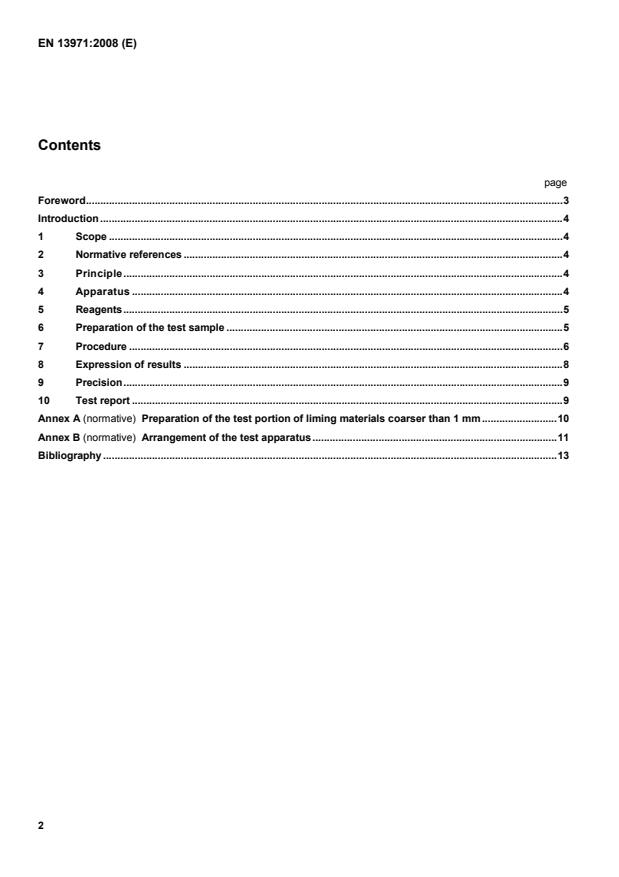
Preparation of the test portion of liming materials coarser than 1 mm.10 Annex B (normative)
Arrangement of the test apparatus.11 Bibliography.13
1) Metrohm 716 DMS Titrino® is an example of a suitable product available commercially. This information is given for the convenience of users of this European Standard and does not constitute an endorsement by CEN of this product. Equivalent products may be used if they can be shown to lead to the same results.
...