


prEN 1493
(Main)Vehicle lifts
Vehicle lifts
This document is applicable to stationary and mobile vehicle lifts, which are not intended to lift persons but which are designed to raise vehicles totally, for the purpose of examining and working on or under the vehicles whilst in a raised position. The vehicle lift may consist of one or more lifting units.
Power supply to the vehicle lift by internal combustion engines is not considered.
The floor or ground supporting the vehicle lift in use is assumed to be horizontal.
This document does not exclude a person from entering a lifted vehicle on wheel supporting lifts, e.g. for special works or for periodical technical inspection, and vehicle lifts for rail-bound vehicles.
This document does not contain requirements for hazards which may arise on vehicle lifts where the carrying device can be tilted.
NOTE Noise does not play a role in vehicle lifts in the majority of cases and is therefore not considered in this document.
This document does not apply to:
- vehicle lifts movable when loaded;
- equipment for power driven parking of motor vehicles (see EN 14010:2003+A1:2009).
This document is applicable to vehicle lifts which are manufactured six months after the date of its publication as a European Standard.
Fahrzeug-Hebebühnen
Dieses Dokument ist anzuwenden für Fahrzeug-Hebebühnen, die zum Anheben von Fahrzeugen vorgesehen sind, um die angehobenen Fahrzeuge zu untersuchen und an oder unter ihnen in aufrechter Position zu arbeiten.
Fahrzeug-Hebebühnen sind nicht zum Anheben von Personen vorgesehen. Bei besonderer Verwendung, wie z. B. bei Hebebühnen für die periodische technische Inspektion von Fahrzeugen oder bei Hebebühnen für Schienenfahrzeuge, ist es jedoch zulässig, dass eine Person ein angehobenes Fahrzeug betritt, vorausgesetzt, der Hersteller hat angemessene Sicherheitsmaßnahmen festgelegt und in der Bedienungsanleitung darauf hingewiesen.
Fahrzeug-Hebebühnen können aus einer oder mehreren Hubeinheiten (stationär oder ortsveränderlich) bestehen.
Es wird vorausgesetzt, dass der Boden, auf dem die Fahrzeug-Hebebühne benutzt wird, horizontal ist (Toleranzen sollten angegeben werden).
Dieses Dokument ist nicht anzuwenden für:
- Fahrzeug-Hebebühnen, die ein Fahrzeug teilweise anheben können.
- Fahrzeug-Hebebühnen, die in beladenem Zustand verfahrbar sind.
- Fahrzeug-Hebebühne, bei der das Lastaufnahmemittel gekippt werden kann.
- Fahrzeug-Hebebühnen, die von Verbrennungsmotoren angetrieben werden.
- Kraftbetriebene Parkeinrichtungen für Kraftfahrzeuge (siehe EN 1410:2003+A1:2009).
Lärm wird in diesem Dokument nicht berücksichtigt, da er in der praktischen Anwendung von Fahrzeug-Hebebühnen keine Rolle spielt.
Dieses Dokument ist anwendbar für Fahrzeug-Hebebühnen, die sechs Monate nach der Veröffentlichung als Europäische Norm hergestellt wurden.
Élévateurs de véhicules
Dvigala za servisiranje vozil
General Information
- Status
- Not Published
- Publication Date
- 12-Aug-2026
- Technical Committee
- CEN/TC 98 - Lifting platforms
- Drafting Committee
- CEN/TC 98/WG 3 - Vehicle lifting devices
- Current Stage
- 4599 - Dispatch of FV draft to CMC - Finalization for Vote
- Start Date
- 06-Feb-2026
- Due Date
- 06-Nov-2024
- Completion Date
- 06-Feb-2026
- Ref Project
oSIST prEN 1493:2024 - Vehicle lifts
Relations
- Effective Date
- 28-Jan-2026
- Revises
EN 1493:2022 - Vehicle lifts - Effective Date
- 28-Jan-2023
Overview
prEN 1493 (2024) - Vehicle lifts is a CEN draft European standard that sets safety, design and verification requirements for stationary and mobile vehicle lifts used to raise vehicles completely for examination and maintenance. It applies to single or multiple lifting units and to most vehicle types (including rail‑bound vehicles) but excludes power‑supply by internal combustion engines, lifts movable when loaded, and powered vehicle parking systems. The standard assumes the supporting floor is horizontal and does not address noise or hazards from tilting carrying devices.
Key topics and technical requirements
prEN 1493 covers the full lifecycle of vehicle lift safety, with emphasis on:
- Safety requirements and protective measures - preventing unauthorized/unintentional operation, pinching/shearing protection, and guarding of moving parts.
- Control systems - hold‑to‑run logic, grouped controls, emergency stop and stopping devices, fixed and mobile control units, and marking requirements.
- Drive systems - requirements for mechanical, hydraulic and pneumatic drives, including measures to prevent uncontrolled motion and inadvertent movement when raised.
- Structural design and loads - load and force definitions, load combinations, load distribution, lifting elements and proof of overturning stability.
- Load carrying devices - pick‑up plates/pads, arm locking systems, and protection against rolling off.
- Safety devices and electrical equipment - mechanical safety devices, safety switches, IP rating, means of disconnecting power and protection against leakage.
- Verification and testing - design checks, manufacturing inspections, visual verification and practical tests (overload static and dynamic, functional and electrical tests).
- Information for use - marking, nameplates, complete instructions and a user digest for safe operation and maintenance.
Applications and users
prEN 1493 is essential for:
- Manufacturers of vehicle lifts (design, production and conformity assessment)
- Automotive repair workshops and service centers (safe selection and use of lifts)
- Safety engineers and maintenance teams (inspection, commissioning and routine testing)
- Certifiers, notified bodies and national standards organizations (type testing and regulatory compliance)
- Procurement and facility managers specifying lifts for garages, depots and inspection stations
Compliance helps reduce accidents, ensures structural integrity and simplifies market access across CEN member states. Note: equipment manufactured six months after publication must meet the standard.
Related standards
- Supersedes/enhances EN 1493:2022 (draft prEN 1493:2024 is intended to replace the 2022 edition)
- Cross‑references to standards on parking systems (EN 14010) and electrical/equipment safety are relevant when integrating vehicle lifts into broader installations.
Keywords: prEN 1493, vehicle lifts, CEN standard, lift safety, hydraulic lifts, mechanical drives, lift verification, automotive workshop safety.

Get Certified
Connect with accredited certification bodies for this standard

TÜV Rheinland
TÜV Rheinland is a leading international provider of technical services.

TÜV SÜD
TÜV SÜD is a trusted partner of choice for safety, security and sustainability solutions.

AIAG (Automotive Industry Action Group)
American automotive industry standards and training.
Sponsored listings
Frequently Asked Questions
prEN 1493 is a draft published by the European Committee for Standardization (CEN). Its full title is "Vehicle lifts". This standard covers: This document is applicable to stationary and mobile vehicle lifts, which are not intended to lift persons but which are designed to raise vehicles totally, for the purpose of examining and working on or under the vehicles whilst in a raised position. The vehicle lift may consist of one or more lifting units. Power supply to the vehicle lift by internal combustion engines is not considered. The floor or ground supporting the vehicle lift in use is assumed to be horizontal. This document does not exclude a person from entering a lifted vehicle on wheel supporting lifts, e.g. for special works or for periodical technical inspection, and vehicle lifts for rail-bound vehicles. This document does not contain requirements for hazards which may arise on vehicle lifts where the carrying device can be tilted. NOTE Noise does not play a role in vehicle lifts in the majority of cases and is therefore not considered in this document. This document does not apply to: - vehicle lifts movable when loaded; - equipment for power driven parking of motor vehicles (see EN 14010:2003+A1:2009). This document is applicable to vehicle lifts which are manufactured six months after the date of its publication as a European Standard.
This document is applicable to stationary and mobile vehicle lifts, which are not intended to lift persons but which are designed to raise vehicles totally, for the purpose of examining and working on or under the vehicles whilst in a raised position. The vehicle lift may consist of one or more lifting units. Power supply to the vehicle lift by internal combustion engines is not considered. The floor or ground supporting the vehicle lift in use is assumed to be horizontal. This document does not exclude a person from entering a lifted vehicle on wheel supporting lifts, e.g. for special works or for periodical technical inspection, and vehicle lifts for rail-bound vehicles. This document does not contain requirements for hazards which may arise on vehicle lifts where the carrying device can be tilted. NOTE Noise does not play a role in vehicle lifts in the majority of cases and is therefore not considered in this document. This document does not apply to: - vehicle lifts movable when loaded; - equipment for power driven parking of motor vehicles (see EN 14010:2003+A1:2009). This document is applicable to vehicle lifts which are manufactured six months after the date of its publication as a European Standard.
prEN 1493 is classified under the following ICS (International Classification for Standards) categories: 43.180 - Diagnostic, maintenance and test equipment; 53.020.99 - Other lifting equipment. The ICS classification helps identify the subject area and facilitates finding related standards.
prEN 1493 has the following relationships with other standards: It is inter standard links to EN ISO 12625-17:2021, EN 1493:2022. Understanding these relationships helps ensure you are using the most current and applicable version of the standard.
prEN 1493 is associated with the following European legislation: EU Directives/Regulations: 2006/42/EC, 2023/1230; Standardization Mandates: M/396, M/605. When a standard is cited in the Official Journal of the European Union, products manufactured in conformity with it benefit from a presumption of conformity with the essential requirements of the corresponding EU directive or regulation.
prEN 1493 is available in PDF format for immediate download after purchase. The document can be added to your cart and obtained through the secure checkout process. Digital delivery ensures instant access to the complete standard document.
Standards Content (Sample)
SLOVENSKI STANDARD
01-maj-2024
Dvigala za servisiranje vozil
Vehicle lifts
Fahrzeug-Hebebühnen
Élévateurs de véhicules
Ta slovenski standard je istoveten z: prEN 1493
ICS:
43.180 Diagnostična, vdrževalna in Diagnostic, maintenance and
preskusna oprema test equipment
53.020.99 Druga dvigalna oprema Other lifting equipment
2003-01.Slovenski inštitut za standardizacijo. Razmnoževanje celote ali delov tega standarda ni dovoljeno.
DRAFT
EUROPEAN STANDARD
NORME EUROPÉENNE
EUROPÄISCHE NORM
March 2024
ICS 43.180; 53.020.99 Will supersede EN 1493:2022
English Version
Vehicle lifts
??ateurs de v?icules Fahrzeug-Hebeb?nen
This draft European Standard is submitted to CEN members for enquiry. It has been drawn up by the Technical Committee
CEN/TC 98.
If this draft becomes a European Standard, CEN members are bound to comply with the CEN/CENELEC Internal Regulations
which stipulate the conditions for giving this European Standard the status of a national standard without any alteration.
This draft European Standard was established by CEN in three official versions (English, French, German). A version in any other
language made by translation under the responsibility of a CEN member into its own language and notified to the CEN-CENELEC
Management Centre has the same status as the official versions.
CEN members are the national standards bodies of Austria, Belgium, Bulgaria, Croatia, Cyprus, Czech Republic, Denmark, Estonia,
Finland, France, Germany, Greece, Hungary, Iceland, Ireland, Italy, Latvia, Lithuania, Luxembourg, Malta, Netherlands, Norway,
Poland, Portugal, Republic of North Macedonia, Romania, Serbia, Slovakia, Slovenia, Spain, Sweden, Switzerland, Türkiye and
United Kingdom.
Recipients of this draft are invited to submit, with their comments, notification of any relevant patent rights of which they are
aware and to provide supporting documentation.
Warning : This document is not a European Standard. It is distributed for review and comments. It is subject to change without
notice and shall not be referred to as a European Standard.
EUROPEAN COMMITTEE FOR STANDARDIZATION
COMITÉ EUROPÉEN DE NORMALISATION
EUROPÄISCHES KOMITEE FÜR NORMUNG
CEN-CENELEC Management Centre: Rue de la Science 23, B-1040 Brussels
© 2024 CEN All rights of exploitation in any form and by any means reserved Ref. No. prEN 1493:2024 E
worldwide for CEN national Members.
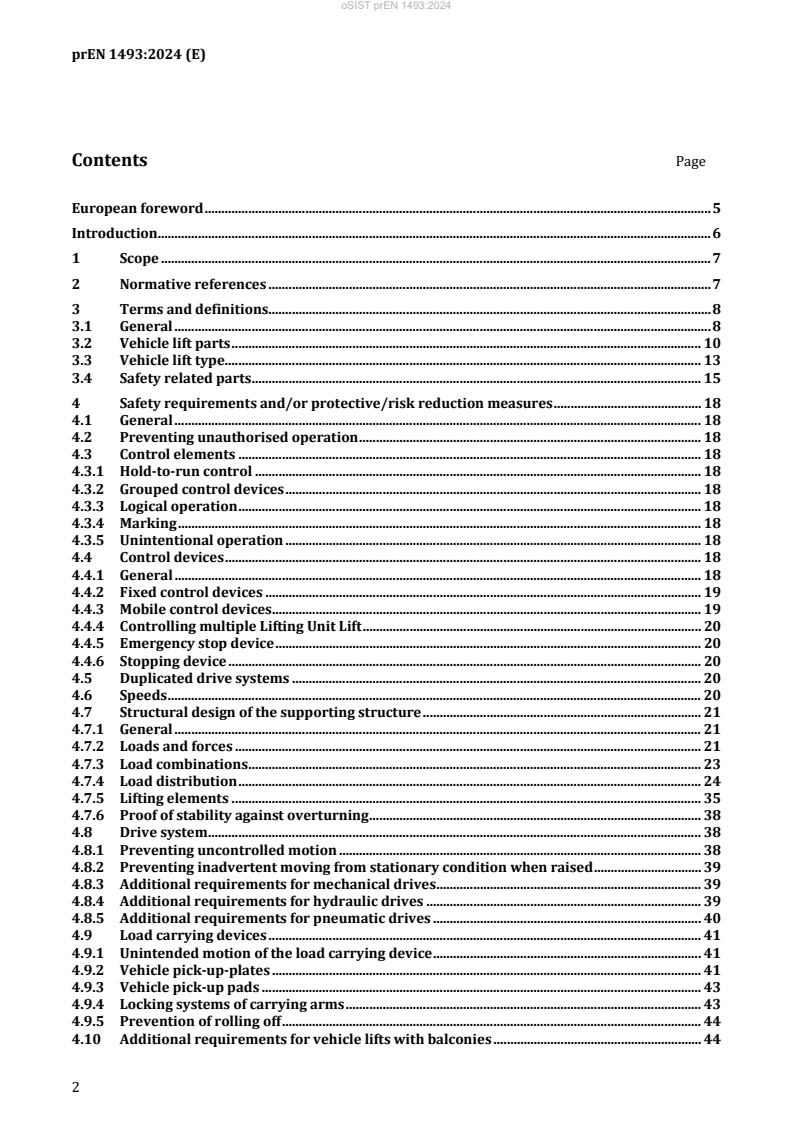
Contents Page
European foreword . 5
Introduction. 6
1 Scope . 7
2 Normative references . 7
3 Terms and definitions. 8
3.1 General . 8
3.2 Vehicle lift parts . 10
3.3 Vehicle lift type . 13
3.4 Safety related parts . 15
4 Safety requirements and/or protective/risk reduction measures . 18
4.1 General . 18
4.2 Preventing unauthorised operation . 18
4.3 Control elements . 18
4.3.1 Hold-to-run control . 18
4.3.2 Grouped control devices . 18
4.3.3 Logical operation . 18
4.3.4 Marking . 18
4.3.5 Unintentional operation . 18
4.4 Control devices . 18
4.4.1 General . 18
4.4.2 Fixed control devices . 19
4.4.3 Mobile control devices . 19
4.4.4 Controlling multiple Lifting Unit Lift . 20
4.4.5 Emergency stop device . 20
4.4.6 Stopping device . 20
4.5 Duplicated drive systems . 20
4.6 Speeds . 20
4.7 Structural design of the supporting structure . 21
4.7.1 General . 21
4.7.2 Loads and forces . 21
4.7.3 Load combinations . 23
4.7.4 Load distribution . 24
4.7.5 Lifting elements . 35
4.7.6 Proof of stability against overturning . 38
4.8 Drive system . 38
4.8.1 Preventing uncontrolled motion . 38
4.8.2 Preventing inadvertent moving from stationary condition when raised . 39
4.8.3 Additional requirements for mechanical drives . 39
4.8.4 Additional requirements for hydraulic drives . 39
4.8.5 Additional requirements for pneumatic drives . 40
4.9 Load carrying devices . 41
4.9.1 Unintended motion of the load carrying device . 41
4.9.2 Vehicle pick-up-plates . 41
4.9.3 Vehicle pick-up pads . 43
4.9.4 Locking systems of carrying arms . 43
4.9.5 Prevention of rolling off . 44
4.10 Additional requirements for vehicle lifts with balconies . 44
4.11 Limiting the travel of the load carrying device . 45
4.12 Unintended blocking of the load carrying device . 45
4.13 Safety against rupture of mechanical lifting elements . 46
4.14 Safety against leakage . 46
4.14.1 Limiting the lowering speed . 46
4.14.2 Protection against leakage . 46
4.15 Additional requirements for vehicle lifts with more than one lifting units . 46
4.16 Additional requirements for mobile vehicle lifts . 47
4.16.1 Safety against unintended motion . 47
4.16.2 Service brakes for vehicle lifts using powered mobility . 47
4.16.3 Devices for moving manually mobile vehicle lifts . 47
4.16.4 Derailment protection . 47
4.16.5 Forces . 47
4.16.6 Visibility . 47
4.17 Protection against pinching and shearing . 48
4.17.1 General . 48
4.17.2 Safety distances . 48
4.17.3 Other safety measures . 48
4.18 Safety devices . 49
4.18.1 General . 49
4.18.2 Arrangement . 49
4.18.3 Function of mechanical safety devices . 49
4.18.4 Safety switches . 49
4.18.5 Springs in safety devices . 50
4.19 Protection against damage . 50
4.19.1 Wearing parts . 50
4.19.2 Lead screws . 50
4.19.3 Installation of hoses, pipes and electrical equipment . 50
4.20 Manually driven vehicle lifts . 50
4.21 Electrical equipment . 50
4.21.1 General . 50
4.21.2 IP-code . 50
4.21.3 Means of disconnecting the power supply . 51
4.22 Special requirements for vehicle lifts where it is permitted to stand under the load
during lifting and lowering movement . 51
4.22.1 Control devices . 51
4.22.2 Control positions . 51
4.22.3 Lifting and lowering speed . 51
4.22.4 Safety against rupture or leakage of load bearing devices . 51
4.22.5 Operation instructions . 51
4.23 Additional requirements for vehicle lifts for motorcycles . 51
5 Verification of the safety requirements and/or measures. 52
5.1 General . 52
5.2 Design check . 55
5.3 Manufacturing check . 56
5.4 Visual verification . 56
5.5 Practical tests . 56
5.5.1 General . 56
5.5.2 Overload dynamic test . 56
5.5.3 Overload static test . 56
5.5.4 Functional tests . 57
5.5.5 Electrical tests . 57
6 Information for use . 57
6.1 General . 57
6.2 Marking . 57
6.3 Operation instructions . 58
6.3.1 Complete instructions . 58
6.3.2 Digest of the instructions for use . 60
6.4 Name plate . 60
Annex A (informative) List of significant hazards . 61
Annex B (informative) Structural calculations . 63
Annex C (informative) Examples of solutions . 67
Annex D (informative) Example of information about wind . 100
Annex E (normative) Test procedure for unintended blocking of the load carrying device
(4.12). 101
Annex F (normative) Deflection test of a chassis supporting vehicle lift with carrying arms . 102
Annex G (normative) Test method for platform end stop . 104
Annex H (normative) Arm locking device proof test procedure . 109
Annex I (normative) Test method for end stop of telescopic arms . 110
Annex ZA (informative) Relationship between this European Standard and the essential
requirements of Directive 2006/42/EC aimed to be covered . 112
Bibliography . 116
European foreword
This document (prEN 1493:2024) has been prepared by Technical Committee CEN/TC 98 “Lifting
platforms”, the secretariat of which, is held by DIN.
This document is currently submitted to the CEN Enquiry.
This document will supersede EN 1493:2023.
This document has been prepared under a Standardization Request given to CEN by the European
Commission and the European Free Trade Association, and supports essential requirements of EU
Directive(s) / Regulation(s).
For relationship with EU Directive(s) / Regulation(s), see informative Annex ZA, which is an integral part
of this document.
Compared to EN 1493:2010, the following changes have been made:
• The Terms and Definitions chapter (and consequently the entire text of the standard) has been
completely revised
• The presence of people on the raised vehicle is admitted but only in special cases
• References for motorcycles and light quadricycles were added
• Resolved the inconsistency on the interpretation of the normative vehicle in the case of chassis
supporting lifts with arms
• Control devices: completely revised, dividing the controls into two categories: Fixed controls and
mobile controls
• For multiple element lifts (e.g. mobile columns) the “rated load”, intended as the maximum weight
of the vehicle to be lifted, is replaced by the “lifting capacity” referred to the single column
• In the case of special vehicles lifts, two distinct rated loads can be provided: One for normal vehicles
(and therefore based on the Normative Vehicle) and the other specific for the special vehicles for
which the vehicle lift is intended
• Rope calculation: completely revised, with reference to ISO16625: 2013 and ISO 4301-1: 2016
standards
• Vehicle stop devices in wheel support lifts: revised calculation and verification method
• Arm locking devices: revised calculation and verification method. Added prescriptions for anti-slip
safety and play limitation between the various elements of the arms
• Important interventions on the instruction manual requirements
Introduction
This document is a type-C standard as stated in EN ISO 12100.
This document is of relevance, in particular, for the following stakeholder groups representing the market
players with regard to machinery safety:
— machine manufacturers (small, medium and large enterprises);
— health and safety bodies (regulators, accident prevention organizations, market surveillance etc.).
Others can be affected by the level of machinery safety achieved with the means of the document by the
above-mentioned stakeholder groups:
— machine users/employers (small, medium and large enterprises);
— machine users/employees (e.g. trade unions, organizations for people with special needs);
— service providers, e.g. for maintenance (small, medium and large enterprises);
— consumers (in case of machinery intended for use by consumers).
The above-mentioned stakeholder groups have been given the possibility to participate at the drafting
process of this document.
The machinery concerned and the extent to which hazards, hazardous situations or hazardous events are
covered are indicated in the Scope of this document.
When requirements of this type-C standard are different from those which are stated in type-A or type-B
standards, the requirements of this type-C standard take precedence over the requirements of the other
standards for machines that have been designed and built according to the requirements of this type-C
standard.
The object of this document is to define rules for safeguarding persons against the risk of accidents
associated with the operation of vehicle lifts.
While devising this document it was assumed that only authorized persons operate or use the vehicle lifts
and that the working area is sufficiently lit.
This standard assumes that an operator will lower a raised vehicle to the ground level or as low as
possible when he/she is not working on it.
The requirement concerning loading control is not deemed pertinent to this standard in so far as:
— experience and the state of the art suggests that failing to observe this requirement has not
historically given rise to unsafe situations;
— such devices which would give protection against overall and local overloading are not currently
available in forms which cover all eventualities;
— the weight and weight distribution is freely available for the type of vehicles to be lifted and as such
it is the responsibility of the user to prevent an unsafe situation arising;
— vehicle lifts are generally designed to suit the maximum weight of vehicle to which it would
reasonably be subjected, hence the normal duty of a vehicle lift is substantially lower than the
maximum.
1 Scope
This document is applicable to vehicle lifts designed to raise vehicles for the purpose of examining and
working on or under the vehicles whilst in a raised position.
Vehicle lifts are not intended to lift persons, but in case of particular use like lift for vehicles periodical
technical inspection or lifts for railbound vehicles, it is allowed for a person to enter a lifted vehicle,
provided that adequate safety measures are defined by the manufacturer and highlighted in the
instruction manual.
The vehicle lift may consist of one or more lifting units, stationary or mobile.
The floor or ground supporting the vehicle lift in use is assumed to be horizontal (tolerance should be
indicated).
This document does not apply to:
o Vehicle lifts designed to lift the vehicle partially
o Vehicle lifts movable when loaded
o Vehicle lifts where the load carrying device can be tilted
o Vehicle lifts where power supply is given by internal combustion engines
o Equipment for power driven parking of motor vehicles (see EN1410:2003 +A1:2009)
Noise is not considered in this document because in practice it does not play a role in vehicle lifts.
This document is applicable to vehicle lifts which are manufactured six months after the date of its
publication as a European Standard.
2 Normative references
The following documents are referred to in the text in such a way that some or all of their content
constitutes requirements of this document. For dated references, only the edition cited applies. For
undated references, the latest edition of the referenced document (including any amendments) applies.
EN 13557:2003+A2:2008, Cranes - Controls and control stations
EN 60204-1:2018, Safety of machinery - Electrical equipment of machines - Part 1: General requirements
(IEC 60204-1:2016, modified)
1),
Degrees of protection provided by enclosures (IP Code) (IEC 60529:1989 + A1:1999 +
EN 60529:1991,
A2:2013)
EN 60947-5-1:2017, Low-voltage switchgear and controlgear - Part 5-1: Control circuit devices and
switching elements - Electromechanical control circuit devices (IEC 60947-5-1:2016 + COR1:2016)
EN ISO 3691-5:2015+AC:2016+A1:2020, Industrial trucks - Safety requirements and verification - Part 5:
Pedestrian-propelled trucks (ISO 3691-5:2014)
EN ISO 4413:2010, Hydraulic fluid power - General rules and safety requirements for systems and their
components (ISO 4413:2010)
1)
This document is impacted by A1:2000 and A2:2013.
EN ISO 4414:2010, Pneumatic fluid power - General rules and safety requirements for systems and their
components (ISO 4414:2010)
EN ISO 12100:2010, Safety of machinery - General principles for design - Risk assessment and risk reduction
(ISO 12100:2010)
EN ISO 13849-1:2015, Safety of machinery - Safety-related parts of control systems - Part 1: General
principles for design (ISO 13849-1:2015)
EN ISO 13849-2:2012, Safety of machinery - Safety-related parts of control systems - Part 2: Validation (ISO
13849-2:2012)
EN ISO 13850:2015, Safety of machinery - Emergency stop function - Principles for design (ISO 13850:2015)
ISO 4301-1:2016, Cranes — Classification — Part 1: General
ISO 16625:2013, Cranes and hoists — Selection of wire ropes, drums and sheaves
3 Terms and definitions
For the purposes of this document, the terms and definitions given in EN ISO 12100:2010 and the
following apply.
ISO and IEC maintain terminological databases for use in standardization at the following addresses:
— IEC Electropedia: available at http://www.electropedia.org/
— ISO Online browsing platform: available at http://www.iso.org/obp
3.1 General
3.1.1
vehicle lift
lifting device with guided load carrying device for lifting land based means of transportation and which
is designed to allow working on or under the raised vehicle
Note 1 to entry: Land based means of transportation are cars, motorcycles, lorries, buses, trams, rail vehicles,
industrial trucks and similar,
Note 2 to entry: The following types of vehicle lift are examples of those covered by this definition: single and multi-
column lifts (e.g. two or four column lifts), single and multi-cylinder lifts, mobile column lifts, scissor and
parallelogram lifts, double scissor lifts, in-ground piston lifts, in-ground scissor lifts, short stroke lifts, which support
vehicle wheels, chassis or other designated lifting points (see Annex C).
3.1.2
normative vehicle
theoretical vehicle representative of the normal vehicles on which a vehicle lift is intended to operate,
used as reference vehicle for structural calculations of the vehicle lift itself (see 4.7.4.2, 4.7.4.3 and
Table 3)
3.1.3
normal vehicle
land based mean of transport such as cars, motorcycles, lorries, buses, trams, trucks and similar
commonly on the road
3.1.4
special vehicle
vehicle that does not fall within the normal vehicle types and for which the Normative Vehicle is no longer
representative (i.e.: fork-lifts, dumpers, snowcats, rail bound vehicles, mobile cranes, .)
3.1.5
wheel track (WT)
distance between the centre lines of the wheels on one axle or between centre lines of wheel pairs on
twin wheel axles
3.1.6
wheelbase
distance between the centres of wheels of front and rear axle or from the centre of the wheels on the front
axle to a point mid-way between axle pairs on twin axle vehicles
3.1.7
rated load
maximum load that a vehicle lift has been designed to carry referring to the normative vehicle or to
special vehicles
3.1.8
lifting capacity
maximum load that a single independent lifting unit has been designed to carry when part of a multiple
lifting unit lift
3.1.9
lifting height
distance between the floor where the user is standing and the vehicle’s pickup points
3.1.10
hazardous area
area under the load carrying device and under the lifted vehicle
Note 1 to entry: The hazardous area is part of the hazard zone according to EN ISO 12100:2010, 3.11.
3.1.11
operator
trained person authorised to use the vehicle lift by the workshop safety manager
3.1.12
bystander
person other than the operator near the vehicle lift
3.1.13
initial position
lower limit position of the carrying device
3.1.14
unauthorised use
use by a person who has not received permission to operate the vehicle lift and instruction on its safe
operation
3.1.15
periodical test investigation (PTI)
periodic roadworthiness tests for motor vehicles and their trailers in accordance with current legislation
3.2 Vehicle lift parts
3.2.1
drive system
components and systems for lifting and lowering movements, including power source, controls and lifting
elements
Note 1 to entry: Examples are
— in electrohydraulic vehicle lifts: Electrohydraulic unit, cylinders, ropes, electric controls;
— in electromechanical vehicle lifts: Electric motor + transmission (pulley, gear box, .), lifting screws,
electric controls.
3.2.2
lifting unit
lifting device in general made up of a load carrying device, a supporting structure and its drive system
Note 1 to entry: A lifting unit may share parts of its drive system with other lifting units.
Note 2 to entry: Examples of lifting units are one column of a two column lift (see Figure C.2), one unit of a double-
scissor lift (see Figure C.3).
3.2.3
independent lifting unit
lifting unit not sharing any part of or all of the drive system with other lifting units
Note 1 to entry: Example of an independent lifting unit is a single column of a mobile column lift.
3.2.4
supporting structure
part(s) of the vehicle lift which offer guidance to the load carrying device, but which do not move when
the load is raised/lowered
EXAMPLE: The posts on a two/four post lift.
3.2.5
load carrying device
part(s) of the vehicle lift which support the load either by direct contact with the vehicle or through
contact with pick-up plates and/or pads
Note 1 to entry: The load carrying device is the part of the structure of the vehicle lift which is moving when the
load is raised/lowered.
EXAMPLE: Platforms, carrying arms or other mechanical devices designed to raise and support a vehicle by
designated lifting points.
3.2.6
lifting element
medium through which the force is transmitted from the power source to the load carrying device
Note 1 to entry: Lifting elements include hydraulic and pneumatic cylinders, lead screw and nut systems as well as
any flexible connections such as steel wire ropes and chains but excluding the ropes/chains having the sole scope
of synchronising different lifting units.
3.2.7
mechanical lifting element
lifting element constructed from engineering materials and which may be reasonably subjected to wear
Note 1 to entry: Mechanical lifting elements are e.g. ropes, chains, carrying nuts and gears. Hydraulic and
pneumatic cylinders do not fall under this definition.
3.2.8
carrying arm
load carrying device attached at one end, directly or indirectly to the lifting element and supporting the
load at its other end
Note 1 to entry: Carrying arms are as an example used on two column lifts.
3.2.9
platform
horizontal surface or structure, part of the load carrying device, designed to drive on it with the vehicle
when entering/leaving the vehicle lift
Note 1 to entry: E.g. tracks in scissor lifts
3.2.10
pick-up plate
part of the load carrying device, e.g. on two column lifts with carrying arms, which has direct contact to
the vehicle and which has an assigned position on the load carrying device
Note 1 to entry: See Figure 1.
3.2.11
pick-up pad
vehicle supporting pad which has direct contact with the vehicle but which does not have an assigned
position, e.g. pads used on wheel free systems with platforms
Note 1 to entry: See Figure 2.
Key
1 pick-up plate
2 load carrying device
3 pin
Figure 1 — Pick-up plate
Key
1 pick-up pad
2 platform
Figure 2 — Pick-up pad
3.2.12
roll off safety device
device that prevents the vehicle from rolling off the platforms of wheel support vehicle lifts in the event
of involuntary movement of the vehicle
Note 1 to entry: The roll off safety device is not the single wheel stop but is the whole system that prevents the
vehicle from falling off (i.e. both wheel stops when you have two, the single wheel stop when you have one …).
3.2.13
wheel stop
part of roll off safety device at the end of a platform on vehicle lifts which opposes the movement of the
wheel of the vehicle
3.2.14
end stop
mechanical stop that limits the movement of elements within maximum admissible values, ensuring the
maintenance of the intended function of the system
3.2.15
control element
device through which the operator commands at least one of the working functions of the vehicle lift
Note 1 to entry: Examples of control elements are push buttons, joysticks, pedals
3.2.16
fixed control device
control device fixed to the structure of the vehicle lift or in any case set in a predefined fixed position
when the vehicle lift is installed (e.g. fixed control console, controls installed on the walls of the workshop
where the vehicle lift is installed)
3.2.17
mobile control device
control device not fixed to the vehicle lift structure or somewhere else
3.2.18
remote control device
handheld control device connected to the vehicle lift's electrical system via cable or wireless that allows
the vehicle lift to be operated remotely from the main control
3.2.19
consensus control element
additional control element having the sole function of confirming the command implemented by the main
control
3.2.20
wheel free system
lifting unit which is used in conjunction with a pit or vehicle lift with platform lifting the whole vehicle
and allows the wheels to be removed
3.3 Vehicle lift type
3.3.1
multiple lifting unit lift
combination of independent units lifts or two or more vehicle lifts matched to each other
Note 1 to entry: A mobile column lift or two or more lifts installed each one after in tandem with the other and
synchronized with each other are examples of multiple lifting unit lift.
3.3.2
short stroke lift
floor mounted vehicle lift with a maximum vertical travel of not more than 500 mm, which is not designed
for working under the raised load
Note 1 to entry: These vehicle lifts are different to wheel free systems according to 3.2.20.
3.3.3
long lifting system
lifting system consisting of several lifting units distributed over a distance of more than 15 m
3.3.4
scissor lift
vehicle lift where the vehicle is supported on its wheels or chassis by one or two platforms, supported on
a single foldable supporting structure
3.3.5
double scissor lift
vehicle lift where the vehicle is supported on its frame by two separate platforms, which are moving
vertically, each supported on two foldable supporting structures
3.3.6
single column lift
vehicle lift with a vertical supporting structure where a single lifting element is supporting a whole
vehicle on its frame or on its wheels
3.3.7
two column lift
vehicle lift with a fixed vertical supporting structure where two lifting elements are supporting the
vehicle on its frame or on its wheels
3.3.8
four column lift
vehicle lift where the vehicle is supported on its wheels by platforms rising and lowering along four
vertical fixed columns
3.3.9
in-ground piston lift
vehicle lift where the vehicle is supported on its frame, axles or wheels by a single/multiple hydraulic
lifting unit(s), partially or totally fitted below ground level
3.3.10
in-ground scissor lift
vehicle lift where the vehicle is supported on its frame, axles or wheels by a foldable structure, partially
or totally fitted below ground level
3.3.11
mobile column lift
combination of independent lifting units, each with a vertical supporting structure supporting part of a
vehicle on its frame or on a wheel, acting as one vehicle lift
Note 1 to entry: A mobile column lift is a special case of multiple lifting unit lift.
Note 2 to entry: A single independent lifting unit part of a mobile columns lift is not designed to raise a vehicle but
shall be combined with other units to achieve that.
3.3.12
platform lift
vehicle lift where the vehicle is supported on its wheels or chassis by one or two separate platforms
3.3.13
rolling jack
auxiliary lifting device used typically to raise just one end of the vehicle
Note 1 to entry: A rolling jack cannot be used as a stand-alone device but shall always be used in conjunction with
another vehicle lift, typically a platform lift or a 4 post lift.
Note 2 to entry: Synonyms for rolling jack are e.g. pit jack, jacking beam.
3.3.14
mobile vehicle lift
movable vehicle lift equipped with wheels, rollers, etc. such that it can be moved from one place to
another without load and can fulfil its function without being fixed to the floor
3.3.15
manually driven vehicle lift
vehicle lift where the load carrying device is driven by human effort
3.3.16
power-driven vehicle lift
vehicle lift where the load carrying device is driven by effort other than human
3.3.17
mechanically driven vehicle lift
power-driven lift not using hydraulic nor pneumatic fluid power
3.4 Safety related parts
3.4.1
catching device
mechanical safety device which holds the load carrying device in case of failure of a lifting element
Note 1 to entry: See Figure 3.
Figure 3 — Catching device
3.4.2
latch
device normally used to prevent unexpected movements in vehicle lifts operated by hydraulic/pneumatic
cylinders
Note 1 to entry: A latch can e.g. consist of a ratchet and pawl device.
Note 2 to entry: See Figures 4 and 5.
Figure 4 — latch consisting of hooks
Figure 5 — latch consisting of pawl
3.4.3
pipe rupture valve
valve that limits the unintentional lowering speed of the lift in case of breakage of a hydraulic pipe
3.4.4
total hydraulic redundancy
characteristic of the hydraulic system of a vehicle lift with two or more hydraulic lifting elements for
which any hydraulic leaks do not compromise the safety of the vehicle lift
3.4.5
holding device
device, which holds the load carrying device automatically in a stationary raised position
3.4.6
re-raising prevention device
device which prevents re-raising of load carrying device from the initial position in the event of failure of
the lifting element
3.4.7
automatic brake
braking device which is normally held on and which is released only by application of power
Note 1 to entry: Operation of the braking device is also instigated automatically by releasing the vehicle lift controls
and by interruption of the power supply.
3.4.8
self braking system
system which, due to its inherent resistance to movement, stops the movement of the load carrying device
when the drive power is interrupted
3.4.9
safety switch
switch which performs a safety function
Note 1 to entry: Safety function is as defined in EN ISO 12100:2010, 3.30.
4 Safety requirements and/or protective/risk reduction measures
4.1 General
Machinery shall comply with the safety requirements and/or protective/risk reduction measures of this
clause.
In addition, the machine shall be designed according to the principles of EN ISO 12100:2010 for relevant
but not significant hazards which are not dealt with by this d
...
Questions, Comments and Discussion
Ask us and Technical Secretary will try to provide an answer. You can facilitate discussion about the standard in here.
Loading comments...