

EN 18218-1:2026
(Main)Food authenticity - Non-targeted testing methods - Part 1: General considerations and definitions
- Abstract
This document provides a common language covering NTTM in food and feed authentication. It provides:
— definitions of terms involved in the development and validation of NTTM;
— a general structure and guidelines for development of NTTM;
— general considerations for the validation of NTTM.
NOTE “Food and feed” is implied whenever the term “food” is used in this document.
- Status
- Published
- Publication Date
- 15-Sep-2026
- Technical Committee
- CEN/TC 460 - Food Authenticity
- Drafting Committee
- CEN/TC 460/WG 5 - Validation concepts of non-targeted methods
- Current Stage
- 6060 - Definitive text made available (DAV) - Publishing
- Start Date
- 16-Sep-2026
- Due Date
- 15-Mar-2027
- Completion Date
- 16-Sep-2026

EN 18218-1:2026 is a CEN European Standard for food authenticity - non-targeted testing methods. It sets out general considerations and definitions for non-targeted testing methods (NTTM) used in food and feed authentication, including how they are developed, validated and kept under control in routine use. The document is aimed at laboratories and other users who need a common technical language for checking whether a product claim matches measured product characteristics.
What does EN 18218-1:2026 specify?
EN 18218-1:2026 specifies a shared framework for NTTM in food and feed authentication. It defines the terms used in method development and validation, gives a general structure for developing a method, and sets out general considerations for validation.
The document is organized into these main clauses:
- Clause 1 - Scope
- Clause 2 - Normative references
- Clause 3 - Terms and definitions
- Clause 4 - General considerations on NTTM
- Clause 5 - Development of a NTTM
- Clause 6 - Validation of a non-targeted testing method
- Clause 7 - Routine use, quality control and long-term maintenance
The scope note states that whenever the document says "food", it also means food and feed.
What are the key requirements of EN 18218-1:2026?
EN 18218-1:2026 focuses on how to define, build, validate and maintain an NTTM so that it can be used to judge whether a claimed characteristic matches the product being tested. In practice, this means the standard is about the full workflow, from planning the method to monitoring it in routine use.
Define the scope and performance target first
Clause 5.1 says the scope and purpose of the NTTM shall be stated at the start of development, together with the target performance characteristics and performance criteria. That scope should cover the food product, the characteristic or claim to be verified, the analytical measurement technique, the classification approach, the desired probability of correct identification or detection, and, where possible, the product tampering type and minimum adulterant level.
This matters because an NTTM is only fit for the exact claim and product range it was designed for. If development shows the original performance target is unrealistic, the criteria shall be reviewed and the method then validated against the revised criteria.
Build representative reference and calibration samples
Clause 5.2 requires a reference sample set that reflects the authentic population, likely adulterants and the defined tampering types as far as possible. Each sample needs documented and traceable meta-data, and the source should be trustworthy, preferably at the production source.
The calibration sample set is the part of the reference sample set used to develop the model, while the validation sample set is kept separate for validation. In practice, this separation is what allows the method developer to test whether the model still works on new samples rather than only on samples already used to train it.
Use suitable measurement methods and control their stability
Clause 5.3 allows any measurement method, or combination of methods, if it produces analytical features suitable for the NTTM. The measurement method shall first be checked for intermediate precision, robustness and suitability before it is used further.
The same clause says an internal quality control (IQC) mechanism shall be available or developed to support long-term stability. A ruggedness test can be useful to identify critical steps in the measurement procedure. For a reader, this means the wet-lab part of the method needs to be stable enough that the data model is not built on uncontrolled variation.
Prepare data and model the classes
Clause 5.4 describes data analytics as data preparation, data pre-processing and, where needed, feature selection followed by statistical modelling. The standard allows one-class classification models and two-class classification models, and notes that cross-validation is commonly used for optimization.
The practical point is that NTTM does not stop at measurement. The analytical features have to be turned into a model that links data to product characteristics, and the model choice has to match the authentication task.
Judge performance with sensitivity, specificity and decision scores
Clause 5.5 says method performance is usually assessed by sensitivity and specificity. The standard prefers a continuous decision score, because it supports a more informative threshold choice than a simple yes/no result.
The clause also points to density plots, receiver operating characteristic (ROC) plots and confusion matrices as ways to understand model behavior. In practice, this helps users see how often authentic samples are accepted and non-authentic samples are rejected, and where the decision threshold should be set.
Validate with a written plan and an appropriate study design
Clause 6 says validation shall demonstrate that the NTTM is fit for its intended purpose. The validation plan shall state the scope, performance characteristics, criteria, validation sample set, experimental design, measurement procedure, data analytics and how fitness for purpose will be judged.
The main validation characteristics are sensitivity and specificity. The standard also recommends reporting a confusion matrix, and it treats repeatability and reproducibility of decision scores as important validation characteristics for long-term monitoring. Single-lab validation (SLV) and multi-lab validation (MLV) are both covered, and factorial study designs may be used.
Control routine use and long-term maintenance
Clause 7 requires a quality-assured laboratory setup when an NTTM is introduced into routine use. If the method is transferred to another laboratory, the receiving laboratory shall verify that its implementation meets the performance characteristics of the validated method.
Internal quality control uses quality control materials (QCM) alongside test samples, and the QCM classification result shall be correct before the analytical series is accepted. The standard also requires a conformance probability for each test sample, and it addresses method updates, reference data set updates and revalidation when changes affect performance.
What terms does EN 18218-1:2026 define?
EN 18218-1:2026 defines the vocabulary used to design, validate and operate an NTTM.
- Non-targeted testing method (NTTM) - a set of procedures that uses a measurement procedure and data analytics, including a reference data set, to assess whether a claimed characteristic is authentic.
- Reference sample set - the collection of reference samples used to establish an NTTM for development and validation.
- Calibration sample set - the part of the reference sample set used to create and optimize the method.
- Validation sample set - the part of the reference sample set reserved for validation during method validation.
- Decision score - the continuous output of the statistical model used to support classification.
- Conformance probability - the probability that a test item has the specified characteristic, reported as a percentage.
- Quality control materials (QCM) - materials analyzed alongside test samples for internal quality control.
- Single-lab validation (SLV) and multi-lab validation (MLV) - validation carried out in one laboratory or across several laboratories.
Who uses EN 18218-1:2026?
EN 18218-1:2026 is used by laboratories developing or running food authenticity methods, especially those using data-rich analytical techniques. It is relevant to control laboratories, validation teams, quality managers, method developers and receiving laboratories that need to verify transferred methods.
It also speaks to government agencies, policy makers, producers and industry stakeholders involved in food and feed authenticity, fraud detection and quality control. In practice, they use it to define claims, build reference sample sets, validate models, monitor routine performance and document whether a product matches its declared characteristics.
Which standards are used with EN 18218-1:2026?
| Standard | Contribution |
|---|---|
| EN 17972:2024 | Provides the core food authenticity and fraud concepts, terms and definitions used by EN 18218-1:2026. |
| EN ISO/IEC 17025:2017 | Is cited for the extent of validation needed for a given application or field of application. |
| JCGM 106:2012 | Is cited for the rules used to evaluate conformance probability. |
| ISO 3534-2:2006 | Supplies statistical vocabulary used for precision terms such as repeatability and reproducibility. |
| ISO/IEC Guide 99:2007 | Supplies metrology vocabulary for concepts such as measurement, measurement method and measurement procedure. |
| ISO 18115-1:2023 | Is cited for terminology related to data pre-processing. |
What does the EN 18218-1:2026 document contain?
EN 18218-1:2026 contains a schematic workflow for an NTTM, followed by clauses that break the workflow into development, validation and routine use. It explains sample-set planning, measurement method control, data preparation, model building and validation study design.
The document also includes a defined vocabulary section and a list of abbreviations such as FN, FP, IQC, MLV, QCM, SLV, TN, TP and TPR. Its figures illustrate the workflow, a density plot, an ROC plot and a confusion matrix, all of which support decision-making for classification and validation.
Get Certified
Connect with accredited certification bodies for this standard

BSI Group
BSI (British Standards Institution) is the business standards company that helps organizations make excellence a habit.

Bureau Veritas
Bureau Veritas is a world leader in laboratory testing, inspection and certification services.

DNV
DNV is an independent assurance and risk management provider.
Sponsored listings
Frequently Asked Questions
EN 18218-1:2026 is a standard published by the European Committee for Standardization (CEN). Its full title is "Food authenticity - Non-targeted testing methods - Part 1: General considerations and definitions". This standard covers: This document provides a common language covering NTTM in food and feed authentication. It provides: — definitions of terms involved in the development and validation of NTTM; — a general structure and guidelines for development of NTTM; — general considerations for the validation of NTTM. NOTE “Food and feed” is implied whenever the term “food” is used in this document.
This document provides a common language covering NTTM in food and feed authentication. It provides: — definitions of terms involved in the development and validation of NTTM; — a general structure and guidelines for development of NTTM; — general considerations for the validation of NTTM. NOTE “Food and feed” is implied whenever the term “food” is used in this document.
EN 18218-1:2026 is classified under the following ICS (International Classification for Standards) categories: 01.040.67 - Food technology (Vocabularies); 67.020 - Processes in the food industry. The ICS classification helps identify the subject area and facilitates finding related standards.
EN 18218-1:2026 is available in PDF format for immediate download after purchase. The document can be added to your cart and obtained through the secure checkout process. Digital delivery ensures instant access to the complete standard document.
Standards Content (Sample)
SLOVENSKI STANDARD
01-november-2026
Pristnost živil - Netargetirane metode preskušanja - 1. del: Splošne ugotovitve in
definicije
Food authenticity - Non-targeted testing methods - Part 1: General considerations and
definitions
Lebensmittelauthentizität - Nicht-zielgerichtete Prüfverfahren - Teil 1: Allgemeines und
Begriffe
Authenticité des aliments - Méthodes d’essai non ciblées - Partie 1 : Généralités et
définitions
Ta slovenski standard je istoveten z: EN 18218-1:2026
ICS:
01.040.67 Živilska tehnologija (Slovarji) Food technology
(Vocabularies)
67.020 Procesi v živilski industriji Processes in the food
industry
2003-01.Slovenski inštitut za standardizacijo. Razmnoževanje celote ali delov tega standarda ni dovoljeno.
EN 18218-1
EUROPEAN STANDARD
NORME EUROPÉENNE
September 2026
EUROPÄISCHE NORM
ICS 01.040.67; 67.020
English Version
Food authenticity - Non-targeted testing methods - Part 1:
General considerations and definitions
Authenticité des aliments - Méthodes d'essai non Lebensmittelauthentizität - Nicht-zielgerichtete
ciblées - Partie 1 : Généralités et définitions Prüfverfahren - Teil 1: Allgemeines und Begriffe
This European Standard was approved by CEN on 17 August 2026.
CEN members are bound to comply with the CEN/CENELEC Internal Regulations which stipulate the conditions for giving this
European Standard the status of a national standard without any alteration. Up-to-date lists and bibliographical references
concerning such national standards may be obtained on application to the CEN-CENELEC Management Centre or to any CEN
member.
This European Standard exists in three official versions (English, French, German). A version in any other language made by
translation under the responsibility of a CEN member into its own language and notified to the CEN-CENELEC Management
Centre has the same status as the official versions.
CEN members are the national standards bodies of Austria, Belgium, Bulgaria, Croatia, Cyprus, Czech Republic, Denmark, Estonia,
Finland, France, Germany, Greece, Hungary, Iceland, Ireland, Italy, Latvia, Lithuania, Luxembourg, Malta, Netherlands, Norway,
Poland, Portugal, Republic of North Macedonia, Romania, Serbia, Slovakia, Slovenia, Spain, Sweden, Switzerland, Türkiye and
United Kingdom.
EUROPEAN COMMITTEE FOR STANDARDIZATION
COMITÉ EUROPÉEN DE NORMALISATION
EUROPÄISCHES KOMITEE FÜR NORMUNG
CEN-CENELEC Management Centre: Rue de la Science 23, B-1040 Brussels
© 2026 CEN All rights of exploitation in any form and by any means reserved Ref. No. EN 18218-1:2026 E
worldwide for CEN national Members.
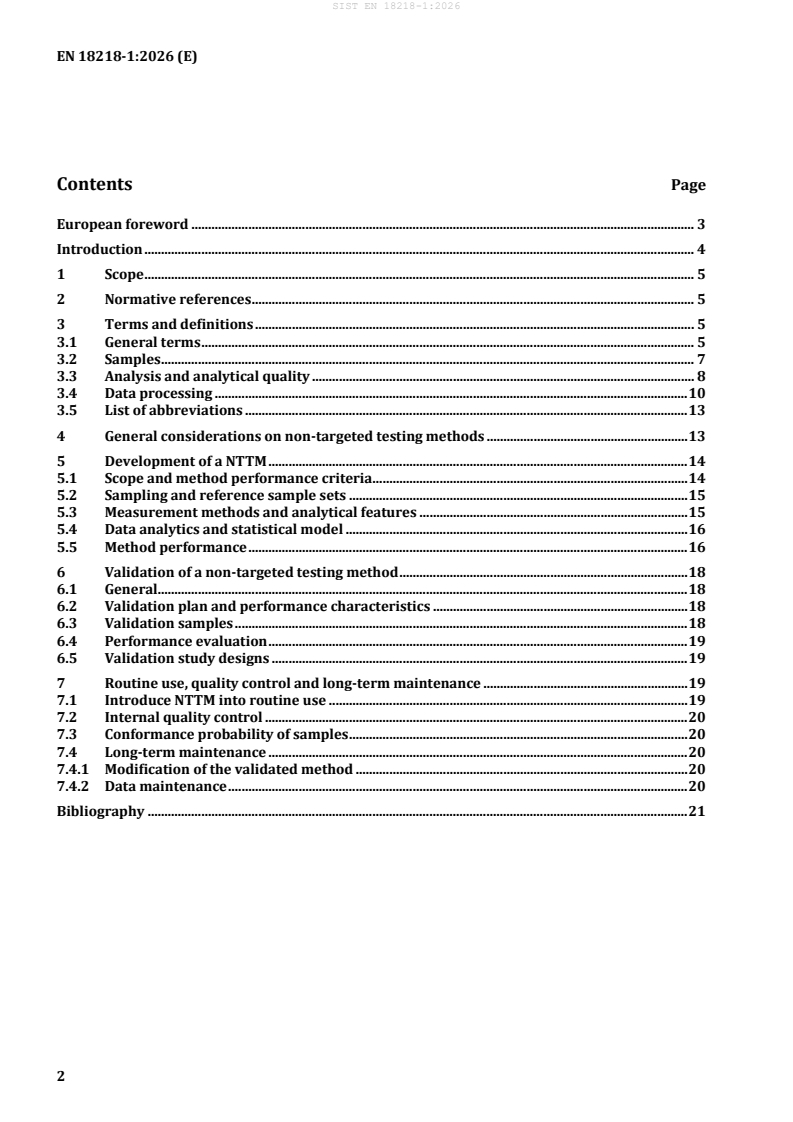
Contents Page
European foreword . 3
Introduction . 4
1 Scope . 5
2 Normative references . 5
3 Terms and definitions . 5
3.1 General terms . 5
3.2 Samples . 7
3.3 Analysis and analytical quality . 8
3.4 Data processing . 10
3.5 List of abbreviations . 13
4 General considerations on non-targeted testing methods . 13
5 Development of a NTTM . 14
5.1 Scope and method performance criteria . 14
5.2 Sampling and reference sample sets . 15
5.3 Measurement methods and analytical features . 15
5.4 Data analytics and statistical model . 16
5.5 Method performance . 16
6 Validation of a non-targeted testing method . 18
6.1 General. 18
6.2 Validation plan and performance characteristics . 18
6.3 Validation samples . 18
6.4 Performance evaluation . 19
6.5 Validation study designs . 19
7 Routine use, quality control and long-term maintenance . 19
7.1 Introduce NTTM into routine use . 19
7.2 Internal quality control . 20
7.3 Conformance probability of samples . 20
7.4 Long-term maintenance . 20
7.4.1 Modification of the validated method . 20
7.4.2 Data maintenance . 20
Bibliography . 21
European foreword
This document (EN 18218-1:2026) has been prepared by Technical Committee CEN/TC 460 “Food
authenticity”, the secretariat of which is held by DIN.
This European Standard shall be given the status of a national standard, either by publication of an
identical text or by endorsement, at the latest by March 2027, and conflicting national standards shall be
withdrawn at the latest by March 2027.
Attention is drawn to the possibility that some of the elements of this document may be the subject of
patent rights. CEN shall not be held responsible for identifying any or all such patent rights.
.
A list of all parts in this series can be found on the CEN website: www.cencenelec.eu
EN 18218, Food authenticity — Non-targeted testing methods, is currently composed with the following
parts:
— Part 1: General considerations and definitions
Any feedback and questions on this document should be directed to the users’ national standards body.
A complete listing of these bodies can be found on the CEN website.
According to the CEN-CENELEC Internal Regulations, the national standards organisations of the
following countries are bound to implement this European Standard: Austria, Belgium, Bulgaria, Croatia,
Cyprus, Czech Republic, Denmark, Estonia, Finland, France, Germany, Greece, Hungary, Iceland, Ireland,
Italy, Latvia, Lithuania, Luxembourg, Malta, Netherlands, Norway, Poland, Portugal, Republic of North
Macedonia, Romania, Serbia, Slovakia, Slovenia, Spain, Sweden, Switzerland, Türkiye and the United
Kingdom.
Introduction
Food and feed authentication aims at verifying whether a product claim matches with the expected
product characteristics. Traditionally, the majority of analytical methods for food authentication are
based on targeted approaches. However, non-targeted testing methods (NTTM) could provide a more
cost-effective approach for authentication of food and feed in the increasingly complex international
supply chain. Product characteristics of interest are for instance:
— the geographical origin of a product (e.g. a declared country of origin or a region indicated by
“Protected Designation of Origin” or “Protected Geographical Indication” food labels);
— the biological origin (e.g. a declared species or variety);
— the production mode (e.g. produced under organic conditions);
— the absence of adulterants.
A targeted method aims for specific parameters, compounds or markers in a food product. A NTTM
provides a broad subset of chemical/physical features of the product and can detect expected and
unexpected alterations in a food product. The product characteristics often cannot be directly measured,
but they can be modelled and predicted from measurable analytical features using classification methods.
A NTTM used for authenticating food analyses a food product bearing a specific claim, and can be used to
compare the data with those of known authentic materials. The outcome allows to verify whether the
characteristics of the food product and the claim match. Research on NTTM has mainly been driven by
the following factors:
— food product claims have become more complex by declaring, e.g. variety, breed, production and food
transformation processes;
— more food inspections are wanted by stakeholders such as government agencies, policy makers,
control laboratories, producers, industry and consumers in order to provide evidence about the
quality, authenticity and integrity on the large volume of food traded globally.
Until now, no European standard is available for the validation of NTTM in food authenticity. Not having
widely accepted guidelines complicates the acceptability of results of NTTM used in the analysis of food
authenticity. Such methods are regarded as a useful complement to other risk-based food controls to
detect fraudulent and deceptive practices.
1 Scope
This document provides a common language covering NTTM in food and feed authentication. It provides:
— definitions of terms involved in the development and validation of NTTM;
— a general structure and guidelines for development of NTTM;
— general considerations for the validation of NTTM.
NOTE “Food and feed” is implied whenever the term “food” is used in this document.
2 Normative references
The following documents are referred to in the text in such a way that some or all of their content
constitutes requirements of this document. For dated references, only the edition cited applies. For
undated references, the latest edition of the referenced document (including any amendments) applies.
EN 17972:2024, Food authenticity — Food authenticity and fraud — Concepts, terms, and definitions
3 Terms and definitions
For the purposes of this document, the terms and definitions given in EN 17972:2024 and the following
apply.
ISO and IEC maintain terminology databases for use in standardization at the following addresses:
— ISO Online browsing platform: available at https://www.iso.org/obp/
— IEC Electropedia: available at https://www.electropedia.org/
3.1 General terms
3.1.1
adulterant
material used to adulterate food
3.1.2
adulteration
intentionally adding an undeclared ingredient to the food product, or substituting a declared ingredient
with another ingredient, or increasing the volume of a liquid product by dilution
Note 1 to entry: In practice, there might not be a clear difference between dilution, addition, and substitution,
and it might be difficult to distinguish between them.
[SOURCE: EN 17972:2024, 3.20]
3.1.3
analytical features
collection of observations from analysed samples
Note 1 to entry: Analytical features can include, but are not limited to, quantities of discrete
elements/molecules/marker compounds or electronic records of analytical measurement techniques (3.3.1) such as
spectra, sequences (e.g. gene/peptide), or chromatograms.
Note 2 to entry: The features resulting from the measurement procedure (3.3.7), independent of its measurement
principle (3.3.6) or analytical measurement technique (3.3.1), can typically not be directly mapped to any
characteristic (3.1.7) of the food, such as species, origin (e.g. country, region), agronomical practices (e.g. organic vs.
conventional), production/processing system, or purity.
3.1.4
authentic
state where there is a match between the product characteristic (3.1.7) and the corresponding claim(s)
[SOURCE: EN 17972:2024, 3.5, modified — definition rephrased]
3.1.5
authentication
process of verifying the authenticity (3.1.6) of the food product
[SOURCE: EN 17972:2024, 3.7]
3.1.6
authenticity
quality of being authentic (3.1.4)
[SOURCE: EN 17972:2024, 3.6]
3.1.7
characteristic
distinguishing feature of the product
Note 1 to entry: A product characteristic can be qualitative or quantitative.
Note 2 to entry: A product characteristic can be inherent in the product itself, or it can relate to the conditions
under which the product was produced, or the environment it was produced in.
Note 3 to entry: A product characteristic is sometimes referred to as a product attribute or a product property.
[SOURCE: EN 17972:2024, 3.3, modified — notes to entry removed]
3.1.8
non-targeted testing method
NTTM
set of procedures involving a measurement procedure (3.3.7) yielding several analytical features (3.1.3)
which are contextualized using data analytics (3.4.4), including a reference data set (3.2.3), in order to
ascertain the authenticity (3.1.6) of a claimed characteristic (3.1.7) of a food product
Note 1 to entry: Data analytics (3.4.4) can include but is not limited to statistical models (3.4.13), to evaluate
similarity to the reference sample set (3.2.5).
Note 2 to entry: The result from the measurement procedure (3.3.7) is commonly referred to as the ‘fingerprint’,
‘profile’, or ‘signature’. The exact definitions of these terms are different in different scientific fields and not
provided in this document.
Note 3 to entry: The term “non-targeted method” is also frequently used.
3.1.9
product tampering
type of fraud which includes the deliberate changing of product characteristics (3.1.7) so that they no
longer match the implicit or explicit claims associated with the product
Note 1 to entry: Product tampering can happen either by subjecting the food product to an unapproved or
undeclared process, by removing a substance which should have been present in the food product (removal), or by
adding or replacing a substance (adulteration (3.1.2)).
[SOURCE: EN 17972:2024, 3.16, modified — definition rephrased, notes to entry removed]
3.2 Samples
3.2.1
calibration sample set
part of the reference sample set (3.2.5) used for developing (creation and optimization) a NTTM (3.1.8)
Note 1 to entry: The calibration sample set may be split in subgroups for model optimization (division into
training/test data sets using resampling techniques). 'Cross validation' is a common resampling technique, and
despite the name, it is not equal to method validation (3.3.11).
Note 2 to entry: The split of the calibration sample set into training/test data sets is sometimes also referred to
as training/validation data sets. The latter are not to be confused with the validation sample set (3.2.6).
3.2.2
meta-data
meta-information
documented characteristics (3.1.7) of samples and analytical data
EXAMPLE Typical examples are the name of the species/variety representing the food, food production and
processing specificities, geographical origin, sampling, measurement procedure (3.3.7) and data analytics (3.4.4),
etc.
3.2.3
reference data set
reference database
analytical features (3.1.3) obtained from the reference sample set (3.2.5)
3.2.4
reference sample
material with known and documented specified characteristic(s) (3.1.7)
Note 1 to entry: Product characteristics (3.1.7) are e.g. a certain biological origin (e.g. beef meat, Manuka honey),
a certain geographical origin (e.g. Protected Designation of Origin), a certain production/processing system (e.g.
organic production, frozen–thawed) or the absence of adulterants (3.1.1), documented through meta-data (3.2.2).
Note 2 to entry: Product characteristics (3.1.7) are specified in the scope of the NTTM (3.1.8).
Note 3 to entry: Reference samples can be authentic (3.1.4) or non-authentic with regard to specified
characteristic(s) (3.1.7). For example, reference samples (3.2.4) of Greek olive oil are regarded as authentic (3.1.4)
for the development, validation (3.3.11) and use of a NTTM (3.1.8) to test whether a test item truly originated from
Greece, but the Greek reference samples are regarded as non-authentic if the purpose of the NTTM (3.1.8) is to test
whether a test item truly originates from Tunisia.
3.2.5
reference sample set
collection of reference samples (3.2.4) used for establishing a NTTM (3.1.8), including method
development and method validation (3.3.11)
3.2.6
validation sample set
part of the reference sample set (3.2.5) used for validating a NTTM (3.1.8) during method validation
(3.3.11)
Note 1 to entry: Samples in the validation sample set are, whenever possible, sourced independently from the
calibration sample set (3.2.1).
Note 2 to entry: The validation sample set is a set of samples which is not used until the validation (3.3.11) phase
of the NTTM (3.1.8).
Note 3 to entry: Preferably, samples are gathered sometime after the sampling period of the calibration sample
set (3.2.1) and include as many sources of variation within the defined scope as possible that can be expected in
future use. Examples include different sample providers, storage periods, different analytical instruments (or after
maintenance, part replacements) and different operators.
3.3 Analysis and analytical quality
3.3.1
analytical measurement technique
technology, applying (a) certain measurement principle(s) (3.3.7) to yield results
Note 1 to entry: These technologies include chromatography, electrophoresis, spectroscopy, spectrometry, and
molecular biology based analytical measurement techniques that are widely used for authentication (3.1.5).
3.3.2
factorial study design
validation (3.3.11) by using systematic variation of factors to evaluate its contribution to the variation in
the measurement (3.3.4)
3.3.3
intermediate precision
precision where test/measurement results are obtained with the same method, on identical
test/measurement items in the same test or measurement, under some different operating condition
[SOURCE: ISO 3534-2:2006, 3.3.15 and 3.3.16, modified — terms merged, and definition rephrased]
3.3.4
measurement
process of experimentally obtaining one or more values that can reasonably be attributed to a quantity
together with any other available relevant information
[SOURCE: ISO/IEC Guide 99:2007, 2.1, modified — definition rephrased]
3.3.5
measurement method
generic description of a logical organization of operations used in a measurement (3.3.4)
[SOURCE: ISO/IEC Guide 99:2007, 2.5, modified — note to entry removed]
3.3.6
measurement principle
phenomenon serving as a basis of a measurement (3.3.4)
Note 1 to entry: The phenomenon can be of a physical, chemical, or biological nature.
[SOURCE: ISO/IEC Guide 99:2007, 2.4, modified — examples removed]
3.3.7
measurement procedure
standard operating procedure
SOP
detailed description of a measurement (3.3.4) according to one or more measurement principles (3.3.6)
and to a given measurement method (3.3.5)
Note 1 to entry: A measurement procedure is usually documented in sufficient detail to enable an operator to
perform a measurement (3.3.4).
Note 2 to entry: Sample preparation and the measurement procedure are also called “wet lab” procedures.
[SOURCE: ISO/IEC Guide 99:2007, 2.6, modified — definition shortened, notes to entry removed]
3.3.8
repeatability
precision where independent test/measurement results are obtained with the same method on identical
test/measurement items in the same test or measuring facility by the same operator using the same
equipment within short intervals of time
Note 1 to entry: Repeatability can be expressed quantitatively in terms of the dispersion characteristics of the
results.
[SOURCE: ISO 3534-2:2006, 3.3.5 and 3.3.6, modified — terms merged, definition rephrased and note to
entry removed]
3.3.9
reproducibility
precision where independent test/measurement results are obtained with the same method on identical
test/measurement items in different test or measuring facility with different operators using different
equipment
Note 1 to entry: Reproducibility can be expressed quantitatively in terms of the dispersion characteristics of the
results.
[SOURCE: ISO 3534-2:2006, 3.3.10 and 3.3.11, modified — terms merged, and definition rephrased, note
to entry 2 removed]
3.3.10
testing
subjecting a sample to a measurement procedure (3.3.7) and data analytics (3.4.4) in order to get results
3.3.11
validation
verification (3.3.12), where the specified requirements are adequate (fit for purpose) for an intended use
EXAMPLE 1 A NTTM (3.1.8) procedure has been newly developed and values for performance characteristics
(3.4.9) should be (experimentally) determined and compared to previously defined criteria, to decide whether they
are fit for the intended use.
EXAMPLE 2 A multivariate model derived from samples of past harvests could be validated for samples from a
new year of harvest.
Note 1 to entry: Special case of a verification (3.3.12) confirming whether the achievable performance
characteristics (3.4.9) satisfy the intended purpose.
Note 2 to entry: The validation is as extensive as is necessary to meet the needs of the given application or field
of application (see EN ISO/IEC 17025:2017, 7.2.2.1).
Note 3 to entry: Validation can apply to the NTTM (3.1.8) as a whole as well as to the measurement procedure
(3.3.7).
[SOURCE: ISO/IEC Guide 99:2007, 2.45, modified — Example removed, new examples and notes to entry
added]
3.3.12
verification
provision of objective evidence that a given item fulfils specified requirements
EXAMPLE 1 Confirmation that a particular laboratory is capable of detecting adulteration (3.1.2) with the
performance characteristics (3.4.9) (e.g. sensitivity (3.4.11), specificity (3.4.12) or the precision of underlying decision
scores (3.4.6)) specified in a standardized method.
EXAMPLE 2 Confirmation that the outcome of a particular mathematical routine can be considered equivalent
to the outcome of a previously established evaluation routine that sets specified requirements.
Note 1 to entry: ‘Item’ can be an analytical measurement (3.3.4), a mathematical evaluation routine, a
combination of both, such as a multivariate evaluation of spectral data sets, or a reference material, in particular
samples for training methods in this context. In the context of this document, item represents the combination of
analytical method and the mathematical evaluation routine.
Note 2 to entry: ‘Specified requirements’ typically refers to values and/or ranges for performance characteristics
(3.4.9) defined by a specification.
[SOURCE: ISO/IEC Guide 99:2007, 2.44, modified — example removed and rephrased, and notes to entry
removed]
3.4 Data processing
3.4.1
classification
assignment to which class of objects (product characteristics (3.1.7)) an object (product sample) belongs
3.4.2
conformance probability
probability that a test item has a specified characteristic (3.1.7)
Note 1 to entry: Conformance probability is reported as percentage (%).
[SOURCE: JCGM 106:2012, 3.3.7, modified]
3.4.3
confusion matrix
contingency table
table giving the relation between the known classes of samples and the classes predicted by a NTTM
(3.1.8)
Note 1 to entry: The cells for a confusion matrix contain the observed number of samples, or percentages of
occurrence (an example is shown below). Positive and Negative typically refer respectively
...