

EN 12952-15:2003
(Main)Water-tube boilers and auxiliary installations - Part 15: Acceptance tests
- Abstract
This European Standard covers direct-fired steam and hot water generators, including the auxiliaries. For the purposes of this standard, steam and hot water generators are vessels and pipework systems in which:
¾ steam at a pressure higher than atmospheric pressure is generated for use external to the system;
¾ water is heated to a temperature higher than the saturation temperature at atmospheric pressure for use external to the system.
A steam generator normally consists of the flue gas-heated evaporator, the superheater, the reheater, the feedwater heater, the air heater, the fuel heater, if any, and the fuel burning equipment.
The term 'direct-fired' relates to equipment by means of which the chemical heat in the fuel of known composition is converted to sensible heat. Such equipment can involve stoker firing, fluidized-bed combustion or burner systems.
The auxiliaries include the fuel feeders, the pulverizer, the FD (forced draught) fan, the ID (induced draught) fan, the facilities for removal of the refuse (combustion residues), the steam air heater, the main air heater, the fuel heater, if any, and the dust collector.
- Status
- Published
- Publication Date
- 16-Sep-2003
- Withdrawal Date
- 30-Mar-2004
- Technical Committee
- CEN/TC 269 - Shell and water tube boilers
- Drafting Committee
- CEN/TC 269/WG 3 - Equipment
- Current Stage
- 9092 - Decision on results of review/2YR ENQ - revise - Review Enquiry
- Start Date
- 04-Jun-2021
- Completion Date
- 07-Oct-2026
- Directive
- 97/23/EC - Pressure equipment

Overview
EN 12952-15:2003 - part of the CEN series on water‑tube boilers and auxiliary installations - specifies requirements and recommendations for acceptance (thermal performance) tests of direct‑fired steam boilers and hot‑water generators and their auxiliaries. The standard is intended to verify that contractual guarantees (efficiency, output and other guaranteed parameters) have been met for steam generators that supply steam or hot water for external use.
Key topics and technical requirements
- Scope and field of application: Applies to direct‑fired steam and hot‑water generators (including evaporator, superheater, reheater, feedwater heater, air/fuel heaters and fuel‑burning equipment) and common auxiliaries (fans, pulverizers, dust collectors, feeders). Excludes special fuels, pressurized steam generators (e.g. PFBC) and combined‑cycle steam generators.
- Acceptance test methods: Two principal approaches are defined:
- Direct (input–output) method - compares heat absorbed by water/steam with heat input from fuel (plus any heat credits).
- Indirect (heat‑loss) method - identifies and sums accountable heat losses and credits; efficiency = 100% − (sum of losses)/(fuel energy + credits).
- Envelope boundary and efficiency definition: Establishes the system boundary for heat balance and a reference temperature for reporting efficiency.
- Basic test conditions and performance: Guidance on test preparation (cleanliness, steady‑state conditions, test duration), preliminary runs, and handling multi‑supplier systems.
- Instrumentation and measurement: Requirements for pressure, temperature, flow, calorific value and composition measurements; guidance on location and metrology of measuring points.
- Corrections and uncertainty: Procedures to correct measured results to guarantee conditions (e.g., inlet parameter deviations) and detailed treatment of averaging and measurement uncertainty, including guide values and calculation fundamentals.
- Guaranteed parameters & reporting: Defines parameters typically subject to guarantee and the basis for determining them.
Applications and users
EN 12952-15 is used for:
- Boiler manufacturers and suppliers to demonstrate contractual performance.
- Owners/operators and commissioning engineers for acceptance testing and warranty verification.
- Independent inspection bodies, test laboratories and certifiers for compliance checks.
- Consultants and EPC contractors for specifying test regimes in procurement and contracts.
- Maintenance teams for benchmarking performance during upgrades or troubleshooting.
Practical uses include commissioning acceptance, efficiency validation, contractual disputes, retrofit verification and energy audits.
Related standards
- Part of the EN 12952 series (e.g., EN 12952‑1: General) and references multiple ISO/EN measurement and instrument standards for pressure, temperature and flow measurements. Use EN 12952‑15 alongside other Parts to cover design, materials, testing and safety comprehensively.
Keywords: EN 12952-15, water-tube boilers, acceptance tests, thermal efficiency, heat balance, direct-fired steam boilers, hot water generators, measurement uncertainty, CEN standard.
Relations
- Effective Date
- 25-Aug-2026
- Effective Date
- 25-Aug-2026
- Effective Date
- 25-Aug-2026
- Effective Date
- 25-Aug-2026
- Effective Date
- 25-Aug-2026
- Effective Date
- 25-Aug-2026
- Refers
EN IEC 60751:2022 - Industrial platinum resistance thermometers and platinum temperature sensors - Effective Date
- 09-Feb-2026
- Effective Date
- 09-Feb-2026
- Effective Date
- 09-Feb-2026
- Effective Date
- 09-Feb-2026
- Effective Date
- 09-Feb-2026
- Effective Date
- 28-Jan-2026
- Effective Date
- 28-Jan-2026
- Effective Date
- 28-Jan-2026
- Effective Date
- 28-Jan-2026
Get Certified
Connect with accredited certification bodies for this standard

DNV
DNV is an independent assurance and risk management provider.

Lloyd's Register
Lloyd's Register is a global professional services organisation specialising in engineering and technology.
DNV Energy Systems
Energy and renewable energy certification.
Sponsored listings
Frequently Asked Questions
EN 12952-15:2003 is a standard published by the European Committee for Standardization (CEN). Its full title is "Water-tube boilers and auxiliary installations - Part 15: Acceptance tests". This standard covers: This European Standard covers direct-fired steam and hot water generators, including the auxiliaries. For the purposes of this standard, steam and hot water generators are vessels and pipework systems in which: ¾ steam at a pressure higher than atmospheric pressure is generated for use external to the system; ¾ water is heated to a temperature higher than the saturation temperature at atmospheric pressure for use external to the system. A steam generator normally consists of the flue gas-heated evaporator, the superheater, the reheater, the feedwater heater, the air heater, the fuel heater, if any, and the fuel burning equipment. The term 'direct-fired' relates to equipment by means of which the chemical heat in the fuel of known composition is converted to sensible heat. Such equipment can involve stoker firing, fluidized-bed combustion or burner systems. The auxiliaries include the fuel feeders, the pulverizer, the FD (forced draught) fan, the ID (induced draught) fan, the facilities for removal of the refuse (combustion residues), the steam air heater, the main air heater, the fuel heater, if any, and the dust collector.
This European Standard covers direct-fired steam and hot water generators, including the auxiliaries. For the purposes of this standard, steam and hot water generators are vessels and pipework systems in which: ¾ steam at a pressure higher than atmospheric pressure is generated for use external to the system; ¾ water is heated to a temperature higher than the saturation temperature at atmospheric pressure for use external to the system. A steam generator normally consists of the flue gas-heated evaporator, the superheater, the reheater, the feedwater heater, the air heater, the fuel heater, if any, and the fuel burning equipment. The term 'direct-fired' relates to equipment by means of which the chemical heat in the fuel of known composition is converted to sensible heat. Such equipment can involve stoker firing, fluidized-bed combustion or burner systems. The auxiliaries include the fuel feeders, the pulverizer, the FD (forced draught) fan, the ID (induced draught) fan, the facilities for removal of the refuse (combustion residues), the steam air heater, the main air heater, the fuel heater, if any, and the dust collector.
EN 12952-15:2003 is classified under the following ICS (International Classification for Standards) categories: 27.040 - Gas and steam turbines. Steam engines. The ICS classification helps identify the subject area and facilitates finding related standards.
EN 12952-15:2003 has the following relationships with other standards: It is inter standard links to ISO 625:1996, ISO 609:1996, ISO 5389:1992, ISO 334:1992, ISO 1928:1995, ISO 1988:1975, EN IEC 60751:2022, ISO 157:1996, ISO 589:1981, EN 60584-1:2013, ISO 1217:1996, EN 1176-6:1998/A1:2002, EN ISO 3993:1995, EN ISO 5167-1:2022, EN 12373-2:1998. Understanding these relationships helps ensure you are using the most current and applicable version of the standard.
EN 12952-15:2003 is associated with the following European legislation: EU Directives/Regulations: 97/23/EC; Standardization Mandates: M/071. When a standard is cited in the Official Journal of the European Union, products manufactured in conformity with it benefit from a presumption of conformity with the essential requirements of the corresponding EU directive or regulation.
EN 12952-15:2003 is available in PDF format for immediate download after purchase. The document can be added to your cart and obtained through the secure checkout process. Digital delivery ensures instant access to the complete standard document.
Standards Content (Sample)
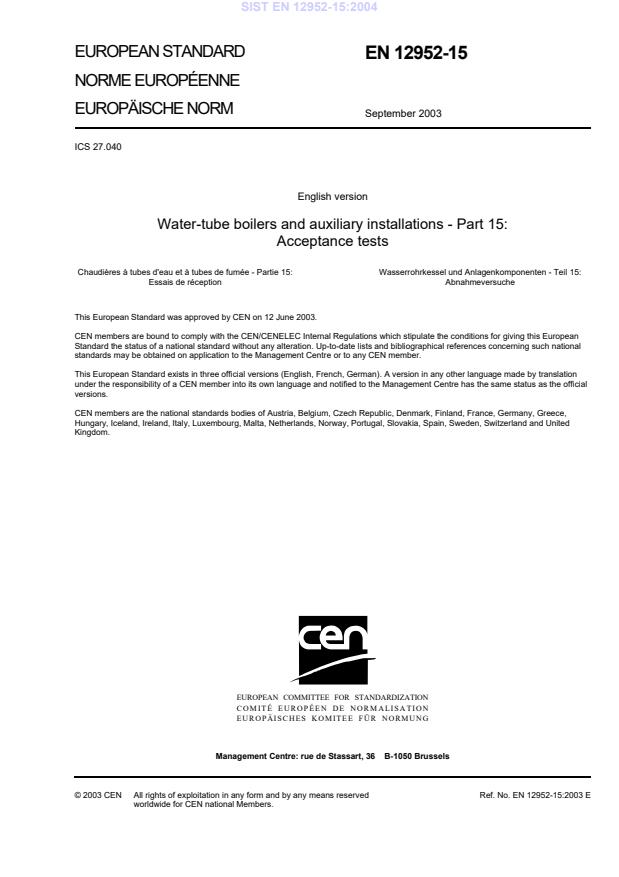
2003-01.Slovenski inštitut za standardizacijo. Razmnoževanje celote ali delov tega standarda ni dovoljeno.Vodocevni kotli in pomožne napeljave – 15. del: Prevzemni preskusiWasserrohrkessel und Anlagenkomponenten - Teil 15: AbnahmeversucheChaudieres a tubes d'eau et installations auxiliaires - Partie 15: Essais de réceptionWater-tube boilers and auxiliary installations - Part 15: Acceptance tests27.060.30Grelniki vode in prenosniki toploteBoilers and heat exchangersICS:Ta slovenski standard je istoveten z:EN 12952-15:2003SIST EN 12952-15:2004en01-junij-2004SIST EN 12952-15:2004SLOVENSKI
STANDARD
EUROPEAN STANDARDNORME EUROPÉENNEEUROPÄISCHE NORMEN 12952-15September 2003ICS 27.040English versionWater-tube boilers and auxiliary installations - Part 15:Acceptance testsChaudières à tubes d'eau et à tubes de fumée - Partie 15:Essais de réceptionWasserrohrkessel und Anlagenkomponenten - Teil 15:AbnahmeversucheThis European Standard was approved by CEN on 12 June 2003.CEN members are bound to comply with the CEN/CENELEC Internal Regulations which stipulate the conditions for giving this EuropeanStandard the status of a national standard without any alteration. Up-to-date lists and bibliographical references concerning such nationalstandards may be obtained on application to the Management Centre or to any CEN member.This European Standard exists in three official versions (English, French, German). A version in any other language made by translationunder the responsibility of a CEN member into its own language and notified to the Management Centre has the same status as the officialversions.CEN members are the national standards bodies of Austria, Belgium, Czech Republic, Denmark, Finland, France, Germany, Greece,Hungary, Iceland, Ireland, Italy, Luxembourg, Malta, Netherlands, Norway, Portugal, Slovakia, Spain, Sweden, Switzerland and UnitedKingdom.EUROPEAN COMMITTEE FOR STANDARDIZATIONCOMITÉ EUROPÉEN DE NORMALISATIONEUROPÄISCHES KOMITEE FÜR NORMUNGManagement Centre: rue de Stassart, 36
B-1050 Brussels© 2003 CENAll rights of exploitation in any form and by any means reservedworldwide for CEN national Members.Ref. No. EN 12952-15:2003 ESIST EN 12952-15:2004
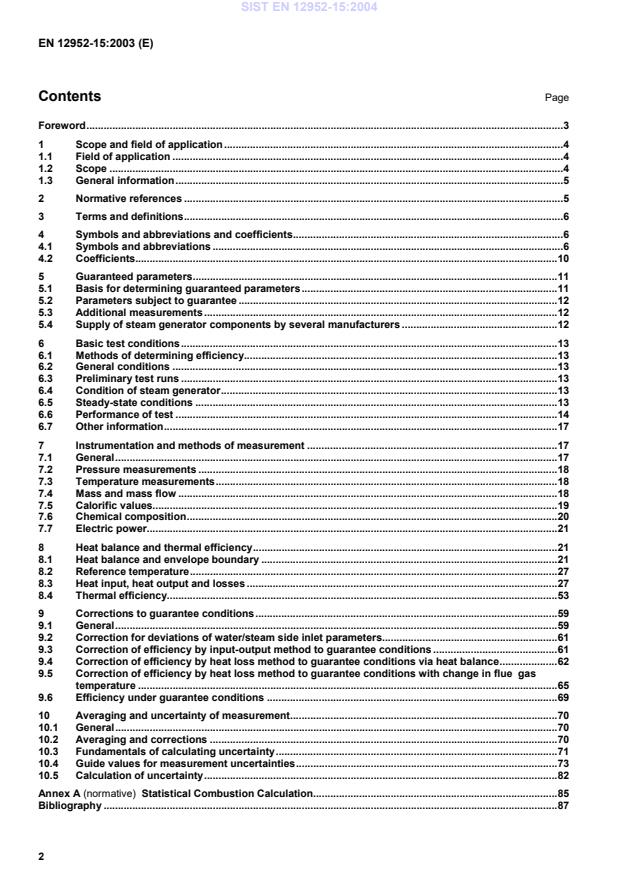
gastemperature.659.6Efficiency under guarantee conditions.6910Averaging and uncertainty of measurement.7010.1General.7010.2Averaging and corrections.7010.3Fundamentals of calculating uncertainty.7110.4Guide values for measurement uncertainties.7310.5Calculation of uncertainty.82Annex A (normative)
Statistical Combustion Calculation.85Bibliography.87SIST EN 12952-15:2004
...