

EN 12952-8:2022
(Main)Water-tube boilers and auxiliary installations - Part 8: Requirements for firing systems for liquid and gaseous fuels for the boiler
- Abstract
1.1 Firing systems
This document specifies requirements for liquid and gaseous fuel firing systems of steam boilers and hot water generators as defined in EN 12952-1:2015.
These requirements also apply to firing systems of chemical recovery boilers (black liquor boilers) with the additions and amendments specified in Annex A.
These requirements also apply to gas turbines in combination with fired/unfired heat recovery steam generators with the additions and amendments specified in Annex B.
NOTE 1 This document is not applicable to coil type boilers (flash boilers/small boilers) that use burners in accordance with EN 12953-7 for single burner installations.
NOTE 2 This document is not applicable to the storage of liquid fuels and to transfer stations of long-distance gas pipelines.
1.2 Fuels
This document specifies requirements which cover the use of liquid and gaseous fuels as defined in this document. Fuels deviating from standardized commercially available types can require additional or alternative safety measures. For black liquor these safety measures are given in Annex A.
- Status
- Published
- Publication Date
- 18-Oct-2022
- Technical Committee
- CEN/TC 269 - Shell and water tube boilers
- Drafting Committee
- CEN/TC 269/WG 1 - Water-tube boilers
- Current Stage
- 6060 - Definitive text made available (DAV) - Publishing
- Start Date
- 19-Oct-2022
- Due Date
- 26-Aug-2021
- Completion Date
- 19-Oct-2022
- Directive
- 2014/68/EU - Directive 2014/68/EU of the European Parliament and of the Council of 15 May 2014 on the harmonisation of the laws of the Member States relating to the making available on the market of pressure equipmentOJ Ref: 2025/165, OJ, OJ L, OJ L, 2025/165 OJ Date: 31-Jan-2025


Overview - EN 12952-8:2022 (firing systems for liquid & gaseous fuels)
EN 12952-8:2022 is the CEN European standard that specifies requirements for firing systems for liquid and gaseous fuels used with water‑tube steam boilers and hot‑water generators (as defined in EN 12952‑1:2015). It updates and supersedes the 2002 edition and includes specific normative additions for:
- chemical recovery (black liquor) boilers (Annex A) and
- gas turbines combined with fired/unfired heat recovery steam generators (HRSGs) (Annex B).
Note: the standard does not cover coil‑type (flash/small) boilers using single burners per EN 12953‑7, nor fuel storage and long‑distance gas transfer stations.
Key topics and technical requirements
EN 12952‑8 addresses the full firing‑system lifecycle and safety elements, including:
- Fuel supply and transfer: requirements for fuel lines, preparation and transfer systems.
- Safety shut‑off devices: specification and application of safety trip valves.
- Burners and burner groups: design, types (pilot, multi‑fuel), ignition and management.
- Air supply and air/fuel ratio control: ensuring correct combustion and safe operation.
- Flue gas handling: discharge, recirculation and common stack arrangements for multiple firing systems.
- Control, monitoring and electrical equipment: burner management systems, flame monitoring, control sequences and supervised operation.
- Operation & documentation: required operating manual, maintenance and operational guidance.
- Special fuel considerations: requirements for gaseous fuels with high relative density; additional black liquor safety measures (Annex A); HRSG‑turbine interface requirements (Annex B).
- Normative references: links to related standards (examples include EN 161, EN 16678, EN ISO 23553‑1, EN 12952‑18).
Practical applications and target users
EN 12952‑8 is intended for professionals involved in the specification, design, manufacture, installation, operation and inspection of firing systems for water‑tube boilers. Typical users:
- Boiler and burner manufacturers
- Power plant and industrial boiler engineers
- HRSG and combined‑cycle plant designers (gas turbine integrations)
- Chemical recovery (pulp & paper) process engineers working with black liquor boilers
- Inspection bodies, safety and compliance officers
- Maintenance and operations teams preparing operating manuals and safety procedures
Practical uses include designing compliant burner systems, selecting safety shut‑off devices, defining control and flame monitoring strategies, and preparing operation/maintenance documentation.
Related standards
EN 12952‑8 is part of the EN 12952 water‑tube boiler series (Parts 1–18). It cross‑references other standards such as:
- EN 12952‑1 (general boiler definitions)
- EN 12952‑5 (workmanship & construction)
- EN 12952‑18 (operating instructions)
- EN 161, EN 16678, EN ISO 23553‑1 (safety/control devices)
Keywords: EN 12952-8:2022, water-tube boilers, firing systems, liquid fuels, gaseous fuels, burners, black liquor, HRSG, gas turbine, boiler safety, air/fuel ratio.
Relations
- Effective Date
- 26-Oct-2022
- Effective Date
- 12-Aug-2026
- Effective Date
- 28-Jan-2026
- Effective Date
- 28-Jan-2026
- Refers
prEN 15116 - Ventilation in buildings - Chilled beams - Testing and rating of active chilled beams - Effective Date
- 28-Jan-2026
- Effective Date
- 28-Jan-2026
- Effective Date
- 28-Jan-2026
- Effective Date
- 28-Jan-2026
- Effective Date
- 28-Jan-2026
- Refers
EN 12952-18:2012 - Water-tube boilers and auxiliary installations - Part 18: Operating instructions - Effective Date
- 28-Jan-2026
- Effective Date
- 28-Jan-2026
- Effective Date
- 28-Jan-2026
- Effective Date
- 28-Jan-2026
- Effective Date
- 28-Jan-2026
- Effective Date
- 28-Jan-2026
Get Certified
Connect with accredited certification bodies for this standard

DNV
DNV is an independent assurance and risk management provider.

Lloyd's Register
Lloyd's Register is a global professional services organisation specialising in engineering and technology.
DNV Energy Systems
Energy and renewable energy certification.
Sponsored listings
Frequently Asked Questions
EN 12952-8:2022 is a standard published by the European Committee for Standardization (CEN). Its full title is "Water-tube boilers and auxiliary installations - Part 8: Requirements for firing systems for liquid and gaseous fuels for the boiler". This standard covers: 1.1 Firing systems This document specifies requirements for liquid and gaseous fuel firing systems of steam boilers and hot water generators as defined in EN 12952-1:2015. These requirements also apply to firing systems of chemical recovery boilers (black liquor boilers) with the additions and amendments specified in Annex A. These requirements also apply to gas turbines in combination with fired/unfired heat recovery steam generators with the additions and amendments specified in Annex B. NOTE 1 This document is not applicable to coil type boilers (flash boilers/small boilers) that use burners in accordance with EN 12953-7 for single burner installations. NOTE 2 This document is not applicable to the storage of liquid fuels and to transfer stations of long-distance gas pipelines. 1.2 Fuels This document specifies requirements which cover the use of liquid and gaseous fuels as defined in this document. Fuels deviating from standardized commercially available types can require additional or alternative safety measures. For black liquor these safety measures are given in Annex A.
1.1 Firing systems This document specifies requirements for liquid and gaseous fuel firing systems of steam boilers and hot water generators as defined in EN 12952-1:2015. These requirements also apply to firing systems of chemical recovery boilers (black liquor boilers) with the additions and amendments specified in Annex A. These requirements also apply to gas turbines in combination with fired/unfired heat recovery steam generators with the additions and amendments specified in Annex B. NOTE 1 This document is not applicable to coil type boilers (flash boilers/small boilers) that use burners in accordance with EN 12953-7 for single burner installations. NOTE 2 This document is not applicable to the storage of liquid fuels and to transfer stations of long-distance gas pipelines. 1.2 Fuels This document specifies requirements which cover the use of liquid and gaseous fuels as defined in this document. Fuels deviating from standardized commercially available types can require additional or alternative safety measures. For black liquor these safety measures are given in Annex A.
EN 12952-8:2022 is classified under the following ICS (International Classification for Standards) categories: 27.040 - Gas and steam turbines. Steam engines. The ICS classification helps identify the subject area and facilitates finding related standards.
EN 12952-8:2022 has the following relationships with other standards: It is inter standard links to EN 12952-8:2002, ISO 7-1:1994, EN ISO 9606-1:2017, EN 161:2011+A3:2013, prEN 15116, EN 751-3:1996, EN 12952-5:2021, EN ISO 23553-1:2022, EN 16678:2015, EN 12952-18:2012, EN 13480-2:2017, EN ISO 228-1:2003, EN 12952-16:2022, EN 12952-9:2002, EN 12952-13:2003. Understanding these relationships helps ensure you are using the most current and applicable version of the standard.
EN 12952-8:2022 is associated with the following European legislation: EU Directives/Regulations: 2014/68/EU, 97/23/EC; Standardization Mandates: M/071, M/601. When a standard is cited in the Official Journal of the European Union, products manufactured in conformity with it benefit from a presumption of conformity with the essential requirements of the corresponding EU directive or regulation.
EN 12952-8:2022 is available in PDF format for immediate download after purchase. The document can be added to your cart and obtained through the secure checkout process. Digital delivery ensures instant access to the complete standard document.
Standards Content (Sample)
SLOVENSKI STANDARD
01-december-2022
Nadomešča:
SIST EN 12952-8:2002
Vodocevni kotli in pomožne napeljave - 8. del: Zahteve za gorilnike kotlov na
tekoča in plinasta goriva
Water-tube boilers and auxiliary installations - Part 8: Requirements for firing systems for
liquid and gaseous fuels for the boiler
Wasserrohrkessel und Anlagenkomponenten - Teil 8: Anforderungen an
Feuerungsanlagen für flüssige und gasförmige Brennstoffe für den Kessel
Chaudières à tubes d'eau et installations auxiliaires - Partie 8 : Exigences pour les
équipements de chauffe pour combustibles gazeux et liquides de la chaudière
Ta slovenski standard je istoveten z: EN 12952-8:2022
ICS:
27.060.30 Grelniki vode in prenosniki Boilers and heat exchangers
toplote
2003-01.Slovenski inštitut za standardizacijo. Razmnoževanje celote ali delov tega standarda ni dovoljeno.
EN 12952-8
EUROPEAN STANDARD
NORME EUROPÉENNE
October 2022
EUROPÄISCHE NORM
ICS 27.040 Supersedes EN 12952-8:2002
English Version
Water-tube boilers and auxiliary installations - Part 8:
Requirements for firing systems for liquid and gaseous
fuels for the boiler
Chaudières à tubes d'eau et installations auxiliaires - Wasserrohrkessel und Anlagenkomponenten - Teil 8:
Partie 8 : Exigences pour les équipements de chauffe Anforderungen an Feuerungsanlagen für flüssige und
pour combustibles gazeux et liquides de la chaudière gasförmige Brennstoffe für den Kessel
This European Standard was approved by CEN on 15 August 2022.
CEN members are bound to comply with the CEN/CENELEC Internal Regulations which stipulate the conditions for giving this
European Standard the status of a national standard without any alteration. Up-to-date lists and bibliographical references
concerning such national standards may be obtained on application to the CEN-CENELEC Management Centre or to any CEN
member.
This European Standard exists in three official versions (English, French, German). A version in any other language made by
translation under the responsibility of a CEN member into its own language and notified to the CEN-CENELEC Management
Centre has the same status as the official versions.
CEN members are the national standards bodies of Austria, Belgium, Bulgaria, Croatia, Cyprus, Czech Republic, Denmark, Estonia,
Finland, France, Germany, Greece, Hungary, Iceland, Ireland, Italy, Latvia, Lithuania, Luxembourg, Malta, Netherlands, Norway,
Poland, Portugal, Republic of North Macedonia, Romania, Serbia, Slovakia, Slovenia, Spain, Sweden, Switzerland, Türkiye and
United Kingdom.
EUROPEAN COMMITTEE FOR STANDARDIZATION
COMITÉ EUROPÉEN DE NORMALISATION
EUROPÄISCHES KOMITEE FÜR NORMUNG
CEN-CENELEC Management Centre: Rue de la Science 23, B-1040 Brussels
© 2022 CEN All rights of exploitation in any form and by any means reserved Ref. No. EN 12952-8:2022 E
worldwide for CEN national Members.
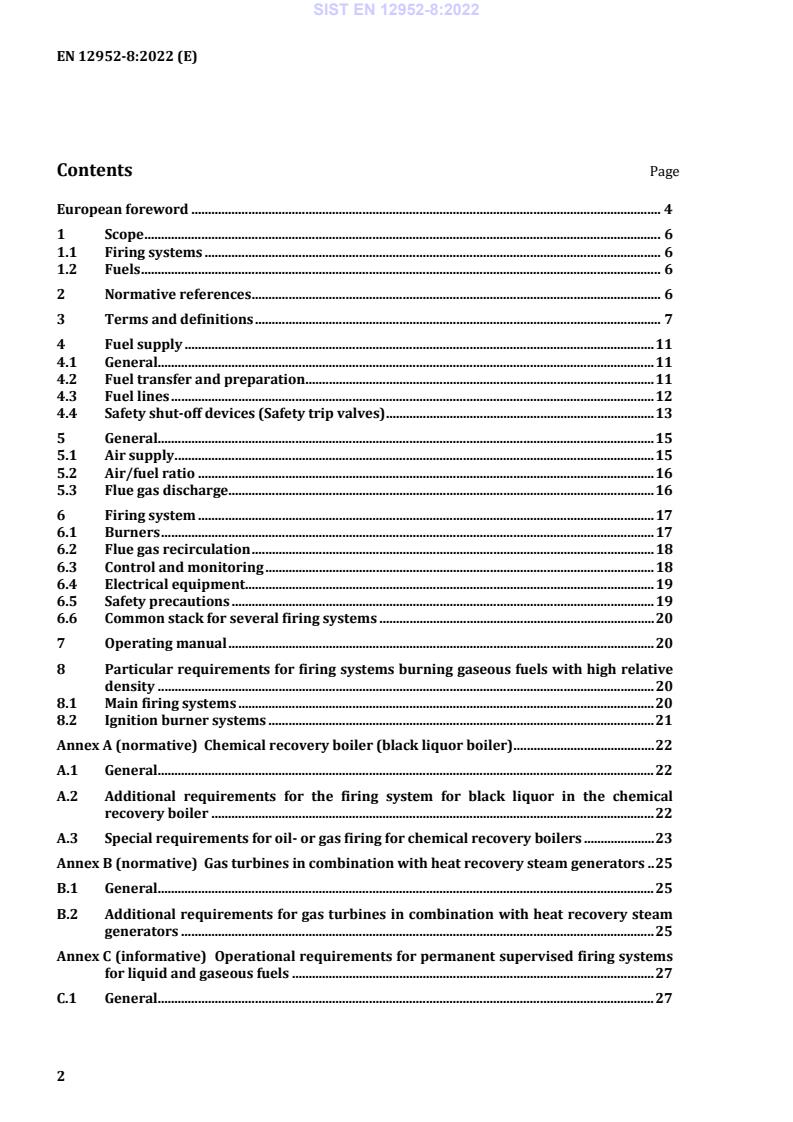
Contents Page
European foreword . 4
1 Scope . 6
1.1 Firing systems . 6
1.2 Fuels . 6
2 Normative references . 6
3 Terms and definitions . 7
4 Fuel supply . 11
4.1 General. 11
4.2 Fuel transfer and preparation . 11
4.3 Fuel lines . 12
4.4 Safety shut-off devices (Safety trip valves) . 13
5 General. 15
5.1 Air supply . 15
5.2 Air/fuel ratio . 16
5.3 Flue gas discharge . 16
6 Firing system . 17
6.1 Burners . 17
6.2 Flue gas recirculation . 18
6.3 Control and monitoring . 18
6.4 Electrical equipment. 19
6.5 Safety precautions . 19
6.6 Common stack for several firing systems . 20
7 Operating manual . 20
8 Particular requirements for firing systems burning gaseous fuels with high relative
density . 20
8.1 Main firing systems . 20
8.2 Ignition burner systems . 21
Annex A (normative) Chemical recovery boiler (black liquor boiler) . 22
A.1 General. 22
A.2 Additional requirements for the firing system for black liquor in the chemical
recovery boiler . 22
A.3 Special requirements for oil- or gas firing for chemical recovery boilers . 23
Annex B (normative) Gas turbines in combination with heat recovery steam generators . 25
B.1 General. 25
B.2 Additional requirements for gas turbines in combination with heat recovery steam
generators . 25
Annex C (informative) Operational requirements for permanent supervised firing systems
for liquid and gaseous fuels . 27
C.1 General. 27
C.2 Operation . 27
C.3 Fuel preparation . 27
C.4 Safety shutoff devices . 27
C.5 Air/fuel ratio . 27
C.6 Modification of firing, burner or air/fuel ratio setting . 27
C.7 Control and monitoring . 28
C.8 Emergency operation . 28
C.9 Operating and maintenance instructions . 28
C.10 Firing systems burning gaseous fuels with high relative density . 28
Annex D (informative) Significant technical changes between this document and the
previous edition . 30
Annex ZA (informative) Relationship between this European Standard and the essential
requirements of Directive 2014/68/EU aimed to be covered . 31
Bibliography . 33
European foreword
This document (EN 12952-8:2022) has been prepared by Technical Committee CEN/TC 269 “Shell and
water-tube boilers”, the secretariat of which is held by DIN.
This European Standard shall be given the status of a national standard, either by publication of an
identical text or by endorsement, at the latest by April 2023, and conflicting national standards shall be
withdrawn at the latest by April 2023.
Attention is drawn to the possibility that some of the elements of this document may be the subject of
patent rights. CEN shall not be held responsible for identifying any or all such patent rights.
This document supersedes EN 12952-8:2002.
The technical modifications in comparison with the previous edition are listed in Annex D.
The EN 12952 series “Water-tube boilers and auxiliary installations” consists of the following Parts:
• Part 1: General;
• Part 2: Materials for pressure parts of boilers and accessories;
• Part 3: Design and calculation for pressure parts;
• Part 4: In-service boiler life expectancy calculations;
• Part 5: Workmanship and construction of pressure parts of the boiler;
• Part 6: Inspection during construction, documentation and marking of pressure parts of the boiler;
• Part 7: Requirements for equipment for the boiler;
• Part 8: Requirements for firing systems for liquid and gaseous fuels for the boiler;
• Part 9: Requirements for firing systems for pulverized solid fuels for the boiler;
• Part 10: Requirements for safeguards against excessive pressure;
• Part 11: Requirements for limiting devices of the boiler and accessories;
• Part 12: Requirements for boiler feedwater and boiler water quality;
• Part 13: Requirements for flue gas cleaning systems;
• Part 14: Requirements for flue gas DENOX systems using liquefied pressurized ammonia and ammonia
water solution;
• Part 15: Acceptance tests;
• Part 16: Requirements for grate and fluidized-bed firing systems for solid fuels for the boiler;
• CR 12952 Part 17: Guideline for the involvement of an inspection body independent of the
manufacturer.
• Part 18: Operating instructions
Although these parts can be obtained separately, it should be recognized that the parts are inter-
dependent. As such, the design and manufacture of water-tube boilers requires the application of more
than one part in order for the requirements of the document to be satisfactorily fulfilled.
This document has been prepared under a Standardization Request given to CEN by the European
Commission and the European Free Trade Association, and supports essential requirements of
EU Directive(s) / Regulation(s).
For relationship with EU Directive(s) / Regulation(s), see informative Annex ZA, which is an integral part
of this document.
Any feedback and questions on this document should be directed to the users’ national standards body.
A complete listing of these bodies can be found on the CEN website.
According to the CEN-CENELEC Internal Regulations, the national standards organisations of the
following countries are bound to implement this European Standard: Austria, Belgium, Bulgaria, Croatia,
Cyprus, Czech Republic, Denmark, Estonia, Finland, France, Germany, Greece, Hungary, Iceland, Ireland,
Italy, Latvia, Lithuania, Luxembourg, Malta, Netherlands, Norway, Poland, Portugal, Republic of North
Macedonia, Romania, Serbia, Slovakia, Slovenia, Spain, Sweden, Switzerland, Türkiye and the United
Kingdom.
1 Scope
1.1 Firing systems
This document specifies requirements for liquid and gaseous fuel firing systems of steam boilers and hot
water generators as defined in EN 12952-1:2015.
These requirements also apply to firing systems of chemical recovery boilers (black liquor boilers) with
the additions and amendments specified in Annex A.
These requirements also apply to gas turbines in combination with fired/unfired heat recovery steam
generators with the additions and amendments specified in Annex B.
NOTE 1 This document is not applicable to coil type boilers (flash boilers/small boilers) that use burners in
accordance with EN 12953-7 for single burner installations.
NOTE 2 This document is not applicable to the storage of liquid fuels and to transfer stations of long-distance
gas pipelines.
1.2 Fuels
This document specifies requirements which cover the use of liquid and gaseous fuels as defined in this
document. Fuels deviating from standardized commercially available types can require additional or
alternative safety measures. For black liquor these safety measures are given in Annex A.
2 Normative references
The following documents are referred to in the text in such a way that some or all of their content
constitutes requirements of this document. For dated references, only the edition cited applies. For
undated references, the latest edition of the referenced document (including any amendments) applies.
EN 161:2011+A3:2013, Automatic shut-off valves for gas burners and gas appliances
EN 751-3:1996, Sealing materials for metallic threaded joints in contact with 1st, 2nd and 3rd family gases
and hot water – Part 3: Unsintered PTFE tapes
EN 12952-18:2012, Water-tube boilers and auxiliary installations - Part 18: Operating instructions
EN 12952-5:2021, Water-tube boilers and auxiliary installations - Part 5: Workmanship and construction
of pressure parts of the boiler
EN 13480-2:2017, Metallic industrial piping - Part 2: Materials
EN 16678:2015, Safety and control devices for gas burners and gas burning appliances - Automatic shut-
off valves for operating pressure of above 500 kPa up to and including 6 300 kPa
EN ISO 228-1:2003, Pipe threads where pressure-tight joints are not made on the threads - Part 1:
Dimensions, tolerances and designation (ISO 228-1:2000)
EN ISO 9606-1:2017, Qualification testing of welders - Fusion welding - Part 1: Steels (ISO 9606-1:2012
including Cor 1:2012 and Cor 2:2013)
As impacted by EN 751-3:1996/AC:1997.
EN ISO 23553-1:2022, Safety and control devices for oil burners and oil-burning appliances - Particular
requirements - Part 1: Automatic and semi-automatic valves (ISO 23553-1:2022)
ISO 7-1:1994, Pipe threads where pressure-tight joints are made on the threads — Part 1: Dimensions,
tolerances and designation
3 Terms and definitions
For the purposes of this document, the following terms and definitions apply.
ISO and IEC maintain terminological databases for use in standardization at the following addresses:
• IEC Electropedia: available at https://www.electropedia.org/
• ISO Online browsing platform: available at https://www.iso.org/obp
3.1
black liquor
spent liquor from the pulp cook
3.2
black liquor gun
device for the introduction of the black liquor as a spray of droplets into the furnace
Note 1 to entry: The black liquor gun is not a burner.
3.3
high volume low concentration odorous gas
mixtures of air and a low concentration of odorous gases collected from the pulp mill processes, where
the concentration of the combustible odorous gas is always kept below the lower explosion limit
3.4
burner
device (including main or igniter burners) for the introduction of fuel and air into a combustion chamber
of a steam generator at required velocities, turbulence and local fuel concentration to establish and
maintain proper ignition and stable combustion of the fuel
Note 1 to entry: Burners are differentiated by their mode of operation.
3.4.1
chemical recovery boiler start-up burner
oil- or gasfired burner mainly intended for the initiation of the black liquor combustion process
Note 1 to entry: The chemical recovery boiler start-up burners are located in and integrated with a combustion air
register, like the primary or the secondary air register of the furnace. Thus, they have no individual air supply and
no individual combustion air control.
3.4.2
multi-fuel burner
burner in which more than one fuel is burned either simultaneously or alternately
3.4.3
pilot burner
burner which maintains a proper permanent ignition source for one or a group of other non-monitored
burners
3.5
burner group
burners operated in unison and controlled jointly, one of which can be a master burner
3.6
burner management system
system that performs a predetermined sequence of actions and always operates in conjunction with a
flame monitor that reacts to signals from control and safety devices, gives control commands, controls
the start-up sequence, supervises the burner operation, and manages controlled shutdown and lockout
3.7
firing system
total equipment required for the combustion of fuels including the installations for the storage,
preparation, and supply of fuels, the combustion air supply, the burner(s), the flue gas discharge, and all
related control and monitoring devices
Note 1 to entry: A flue gas recirculation system can be an integral part of the firing system.
3.8
firing system heat input
heat input into the combustion chamber according to the mass flow of the fuel supplied multiplied by the
net calorific value
3.9
flame monitor
device which detects the presence or absence or break-away of the flame and transmits a signal to the
control device, and generally consists of a sensing device (with amplifier if necessary) and switching
equipment
3.10
flue gas recirculation
return of flue gas from downstream of the flame zone or from the flue gas exit by hydrodynamic pressure
difference or a separate fan into the air register of the burner or directly into the combustion chamber
3.11
implosion
unintentional instantaneous negative pressure build-up caused, for example, by an explosion in a
confined space, by rapid closing of dampers, or by rapid reduction in temperature (flame out)
3.12
limiters
transducer, which, on reaching a fixed value (e.g. pressure, temperature, flow, water level) is used to
interrupt and lock-out the energy supply, and requires manual unlocking before restart
3.13
lock-out
isolation of energy supply which requires a manual intervention to reinstate
3.14
master fuel trip
extinction of all burners and igniters in the combustion chamber
3.15
maximum heat input of the firing system
heat input including the reserve required for load control at which the boiler can be safely operated
3.16
maximum firing rate of the burners
firing rate at which the burner may be operated
3.17
monitor
limit transducer which senses the reaching of a fixed limit value and initiates an alarm and/or a cut out
Note 1 to entry: The output signal is only cancelled if the cause of the alarm has been removed and the value has
returned to within its fixed limits.
3.18
multi-fuel firing system
firing system where, in a common combustion chamber, more than one fuel can be burnt simultaneously
or alternately by separate or multi-fuel burners
3.19
purge of burner guns
carried out after shutdown of a burner to ensure the removal of residual fuel by the introduction of steam
or pressurized air into the fuel lines downstream of the shut-off devices
3.20
purging of the flue gas passes
forced flow of air through the combustion chamber, flue gas passes, and associated ducts which
effectively removes any gaseous combustibles and replace them with air
3.21
quick-acting shut-off device
safety trip valve which closes within 1 s according to EN 161:2011+A3:2013, EN 16678:2015 or
EN ISO 23553-1:2022, as appropriate
3.22
relative density
ratio of the density of the gas to the density of dry air under equal conditions of pressure and temperature
3.23
liquid fuel
fuel including light fuel oils, and heavy fuel oils which need preheating for proper atomisation
Note 1 to entry: For improvement of atomisation, emulsions of heavy fuel oil with water may be used with
appropriate precautions
3.24
gaseous fuel
standardized quality differentiated mainly by their relative density
3.24.1
light gas
with relative density below 1,3 e.g. natural gas, coke-oven gas, blast-furnace gas
Note 1 to entry: Natural gas in accordance with ISO 6976 [4].
3.24.2
heavy gas
with relative density exceeding 1,3 e.g. liquefied petroleum gases, the main components of which are
propane and butane
3.25
restart
operation where fuel supply shut-off is initiated within 1 s at the latest after extinction of the flame during
operation, and a directly following attempt of re-ignition is automatically made in compliance with the
start-up sequence
Note 1 to entry: This operation ends with the operating condition being reached or, if the flame is not ignited after
expiration of the ignition safety time, with the lock-out.
3.26
return-flow atomizer
oil burners where a portion of the quantity of oil supplied to the burner via the flow line does not flow
from a burner gun vortex chamber into the combustion chamber, but flows backwards into the storage
tank or to the suction side of the pump via a separate return line
Note 1 to entry: Output is adjusted by a control device in the return line.
3.27
safety shut-off device
safety trip valve
valve which automatically and totally cuts off the fuel supply
3.28
safety time
time taken from the occurrence of an unsafe operating condition (for example, flame interrupt during
normal operation) to the point at which the actuating element is initiated
Note 1 to entry: The reaction time of the actuating element is to be considered separately.
[SOURCE: EN 50156-1:2015 [9], 3.43]
3.28.1
ignition time
when starting-up the burner, the period of time between the first fuel entering the combustion chamber
and the first indication of the flame by the flame monitor
3.28.2
ignition safety time
when starting-up the burner, the period of time between the first fuel entering the combustion chamber
and the de-energizing of the quick-acting shut-off device if the flame monitor does not indicate a flame
3.28.3
main burner safety time
when there is an ignition safety time applicable to an igniter burner only, the period of time between the
first fuel of the main burner entering the combustion chamber and the de energizing of the quick acting
shut-off device of the main burner if the flame monitor does not indicate a flame
3.28.4
extinction safety time
during operation of the burner, the period of time between the extinction of the flame and the de-
energizing of the quick-acting shut-off device
3.29
transfer station
one or more lines each including a pressure control valve and a quick-acting shut-off device for the
protection of the downstream supply lines and the connected appliances against overpressure
Note 1 to entry: The transfer station may comprise heating and filtering equipment for the gas supply, measuring
equipment for flow and calorific value and noise abatement devices.
4 Fuel supply
4.1 General
For multifuel firing systems using separate or combined burners these requirements shall apply to the
oil and/or gas firing part involved.
Where several fuels are burnt simultaneously, improved safety measures can be necessary, especially in
respect to limitation of heat input into the firing system and proper air supply to the individual fuels.
4.2 Fuel transfer and preparation
4.2.1 The fuel supply line shall be equipped with a reliable shut-off device which shall be positioned in
a safe location. It shall reliably cut off the fuel supply to the boiler room or the boiler area and shall be
operable by remote control or by an emergency switch (see 6.4.2).
4.2.2 Some liquid fuels, such as heavy fuel oil, require preheating to achieve the viscosity required for
proper atomisation. Where national oil quality standards are in existence, these shall be observed.
Any heat source other than open flames, that can be cut off immediately if required, and the rating of
which can be automatically controlled, shall be used for oil preheating.
In the unpressurized condition the fuel oil temperature shall not attain the fuel oil flash point.
To attain the temperature for the required atomisation viscosity, pressure type preheaters shall be used.
The maximum temperature shall be at least 5 °C below the boiling temperature of water in the oil at the
connected pressure.
Each fuel oil preheating system shall be automatically temperature controlled. A temperature indicator
shall be fitted downstream of the preheating system. Oil temperatures below the temperature prescribed
upstream of each burner or burner group shall shut off the burner or burner group.
Oil temperatures above the temperature prescribed upstream of the burners shall shut off the heat supply
of the preheater or other suitable measures shall be taken.
For pressurized preheaters, the requirements for pressure vessels shall be applied. Functioning of the
necessary overpressure protection shall be ensured by suitable temperature control. Any escaping oil
shall be safely discharged.
Where steam heating coils for oil preheating are installed and the condensate is returned to the boiler,
the heating coils shall be safely dimensioned and tested to ensure that no oil can escape into the
condensate. A means of checking the condensate for oil content shall be provided. When steam lines are
connected to fuel oil lines for purging purposes or for steam assisted atomisation, the line shall be
protected against back flow from the higher pressured fluid.
4.2.3 For gaseous fuels, a pressure controller shall be provided in the supply line assuring continuous
flow pressure to each firing system unless this task is performed by the transfer station. The pressure
controller shall reliably prevent the firing system from overpressurization when the control function has
failed.
NOTE Requirements on pressure controller can be found in EN 676:2020 [3].
4.3 Fuel lines
4.3.1 Fuel lines, including gaskets and valves shall be designed and laid out to withstand the
mechanical, chemical and thermal loads to which they are exposed in service. Only fire resistant piping
material shall be permitted.
4.3.2 The fuel lines shall be tight and properly fixed. In systems subjected to vibrations the resulting
stresses shall be minimized to avoid leakage.
4.3.3 Connections shall preferably be welded or brazed. Threaded joints or bolted flanges shall also be
used.
Welded joints shall only be made by welders approved to the appropriate standards (see
EN ISO 9606-1:2017).
Brazed joints shall be permitted in oil lines for pipe diameters < DN 25 and/or operating
pressure < 10 bar provided the brazers shall be approved and the filler materials have been certified, e.g.
by a certificate of a specialized manufacturer (see EN ISO 3677:2016 [12] and EN ISO 17672:2016 [13]).
They shall also be permitted in gas lines for pipe diameter < DN 80 and/or operating pressure < 5 bar.
For threaded joints the requirements of ISO 7-1:1994 and EN ISO 228-1:2003 shall apply. Thread joints
shall be used up to DN 50 and shall be sealed by metal to metal contact, or sealed by non-hardening
sealing materials. Hemp shall only be used as a sealant support. The use of PTFE sealing materials shall
be restricted as indicated in EN 751-3:1996.
Compression-type fittings in accordance with appropriate standards may be used up to DN 25, provided
they shall be not to be dismantled for maintenance purposes.
Flanged connections on apparatus, equipment and valves shall be permitted for all diameters.
Material shall be in accordance with EN 13480-2:2017.
4.3.4 Flexible lines shall be used for connecting the burner to the fixed piping. For fuel oil in the
preheated state only jacketed metallic hoses shall be permitted.
Furthermore, flexible lines may be used instead of expansion joints at protected locations. For oil, these
lines should be jacketed metallic hoses, otherwise they shall be provided with a protective device
consisting of e.g. a double line with an oil monitor which switches off the oil supply pump in case of an oil
leakage. For gas, these lines shall be corrugated steel pipes.
All flexible lines shall be as short as possible, be readily visible, and shall be installed with adequate
bending radii. The flexible lines and the connections shall carry the manufacturer’s symbols and
indication of the nominal pressure. The design pressure shall be at least 1,5 times the maximum allowable
pressure. The lines shall be protected against unacceptable external heating.
4.3.5 To protect fuel lines against unacceptable high pressure, automatic control and safety devices
shall be provided. For oil lines, pressure relief valves shall be installed. Protection of oil pumps and the
effect of pressure rise in lines between closed shut-off devices due to heating shall also be taken into
consideration. For gas lines the necessary protection against overpressure shall be performed by a safety
shut-off valve plus a pressure relief valve.
4.3.6 On completion of installation, all fuel piping including valves and other equipment within the fuel
lines up to the burner nozzles shall be cleaned to remove any weld spatter, corrosion products and foreign
matter. The type and performance of the cleaning process shall also be recorded. In addition leakage
testing and strength testing in accordance with a good engineering practice shall be performed.
For oil and gas, each safety shut-off device shall be subject to internal leakage testing, to confirm that fuels
does not leak through the device.
After any welding work or replacement of components on fuel lines, the aforementioned tests shall be
repeated.
The performance of the tests shall be authenticated by certificates recording the test procedure, the
medium used, the test pressure and the test results obtained.
The certificates shall be issued by the person responsible for the testing.
4.3.7 Gas escape lines for intermediate venting and for purging or charging shall be arranged such, that
the escaping gas is either reliably ignited and burnt off with a flame trap installed in the pipe where the
gases are transferred to the burning device or is safely discharged to the atmosphere if unburnt. The
joining together of these lines shall only permitted if no dangerous operating conditions are expected.
When necessary, gas escape lines shall be equipped with the necessary draining facilities. Connections
for test devices shall be provided so that the adequacy of venting can be checked.
For oil, intermediate drains shall be provided to ensure the safe discharge of escaping oil.
4.4 Safety shut-off devices (Safety trip valves)
4.4.1 The fuel supply line shall be equipped with two safety shut-off devices arranged in series
immediately upstream of each burner, or burner group. One of these safety shut-off devices shall be of
quick-acting design, and correspond for:
a) gaseous fuels
with class A of EN 161:2011+A3:2013 or with class A of EN 16678:2015 for inlet pressures of more
than 500 kPa (5 bar) and up to and including 6 300 kPa (63 bar)
b) liquid fuels
with EN ISO 23553-1:2022.
The second safety shut-off device can also be used as a fuel mass flow actuator for the control of the firing
rate of the burner, but its closing time shall not exceed 5 s.
The fuel supply lines shall be provided with devices for removing those impurities from the fuel which
can impair the functioning of the safety shut-off devices.
The safety shut-off devices shall automatically and reliably cut off the fuel supply to the burner. An
adequate auxiliary power source, e.g. a spring, shall be permanently available to ensure this occurs. The
reliability of the automatic shut-off devices shall be proved. This proof shall be performed by component
testing as specified in EN 161:2011+A3:2013 and EN 16678:2015 for gaseous fuels or in
EN ISO 23553-1:2022 for liquid fuels.
Leakage testing of each of the safety shut-off devices shall be possible in its installed condition at regular
time intervals. For gas, the connection line between these two safety shut-off devices shall be equipped
with an intermediate venting or a leakage detection device.
Oil burners of special design such as return-flow atomizers, burners with a tip shut-off device etc., using
return-flow lines shall be provided with additional double shut-off valves in these lines.
Fuels deviating from standardized commercially available types can require additional or alternative
safety measures.
For gaseous fuels with low calorific value and with very low supply pressure, e.g. below 200 mbar, the
duty of the aforementioned safety shut-off devices may be performed by equivalent devices, e.g. rotary
slide valves with sealing water, or double-seat valves with an intermediate venting.
4.4.2 The automatic safety shut-off devices shall not release the fuel supply to the burners during the
start-up operation until
a) the ignition device is ready for ignition (see 6.1.5);
b) purging is completed (see 6.5.2 and 6.5.3) or there is fire in the combustion chamber;
c) the minimum preheating temperature required for the oil has been reached;
d) the safety shut-off devices proved to be closed or the leakage test proved to be successful;
e) the fuel control valve(s) and the air damper(s) are in the start position;
f) functional control of the flame monitor proves no defect to be present, and in the case of individual
flame monitoring detects there is no flame present prior to ignition.
4.4.3 The automatic safety shut-off devices shall be operated such that they do not release the fuel
supply to the burners during the start-up and operation, and cut it off during operation whenever
a) the control power for the safety devices fails;
b) the flue gas damper is not fully open or the induced draught fan fails, or the combustion chamber
pressure is too high;
c) the combustion air fails to be supplied (see 5.1.1);
d) the combustion air flow is insufficient (see 5.2);
e) pressure related abnormal conditions occur, such as
1) the pressure of the atomising medium is less than that required (for steam and pressure-air
atomizers),
2) the fuel pressure is less than the minimum pressure (for gas burners, and oil burners with
pressure atomizers),
3) the maximum fuel return flow pressure is exceeded (for oil burners with return-flow atomizers),
4) the speed of rotation of the atomising cup is insufficient (for oil burners with rotary atomizers).
Where the atomising cup is on the same shaft as the fan, it will suffice to monitor the fan air
pressure.
f) there is an unacceptably high fuel flow rate in the burners; if necessary cut-off may be effected with
a delay in time;
g) the ratio of flue gas recirculation flow/burner firing rate is unacceptable (see 6.2);
h) the flue gas recirculation fan, if fitted, fails and the ratio of flue gas recirculation flow/burner firing
rate is unacceptable (see 6.2);
i) the emergency switch is actuated (see 6.4.2);
j) any of the limiters responds (e.g. for water level, temperature);
k) burners (also burner guns) which can be swung out or retracted without the aid of tools are swung
out or retracted;
l) the flame monitor responds due to the absence or extinction of the flame.
4.4.4 As soon as the causes for conditions 4.4.2 a) to f) and 4.4.3 a) to h) have been removed, the
burners may automatically restart by following the regular start-up programme if this shall be permitted
for the plant.
Where the conditions 4.4.3 i) to l) apply, lock out shall always occur. Restarting shall only be possible by
manual intervention.
Where boilers have multiple burners, if the conditions mentioned in 4.4.3 a), c), d), e), g), h) and l) occur
only on one burner or one burner group, it shall suffice if the fuel supply to the respective burner or
burner group is not released during start-up and is interrupted during operation. This shall also apply to
4.4.3 k) if a hazardous escape of flames and flue gases is prevented.
4.4.5 One manually operated emergency shut-off device shall be arranged immediately upstream of the
burner, or each burner group. A manually operated emergency shut-off device is for example:
• a stop cock;
• a stop valve provided the open cross-section can be completely closed by a maximum of two hand-
wheel rotations; or
• an automatic safety shut-off device according to 4.4.1 if it can be additionally operated by hand at the
location of operation.
4.4.6 All safety related valves shall be durably marked with regard to their intended use.
5 General
5.1 Air supply
5.1.1 The combustion air fan shall be monitored by the air flow and one of the following criteria:
a) speed of the forced draught fan;
b) pressure downstream of the forced draught fan;
c) differential pressure at the forced draught fan;
d) power input of the forced draught fan motor.
If burners with individual combustion air fans are used, monitoring of the air flow may be replaced if two
criteria of a) to d) are monitored
5.1.2 Where there are several burners with a common fan each shall be equipped with a pressure gauge
or flowmeter in the air supply line. This does not apply to burners with a common wind box.
5.1.3 In the case of firing systems with several burners to which combustion air is supplied by a
common control device, each burner shall be equipped with a shut-off device (e.g. damper) in the air duct
except when all burners fire in unison.
Shut-off devices in the air line to the burner shall be protected against unintentional mal-adjustment. The
positions during normal operation and ignition shall be monitored.
In the case of interruption of fuel supply to the burner, this shut-off device shall also cut off the air supply
automatically (if necessary, only to provide a minimum opening). This shall ensure sufficient air supply
for the burners still in operation in the case of failure and shutdown of a burner or burner group. The
position of the shut-off device shall be monitored.
In the case of interruption of fuel supply to all burners, it can be necessary to avoid the risk of implosion
in the combustion chamber (e.g. by temporally staggered shut down of burners).
5.2 Air/fuel ratio
The air/fuel ratio shall be controlled within admissible limits. The predetermined values of the air/fuel
ratio and the admissible limits shall be stated in the operating manual.
The air/fuel ratio shall be monitored so, that in the case of unacceptable deviations from the ratio
determined by the manufacturer of the firing system and defined within the operational instructions, the
fuel supply is cut off. The air/fuel ratio monitoring circuit shall be independent of the control circuit.
Monitoring shall not be required if the air/fuel ratio is controlled by mechanical means, and this ratio
cannot be changed to exceed the admissible limits as a result of upset or operating conditions.
5.3 Flue gas discharge
5.3.1 Flue gas discharge shall be monitored to ensure it is not unnecessarily restricted. This shall be
performed by the following measures:
a) checking the position of the damper(s) during start-up;
b) monitoring of the induced draught fan operation and combustion chamber pressure.
If the relevant combustion chamber pressure is exceeded the firing shall be cut-off and locked-out.
5.3.2 The induced draught fan shall be monitored in accordance with 5.3.1 b) and one of the following
criteria:
a) speed of the induced draught fan;
b) pressure upstream of the induced draught fan;
c) differential pressure at the induced draught fan;
d) power input to the induced draught fan motor.
6 Firing system
6.1 Burners
6.1.1 The firing system shall be suitable for the respective boiler and can consist of a single burner or
a multiple burner arrangement. The task of the burners and the mode of operation of the burners are
defined in 3.4. The requirements specified in Clause 4 and Clause 5 shall be fulfilled by each individual
burner. Burners shall be individually tested (but see 6.1.3), at the latest during commissioning, or
following any safety relevant modification to the firing system, and shall include:
a) verification of completeness of equipment according to the requirements of this document;
b) functional testing of all safety-related equipment;
c) testing of burner management system in accordance with 6.4;
d) verification of maximum and minimum burner firing rate, including injection of additives, if used;
e) verification of flame stability during burner start-up, at the conditions given in d) above, with the flue
gas recirculation if any, and in the case of changes in f
...