

EN 14492-2:2019
(Main)Cranes - Power driven winches and hoists - Part 2: Power driven hoists
- Abstract
This document is applicable to the design, information for use, maintenance and testing of power driven hoists, compact or open construction, with or without trolleys for which the prime mover is an electric, hydraulic or pneumatic motor. They are designed for the lifting and lowering of loads that are suspended on hooks or other load lifting attachments. Hoists can be used either in cranes, in other machines, e.g. rail dependent storage and retrieval equipment, monorail conveyors or by itself.
This document is applicable to the following types of hoist:
a) rope hoist;
b) chain hoist;
c) belt hoist, except belt hoist with steel belts as hoisting media;
d) NGL building hoists including supporting structures;
e) Winches used for lifting operation.
This document is not applicable of the following hazards:
f) this document does not cover hazards related to builders hoists for the transport of goods as defined in Noise Outdoor Directive (OND) 2000/14/EC;
g) this document does not cover hazards related to the lifting of persons.
This document does not specify additional requirements for hazards related to the use of hoists in explosive atmospheres in underground mines.
The significant hazards covered by this document are identified in Clause 4.
This document is not applicable to power driven hoists that are manufactured before the date of publication of this document by CEN.
- Status
- Published
- Publication Date
- 11-Jun-2019
- Withdrawal Date
- 30-Dec-2019
- Technical Committee
- CEN/TC 147 - Cranes - Safety
- Drafting Committee
- CEN/TC 147/WG 17 - Power driven winches and hoists
- Current Stage
- 9092 - Decision on results of review/2YR ENQ - revise - Review Enquiry
- Start Date
- 29-Jul-2025
- Completion Date
- 07-Oct-2026



Overview
EN 14492-2:2019 is the CEN European standard for power driven hoists (Part 2 of the Cranes - Power driven winches and hoists series). It specifies safety, design, information for use, maintenance and testing requirements for electrically, hydraulically or pneumatically driven hoists used to lift and lower suspended loads. Covered hoist types include rope hoists, chain hoists, belt hoists (except steel-belt types), NGL building hoists and winches used for lifting operations. The standard replaces earlier editions and is not applicable to hoists manufactured before its publication.
Key Topics
- Scope and exclusions
- Applies to compact or open hoist constructions, with or without trolleys.
- Not applicable to builders’ hoists for goods as defined in OND 2000/14/EC and not for lifting persons.
- Does not add requirements for hoists used in explosive underground mine atmospheres.
- Safety requirements and protective measures
- Control devices, emergency stop functions and rated capacity limiters/indicators.
- Hoisting/lowering limiters, safety-related functions and braking systems.
- Mechanical elements: couplings, gearboxes, load hooks, rope/chain/belt drives and terminations.
- Energy systems
- Requirements for electrical, hydraulic and pneumatic equipment, including motors, converters and control units.
- Verification and testing
- Procedures for verification of safety requirements for series-manufactured and individually designed hoists.
- Noise & warnings
- Measures to reduce noise by design and requirements for warning markings and acoustic signals.
- Classification and special cases
- Annexes provide classification, guidance, additional requirements for high-risk applications, holding stationary loads above persons and for potentially explosive atmospheres.
Applications
- Ensures safe design and operation of hoists used in:
- Overhead and bridge cranes, monorail conveyors, rail-dependent storage/retrieval equipment.
- Industrial lifting, assembly lines, warehousing and building-site lifting (where applicable).
- Useful for manufacturers, integrators and safety engineers specifying hoist components, testing regimes and maintenance procedures.
Who should use this standard
- Hoist and crane manufacturers
- Machine designers and integrators
- Occupational health & safety professionals and test/inspection bodies
- Maintenance planners and operators responsible for compliance and safe operation
Related standards
- Other parts of EN 14492 series (Part 1: winches) and relevant electrical, hydraulic and machine safety standards referenced within EN 14492-2:2019.
Keywords: EN 14492-2:2019, power driven hoists, crane hoists, rope hoist, chain hoist, belt hoist, hoist safety, hoist testing, CEN standard.
Relations
- Replaces
EN 14492-2:2006+A1:2009 - Cranes - Power driven winches and hoists - Part 2: Power driven hoists - Effective Date
- 19-Jun-2019
- Effective Date
- 19-Jun-2019
- Effective Date
- 29-Jul-2026
- Effective Date
- 02-Jun-2026
- Effective Date
- 20-May-2026
- Effective Date
- 20-May-2026
- Effective Date
- 20-May-2026
- Effective Date
- 20-May-2026
- Effective Date
- 09-Feb-2026
- Effective Date
- 09-Feb-2026
- Effective Date
- 09-Feb-2026
- Effective Date
- 09-Feb-2026
- Effective Date
- 09-Feb-2026
- Effective Date
- 09-Feb-2026
- Effective Date
- 09-Feb-2026
Frequently Asked Questions
EN 14492-2:2019 is a standard published by the European Committee for Standardization (CEN). Its full title is "Cranes - Power driven winches and hoists - Part 2: Power driven hoists". This standard covers: This document is applicable to the design, information for use, maintenance and testing of power driven hoists, compact or open construction, with or without trolleys for which the prime mover is an electric, hydraulic or pneumatic motor. They are designed for the lifting and lowering of loads that are suspended on hooks or other load lifting attachments. Hoists can be used either in cranes, in other machines, e.g. rail dependent storage and retrieval equipment, monorail conveyors or by itself. This document is applicable to the following types of hoist: a) rope hoist; b) chain hoist; c) belt hoist, except belt hoist with steel belts as hoisting media; d) NGL building hoists including supporting structures; e) Winches used for lifting operation. This document is not applicable of the following hazards: f) this document does not cover hazards related to builders hoists for the transport of goods as defined in Noise Outdoor Directive (OND) 2000/14/EC; g) this document does not cover hazards related to the lifting of persons. This document does not specify additional requirements for hazards related to the use of hoists in explosive atmospheres in underground mines. The significant hazards covered by this document are identified in Clause 4. This document is not applicable to power driven hoists that are manufactured before the date of publication of this document by CEN.
This document is applicable to the design, information for use, maintenance and testing of power driven hoists, compact or open construction, with or without trolleys for which the prime mover is an electric, hydraulic or pneumatic motor. They are designed for the lifting and lowering of loads that are suspended on hooks or other load lifting attachments. Hoists can be used either in cranes, in other machines, e.g. rail dependent storage and retrieval equipment, monorail conveyors or by itself. This document is applicable to the following types of hoist: a) rope hoist; b) chain hoist; c) belt hoist, except belt hoist with steel belts as hoisting media; d) NGL building hoists including supporting structures; e) Winches used for lifting operation. This document is not applicable of the following hazards: f) this document does not cover hazards related to builders hoists for the transport of goods as defined in Noise Outdoor Directive (OND) 2000/14/EC; g) this document does not cover hazards related to the lifting of persons. This document does not specify additional requirements for hazards related to the use of hoists in explosive atmospheres in underground mines. The significant hazards covered by this document are identified in Clause 4. This document is not applicable to power driven hoists that are manufactured before the date of publication of this document by CEN.
EN 14492-2:2019 is classified under the following ICS (International Classification for Standards) categories: 53.020.20 - Cranes. The ICS classification helps identify the subject area and facilitates finding related standards.
EN 14492-2:2019 has the following relationships with other standards: It is inter standard links to EN 14492-2:2006+A1:2009, EN 14492-2:2006+A1:2009/AC:2010, EN 13135:2026, EN IEC 61000-6-3:2026, ISO 4301-1:1986, ISO 4306-1:2007, ISO 4309:2017, ISO 606:2015, EN 60204-32:2008, EN IEC 61000-6-2:2019, EN 60079-0:2012, EN IEC 61000-6-3:2021, EN 60529:1991, EN IEC 60079-14:2024, EN IEC 60034-5:2020. Understanding these relationships helps ensure you are using the most current and applicable version of the standard.
EN 14492-2:2019 is associated with the following European legislation: EU Directives/Regulations: 2006/42/EC, 2014/34/EU, 94/9/EC; Standardization Mandates: M/396, M/BC/CEN/91/1, M/BC/CEN/92/46. When a standard is cited in the Official Journal of the European Union, products manufactured in conformity with it benefit from a presumption of conformity with the essential requirements of the corresponding EU directive or regulation.
EN 14492-2:2019 is available in PDF format for immediate download after purchase. The document can be added to your cart and obtained through the secure checkout process. Digital delivery ensures instant access to the complete standard document.
Standards Content (Sample)
SLOVENSKI STANDARD
01-oktober-2019
Nadomešča:
SIST EN 14492-2:2007+A1:2010
SIST EN 14492-2:2007+A1:2010/AC:2010
Žerjavi - Motorni vitli in dvižni mehanizmi - 2. del: Motorni dvižni mehanizmi
Cranes - Power driven winches and hoists - Part 2: Power driven hoists
Krane - Kraftgetriebene Winden und Hubwerke - Teil 2: Kraftgetriebene Hubwerke
Appareils de levage à charge suspendue - Treuils et palans motorisés - Partie 2: Palans
motorisés
Ta slovenski standard je istoveten z: EN 14492-2:2019
ICS:
53.020.20 Dvigala Cranes
2003-01.Slovenski inštitut za standardizacijo. Razmnoževanje celote ali delov tega standarda ni dovoljeno.
EN 14492-2
EUROPEAN STANDARD
NORME EUROPÉENNE
June 2019
EUROPÄISCHE NORM
ICS 53.020.20 Supersedes EN 14492-2:2006+A1:2009
English Version
Cranes - Power driven winches and hoists - Part 2: Power
driven hoists
Appareils de levage à charge suspendue - Treuils et Krane - Kraftgetriebene Winden und Hubwerke - Teil
palans motorisés - Partie 2 : Palans motorisés 2: Kraftgetriebene Hubwerke
This European Standard was approved by CEN on 29 April 2019.
CEN members are bound to comply with the CEN/CENELEC Internal Regulations which stipulate the conditions for giving this
European Standard the status of a national standard without any alteration. Up-to-date lists and bibliographical references
concerning such national standards may be obtained on application to the CEN-CENELEC Management Centre or to any CEN
member.
This European Standard exists in three official versions (English, French, German). A version in any other language made by
translation under the responsibility of a CEN member into its own language and notified to the CEN-CENELEC Management
Centre has the same status as the official versions.
CEN members are the national standards bodies of Austria, Belgium, Bulgaria, Croatia, Cyprus, Czech Republic, Denmark, Estonia,
Finland, Former Yugoslav Republic of Macedonia, France, Germany, Greece, Hungary, Iceland, Ireland, Italy, Latvia, Lithuania,
Luxembourg, Malta, Netherlands, Norway, Poland, Portugal, Romania, Serbia, Slovakia, Slovenia, Spain, Sweden, Switzerland,
Turkey and United Kingdom.
EUROPEAN COMMITTEE FOR STANDARDIZATION
COMITÉ EUROPÉEN DE NORMALISATION
EUROPÄISCHES KOMITEE FÜR NORMUNG
CEN-CENELEC Management Centre: Rue de la Science 23, B-1040 Brussels
© 2019 CEN All rights of exploitation in any form and by any means reserved Ref. No. EN 14492-2:2019 E
worldwide for CEN national Members.
Contents Page
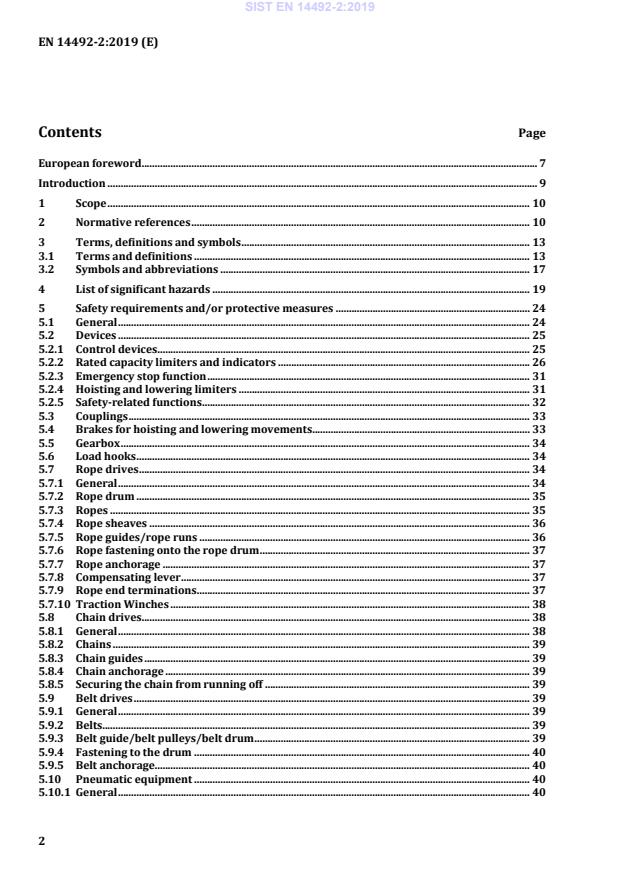
European foreword . 7
Introduction . 9
1 Scope . 10
2 Normative references . 10
3 Terms, definitions and symbols . 13
3.1 Terms and definitions . 13
3.2 Symbols and abbreviations . 17
4 List of significant hazards . 19
5 Safety requirements and/or protective measures . 24
5.1 General . 24
5.2 Devices . 25
5.2.1 Control devices . 25
5.2.2 Rated capacity limiters and indicators . 26
5.2.3 Emergency stop function . 31
5.2.4 Hoisting and lowering limiters . 31
5.2.5 Safety-related functions . 32
5.3 Couplings . 33
5.4 Brakes for hoisting and lowering movements. 33
5.5 Gearbox . 34
5.6 Load hooks . 34
5.7 Rope drives . 34
5.7.1 General . 34
5.7.2 Rope drum . 35
5.7.3 Ropes . 35
5.7.4 Rope sheaves . 36
5.7.5 Rope guides/rope runs . 36
5.7.6 Rope fastening onto the rope drum . 37
5.7.7 Rope anchorage . 37
5.7.8 Compensating lever . 37
5.7.9 Rope end terminations . 37
5.7.10 Traction Winches . 38
5.8 Chain drives . 38
5.8.1 General . 38
5.8.2 Chains . 39
5.8.3 Chain guides . 39
5.8.4 Chain anchorage . 39
5.8.5 Securing the chain from running off . 39
5.9 Belt drives . 39
5.9.1 General . 39
5.9.2 Belts. 39
5.9.3 Belt guide/belt pulleys/belt drum . 39
5.9.4 Fastening to the drum . 40
5.9.5 Belt anchorage. 40
5.10 Pneumatic equipment . 40
5.10.1 General . 40
5.10.2 Energy converters . 40
5.10.3 Control devices/controls . 41
5.10.4 Control units/control systems . 41
5.10.5 Protective measures . 41
5.11 Hydraulic equipment . 42
5.11.1 General . 42
5.11.2 Materials and auxiliary materials . 42
5.11.3 Energy converters . 43
5.11.4 Connecting elements and accessories . 43
5.11.5 Control devices/controls . 44
5.11.6 Protective measures . 44
5.12 Trolleys. 46
5.12.1 General . 46
5.12.2 Braking . 46
5.12.3 Operating chains (hand chain) . 46
5.12.4 Derailment safety device . 47
5.13 Electrical equipment of hoists and their trolleys . 47
5.13.1 General . 47
5.13.2 Electrical supply . 47
5.13.3 Ambient and operating conditions . 47
5.13.4 Supply disconnecting (isolating) and switching devices . 47
5.13.5 Overload protection of motors . 48
5.13.6 Control circuits and control functions . 48
5.13.7 Emergency stop function . 48
5.13.8 Electric motors . 48
5.13.9 Electric motion limiters . 49
5.14 Reduction of noise by design . 50
5.14.1 General . 50
5.14.2 Main noise sources on hoist units . 50
5.14.3 Measures for noise reduction at source . 50
5.14.4 Protective measures . 50
5.14.5 Information on noise . 50
5.15 Hoists for use in potentially explosive atmosphere . 51
5.16 Equipment for warning . 51
5.16.1 General . 51
5.16.2 Warning markings . 51
5.16.3 Warning means for cableless control . 51
5.16.4 Acoustic warning means . 51
6 Verification of the safety requirements and/or protective measures . 51
6.1 Hoists manufactured in series . 51
6.2 Hoists designed individually . 51
7 User information . 59
7.1 General . 59
7.2 Special requirements . 59
7.3 Marking . 61
Annex A (informative) Examples of power driven hoists. 63
A.1 Rope hoist . 63
A.2 Chain hoist . 66
A.3 Belt hoist . 67
A.4 Open type hoist . 69
A.5 NGL building hoists — Treuil potence de chantier — Bauaufzüge für nicht geführte
Lasten . 70
Annex B (normative) Classification . 72
B.1 General hoist class . 72
B.2 Class for average hoisting displacement . 74
B.3 Class for average traversing displacement . 75
Annex C (informative) Guidance on hoist classification . 77
Annex D (normative) Additional requirements for high risk applications . 81
Annex E (normative) Additional requirements for Power driven hoists designed for holding
stationary loads above persons . 82
Annex F (normative) Additional requirements for hoists intended to be used in potentially
explosive atmospheres . 83
F.1 General . 83
F.2 Avoidance or reduction of ignition sources. 83
F.2.1 General . 83
F.2.2 Electrical equipment . 83
F.2.3 Non-electrical equipment . 84
F.2.4 Electrostatic discharge . 84
F.2.5 Hazards caused by external influences . 84
F.2.6 Measures to reduce hazards in potentially explosive atmospheres . 84
F.3 Marking . 84
F.4 User information . 84
Annex G (informative) Additional requirements for operation in aggressive environments
and outdoors . 85
G.1 General . 85
G.2 Ropes and chains . 85
Annex H (informative) Additional requirements for operation at low temperatures . 87
Annex I (normative) Supporting structures for NGL building hoists . 88
I.1 General . 88
I.2 Terms and definitions . 88
I.3 Classification . 89
I.4 Construction characteristics . 92
I.4.1 General requirements . 92
I.4.2 Interchangeability of parts and modularity . 93
I.5 Calculations . 98
I.5.1 General . 98
I.5.2 Forces and load combinations to be considered . 98
I.5.3 Overturning stability . 99
I.5.4 Structural verification . 99
I.5.5 Loads transmitted calculations . 100
I.6 Instructions . 100
I.6.1 Transmitted forces/moments information. 100
I.6.2 Markings . 103
I.6.3 User information . 104
I.7 Verifications . 105
Annex J (normative) Power driven series hoist mechanisms – Test procedure for
verification of the classification . 106
J.1 Introduction. 106
J.2 Application . 106
J.3 Implementation of the test . 106
J.3.1 Framework conditions . 106
J.3.2 Configurations . 107
J.3.3 Test programme . 108
J.4 Acceptance criteria . 111
J.5 Determination of load variation factor according to reeving . 111
J.6 Conversion of Classification of hoists which are classified according to previous
standards . 113
Annex K (informative) Values of ϕ , ϕ for different types of rated capacity limiters . 116
IAL DAL
Annex L (informative) Number of starts and cyclic duration factor of motors . 118
Annex M (normative) Noise test code . 119
M.1 Scope . 119
M.2 General . 119
M.3 Determination of the emission sound pressure level at the operator’s position by
measurement . 119
M.3.1 General . 119
M.3.2 Measurement for hoists in general not subject to directive 2000/14/EC . 119
M.3.3 Hoists subject to Directive 2000/14/EC . 120
M.4 Determination of the sound power level . 120
M.4.1 General . 120
M.4.2 Hoists in general, not subject to Directive 2000/14/EC . 120
M.4.3 Hoists subject to Directive 2000/14/EC . 120
M.5 Mounting and operation conditions . 121
M.5.1 General . 121
M.5.2 Hoists in general, not subject to Directive 2000/14/EC . 121
M.5.3 Hoist subject to Directive 2000/14/EC . 121
M.6 Uncertainties . 122
M.7 Information to be recorded . 122
M.8 Information to be reported . 122
M.9 Declaration and verification of noise emission values . 122
Annex N (normative) Design calculation parameters for chains . 123
N.1 General . 123
N.2 Chain mean stresses . 123
N.3 Design factor c . 124
N.4 Working and dynamic coefficients . 124
Annex O (informative) Selection of a suitable set of crane standards for a given application. 125
Annex ZA (informative) Relationship between this European Standard and the Essential
Requirements of EU Directive 2006/42/EC aimed to be covered . 127
Annex ZB (informative) Relationship between this European Standard and the Essential
Requirements of EU Directive 2014/34/EU aimed to be covered. 131
Bibliography . 134
European foreword
This document (EN 14492-2:2019) has been prepared by Technical Committee CEN/TC 147 “Cranes -
Safety”, the secretariat of which is held by BSI.
This European Standard shall be given the status of a national standard, either by publication of an
identical text or by endorsement, at the latest by December 2019, and conflicting national standards shall
be withdrawn at the latest by December 2019.
Attention is drawn to the possibility that some of the elements of this document may be the subject of
patent rights. CEN shall not be held responsible for identifying any or all such patent rights.
This document supersedes EN 14492-2:2006+A1:2009.
CEN/TC 147 WG 17 has reviewed EN 14492-2:2006+A1:2009 to adapt the standard to the technical
progress, new requirements and changes in standards referenced; the main topics are:
— the design and calculation references to EN 13001-1, EN 13001-2 and EN 13001-3-1 are adopeted in
the document FEM-documents FEM 1.001, FEM 9.901 are no longer referenced;
— the design and calculation to EN 13001-3-2, Limit states and proof of competence of wire ropes in
reeving systems is adopted in the document. The standard ISO 4308-1:2003, in the Chapter 5.7 Rope
drives is no longer referenced.
— the design and calculation to EN 13001-3-5, Limit states and proof of competence of forged hooks is
adopted in the document. The standards DIN 15400, UNI 9465 in the Annex H (informative) are no
longer referenced;
— a guidance of relationships between the FEM and ISO-Classification (Hoist Classification) and the
new Classification according to the EN 13001 series is added; see Annex C;
— the EN 14492-2 references to EN 13135;
— this document will supersede EN 14492-2:2006+A1:2009 and the relevant clauses of
EN 14492-1:2006+A1:2009 winches dealing with lifting applications.
This is the second part of the standard “Cranes — Power driven winches and hoists”. The parts of the
standard are:
— Part 1: Power driven winches
— Part 2: Power driven hoists [the present document]
For the relationship with other European Standards for cranes, see Annex O.
This document has been prepared under a standardization request given to CEN by the European
Commission and the European Free Trade Association, and supports essential requirements of
EU Directive(s).
For relationship with EU Directive(s), see informative Annexes ZA and ZB, which are integral parts of this
document.
According to the CEN-CENELEC Internal Regulations, the national standards organisations of the
following countries are bound to implement this European Standard: Austria, Belgium, Bulgaria, Croatia,
Cyprus, Czech Republic, Denmark, Estonia, Finland, Former Yugoslav Republic of Macedonia, France,
Germany, Greece, Hungary, Iceland, Ireland, Italy, Latvia, Lithuania, Luxembourg, Malta, Netherlands,
Norway, Poland, Portugal, Romania, Serbia, Slovakia, Slovenia, Spain, Sweden, Switzerland, Turkey and
the United Kingdom.
Introduction
This European standard is a harmonized standard to provide one means for power driven hoists to
conform to the essential health and safety requirements of the EU Directive 2006/42/EC (Machinery)
and essential safety requirements of EU Directive 2014/34/EU (ATEX).
The machinery concerned and the extent to which hazards, hazardous situations and events are covered
are indicated in the scope of this European Standard.
This European Standard is a type C standard as stated in EN ISO 12100.
When provisions of this type C standard are different from those stated in type A or B standards, the
provisions of this type C standard take precedence over the provision of the other standards, for
machines that have been designed and built according to the provisions of this type C standard.
1 Scope
This document is applicable to the design, information for use, maintenance and testing of power driven
hoists, compact or open construction, with or without trolleys for which the prime mover is an electric,
hydraulic or pneumatic motor. They are designed for the lifting and lowering of loads that are suspended
on hooks or other load lifting attachments. Hoists can be used either in cranes, in other machines, e.g. rail
dependent storage and retrieval equipment, monorail conveyors or by itself.
This document is applicable to the following types of hoist:
a) rope hoist;
b) chain hoist;
c) belt hoist, except belt hoist with steel belts as hoisting media;
d) NGL building hoists including supporting structures;
e) Winches used for lifting operation.
This document is not applicable of the following hazards:
f) this document does not cover hazards related to builders hoists for the transport of goods as defined
in Noise Outdoor Directive (OND) 2000/14/EC;
g) this document does not cover hazards related to the lifting of persons.
This document does not specify additional requirements for hazards related to the use of hoists in
explosive atmospheres in underground mines.
The significant hazards covered by this document are identified in Clause 4.
This document is not applicable to power driven hoists that are manufactured before the date of
publication of this document by CEN.
2 Normative references
The following documents are referred to in the text in such a way that some or all of their content
constitutes requirements of this document. For dated references, only the edition cited applies. For
undated references, the latest edition of the referenced document (including any amendments) applies.
EN 81-50:2014, Safety rules for the construction and installation of lifts — Examinations and tests — Part
50: Design rules, calculations, examinations and tests of lift components
EN 818-1:1996+A1:2008, Short link chain for lifting purposes — Safety — Part 1: General conditions of
acceptance
EN 818-7:2002+A1:2008, Short link chain for lifting purposes — Safety — Part 7: Fine tolerance hoist
chain, Grade T (Types T, DAT and DT)
EN 1127-1, Explosive atmospheres — Explosion prevention and protection — Part 1: Basic concepts and
methodology
EN 12077-2:1998+A1:2008, Cranes safety — Requirements for health and safety — Part 2: Limiting and
indicating devices
EN 12644-2, Cranes — Information for use and testing — Part 2: Marking
EN 13001-1, Cranes — General design — Part 1: General principles and requirements
EN 13001-2, Crane safety — General design — Part 2: Load actions
EN 13001-3-1, Cranes — General Design — Part 3-1: Limit States and proof competence of steel structure
EN 13001-3-2, Cranes — General design — Part 3-2: Limit states and proof of competence of wire ropes in
reeving systems
EN 13001-3-3, Cranes — General design — Part 3-3: Limit states and proof of competence of wheel/rail
contacts
EN 13001-3-5, Cranes — General design — Part 3-5: Limit states and proof of competence of forged hooks
EN 13135, Cranes — Safety — Design — Requirements for equipment
EN 13411-3, Terminations for steel wire ropes — Safety — Part 3: Ferrules and ferrule-securing
EN 13411-4, Terminations for steel wire ropes — Safety — Part 4: Metal and resin socketing
EN 13411-6, Terminations for steel wire ropes — Safety — Part 6: Asymmetric wedge socket
EN 13411-7, Terminations for steel wire ropes — Safety — Part 7: Symmetric wedge socket
EN 13557:2003+A2:2008, Cranes — Controls and control stations
EN 60034-5, Rotating electrical machines — Part 5: Degrees of protection provided by the integral design
of rotating electrical machines (IP code) — Classification (IEC 60034-5)
EN 60079-0:2012, Explosive atmospheres — Part 0: Equipment — General requirements (IEC 60079-
0:2011)
EN 60079-14, Explosive atmospheres — Part 14: Electrical installations design, selection and erection (IEC
60079-14)
EN 60204-32:2008, Safety of machinery — Electrical equipment of machines - Part 32: Requirements for
hoisting machines (IEC 60204-32:2008)
EN 60529, Degrees of protection provided by enclosures (IP Code) (IEC 60529)
EN 61000-6-2, Electromagnetic compatibility (EMC) — Part 6-2: Generic standards — Immunity for
industrial environments (IEC 61000-6-2)
EN 61000-6-3, Electromagnetic compatibility (EMC) — Part 6-3: Generic standards — Emission standard
for residential, commercial and light-industrial environments (IEC 61000-6-3)
EN 61000-6-4, Electromagnetic compatibility (EMC) — Part 6-4: Generic standards — Emission standard
for industrial environments (IEC 61000-6-4)
EN ISO 3744:2010, Acoustics — Determination of sound power levels and sound energy levels of noise
sources using sound pressure — Engineering methods for an essentially free field over a reflecting plane (ISO
3744:2010)
EN ISO 4413:2010, Hydraulic fluid power — General rules and safety requirements for systems and their
components (ISO 4413:2010)
EN ISO 4414, Pneumatic fluid power — General rules and safety requirements for systems and their
components (ISO 4414)
EN ISO 4871, Acoustics — Declaration and verification of noise emission values of machinery and equipment
(ISO 4871)
EN ISO 11201:2010, Acoustics — Noise emitted by machinery and equipment — Determination of emission
sound pressure levels at a work station and at other specified positions in an essentially free field over a
reflecting plane with negligible environmental corrections (ISO 11201:2010)
EN ISO 11688-1, Acoustics — Recommended practice for the design of low-noise machinery and equipment
— Part 1: Planning (ISO/TR 11688-1)
EN ISO 12100, Safety of machinery — General principles for design - Risk assessment and risk reduction
(ISO 12100)
EN ISO 13732-1, Ergonomics of the thermal environment — Methods for the assessment of human
responses to contact with surfaces — Part 1: Hot surfaces (ISO 13732-1)
EN ISO 13849-1, Safety of machinery — Safety-related parts of control systems — Part 1: General principles
for design (ISO 13849-1)
EN ISO 13850:2015, Safety of machinery — Emergency stop function — Principles for design (ISO
13850:2015)
EN ISO 80079-36, Explosive atmospheres — Part 36: Non-electrical equipment for explosive atmospheres
— Basic method and requirements (ISO 80079-36)
EN ISO 80079-37, Explosive atmospheres — Part 37: Non-electrical equipment for explosive atmospheres
— Non-electrical type of protection constructional safety ''c'', control of ignition sources ''b'', liquid
immersion ''k'' (ISO 80079-37)
ISO 606, Short-pitch transmission precision roller and bush chains, attachments and associated chain
sprockets
1)
ISO 4301-1:1986, Cranes and lifting appliances — Classification — Part 1: General
ISO 4306-1, Cranes — Vocabulary — Part 1: General
ISO 4309, Cranes — Wire ropes — Care and maintenance, inspection and discard
ISO 12482, Cranes — Monitoring for crane design working period
1)
ISO 4301:1986 is “time based” approached and changed in the updated versions.
3 Terms, definitions and symbols
3.1 Terms and definitions
For the purposes of this document, the terms and definitions given in EN ISO 12100, ISO 4306-1 and the
following apply.
ISO and IEC maintain terminological databases for use in standardization at the following addresses:
— IEC Electropedia: available at http://www.electropedia.org/
— ISO Online browsing platform: available at http://www.iso.org/obp
3.1.1
belt drive
system of belts as hoisting medium including related belt pulleys, belt drums and belt anchorages
Note 1 to entry: Belts in transmissions of drive forces are excluded.
3.1.2
chain drive
system of fine tolerance steel link chains, roller chains, driven and non-driven chain wheels and chain
anchorages
3.1.3
chain anchorage
arrangement comprising the parts which connect the loaded chain end termination to the major load
bearing structure, e.g. pins, bolts, tension rods
3.1.4
belt anchorage
arrangement comprising the parts which connect the belt end termination to the major load bearing
structure, e.g. pins, bolts, tension rods, the belt fastening on the drum are not included
3.1.5
working coefficient for ropes, chains and belts
ratio between the minimum breaking force and the maximum static tensile force of the ropes, chains and
belts under rated capacity m
RC
3.1.6
direct control
main power circuit is directly controlled by the hand controlled actuator without additional means
between the actuator and the main power circuit
3.1.7
fleet angle
...