

ASTM D1185-98a(2017)
(Test Method)Standard Test Methods for Pallets and Related Structures Employed in Materials Handling and Shipping
General Information
- Abstract
SIGNIFICANCE AND USE
4.1 Static compression and bending tests provide data that are used to estimate stiffness, strength, and safe working loads for pallets under specified load and support conditions. These estimates provide a basis for designing pallets and comparing the performance between pallets of different designs and constructions.
4.2 Dynamic tests provide data which are used to estimate the physical durability and functionality of a pallet in specified material handling and shipping environments. These estimates provide a basis for designing single or multiple-use pallets.
4.3 Other tests may be performed to assess the properties of specific materials (Test Methods D2395, D4442, D4444, and T 208 OM) and connecting devices (Test Methods D1761, F680, Test Method F1575, and Specification F1667), design features, use applications, and other variables encountered.
SCOPE
1.1 These test methods cover the performance of pallets and related structures, functioning as skids, bases, platforms, and bins in materials handling and shipping. Their use facilitates the protection of both packaged and unpackaged products during storage and transportation. The test methods include measurements of the relative resistance of pallets and related structures to deformations, damages, and structural failures which detrimentally affect the functionality of the unit load.
1.2 These test methods include conditioning requirements, static stiffness and strength tests, and dynamic tests of structural reliability. These test methods are used to evaluate the relative performance of new, used, or reconditioned general and special-purpose pallets fabricated from various materials including solid wood, wood composites, fiberboard, honeycomb, plastics, or metal, or to compare the performance of such pallets and related structures to specified performance criteria. Recommended criteria for all tests specified in this standard are listed in Appendix X2.
1.2.1 These test methods are also used to classify pallets as single- or multiple-use pallets and to determine the safe working loads for pallets under specified load and support conditions.
1.3 Nonmandatory Preliminary Tests—Because each pallet may be used under several different conditions of load and support, pallet-design considerations and safe working-load estimates shall be based on that condition under which the pallet offers least resistance or is most severely stressed.
1.3.1 Preliminary, short-duration static tests up to the ultimate (see 8.2, 8.3, and 8.4) shall be performed on previously non-tested pallets to determine which load and support conditions influence most severely the pallet load-carrying capacity and safe working loads.
1.3.2 During the development of prototypes leading to designs that will be subject to acceptance testing, as described in 1.4, these preliminary tests shall include the free-fall drop tests in accordance with 9.1.
1.4 Mandatory Acceptance Tests:
1.4.1 General-Purpose Pallets—When the objective of the test is to determine the safe working load or to classify a general-purpose pallet as a single- or multiple-use pallet, all tests described in these test methods shall be performed in the order specified. The same pallet shall be used for all static and dynamic tests, where feasible.
1.4.2 Special-Purpose Pallets—When the objective of the test is to determine the safe working load or to classify a special-purpose pallet, as a single- or multiple-use pallet, only those tests representing the intended condition of use shall be performed. Certain special–purpose pallet designs, because of the pallet size, its shape, or the material of fabrication, or combinations thereof, cannot be reliably tested using this methodology. When available, alternative test methods should be used.
1.4.3 Field Testing—It is recommended that pallet designs passing these acceptance tests be further subjected to field testing in the distribution en...
- Status
- Published
- Publication Date
- 30-Apr-2017
- Technical Committee
- D10 - Packaging
Overview
ASTM D1185-98a(2017) sets out standardized test methods for evaluating the performance of pallets and related structures used in materials handling and shipping. Published by ASTM, this standard covers static compression, bending, dynamic, and environmental conditioning tests to measure pallet stiffness, strength, durability, and safe working loads. The standard facilitates reliable pallet design and allows for effective comparison between various pallet constructions made from materials such as wood, plastic, metal, and fiberboard. By following ASTM D1185, manufacturers, distributors, and users can ensure the suitability of pallets in safeguarding products throughout storage and transportation.
Key Topics
- Static Testing: Provides methods for determining pallet stiffness, strength, and failure thresholds under load, simulating real-world stacking and storage conditions.
- Dynamic Testing: Evaluates the physical durability and functionality of pallets when subjected to handling and shipping stresses, including impacts, drops, and vibration.
- Material Conditioning: Outlines procedures for preconditioning pallets made from different materials (e.g., wood, plastic, fiberboard) to account for environmental factors affecting performance.
- Classification and Load Assessment:
- Single-use vs Multiple-use pallets classification
- Determination of safe working loads under specific conditions
- Testing for Special and General-Purpose Pallets: Includes mandatory acceptance tests for general-purpose pallets and targeted tests for special-purpose designs, with room for alternative methodologies when standard methods may not apply.
- Field Testing Recommendations: Suggests further real-world distribution testing for designs passing laboratory acceptance criteria.
Applications
ASTM D1185 test methods have wide-ranging practical value in the materials handling and shipping industries:
- Pallet Design Optimization: Data from static and dynamic testing supports the design of more robust, reliable, and efficient pallets tailored to specific load profiles and support conditions.
- Quality Assurance: Ensures that new, used, or reconditioned pallets, regardless of material, meet specified performance criteria before deployment in supply chains.
- Regulatory and Safety Compliance: Helps organizations comply with safety requirements by verifying the maximum loads a pallet can safely carry and resist during routine operations.
- Performance Comparison: Enables objective benchmarking of various pallet styles, constructions, and materials to identify the most suitable solutions for different shipping or materials handling scenarios.
- Cost Effectiveness: By identifying durability and functionality limitations, users can choose single-use or reusable pallets that optimize cost and resource allocation without compromising on safety or product protection.
Related Standards
ASTM D1185 references several other important standards within the packaging, materials testing, and materials handling fields. Key related standards include:
- ASTM D642 – Compression resistance of shipping containers
- ASTM D999 – Vibration testing of shipping containers
- ASTM D1505 – Density of plastics using the density-gradient technique
- ASTM D1761 – Mechanical fasteners in wood
- ASTM D2395/D4442/D4444 – Density, specific gravity, and moisture content measurement of wood and wood-based materials
- ASTM D4003 – Impact testing of shipping containers
- ASTM D4332 – Conditioning containers and packages for testing
- ASTM D4728 – Random vibration testing of shipping containers
- ASTM F1575/F1667 – Bending yield of nails and nail specifications
- ASME MH1 – Pallets and unit loads vocabulary
- ISO 445 – International vocabulary for pallets
- TAPPI T 208 OM – Moisture in wood, pulp, paper, and board
Utilizing ASTM D1185 alongside these standards enables comprehensive pallet performance evaluation and aligns with internationally recognized best practices in materials handling and shipping.
Keywords: ASTM D1185, pallet testing, pallet performance, material handling, shipping pallets, pallet strength, static compression, dynamic testing, safe working load, pallet durability, pallet design, packaging standards, shipping standards.
Relations
- Effective Date
- 01-May-2017
- Effective Date
- 01-Dec-2023
- Refers
ASTM D1761-20 - Standard Test Methods for Mechanical Fasteners in Wood and Wood-Based Materials - Effective Date
- 15-Apr-2020
- Effective Date
- 01-Mar-2020
- Effective Date
- 01-Aug-2019
- Effective Date
- 01-Sep-2018
- Effective Date
- 01-Jul-2018
- Effective Date
- 01-Mar-2017
- Effective Date
- 15-Nov-2016
- Effective Date
- 01-Oct-2015
- Effective Date
- 01-Oct-2015
- Effective Date
- 01-Sep-2015
- Effective Date
- 01-Jun-2015
- Effective Date
- 01-May-2014
- Effective Date
- 01-May-2014
Get Certified
Connect with accredited certification bodies for this standard

BRCGS (Brand Reputation Compliance Global Standards)
Global food safety and quality standards owner.
Sponsored listings
Frequently Asked Questions
ASTM D1185-98a(2017) is a standard published by ASTM International. Its full title is "Standard Test Methods for Pallets and Related Structures Employed in Materials Handling and Shipping". This standard covers: SIGNIFICANCE AND USE 4.1 Static compression and bending tests provide data that are used to estimate stiffness, strength, and safe working loads for pallets under specified load and support conditions. These estimates provide a basis for designing pallets and comparing the performance between pallets of different designs and constructions. 4.2 Dynamic tests provide data which are used to estimate the physical durability and functionality of a pallet in specified material handling and shipping environments. These estimates provide a basis for designing single or multiple-use pallets. 4.3 Other tests may be performed to assess the properties of specific materials (Test Methods D2395, D4442, D4444, and T 208 OM) and connecting devices (Test Methods D1761, F680, Test Method F1575, and Specification F1667), design features, use applications, and other variables encountered. SCOPE 1.1 These test methods cover the performance of pallets and related structures, functioning as skids, bases, platforms, and bins in materials handling and shipping. Their use facilitates the protection of both packaged and unpackaged products during storage and transportation. The test methods include measurements of the relative resistance of pallets and related structures to deformations, damages, and structural failures which detrimentally affect the functionality of the unit load. 1.2 These test methods include conditioning requirements, static stiffness and strength tests, and dynamic tests of structural reliability. These test methods are used to evaluate the relative performance of new, used, or reconditioned general and special-purpose pallets fabricated from various materials including solid wood, wood composites, fiberboard, honeycomb, plastics, or metal, or to compare the performance of such pallets and related structures to specified performance criteria. Recommended criteria for all tests specified in this standard are listed in Appendix X2. 1.2.1 These test methods are also used to classify pallets as single- or multiple-use pallets and to determine the safe working loads for pallets under specified load and support conditions. 1.3 Nonmandatory Preliminary Tests—Because each pallet may be used under several different conditions of load and support, pallet-design considerations and safe working-load estimates shall be based on that condition under which the pallet offers least resistance or is most severely stressed. 1.3.1 Preliminary, short-duration static tests up to the ultimate (see 8.2, 8.3, and 8.4) shall be performed on previously non-tested pallets to determine which load and support conditions influence most severely the pallet load-carrying capacity and safe working loads. 1.3.2 During the development of prototypes leading to designs that will be subject to acceptance testing, as described in 1.4, these preliminary tests shall include the free-fall drop tests in accordance with 9.1. 1.4 Mandatory Acceptance Tests: 1.4.1 General-Purpose Pallets—When the objective of the test is to determine the safe working load or to classify a general-purpose pallet as a single- or multiple-use pallet, all tests described in these test methods shall be performed in the order specified. The same pallet shall be used for all static and dynamic tests, where feasible. 1.4.2 Special-Purpose Pallets—When the objective of the test is to determine the safe working load or to classify a special-purpose pallet, as a single- or multiple-use pallet, only those tests representing the intended condition of use shall be performed. Certain special–purpose pallet designs, because of the pallet size, its shape, or the material of fabrication, or combinations thereof, cannot be reliably tested using this methodology. When available, alternative test methods should be used. 1.4.3 Field Testing—It is recommended that pallet designs passing these acceptance tests be further subjected to field testing in the distribution en...
SIGNIFICANCE AND USE 4.1 Static compression and bending tests provide data that are used to estimate stiffness, strength, and safe working loads for pallets under specified load and support conditions. These estimates provide a basis for designing pallets and comparing the performance between pallets of different designs and constructions. 4.2 Dynamic tests provide data which are used to estimate the physical durability and functionality of a pallet in specified material handling and shipping environments. These estimates provide a basis for designing single or multiple-use pallets. 4.3 Other tests may be performed to assess the properties of specific materials (Test Methods D2395, D4442, D4444, and T 208 OM) and connecting devices (Test Methods D1761, F680, Test Method F1575, and Specification F1667), design features, use applications, and other variables encountered. SCOPE 1.1 These test methods cover the performance of pallets and related structures, functioning as skids, bases, platforms, and bins in materials handling and shipping. Their use facilitates the protection of both packaged and unpackaged products during storage and transportation. The test methods include measurements of the relative resistance of pallets and related structures to deformations, damages, and structural failures which detrimentally affect the functionality of the unit load. 1.2 These test methods include conditioning requirements, static stiffness and strength tests, and dynamic tests of structural reliability. These test methods are used to evaluate the relative performance of new, used, or reconditioned general and special-purpose pallets fabricated from various materials including solid wood, wood composites, fiberboard, honeycomb, plastics, or metal, or to compare the performance of such pallets and related structures to specified performance criteria. Recommended criteria for all tests specified in this standard are listed in Appendix X2. 1.2.1 These test methods are also used to classify pallets as single- or multiple-use pallets and to determine the safe working loads for pallets under specified load and support conditions. 1.3 Nonmandatory Preliminary Tests—Because each pallet may be used under several different conditions of load and support, pallet-design considerations and safe working-load estimates shall be based on that condition under which the pallet offers least resistance or is most severely stressed. 1.3.1 Preliminary, short-duration static tests up to the ultimate (see 8.2, 8.3, and 8.4) shall be performed on previously non-tested pallets to determine which load and support conditions influence most severely the pallet load-carrying capacity and safe working loads. 1.3.2 During the development of prototypes leading to designs that will be subject to acceptance testing, as described in 1.4, these preliminary tests shall include the free-fall drop tests in accordance with 9.1. 1.4 Mandatory Acceptance Tests: 1.4.1 General-Purpose Pallets—When the objective of the test is to determine the safe working load or to classify a general-purpose pallet as a single- or multiple-use pallet, all tests described in these test methods shall be performed in the order specified. The same pallet shall be used for all static and dynamic tests, where feasible. 1.4.2 Special-Purpose Pallets—When the objective of the test is to determine the safe working load or to classify a special-purpose pallet, as a single- or multiple-use pallet, only those tests representing the intended condition of use shall be performed. Certain special–purpose pallet designs, because of the pallet size, its shape, or the material of fabrication, or combinations thereof, cannot be reliably tested using this methodology. When available, alternative test methods should be used. 1.4.3 Field Testing—It is recommended that pallet designs passing these acceptance tests be further subjected to field testing in the distribution en...
ASTM D1185-98a(2017) is classified under the following ICS (International Classification for Standards) categories: 55.180.20 - General purpose pallets. The ICS classification helps identify the subject area and facilitates finding related standards.
ASTM D1185-98a(2017) has the following relationships with other standards: It is inter standard links to ASTM D1185-98a(2009), ASTM D999-08(2023), ASTM D1761-20, ASTM D4442-20, ASTM D4003-98(2019)e1, ASTM F1667-18, ASTM D4444-13(2018), ASTM F1667-17, ASTM D4442-16, ASTM D999-08(2015), ASTM D4003-98(2015), ASTM F1667-15, ASTM D4442-15, ASTM D2395-14, ASTM D2395-14e1. Understanding these relationships helps ensure you are using the most current and applicable version of the standard.
ASTM D1185-98a(2017) is available in PDF format for immediate download after purchase. The document can be added to your cart and obtained through the secure checkout process. Digital delivery ensures instant access to the complete standard document.
Standards Content (Sample)
This international standard was developed in accordance with internationally recognized principles on standardization established in the Decision on Principles for the
Development of International Standards, Guides and Recommendations issued by the World Trade Organization Technical Barriers to Trade (TBT) Committee.
Designation: D1185 − 98a (Reapproved 2017)
Standard Test Methods for
Pallets and Related Structures Employed in Materials
Handling and Shipping
This standard is issued under the fixed designation D1185; the number immediately following the designation indicates the year of
original adoption or, in the case of revision, the year of last revision.Anumber in parentheses indicates the year of last reapproval.A
superscript epsilon (´) indicates an editorial change since the last revision or reapproval.
This standard has been approved for use by agencies of the U.S. Department of Defense.
1. Scope 1.3.2 During the development of prototypes leading to
designs that will be subject to acceptance testing, as described
1.1 Thesetestmethodscovertheperformanceofpalletsand
in 1.4, these preliminary tests shall include the free-fall drop
related structures, functioning as skids, bases, platforms, and
tests in accordance with 9.1.
bins in materials handling and shipping. Their use facilitates
the protection of both packaged and unpackaged products
1.4 Mandatory Acceptance Tests :
during storage and transportation. The test methods include
1.4.1 General-Purpose Pallets—When the objective of the
measurements of the relative resistance of pallets and related
test is to determine the safe working load or to classify a
structures to deformations, damages, and structural failures
general-purpose pallet as a single- or multiple-use pallet, all
which detrimentally affect the functionality of the unit load.
tests described in these test methods shall be performed in the
1.2 These test methods include conditioning requirements,
order specified. The same pallet shall be used for all static and
static stiffness and strength tests, and dynamic tests of struc-
dynamic tests, where feasible.
tural reliability. These test methods are used to evaluate the
1.4.2 Special-Purpose Pallets—When the objective of the
relative performance of new, used, or reconditioned general
test is to determine the safe working load or to classify a
and special-purpose pallets fabricated from various materials
special-purpose pallet, as a single- or multiple-use pallet, only
including solid wood, wood composites, fiberboard,
those tests representing the intended condition of use shall be
honeycomb, plastics, or metal, or to compare the performance
performed. Certain special–purpose pallet designs, because of
of such pallets and related structures to specified performance
the pallet size, its shape, or the material of fabrication, or
criteria. Recommended criteria for all tests specified in this
combinations thereof, cannot be reliably tested using this
standard are listed in Appendix X2.
methodology. When available, alternative test methods should
1.2.1 These test methods are also used to classify pallets as
be used.
single- or multiple-use pallets and to determine the safe
working loads for pallets under specified load and support
1.4.3 Field Testing— It is recommended that pallet designs
conditions.
passing these acceptance tests be further subjected to field
testing in the distribution environment.
1.3 Nonmandatory Preliminary Tests —Because each pallet
may be used under several different conditions of load and
1.5 Simulation of the Distribution Environment—These test
support, pallet-design considerations and safe working-load
methods are not intended to lead to exact simulations of pallet
estimates shall be based on that condition under which the
performance in the distribution environment. These test meth-
pallet offers least resistance or is most severely stressed.
ods are designed to relate to practice with the added provision
1.3.1 Preliminary, short-duration static tests up to the ulti-
that they are repeatable, do not depend on exceptional skills,
mate (see 8.2, 8.3, and 8.4) shall be performed on previously
and are safe to conduct without elaborate precautions.The test
non-tested pallets to determine which load and support condi-
findings are not expected to lead to unalterable conclusions.
tions influence most severely the pallet load-carrying capacity
Testing in the distribution environment may be necessary to
and safe working loads.
verify the results obtained from laboratory tests.
1.6 This standard does not purport to address all of the
safety concerns, if any, associated with its use. It is the
These test methods are under the jurisdiction of ASTM Committee D10 on
Packaging and are the direct responsibility of Subcommittee D10.21 on Shipping responsibility of the user of this standard to establish appro-
Containers and Systems - Application of Performance Test Methods.
priate safety and health practices and determine the applica-
CurrenteditionapprovedMay1,2017.PublishedJuly2017.Originallyapproved
bility of regulatory limitations prior to use. Specific warnings
in 1951. Last previous edition approved in 2009 as D1185–98a(2009). DOI:
10.1520/D1185-98AR17. are given in 9.5.3.5.
Copyright © ASTM International, 100 Barr Harbor Drive, PO Box C700, West Conshohocken, PA 19428-2959. United States
D1185 − 98a (2017)
1.7 This international standard was developed in accor- the initial stage of testing. Test deformations shall be assumed
dance with internationally recognized principles on standard- to be zero at this preload level.
ization established in the Decision on Principles for the
3.1.3 general-purpose pallets—pallets designed and con-
Development of International Standards, Guides and Recom-
structed to support a wide range of loads using a variety of
mendations issued by the World Trade Organization Technical
applicable handling devices.
Barriers to Trade (TBT) Committee.
3.1.4 preliminary safe working load—anestimateofthesafe
working load of a pallet not yet confirmed by all of the
2. Referenced Documents
appropriate tests specified in these test methods.
2.1 ASTM Standards:
3.1.5 safe working load—The maximum load, determined
D642Test Method for Determining Compressive Resistance
fromtests,thatapalletcansupportwithoutfailureinhandling,
of Shipping Containers, Components, and Unit Loads
storage, and distribution including an appropriate allowance
D996Terminology of Packaging and Distribution Environ-
for variations in performance as well as necessary safety
ments
factors.
D999Test Methods for Vibration Testing of Shipping Con-
3.1.6 special-purpose pallets—pallets designed and con-
tainers
structed to support a specified load using certain handling
D1505Test Method for Density of Plastics by the Density-
devices.
Gradient Technique
D1761Test Methods for Mechanical Fasteners in Wood
4. Significance and Use
D2395TestMethodsforDensityandSpecificGravity(Rela-
tive Density) of Wood and Wood-Based Materials
4.1 Static compression and bending tests provide data that
D4003Test Methods for Programmable Horizontal Impact are used to estimate stiffness, strength, and safe working loads
Test for Shipping Containers and Systems
for pallets under specified load and support conditions. These
D4332Practice for Conditioning Containers, Packages, or estimates provide a basis for designing pallets and comparing
Packaging Components for Testing
the performance between pallets of different designs and
D4442Test Methods for Direct Moisture Content Measure- constructions.
ment of Wood and Wood-Based Materials
4.2 Dynamic tests provide data which are used to estimate
D4444Test Method for Laboratory Standardization and
the physical durability and functionality of a pallet in specified
Calibration of Hand-Held Moisture Meters
material handling and shipping environments. These estimates
D4728Test Method for Random Vibration Testing of Ship-
provide a basis for designing single or multiple-use pallets.
ping Containers
4.3 Other tests may be performed to assess the properties of
F680Test Methods for Nails
specificmaterials(TestMethodsD2395,D4442,D4444,andT
F1575Test Method for Determining BendingYield Moment
208 OM) and connecting devices (Test Methods D1761, F680,
of Nails
TestMethodF1575,andSpecificationF1667),designfeatures,
F1667SpecificationforDrivenFasteners:Nails,Spikes,and
use applications, and other variables encountered.
Staples
2.2 ASME Standard:
5. Materials
MH 1Pallets, Slipsheets, and Other Bases for Unit Loads
5.1 These test methods are pertinent to pallets constructed
2.3 ISO Standard:
of materials listed in Table 1.
ISO 445Pallets for Material Handling– Vocabulary
2.4 TAPPI Standard:
6. Sampling
TAPPI T 208 OM - 89Moisture in Wood, Pulp, Paper and
6.1 Sampling shall provide for the selection of representa-
Paper Board by Tolvene Distillation
tivespecimens.Thenumberoftestreplicationsrequiredvaries.
3. Terminology At least three replications per pallet design shall be tested.
3.1 Definitions:
7. Conditioning
3.1.1 The following standards are applicable, with Termi-
7.1 Some pallets are constructed of materials whose prop-
nology D996, to be considered the governing standard in the
ertiesareaffectedbychangesintemperature,relativehumidity,
case of a dispute: Terminology D996, MH 1, and ISO 445.
and environmental moisture conditions prior to and during use
3.1.2 datum load—a preload level applied to the specimen
inthedistributionenvironment.Priortotest,thesepalletsshall
to reduce test variables as influenced by the test setup during
be conditioned as described in Table 1.
7.2 Where conditioning influences pallet performance, the
For referenced ASTM standards, visit the ASTM website, www.astm.org, or
specifiedtest-specimenenvironmentshallexistduringthetime
contactASTM Customer Service at service@astm.org. ForAnnual Book ofASTM
of testing. If the test environment cannot be maintained at the
Standards volume information, refer to the standard’s Document Summary page on
the ASTM website.
required conditioning level, the tests shall be performed
Available fromAmerican National Standards Institute (ANSI), 25 W. 43rd St.,
immediately after the pallet has been removed from the
4th Floor, New York, NY 10036, http://www.ansi.org.
conditioning environment. Immediately after each individual
Available from TechnicalAssociation of the Pulp and Paper Industry (TAPPI),
15 Technology Parkway South, Norcross, GA 30092, http://www.tappi.org. test, specimens subjected to Environments A or B shall be
D1185 − 98a (2017)
TABLE 1 Conditioning and Testing Environments
Minimum
Conditioning Temperature, Relative
Conditioning Pallet Material
Environment °C Humidity, %
Time, h
A,B
no conditioning unprocessed sawn wood assembled with metal connectors
metals
required
C B
A +60±2 . 24 plastics
B –25 ± 3 . .
C 25±3 90±5 48 paper-based materials, wood assembled with adhesives, and processed
D 20±5 . 24 wood (that is, plywood, strandboard, particle board, and other wood based
D
materials).
A
The moisture content of unprocessed sawn wood components shall represent the maximum that would occur during the use of the pallet.
B
Special purpose pallets may be conditioned to temperatures reflecting anticipated use conditions.
C
45°C shall be the temperature used for 8.4, Pallet Bending Tests.
D
Environment D shall be used for pallets made of these materials when it is expected that the pallets may be exposed to water in the distribution environment.
returned to the conditioning environment for a minimum of 1 8.3 Compression Tests on Pallet Deck Spacers or
h prior to the next test. For additional details concerning Supports—The purpose of this test is to determine the resis-
conditioning procedures, see Practice D4332. tance to compression of deck spacers (stringers, blocks, and
posts) of pallets.
7.3 For wood or wood-base materials, the moisture content
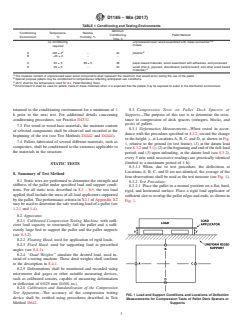
8.3.1 Deformation Measurements—When tested in accor-
of selected components shall be observed and recorded at the
dance with the procedure specified in 8.3.2, record the change
beginning of the test (see Test Methods D4442 and D4444).
in the height, y, at LocationsA, B, C, and D, as shown in Fig.
7.4 Pallets fabricated of several different materials, such as
1, relative to the ground (or test frame), (1) at the datum load
composites, shall be conditioned to the extremes applicable to
(see8.3.2and3.1);(2)atthebeginningandendofthefull-load
the materials in the structure.
period; and (3) upon unloading, at the datum load (see 8.3.2),
every 5 min until successive readings are practically identical
(limited to a maximum period of 1 h).
STATIC TESTS
8.3.1.1 When, due to test procedure, the deflections at
LocationsA, B, C, and D are not identical, the average of the
8. Summary of Test Method
fourobservationsshallbeusedasthetestmeasure(seeFig.1).
8.1 Static tests are performed to determine the strength and
8.3.2 Test Procedure:
stiffness of the pallet under specified load and support condi-
8.3.2.1 Place the pallet in a normal position on a flat, hard,
tions. For all static tests described in 8.3 – 8.5, the test load
rigid, and horizontal surface. Place a rigid load applicator of
appliedshallincludethemassofallloadapplicatorssupported
sufficientsizetooverlapthepalletedgesandends,asshownin
bythepallet.TheperformancecriteriainX2.1ofAppendixX2
Fig. 1.
maybeusedtodeterminethesafeworkingloadofapallet(see
1.2.1 and 1.4).
8.2 Apparatus:
8.2.1 Calibrated Compression Testing Machine, with suffi-
cient load capacity to structurally fail the pallet and a suffi-
ciently large bed to support the pallet and the pallet supports
(see 8.3.2).
8.2.2 Floating Head, used for application of rigid loads.
8.2.3 Fixed Head, used for supporting load at prescribed
angles (see 8.4.1).
8.2.4 “Dead Weights” simulate the desired load, used in-
stead of a testing machine. These dead weights shall conform
to the description in 8.4.1.
8.2.5 Deformations shall be monitored and recorded using
micrometer dial gages or other suitable measuring devices,
such as calibrated sensors, capable of measuring deformation
or deflection of 0.025 mm (0.001 in.).
8.2.6 Calibration and Standardization of the Compression
Test Apparatus—The accuracy of the compression testing
FIG. 1 Load and Support Conditions and Locations of Deflection
device shall be verified using procedures described in Test
Measurements for Compression Tests of Pallet Deck Spacers or
Method D642. Supports
D1185 − 98a (2017)
8.3.2.2 Graduallyapplythetestloadatauniformrateof0.5 any pallet tested would affect pallet stiffness, strength, or
60.1in./minfrom0to0.10 R,where Risthepreliminarysafe functionality. The rate of deformation is expected to decrease
working load based on the preliminary test or on that deter- during the full-load static test.
mined from tests to failure. This value of 0.10 R shall be the 8.3.2.7 During preliminary testing and to determine the
datum load for subsequent deflection measurements (see Note preliminary safe working load R (see Table X2.1), this test
1). Apply the full test load of 1.1· M·R, where M is the shall be continued to a load level causing structural failure. In
maximum number of pallet loads expected in a stack during such a case, the failed pallet is no longer suitable for use in
use.The datum as well as the full test loads shall be applied in sequential testing.
not less than 1 min or more than 5 min. Maintain the full test
8.4 Bending Tests on Pallet—The purpose of this test is to
load for a period of at least 24 h. Reduce the test load to the
determinetheflexuralstiffnessandstrengthofthewholepallet.
datumloadforthenecessaryperiod(see8.3.1).Takedeflection
8.4.1 Test Loads—Typical representative loads (case goods,
measurements at A, B, C, and D (see Fig. 1).
bagged goods, blocks, barrels, etc.) shall be used in pallet
bending tests. Where various loads will be placed on pallets,
NOTE 1—For plastic, corrugated paperboard, or honeycomb pallets,
datum load levels of 100 to 200 lbf are recommended. that load type resulting in the greatest stress shall be used.
When actual loads cannot be used, simulated loads are accept-
8.3.2.3 If because of the unavailability of a suitable testing
able. Uniformly distributed case goods or bag loads are
machine, dead weights are used for the test load, they shall be
simulated using an inflatable bag or a tube restrained in a
symmetrically placed during loading and unloading. Dead
testing rig or by using a vacuum chamber. Concentrated loads
weights shall be carefully placed, without dropping, within a 1
on pallets are simulated with load applications exhibiting the
to 5-min loading period.
same geometric interface between the load and the pallet deck
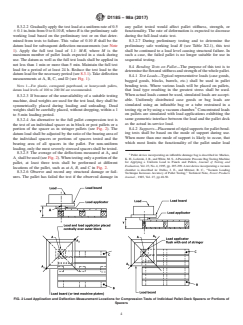
8.3.2.4 An alternative to the full pallet compression test is
as the actual in-service load.
the test of an individual spacer as in block or post pallets or a
8.4.2 Supports—Placementofrigidsupportsforpalletbend-
portion of the spacer as in stringer pallets (see Fig. 2). The
ing tests shall be based on the mode of support during use.
datum load shall be adjusted by the ratio of the bearing area of
When more than one mode of support is likely to occur, that
the individual spacers or portions of spacers tested and the
which most limits the functionality of the pallet under load
bearing area of all spacers in the pallet. For non-uniform
loading,onlythemostseverelystressedspacersshallbetested.
8.3.2.5 The average of the deflections measured at A and 5
Pallet device incorporating an inflatable dunnage bag is described in: Mackes,
A shallbeused(seeFig.2).Whentestingonlyaportionofthe
K.H.,Loferski,J.R.,andWhite,M.S.,APneumaticPressureBagTestingMachine
for Applying a Uniform Load to Panels and Pallets, Journal of Testing and
pallet, at least three tests shall be performed at different
Evaluation,Vol.23,No.4,1995,pp.295-299.Atestdeviceincorporatingavacuum
locations of the pallet, such as at A, B, and C in Fig. 2.
chamber is described in: Dallas, J. E., and Mitzner, R. C., “Vacuum Loading
8.3.2.6 Observe and record any structural damage or fail-
Technique Increases Accuracy of Pallet Testing,” Technical Note, Forest Products
ures. The pallet has failed the test if the observed damage in Journal , 1985, Vol. 27, pp 48-50.
FIG. 2 Load Application and Deflection-Measurement Locations for Compression Tests of Individual Pallet-Deck Spacers or Portions of
Spacers
D1185 − 98a (2017)
shall be used for testing. That support which limits pallet 8.4.3.4 Between the decks, similar measurements made at
functionality in bending shall be used which causes greatest Locations C, D, and E when the test is repeated along the
deflection or structural failure at the lowest load levels.This is second horizontal axis of the pallet (see 8.4.4).
typically the support that results in the greatest unsupported
8.4.4 Test Procedure:
free span. Support modes are shown in Fig. 3 and described as
8.4.4.1 For most pallets stressed in bending, the support
follows:
mode which limits functionality is the rack support or the
8.4.2.1 Fork-Tine Support—Under the top deck or in the
support under the bottom deck in double-face pallets or under
stringer notch in stringer pallets.
the top deck in single-face pallets. Under these conditions of
8.4.2.2 Rack Support—Underthebottomdeckoroutsideof
support, place the pallet top deck uppermost on rigid support
the deck spacers in wing pallets.
beams with square or semicircular cross section. If the span
8.4.2.3 Sling Support— Under the top deck, outside of the
betweenthesupportsisunknown,placetheinsideedgesofthe
deck spacers such as in wing pallets. For sling tests, support
supports (or centerline in semicircular cross-section supports)
modes shall be determined by the intended distribution cycle
51 mm (2 in.) from the outer edges of the pallet (see Fig. 4).
and the sling equipment used in that distribution environment.
8.4.4.2 Gradually apply the test load at a uniform rate from
(Test devices may include wire, tape, or chain slings and rigid,
0to0.1 R, where R is the preliminary safe working load per
round, or rectangular spreader bars.)
pallet and 0.1 R is the datum load for subsequent deflection
8.4.2.4 With the exception of very long or wide pallets,
measurements.Applythefulltestloadof1.25·M·R,where Mis
which exhibit large cantilevers beyond the supports, the rack
themaximumnumberofpalletloadsexpectedwhensupported
mode generally represents the greatest span and corresponding
or tested. Maintain the full test load for a period of at least 24
deflection.
h.
8.4.3 Deformation Measurements—When tested in accor-
8.4.4.3 Reduce the test load to the datum load for the
dance with the method specified in 8.4.4, the deflection at
necessary period (see 8.4.3) and observe the deflection mea-
Locations A, B, and C, as shown in Fig. 4, when measured
surements at Locations A, B, and C (see Fig. 4).
relative to the upper (or lower) surface of the top (or bottom)
8.4.4.4 If, because of the unavailability of a suitable testing
decks and the ground (or test frame), shall be observed and
machine, dead weights are used for the test load, they shall be
recorded as follows:
symmetrically placed during loading and unloading. Dead
8.4.3.1 At the datum load (see 8.4.4),
weightsshallbecarefullyplaced,withoutdropping,andwithin
8.4.3.2 Uponunloading,atthedatumload(see8.4.4),every
a 1 to 5-min loading period.
5 min until successive readings are practically identical (lim-
8.4.4.5 Repeat the test along the second horizontal axis of
ited to a maximum period of 1 h).
thepallet(thatis,whenbothlengthandwidtharetobetested).
8.4.3.3 The distance between the decks, h, at mid-span
A further set of deflection measurements shall be taken at
between deck spacers, measured in order to obtain data on the
Locations C, D, and E. Observe and record any damage and
minimum fork entry heights under given loads.
structural failure. The pallet has failed the test if the observed
damage in any pallet tested affects pallet stiffness, strength, or
functionality. The rate of deformation is expected to decrease
during the full-load static test.
8.4.4.6 During preliminary testing and to determine the
preliminary safe working load R (see Table X2.1), this test
shall be continued to a load level causing structural failure. In
such a case, the failed pallet shall not be used for further
testing.
8.5 Bending Tests on Pallet Decks —Under certain load and
support conditions, the flexural stiffness and strength of the
pallet top or bottom deck limits functionality. The purpose of
this test is to determine the stiffness and flexural strength of
pallet decks between supports.
8.5.1 Deflection Measurements:
8.5.1.1 When tested in accordance with 8.5.2, deflection
shall be measured in a minimum of two locations at mid-span
of the longest span between deck spacers, such as at Locations
A, B, C, and D in Fig. 5, or at the location of the concentrated
loads.
8.5.1.2 Measurements relative to the upper or lower surface
ofthedeckandtheoppositedeckortheground(ortestframe),
shall be recorded as follows:
(1)At the datum load (see 8.5.2);
FIG. 3 Support Modes for Static Pallet-Bending Test (2)At the beginning and end of the full load period;
D1185 − 98a (2017)
FIG. 4 Schematic Diagram of Pallet Bending Test Using Uniformly Distributed Load
shall be applied in not less than 1 min or more than 5 min.
Maintain the full test load in place for a period of at least 24 h.
8.5.2.2 Reduce the test load to the datum load for the
necessary period (see 8.5.1) and take the deflection measure-
ments at LocationsA, B, C, and D. This test shall be repeated
for both decks of a double-face pallet. Observe and record any
damageorstructuralf
...