

ASTM D6199-18a
(Practice)Standard Practice for Quality of Wood Members of Containers and Pallets
General Information
- Abstract
SIGNIFICANCE AND USE
4.1 Each wood member contains a combination of characteristics which affects the performance of the container or pallet in which it is used. The requirements for classes, herein specified, have been established as these characteristics are related to the functional application of members in container and pallet construction and to the service that the container or pallet may be called upon to perform.
4.2 Any other specified requirements or limitations peculiar to a particular container or pallet construction or use, such as prohibiting knotholes or loose knots to provide siftproofness, limitation to certain wood groups or species, or the selection of applicable classes for specific members of or types of containers or pallet shall be the responsibility of the standard for that container or pallet.
SCOPE
1.1 This practice covers the quality requirements for three classes of hardwood and soft-wood members, excluding man-made or fabricated wood composites, used in the construction of boxes, crates, pallets, and blocking and bracing.
1.2 The values stated in inch-pound units are to be regarded as the standard. The SI units given in parentheses are for information only.
1.3 This standard does not purport to address all of the safety concerns, if any, associated with its use. It is the responsibility of the user of this standard to establish appropriate safety, health, and environmental practices and determine the applicability of regulatory limitations prior to use.
1.4 This international standard was developed in accordance with internationally recognized principles on standardization established in the Decision on Principles for the Development of International Standards, Guides and Recommendations issued by the World Trade Organization Technical Barriers to Trade (TBT) Committee.
- Status
- Published
- Publication Date
- 30-Sep-2018
- Technical Committee
- D10 - Packaging
Overview
ASTM D6199-18a is the Standard Practice for Quality of Wood Members of Containers and Pallets, published by ASTM International. This standard provides a comprehensive framework for classifying and evaluating the quality of hardwood and softwood materials used in the construction of wooden boxes, crates, pallets, and associated structural supports. Excluding man-made wood composites, the standard addresses three classes of wood members and sets requirements based on performance, durability, and the intended function of the wood member in the container or pallet. Adhering to this standard helps ensure consistency, structural integrity, and suitability for shipping, storage, and logistics applications.
Key Topics
- Wood Member Classification: Wood members are classified into three categories according to their structural role:
- Class 1: Highly stressed structural members
- Class 2: Moderately stressed structural members
- Class 3: Non-structural, lightly stressed members
- Wood Species Grouping: North American wood species are grouped based on mechanical properties and usage suitability, ranging from soft, easy-to-work woods to dense, hard species with high fastener resistance.
- Dimensional and Surface Quality: Criteria for minimum and nominal lumber sizes, surface smoothness standards for marking, and limitations on undersizing.
- Moisture Content Requirements: Specifies acceptable moisture content ranges to prevent warping and maintain structural performance during fabrication and use.
- Defect and Imperfection Limitations: Restricts wood defects such as knots, decay, split, checks, warp, and wane, according to the class of use. Ensures defects do not compromise performance or assembly.
- Fabrication and Joint Quality: Sets requirements for built-up sheathing members and glued joints to maintain strength and durability.
- Phytosanitary Compliance: Aligns with ISPM 15 and ASTM D6253 for export and import of wood packaging materials.
Applications
ASTM D6199-18a is widely used in industries and supply chains where wooden packaging and support structures are critical. Typical applications include:
- Manufacture of Wooden Pallets and Shipping Containers: Guarantees wood member quality for reliable transportation and stacking performance.
- Design of Custom Crates and Boxes: Supports engineers and packaging designers in selecting appropriate wood species and grades for specific stress, load, and durability requirements.
- Warehousing, Logistics, and Export Operations: Ensures wood packaging complies with domestic and international quality, safety, and phytosanitary standards.
- Quality Assurance and Inspection: Provides objective criteria for wood member acceptance and rejection, simplifying inspection processes and minimizing risk of failure in use.
- Sustainable Sourcing: Guides organizations in sourcing suitable wood species and maintaining compliance with trade and regulatory requirements.
Related Standards
When implementing ASTM D6199-18a, the following standards may also be relevant:
- ASTM D9: Terminology Relating to Wood and Wood-Based Products
- ASTM D996: Terminology of Packaging and Distribution Environments
- ASTM D4442: Test Methods for Direct Moisture Content Measurement of Wood and Wood-Based Materials
- ASTM D4444: Test Method for Standardization and Calibration of Hand-Held Moisture Meters
- ASTM D6253: Practice for Treatment and/or Marking of Wood Packaging Materials
- MHIA/ANSI MH1-2016: Pallets, Slip Sheets, and Other Bases for Unit Loads
- ISPM 15: Regulation of Wood Packaging Material in International Trade (IPPC Standard)
ASTM D6199-18a is integral to effective and compliant wood packaging, supporting safety, quality, and global conformity in supply chains and logistics. Proper implementation ensures that wood containers and pallets deliver the required performance throughout their service life.
Relations
- Effective Date
- 01-Oct-2018
- Effective Date
- 01-Mar-2024
- Effective Date
- 01-Mar-2020
- Effective Date
- 01-Jul-2018
- Effective Date
- 15-Nov-2016
- Effective Date
- 01-Apr-2016
- Effective Date
- 01-Jun-2015
- Effective Date
- 01-Apr-2013
- Effective Date
- 15-Oct-2012
- Effective Date
- 01-Dec-2010
- Effective Date
- 01-Jan-2010
- Effective Date
- 15-Nov-2009
- Effective Date
- 15-Nov-2009
- Effective Date
- 01-May-2009
- Effective Date
- 01-Apr-2008
Get Certified
Connect with accredited certification bodies for this standard

BRCGS (Brand Reputation Compliance Global Standards)
Global food safety and quality standards owner.
Sponsored listings
Frequently Asked Questions
ASTM D6199-18a is a standard published by ASTM International. Its full title is "Standard Practice for Quality of Wood Members of Containers and Pallets". This standard covers: SIGNIFICANCE AND USE 4.1 Each wood member contains a combination of characteristics which affects the performance of the container or pallet in which it is used. The requirements for classes, herein specified, have been established as these characteristics are related to the functional application of members in container and pallet construction and to the service that the container or pallet may be called upon to perform. 4.2 Any other specified requirements or limitations peculiar to a particular container or pallet construction or use, such as prohibiting knotholes or loose knots to provide siftproofness, limitation to certain wood groups or species, or the selection of applicable classes for specific members of or types of containers or pallet shall be the responsibility of the standard for that container or pallet. SCOPE 1.1 This practice covers the quality requirements for three classes of hardwood and soft-wood members, excluding man-made or fabricated wood composites, used in the construction of boxes, crates, pallets, and blocking and bracing. 1.2 The values stated in inch-pound units are to be regarded as the standard. The SI units given in parentheses are for information only. 1.3 This standard does not purport to address all of the safety concerns, if any, associated with its use. It is the responsibility of the user of this standard to establish appropriate safety, health, and environmental practices and determine the applicability of regulatory limitations prior to use. 1.4 This international standard was developed in accordance with internationally recognized principles on standardization established in the Decision on Principles for the Development of International Standards, Guides and Recommendations issued by the World Trade Organization Technical Barriers to Trade (TBT) Committee.
SIGNIFICANCE AND USE 4.1 Each wood member contains a combination of characteristics which affects the performance of the container or pallet in which it is used. The requirements for classes, herein specified, have been established as these characteristics are related to the functional application of members in container and pallet construction and to the service that the container or pallet may be called upon to perform. 4.2 Any other specified requirements or limitations peculiar to a particular container or pallet construction or use, such as prohibiting knotholes or loose knots to provide siftproofness, limitation to certain wood groups or species, or the selection of applicable classes for specific members of or types of containers or pallet shall be the responsibility of the standard for that container or pallet. SCOPE 1.1 This practice covers the quality requirements for three classes of hardwood and soft-wood members, excluding man-made or fabricated wood composites, used in the construction of boxes, crates, pallets, and blocking and bracing. 1.2 The values stated in inch-pound units are to be regarded as the standard. The SI units given in parentheses are for information only. 1.3 This standard does not purport to address all of the safety concerns, if any, associated with its use. It is the responsibility of the user of this standard to establish appropriate safety, health, and environmental practices and determine the applicability of regulatory limitations prior to use. 1.4 This international standard was developed in accordance with internationally recognized principles on standardization established in the Decision on Principles for the Development of International Standards, Guides and Recommendations issued by the World Trade Organization Technical Barriers to Trade (TBT) Committee.
ASTM D6199-18a is classified under the following ICS (International Classification for Standards) categories: 55.160 - Cases. Boxes. Crates; 55.180.20 - General purpose pallets. The ICS classification helps identify the subject area and facilitates finding related standards.
ASTM D6199-18a has the following relationships with other standards: It is inter standard links to ASTM D6199-18, ASTM D6253-24, ASTM D4442-20, ASTM D4444-13(2018), ASTM D4442-16, ASTM D6253-16, ASTM D4442-15, ASTM D4444-13, ASTM D9-12, ASTM D996-10a, ASTM D6253-10, ASTM D9-09a, ASTM D9-09ae1, ASTM D9-09, ASTM D4444-08. Understanding these relationships helps ensure you are using the most current and applicable version of the standard.
ASTM D6199-18a is available in PDF format for immediate download after purchase. The document can be added to your cart and obtained through the secure checkout process. Digital delivery ensures instant access to the complete standard document.
Standards Content (Sample)
This international standard was developed in accordance with internationally recognized principles on standardization established in the Decision on Principles for the
Development of International Standards, Guides and Recommendations issued by the World Trade Organization Technical Barriers to Trade (TBT) Committee.
Designation: D6199 − 18a
Standard Practice for
Quality of Wood Members of Containers and Pallets
This standard is issued under the fixed designation D6199; the number immediately following the designation indicates the year of
original adoption or, in the case of revision, the year of last revision. A number in parentheses indicates the year of last reapproval. A
superscript epsilon (´) indicates an editorial change since the last revision or reapproval.
This standard has been approved for use by agencies of the U.S. Department of Defense.
1. Scope 2.2 MHIA/ANSI Standard:
MHIA/ANSI MH1–2016 Pallets, Slip Sheets, and Other
1.1 This practice covers the quality requirements for three
Bases for Unit Loads
classes of hardwood and soft-wood members, excluding man-
made or fabricated wood composites, used in the construction 2.3 IPPC Standard:
of boxes, crates, pallets, and blocking and bracing. ISPM 15 Regulation of Wood Packaging Material in Inter-
national Trade
1.2 The values stated in inch-pound units are to be regarded
as the standard. The SI units given in parentheses are for
3. Terminology
information only.
3.1 Definitions—General definitions for packaging and dis-
1.3 This standard does not purport to address all of the
tribution environments are found in Terminology D996. Gen-
safety concerns, if any, associated with its use. It is the
eral definitions for wood are found in Terminology D9.
responsibility of the user of this standard to establish appro-
priate safety, health, and environmental practices and deter-
3.2 Definitions of Terms Specific to This Standard:
mine the applicability of regulatory limitations prior to use.
3.2.1 brash, n—decay characteristic, which is the breaking
1.4 This international standard was developed in accor-
of the grain without splintering.
dance with internationally recognized principles on standard-
3.2.2 crate frame members, n—those parts which form the
ization established in the Decision on Principles for the
fundamental structure upon which the strength and rigidity of
Development of International Standards, Guides and Recom-
crates depend.
mendations issued by the World Trade Organization Technical
Barriers to Trade (TBT) Committee.
3.2.3 diagonals, n—frame members placed at angles of
nearly45°tootherframemembers,toensuretherigidityofthe
2. Referenced Documents
crate.
2.1 ASTM Standards:
3.2.4 linderman joint, n—glued dove-tailed joint between
D9 Terminology Relating to Wood and Wood-Based Prod-
two or more pieces of wood.
ucts
3.2.5 longitudinal frame members, n—horizontal members
D996 Terminology of Packaging and Distribution Environ-
of the side, end, and top panels of crates.
ments
D4442 Test Methods for Direct Moisture Content Measure-
3.2.6 punk, n—decay characteristic, which is very dry,
ment of Wood and Wood-Based Materials
powdery, and crumbly wood.
D4444 Test Method for Laboratory Standardization and
3.2.7 siftproofness, n—the prohibition of the migration of
Calibration of Hand-Held Moisture Meters
material, of any size, from the interior to the exterior of a
D6253 Practice for Treatment and/or Marking of Wood
container.
Packaging Materials
3.2.8 struts, n—vertical frame members placed between the
upper and lower frame members of the side and end panels of
This practice is under the jurisdiction ofASTM Committee D10 on Packaging
a crate that serve as columns for supporting vertical stacking
and is the direct responsibility of Subcommittee D10.12 on Shipping Containers,
loads.
Crates, Pallets, Skids and Related Structures.
Current edition approved Oct. 1, 2018. Published November 2018. Originally
approved in 1997. Last previous edition approved in 2018 as D6199 – 18. DOI:
10.1520/D6199-18A.
2 3
For referenced ASTM standards, visit the ASTM website, www.astm.org, or Available from Material Handling Industry MH1 Secretariat, 8720 Red Oak
contact ASTM Customer Service at service@astm.org. For Annual Book of ASTM Blvd., Suite 201, Charlotte, NC 28217, http://www.mhiastore.org.
Standards volume information, refer to the standard’s Document Summary page on International Plant Protection Convention Secretariat (IPPC),Viale delleTerme
the ASTM website. di Caracalla 00153 Rome, Italy, https://www.ippc.int/en/.
Copyright © ASTM International, 100 Barr Harbor Drive, PO Box C700, West Conshohocken, PA 19428-2959. United States
D6199 − 18a
4. Significance and Use have a greater fastener withdrawal resistance than Group I
woods, but are more likely to split, and the hard summerwood
4.1 Each wood member contains a combination of charac-
bands occasionally deflect the nails causing them to run out at
teristics which affects the performance of the container or
the sides of the piece.
pallet in which it is used. The requirements for classes, herein
6.1.1.3 Group III—This group consists of hardwoods of
specified, have been established as these characteristics are
medium density. These woods have about the same fastener
related to the functional application of members in container
withdrawal resistance and strength as a beam as the Group II
and pallet construction and to the service that the container or
woods, but are less likely to split and shatter under impacts.
pallet may be called upon to perform.
The species in this group are the most useful for constructing
4.2 Any other specified requirements or limitations peculiar
box ends and cleats. They also furnish most of the rotary-cut
to a particular container or pallet construction or use, such as
veneers for wirebound boxes and plywood panels for construc-
prohibiting knotholes or loose knots to provide siftproofness,
tion of plywood boxes.
limitation to certain wood groups or species, or the selection of
6.1.1.4 Group IV—This group consists of the high density
applicable classes for specific members of or types of contain-
hardwood species. They have both the greatest shock resisting
ers or pallet shall be the responsibility of the standard for that
capacity and fastener withdrawal resistance, but because of
container or pallet.
their extreme hardness present difficulties with respect to the
driving of nails, plus the greatest tendency to split at the nails.
5. Wood Member Classification
They are the heaviest and hardest domestic woods and are
5.1 Class 1—Structural (highly stressed members).
difficult to work. They are especially useful where high
5.2 Class 2—Structural (moderately stressed members).
fastener withdrawal resistance is required and many of them
make excellent rotary cut veneers for wirebound and plywood
5.3 Class 3—Non-structural (lightly stressed members).
boxes.
6. Wood Characteristics
6.1.2 Species—The species of wood, in the four groups, that
may be used for wood members of containers or pallets are
6.1 Classification:
classified as indicated in Table 1 (see Appendix X1, Table
6.1.1 Groups—For the purposes of this practice, North
X1.1, for groups specific to pallet construction). When it is
American wood species are broken into four groupings. These
stipulated that members shall be fabricated from a particular
groupings are general in nature (Table 1) and do not include all
wood group, the species within that group may be mixed
species of wood.Woods used specifically in pallet construction
together or used interchangeably.
are listed in MHIA/ANSI MH1–2016 Annex B according to
similarities in mechanical properties, regional availability, and
6.2 Surfaces—Rough lumber is permitted in the construc-
commercial uses in pallets. Table X1.1 provides a cross
tion of the crate bases, sheathed-crate framing, boxes, and
reference between the wood groups used herein and those
pallets. For box and crate sheathing, at least one surface of all
listed in MHIA/ANSI MH1–2016.
wood members will be sufficiently smooth to permit legible
6.1.1.1 Group I—This group embraces the softer woods of
marking.
both the coniferous and the broad-leafed species. These woods
6.3 Dimensional Requirements:
are relatively free from splitting in nailing, have moderate
6.3.1 When nominal sizes of lumber are specified, the
fastener withdrawal resistance, moderate strength as a beam,
minimum sizes shall be as shown in Table 2.
and moderate shock resisting capacity. They are soft, light in
weight,easytowork,holdtheirshapewellinmanufacture,and 6.3.2 When sizes of wood members other than the nominals
are normally easy to dry. cited in Table 2 are specified, undersizing in thickness and
6.1.1.2 Group II—This group consists of heavier coniferous width shall not be permitted in more than 10 % of the number
woods, only. These woods usually have a pronounced contrast of pieces. In addition, these parts shall be no thinner than ⁄8 of
the stated thickness and no narrower than ⁄4 in. (6 mm) less
in the hardness of the springwood and the summerwood. They
TABLE 1 Wood Groups
Group I
Aspen Basswood Buckeye Cedar Chestnut
A
Cottonwood Cypress Fir (true firs) Magnolia Pine
Redwood Spruce Willow Yellow poplar Red alder
Group II
Douglas fir Hemlock Southern yellow pine Tamarack
Western larch
Group III
B
Ash California black oak California maple
Soft Elm Soft maple Sweetgum Sycamore Tupelo
Group IV
Beech Birch Hackberry Hard maple Hickory
Oak Pecan Rock elm White ash
A
Except Southern yellow pine.
B
Except White ash.
D6199 − 18a
TABLE 2 Relationship of Nominal to Minimum Dimensions for
areas are usually abnormally brown, bleached looking, or
Dry Lumbers
mottled and indicated by the absence of luster that is present in
Thickness Width
normal wood.
(Smaller Dimension) (Larger Dimension)
6.5.2 Checks, Splits, and Shakes—Checks, splits, and
Nominal Minimum Nominal Minimum
shakes that are not longer than the width of the member will be
in. (mm) in. (mm) in. (mm) in. (mm)
permitted. Checks that do not extend through the full thickness
3 1
1 (25) ⁄4 (20) 2 (50) 1 ⁄2 (40)
1 1
of the member are permitted.
2 (50) 1 ⁄2 (40) 3 (75) 2
...
This document is not an ASTM standard and is intended only to provide the user of an ASTM standard an indication of what changes have been made to the previous version. Because
it may not be technically possible to adequately depict all changes accurately, ASTM recommends that users consult prior editions as appropriate. In all cases only the current version
of the standard as published by ASTM is to be considered the official document.
Designation: D6199 − 18 D6199 − 18a
Standard Practice for
Quality of Wood Members of Containers and Pallets
This standard is issued under the fixed designation D6199; the number immediately following the designation indicates the year of
original adoption or, in the case of revision, the year of last revision. A number in parentheses indicates the year of last reapproval. A
superscript epsilon (´) indicates an editorial change since the last revision or reapproval.
This standard has been approved for use by agencies of the U.S. Department of Defense.
1. Scope
1.1 This practice covers the quality requirements for three classes of hardwood and soft-wood members, excluding man-made
or fabricated wood composites, used in the construction of boxes, crates, pallets, and blocking and bracing.
1.2 The values stated in inch-pound units are to be regarded as the standard. The SI units given in parentheses are for
information only.
1.3 This standard does not purport to address all of the safety concerns, if any, associated with its use. It is the responsibility
of the user of this standard to establish appropriate safety, health, and environmental practices and determine the applicability of
regulatory limitations prior to use.
1.4 This international standard was developed in accordance with internationally recognized principles on standardization
established in the Decision on Principles for the Development of International Standards, Guides and Recommendations issued
by the World Trade Organization Technical Barriers to Trade (TBT) Committee.
2. Referenced Documents
2.1 ASTM Standards:
D9 Terminology Relating to Wood and Wood-Based Products
D996 Terminology of Packaging and Distribution Environments
D4442 Test Methods for Direct Moisture Content Measurement of Wood and Wood-Based Materials
D4444 Test Method for Laboratory Standardization and Calibration of Hand-Held Moisture Meters
D6253 Practice for Treatment and/or Marking of Wood Packaging Materials
2.2 MHIA/ANSI Standard:
MHIA/ANSI MH1–2005MH1–2016 Pallets, Slip Sheets, and Other Bases for Unit Loads
2.3 IPPC Standard:
ISPM 15 Regulation of Wood Packaging Material in International Trade
3. Terminology
3.1 Definitions—General definitions for packaging and distribution environments are found in Terminology D996. General
definitions for wood are found in Terminology D9.
3.2 Definitions of Terms Specific to This Standard:
3.2.1 brash, n—decay characteristic, which is the breaking of the grain without splintering.
3.2.2 crate frame members, n—those parts which form the fundamental structure upon which the strength and rigidity of crates
depend.
3.2.3 diagonals, n—frame members placed at angles of nearly 45° to other frame members, to ensure the rigidity of the crate.
3.2.4 linderman joint, n—glued dove-tailed joint between two or more pieces of wood.
This practice is under the jurisdiction of ASTM Committee D10 on Packaging and is the direct responsibility of Subcommittee D10.12 on Shipping Containers, Crates,
Pallets, Skids and Related Structures.
Current edition approved March 1, 2018Oct. 1, 2018. Published April 2018November 2018. Originally approved in 1997. Last previous edition approved in 20122018
as D6199 – 07 (2012).D6199 – 18. DOI: 10.1520/D6199-18.10.1520/D6199-18A.
For referenced ASTM standards, visit the ASTM website, www.astm.org, or contact ASTM Customer Service at service@astm.org. For Annual Book of ASTM Standards
volume information, refer to the standard’s Document Summary page on the ASTM website.
Available from Material Handling Industry MH1 Secretariat, 8720 Red Oak Blvd., Suite 201, Charlotte, NC 28217, http://www.mhiastore.org.
International Plant Protection Convention Secretariat (IPPC), Viale delle Terme di Caracalla 00153 Rome, Italy, https://www.ippc.int/en/.
Copyright © ASTM International, 100 Barr Harbor Drive, PO Box C700, West Conshohocken, PA 19428-2959. United States
D6199 − 18a
3.2.5 longitudinal frame members, n—horizontal members of the side, end, and top panels of crates.
3.2.6 punk, n—decay characteristic, which is very dry, powdery, and crumbly wood.
3.2.7 siftproofness, n—the prohibition of the migration of material, of any size, from the interior to the exterior of a container.
3.2.8 struts, n—vertical frame members placed between the upper and lower frame members of the side and end panels of a crate
that serve as columns for supporting vertical stacking loads.
4. Significance and Use
4.1 Each wood member contains a combination of characteristics which affects the performance of the container or pallet in
which it is used. The requirements for classes, herein specified, have been established as these characteristics are related to the
functional application of members in container and pallet construction and to the service that the container or pallet may be called
upon to perform.
4.2 Any other specified requirements or limitations peculiar to a particular container or pallet construction or use, such as
prohibiting knotholes or loose knots to provide siftproofness, limitation to certain wood groups or species, or the selection of
applicable classes for specific members of or types of containers or pallet shall be the responsibility of the standard for that
container or pallet.
5. Wood Member Classification
5.1 Class 1—Structural (highly stressed members).
5.2 Class 2—Structural (moderately stressed members).
5.3 Class 3—Non-structural (lightly stressed members).
6. Wood Characteristics
6.1 Classification:
6.1.1 Groups—For the purposes of this practice, North American wood species are broken into four groupings. These groupings
are general in nature (Table 1) and do not include all species of wood. Woods used specifically in pallet construction are listed in
MHIA/ANSI MH1–2005 Appendix A3–1MH1–2016 Annex B according to similarities in mechanical properties, regional
availability, and commercial uses in pallets. Table X1.1 provides a cross reference between the wood groups used herein and those
listed in MHIA/ANSI MH1–2005.MH1–2016.
6.1.1.1 Group I—This group embraces the softer woods of both the coniferous and the broad-leafed species. These woods are
relatively free from splitting in nailing, have moderate fastener withdrawal resistance, moderate strength as a beam, and moderate
shock resisting capacity. They are soft, light in weight, easy to work, hold their shape well in manufacture, and are normally easy
to dry.
6.1.1.2 Group II—This group consists of heavier coniferous woods, only. These woods usually have a pronounced contrast in
the hardness of the springwood and the summerwood. They have a greater fastener withdrawal resistance than Group I woods, but
are more likely to split, and the hard summerwood bands occasionally deflect the nails causing them to run out at the sides of the
piece.
6.1.1.3 Group III—This group consists of hardwoods of medium density. These woods have about the same fastener withdrawal
resistance and strength as a beam as the Group II woods, but are less likely to split and shatter under impacts. The species in this
group are the most useful for constructing box ends and cleats. They also furnish most of the rotary-cut veneers for wirebound
boxes and plywood panels for construction of plywood boxes.
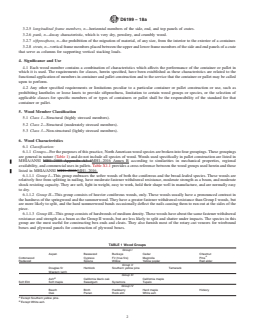
TABLE 1 Wood Groups
Group I
Aspen Basswood Buckeye Cedar Chestnut
A
Cottonwood Cypress Fir (true firs) Magnolia Pine
Redwood Spruce Willow Yellow poplar Red alder
Group II
Douglas fir Hemlock Southern yellow pine Tamarack
Western larch
Group III
B
Ash California black oak California maple
Soft Elm Soft maple Sweetgum Sycamore Tupelo
Group IV
Beech Birch Hackberry Hard maple Hickory
Oak Pecan Rock elm White ash
A
Except Southern yellow pine.
B
Except White ash.
D6199 − 18a
6.1.1.4 Group IV—This group consists of the high density hardwood species. They have both the greatest shock resisting
capacity and fastener withdrawal resistance, but because of their extreme hardness present difficulties with respect to the driving
of nails, plus the greatest tendency to split at the nails. They are the heaviest and hardest domestic woods and are difficult to work.
They are especially useful where high fastener withdrawal resistance is required and many of them make excellent rotary cut
veneers for wirebound and plywood boxes.
6.1.2 Species—The species of wood, in the four groups, that may be used for wood members of containers or pallets are
classified as indicated in Table 1 (see Appendix X1, Table X1.1, for groups specific to pallet construction). When it is stipulated
that members shall be fabricated from a particular wood group, the species within that group may be mixed together or used
interchangeably.
6.2 Surfaces—Rough lumber is permitted in the construction of the crate bases, sheathed-crate framing, boxes, and pallets. For
box and crate sheathing, at least one surface of all wood members will be sufficiently smooth to permit legible marking.
6.3 Dimensional Requirements:
6.3.1 When nominal sizes of lumber are specified, the minimum sizes shall be as shown in Table 2.
6.3.2 When sizes of wood members other than the nominals cited in Table 2 are specified, undersizing in thickness and width
shall not be permitted in more than 10 % of the number of pieces. In addition, these parts shall be no thinner than ⁄8 of the stated
thickness and no narrower than ⁄4 in. (6 mm) less than the stated width. An exception to this requirement is that if members of
nailed-wood boxes ⁄8 in. (10 mm) or more in thickness are surfaced on both sides (to protect the contents) then the thickness may
be ⁄32 in. (1 mm) less than stated.
6.3.3 When nominal 2 in. (50 mm) thick lumber is resawn to obtain 1 in. (25 mm) nominal thick members, the resulting
11 3
minimum thickness shall be ⁄16 in. (18 mm) for dry lumber; except that for Class 1 structural members, which shall be ⁄4 in. (20
mm).
6.4 Moisture Content—Container and pallet members shall have a moisture content (as measured by an electric type moisture
me
...