

ASTM D6253-24
(Practice)Standard Practice for Treatment and/or Marking of Wood Packaging Materials
General Information
- Abstract
SIGNIFICANCE AND USE
4.1 This practice establishes the criteria to treat, or mark, or both WPM with permanent identification for the phytosanitary treatment, or intended service cycle, or both, repair, specification used, and other designated characteristics.
4.2 The marking of the WPM shall be performed after ensuring the material complies with the applicable specification.
SCOPE
1.1 This practice covers the development of recommended treatment, or marking practices, or both, for wood packaging materials (WPM) and aids in identifying WPM as to phytosanitary treatment, intended service cycles, repair, the specific specification used to manufacture or recycle, and other user designated characteristics.
1.2 This practice identifies WPM treated, or marked, or both in accordance with industry, government, or international recognized standards.
1.3 The values stated in inch-pound units are to be regarded as standard. The values given in parentheses are mathematical conversions to SI units that are provided for information only and are not considered standard.
1.4 This standard does not purport to address all of the safety concerns, if any, associated with its use. It is the responsibility of the user of this standard to establish appropriate safety, health, and environmental practices and determine the applicability of regulatory limitations prior to use.
1.5 This international standard was developed in accordance with internationally recognized principles on standardization established in the Decision on Principles for the Development of International Standards, Guides and Recommendations issued by the World Trade Organization Technical Barriers to Trade (TBT) Committee.
- Status
- Published
- Publication Date
- 29-Feb-2024
- Technical Committee
- D10 - Packaging
Overview
ASTM D6253-24: Standard Practice for Treatment and/or Marking of Wood Packaging Materials establishes key criteria for the effective treatment and permanent marking of wood packaging materials (WPM). This standard supports the identification of WPM with respect to phytosanitary treatment status, intended service cycle, repair history, applicable specifications, and other relevant characteristics. It is widely recognized by industry, government, and international stakeholders and enhances the safety, traceability, and compliance of wooden packaging throughout the supply chain.
ASTM D6253-24 plays a critical role in global trade by ensuring that WPM such as pallets, crates, boxes, and other wooden shipping containers meet recognized sanitary and durability standards. Adherence to this standard helps prevent the spread of pests and facilitates the safe and efficient transportation of goods.
Key Topics
Phytosanitary Treatment Identification
- Outlines procedures for marking WPM that is treated to meet phytosanitary measures, such as heat treatment (HT), dielectric heating (DH), methyl bromide fumigation (MB), or sulfuryl fluoride fumigation (SF).
- Mandates internationally recognizable stamps or marks, including the IPPC logo and required codes, per ISPM 15 regulations.
Marking Practices and Durability
- Specifies permanent and legible marking requirements for indicating service cycles (single-use, multiple-use, repaired), date of manufacture/repair, and applicable specification codes.
- Calls for marks that endure for the expected service life of the packaging material.
Specification and Compliance
- Requires that marking be applied only after verifying compliance with the relevant specifications and treatments.
- Addresses marking and identification for specific container types, such as crates, palletized boxes, and wirebound shipping containers.
Health, Safety, and Environmental Considerations
- Emphasizes the end user’s responsibility for ensuring safety, health, and environmental practices when applying treatments and markings.
- Stresses compliance with regulatory limitations, including the safe use of chemical preservatives where applicable.
Applications
ASTM D6253-24 is essential across multiple sectors involved in the manufacture, treatment, and use of wood packaging, including:
- International Shipping and Export: Ensures WPM meets global phytosanitary requirements such as ISPM 15, reducing the risk of pest transmission and customs delays.
- Logistics and Warehousing: Enables clear identification of pallets and containers as reusable, single-use, or repaired, improving management and lifecycle control.
- Manufacturing and Recycling: Guides manufacturers and recyclers on compliant marking of new and reused wood packaging, supporting quality assurance.
- Military and Industrial Packaging: Specifies requirements for government and military shipments utilizing treated and marked wood crates or containers.
- Inspection and Audit: Assists certifying and inspection agencies in the verification of treatment and marking processes across supply chains.
Related Standards
Practitioners referencing ASTM D6253-24 should also consult the following standards for comprehensive guidance:
- ASTM D996 - Terminology of Packaging and Distribution Environments
- ASTM D6039/D6039M - Specification for Open and Covered Wood Crates
- ASTM D6251/D6251M - Specification for Wood-Cleated Panelboard Shipping Boxes
- ASTM D6254/D6254M - Specification for Wirebound Pallet-Type Wood Boxes
- ASTM D6255/D6255M - Specification for Steel or Aluminum Slotted Angle Crates
- ASTM D6256/D6256M - Specification for Wood-Cleated Shipping Boxes with Skidded, Load-Bearing Bases
- ASTM D6573/D6573M - Specification for General Purpose Wirebound Shipping Boxes
- ISPM 15 - International Standards for Phytosanitary Measures (Regulation of Wood Packaging Material in International Trade)
- AWPA P8-03, P9-03 - Standards for Wood Preservatives and Formulations
- MHIA MH1–2005 - Pallets, Slip Sheets, and Other Bases for Unit Loads
- NFPA 704 - Identification of Hazards of Materials for Emergency Response
By following ASTM D6253-24 and relevant related standards, organizations can ensure their wood packaging materials are both compliant and optimized for international use, safety, and sustainability.
Keywords: wood packaging materials, WPM, ASTM D6253-24, marking, phytosanitary treatment, pallets, crates, ISPM 15, heat treatment, fumigation, logistics, export compliance, quality assurance.
Relations
- Effective Date
- 01-Mar-2024
- Effective Date
- 01-Mar-2024
- Referred By
ASTM D6573/D6573M-13(2020) - Standard Specification for General Purpose Wirebound Shipping Boxes - Effective Date
- 01-Mar-2024
- Effective Date
- 01-Mar-2024
- Effective Date
- 01-Mar-2024
- Effective Date
- 01-Mar-2024
- Effective Date
- 01-Mar-2024
- Effective Date
- 01-Mar-2024
- Effective Date
- 01-Mar-2024
- Effective Date
- 01-Mar-2024
Get Certified
Connect with accredited certification bodies for this standard

BRCGS (Brand Reputation Compliance Global Standards)
Global food safety and quality standards owner.
Sponsored listings
Frequently Asked Questions
ASTM D6253-24 is a standard published by ASTM International. Its full title is "Standard Practice for Treatment and/or Marking of Wood Packaging Materials". This standard covers: SIGNIFICANCE AND USE 4.1 This practice establishes the criteria to treat, or mark, or both WPM with permanent identification for the phytosanitary treatment, or intended service cycle, or both, repair, specification used, and other designated characteristics. 4.2 The marking of the WPM shall be performed after ensuring the material complies with the applicable specification. SCOPE 1.1 This practice covers the development of recommended treatment, or marking practices, or both, for wood packaging materials (WPM) and aids in identifying WPM as to phytosanitary treatment, intended service cycles, repair, the specific specification used to manufacture or recycle, and other user designated characteristics. 1.2 This practice identifies WPM treated, or marked, or both in accordance with industry, government, or international recognized standards. 1.3 The values stated in inch-pound units are to be regarded as standard. The values given in parentheses are mathematical conversions to SI units that are provided for information only and are not considered standard. 1.4 This standard does not purport to address all of the safety concerns, if any, associated with its use. It is the responsibility of the user of this standard to establish appropriate safety, health, and environmental practices and determine the applicability of regulatory limitations prior to use. 1.5 This international standard was developed in accordance with internationally recognized principles on standardization established in the Decision on Principles for the Development of International Standards, Guides and Recommendations issued by the World Trade Organization Technical Barriers to Trade (TBT) Committee.
SIGNIFICANCE AND USE 4.1 This practice establishes the criteria to treat, or mark, or both WPM with permanent identification for the phytosanitary treatment, or intended service cycle, or both, repair, specification used, and other designated characteristics. 4.2 The marking of the WPM shall be performed after ensuring the material complies with the applicable specification. SCOPE 1.1 This practice covers the development of recommended treatment, or marking practices, or both, for wood packaging materials (WPM) and aids in identifying WPM as to phytosanitary treatment, intended service cycles, repair, the specific specification used to manufacture or recycle, and other user designated characteristics. 1.2 This practice identifies WPM treated, or marked, or both in accordance with industry, government, or international recognized standards. 1.3 The values stated in inch-pound units are to be regarded as standard. The values given in parentheses are mathematical conversions to SI units that are provided for information only and are not considered standard. 1.4 This standard does not purport to address all of the safety concerns, if any, associated with its use. It is the responsibility of the user of this standard to establish appropriate safety, health, and environmental practices and determine the applicability of regulatory limitations prior to use. 1.5 This international standard was developed in accordance with internationally recognized principles on standardization established in the Decision on Principles for the Development of International Standards, Guides and Recommendations issued by the World Trade Organization Technical Barriers to Trade (TBT) Committee.
ASTM D6253-24 is classified under the following ICS (International Classification for Standards) categories: 55.180.99 - Other standards related to freight distribution of goods. The ICS classification helps identify the subject area and facilitates finding related standards.
ASTM D6253-24 has the following relationships with other standards: It is inter standard links to ASTM D6253-16, ASTM D6251/D6251M-23, ASTM D6573/D6573M-13(2020), ASTM D6254/D6254M-20, ASTM D6256/D6256M-16, ASTM D6199-18a, ASTM D7478/D7478M-11(2017), ASTM D6880/D6880M-19, ASTM D6255/D6255M-18, ASTM D6039/D6039M-18. Understanding these relationships helps ensure you are using the most current and applicable version of the standard.
ASTM D6253-24 is available in PDF format for immediate download after purchase. The document can be added to your cart and obtained through the secure checkout process. Digital delivery ensures instant access to the complete standard document.
Standards Content (Sample)
This international standard was developed in accordance with internationally recognized principles on standardization established in the Decision on Principles for the
Development of International Standards, Guides and Recommendations issued by the World Trade Organization Technical Barriers to Trade (TBT) Committee.
Designation: D6253 − 24
Standard Practice for
Treatment and/or Marking of Wood Packaging Materials
This standard is issued under the fixed designation D6253; the number immediately following the designation indicates the year of
original adoption or, in the case of revision, the year of last revision. A number in parentheses indicates the year of last reapproval. A
superscript epsilon (´) indicates an editorial change since the last revision or reapproval.
1. Scope D6254/D6254M Specification for Wirebound Pallet-Type
Wood Boxes
1.1 This practice covers the development of recommended
D6255/D6255M Specification for Steel or Aluminum Slot-
treatment, or marking practices, or both, for wood packaging
ted Angle Crates
materials (WPM) and aids in identifying WPM as to phytosani-
D6256/D6256M Specification for Wood-Cleated Shipping
tary treatment, intended service cycles, repair, the specific
Boxes with Skidded, Load-Bearing Bases
specification used to manufacture or recycle, and other user
D6573/D6573M Specification for General Purpose Wire-
designated characteristics.
bound Shipping Boxes
1.2 This practice identifies WPM treated, or marked, or both
2.2 MHIA Standard :
in accordance with industry, government, or international
MHIA MH1–2005 Pallets, Slip Sheets, and Other Bases for
recognized standards.
Unit Loads
1.3 The values stated in inch-pound units are to be regarded 4
2.3 Military Standard :
as standard. The values given in parentheses are mathematical
MIL-DTL-2427 Detail Specification, Box, Ammunition
conversions to SI units that are provided for information only
Packaging: Wood, Nailed
and are not considered standard.
2.4 NFPA Standard :
1.4 This standard does not purport to address all of the
NFPA 704, Standard System for Identification of Hazards of
safety concerns, if any, associated with its use. It is the
Materials for Emergency Response
responsibility of the user of this standard to establish appro-
2.5 International Standard :
priate safety, health, and environmental practices and deter-
International Standards for Phytosanitary Measures (ISPM)
mine the applicability of regulatory limitations prior to use.
Publication No. 15, Regulation of Wood Packaging Mate-
1.5 This international standard was developed in accor-
rial in International Trade
dance with internationally recognized principles on standard-
ization established in the Decision on Principles for the
3. Terminology
Development of International Standards, Guides and Recom-
3.1 Definitions—General definitions for the packaging and
mendations issued by the World Trade Organization Technical
distribution environments are found in Terminology D996.
Barriers to Trade (TBT) Committee.
3.2 Definitions of Terms Specific to This Standard:
2. Referenced Documents
3.2.1 certifying or inspection agency, n—a qualified inde-
2.1 ASTM Standards:
pendent agency providing an audit service to verify the
D996 Terminology of Packaging and Distribution Environ-
manufacturer or recycler has complied with government or
ments
industry-recognized programs.
D6039/D6039M Specification for Open and Covered Wood
3.2.2 dielectric heat treatment (DH), n—heating of WPM
Crates
using dielectric heating in accordance with a specific time-
D6251/D6251M Specification for Wood-Cleated Panelboard
temperature schedule that achieves a minimum wood core
Shipping Boxes
temperature of 60°C for a minimum of 1 continuous minute.
This practice is under the jurisdiction of ASTM Committee D10 on Packaging
and is the direct responsibility of Subcommittee D10.12 on Shipping Containers,
Crates, Pallets, Skids and Related Structures. Available from Material Handling Industry of America (MHIA), 8720 Red Oak
Current edition approved March 1, 2024. Published April 2024. Originally Blvd., Suite 201, Charlotte, NC 28217–3992, http://www.mhia.org.
approved in 1998. Last previous edition approved in 2016 as D6253 – 16. DOI: Available from Document Automation and Production Service, Building 4/D,
10.1520/D6253-24. 700 Robbins Avenue, Philadelphia, PA 19111-5094, http://assist.daps.dla.mil/
For referenced ASTM standards, visit the ASTM website, www.astm.org, or quicksearch.
contact ASTM Customer Service at service@astm.org. For Annual Book of ASTM Available from National Fire Protection Association (NFPA), 1 Batterymarch
Standards volume information, refer to the standard’s Document Summary page on Park, Quincy, MA 02269-9101.
the ASTM website. Available from the International Plant Protection Convetion, www.ippc.int.
Copyright © ASTM International, 100 Barr Harbor Drive, PO Box C700, West Conshohocken, PA 19428-2959. United States
D6253 − 24
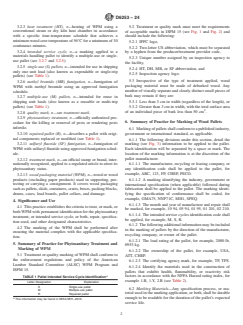
3.2.3 heat treatment (HT), n—heating of WPM using a 5.2 Treatment or quality mark must meet the requirements
conventional steam or dry kiln heat chamber in accordance of acceptable marks in ISPM 15 (see Fig. 1 and Fig. 2) and
with a specific time-temperature schedule that achieves a should include the following:
minimum wood core temperature of 56°C for a minimum of 30
5.2.1 IPPC logo,
continuous minutes.
5.2.2 Two-letter US abbreviation, which must be separated
3.2.4 intended service cycle, n—a marking applied to a
by a hyphen from the producer/treatment provider code,
materials handling pallet to identify a multiple-use or single-
5.2.3 Unique number assigned by an inspection agency to
use pallet (see 3.2.7 and 3.2.5).
the facility,
3.2.5 single-use (S) pallets, n—intended for use in shipping
5.2.4 HT, DH, MB, or SF abbreviation, and
only one unit load (also known as expendable or single-trip
5.2.5 Inspection agency logo.
pallets) (see Table 1).
5.3 Irrespective of the type of treatment applied, wood
3.2.6 methyl bromide (MB) fumigation, n—fumigation of
packaging material must be made of debarked wood. Any
WPM with methyl bromide using an approved fumigation
number of visually separate and clearly distinct small pieces of
schedule.
bark may remain if they are:
3.2.7 multiple-use (M) pallets, n—intended for reuse in
5.3.1 Less than 3 cm in width (regardless of the length), or
shipping unit loads (also known as a reusable or multi-trip
pallets) (see Table 1).
5.3.2 Greater than 3 cm in width, with the total surface area
of an individual piece of bark less than 50 cm .
3.2.8 quality mark, n—see treatment mark.
3.2.9 phytosanitary treatment, n—officially authorized pro-
6. Summary of Practice for Marking of Wood Pallets
cedure for the killing or removal of pests or rendering pests
infertile.
6.1 Marking of pallets shall conform to a published industry,
3.2.10 repaired-pallet (R), n—describes a pallet with origi- government or international standard, as applicable.
nal components replaced or modified (see Table 1).
6.1.1 The following divisions under this section, detail the
3.2.11 sulfuryl fluoride (SF) fumigation, n—fumigation of marking (see Fig. 3) information to be applied to the pallet.
WPM with sulfuryl fluoride using approved fumigation sched-
Each identification will be separated by a space or mark. The
ule. location of the marking information is at the discretion of the
pallet manufacturer.
3.2.12 treatment mark, n—an official stamp or brand, inter-
nationally recognized, applied to a regulated article to attest its 6.1.1.1 The manufacturer, recycling or leasing company, or
phytosanitary status. any identification code shall be applied to the pallet, for
example, ABC, 123, FP, CHEP, PECO.
3.2.13 wood packaging material (WPM), n—wood or wood
products (excluding paper products) used in supporting, pro- 6.1.1.2 A marking identifying the industry, government or
tecting or carrying a consignment. It covers wood packaging
international specification (when applicable) followed during
such as pallets, skids, containers, crates, boxes, packing blocks, fabrication shall be applied to the pallet. The marking identi-
drums, cases, load boards, pallet collars, and dunnage.
fying the specification of conformance shall be coded, for
example, GMA75, NNP71C, MH1, SPEQ.
4. Significance and Use
6.1.1.3 The month and year of manufacture and repair shall
4.1 This practice establishes the criteria to treat, or mark, or
be marked, for example, 10 94, 05 94, 01 95, 01 201, 02 210.
both WPM with permanent identification for the phytosanitary
6.1.1.4 The intended service cycles identification code shall
treatment, or intended service cycle, or both, repair, specifica-
be applied, for example, M, S, R.
tion used, and other designated characteristics.
6.1.2 The following additional information may be included
4.2 The marking of the WPM shall be performed after
in the marking of pallets by the direction of the manufacturer,
ensuring the material complies with the applicable specifica-
recycling company, or owner of the pallet.
tion.
6.1.2.1 The load rating of the pallet, for example, 2000 lb,
5. Summary of Practice for Phytosanitary Treatment and
0953 kg.
Marking of WPM
6.1.2.2 The ownership of the pallet, for
...
This document is not an ASTM standard and is intended only to provide the user of an ASTM standard an indication of what changes have been made to the previous version. Because
it may not be technically possible to adequately depict all changes accurately, ASTM recommends that users consult prior editions as appropriate. In all cases only the current version
of the standard as published by ASTM is to be considered the official document.
Designation: D6253 − 16 D6253 − 24
Standard Practice for
Treatment and/or Marking of Wood Packaging Materials
This standard is issued under the fixed designation D6253; the number immediately following the designation indicates the year of
original adoption or, in the case of revision, the year of last revision. A number in parentheses indicates the year of last reapproval. A
superscript epsilon (´) indicates an editorial change since the last revision or reapproval.
1. Scope
1.1 This practice covers the development of recommended treatment, or marking practices, or both, for wood packaging materials
(WPM) and aids in identifying WPM as to phytosanitary treatment, intended service cycles, repair, the specific specification used
to manufacture or recycle, and other user designated characteristics.
1.2 This practice identifies WPM treated, or marked, or both in accordance with industry, government, or international recognized
standards.
1.3 The values stated in inch-pound units are to be regarded as standard. The values given in parentheses are mathematical
conversions to SI units that are provided for information only and are not considered standard.
1.4 This standard does not purport to address all of the safety concerns, if any, associated with its use. It is the responsibility
of the user of this standard to establish appropriate safety and healthsafety, health, and environmental practices and determine
the applicability of regulatory limitations prior to use.
1.5 This international standard was developed in accordance with internationally recognized principles on standardization
established in the Decision on Principles for the Development of International Standards, Guides and Recommendations issued
by the World Trade Organization Technical Barriers to Trade (TBT) Committee.
2. Referenced Documents
2.1 ASTM Standards:
D996 Terminology of Packaging and Distribution Environments
D6039/D6039M Specification for Open and Covered Wood Crates
D6251/D6251M Specification for Wood-Cleated Panelboard Shipping Boxes
D6254/D6254M Specification for Wirebound Pallet-Type Wood Boxes
D6255/D6255M Specification for Steel or Aluminum Slotted Angle Crates
D6256/D6256M Specification for Wood-Cleated Shipping Boxes with Skidded, Load-Bearing Bases
D6573/D6573M Specification for General Purpose Wirebound Shipping Boxes
2.2 MHIA Standard:Standard :
MHIA MH1–2005 Pallets, Slip Sheets, and Other Bases for Unit Loads
This practice is under the jurisdiction of ASTM Committee D10 on Packaging and is the direct responsibility of Subcommittee D10.12 on Shipping Containers, Crates,
Pallets, Skids and Related Structures.
Current edition approved April 1, 2016March 1, 2024. Published May 2016April 2024. Originally approved in 1998. Last previous edition approved in 20102016 as
D6253 – 10.D6253 – 16. DOI: 10.1520/D6253-16.10.1520/D6253-24.
For referenced ASTM standards, visit the ASTM website, www.astm.org, or contact ASTM Customer Service at service@astm.org. For Annual Book of ASTM Standards
volume information, refer to the standard’s Document Summary page on the ASTM website.
Available from Material Handling Industry of America (MHIA), 8720 Red Oak Blvd., Suite 201, Charlotte, NC 28217–3992, http://www.mhia.org.
Copyright © ASTM International, 100 Barr Harbor Drive, PO Box C700, West Conshohocken, PA 19428-2959. United States
D6253 − 24
2.3 AWPA Standards:Military Standard :
P8-03,MIL-DTL-2427 Standard for Oil-Borne PreservativesDetail Specification, Box, Ammunition Packaging: Wood, Nailed
P9-03, Standards for Solvents and Formulations for Organic Preservative Systems
2.4 NFPA Standard:Standard :
NFPA 704, Standard System for Identification of Hazards of Materials for Emergency Response
2.5 International Standard:Standard :
International Standards for Phytosanitary Measures (ISPM) Publication No. 15, Regulation of Wood Packaging Material in
International Trade
3. Terminology
3.1 Definitions—General definitions for the packaging and distribution environments are found in Terminology D996.
3.2 Definitions of Terms Specific to This Standard:
3.2.1 certifying or inspection agency, n—a qualified independent agency providing an audit service to verify the manufacturer or
recycler has complied with government or industry-recognized programs.
3.2.2 dielectric heat treatment (DH), n—heating of WPM using dielectric heating in accordance with a specific time-temperature
schedule that achieves a minimum wood core temperature of 60°C for a minimum of 1 continuous minute.
3.2.3 heat treatment (HT), n—heating of WPM using a conventional steam or dry kiln heat chamber in accordance with a specific
time-temperature schedule that achieves a minimum wood core temperature of 56°C for a minimum of 30 continuous minutes.
3.2.4 intended service cycle, n—a marking applied to a materials handling pallet to identify a multiple-use or single-use pallet (see
3.2.7 and 3.2.5).
3.2.5 single-use (S) pallets, n—intended for use in shipping only one unit load (also known as expendable or single-trip pallets)
(see Table 1).
3.2.6 methyl bromide (MB) fumigation, n—fumigation of WPM with methyl bromide using an approved fumigation schedule.
3.2.7 multiple-use (M) pallets, n—intended for reuse in shipping unit loads (also known as a reusable or multi-trip pallets) (see
Table 1).
3.2.8 quality mark, n—see treatment mark.
3.2.9 phytosanitary treatment, n—officially authorized procedure for the killing or removal of pests or rendering pests infertile.
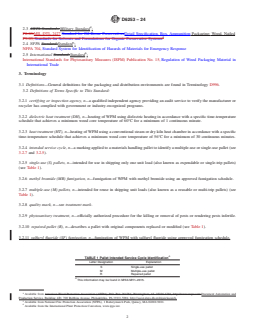
3.2.10 repaired-pallet (R), n—describes a pallet with original components replaced or modified (see Table 1).
3.2.11 sulfuryl fluoride (SF) fumigation, n—fumigation of WPM with sulfuryl fluoride using approved fumigation schedule.
A
TABLE 1 Pallet Intended Service Cycle Identification
Letter Designation Explanation
S Single-use pallet
M Multiple-use pallet
R Repaired pallet
A
This information may be found in MHIA MH1–2015.
Available from American Wood Protection Association (AWPA), P.O. Box 361784, Birmingham, AL 35236-1784, http://www.awpa.com.Document Automation and
Production Service, Building 4/D, 700 Robbins Avenue, Philadelphia, PA 19111-5094, http://assist.daps.dla.mil/quicksearch.
Available from National Fire Protection Association (NFPA), 1 Batterymarch Park, Quincy, MA 02269-9101.
Available from the International Plant Protection Convetion, www.ippc.int.
D6253 − 24
3.2.12 treatment mark, n—an official stamp or brand, internationally recognized, applied to a regulated article to attest its
phytosanitary status.
3.2.13 wood packaging material (WPM), n—wood or wood products (excluding paper products) used in supporting, protecting or
carrying a consignment. It covers wood packaging such as pallets, skids, containers, crates, boxes, packing blocks, drums, cases,
load boards, pallet collars, and dunnage.
4. Significance and Use
4.1 This practice establishes the criteria to treat, or mark, or both WPM with permanent identification for the phytosanitary
treatment, or intended service cycle, or both, repair, specification used, and other designated characteristics.
4.2 The marking of the WPM shall be performed after ensuring the material complies with the applicable specification.
5. Summary of Practice for Phytosanitary Treatment and Marking of WPM
5.1 Treatment or quality marking of WPM shall conform to the enforcement regulations and policy of the American Lumber
Standard Committee (ALSC) WPM Program and ISPM 15.
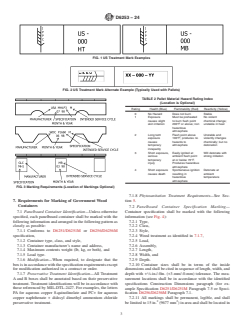
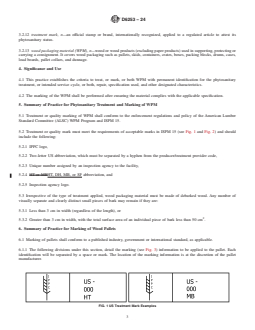
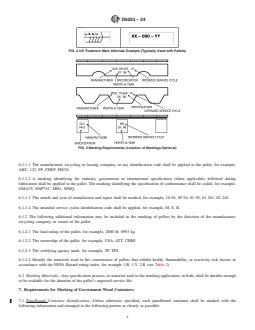
5.2 Treatment or quality mark must meet the requirements of acceptable marks in ISPM 15 (see Fig. 1 and Fig. 2) and should
include the following:
5.2.1 IPPC logo,
5.2.2 Two-letter US abbreviation, which must be separated by a hyphen from the producer/treatment provider code,
5.2.3 Unique number assigned by an inspection agency to the facility,
5.2.4 HT or MBHT, DH, MB, or SF abbreviation, and
5.2.5 Inspection agency logo.
5.3 Irrespective of the type of treatment applied, wood packaging material must be made of debarked wood. Any number of
visually separate and clearly distinct small pieces of bark may remain if they are:
5.3.1 Less than 3 cm in width (regardless of the length), or
5.3.2 Greater than 3 cm in width, with the total surface area of an individual piece of bark less than 50 cm .
6. Summary of Practice for Marking of Wood Pallets
6.1 Marking of pallets shall conform to a published industry, government or international standard, as applicable.
6.1.1 The following divisions under this section, detail the marking (see Fig. 3) information to be applied to the pallet. Each
identification will be separated by a space or mark. The location of the marking information is at the discretion of the pallet
manufacturer.
FIG. 1 US Treatment Mark Examples
D6253 − 24
FIG. 2 US Treatment Mark Alternate Example (Typically Used with Pallets)
FIG. 3 Marking Requirements (Location of Markings Optional)
6.1.1.1 The manufacturer, recycling or leasing company, or any identification code shall be applied to the pallet, for example,
ABC, 123, FP, CHEP, PECO.
6.1.1.2 A marking identifying the industry, government or international specification (when applicable) followed during
fabrication shall be applied to the pallet. The marking identifying the specification of conformance shall be coded, for example,
GMA75, NNP71C, MH1, SPEQ.
6.1.1.3 The month and year of manufacture and repair shall be marked, for example, 10 94, 05 94, 01 95, 01 201, 02 210.
6.1.1.4 The intended service cycles identification code shall be applied, for example, M, S, R.
6.1.2 The following additional information may be included in the marking of pallets by the direction of the manufacturer,
recycling company, or owner of the pallet.
6.1.2.1 The load rating of the pallet, for example, 2000 lb, 0953 kg.
6.1.2.2 The ownership of the pallet, for example, USA, ATT, CHEP.
6.1.2.3 The certifying agency mark, for example, TP, TPS.
6.1.2.4 Identify the materials used in the construction of pallets that exhibit health, flammability, or reactivity risk factors in
accordance with the NFPA Hazard rating index, for example 1.B, 1.Y, 2.R (see Table 2).
6.2 Marking Materials—Any specification process, or material used in the marking application, or both, shall be durable enough
to be readable for the duration of the pallet’s expected service life.
7. Requirements for Marking of Government Wood Containers
7.1 Panelboard Container Identification—Unless otherwise specified, each panelboard container shall be marked with the
following information and arranged in the following pattern as closely as possible:
D6253 − 24
TABLE 2 Pallet Material Hazard Rating Index
(Location is Optional)
Rating Health (Blue) Flammability (Red) Reactivity (Yellow)
0 No Hazard Does not burn Stable
1 Exposure Must be preheated No violent
causes slight to burn flash point chemical change;
skin irritation 200°F or above; non unstable in heat
hazardous
atmosphere
2 Long term Flash point above Unstable and
exposure 100°F; produces no violently changes
causes hazards to chemically; but no
temporary atmosphere detonation
incapacity
3 Short exposure, Easily ignited at Will detonate with
serious ambient flash point strong initiation
temporary at or below 73°F.
injury Produces hazardous
atmosphere
4 Short exposure Spontaneous ignition Detonate at
causes death resulting in ambient
hazardous temperature
atmosphere
7.1.1 Conforms to D6251/D6251M or D6256/D6256M specification,
7.1.2 BoxContainer type, class, and style,
7.1.3 BoxContainer manufacturer’s name and address,
7.1.4 Maximum contents weight (lb, kg, or both), and
7.1.5 Load type.
7.1.6 Modification—When required, to designate that the box is in accordance with the specification requirements except for
modification authorized in a contract or order.
7.1.7 Preservative Treatment Identification—All Treatment A and B boxes shall be annotated based on their preservative treatment.
The Treatment identifications will be in accordance with those referenced by MIL-DTL-2427. For examples, the letters PA for
oxine copper preservative, PB for zinc naphthenate preservative, and PC for copper naphthenate aqueous copper 8-quinolinolate
and PC+ for aqueous copper naphthenate + didecyl dimethyl ammonium chloride preservative treatment.
7.1.8 ExportPhytosanitation Treatment Requirements—See Section 5.
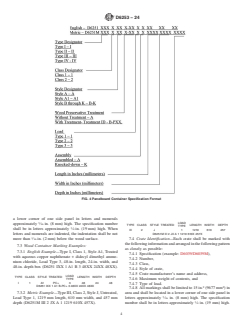
7.2 Container Specification—Panelboard Container Specification Marking—Container specification shall be marked with the
following information (see Fig. 4):
7.2.1 Type,
7.2.2 Class,
7.2.3 Style,
7.2.4 Wood treatment,treatment as identified in 7.1.7,
7.2.5 Load,
7.2.6 Assembly,
7.2.7 Length,
D6253 − 24
FIG. 4 Panelboard Container Specification Format
7.2.8 Width, and
...