

ASTM D7478/D7478M-11(2017)
(Specification)Standard Specification for Heavy Duty Sheathed Wood Crates
General Information
- Abstract
SCOPE
1.1 This specification covers requirements for two types and two classes of sheathed crates each of which may have two base styles. The crates are designed for net loads not exceeding 30 000 pounds lb [13 607 kg] and to withstand the most severe overseas shipping and storage conditions.
1.2 The crates described by this specification are intended to protect items from atmospheric elements during shipment and storage. They are designed to withstand the rough handling of logistic operations including stacking and outside storage for a prolonged period.
1.3 Class 1 and 2 crates may be used interchangeably as desired. However, the Class 2 crate should be used when weight is a prime consideration, as the lack of diagonals and thinner plywood sheathing results in a lighter crate.
1.4 Demountable crates, Type II, should be used whenever it is expected that the contained item will require reshipping to another destination.
1.5 Sill bases, Style B, are intended for items that project below their mounting points, such as disassembled vehicles.
1.6 If the use of other construction method or techniques is acceptable and permitted (see 5.10), the resulting packaging systems shall be of equal or better performance than would result from the use of these specified materials and procedures. The appropriate distribution cycle, specified in Practice D4169 can be used to develop comparative procedures and criteria.
1.7 The values stated in either SI units or inch-pound units are to be regarded separately as standard. The values stated in each system may not be exact equivalents; therefore, each system shall be used independently of the other. Combining values from the two systems may result in non-conformance with the standard. See IEEE/ASTM SI 10 for conversion of units.
1.8 This standard does not purport to address all of the safety concerns, if any, associated with its use. It is the responsibility of the user of this standard to establish appropriate safety and health practices and determine the applicability of regulatory limitations prior to use.
1.9 This international standard was developed in accordance with internationally recognized principles on standardization established in the Decision on Principles for the Development of International Standards, Guides and Recommendations issued by the World Trade Organization Technical Barriers to Trade (TBT) Committee.
- Status
- Published
- Publication Date
- 31-Aug-2017
- Technical Committee
- D10 - Packaging
Overview
ASTM D7478/D7478M-11(2017) Standard Specification for Heavy Duty Sheathed Wood Crates is an internationally recognized standard developed by ASTM International. This standard outlines the requirements for robust wood crates designed to protect and transport heavy and valuable items in harsh logistics environments, including overseas shipping and prolonged outdoor storage. The specification is intended for crates with net loads up to 30,000 pounds (13,607 kg) and addresses two primary types (nailed and bolted), two classes (lumber and plywood sheathed), and two base styles (skid and sill base).
Key Topics
- Crate Classification:
- Two crate types: Type I (Nailed), Type II (Bolted/Demountable)
- Two classes: Class 1 (Lumber sheathed), Class 2 (Plywood sheathed)
- Two base styles: Style A (Skid base), Style B (Sill base)
- Capacity and Performance:
- Designed for net loads not exceeding 30,000 pounds (13,607 kg)
- Capable of withstanding rough handling, stacking, and outdoor storage
- Construction Options:
- Standard methods use specified materials and jointing techniques for reliable, repeatable performance
- Alternate construction methods are permissible if equivalent or better performance can be proven
- Protection and Durability:
- Crates shield contents from external atmospheric elements
- Provides robust protection during all logistical operations
- Global Compliance:
- Developed as per internationally recognized standardization principles, aligning with WTO Technical Barriers to Trade (TBT)
- Considers both SI and inch-pound units for international interoperability
Applications
Heavy duty sheathed wood crates as specified in ASTM D7478/D7478M-11(2017) are especially valuable in logistics, defense, manufacturing, and export industries. Key practical applications include:
- Overseas Shipping and Export:
- These crates ensure secure transportation of industrial equipment, machinery, and large spare parts across international borders, including by sea and air.
- Military and Defense Logistics:
- Approved for use by agencies of the U.S. Department of Defense, making them suitable for military equipment, vehicles, and sensitive components.
- Long-term Outdoor and Warehouse Storage:
- Designed to withstand prolonged exposure to harsh climates, rain, and sunlight, making them ideal for items stored outdoors or in less-protected environments.
- Reusable and Demountable Crating:
- Type II demountable crates can be disassembled and reassembled, optimal for items that require reshipping or inspection at multiple destinations.
- Specialized Uses:
- Sill bases (Style B) can accommodate items with parts that project below their mounting points, such as disassembled vehicles or complex machinery.
Related Standards
Several standards and best practices are referenced within ASTM D7478/D7478M-11(2017) to ensure comprehensive guidance for crate fabrication, material selection, and performance:
- ASTM D4169: Practice for Performance Testing of Shipping Containers and Systems
- ASTM D6199: Practice for Quality of Wood Members of Containers and Pallets
- ASTM D3953: Specification for Strapping, Flat Steel and Seals
- ISPM 15: Regulation of Wood Packaging Material in International Trade (for phytosanitary compliance)
- IEEE/ASTM SI 10: Use of International System of Units (SI)
- NIST PS 1 and PS 20: Product standards for structural plywood and American softwood lumber
- ASME and NHLA standards: For fasteners, bolts, plywood, and hardwood lumber used in crate construction
Practical Value
Utilizing ASTM D7478/D7478M-11(2017) ensures that heavy duty sheathed wood crates meet strict requirements for load capacity, durability, and reusability, which are critical for protecting high-value cargo during shipping and storage. Adherence to this standard supports safe, efficient, and internationally compliant logistics operations, minimizing damage risk and assuring performance in the most demanding shipping environments.
Keywords: ASTM D7478, heavy duty wood crates, shipping crates standard, overseas packaging, export packaging, military crates, plywood sheathed crates, lumber crates, durable packaging, international shipping crates.
Relations
- Effective Date
- 01-Sep-2017
- Effective Date
- 01-Mar-2024
- Refers
ASTM D4169-23e1 - Standard Practice for Performance Testing of Shipping Containers and Systems - Effective Date
- 01-Dec-2023
- Effective Date
- 01-Dec-2023
- Effective Date
- 01-Mar-2020
- Effective Date
- 01-Oct-2018
- Effective Date
- 01-Sep-2018
- Effective Date
- 01-Mar-2018
- Effective Date
- 01-Mar-2017
- Effective Date
- 15-Nov-2016
- Effective Date
- 01-Apr-2016
- Effective Date
- 01-Sep-2015
- Effective Date
- 01-Jun-2015
- Effective Date
- 01-Nov-2014
- Effective Date
- 01-Apr-2014
Get Certified
Connect with accredited certification bodies for this standard

BRCGS (Brand Reputation Compliance Global Standards)
Global food safety and quality standards owner.
Sponsored listings
Frequently Asked Questions
ASTM D7478/D7478M-11(2017) is a technical specification published by ASTM International. Its full title is "Standard Specification for Heavy Duty Sheathed Wood Crates". This standard covers: SCOPE 1.1 This specification covers requirements for two types and two classes of sheathed crates each of which may have two base styles. The crates are designed for net loads not exceeding 30 000 pounds lb [13 607 kg] and to withstand the most severe overseas shipping and storage conditions. 1.2 The crates described by this specification are intended to protect items from atmospheric elements during shipment and storage. They are designed to withstand the rough handling of logistic operations including stacking and outside storage for a prolonged period. 1.3 Class 1 and 2 crates may be used interchangeably as desired. However, the Class 2 crate should be used when weight is a prime consideration, as the lack of diagonals and thinner plywood sheathing results in a lighter crate. 1.4 Demountable crates, Type II, should be used whenever it is expected that the contained item will require reshipping to another destination. 1.5 Sill bases, Style B, are intended for items that project below their mounting points, such as disassembled vehicles. 1.6 If the use of other construction method or techniques is acceptable and permitted (see 5.10), the resulting packaging systems shall be of equal or better performance than would result from the use of these specified materials and procedures. The appropriate distribution cycle, specified in Practice D4169 can be used to develop comparative procedures and criteria. 1.7 The values stated in either SI units or inch-pound units are to be regarded separately as standard. The values stated in each system may not be exact equivalents; therefore, each system shall be used independently of the other. Combining values from the two systems may result in non-conformance with the standard. See IEEE/ASTM SI 10 for conversion of units. 1.8 This standard does not purport to address all of the safety concerns, if any, associated with its use. It is the responsibility of the user of this standard to establish appropriate safety and health practices and determine the applicability of regulatory limitations prior to use. 1.9 This international standard was developed in accordance with internationally recognized principles on standardization established in the Decision on Principles for the Development of International Standards, Guides and Recommendations issued by the World Trade Organization Technical Barriers to Trade (TBT) Committee.
SCOPE 1.1 This specification covers requirements for two types and two classes of sheathed crates each of which may have two base styles. The crates are designed for net loads not exceeding 30 000 pounds lb [13 607 kg] and to withstand the most severe overseas shipping and storage conditions. 1.2 The crates described by this specification are intended to protect items from atmospheric elements during shipment and storage. They are designed to withstand the rough handling of logistic operations including stacking and outside storage for a prolonged period. 1.3 Class 1 and 2 crates may be used interchangeably as desired. However, the Class 2 crate should be used when weight is a prime consideration, as the lack of diagonals and thinner plywood sheathing results in a lighter crate. 1.4 Demountable crates, Type II, should be used whenever it is expected that the contained item will require reshipping to another destination. 1.5 Sill bases, Style B, are intended for items that project below their mounting points, such as disassembled vehicles. 1.6 If the use of other construction method or techniques is acceptable and permitted (see 5.10), the resulting packaging systems shall be of equal or better performance than would result from the use of these specified materials and procedures. The appropriate distribution cycle, specified in Practice D4169 can be used to develop comparative procedures and criteria. 1.7 The values stated in either SI units or inch-pound units are to be regarded separately as standard. The values stated in each system may not be exact equivalents; therefore, each system shall be used independently of the other. Combining values from the two systems may result in non-conformance with the standard. See IEEE/ASTM SI 10 for conversion of units. 1.8 This standard does not purport to address all of the safety concerns, if any, associated with its use. It is the responsibility of the user of this standard to establish appropriate safety and health practices and determine the applicability of regulatory limitations prior to use. 1.9 This international standard was developed in accordance with internationally recognized principles on standardization established in the Decision on Principles for the Development of International Standards, Guides and Recommendations issued by the World Trade Organization Technical Barriers to Trade (TBT) Committee.
ASTM D7478/D7478M-11(2017) is classified under the following ICS (International Classification for Standards) categories: 55.160 - Cases. Boxes. Crates. The ICS classification helps identify the subject area and facilitates finding related standards.
ASTM D7478/D7478M-11(2017) has the following relationships with other standards: It is inter standard links to ASTM D7478/D7478M-11, ASTM D6253-24, ASTM D4169-23e1, ASTM D4169-23, ASTM D4442-20, ASTM D6199-18a, ASTM F1667-18, ASTM D6199-18, ASTM F1667-17, ASTM D4442-16, ASTM D6253-16, ASTM F1667-15, ASTM D4442-15, ASTM D4169-14, ASTM D4675-14. Understanding these relationships helps ensure you are using the most current and applicable version of the standard.
ASTM D7478/D7478M-11(2017) is available in PDF format for immediate download after purchase. The document can be added to your cart and obtained through the secure checkout process. Digital delivery ensures instant access to the complete standard document.
Standards Content (Sample)
This international standard was developed in accordance with internationally recognized principles on standardization established in the Decision on Principles for the
Development of International Standards, Guides and Recommendations issued by the World Trade Organization Technical Barriers to Trade (TBT) Committee.
Designation:D7478/D7478M −11(Reapproved 2017)
Standard Specification for
Heavy Duty Sheathed Wood Crates
This standard is issued under the fixed designation D7478/D7478M; the number immediately following the designation indicates the
year of original adoption or, in the case of revision, the year of last revision. A number in parentheses indicates the year of last
reapproval. A superscript epsilon (´) indicates an editorial change since the last revision or reapproval.
This standard has been approved for use by agencies of the U.S. Department of Defense.
1. Scope 1.8 This standard does not purport to address all of the
safety concerns, if any, associated with its use. It is the
1.1 Thisspecificationcoversrequirementsfortwotypesand
responsibility of the user of this standard to establish appro-
two classes of sheathed crates each of which may have two
priate safety and health practices and determine the applica-
basestyles.Thecratesaredesignedfornetloadsnotexceeding
bility of regulatory limitations prior to use.
30000poundslb[13607kg]andtowithstandthemostsevere
1.9 This international standard was developed in accor-
overseas shipping and storage conditions.
dance with internationally recognized principles on standard-
1.2 Thecratesdescribedbythisspecificationareintendedto
ization established in the Decision on Principles for the
protect items from atmospheric elements during shipment and
Development of International Standards, Guides and Recom-
storage. They are designed to withstand the rough handling of
mendations issued by the World Trade Organization Technical
logistic operations including stacking and outside storage for a
Barriers to Trade (TBT) Committee.
prolonged period.
2. Referenced Documents
1.3 Class 1 and 2 crates may be used interchangeably as
2.1 ASTM Standards:
desired. However, the Class 2 crate should be used when
D996Terminology of Packaging and Distribution Environ-
weight is a prime consideration, as the lack of diagonals and
ments
thinner plywood sheathing results in a lighter crate.
D3953Specification for Strapping, Flat Steel and Seals
1.4 Demountable crates, Type II, should be used whenever
D4169Practice for Performance Testing of Shipping Con-
it is expected that the contained item will require reshipping to
tainers and Systems
another destination.
D4442Test Methods for Direct Moisture Content Measure-
1.5 Sill bases, Style B, are intended for items that project
ment of Wood and Wood-Based Materials
below their mounting points, such as disassembled vehicles.
D4675Guide for Selection and Use of Flat Strapping Ma-
terials
1.6 If the use of other construction method or techniques is
D6199PracticeforQualityofWoodMembersofContainers
acceptable and permitted (see 5.10), the resulting packaging
and Pallets
systems shall be of equal or better performance than would
D6253Practice for Treatment and/or Marking of Wood
resultfromtheuseofthesespecifiedmaterialsandprocedures.
Packaging Materials
The appropriate distribution cycle, specified in Practice D4169
F1667SpecificationforDrivenFasteners:Nails,Spikes,and
can be used to develop comparative procedures and criteria.
Staples
1.7 The values stated in either SI units or inch-pound units
IEEE/ASTMSI10StandardforUseofInternationalSystem
are to be regarded separately as standard. The values stated in
of Units (SI): The Modern Metric System
each system may not be exact equivalents; therefore, each
2.2 National Institute of Standards and Technology (NIST)
system shall be used independently of the other. Combining
Standards:
values from the two systems may result in non-conformance
PS 1Voluntary Product Standard, Structural Plywood
with the standard. See IEEE/ASTM SI 10 for conversion of 4
PS 20American Softwood Lumber Standard
units.
For referenced ASTM standards, visit the ASTM website, www.astm.org, or
contact ASTM Customer Service at service@astm.org. For Annual Book of ASTM
This specification is under the jurisdiction of ASTM Committee D10 on Standards volume information, refer to the standard’s Document Summary page on
Packaging and is the direct responsibility of Subcommittee D10.12 on Shipping the ASTM website.
Containers, Crates, Pallets, Skids and Related Structures. Available fromAPA, The Engineered WoodAssociation, 7011 South 19th St.,
Current edition approved Sept. 1, 2017. Published September 2017. Originally Tacoma, WA 98466–5399, http://www.apawood.org.
approved in 2008. Last previous edition approved in 2011 as D7478/D7478M–11. Available from American Lumber Standards Committee, Inc., (ALSC), P.O.
DOI: 10.1520/D7478_D7478M-11R17. Box 210, Germantown, MD 20875–0210, http://www.alsc.org.
Copyright © ASTM International, 100 Barr Harbor Drive, PO Box C700, West Conshohocken, PA 19428-2959. United States
D7478/D7478M−11(2017)
2.3 Hardwood Plywood and Veneer Association Standard: 3.2.7 headers—headers are either transverse members at
ANSI/HPVA HP-1-2004American National Standard for each end of skid bases or longitudinal members at each end of
Hardwood and Decorative Plywood top joists. Headers in bases serve to hold the base together as
a unit, to transfer loads to outside skids, and to provide a
2.4 National Hardwood Lumber Association (NHLA) Stan-
fastening member for end panels. Headers in top panels serve
dard:
to position and support joists and to provide a fastening
NHLA Rulesfor the Measurement and Inspection of Hard-
member for side panels.
wood and Cypress
2.5 ASME Standards:
3.2.8 horizontal braces—horizontal braces are members
ASME B18.2.1-2010Square, Hex, Heavy Hex, and Askew
positioned between struts and parallel to the upper and lower
Head Bolts and Hex, Heavy Hex, Hex Flange, Lobed
frame members and serve to reduce the unsupported span of
Head, and Lag Screws (Inch Series)
the sheathing.
ASME B18.2.2-2010Nuts for General Applications: Ma-
3.2.9 joists—joists are members extending across the crate
chine Screw Nuts, Hex, Square, Hex Flange, and Cou-
underneaththetop,whichservetosupportandtransfervertical
pling Nuts (Inch Series)
stacking loads to the side panels. Joists also serve to prevent
ASME B18.2.3.8M - 1981Metric Hex Lag Screws
crushing or buckling of crate tops when slings or grab hooks
ASME B18.2.4.3M-1979Metric Slotted Hex Nuts
are used.
ASME B18.5-2008Round Head Bolts (Inch Series)
ASME B18.5.2.2M-1982Metric Round head Square Neck
3.2.10 lag screw strap—lag screw strap is a metal reinforc-
Bolts ing strap used on bolted crates sides and ends to reinforce and
ASME B18.22M-1981Metric Plain Washers
increase lag screw lateral resistance.
ASME B18.21.1-2009Washers: Helical Spring-Lock,Tooth
3.2.11 load-bearing floorboards—load-bearing floorboards
Lock, and Plain Washers (Inch Series)
are transverse base members which serve to distribute and
2.6 International Standard:
transfer loads to the outside skids.
ISPM15InternationalStandardsforPhytosanitaryMeasures
3.2.12 rubbing strips—rubbing strips are longitudinal mem-
Publication No. 15 (ISPM 15), Regulation of Wood
bers nailed to the skid bottom to provide for sling and forklift
Packaging Material in International Trade
truck handling.
3. Terminology
3.2.13 sheathing—sheathing is the plywood or boards
3.1 Definitions—General definitions for packaging and dis- nailed to the frame members and enclose the crate. Sheathing
tribution environments are found in Terminology D996.
used on the top panels is called top sheathing; that used on the
sideorendpanelsiscalledsideorendsheathing;thatnailedto
3.2 Definitions of Terms Specific to This Standard:
thetopofskidsiscalledflooring;andthatnailedtothebottom
3.2.1 The crate component parts discussed herein were
of sills is called bottom sheathing.
selected on the basis of part function. Alternate names are
sometimes used by industry.
3.2.14 side frame members—side frame members are the
3.2.2 diagonals—diagonals are frame members positioned
members of the crate top, without joists, which are parallel to
between parallel frame members and placed at nearly 45°
the long dimension and serve as fastening members and to tie
anglestothem.Diagonalsserveasbracesandensurerigidityin
the crate construction together.
the crate.
3.2.15 sill bridging—sill bridging are members of the same
3.2.3 end frame members—end frame members are similar
depth as the sills, which are inserted at right angles to the
to side frame members but perpendicular to the long dimen-
intermediate sills, and serve to prevent lateral sill turning or
sion.
buckling.
3.2.4 filler strips—filler strips are boards placed across the
3.2.16 sills—sills are the members, which with sill bridging
ends of thin, non-load-bearing floorboards, which serve to fill
form the frame work of sill-type bases. Sills carry and transfer
the space below the lower frame member of the crate sides.
loads to side panels and serve as fastening members.There are
3.2.5 frame members—frame members are those parts
side, end, and intermediate sills.
which form the fundamental crate structure upon which the
3.2.17 skids—skids are longitudinal members attached to
strength and rigidity of a lumber-sheathed crate depends.
the crate bottom, which serve to support and transfer the load
3.2.6 hanger-metal—hanger-metal is a metal nailed strap
to the side panels.
used to aid in support of the intermediate sill in sill-type bases.
3.2.18 sleepers—sleepers are members underneath the floor
of skid-type bases to which the item is anchored (through the
Available from Hardwood Plywood and VeneerAssociation (HPVA), P.O. Box
floor) so that the tie-down stress will be distributed.
2789, Reston, VA 22090–0789, http://www.hpva.org.
3.2.19 struts—struts are vertical frame members, placed
Available from National Hardwood Lumber Association (NHLA), 6830 Ra-
leigh LaGrange Rd., Memphis, TN 38134, http://www.natlhardwood.org.
between the side and end panels’ upper and lower frame
Available from American Society of Mechanical Engineers (ASME), ASME
members, and serve as columns for supporting vertical stack-
International Headquarters, Three Park Ave., New York, NY 10016–5990, http://
ing loads. The end struts are sometimes referred to as corner
www.asme.org.
Available from the International Plant Protection Convention, www.ippc.int. posts.
D7478/D7478M−11(2017)
3.2.20 upper and lower frame members—upper and lower 6.2.2 Outside Dimensions—Outside dimensions are the
frame members are those horizontal members at the top and crate, or its contents, overall length, width, and height, which-
bottom of the side and end panels which serve to tie the ever is greater. Actual dimensions, except in designing, are
construction together. corrected whole inches [25 mm increments], any fraction less
1 1
than ⁄2 in. [13 mm] being disregarded, and any fraction of ⁄2
3.2.21 vertical joist supports—vertical joist supports are
in. [13 mm] or greater being considered a full inch [25 mm
vertical members attached to the crate sides inside face, which
increment].
serve to support the joists and assist the struts in supporting
6.2.3 Cubic Displacement—Cratecubicdisplacementiscal-
vertical stacking loads.
culated from the outside dimensions in inches [millimetres]
4. Classification and is stated in cubic feet [cubic metres].
6.2.4 Limitations—The crate exterior dimensions shall not
4.1 Crates shall be of the following types, classes, and
exceed the following limitations:
styles:
6.2.4.1 Length—30 ft [9144 mm].
4.2 Type:
6.2.4.2 Width—9 ft [2743 mm].
4.2.1 Type I—Nailed.
6.2.4.3 Height—10 ft [3048 mm].
4.2.2 Type II—Bolted.
6.2.5 Interior Clearance—Aclearance of not less than 2 in.
4.3 Class:
[50 mm] shall be allowed between the item and the closest
4.3.1 Class 1—Lumber sheathed.
side, end, or top crate member. Additional clearances may be
4.3.2 Class 2—Plywood sheathed.
provided for shock-mounted items. Protruding parts at the top
4.4 Style: may be allowed to extend between joists; joist spacing may be
adjusted slightly to accommodate projections.
4.4.1 Style A—Skid base.
4.4.2 Style B—Sill base.
7. Materials and Manufacture
5. Ordering Information
7.1 Materials—Materials shall be as specified herein. Ma-
5.1 Purchasers should select the preferred permitted options
terials not specified shall be selected by the contractor or crate
and include the following information in procurement docu-
builder and shall be subject to all provisions of this specifica-
ments:
tion (see Section 11). Materials shall be free of defects, which
adversely affect performance or serviceability of the finished
5.2 Specification title, number, and date.
product.
5.3 Crate type, class, and style (see Section 4).
7.2 Lumber—LumbercomponentsshallconformtoPractice
5.4 Contents weight.
D6199, PS 20, or the NHLARules.All lumber sizes specified
5.5 Crate dimensions specified in order of length by width
herein shall be nominal and shall be the minimum acceptable
by depth.
sizesforlumbercomponents.Lumbercomponentsshallhavea
target thickness and width uniform in dimension and 50% of
5.6 When inspection doors are required.
components shall meet or exceed the target dimensions at the
5.7 When top, sides, and ends shall be assembled with nails
time of component manufacture.
and the entire assembly bolted to the base.
7.3 Plywood—Plywood shall conform to PS 1 or ANSI/
5.8 Whether crates are to be shipped assembled or knocked
HPVA HP-1-2004. All panels shall be bonded with moisture
down.
resistant adhesive and be identified as either Exposure 1 or
5.9 Whether other construction methods or techniques are
Exterior.
acceptable and permitted (see 1.6).
7.4 Fasteners—Fasteners are classified as driven nails,
5.10 Whether proof that other constructions methods or
bolts, lag bolts, wood screws, and metal strapping.
techniques are acceptable (see 1.6) is required.
7.4.1 Nails—NailsshallbeinaccordancewithSpecification
5.11 If packaging is other than as specified. F1667 and other industry standards. Nails are classified as
plain-shank, helically threaded, annularly threaded, fluted, or
5.12 When ISPM 15 compliance is required (see 12.1).
twisted square wire.
7.4.2 Staples—Staples have either round-wire or approxi-
6. General Requirements
mately square-wire legs, referring to the cross-sectional shape
6.1 Crate Loading—When crates are furnished as filled
of the wire. Staples should be made of low carbon steel wire
containers, the extent of contents disassembly, the anchoring,
and galvanized.
blocking, and lifting attachments application shall be in accor-
7.4.3 Bolts, Lag Bolts, Nuts and Washers—Bolts, lag bolts,
dance with this specification’s Supplemental Requirements.
nuts and washers shall conform to industry standards, includ-
6.2 Dimensions:
ing the following:
6.2.1 Inside Dimension—Inside crate length or width is the
ASME B18.2.1-2010 (ASME B18.2.3.8M-1981),
distancebetweenoppositestrutsinnersurfaces.Insideheightis
ASME B18.5-2008 (ASME B18.5.2.2M-1982),
ASME B18.2.2-2010 (ASME B18.2.4.3M-1979), and
the distance between skid base floorboards or sill bases’ sill
ASME B18.21.1-2009 (ASME B18.22M-1981).
tops and the underside of top joists or framing members.
D7478/D7478M−11(2017)
Standard steel carriage bolts can be used in any of three 8.1.2 All nails that are not to be clinched shall be cement-
styles: standard, slotted, or large head. coated.
7.4.4 Wood Screws—Screws shall be inserted into the crate
8.1.3 Nails shall be driven through the thinner member into
components to be assembled with a screwdriver or screw
the thicker member wherever possible.
motion machine tool. Approximately two-thirds of the screw
8.1.4 Nails for fastening plywood to framing shall be
length and seven times the shank diameter shall be the
clinched at least ⁄4 in. [6 mm]. Nail heads shall always be on
penetration length into the fastening member. Where pre-
the plywood side.
drilling is required, the maximum lead-hold diameter shall be
8.1.5 When the flat faces of lumber pieces are nailed
the fastener-shank diameter, and the pilot-hole diameter shall
together and the combined thickness is 3 in. [76 mm] or less
not be larger than the thread-root diameter.
(exceptfortopjoistsandcoveringmaterial),nailsshallbelong
7.4.5 Strapping—Strapping shall conform to Specification
enough to pass through both thicknesses and shall be clinched
D3953 and as specified herein (8.7.5.3). Finish shall be A, B,
1 3
not less than ⁄4 in. [6 mm] or more than ⁄8 in. [10 mm].
or C as applicable. Refer to Guide D4675 for additional
8.1.6 When the flat faces of lumber pieces are nailed
guidelines.
together and the combined thickness is more than 3 in. [76
7.5 Protective Covering—Felt or film.
mm]orwhentheflatfaceofoneormorepiecesisnailedtothe
edgeorendfaceofanother,nailsshallnotbeclinched.Thenail
8. Construction
portion in the thicker piece shall not be less than 2 times the
8.1 Nailing Procedure—Sinkers, coolers, corkers, or com-
nail length in the thinner piece for ten-penny (3 in. [76 mm])
mon nails shall be used. Nail sizes specified for crate fabrica-
nails and smaller, and not less than 1 ⁄2 in. [38 mm] for
tion are based on Practice D6199 Group I and IIWoods.When
twelve-penny (3 ⁄4 in. [82 mm]) nails and larger.
Group III or IV Woods are used, nail sizes may be one-penny
8.1.7 When diamond-point nails cause crate member
size smaller than those specified. The nail patterns to be used
splitting, the nails shall be slightly blunted. When blunting
fornailingtwoflatpiecesoflumbershallconformtothedetails
does not prevent the splitting, holes slightly smaller than the
shown in Fig. 1 or as specified herein. Unless otherwise
nail diameter shall be drilled for each nail.
specified herein, the following requirements shall determine
8.1.8 Nails shall be driven so that neither the head nor the
nail size, placement, and quantity.
8.1.1 All adjacent crate members shall be securely fastened pointprojectsabovethewoodsurface.Occasionalover-driving
will be permitted, but nails shall not be over-driven more than
nailed to each other, either directly or by means of the
covering. one-eighth the thickness of the piece holding the head.
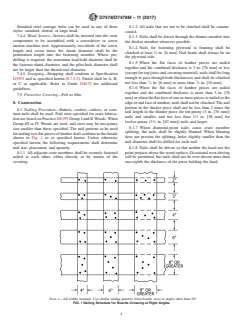
NOTE 1—All widths nominal. Use similar nailing patterns when boards cross at angles other than 90°.
FIG. 1Nailing Schedule for Boards Crossing at Right Angles
D7478/D7478M−11(2017)
8.1.9 Nails shall be positioned not less than the thickness of The lead holes for lag bolts shall be the same diameter as the
the piece from the end not less than one-half the thickness of shank, even though the threaded portion may have a greater
the piece from the side edge of the lumber whenever possible. diameter than the shank, and shall be as shown in Table 1. Lag
Nails driven into the lumber side edge shall be centered on the bolts shall be placed by being turned in their holes the full bolt
side edge. length and shall not be driven in with a hammer or by any
8.1.10 Nails securing plywood sheathing to frame members similar means. If, for any reason, the thread in the wood is
shallbespacedasshowninFig.2.Machinedrivennailshaving stripped when the lag blots are placed, the lag bolt shall be
a definite head may be used for securing plywood sheathing removed and placed in a new hole near the old position.Aflat
providing they meet size requirements specified herein. washer shall be used under each lag bolt head and under each
carriage bolt nut.
8.2 Stapling—Staples may be used to fasten sheathing to
frame members. Staples shall not be used for base fabrication, 8.4 Splices, Butt Joints and Lamination—Splices and butt
fasteningframingmemberstoeachother,orforcrateassembly. jointsmadeinframemembersandskidsoflongcratesshallbe
Staples shall have crowns of not less than ⁄8 in. [10 mm] wide as shown in Fig. 3. Lamination of wood is shown in Fig. 4.
and shall have a wire diameter of not less than 0.062 in. [16
8.5 Inspection Doors—When specified (see 5.6), one or
gage, 1.59 mm]. Straight leg staples shall be long enough to
more inspection or access doors shall be provided. Door size
provide a minimum ⁄4-in. [6-mm] clinch; divergent point
and location shall be specified by the purchaser and will be
staplesshallnotbelessthan1in.[25mm]long.Staplespacing
used for interim inspection or servicing of contents. Doors
shall be the same as for nails specified herein. Staples shall
shall be built without cutting the frame members and shall be
always be driven from the plywood side.
hinged at the top and fastened by lag screws at the sides and
8.3 Bolt Application—Holes shall be pre-bored to receive bottom as shown in Fig. 5. Cleats and stops shall be made of
carriageboltsandshallbenolessthanthediameterofthebolt. 1-in. [19-mm] material. Doors shall be made of the same type
NOTE 1—All dimensions in inches. Three rows of nails for all members over 4 in. wide. Two rows of nails for all members up to 4 in. wide.
FIG. 2Fabrication Nailing Plywood Sheathing
D7478/D7478M−11(2017)
TABLE 1 Lag Bolt Lead Hole Sizes
placed crosswise and 2 to 3 in. [51 to 76 mm] back from each
Lag Bolt Threaded Lead Hole Diameter, in. [mm] skid end as shown in Fig. 7 and 24. Bolt sizes shall comply
Portion Diameter Group I, II, & III Woods Group IV Woods
with Table 4.
in. [mm] in. [mm] in. [mm]
(2) Rubbing Strip for Skids—Rubbing strips of 3-in. [64-
1 3 3
⁄4 6 ⁄16 5 ⁄16 5
mm] thick lumber, the same width as the skids, shall be
5 1 1
⁄16 8 ⁄4 6 ⁄4 6
3 1 5 attached to the skids with two staggered rows of nails spaced
⁄8 10 ⁄4 6 ⁄16 8
1 3 7
⁄2 12 ⁄8 1 ⁄16 11
12 in. [305 mm] apart in each row. The nails shall be driven
5 3 1
⁄8 16 ⁄8 10 ⁄2 12
through the rubbing strip into the skid. The nails shall be long
3 1 5
⁄4 19 ⁄2 12 ⁄8 16
enough to penetrate approximately 70% (minimum) of the
skid thickness and shall not protrude through the skid. The
strips shall be beveled 45° full depth at sling and forklift
openings. Openings in the rubbing strips for forklift-truck
and thickness as material used for sheathing. Holes shall be access shall be 12 in. [305 mm] in length, 28 in. [711 mm]
provided through the door and an adjacent frame member for
center-to-center, and positioned to straddle the loaded crate
a seal wire and lead seal bearing the inspectors’ stamp. When
center of balance. Sling openings not less than 4 in. [102 mm]
hingeswithexposedscrewsareused,thehingesideofthedoor
in length, and preferably 8 in. [203 mm], shall be provided at
shall also be sealed.
the rubbing strip ends where permitted by the crate length and
by the location of the forklift-truck access openings. No
8.6 Ventilation—All lumber and plywood sheathed crates
rubbing strips center pieces shall be less than 16 in. [406 mm]
shall be provided with ventilation holes or slots which shall be
in length. On crates 5 ft [1524 mm] and less in length, the
located at each end, or at ends and sides, or around the
forklift openings shall be omitted; end sling openings shall not
perimeter (Table 2). These ventilating holes or slots shall be
belessthan6in.[152mm]longandshallserveasbothforklift
located immediately below the top frame member, and be
and sling openings.
provided with a baffle as shown in Fig. 6 when slots are used
(3) Headers—Headers shall be placed at each end of the
in plywood sheathed crates, or when holes are in clusters in
base and shall be bolted to each skid with one carriage bolt
lumber sheathed crates. Single holes drilled without baffles
(Figs. 9 and 10). Header and bolts sizes shall be as shown in
shall be sloped at 45° to drain outward. No holes or slots shall
be cut in any frame member. Table 4. Headers shall be a single piece and not built up to two
or more pieces to meet the dimension requirements. Headers
8.7 Class 1 Crates—Class 1 crates may be either bolted or
shall be placed atop the plywood when plywood flooring is
nailed. Bolted crates shall be designed so that the base, sides,
used. Headers shall be placed a distance back from the skid
ends, and top may be assembled to each other with lag bolts in
ends skids equal to the end sheathing thickness. The header
orderthatthecratecanbereadilydisassembledand,ifdesired,
ends shall be notched for bases floored with lumber; header
reassembled without major damage to the parts. Nailed crates
ends for plywood floored bases shall be set back from the
are assembled with nails and straps, are not easily
outside edges of the outer skids (see Figs. 9 and 10). The
disassembled, and because of probable damage during
notched and set back distances shall be equal to the thickness
disassembly, are not generally reused. When specified (see
of the skids lower frame members.
Section 5), a combination of top, side, and end panels may be
(4) Forklift Members—The forklift members shall consist
fabricated and assembled to each other as specified for nailed
oftheheaderandtwoequalsizemembers,spaced20and40in.
crates, and the unit fastened to the base as specified for bolted
[508 and 1016 mm] (on center) from each skid end and bolted
crates.
as shown in Fig. 7. Where the form of the item to be crated
8.7.1 Bases—Bases shall be designed to support the weight
makes it impractical to use these members, or when crates are
of the crated article only when the sides and ends are fastened
shortornarrow,2-in.[38-mm]thicklumbershallbeusedinthe
10).
in place (see Section
48-in. [1219-mm] end areas as shown in Fig. 8. When 2-in.
8.7.1.1 Style A (Skid-Type)—Style A bases shall consist of
[38-mm] lumber is used in the forklift area and intermediate
longitudinal skids and rubbing strips, headers, load-bearing
skidsarerequiredbecauseofthebasewidth,the2-in.[38-mm]
floorboards, and flooring as shown on Figs. 7 and 8. Details of
forklift members shall be bolted to the intermediate skids.
construction shall be the same for bolted and nailed crates.
Forklift members shall be bolted to the intermediate skids.
(1) Skids—Any species of wood except Group I shall be
Forklift members shall be notched or set back as specified for
usedforskids.Skidsshallbespacednofartherapartthan48in.
headers in 8.7.1.1(3). If loaded containers center of balance is
[1219 mm], center to center, across the base width. Minimum
sizeshallbeasshowninTable3.Wheneitherthelengthornet other than the center of the base, the space for forklift entry
shall be positioned so that the center of balance is centered in
loadexceedsthemaximumshown,thenextlargerskidshallbe
used. When necessary, skids may be spliced or laminated between forklift openings.
(5) Load-bearing Floorboards—Load-bearing floorboards
according to the details shown in Fig. 3 or Fig. 4, but the use
of2×4in.[38×89mm]skidsshallbelimitedtosuchlengths shall be placed where the concentrated loads of the contents
occur. The cross section shall be determined from Table 10.
that no splicing would be required.Whenever possible, splices
shall be made not more than one-third of the base length from Theforkliftmembersandany1or2-in.[19or38-mm]flooring
the skid ends and the splice locations alternated in adjacent may be considered as load bearing within limits of their
skids. To prevent splitting, all skids shall have a carriage bolt assigned values. The load-bearing floor boards ends shall be
D7478/D7478M−11(2017)
NOTE 1—Use carriage bolts. All dimensions in inches.
FIG. 3Splicing of Members
notched or set back from the base edge in the same manner as over the thinner flooring to equal the thickness of the 2-in.
describedforheadersasspecifiedin8.7.1.1(3)(seeFigs.7and [38-mm] flooring as shown in Fig. 8. The filler strips shall be
8). Load-bearing floorboards 4 in. [89 mm] wide shall be nailed to the flooring with two staggered rows of nails spaced
bolted to each skid with one carriage bolt, and load-bearing 10 in. [254 mm] apart. Nailing of floorboards to skids shall be
floorboards over 4 in. [89 mm] wide shall be bolted to each as shown on Fig. 1 and as specified in 8.1.
skid with two carriage bolts, and the intermediate skid where (7) Plywood Flooring—Plywood ⁄8in.[10mm]thick,may
oneisrequired.Boltdiametersshallbethesameasspecifiedin be used in place of 1-in. [19-mm] lumber flooring as shown in
8.7.1.1(3) for corresponding skid sizes. Figs. 7 and 8, but not as load-bearing floorboards. Plywood
(6) Lumber Flooring—Lumber floorboards shall be neither flooringshallbelaidflushwiththeskids’outeredgesandwith
less than 1 in. [19 mm] thick nor less than 4 in. [89 mm] wide, the face grain perpendicular to the skid length. Headers and
and shall be placed at right angles to the skids. Boards shall be load-bearingfloorboardsshallbeplacedontopoftheplywood
spaced ⁄4 in. [6 mm] apart for drainage and the leadboards and bolted to the skids after the plywood has been nailed in
flushed with the skids’ outside face. When a large area of the place. Plywood flooring shall be nailed to each skid with two
base is floored with 2-in. [38-mm] thick lumber, the use of staggered rows of nails, staggered and spaced 6 in. [152 mm]
filler strips 2 in. [38 mm] wide shall be used along each side apart in each row. Spacing, ⁄4 in. [6 mm], shall be allowed
D7478/D7478M−11(2017)
NOTE 1—All dimensions in inches.
FIG. 4Laminating Method
1 1
between plywood sheets for drainage. When ⁄3 to ⁄2 the area 8.7.1.2 Style B (Sill-Type)—Style B bases shall be con-
of the base is floored with 2-in. [38 mm] boards, the plywood structed as shown in Fig. 9. The load contained on Style B
flooring shall be used only between these areas. Filler strips bases shall always be transmitted to the side sills by means of
shall be nailed over the plywood as shown in Fig. 8, with intermediate sills or by the article itself.
nailing as specified in 8.1. (1) Side and End Sills—The side sill size shall be deter-
(8) Drainage—A drainage hole, ⁄2 in. [13 mm] diameter, mined from Table 11. End sills shall be the same size as side
shallbedrilledadjacenttoeachheaderorload-bearingmember sills. The side sills shall overlap the end sills as shown in Fig.
in each outer edge of each base plywood floored section (a 9. Sills shall be laminated as shown in Fig. 4, when necessary.
“section” being a portion of the base in which water might be (2) Intermediate Sills and Load-Bearing Headers—
trapped) (Figs. 7 and 8). Care shall be taken to locate the holes Intermediate sills shall be applied crosswise of the base. The
so that the holes will not be covered when the contents are intermediate sill size shall be determined from Table 12. The
placed on the crate base. weight used to determine the size of an intermediate sill shall
D7478/D7478M−11(2017)
NOTE 1—All dimensions in inches.
FIG. 5Inspection Door (Inside View)
A
TABLE 2 Ventilation Hole Requirements
bearing headers shall be attached at their ends to intermediate
Plywood-Sheathed
sillsandintermediatesillsshallbeattachedattheirendstoside
Crate Lumber-Sheathed
Perimeter Crates Area Required
Volume Crates End
C sills by a combination of nailing and the use of metal strap
D
Ventilation
in Each End
3 3 B
ft [m ] Ventilation
2 2
in. [mm ] hangersfabricatedfrom1 ⁄4×0.035in.[32×0.89mm]nail-on
0–100 36 7
strapping as shown in Fig. 10.
[0–2.8] [4516]
(3) Bridging—Intermediate sills shall be bridged at the
100–150 48 10
endswith1-in.[19-mm]lumberandatintervalsalongthespan
[2.8–4.3] [6451]
150–200 510 14
not exceeding 4 ft [1219 mm] with 2-in. [38-mm] lumber the
[4.3–5.7] [9032]
same depth as the intermediate sills (see Fig. 9).
200–400 918 27
(4) Bottom Sheathing—Style B bases shall be sheathed on
[5.7–11.3] [17 429]
400–600 14 27 40
the bottom with lumber securely nailed to the sills bottom
[11.3–17] [25 806]
surface at right angles to the direction of the side sills. Boards
600–800 18 36 52
shallbe4to10in.[89to235mm]wideandnotlessthan1-in.
[17–22.7] [33 548]
800–1000 22 44 66
[19-mm] material for spans less than 30 in. [762 mm] between
[22.7–28.3] [42 581]
longitudinal members and not less than 2-in. [38-mm] material
1000–1200 27 54 80
for spans of 30 in. [762 mm] or more. Bottom sheathing shall
[28.3–34] [51 613]
1200 and 33 66 100
be flush with the outside face of all side and end sills and be
over [64 516]
spaced ⁄4 in. [6 mm] apart for drainage. Nailing pattern as
[34 and over]
shown in Fig. 1 shall be followed.
A
In large crates, where a large ventilating area is required, two or more slots or
(5) RubbingStrips—StyleBbasesshallhave3-in.[64-mm]
clusters of holes may be used in each panel.
B 3
Minimum number of ⁄4 in. [19 mm] diameter holes required in each end (place
thick rubbing strips, not less than 4 in. [89 mm] wide. The
in cluster and use baffle).
rubbing strips shall always be applied lengthwise of the base
C 3
As an alternative, total minimum number of ⁄4 in. [19 mm] diameter holes
and positioned under each longitudinal member. When
required around perimeter (space evenly and slope to drain out).
D
Use baffle and screen.
required, intermediate rubbing strips of the same sizes are
located so that the clear distance between rubbing strips does
not exceed 36 in. [914 mm]. Other requirements shall be as
specified in 8.7.1.1(2).
be that amount of the load actually supported by that sill.
Load-bearing headers shall be the same size as intermediate 8.7.2 Tops—Tops shall be double sheathed and shall be (a)
sills. Load-bearing headers and intermediate sills will not be narrow, widths through 54 in. [1372 mm]; (b) intermediate,
required when the side sills support the entire load. Load- widths over 54 through 60 in. [1372 through 1524 mm]; (c)
D7478/D7478M−11(2017)
NOTE 1—All dimensions in inches.
FIG. 6Crate Ventilation (Inside View)
wide, over 60 through 120 in. [1524 through 3048 mm] in tops not exceeding 96 in. [2438 mm] wide, ⁄2-in. [13-mm]
width.Plywoodsheathing ⁄4in.[6mm]thick,shallbeattached thick plywood single sheathing may be used in lieu of the
to the lumber framing with its face grain parallel with the top double sheathed top. Plywood face grain shall be parallel with
width and its edges flush with the framing outside edges. All thetopwidth.Whenjoistsdonotcoincidewithplywoodjoints,
plywood sheathing joints shall be made over joists or other a 1 × 4-in. [16 × 89-mm] lumber joint cover shall be used on
framemembers.Roofingfelt,orpolyethylenefilmnotlessthan theinsideofthetop.Priortosecuringtheplywoodtothejoists
4 mils thick, shall be applied over the plywood with a or joint covers, a non-hardening caulking shall be applied at
minimum 4-in. [102-mm] overlap at joints. A non-hardening threeplacesateachjoint—betweentheplywoodpanelsattheir
caulk or mastic shall be applied in the overlap area. Top butt joint, and between the plywood and joint cover or joist on
sheathing boards not less than 4 in. [89 mm] wide shall be either side of the butt joint. The caulk shall be applied as a
placed over the plywood sheathing and waterproof barrier and continuous bead and may be either performed or applied with
shall extend beyond the top framing outer edges by an amount a gun.
equal to the thickness of side and end panel sheathing less ⁄8 8.7.2.1 Narrow Tops—Narrow tops shall be framed on
in.[3mm].Headersjoiningthejoiststogethershallbe1in.[19 2×4-in. [38 × 89-mm] members as shown in Fig. 11.Top
mm]thickbythejoistdepthforintermediateandwidetopsFor sheathing board shall be applied parallel to the top width and
D7478/D7478M−11(2017)
NOTE 1—All dimensions in inches.
FIG. 7Details of Skid-Type Base (With Forklift Headers)
NOTE 1—All dimensions in inches.
FIG. 8Details of Skid-Type Base (With 2-in. Forklift Flooring)
D7478/D7478M−11(2017)
TABLE 3 Allowable Minimum Skid Sizes
3 ft [610 to 914 mm] each way from the center of balance, for
Maximum Net the use of two sets of grab hooks.
Crate Maximum Length Skids Nominal Size
Load
8.7.3 Sides:
lb kg ft mm in. mm
A
8.7.3.1 Number and Type of Panels—Sides shall be con-
300 [136] 16 [4877] 2×4(flat) 38×89(flat)
A
1000 [454] 12 [6858] 2×4(flat) 38×89(flat)
structed as shown in Figs. 16-18. In crates with Style B bases,
2000 [907] 20 [6096] 3×3or 64×64or
the sides and ends sheathing shall reach below the lower
B
3×4(flat) 64×89(flat)
horizontalframememberadistanceequaltothesilldepthplus
10000 [4535] 32 [9754] 4 × 4 89 × 89
30000 [13608] 20 [6096] 4 × 6 89 × 140
floorthickness,less ⁄8in.[3mm].Thetypeofsidepanelsshall
(on edge) (on edge)
vary with the inside crate height as specified in Table 6. The
A
For nailed crates only.
number of panels for each full-length side shall be computed
B
For crates with 2-in. [38-mm] thick lower frame member or 2-in. [38-mm] end
by dividing the inside crate length by the inside height, and
struts.
using the nearest whole number.
8.7.3.2 Member Selection—The upper and lower frame
TABLE 4 Required Header Sizes and Carriage Bolt Sizes
members, struts, and diagonals sizes shall be determined from
Skid Size Header Size Bolt Diameter
Tables 13-22 except as otherwise specified. Loads referred to
in. [mm] in. [mm] in. [mm]
inthetablesarethenetloadsandthedimensionsarethecrates’
A
2×4 [38×89] 2×4 [38 × 89] ⁄8 10
inside measurements. The member sizes shall be based on
3×3 [64×64] 3×3 [64×64] ⁄8 10
Group II Woods. If the exact crate size is not given in the
3×4 [64×89]
4×4 [89×89] 4×4 [89×89] ⁄2 12
tables, member sizes for next greater length and width the
4 × 6 [89 × 140]
crate, and the next smaller height shall be used.
A
For nailed crates only in width to 48 in. [1219 mm]. For wider crates or bolted
(1) Upper and Lower Frame Members—Except where
crates,use3×3in.[64×64mm].
vertical joist supports are required, upper frame members for
crates over 54 in. [1372 mm] wide shall always be 2 in. [38
mm] thick and a minimum of2×4in.[38×89mm]in size.
Upper or lower frame member splicing shall be done over or
under a strut and shall be as shown in Fig. 3.
shall be single pieces. At plywood joints on the inside of the
(2) Vertical Struts—Verticalstrutsshallbecontinuousfrom
top, 2 × 3-in. [38 × 64-mm] pieces shall be used as shown in
the lower to the upper frame member and the diagonal and
Fig. 11.
horizontal braces shall be cut in between. The end struts shall
8.7.2.2 Intermediate Tops—Intermediate tops shall be
be as shown in Table 7.
framedon2-in.[38-mm]joistsplacedflatandheaders1in.[19
(3) Horizontal Braces—Horizontal braces for Types B and
mm] by the thickness of the joists. The top sheathing boards
C panels (Figs. 17 and 18) shall be the same thickness as the
shall be placed parallel to the top length (see Fig. 12). When
struts and 4 in. [89 mm] wide.
the crate length is over 10 ft [3048 mm], end joints will be
(4) Diagonals—Diagonals’ size shall be as specified in the
permittedintopsheathingboards.Alljointsshallbemadeover
member selection Tables 13-22 and shall be located as shown
joists, two joints shall be adjacent to each other, and not more
in Figs. 16-18. When frame members are 1 in. [19 mm] thick,
than one-third of the joints shall be made over any one joist.
gussetplatesshallbecutfrom ⁄4-in.[6-mm]plywoodandshall
8.7.2.3 Wide Tops—Wide tops shall be constructed similar
be 12 in. [305 mm] minimum, in the shortest dimension. The
to intermediate tops except that the wide tops shall be framed
corners shall coincide with the centerline of the diagonals as
in joists and headers placed on edge as shown in Fig. 13.
shown in Fig. 19.
8.7.2.4 Fabrication Nailing—Fabrication nailing of tops
(5) Joist Supports—The upper frame members shall serve
shall be as shown in Figs. 14 and 15. All plywood members
as supports for tops.When crates are 6 ft [1829 mm] wide and
shall be nailed on at least three edges.
12 ft [6858 mm] high or 8 ft [2438] wide and 10 ft [3048 mm]
8.7.2.5 Grab Hook Reinforcing Joists for Lifting Crates—
high (Tables 13-22) and when the struts are 1 in. [19 mm]
Whennojoistsareused,orwhenajoistdoesnotcoincidewith
thick, vertical joist supports shall be provided as shown in Fig.
the center of balance, a reinforcing joist shall be placed at the
19. These shall consist of 2 × 4-in. [38 × 89-mm] members
center of balance to distribute the load when the crate is lifted
placed on and nailed to the side frame members and extending
with a single set of grab hooks. Reinforcing joists shall
under each interior joist to the floor.
conform to the requirements of Table 5.
8.7.3.3 Liners—A crate liner shall be applied between the
8.7.2.6 Joint Lamination—When two members are to be
sheathing and frame members of sides and ends of all
nailed together for joists and are 1 and 2 in. [19 and 38 mm]
lumber-sheathed crates. The liner shall be placed horizontally
thick, respectively, they shall be nailed with the nail heads in
as unrolled, with a 4-in. [102-mm] minimum shingle lap
thethinnerpiece.Whenbothmembersare2in.[38mm]thick,
applied for proper drainage and shall cover the entire framed
appropriate nails shall be used. Nails shall be staggered in two
area.Verticaljoints,whenrequired,shallhaveaminimum4-in.
rows at least 1 in. [25 mm] from the edges, and shall be 18 in.
[102-mm] lap and shall be located at a vertical member.
[457 mm] apart in the rows. When the gross loads exceed
22000 lb [9979 kg] or where the width exceeds 96 in. [2438 8.7.3.4 Sheathing—Sheathing for the crate side and end
mm] for any load over 10000 lb [4536 kg], two 4 × 4-in. [89 panels shall be applied vertically, shall extend to the skids
× 89-mm] joists shall be used; one placed approximately 2 to bottoms on side panels and to the skids tops on the end panels
D7478/D7478M−11(2017)
FIG. 9Sill-Type Bases
of skid type base crates. Sheathing shall extend to the sills (2)A short sheathing board center shall be at the approxi-
bottoms on sill-type base crates. Sheathing shall be either mate center of the width of a diagonal and shall have full
tongue-and-groove or square and shall be 1 in. [19 mm] thick. coverage by the diagonal, or shall be joined on a horizontal
At least one side of all boards shall be dressed and the dressed member.
sideplacedoutward.Noboardsshallbelessthan4in.[89mm] (3)At least every second board and all end boards shall be
width. End boards shall be not less than 6 in. [140 mm] wide full length.
and preferably wider. No more than 10% of the boards (not (4)Nailing shall be as shown in Fig. 20.
more than one out of 10 boards) shall be the minimum width, 8.7.3.5 Fabrication Nailing—Nails securing sheathing to
nor shall the narrow boards be adjacent to each other. Short framing up to and including 2 in. [38 mm] thickness shall be
boards, not less than 2 ft [610 mm] length, may be used under driventhroughthesheathingandlongenoughtopermita ⁄4-in.
the following conditions (Fig. 20). [6-mm] (minimum) clinch on the framing. For nailing sheath-
(1)Boards shall be cut at right angles. ing to horizontal and diagonal frame members 4 to 6 in. [89 to
D7478/D7478M−11(2017)
FIG. 10Attaching Intermediate Sills to Side Sills
TABLE 5 Reinforcing Joist Requirements TABLE 6 Side Panel Types—Class 1 Crates
Single Gross Loads Joint Length Reference
Crate Inside Height
Type
Reinforcing Size Not Exceeding Not Exceeding Figure
of Panel
in. mm
in. [mm] lb [kg] in. [mm] No.
2 × 4 38 × 89 1000 [454] 72 1829 Over 24 to 60 Over 610 to 1524 A 13
2 × 4 38 × 89 2000 [907] 60 1524 Over 60 to 108 Over 1524 to 2743 B 14
2 × 4 38 × 89 3000 [1361] 48 1219 Over 108 to 144 Over 2743 to 3658 C 15
2 × 4 38 × 89 5000 [2268] 36 914
4 × 4 89 × 89 10000 [4536] 96 2438
4 × 4 89 × 89 15000 [6804] 72 1829
4 × 4 89 × 89 22000 [9979] 60 1524
140mm]wide,threerowsofnailsshallbeused.Thereshallbe
a minimum of three nails per crossing in sheathing boards 4 to
6 in. [89 to 140 mm] wide and four nails (minimum) in wider
D7478/D7478M−11(2017)
TABLE 7 End Strut Requirements
(1) General—Type II (bolted) crates shall be assembled
End Struts Nominal Sizes with lag bolts (see 8.3). Lead holes shall be used for lag bolts.
Net Load
Bolted Crate Nailed Crate
(2) Fastening Sides to Base—The sides shall be secured to
lb [kg] in. [mm] in. [mm]
the skids with lag bolts. Lag bolts ⁄8 in. [10 mm] diameter by
1000 or under 454 or under 2 × 4 38 × 89 2 × 4 38 × 89
3-in.[76-mm]longshallbeusedfor3×3-in.[64×64-mm]or
over 1000 over 454 3 × 3 64 × 64 2 × 4 38 × 89
3 × 4-in. [64 × 89-mm] skids. Lag bolts ⁄2 in. [1
...