

ASTM D6573/D6573M-13(2020)
(Specification)Standard Specification for General Purpose Wirebound Shipping Boxes
General Information
- Abstract
ABSTRACT
This specification covers the fabrication of new wire-bound general purpose panelboard shipping boxes for use as containers for domestic and overseas shipment of materials and supplies. This specification does not include wirebound box performance under all atmosphere, handling, shipping, and storage conditions. Methods other than those detailed here may be used for the construction of the boxes, provided, that the finished products are of equal or better performance than those produced using the recommended procedures. The boxes are grouped into three types according to the load each box can carry, three classes according to shipment specifications, three styles, and two grades. It is recommended that the boxes be made from recycled materials, lumber, wires, and fasteners that meet the requirements of this specification. Each box side and joint should be assembled according to the recommended procedures.
SCOPE
1.1 This specification covers the fabrication of new wirebound general purpose (GP) panelboard (hereafter referred to as wirebound boxes) shipping boxes intended for use as containers for domestic and overseas shipment of general materials and supplies, not exceeding 500 lb [226.8 kg] for Class 1 domestic, 400 lb [181.4 kg] for Class 2 overseas shipments or 300 lb [136.0 kg] for Class 3 extreme distribution hazard conditions or military contingency purposes.
1.2 Wirebound box performance is dependent on its fabricated components; therefore, a variety of types of load, classes, styles, and treatments reflecting varied performance are specified. This specification does not cover wirebound box performance under all atmosphere, handling, shipping, and storage conditions. Wirebound boxes in compliance with Hazardous Material Modal Regulations or United States Code of Federal Regulations (CFRs) are found in the Supplementary Requirements.
1.3 The use of other construction methods or techniques are acceptable and shall be permitted, provided the resulting packaging systems are of equal or better performance than would result from the use of these specified materials and procedures. The appropriate Practice D4169 distribution cycle(s) can be used to develop comparative procedures and criteria.
1.4 Units—The values stated in inch-pound units are to be regarded as standard. The SI values given in brackets are mathematical. The values stated in each system are not exact equivalents; therefore, each system must be used independently of the other. Combining values from the two systems may result in non-conformance with the standard. See IEEE/ASTM SI 10 for conversion of units.
1.5 This standard does not purport to address all of the safety concerns, if any, associated with its use. It is the responsibility of the user of this standard to establish appropriate safety, health, and environmental practices and determine the applicability of regulatory limitations prior to use.
1.6 This international standard was developed in accordance with internationally recognized principles on standardization established in the Decision on Principles for the Development of International Standards, Guides and Recommendations issued by the World Trade Organization Technical Barriers to Trade (TBT) Committee.
- Status
- Published
- Publication Date
- 30-Sep-2020
- Technical Committee
- D10 - Packaging
Overview
ASTM D6573/D6573M-13(2020): Standard Specification for General Purpose Wirebound Shipping Boxes provides comprehensive requirements for the fabrication of new wirebound panelboard shipping boxes. These boxes are utilized as robust containers for the domestic and international transportation of materials and supplies. The standard defines multiple classifications to accommodate various shipment types, load capacities, and handling conditions, providing versatility and safety in shipping applications. ASTM D6573/D6573M-13(2020) emphasizes the importance of materials sourcing, construction methods, and performance requirements to ensure the durability and functionality of wirebound boxes in diverse logistics environments.
Key Topics
- Box Types and Load Ratings: Specified for three types of loads - easy, average, and difficult - each with differing requirements based on the nature and fragility of the contents.
- Classification and Usage Classes:
- Class 1: Domestic shipments, up to 500 lb (226.8 kg)
- Class 2: Overseas shipments, up to 400 lb (181.4 kg)
- Class 3: Extreme distribution hazards/military use, up to 300 lb (136 kg)
- Styles and Grades: Three closure styles and two grades (treated and untreated) address specific handling and environmental conditions.
- Materials: Recommends use of recycled panelboard, compliant lumber, wires, fasteners, and optional preservative treatment for overseas or severe applications.
- Construction Requirements: Details on box dimensions, board thickness, assembly of sides and joints, and fastening methods (staples, nails, wires) to ensure performance.
- Flexibility in Methods: Permits alternate construction methods if finished boxes meet or exceed prescribed performance.
- Environmental and Regulatory Alignment: Developed under internationally recognized standardization principles and references compliance with phytosanitary (ISPM 15), hazardous material, and U.S. Federal Regulations where required.
Applications
Wirebound shipping boxes manufactured to ASTM D6573/D6573M-13(2020) are widely used for:
- Domestic and International Shipping: Secure transport of commercial goods, industrial supplies, and materials subjected to rough handling, stacking, or exposure during transit.
- Military and Extreme Environments: Packaging for mission-critical supplies and equipment requiring additional structural protection.
- Custom and Heavy-Duty Packaging: Suitable for difficult-to-package items such as hardware, machinery, and fragile components that need high-impact resistance.
- Sustainable Packaging Solutions: Supports the use of recycled materials and mandates compliance with regulations for wood packaging in international trade.
Key benefits for manufacturers, freight forwarders, and logistics companies include:
- Enhanced product protection through tested structural integrity
- Customizable specifications for load, class, and closure style
- Compliance with global shipping regulations and standards
- Applicability to automated or manual production processes
Related Standards
ASTM D6573/D6573M-13(2020) cross-references a number of related standards to ensure comprehensive performance, material quality, and regulatory compliance in packaging operations. Notable referenced standards include:
- ASTM D4169: Practice for performance testing of shipping containers and systems
- ASTM D6199: Practice for quality of wood members of containers and pallets
- ASTM F1667: Specification for driven fasteners (nails, spikes, staples)
- ASTM D3951: Practice for commercial packaging
- ISPM 15: International Standards for Phytosanitary Measures (regulating wood packaging in international trade)
- 49 CFR Parts 107–180: U.S. regulations for the shipping of hazardous materials
By referencing and integrating these related standards, ASTM D6573/D6573M-13(2020) supports consistent, high-quality manufacturing, and aligns with international logistics requirements, making it essential for stakeholders in packaging, shipping, and supply chain management.
Relations
- Effective Date
- 01-Mar-2024
- Refers
ASTM D4169-23e1 - Standard Practice for Performance Testing of Shipping Containers and Systems - Effective Date
- 01-Dec-2023
- Effective Date
- 01-Dec-2023
- Effective Date
- 01-Oct-2023
- Effective Date
- 01-Mar-2020
- Effective Date
- 01-Oct-2018
- Effective Date
- 01-Sep-2018
- Effective Date
- 01-Jul-2018
- Effective Date
- 01-May-2018
- Effective Date
- 01-Mar-2018
- Effective Date
- 01-Mar-2017
- Effective Date
- 15-Nov-2016
- Effective Date
- 01-Apr-2016
- Effective Date
- 01-Dec-2015
- Effective Date
- 01-Sep-2015
Get Certified
Connect with accredited certification bodies for this standard

BRCGS (Brand Reputation Compliance Global Standards)
Global food safety and quality standards owner.
Sponsored listings
Frequently Asked Questions
ASTM D6573/D6573M-13(2020) is a technical specification published by ASTM International. Its full title is "Standard Specification for General Purpose Wirebound Shipping Boxes". This standard covers: ABSTRACT This specification covers the fabrication of new wire-bound general purpose panelboard shipping boxes for use as containers for domestic and overseas shipment of materials and supplies. This specification does not include wirebound box performance under all atmosphere, handling, shipping, and storage conditions. Methods other than those detailed here may be used for the construction of the boxes, provided, that the finished products are of equal or better performance than those produced using the recommended procedures. The boxes are grouped into three types according to the load each box can carry, three classes according to shipment specifications, three styles, and two grades. It is recommended that the boxes be made from recycled materials, lumber, wires, and fasteners that meet the requirements of this specification. Each box side and joint should be assembled according to the recommended procedures. SCOPE 1.1 This specification covers the fabrication of new wirebound general purpose (GP) panelboard (hereafter referred to as wirebound boxes) shipping boxes intended for use as containers for domestic and overseas shipment of general materials and supplies, not exceeding 500 lb [226.8 kg] for Class 1 domestic, 400 lb [181.4 kg] for Class 2 overseas shipments or 300 lb [136.0 kg] for Class 3 extreme distribution hazard conditions or military contingency purposes. 1.2 Wirebound box performance is dependent on its fabricated components; therefore, a variety of types of load, classes, styles, and treatments reflecting varied performance are specified. This specification does not cover wirebound box performance under all atmosphere, handling, shipping, and storage conditions. Wirebound boxes in compliance with Hazardous Material Modal Regulations or United States Code of Federal Regulations (CFRs) are found in the Supplementary Requirements. 1.3 The use of other construction methods or techniques are acceptable and shall be permitted, provided the resulting packaging systems are of equal or better performance than would result from the use of these specified materials and procedures. The appropriate Practice D4169 distribution cycle(s) can be used to develop comparative procedures and criteria. 1.4 Units—The values stated in inch-pound units are to be regarded as standard. The SI values given in brackets are mathematical. The values stated in each system are not exact equivalents; therefore, each system must be used independently of the other. Combining values from the two systems may result in non-conformance with the standard. See IEEE/ASTM SI 10 for conversion of units. 1.5 This standard does not purport to address all of the safety concerns, if any, associated with its use. It is the responsibility of the user of this standard to establish appropriate safety, health, and environmental practices and determine the applicability of regulatory limitations prior to use. 1.6 This international standard was developed in accordance with internationally recognized principles on standardization established in the Decision on Principles for the Development of International Standards, Guides and Recommendations issued by the World Trade Organization Technical Barriers to Trade (TBT) Committee.
ABSTRACT This specification covers the fabrication of new wire-bound general purpose panelboard shipping boxes for use as containers for domestic and overseas shipment of materials and supplies. This specification does not include wirebound box performance under all atmosphere, handling, shipping, and storage conditions. Methods other than those detailed here may be used for the construction of the boxes, provided, that the finished products are of equal or better performance than those produced using the recommended procedures. The boxes are grouped into three types according to the load each box can carry, three classes according to shipment specifications, three styles, and two grades. It is recommended that the boxes be made from recycled materials, lumber, wires, and fasteners that meet the requirements of this specification. Each box side and joint should be assembled according to the recommended procedures. SCOPE 1.1 This specification covers the fabrication of new wirebound general purpose (GP) panelboard (hereafter referred to as wirebound boxes) shipping boxes intended for use as containers for domestic and overseas shipment of general materials and supplies, not exceeding 500 lb [226.8 kg] for Class 1 domestic, 400 lb [181.4 kg] for Class 2 overseas shipments or 300 lb [136.0 kg] for Class 3 extreme distribution hazard conditions or military contingency purposes. 1.2 Wirebound box performance is dependent on its fabricated components; therefore, a variety of types of load, classes, styles, and treatments reflecting varied performance are specified. This specification does not cover wirebound box performance under all atmosphere, handling, shipping, and storage conditions. Wirebound boxes in compliance with Hazardous Material Modal Regulations or United States Code of Federal Regulations (CFRs) are found in the Supplementary Requirements. 1.3 The use of other construction methods or techniques are acceptable and shall be permitted, provided the resulting packaging systems are of equal or better performance than would result from the use of these specified materials and procedures. The appropriate Practice D4169 distribution cycle(s) can be used to develop comparative procedures and criteria. 1.4 Units—The values stated in inch-pound units are to be regarded as standard. The SI values given in brackets are mathematical. The values stated in each system are not exact equivalents; therefore, each system must be used independently of the other. Combining values from the two systems may result in non-conformance with the standard. See IEEE/ASTM SI 10 for conversion of units. 1.5 This standard does not purport to address all of the safety concerns, if any, associated with its use. It is the responsibility of the user of this standard to establish appropriate safety, health, and environmental practices and determine the applicability of regulatory limitations prior to use. 1.6 This international standard was developed in accordance with internationally recognized principles on standardization established in the Decision on Principles for the Development of International Standards, Guides and Recommendations issued by the World Trade Organization Technical Barriers to Trade (TBT) Committee.
ASTM D6573/D6573M-13(2020) is classified under the following ICS (International Classification for Standards) categories: 55.160 - Cases. Boxes. Crates. The ICS classification helps identify the subject area and facilitates finding related standards.
ASTM D6573/D6573M-13(2020) has the following relationships with other standards: It is inter standard links to ASTM D6253-24, ASTM D4169-23e1, ASTM D4169-23, ASTM D3951-18(2023), ASTM D4442-20, ASTM D6199-18a, ASTM F1667-18, ASTM D4444-13(2018), ASTM D3951-18, ASTM D6199-18, ASTM F1667-17, ASTM D4442-16, ASTM D6253-16, ASTM D3951-15, ASTM F1667-15. Understanding these relationships helps ensure you are using the most current and applicable version of the standard.
ASTM D6573/D6573M-13(2020) is available in PDF format for immediate download after purchase. The document can be added to your cart and obtained through the secure checkout process. Digital delivery ensures instant access to the complete standard document.
Standards Content (Sample)
This international standard was developed in accordance with internationally recognized principles on standardization established in the Decision on Principles for the
Development of International Standards, Guides and Recommendations issued by the World Trade Organization Technical Barriers to Trade (TBT) Committee.
Designation:D6573/D6573M −13 (Reapproved 2020)
Standard Specification for
General Purpose Wirebound Shipping Boxes
This standard is issued under the fixed designation D6573/D6573M; the number immediately following the designation indicates the
year of original adoption or, in the case of revision, the year of last revision. A number in parentheses indicates the year of last
reapproval. A superscript epsilon (´) indicates an editorial change since the last revision or reapproval.
1. Scope priate safety, health, and environmental practices and deter-
mine the applicability of regulatory limitations prior to use.
1.1 This specification covers the fabrication of new wire-
1.6 This international standard was developed in accor-
bound general purpose (GP) panelboard (hereafter referred to
dance with internationally recognized principles on standard-
as wirebound boxes) shipping boxes intended for use as
ization established in the Decision on Principles for the
containers for domestic and overseas shipment of general
Development of International Standards, Guides and Recom-
materials and supplies, not exceeding 500 lb [226.8 kg] for
mendations issued by the World Trade Organization Technical
Class 1 domestic, 400 lb [181.4 kg] for Class 2 overseas
Barriers to Trade (TBT) Committee.
shipmentsor300lb[136.0kg]forClass3extremedistribution
hazard conditions or military contingency purposes.
2. Referenced Documents
1.2 Wirebound box performance is dependent on its fabri-
2.1 ASTM Standards:
catedcomponents;therefore,avarietyoftypesofload,classes,
A641/A641MSpecification for Zinc–Coated (Galvanized)
styles, and treatments reflecting varied performance are speci-
Carbon Steel Wire
fied. This specification does not cover wirebound box perfor-
D996Terminology of Packaging and Distribution Environ-
mance under all atmosphere, handling, shipping, and storage
ments
conditions. Wirebound boxes in compliance with Hazardous
D3951Practice for Commercial Packaging
Material Modal Regulations or United States Code of Federal
D3953Specification for Strapping, Flat Steel and Seals
Regulations (CFRs) are found in the Supplementary Require-
D4169Practice for Performance Testing of Shipping Con-
ments.
tainers and Systems
1.3 Theuseofotherconstructionmethodsortechniquesare
D4442Test Methods for Direct Moisture Content Measure-
acceptable and shall be permitted, provided the resulting
ment of Wood and Wood-Based Materials
packaging systems are of equal or better performance than
D4444Test Method for Laboratory Standardization and
would result from the use of these specified materials and
Calibration of Hand-Held Moisture Meters
procedures. The appropriate Practice D4169 distribution
D6199PracticeforQualityofWoodMembersofContainers
cycle(s) can be used to develop comparative procedures and
and Pallets
criteria.
D6253Practice for Treatment and/or Marking of Wood
1.4 Units—The values stated in inch-pound units are to be Packaging Materials
regarded as standard. The SI values given in brackets are D6254/D6254MSpecification for Wirebound Pallet-Type
mathematical. The values stated in each system are not exact Wood Boxes
equivalents; therefore, each system must be used indepen- F1667SpecificationforDrivenFasteners:Nails,Spikes,and
dently of the other. Combining values from the two systems Staples
may result in non-conformance with the standard. See IEEE/ IEEE/ASTM SI 10Standard for Use of the International
ASTM SI 10 for conversion of units. System of Units (SI) (the Modern Metric System)
1.5 This standard does not purport to address all of the 2.2 Code of Federal Regulations:
safety concerns, if any, associated with its use. It is the CFR Parts 107–180, Title 49Hazardous Materials Regula-
responsibility of the user of this standard to establish appro- tions
1 2
This specification is under the jurisdiction of ASTM Committee D10 on For referenced ASTM standards, visit the ASTM website, www.astm.org, or
Packaging and is the direct responsibility of Subcommittee D10.12 on Shipping contact ASTM Customer Service at service@astm.org. For Annual Book of ASTM
Containers, Crates, Pallets, Skids and Related Structures. Standards volume information, refer to the standard’s Document Summary page on
Current edition approved Oct. 1, 2020. Published October 2020. Originally the ASTM website.
approved in 2000. Last previous edition approved in 2013 as D6573/D6573M–13. AvailablefromU.S.GovernmentPrintingOffice,732N.CapitolSt.,NW,Mail
DOI: 10.1520/D6573_D6573M-13R20. Stop: SDE, Washington, DC 20401, www.access.gpo.gov.
Copyright © ASTM International, 100 Barr Harbor Drive, PO Box C700, West Conshohocken, PA 19428-2959. United States
D6573/D6573M−13 (2020)
2.3 Federal Standard: 3.2.7 lumber—manufactured wood product derived from a
Fed-Std-123Federal Standard Marking for Shipment (Civil log through sawing or planing.
Agencies)
3.2.8 plywood—panel built up of sheers of veneer called
2.4 Military Handbook:
plies, united under pressure by a bonding agent to create a
MIL-HDBK-129DepartmentofDefenseHandbookMilitary
panel with an adhesive bond between plies.
Marking
3.2.9 staple—U-shaped piece of wire with pointed ends,
2.5 National Motor Freight Traffıc Association Standard:
driven astride the binding wires in fabricating the blank or
National Motor Freight Classification
attaching boards to battens.
2.6 ANSI Standard:
3.2.10 veneer—thin layer or sheet of wood.
ANSI/ASQC Q91-1987Quality Systems-Model for Quality
Assurance and Design/Development, Production,
7 4. Classification
Installation, and Servicing
4.1 Type of Load:
2.7 Hardwood Plywood and Veneer Association Standard:
ANSI/HPVA HP-1-2004American National Standard for
4.1.1 Type 1—Easyload,oneinteriorcontainerthatsupports
Hardwood and Decorative Plywood thetop,bottom,andsidesoftheouterwireboundshippingbox.
Articles of moderate density packed in and completely filling
2.8 National Institute of Standards and Technology (NIST)
one and only one interior box, which, in turn, completely fills
Standard:
and supports all the faces of the outer shipping box into which
PS 1-07Structural Plywood
itispacked.Asexamples,cannedandboxedarticles,whichare
PS 20-05American Softwood Lumber Standard
10 repacked in a fiberboard box which completely fills the outer
2.9 International Standard:
shipping box. A single article of moderate density which
International Standards for Phytosanitary Measures Publica-
contacts and completely supports all the faces of the shipping
tion No. 15 (ISPM 15)Regulation of Wood Packaging
box and has sufficient strength, even though not boxed, to
Material in International Trade
withstand the forces encountered in transportation and
handling, but required the protection of the box to prevent
3. Terminology
scratchingormarring.Asexamples,woodormetalchests,tool
3.1 Definitions—General definitions for packaging and dis-
kits, and boxed sturdy instruments packed one in a shipping
tribution environments are found in Terminology D996.
box.
3.2 Definitions of Terms Specific to This Standard: The
4.1.2 Type 2—Average load, interior or intermediate con-
wood box components discussed herein were selected on the
tainers that support and fill the voids of outer wirebound
basis of part function.Alternate names are sometimes used by
container.Contentsaremoderatelyconcentratedarticles,which
the wood packaging industry and end-users.
may either be packed directly into the outer shipping box or
3.2.1 batten—lumber reinforcement nailed or stapled to the
subject to an intermediate stage of packing, such as wrapping
end faceboards together to create rigidity.
or packing in interior boxes, or protected by other types of
suitable interior intermediate stage of packing, such as wrap-
3.2.2 binding wire—round steel wire stapled to the face-
pingorpackingininteriorboxes,orprotectedbyothertypesof
boards which ends in a loop, the prong of which is firmly
suitable interior packing. The contents or interior packing
anchored in a board or twisted to form a loop.
provide support for all the faces of the shipping box. As
3.2.3 cleat—lumber pieces which form the wirebound box
examples, goods in metal cans, which are packed in an inner
framework and to which the faceboards are stapled.
container, bottles individually cushioned, hardware in cartons.
3.2.4 end—composed of faceboard to which liners, battens,
4.1.3 Type 3—Difficult load, interior contents that require a
or both are attached forming a subassembly.
high degree of protection. Interior contents will not support
3.2.5 faceboard—sheating materials used for the container
outer wirebound shipping container top, bottom, or sides.
faces (top, bottom, sides, and ends).
Contentsarearticles,whicharehighlyconcentrated,requireda
3.2.6 liner—thin wood board staples to the end to reinforce high degree of protection, or do not support the faces of the
shipping box. As examples, wrenches, long bolts, and rods,
the end faceboard.
which can exert highly concentrated forces on faces of ship-
ping box. Rivets, drop forgings, and bulk hardware which are
Available from ASSIST Quicksearch, assist.daps.dla.mil/quicksearch. packed loosely and according to no definite pattern and apply
Available from ASSIST Quicksearch, assist.daps.dla.mil/quicksearch.
force on all faces of the shipping box, fragile articles and
AvailablefromtheNationalMotorFreightTrafficAssociation(NMFTA),1001
delicate instruments, which require special protection, valves,
N Fairfax St., Ste 600, Alexandria, VA 22314, www.nmfta.org.
7 fittings, and machine parts which do not completely fill the
Available from the American National Standards Institute, 25 West 43rd St.,
New York, NY 10036.
shipping box.
Available from Hardwood Plywood andVeneerAssociation (HPVA), P.O. Box
2789, Reston, VA 22090-0789, www.hpva.org. 4.2 Class:
Available from National Institute of Standards and Technology (NIST), 100
4.2.1 Class 1—Domestic shipments capable of passing
Bureau Dr., Stop 1070, Gaithersburg, MD 20899-1070, www.nist.gov.
Practice D4169, distribution Cycle 1 testing as a minimum,
AvailablefromtheInternationalPlantProtectionConvention(IPPC),www.ip-
pc.int. with no maritime shipment testing required.
D6573/D6573M−13 (2020)
4.2.2 Class 2—OverseasshipmentscapableofpassingPrac- 4.3.3 Style 3—Looped wire closure with wired ends.
tice D4169 distribution Cycles 1 with 15, 16, or 17 as
4.4 Treatment:
applicable to the type of shipping container selected.
4.4.1 Grade A—With preservative treatment.
4.2.3 Class 3—Extreme Distribution hazards or military
4.4.2 Grade B—Without water preservative.
contingency operations the wirebound container will be ca-
pableofpassingPracticeD4169distributioncycle18testingas
5. Ordering Information
a minimum requirement.
5.1 Purchasers should cite the following information in
4.3 Style (based on the method of closure, see Fig. 1):
procurement and purchase order documents:
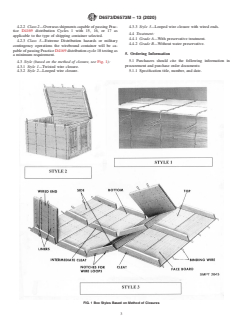
4.3.1 Style 1—Twisted wire closure.
4.3.2 Style 2—Looped wire closure. 5.1.1 Specification title, number, and date.
FIG. 1Box Styles Based on Method of Closures
D6573/D6573M−13 (2020)
5.1.2 Type of load, box, class, and style, and treatment, if 6.1.4 Fasteners:
specified, (see 4.1 – 4.4 and S2). 6.1.4.1 Nails—Nails shall be made of steel wire and shall
5.1.3 Inside box dimensions (see 7.1). conform to the requirements of Specification F1667 or other
5.1.4 Intermediate cleats for special designs, their size and industrystandards.Nailsareclassifiedasplain-shank,helically
location. (see 7.3.1). threaded, annularly threaded, fluted, or twisted square wire.
5.1.5 Weight of contents or load specified in lb (kg). Nails will be clinched, cement-coated, or chemical etched to
5.1.6 Type of girth wire (see 7.7.2). prevent premature withdrawal.
5.1.7 When palletization is required (see S3.4.3). 6.1.4.2 Staples or Wire Stitches—Staples have either round-
5.1.8 Marking required (see S4). wire or approximately square-wire legs, referring to the cross-
5.1.9 Exceptions to these specifications, if authorized. sectional shape of the wire. Staples or wire stitches shall be
5.1.10 When preservative treatment GradeAis required for madeofsteelwirenotlessthan0.0625in.16gage[2mm]and
Class 2 or 3 boxes for overseas shipments (see 6.1.5). comply with Specification F1667 or other industry standards.
5.1.11 When four-way entry skids are required and when 6.1.5 Wood Preservative, Water Repellent—Water repellent
3 ⁄2×4-in.[76×89mm]built-upskidsarerequired(see7.13). preservative shall be composed of either a 2% copper
5.1.12 Purchasers should reference by paragraph number naphthenate, a 3% zinc naphthenate, or a 1.8% oxine copper
any supplemental requirements applicable to their purchase (formerly referred to as copper-8-quinolinolate) solution.
request (see S1.1).
7. Construction
5.1.13 When ISPM 15 compliance is required (See 9.3).
7.1 Dimensions—Boxes shall be furnished having the di-
6. Materials and Manufacture
mensions as specified (see 5.1.3). Dimensions of boxes are
6.1 Materials—Materials shall be as specified herein. Ma-
measured between the inside surfaces of the faceboards, and
terials not specified shall be selected by the contractor or box
calculated to the nearest ⁄8 in. [3 mm], the preferred sequence
builder and shall be subject to all provisions of this specifica- length, width, and depth is used to communicate size in the
tion. Materials shall be free of defects, which adversely affect
purchase order or contract.
performance or serviceability of the finished product.
7.2 Faceboards—The thickness of the faceboard can be
6.1.1 Lumber—Lumber shall conform to Practice D6199,
determined by selecting the appropriate information from
PS 20 or the NHLA rules. All lumber sizes specified herein
Tables 2 and 3. Weight of box contents, type of load and the
shallbenominalandshallbetheminimumacceptablesizesfor
groups of wood based on box class determine the appropriate
lumber components. Lumber components shall have a target
faceboard.
thickness and width uniform in dimension and 50% of
7.2.1 Grain of Faceboards—End faceboards for Styles 1
components shall meet or exceed the target dimensions at the
and 2 boxes shall be placed with the grain horizontal, except
time of component manufacture.
that when horizontal battens are used in end panels, the grain
6.1.2 Plywood Panel—Plywood shall conform to ANSI/
of the faceboards shall be vertical. End faceboards for Style 3
HPVA HP-1-2004 or PS 1, Exposure 1 or Exterior panel.
boxes shall be placed with the grain vertical.Aline of staples
Plywoodshallhavenodefects(knotholes,wormholes,andso
shall be located approximately 1 in. [25 mm] from the parallel
forth)extendingthroughthepanel.Unlessotherwisespecified,
to each horizontal edge of the end faceboard (see 7.8). The
plywood shall be finished unsanded.
direction of grain of the plywood to which the end wire is
6.1.3 Wires:
stitched shall be vertical.
6.1.3.1 Binding Wire and Staple Wire—Binding wire shall
7.3 Cleats—The cleats shall be made of Group II (medium
be low carbon annealed steel wire and have the properties
density softwoods), III (medium density hardwoods), or IV
listed in Table 1. Staple wire shall be hard tempered, low
(high density hardwoods and softwoods) woods only as listed
carbon steel wire, and have the properties listed in Table 1.
with Practice D6199. Each cleat shall be single piece of wood
6.1.3.2 Wire Coatings—The surfaces of binding wire and
without joints. Cleats shall be made with mitered ends or with
staple wire for Class 2 and 3 boxes shall be galvanized. The
mortised and tenoned ends tongue- and groove. Dimensions
surface of binding and staple wires for Class 1 boxes need not
shall be actual dimensions, 1 ⁄32 in. [9 mm]. Edge cleats of all
be galvanized. Galvanized coating shall be smooth and shall
13 7
styles of boxes shall be ⁄16 in. [21 mm] wide and ⁄8 in. [22
not flake or peel when tested in accordance with Specification
mm]inthicknessforboxeshavingweightofcontentsupto300
A641/A641M.
lb [136 kg]. Boxes having weight of contents from 300 to 500
lb [136 to 227 kg] edge cleats shall be 1 ⁄8 in. [29 mm] wide
TABLE 1 Tensile Strength of Binding and Staple Wire
and 1 ⁄8 in. [29 mm] in thickness, except that horizontal and
Tensile Strength/K
vertical battens (HVB) or HVBW end patterns are used (see
Type psi MPa Use 13 7
Fig.2),edgecleatsshallbe ⁄16in.[21mm]wideand ⁄8in.[22
Twist binding 45–70 310–483 Twist closure
mm] in thickness.
Medium binding 60–75 414–517 Groups I, II, and III
7.3.1 Intermediate Cleats—Boxes for Types 2 and 3 loads,
woods
Hard binding 70–85 483–586 Group IV woods having greater between-cleat dimensions than specified in
Stapling wire 95–125 655–862 Group I, II, and III
Table 4, shall be reinforced with one or more rows of
woods
intermediate cleats, except as below. Rows of intermediate
Stapling wire special Up to 180 Up to 1241 Group IV woods
cleats are not required on boxes forType 1 loads.The distance
D6573/D6573M−13 (2020)
TABLE 2 Minimum Thickness of Faceboards
between adjacent rows of cleats shall not exceed the distance
Weight of Box Contents in lb [kg] Group I Woods in. [mm] indicatedinTable4.InspecialdesignsforTypes2and3loads,
Exceeding Not Exceeding Type 1 Load Type 2 Load Type 3 Load whererequired,sizeandlocationofintermediatecleatsshallbe
Class 1 Boxes specified (see 5.1.4) If the use of intermediate cleats may be
7 1 5
0 85 [38.5] ⁄32 [6] ⁄4 [6] ⁄16 [8]
omitted but the thickness of faceboards shall be increased to
1 5 3
85 [38.5] 125 [56.7] ⁄4 [6] ⁄16 [8] ⁄8 [10]
the thickness specified for the between cleat dimension indi-
5 3 7
125 [56.7] 200 [90.7] ⁄16 [8] ⁄8 [10] ⁄16 [11]
A
3 7
200 [90.7] 300 [136.1] ⁄8 [10] ⁄16 [11] cated in Table 4.
AAA
300 [136.1] 400 [181.4]
7.3.2 Cleat Sizes—Unless otherwise specified in the con-
AAA
400 [181.4] 500 [226.8]
tract or purchase order (see 5.1.9), any of the sizes of cleats
Class 2 Boxes
A
5 3
0 85 [38.5] ⁄16 [8] ⁄8 [10]
shown in Table 5 shall be used for intermediate rows. No part
A
3 3
85 [38.5] 125 [56.7] ⁄8 [10] ⁄8 [10]
ofanyintermediatecleatshallbemorethan ⁄32in.[1mm]less
AAA
125 [56.7] 200 [90.7]
AAA
than the dimension shown in Table 5, for dimensions exceed-
200 [90.7] 300 [136.1]
AAA
13 1
300 [136.1] 400 [181.4]
ing ⁄16in.[21mm],or ⁄16in.[2mm]lessthanthedimensions
Class 3 Boxes
exceeding ⁄16 in. [21 mm].
A
3 3
0 85 [38.5] ⁄8 [10] ⁄8 [10]
AAA
85 [38.5] 125 [56.7]
7.4 Battens—Battensshallbeattachedtotheoutsidefaceof
AAA
125 [56.7] 200 [90.7]
AAA the end faceboard and may be positioned horizontal, vertical,
200 [90.7] 500 [226.8]
or both horizontal and vertical. Battens made for Group I
Weight of Box Contents in lb [kg] Group II and III Woods in. [mm] 3
woods shall be not less than 1 ⁄4 in. [45 mm] wide and those
Exceeding Not Exceeding Type 1 Load Type 2 Load Type 3 Load
made from Groups II, III, and IV woods shall be not less than
Class 1 Boxes
1 1 3 3
0 85 [38.5] ⁄7 [4] ⁄6 [4] ⁄16 [5]
1 ⁄8 in. [35 mm] wide. Battens shall be the same thickness as
1 3 7
85 [38.5] 125 [56.7] ⁄6 [4] ⁄16 [5] ⁄32 [6]
the cleats on the boxes. No part of a batten shall be more than
3 7 1
125 [56.7] 200 [90.7] ⁄16 [5] ⁄32 [6] ⁄4 [6]
7 7 1 ⁄32 in. [1 mm] less than the specified thickness nor more than
200 [90.7] 300 [136.1] ⁄32 [6] ⁄32 [6] ⁄4 [6]
1 1 5 1
300 [136.1] 400 [181.4] ⁄4 [6] ⁄4 [6] ⁄16 [8]
⁄16 in. [2 mm] less than the specified width.
5 5 3
400 [181.4] 500 [226.8] ⁄16 [8] ⁄16 [8] ⁄8 [10]
7.5 Liners—The grain of the liner shall be at right angles to
Class 2 Boxes
3 7 5
0 85 [38.5] ⁄16 [5] ⁄32 [6] ⁄16 [8]
thegrainoftheendfaceboard.LinersforStyles1and2boxes
7 1 5
85 [38.5] 125 [56.7] ⁄32 [6] ⁄4 [6] ⁄16 [8]
shallalwaysbevertical;linersforStyle3boxesshallalwaysbe
7 1 5
125 [56.7] 200 [90.7] ⁄32 [6] ⁄4 [6] ⁄16 [8]
1 3 3
200 [90.7] 300 [136.1] ⁄4 [6] ⁄8 [10] ⁄8 [10] horizontal. When liners are attached to the edges of ends, the
5 3 3
300 [136.1] 400 [181.4] ⁄16 [8] ⁄8 [10] ⁄8 [10]
liners shall be not less than 1 ⁄16 in. [30 mm] wide. For Style 3
Class 3 Boxes
boxes more than 14 in. [356 mm] in depth, or having vertical
1 1 5
0 85 [38.5] ⁄4 [6] ⁄4 [6] ⁄16 [8]
1 5 5 7
85 [38.5] 125 [56.7] ⁄4 [6] ⁄16 [8] ⁄16 [8] battens, the liners shall be not less than 2 ⁄8 in. [73 mm] wide.
1 5 3
125 [56.7] 200 [90.7] ⁄4 [6] ⁄16 [8] ⁄8 [10]
Thethicknessofthelinershallbenotlessthanthethicknessof
5 3 3
200 [90.7] 500 [226.8] ⁄16 [8] ⁄8 [10] ⁄8 [10]
the end board, except that it need not exceed ⁄4 in. [6 mm],
Weight of Box Contents in lb [kg] Group IV Woods in. [mm]
when the thickness of the end face board exceeds ⁄4 in. [6
Exceeding Not Exceeding Type 1 Load Type 2 Load Type 3 Load
mm]. Each edge and intermediate liner shall be fastened to the
Class 1 Boxes
1 1 1 end face board by staples. Liners which are 2 ⁄8 in. [73 mm]
0 85 [38.5] ⁄7 [4] ⁄7 [4] ⁄6 [4]
1 1 3
85 [38.5] 125 [56.7] ⁄7 [4] ⁄6 [4] ⁄16 [5] wide shall have two rows of staples.
1 3 7
125 [56.7] 200 [90.7] ⁄6 [4] ⁄16 [5] ⁄32 [6]
3 7 1
7.6 Ends:
200 [90.7] 300 [136.1] ⁄16 [5] ⁄32 [6] ⁄4 [6]
7 1 5
300 [136.1] 400 [181.4] ⁄32 [6] ⁄4 [6] ⁄16 [5]
7.6.1 Ends for Styles 1 and 2 Boxes—Battens shall be
1 1 5
400 [181.4] 500 [226.8] ⁄4 [6] ⁄4 [6] ⁄16 [5]
required on the ends of Styles 1 and 2 boxes, except that
Class 2 Boxes
3 3 7
0 85 [38.5] ⁄16 [5] ⁄16 [5] ⁄32 [6] vertical liners are permitted in lieu of battens under the
3 3 7
85 [38.5] 125 [56.7] ⁄16 [5] ⁄16 [5] ⁄32 [6]
conditions specified in 7.11.2.The number and arrangement of
3 7 1
125 [56.7] 200 [90.7] ⁄16 [5] ⁄32 [6] ⁄4 [6]
battens or liners depend on the class of box, type of load,
7 1 5
200 [90.7] 300 [136.1] ⁄32 [6] ⁄4 [6] ⁄16 [5]
1 5 3
300 [136.1] 400 [181.4] ⁄4 [6] ⁄16 [5] ⁄8 [10]
dimensions, and weight of contents. Vertical liners shall be
Class 3 Boxes
requiredonendsmadefromsawedboardswhenbattensarenot
1 1 1
0 85 [38.5] ⁄4 [6] ⁄4 [6] ⁄4 [6]
1 1 5 used.Whenendsaremadefromone-pieceplywood,nolineris
85 [38.5] 125 [56.7] ⁄4 [6] ⁄4 [6] ⁄16 [5]
1 1 5
125 [56.7] 200 [90.7] ⁄4 [6] ⁄4 [6] ⁄16 [5]
required. Standard arrangements of battened ends and lined
1 5 3
200 [90.7] 500 [226.8] ⁄4 [6] ⁄16 [5] ⁄8 [10]
ends for Styles 1 and 2 boxes are shown in Fig. 3.
A
Group I Woods (low density hardwoods and softwoods) are not permitted.
7.6.2 Ends for Style 3 Boxes—Ends of Style 3 boxes shall
have liners, battens, or both. The number and arrangement of
battens, liners, and end-wires depend on the class of box, type
TABLE 3 Minimum Faceboard Requirements
of load, dimensions, and weight of contents. When ends shall
Resawn faceboard Faceboard edge piece Space between
be made from one-piece plywood, liners are not required.
thickness not less than not less than 2- ⁄2 in. Faceboards not more
1 1
Standard arrangements of battens on the ends of Style 3 boxes
⁄32 in. [1 mm] Less than [63.5 mm] wide than ⁄4 in. [6 mm]
specified in Table 2
are shown in Fig. 4.
Faceboards no less than One full piece of plywood
2 ⁄2 in. [63.5 mm] in width thickness not less than
7.7 Wires—Each girth wire shall be continuous around the
25 %
girth of the box. Whenever practicable, all girth wires shall be
spaceduniformly,exceptthatwhenrowsofintermediatecleats
D6573/D6573M−13 (2020)
Maximum Spacing of Vertical Battens in in. (mm)
Class 1 Class 2 Class 3
Type 1 Load [Easy] 18 [457] 15 [381] 12 [305]
Type 2 Load [Average] 16 [406] 13 [330] 10 [254]
Type 3 Load [Difficult] 14 [356] 11 [279] 7 [178]
NOTE 1—Wires may be placed on either side of face material.
FIG. 2End Panel Patters for Style 3 Boxes
TABLE 4 Maximum Distance Between Adjacent Rows of Cleats TABLE 5 Sizes of Intermediate Cleats
Thickness Width, in. [mm] Thickness, in. [mm]
of
3 3
2 ⁄4 [70] ⁄8 [10]
faceboards
1 1
2 ⁄4 [57] ⁄2 [13]
in
3 5
1 ⁄4 [45] ⁄8 [16]
fractional
1 3
1 ⁄4 [32] ⁄4 [19]
A
in. [mm] Type 2 Load [Average] Type 3 Load [Difficult]
13 13
⁄16 [21] ⁄16 [21]
Groups II Group II
Group I Group IV Group I Group IV
and III and III
in. [mm] Woods, in. Woods, in. Woods, in. Woods in.
Woods, in. Wood in.
[mm] [mm] [mm] [mm]
[mm] [mm]
7.8. Splicing or welding of a binding wire during manufacture
Class 1 Boxes
is acceptable. The number and gage of girth wires shall
⁄6 [4] — 32 [813] 36 [914] — — 24 [610]
conform to the requirements of Table 6 for the weight of
⁄32 [6] — 40 [1016] 44 [1118] — 28 [711] 32 [813]
⁄4 [6] 32 [813] 44 [1118] 48 [1219] — 32 [813] 36 [914] contents and inside length of box specified.
⁄16 [8] 36 [914] 48 [1219] 48 [1219] 24 [610] 36 [914] 40 [1016]
7.7.1 Wire Gage—The gage of end wires on Style 3 boxes
⁄8 [10] 36 [914] 48 [1219] 48 [1219] 24 [610] 40 [1016] 40 [1016]
shall conform to the requirements of Table 7 for the weight of
Class 2 and 3 Boxes
⁄32 [6] — 28 [711] 32 [813] — — 20 [508] contents and class of box specified.
⁄4 [6] — 32 [813] 36 [914] — 20 [508] 24 [610]
7.7.2 Girthwise Wire Closure for Box Styles—The length of
⁄16 [8] — 36 [914] 40 [1016] — 24 [610] 28 [711]
3 girth wires for twisted and looped wire fasteners on Styles 1
⁄8 [10] 32 [813] 40 [1016] 44 [1118] — 28 [711] 32 [813]
and 2 boxes shall be such as to make satisfactory closure. The
A
When intermediate cleats are not desired (see 7.3.1). For Type 1 loads,
lengthofloopedwireontheendsofStyle3boxesshallbesuch
intermediate cleats are not required.
as to make a satisfactory assembly of the box. On Style 1
boxes, for twisted wire closures, the ends of the girth wires
are used, a girth wire shall be placed over each row of cleats. shall not be less than 2 ⁄4 in. [57 mm] beyond the edge of the
On the ends of Style 3 boxes, each wire shall be continuous top boards and not less than 1 in. [25 mm] beyond the edge of
across the end. These wires should be generally stapled to the the side boards. On Style 2 boxes, each end of each girth wire
outside face of the end or may be stapled to the inside face if shall be a looped fastener formed by twisting the wires or by
it is more practical to do so. Stapling shall be as specified in bending the wire back in the opposite direction, driving the
D6573/D6573M−13 (2020)
Maximum Spacing of Vertical Battens
Class 1 in. [mm] Class 2 in. [mm] Class 3 in. [mm]
Type 1 Load [Easy] 15 [381] 12 [305] 12 [305]
Type 2 Load [Average] 13 [330] 10 [254] 10 [254]
Type 3 Load [Difficult] 11 [2793] 7 [178] 7 [178]
FIG. 3End Panel Patterns for Styles1&2 Boxes (see 7.11.1 – 7.11.3)
endsofthewirethroughtheboardsandclinching.Themanner Spacing of staples shall not exceed 2 in. [51 mm] when driven
of forming the looped fastener shall be at the option of the over binding wires for Class 1 boxes. For Class 2 and 3 boxes,
manufacturer. On Style 3 boxes, each end of each end wire
spacing of staples shall not exceed 1 ⁄2 in. [38 mm], except
shall be a looped fastener formed by bending the wire back in where the requirements for positioning end wires or the length
the opposite direction, driving the end of the wire through the
of the cleat requires more staples then the spacing shall not
boards and clinching. When specified in the contract or
exceed1 ⁄2in.[38mm].Staplesdrivenoverbindingwiresinto
purchase order (see 5.1.6), each end of each girth wire may be
faceboards only, shall be not less than 0.0475 in. in diameter
a twisted wire closure, as specified for Style 1 closures above.
18-gage[1.20mm].Thelengthofstaplesshallbenotlessthan
indicated in Table 8 and shall be long enough to penetrate the
7.8 Staples—Staples shall be used for fastening binding
boards and be clinched smooth.
wires for both faceboards and cleats and for fastening liners to
7.8.1 Staples for Securing Binding Wire to Cleats—Staples
end faceboards. Staples also may be used for fastening end
faceboards to battens. Binding wires shall be applied mechani- driven over binding wires and through faceboards into cleats
cally and be fastened by staples astride the wire. Staples shall shall be not less than 0.0625 in. diameter 16 gage [1.6 mm],
pass through the faceboards and be clinched smooth, or shall except that staples driven into cleats 1 ⁄8 in. [29 mm]
pass through the faceboards and into the cleats. The points of wide×1 ⁄8 in. [29 mm] deep shall be not less than 0.072 in.
thestaplesshallnotprotrudefromthesurfaceofthewood,but diameter 15 gage [1.8 mm]. Staples shall not be deformed or
if driven through a board or cleat, they shall be clinched. protrude from the cleats, except that when the thickness of the
D6573/D6573M−13 (2020)
FIG. 4Horizontal and Vertical Battens with Wires
D6573/D6573M−13 (2020)
TABLE 6 Minimum Number and Gage of Girth Wires
Inside length of box, in. [mm]
1 9 1 1 9 1 9 1
Weight of Contents, lb [kg] Up to 8 ⁄2 [216] 8 ⁄16 [218] to 13 [330] 13 ⁄6 [334] to 17 ⁄2 [445] 17 ⁄16 [446] to 22 ⁄2 [572] 22 ⁄16 [573] to 29 ⁄2 [749]
No. of Gage No. of
Range No. of Wires Gage [mm] No. of Wires Gage [mm] No. of Wires Gage [mm] Gage [mm]
Wires [mm] Wires
0–85 [0–38.5] 2 13 [2.3] 3 13 [2.3] 4 14 [2] 5 14 [2] 6 14 [2]
85–125 [38.5–56.7] 2 13 [2.3] 3 13 [2.3] 4 13 [2.3] 5 14 [2] 6 14 [2]
125–200 [56.7–90.7] — — 3 12 [2.7] 4 12 [2.7] 5 13 [2.3] 6 13 [2.3]
200–300 [90.7–136.1] — — — — 4 12 [2.7] 5 13 [2.3] 6 13 [2.3]
300–400 [136.1–181.4] — — — — — — 5 12 [2.7] 7 13 [2.3]
400–500 [181.4–226.8] — — — — — — — — 7 13 [2.3]
29 ⁄16 [751] to
9 1 9 1
Weight of contents [lbs] 35– ⁄16 [903] to 42 ⁄2 [1080] 42 ⁄16 to 51 [1081 to 1295] More than 51 ⁄6 [1300]
35 ⁄2 [902]
No. of Gage
Range No. of Wires Gage [mm] No. of Wires Gage [mm] No. of Wires Gage [mm]
Wires [mm]
0–85 [0–38.5] 6 14 [2] 7 14 [2] 8 14 [2] 9 14 [2]
85–125 [38.5–56.7] 6 13 [2.3] 7 13 [2.3] 8 13 [2.3] 9 13 [2.3]
125–200 [56.7–90.7] 6 13 [2.3] 7 13 [2.3] 8 13 [2.3] 9 13 [2.3]
200–300 [90.7–136.1] 7 13 [2.3] 8 13 [2.3] 8 13 [2.3] 9 13 [2.3]
300–400 [136.1–181.4] 7 13 [2.3] 8 13 [2.3] 8 13 [2.3] 9 13 [2.3]
400–500 [181.4–226.8] 7 13 [2.3] 9 13 [2.3] 9 13 [2.3] 9 13 [2.3]
TABLE 7 Gage of End Wires on Style 3 Boxes TABLE 10 Minimum Number of Staples Required in Any Cleat
Weight of Contents lb [kg] Wire Gage [mm] Weight of Contents lb [kg]
Minimum Number of
Classes 2 and 3
Staples
Exceeding Not Exceeding
Exceeding Not Exceeding Class 1 Boxes
Boxes
0 85 [38.5] 3
0 85 [38.5] 16 [1.6] 15 [1.8]
85 [38.5] 125 [56.7] 4
85 [38.5] 200 [90.7] 15 [1.8] 14 [2]
125 [56.7] 200 [90.7] 5
200 [90.7] 500 [226.8] 14 [2] 14 [2]
200 [90.7] 300 [136.1] 7
300 [136.1] 400 [181.4] 9
400 [181.4] 500 [226.8] 11
TABLE 8 Length of Staples Driven Over Wires Into Faceboards
Only
Length of Staples, Minimum in.
Thickness of Faceboards in. [mm] and intermediate liners to end faceboards or for fabricating
[mm]
two-ply faceboards shall be not less than 0.0475-in. diameter
1 3
⁄6 [4] ⁄8 [10]
1 5 1 18gage[1.2mm],andshallbesufficientlylongtopassthrough
Over ⁄6 [4] but not over ⁄16 [8] ⁄2 [13]
5 9
Over ⁄16 [8] ⁄16 [14]
the liner and faceboard and produce a smooth clinch. Staples
used for fastening end faceboards to battens shall be not less
than 0.0625-in. diameter 16 gage [1.8 mm]. The points of the
cleats is ⁄16 in. [14 mm] or less, the staples shall be driven staples shall not protrude from the battens unless clinched.
through the cleats and shall be sufficiently long to produce a Staples used for fastening end faceboards more than ⁄16 in. [2
smooth clinch. The length of staples shall be not less than mm] thick to battens shall be clinched. The spacing of staples
indicated in Table 9. shall not exceed 2 in. [51 mm], measured along the length of
7.8.2 Number of Cleat Staples—The minimum number of the batten.
staplesinanycleatshallcomplywiththerequirementsofTable
7.9 Nails—Nails used for fastening end faceboards to end
10. Not less than two staples shall be driven over each girth
battens shall not be less than 0.076-in. diameter 14 ⁄2 gage [2
wire through each faceboard, except that when a board is less
mm]. The length of each nail shall be not less than the
than 2 ⁄2 in. [63.5 mm] wide, only one staple need be driven
thickness of the end faceboard plus three-fourths of the
through the board.
thickness of the batten, unless clinched. The point of the nail
7.8.3 Placement of Staples—At each corner of the box the
shall not protrude from the batten, unless clinched. Nails used
distancefromtheendofthecleattotheneareststapleshallnot
tofastenendfaceboardmorethan ⁄6in.[2mm]thicktobattens
exceed 1 ⁄8 in.[41 mm]. Staples used for fastening edge and
shall be clinched. When nails are clinched, they shall have a
intermediate liners to end faceboards or for fabricating edge
1 1
smooth clinch of ⁄8 to ⁄4 in. [3 to 6 mm].The spacing of nails
shall not exceed 2 ⁄2 in. [63.5 mm], measured along the length
TABLE 9 Length of Staples Driven Over Wires and Through of the batten.
A
Faceboards into Cleats
7.10 Types of Loads—For Types 1 and 2 loads, the inside
Size of Cleat Thickness of Faceboards Length of Staples
dimensions of wire bound boxes shall be sufficiently exact so
in. [mm] in. [mm] in. [mm]
13 7 1 that the contents fit into the box when packed and give support
⁄16 [21] × ⁄8 [22] ⁄6 [4] 1 [25]
13 7 1 1 1
⁄16 [21] × ⁄8 [22] Over ⁄6 [4] by not over 4 ⁄4 [6] 1 ⁄8 [28.6]
to the faces of the box. If the contents do not fit the box and
13 7 1 1
⁄16 [21] × ⁄8 [22] Over ⁄4 [6] 1 ⁄4 [32]
permit shifting, a Type 3 load results and a box meeting the
1 1 1 3
1 ⁄8 [28.6] × 1 ⁄8 [28.6] ⁄4 [6]orless 1 ⁄8 [35]
1 1 1 1 requirements for Type 3 load shall be used. For Type 3 loads,
1 ⁄8 [28.6] × 1 ⁄8 [28.6] Over ⁄4 [6] 1 ⁄2 [38]
A other than bulk loads, the contents shall be firmly bolted,
Need not be longer than 1 ⁄8 in. [28.6 mm] for cleats made from Group IV Woods.
blocked,braced,orotherwiseanchoredtotheframeofthebox
D6573/D6573M−13 (2020)
TABLE 12 Selection of End Pattern for Style 3 Boxes
in such manner that shifting of contents will not occur during
handling of shipment. Weight of Contents of Box in lb [kg] Class 1 Box
Exceeding Not Exceeding Type 1 Load Type 2 Load Type 3 Load
7.11 Styles 1 and 2 Boxes—Styles 1 and 2 boxes shall be
0 125 [56.7] HLW HLW HLW
constructed with end patterns shown in Table 11 for the class
125 [56.7] 200 [90.7] HLW HLW HLW
200 [90.7] 300 [136.1] HLW HLW HBW
ofbox,typeofload,andweightofcontentsindicated.Theend
300 [136.1] 400 [181.4] HLW HBW HVBW
patterns shall be constructed with vertical liners (VL-pattern),
400 [181.4] 500 [226.8] HLVBW HLVBW HVBW
vertical battens (VB-pattern), horizontal and vertical battens
Class 2 Box
Exceeding Not Exceeding Type 1 Load Type 2 Load Type 3 Load
(HVB-pattern) as shown on Fig. 3. The following additional
0 125 [56.7] HLW HLW HLW
provisions and limitations for these end patterns also shall
125 [56.7] 200 [90.7] HLW HLW HBW
apply.
200 [90.7] 300 [136.1] HLVBW HLVBW HVBW
300 [136.1] 400 [181.4] HLVBW HLVBW HVBW
7.11.1 VL-Pattern—The maximum inside width or depth of
400 [181.4] 500 [226.8]
boxforwhichVL-patternendsmaybeusedis16in.[406mm]
for Type 1 loads or 14 in. [350 mm] for Type 2 loads.
VL-pattern end shall not be used for Type 3 loads, for Class 3
boxes, or when strapping is required (see the Supplementary mm] in size. When the box width or width and depth exceed
Requirements section). When the box width or depth exceeds the dimensions permitted for this pattern, the HBW-pattern
the dimensions permitted for the VL-pattern, the VB-pattern shallbeused.Whenonlytheboxdepthexceedsthedimensions
shall be used. permittedforthispattern,theHVBW-patternshallbeused(see
7.11.2 VB-Pattern—VB-patternendsshallbeusedinlieuof Fig. 2).
VL-pattern ends when the box width or depth exceeds the 7.12.2 HBW-Pattern—The HBW-pattern ends shall be used
dimensions permitted for the VL-pattern. When the inside only when the inside depth of box does not exceed 30 in. [762
depth or width exceeds 16 in. [406 mm], at least two vertical mm] for Class 1 boxes or 24 in. [610 mm] for Classes 2 and 3
battensshallbeused,withabattenplacedadjacenttoeachside boxes. When the box depth exceeds the dimensions permitted
cleat.Asinglecenterverticalbattenmaybeusedonlywhenthe for this pattern, the HVBW-pattern shall be used (see Fig. 4).
end faceboard is two-ply crossed veneer or plywood. At least 7.12.3 HLVBW-Pattern—TheHLVBW-patternendsshallbe
two vertical battens shall be used for Type 3 loads in Class 1 used where indicated on Table 12 and used in lieu of the
boxes and for Type 2 or 3 loads in Class 2 or 3 boxes. HBW-pattern, or HLVBW-pattern when the box dimensions
7.11.3 HVB-Pattern—HVB-pattern ends shall be used exceed the dimensions permitted for those patterns. When the
where indicated on Table 11 and may be used in lieu of VB inside depth exceeds 16 in. [406 mm], or the inside width
pattern ends. When the inside depth exceeds 16 in. [406 mm], exceeds 24 in. [610 mm] for Type 1 or 2 loads or 18 in. [457
or the inside width exceeds 24 in. [610 mm] for Type 1 or 2 mm] for Type 3 loads, at least two vertical battens shall be
loads or 18 in. [457 mm] forType 3 loads, at least two vertical used. A vertical batten shall be placed adjacent to each side
battens shall be used with a batten placed adjacent to each side cleat (see Fig. 4).
cleat. 7.12.4 HVBW-Pattern—The HVBW-pattern ends shall be
used where indicated on Table 12 and shall in be used in lieu
7.12 Style 3 Boxes—Style 3 boxes shall be constructed with
of the HBW-pattern or HLVBW-pattern when the box dimen-
endsofthepatternshowninTable12fortheclassofbox,type
sions exceed the dimensions permitted for those patterns.
of load, and weight of contents shown. The end patterns shall
When the inside depth exceeds 16 in. [406 mm], or the inside
beconstructedwithhorizontalliners(HLW-pattern),horizontal
widthexceeds24in.[610mm]forType1and2loadsor18in.
battens (HBW-pattern), horizontal liners and vertical battens
[457mm]forType3loads,atleasttwoverticalbattensshallbe
(HLVBW-pattern), or horizontal and vertical battens (HVBW-
used. A vertical batten shall be placed adjacent to each cleat
pattern), as shown on Fig. 4. The maximum spacing between
(see Fig. 2).
vertical battens shall be as shown in the Table 12. In addition,
the following provisions and limitations also shall apply: 7.13 Skids—Each box intended for use with loads having a
7.12.1 HLW-Pattern—The HLW-pattern shall be used only gross weight in excess of 200 lb [90 mm] or when the box
when both the inside width and inside depth of box do not grossweightexceeds100lb[37.3kg]andthelengthandwidth
exceed 16 in. [406 mm], except that this pattern may be used dimensions are 48 in. [1219 mm] × 24 in. [609 mm] or more,
for Class 1 boxes when the inside width or inside depth does shallbeprovidedwithaminimumoftwoskids.Twoskidswill
not exceed 30 in. [762 mm], provided the edge cleats are be attached and positioned to not exceed the inside parallel
1 1
increased to be not less than 1 ⁄8 in. [28.6 mm] × 1 ⁄8 in. [28.6 measurements of 48 in. [1219 mm] apart. Boxes exceeding the
TABLE 11 Selection of End Pattern for Styles 1 and 2 Boxes
Weight of Contents lb [kg] Class 1 box Class 2 box Class 3 box
Exceeding Not Exceeding Type 1 load Type 1 load Type 1 load Type 1 load Type 1 load Type 1 load Type 1 load Type 1 load Type 1 load
0 125 [56.7] VL VL VB VL VL VB VB VB VB
125 [56.7] 200 [90.7] VL VB VB VB VB VB VB VB VB
200 [90.7] 300 [136.1] VB VB VB VB VB VB VB VB HVB
300 [136.1] 400 [181.4] VB VB HVB VB HVB HVB
400 [181.4] 500 [226.8] VB VB HVB — —
D6573/D6573M−13 (2020)
above maximum dimensions shall require additional skids. either end with top open. Any failure to meet the color
Additionalskids,asrequired,shallbepositionedsoastodivide requirements specified in 8.2.1 and 8.2.2 shall be cause for
the area between the end skids into units of equal space.When rejection.
boltholesareprovidedinanenditemorequipment,additional 8.2.1 Oxine Copper Preservative Test—Two drops of a
skids,ifrequired,shallbelocatedsoastoenabletheitemtobe
formulation containing ten parts, by weight, of sodium dieth-
bolted to the skids. The skids or built-up skids and rubbing yldithicocarbamate trihydrate and 90 parts, by weight, of
1 1
stripsshallbeaminimumof2 ⁄2in.[63.5mm]highand3 ⁄2in.
distilled water shall be applied to the wood surface. An
[89mm]wide.Theskidsshallbeplacedparalleltoandextend immediatedarkbrowncolorationandthedropsspreadingshall
the full width of the box (shortest dimension of the bottom of
indicate the presence of treatment. An alternate method is to
the box), and shall be set not less than 2 ⁄2 in. [63.5 mm] or spray, over the dried wood surface, a solution of dissolved 0.5
more than ⁄6 in. [4 mm] the box length from each end. When
g chrome azurol S concentrate and 5.0 g of sodium acetate in
skids only are used, a bevel of 45 6 5° shall be applied to the 80 mL of distilled water, and diluted further to 500 mL total
bottom third of the skid ends. When rubbing strips are used in
distilled water. A deep blue color reveals the presence of
conjunction with the skids, the skid ends shall not be beveled copper (from oxine copper).
and the rubbing strips shall be set back from the ends of the
8.2.2 Zinc Naphthenate Preservative Test—Prepare a solu-
skids a distance of 2 ⁄2 to 4 in. [63.5 to 102 mm] to allow for
tion of 0.1 g of dissolved dithizone (diphenylthiocarbazone) in
sling placement. When four-way fork entry is required, skids
100 mL of chloroform and spray evenly over dried wood. A
shallbeanominal4×4,placedlengthwisenotlessthan1 ⁄2in.
pink color indicates the presence of zinc.
[38 mm] nor more than 2 ⁄2 in. [63.5 mm] from the container
NOTE 1—The pink color fades with light.
sides and cut out a minimum of 2 in. [51 mm] in depth and of
8.2.2.1 An alternate method is to prepare a mixture of 10
such width as to accommodate forks and slings for handling.
mLeach of three stock solutions and pour them in an atomizer
When specified (see 5.1.11), four-way fork entry shall be
[sprayer]. The first stock solution is comprised of1gof
accomplished with built up skids and rubbing strips having
potassium ferricyanide dissolved in 100 mL of distilled water.
minimum dimensions of 3 ⁄2 in. [89 mm] in width and 4 in.
The second solution is made of1gof soluble starch in about
[101.6 mm] in height with the cutouts being not less than 1 ⁄2
5 mL of distilled water which is added to 100 mL of distilled
in.[38mm]indepth.Eachskidshallbenotchedsufficientlyto
waterandboiledforoneminutewithconstantstirring,andthen
provide clearance for strapping. Filler cleats of the same
cooled.
thickness as the end or side cleats of the bottom panel of the
shipping container. The skids shall be secured to the box by
NOTE 2—This solution is subject to biodegradation and should not be
nails conforming to Type 2, Style 18 of Specification F1667,
used longer than three days.
and shall be of such length as to penetrate a minimum of 75%
8.2.2.2 Spray the mixture evenly over the dried wood
oftheskidthickness.Thesenailsshallbearrangedintworows
surface.Thesolutionwillcausethetreatedwoodtoturnadeep
in a staggered pattern, with spacing between nails in each row
blue immediately and the untreated part will retain its original
to be not more than 6 in. [152 mm]. Each row of nails shall be
color.
approximately 1 ⁄4 in. [32 mm] from the edge of the skid, and
8.3 Coating Adherence on Galvanized Wire Test—Coating
the nailing pattern shall begin and end approximately 1 ⁄2 in.
[38 mm] from the end of each skid and shall not be nailed adherence on galvanized wire testing shall be performed on
each sample unit to determine conformance to 6.1.3.1. The
through the strap notch.
sample unit shall be one piece of wire of sufficient length to
7.14 Assembly, Closure, and Strapping of Filled Boxes—
performthetest.Sampleunitsshallbeobtainedfromeachwire
This information is contained in the Supplementary Require-
lot used for binding wires and making staples.
ments section.
8.3.1 Test Procedure—Thewireshallbewrappedinaclosed
7.15 Preservative Treatment—When specified Class 2 or 3
helix for at least two complete turns around a ⁄16 in. [5 mm]
boxes shall be Grade A treated with one of the preservatives
diameter mandrel at a rate of not more than 15 turns per
specified (see 6.1.5). Each preserved box shall be marked with
minute.Thewrappedwireshallbeobservedforcoatingflaking
the letters PAwhen preserved with preservative PQ 56 is used.
and shall be rubbed with bare fingers to determine whether
...