

ASTM D7030-04(2022)
(Test Method)Standard Test Method for Short Term Creep Performance of Corrugated Fiberboard Containers Under Constant Load Using a Compression Test Machine
General Information
- Abstract
SIGNIFICANCE AND USE
4.1 In the distribution system, the packaged product may be stored for a period of time in a manner such that one or more containers are stacked on one another. The bottom package is thus continually subjected to a constant compression load.
4.2 This test method subjects an empty container to a predetermined static load and to specified atmospheric conditions, if required, over a short period of time using fixed platen compression testing equipment. Deflection is measured over time.
4.3 Deflection versus time data can be used to predict time to failure of corrugated shipping containers under constant load.
SCOPE
1.1 This test method covers determining the resistance of an empty paper corrugated shipping container to a vertically applied constant compression load for a specified time. The test method may also include palletized or unitized loads made of such containers. The boxes are tested in the orientation that they are most likely to be stacked in a unitized or palletized load.
1.2 The values stated in inch-pound units are to be regarded as standard. The values given in parentheses are mathematical conversions to SI units that are provided for information only and are not considered standard.
1.3 This standard does not purport to address all of the safety concerns, if any, associated with its use. It is the responsibility of the user of this standard to establish appropriate safety and health practices and determine the applicability of regulatory limitations prior to use.
1.4 This international standard was developed in accordance with internationally recognized principles on standardization established in the Decision on Principles for the Development of International Standards, Guides and Recommendations issued by the World Trade Organization Technical Barriers to Trade (TBT) Committee.
- Status
- Published
- Publication Date
- 30-Apr-2022
- Technical Committee
- D10 - Packaging

Overview
ASTM D7030-04(2022) is an internationally recognized standard that specifies the test method for assessing the short-term creep performance of corrugated fiberboard containers under constant compression load using a compression test machine. Developed by ASTM Committee D10 on Packaging, this standard is vital for evaluating the structural integrity and stacking performance of empty corrugated shipping containers subjected to vertical load during storage and distribution. The methodology is essential in simulating real-world storage scenarios, where packaged products may be stacked for extended periods and the bottom containers must withstand sustained compressive forces.
Key Topics
Test Scope
- Measures the resistance of empty corrugated fiberboard shipping containers to a vertical, static compression load over a specified short duration.
- Applicable to individual containers and unitized or palletized loads, tested in the most likely stacking orientation.
- Utilizes inch-pound units as the standard, with SI unit conversions provided for informational purposes.
Significance and Use
- Helps predict the stability, stacking life, and failure time of containers under constant load.
- Supports decisions in packaging design and logistics by evaluating material and construction effectiveness under operational stresses.
- Captures deflection-versus-time data, enabling accurate modeling and prediction of container deformation and failure under specified warehouse or distribution environments.
Test Equipment and Procedure
- Requires a calibrated fixed-platen compression test machine capable of maintaining constant load and precise platen parallelism.
- Details preconditioning procedures to simulate actual atmospheric conditions such as temperature and humidity.
- Outlines specimen preparation-fully constructed, empty containers with closures as per typical shipping practice.
- Recommends testing at several load levels, typically as a percentage of the known compression strength.
Applications
Quality Assurance and Packaging Design
- Ensures that corrugated fiberboard containers meet performance requirements for stacking and storage, reducing the risk of product damage.
- Allows manufacturers to optimize fiberboard material selection and construction methods to balance cost and performance.
- Facilitates certification for compliance in national and international supply chains.
Shipping and Distribution Validation
- Simulates warehouse stacking conditions to assess potential for container creep deformation and collapse over short-term storage.
- Provides data for logistics planners to maximize warehouse space and stacking configurations, improving operational efficiency.
Predictive Modeling
- Deflection data support calculations to estimate time-to-failure, permitting accelerated life testing and reducing the need for lengthy real-world trials.
- Enables users to refine their container selection or stacking heights for specific distribution environments and handling conditions.
Related Standards
- ASTM D642 - Test Method for Determining Compressive Resistance of Shipping Containers, Components, and Unit Loads
- ASTM D4332 - Practice for Conditioning Containers, Packages, or Packaging Components for Testing
- ASTM D685 - Practice for Conditioning Paper and Paper Products for Testing
- ASTM D4577 - Test Method for Compression Resistance of a Container Under Constant Load
- ASTM D996 - Terminology of Packaging and Distribution Environments
- ASTM E4 - Practices for Force Calibration and Verification of Testing Machines
- ASTM E122 - Practice for Calculating Sample Size to Estimate the Average for a Characteristic of a Lot or Process
Practical Value
ASTM D7030-04(2022) offers packaging professionals and manufacturers a reliable, standardized methodology to evaluate and improve the performance of corrugated fiberboard containers. By quantifying short-term creep under realistic storage conditions, this standard supports safer and more efficient packaging operations, enhances supply chain reliability, and contributes to sustainable and cost-effective material usage in the packaging industry.
Relations
- Effective Date
- 01-Oct-2023
- Refers
ASTM D4577-19 - Standard Test Method for Compression Resistance of a Container Under Constant Load - Effective Date
- 01-Apr-2019
- Effective Date
- 01-Oct-2018
- Effective Date
- 01-Jun-2014
- Effective Date
- 15-Mar-2013
- Effective Date
- 01-Nov-2012
- Effective Date
- 01-Aug-2011
- Effective Date
- 01-Dec-2010
- Effective Date
- 01-Aug-2010
- Effective Date
- 01-Aug-2010
- Effective Date
- 01-Jun-2010
- Effective Date
- 01-Nov-2009
- Effective Date
- 01-Aug-2009
- Effective Date
- 01-Apr-2009
- Effective Date
- 01-Dec-2008
Get Certified
Connect with accredited certification bodies for this standard

BRCGS (Brand Reputation Compliance Global Standards)
Global food safety and quality standards owner.
Sponsored listings
Frequently Asked Questions
ASTM D7030-04(2022) is a standard published by ASTM International. Its full title is "Standard Test Method for Short Term Creep Performance of Corrugated Fiberboard Containers Under Constant Load Using a Compression Test Machine". This standard covers: SIGNIFICANCE AND USE 4.1 In the distribution system, the packaged product may be stored for a period of time in a manner such that one or more containers are stacked on one another. The bottom package is thus continually subjected to a constant compression load. 4.2 This test method subjects an empty container to a predetermined static load and to specified atmospheric conditions, if required, over a short period of time using fixed platen compression testing equipment. Deflection is measured over time. 4.3 Deflection versus time data can be used to predict time to failure of corrugated shipping containers under constant load. SCOPE 1.1 This test method covers determining the resistance of an empty paper corrugated shipping container to a vertically applied constant compression load for a specified time. The test method may also include palletized or unitized loads made of such containers. The boxes are tested in the orientation that they are most likely to be stacked in a unitized or palletized load. 1.2 The values stated in inch-pound units are to be regarded as standard. The values given in parentheses are mathematical conversions to SI units that are provided for information only and are not considered standard. 1.3 This standard does not purport to address all of the safety concerns, if any, associated with its use. It is the responsibility of the user of this standard to establish appropriate safety and health practices and determine the applicability of regulatory limitations prior to use. 1.4 This international standard was developed in accordance with internationally recognized principles on standardization established in the Decision on Principles for the Development of International Standards, Guides and Recommendations issued by the World Trade Organization Technical Barriers to Trade (TBT) Committee.
SIGNIFICANCE AND USE 4.1 In the distribution system, the packaged product may be stored for a period of time in a manner such that one or more containers are stacked on one another. The bottom package is thus continually subjected to a constant compression load. 4.2 This test method subjects an empty container to a predetermined static load and to specified atmospheric conditions, if required, over a short period of time using fixed platen compression testing equipment. Deflection is measured over time. 4.3 Deflection versus time data can be used to predict time to failure of corrugated shipping containers under constant load. SCOPE 1.1 This test method covers determining the resistance of an empty paper corrugated shipping container to a vertically applied constant compression load for a specified time. The test method may also include palletized or unitized loads made of such containers. The boxes are tested in the orientation that they are most likely to be stacked in a unitized or palletized load. 1.2 The values stated in inch-pound units are to be regarded as standard. The values given in parentheses are mathematical conversions to SI units that are provided for information only and are not considered standard. 1.3 This standard does not purport to address all of the safety concerns, if any, associated with its use. It is the responsibility of the user of this standard to establish appropriate safety and health practices and determine the applicability of regulatory limitations prior to use. 1.4 This international standard was developed in accordance with internationally recognized principles on standardization established in the Decision on Principles for the Development of International Standards, Guides and Recommendations issued by the World Trade Organization Technical Barriers to Trade (TBT) Committee.
ASTM D7030-04(2022) is classified under the following ICS (International Classification for Standards) categories: 55.160 - Cases. Boxes. Crates. The ICS classification helps identify the subject area and facilitates finding related standards.
ASTM D7030-04(2022) has the following relationships with other standards: It is inter standard links to ASTM D4577-19(2023), ASTM D4577-19, ASTM D4577-05(2018), ASTM E4-14, ASTM D4332-13, ASTM D685-12, ASTM E122-09e1, ASTM D996-10a, ASTM D642-00(2010), ASTM D4577-05(2010), ASTM E4-10, ASTM E4-09a, ASTM E122-09, ASTM E4-09, ASTM E4-08. Understanding these relationships helps ensure you are using the most current and applicable version of the standard.
ASTM D7030-04(2022) is available in PDF format for immediate download after purchase. The document can be added to your cart and obtained through the secure checkout process. Digital delivery ensures instant access to the complete standard document.
Standards Content (Sample)
This international standard was developed in accordance with internationally recognized principles on standardization established in the Decision on Principles for the
Development of International Standards, Guides and Recommendations issued by the World Trade Organization Technical Barriers to Trade (TBT) Committee.
Designation: D7030 − 04 (Reapproved 2022)
Standard Test Method for
Short Term Creep Performance of Corrugated Fiberboard
Containers Under Constant Load Using a Compression Test
Machine
This standard is issued under the fixed designation D7030; the number immediately following the designation indicates the year of
original adoption or, in the case of revision, the year of last revision. A number in parentheses indicates the year of last reapproval. A
superscript epsilon (´) indicates an editorial change since the last revision or reapproval.
1. Scope Paperboard by Oven Drying (Withdrawn 2010)
D685 Practice for Conditioning Paper and Paper Products
1.1 This test method covers determining the resistance of an
for Testing
empty paper corrugated shipping container to a vertically
D996 Terminology of Packaging and Distribution Environ-
appliedconstantcompressionloadforaspecifiedtime.Thetest
ments
method may also include palletized or unitized loads made of
D4332 Practice for Conditioning Containers, Packages, or
such containers. The boxes are tested in the orientation that
Packaging Components for Testing
they are most likely to be stacked in a unitized or palletized
D4577 Test Method for Compression Resistance of a Con-
load.
tainer Under Constant Load
1.2 The values stated in inch-pound units are to be regarded E4 Practices for Force Calibration and Verification of Test-
as standard. The values given in parentheses are mathematical ing Machines
conversions to SI units that are provided for information only E122 Practice for Calculating Sample Size to Estimate,With
and are not considered standard. Specified Precision, the Average for a Characteristic of a
Lot or Process
1.3 This standard does not purport to address all of the
safety concerns, if any, associated with its use. It is the
3. Terminology
responsibility of the user of this standard to establish appro-
3.1 Definitions—General definitions for the packaging and
priate safety and health practices and determine the applica-
distribution environments are found in Terminology D996.
bility of regulatory limitations prior to use.
1.4 This international standard was developed in accor- 3.2 Definitions of Terms Specific to This Standard:
dance with internationally recognized principles on standard- 3.2.1 constant load—aloadthatisinvariableorunchanging.
ization established in the Decision on Principles for the
3.2.2 creep—continued deformation over time while under
Development of International Standards, Guides and Recom-
constant load.
mendations issued by the World Trade Organization Technical
3.2.3 load—the force applied to a body.
Barriers to Trade (TBT) Committee.
3.2.4 static load—an imposed stationary force, constant in
magnitude and direction.
2. Referenced Documents
2.1 ASTM Standards:
4. Significance and Use
D642 Test Method for Determining Compressive Resistance
4.1 In the distribution system, the packaged product may be
of Shipping Containers, Components, and Unit Loads
stored for a period of time in a manner such that one or more
D644 Test Method for Moisture Content of Paper and
containers are stacked on one another. The bottom package is
thus continually subjected to a constant compression load.
4.2 This test method subjects an empty container to a
This test method is under the jurisdiction of ASTM Committee D10 on
predetermined static load and to specified atmospheric
Packaging and is the direct responsibility of Subcommittee D10.21 on Shipping
conditions, if required, over a short period of time using fixed
Containers and Systems - Application of Performance Test Methods.
Current edition approved May 1, 2022. Published May 2022. Originally
platen compression testing equipment. Deflection is measured
approved in 2004. Last previous edition approved in 2017 as D7030 – 04 (2017).
over time.
DOI: 10.1520/D7030-04R22.
For referenced ASTM standards, visit the ASTM website, www.astm.org, or
contact ASTM Customer Service at service@astm.org. For Annual Book of ASTM
Standards volume information, refer to the standard’s Document Summary page on The last approved version of this historical standard is referenced on
the ASTM website. www.astm.org.
Copyright © ASTM International, 100 Barr Harbor Drive, PO Box C700, West Conshohocken, PA 19428-2959. United States
D7030 − 04 (2022)
4.3 Deflection versus time data can be used to predict time 5.3 Conditioning Apparatus—Adequate facilities shall be
to failure of corrugated shipping containers under constant provided to maintain a conditioned atmosphere of temperature
load.
and humidity as required for the purpose of the test.
5. Apparatus 5.4 Miscellaneous Equipment—Drying oven, scales, knife,
saws, and the like, for use in determination of the moisture
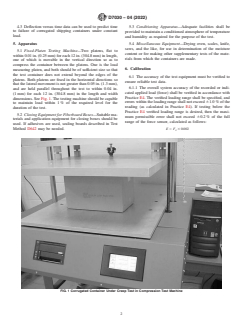
5.1 Fixed-Platen Testing Machine—Two platens, flat to
content or for making other supplementary tests of the mate-
within 0.01 in. (0.25 mm) for each 12 in. (304.8 mm) in length,
rials from which the containers are made.
one of which is movable in the vertical direction so as to
compress the container between the platens. One is the load
6. Calibration
measuring platen, and both should be of sufficient size so that
the test container does not extend beyond the edges of the
6.1 The accuracy of the test equipment must be verified to
platens. Both platens are fixed in the horizontal directions so
ensure reliable test data.
that the lateral movement is not greater than 0.05 in. (1.3 mm),
6.1.1 The overall system accuracy of the recorded or indi-
and are held parallel throughout the test to within 0.04 in.
cated applied load (force) shall be verified in accordance with
(1 mm) for each 12 in. (304.8 mm) in the length and width
Practice E4. The verified loading range shall be specified, and
dimensions. See Fig. 1. The testing machine should be capable
errors within the loading range shall not exceed 61.0 % of the
to maintain load within 1 % of the required level for the
reading (as calculated in Practice E4). If testing below the
duration of the test.
Practice E4 verified loading range is desired, then the maxi-
5.2 Closing Equipment for Fiberboard Boxes—Suitable ma-
mum permissible error shall not exceed 60.2 % of the full
terials and application equipment for closing boxes should be
range of the force sensor, calculated as follows:
used. If adhesives are used, sealing boards described in Test
Method D642 may be needed. E 5 F 30.002
S
FIG. 1 Corrugated Container Under Creep Test in Compression Test Machine
D7030 − 04 (2022)
where: conditions of 73 °F and 50 % relative humidity or at other
climatic conditions as described in Practice D4332.
E = maximum permissible error, lbf or N, and
F = force sensor’s full range, lbf or N.
S 9.5 The deflection shall be taken as zero the moment when
full load has been established.
6.1.2 The accuracy of the recorded or indicated platen
displacement must be verified in accordance with the equip-
9.6 Record the deflection versus time values over a pre-
ment manufacturer’s recommended procedures. The error,
determined period. The recommended test time is 12 h.
including the effects of any backlash in the loading system,
9.7 Moisture Content (when Specified):
shall not exceed 60.1 in. (62.5 mm).
9.7.1 Fiberboard Containers—Determine the moisture con-
6.1.3 The accuracy of the platen travel rate at 0.5 in./min
tent of fiberboard at the end of the test in accordance with Test
(12.7 mm/min) must be verified throughout each loading range
Method D644.
in accordance with the equipment manufacturer’s recom-
mended procedures. The error, including any backlash in the
10. Report
loading system, shall not exceed 60.10 in./min (62.5 mm/
10.1 R
...