

ASTM D6881/D6881M-03(2020)
(Classification)Standard Classification for Standard Plastics Industry Bulk Box/Pallet Unit Size Classified By Bulk Density
General Information
- Abstract
SIGNIFICANCE AND USE
4.1 This standard classification will be used to:
4.1.1 Standardize the package size increasing availability, versatility, and acceptability of bulk box/pallet units.
4.1.2 Lower transport package manufacturing costs.
4.1.3 Lower cost/lb of packaged resin because of higher net weight/package.
4.1.4 Reduce environmental impact of pallets and bulk boxes by reducing waste.
4.1.5 Support reuse of bulk boxes and pallets throughout the supply chain.
4.1.6 Optimize lifecycle package cost.
4.1.7 Improve both inbound and outbound freight cost in comparison to non-optimal packaging.
4.1.8 Lower inventory/storage cost of raw materials (need less on hand).
4.1.9 Reduce warehouse space for resin storage.
4.1.10 Reduce forklift trips (carrying higher weight).
4.1.11 Promote multi-industry usage of common footprint boxes and pallets (examples are the automotive and chemical drum industry).
4.1.12 Guide the first-time resin packager as to a successful bulk box/pallet unit now in use in the resin industry.
4.1.13 Optimize net product weight in truckload trailer vans and oversea containers.
4.2 This standard classification will be used by:
4.2.1 Resin producers/converters/compounders/customers to compare with their current practice.
4.2.2 Bulk box manufacturers to recommend a proven cost-effective package for plastic resins in the targeted bulk density range.
4.2.3 Pallet manufacturers as a common bulk box footprint pallet for the targeted bulk density ranges used by the plastic resin industry.
4.2.4 Box liner manufacturers to size their liners to a specified volume dimension.
4.2.5 Warehouses to provide space layout plans based on dimensions of the standard box/pallet unit.
SCOPE
1.1 This classification covers containers used to hold plastic resins with bulk density (Test Methods D1895) of 27 to 39 lb/ft3 (0.432 to 0.625 g/cm3).
1.2 This classification does not apply to any plastic resins with bulk density below 27 lb/ft3 (0.432 g/cm3) or above 39lb/ft3 (0.625 g/cm3).
1.3 This classification does not apply to bulk boxes containing hazardous materials.
1.4 This classification does not address box/pallet unitization requirements.
1.5 This classification does not address requirements of plastic bag liners normally placed inside the corrugated bulk box before filling with plastic resin.
1.6 This classification does not address tamping, shaking, or other compression methods of the resin filled bulk box to condense entrained air and increase headspace in the bulk box.
1.7 This classification does not address blocking and bracing or other shipping requirements normally associated with bulk box unit deliveries.
1.8 This classification does not address filled bulk box/pallet unit stack height.
1.9 This classification does not address international shipping regulations of bulk box/pallet units.
1.10 This classification does not address pallet opening sizes for pallet trucks.
1.11 The values stated in either SI units or inch-pound units are to be regarded separately as standard. The values stated in each system may not be exact equivalents; therefore, each system shall be used independently of the other. Combining values from the two systems may result in non-conformance with the standard.
1.12 This standard does not purport to address all of the safety concerns, if any, associated with its use. It is the responsibility of the user of this standard to establish appropriate safety, health, and environmental practices and determine the applicability of regulatory limitations prior to use.
1.13 This classification offers an organized collection of information or a series of options and does not recommend a specific course of action. This document cannot replace education or experience and should be used in conjunction with professional judgement. Not all aspects of this classification may be applicable in all circumstances. This...
- Status
- Published
- Publication Date
- 30-Sep-2020
- Technical Committee
- D10 - Packaging
Overview
ASTM D6881/D6881M-03(2020), Standard Classification for Standard Plastics Industry Bulk Box/Pallet Unit Size Classified By Bulk Density, establishes a classification system for containers designed to hold plastic resins with bulk densities between 27 to 39 lb/ft³ (0.432 to 0.625 g/cm³). Developed by ASTM International, this standard supports the unification of bulk box and pallet sizes within the plastics industry, directly benefiting operational efficiency, cost control, and sustainability.
The standard addresses the challenges posed by varied box and pallet dimensions previously in use, streamlining packaging solutions for resin transportation and storage. It is intended for use by resin producers, converters, compounders, packaging engineers, bulk box and pallet manufacturers, warehouses, and logistics professionals in the plastics sector.
Key Topics
Standardization of Bulk Box and Pallet Sizes
Encourages industry-wide adoption of common container footprints, enhancing compatibility and interchangeability.Cost Reduction and Efficiency
- Minimizes transport packaging and manufacturing costs
- Improves freight efficiency by increasing net weight per package
- Reduces required storage space and inventory costs
- Decreases forklift trips and handling
Environmental Sustainability
- Promotes reuse of bulk packaging
- Decreases packaging waste, lowering environmental impact
- Extends lifecycle of packaging materials
Industry Versatility
Supports multi-industry applications (e.g., automotive, chemical drum) through standardized pallet dimensions.Guidance for New Entrants
Serves as a practical reference for first-time resin packagers to select proven, cost-effective, and widely accepted packaging solutions.Bulk Density Criteria
Applies specifically to plastic resin bulk densities between 27 and 39 lb/ft³, using established testing methods (ASTM D1895).
Applications
Plastic Resin Packaging and Shipping
Ensures resins are packaged in containers optimized for bulk density, facilitating easier handling and maximizing shipping payloads both domestically and internationally.Warehouse and Inventory Planning
Standardized packages offer predictable dimensions for warehouse layout, space allocation, and inventory turnover, improving overall efficiency.Supply Chain Optimization
Uniform packaging sizes simplify transportation planning and allow better utilization of container and trailer space, reducing freight costs and shipment frequency.Reusable Packaging Systems
By supporting the return and reuse of boxes and pallets, companies can reduce material procurement and waste, yielding both cost and environmental benefits.Cross-sector Packaging Solutions
Enables use of bulk box and pallet units across industries with varied requirements, strengthening the supply chain and decreasing the complexity arising from disparate packaging standards.
Related Standards
ASTM D1895 – Test Methods for Apparent Density, Bulk Factor, and Pourability of Plastic Materials
Serves as the reference method for determining the bulk density range addressed in ASTM D6881/D6881M.ASTM Standards for Shipping Containers and Pallets
Additional ASTM packaging standards may offer complementary guidance for specific performance, liner requirements, or unitization of packaging.Industry Guidelines and Associations
Relevant practices from organizations including the Society of Plastic Engineers, National Wooden Pallet and Container Association, and Technical Association of the Pulp and Paper Industry are aligned for optimized packaging and logistics processes.
Keywords: bulk box, plastic resin packaging, standard pallet size, bulk density, ASTM D6881, logistics, warehouse optimization, plastics industry, reusable packaging, transport efficiency, environmental impact.
Relations
- Effective Date
- 01-Sep-2017
- Effective Date
- 01-Jan-2010
- Effective Date
- 01-Jan-2010
- Effective Date
- 10-Apr-2003
- Effective Date
- 10-Apr-1996
Get Certified
Connect with accredited certification bodies for this standard

BRCGS (Brand Reputation Compliance Global Standards)
Global food safety and quality standards owner.
Sponsored listings
Frequently Asked Questions
ASTM D6881/D6881M-03(2020) is a standard published by ASTM International. Its full title is "Standard Classification for Standard Plastics Industry Bulk Box/Pallet Unit Size Classified By Bulk Density". This standard covers: SIGNIFICANCE AND USE 4.1 This standard classification will be used to: 4.1.1 Standardize the package size increasing availability, versatility, and acceptability of bulk box/pallet units. 4.1.2 Lower transport package manufacturing costs. 4.1.3 Lower cost/lb of packaged resin because of higher net weight/package. 4.1.4 Reduce environmental impact of pallets and bulk boxes by reducing waste. 4.1.5 Support reuse of bulk boxes and pallets throughout the supply chain. 4.1.6 Optimize lifecycle package cost. 4.1.7 Improve both inbound and outbound freight cost in comparison to non-optimal packaging. 4.1.8 Lower inventory/storage cost of raw materials (need less on hand). 4.1.9 Reduce warehouse space for resin storage. 4.1.10 Reduce forklift trips (carrying higher weight). 4.1.11 Promote multi-industry usage of common footprint boxes and pallets (examples are the automotive and chemical drum industry). 4.1.12 Guide the first-time resin packager as to a successful bulk box/pallet unit now in use in the resin industry. 4.1.13 Optimize net product weight in truckload trailer vans and oversea containers. 4.2 This standard classification will be used by: 4.2.1 Resin producers/converters/compounders/customers to compare with their current practice. 4.2.2 Bulk box manufacturers to recommend a proven cost-effective package for plastic resins in the targeted bulk density range. 4.2.3 Pallet manufacturers as a common bulk box footprint pallet for the targeted bulk density ranges used by the plastic resin industry. 4.2.4 Box liner manufacturers to size their liners to a specified volume dimension. 4.2.5 Warehouses to provide space layout plans based on dimensions of the standard box/pallet unit. SCOPE 1.1 This classification covers containers used to hold plastic resins with bulk density (Test Methods D1895) of 27 to 39 lb/ft3 (0.432 to 0.625 g/cm3). 1.2 This classification does not apply to any plastic resins with bulk density below 27 lb/ft3 (0.432 g/cm3) or above 39lb/ft3 (0.625 g/cm3). 1.3 This classification does not apply to bulk boxes containing hazardous materials. 1.4 This classification does not address box/pallet unitization requirements. 1.5 This classification does not address requirements of plastic bag liners normally placed inside the corrugated bulk box before filling with plastic resin. 1.6 This classification does not address tamping, shaking, or other compression methods of the resin filled bulk box to condense entrained air and increase headspace in the bulk box. 1.7 This classification does not address blocking and bracing or other shipping requirements normally associated with bulk box unit deliveries. 1.8 This classification does not address filled bulk box/pallet unit stack height. 1.9 This classification does not address international shipping regulations of bulk box/pallet units. 1.10 This classification does not address pallet opening sizes for pallet trucks. 1.11 The values stated in either SI units or inch-pound units are to be regarded separately as standard. The values stated in each system may not be exact equivalents; therefore, each system shall be used independently of the other. Combining values from the two systems may result in non-conformance with the standard. 1.12 This standard does not purport to address all of the safety concerns, if any, associated with its use. It is the responsibility of the user of this standard to establish appropriate safety, health, and environmental practices and determine the applicability of regulatory limitations prior to use. 1.13 This classification offers an organized collection of information or a series of options and does not recommend a specific course of action. This document cannot replace education or experience and should be used in conjunction with professional judgement. Not all aspects of this classification may be applicable in all circumstances. This...
SIGNIFICANCE AND USE 4.1 This standard classification will be used to: 4.1.1 Standardize the package size increasing availability, versatility, and acceptability of bulk box/pallet units. 4.1.2 Lower transport package manufacturing costs. 4.1.3 Lower cost/lb of packaged resin because of higher net weight/package. 4.1.4 Reduce environmental impact of pallets and bulk boxes by reducing waste. 4.1.5 Support reuse of bulk boxes and pallets throughout the supply chain. 4.1.6 Optimize lifecycle package cost. 4.1.7 Improve both inbound and outbound freight cost in comparison to non-optimal packaging. 4.1.8 Lower inventory/storage cost of raw materials (need less on hand). 4.1.9 Reduce warehouse space for resin storage. 4.1.10 Reduce forklift trips (carrying higher weight). 4.1.11 Promote multi-industry usage of common footprint boxes and pallets (examples are the automotive and chemical drum industry). 4.1.12 Guide the first-time resin packager as to a successful bulk box/pallet unit now in use in the resin industry. 4.1.13 Optimize net product weight in truckload trailer vans and oversea containers. 4.2 This standard classification will be used by: 4.2.1 Resin producers/converters/compounders/customers to compare with their current practice. 4.2.2 Bulk box manufacturers to recommend a proven cost-effective package for plastic resins in the targeted bulk density range. 4.2.3 Pallet manufacturers as a common bulk box footprint pallet for the targeted bulk density ranges used by the plastic resin industry. 4.2.4 Box liner manufacturers to size their liners to a specified volume dimension. 4.2.5 Warehouses to provide space layout plans based on dimensions of the standard box/pallet unit. SCOPE 1.1 This classification covers containers used to hold plastic resins with bulk density (Test Methods D1895) of 27 to 39 lb/ft3 (0.432 to 0.625 g/cm3). 1.2 This classification does not apply to any plastic resins with bulk density below 27 lb/ft3 (0.432 g/cm3) or above 39lb/ft3 (0.625 g/cm3). 1.3 This classification does not apply to bulk boxes containing hazardous materials. 1.4 This classification does not address box/pallet unitization requirements. 1.5 This classification does not address requirements of plastic bag liners normally placed inside the corrugated bulk box before filling with plastic resin. 1.6 This classification does not address tamping, shaking, or other compression methods of the resin filled bulk box to condense entrained air and increase headspace in the bulk box. 1.7 This classification does not address blocking and bracing or other shipping requirements normally associated with bulk box unit deliveries. 1.8 This classification does not address filled bulk box/pallet unit stack height. 1.9 This classification does not address international shipping regulations of bulk box/pallet units. 1.10 This classification does not address pallet opening sizes for pallet trucks. 1.11 The values stated in either SI units or inch-pound units are to be regarded separately as standard. The values stated in each system may not be exact equivalents; therefore, each system shall be used independently of the other. Combining values from the two systems may result in non-conformance with the standard. 1.12 This standard does not purport to address all of the safety concerns, if any, associated with its use. It is the responsibility of the user of this standard to establish appropriate safety, health, and environmental practices and determine the applicability of regulatory limitations prior to use. 1.13 This classification offers an organized collection of information or a series of options and does not recommend a specific course of action. This document cannot replace education or experience and should be used in conjunction with professional judgement. Not all aspects of this classification may be applicable in all circumstances. This...
ASTM D6881/D6881M-03(2020) is classified under the following ICS (International Classification for Standards) categories: 55.160 - Cases. Boxes. Crates. The ICS classification helps identify the subject area and facilitates finding related standards.
ASTM D6881/D6881M-03(2020) has the following relationships with other standards: It is inter standard links to ASTM D1895-17, ASTM D1895-96(2010), ASTM D1895-96(2010)e1, ASTM D1895-96(2003), ASTM D1895-96. Understanding these relationships helps ensure you are using the most current and applicable version of the standard.
ASTM D6881/D6881M-03(2020) is available in PDF format for immediate download after purchase. The document can be added to your cart and obtained through the secure checkout process. Digital delivery ensures instant access to the complete standard document.
Standards Content (Sample)
This international standard was developed in accordance with internationally recognized principles on standardization established in the Decision on Principles for the
Development of International Standards, Guides and Recommendations issued by the World Trade Organization Technical Barriers to Trade (TBT) Committee.
Designation: D6881/D6881M −03 (Reapproved 2020)
Standard Classification for
Standard Plastics Industry Bulk Box/Pallet Unit Size
Classified By Bulk Density
This standard is issued under the fixed designation D6881/D6881M; the number immediately following the designation indicates the
year of original adoption or, in the case of revision, the year of last revision. A number in parentheses indicates the year of last
reapproval. A superscript epsilon (´) indicates an editorial change since the last revision or reapproval.
INTRODUCTION
An ad-hoc survey in 2000 showed about 40 different box sizes in use by the plastic resin industry;
thepurposeforthisclassificationistoquantifyabox/palletunitsizeacceptableforthisindustrywithin
the limits of the scope.
1. Scope 1.10 This classification does not address pallet opening
sizes for pallet trucks.
1.1 This classification covers containers used to hold plastic
resins with bulk density (Test Methods D1895)of27to39
1.11 The values stated in either SI units or inch-pound units
3 3
lb/ft (0.432 to 0.625 g/cm ).
are to be regarded separately as standard. The values stated in
each system may not be exact equivalents; therefore, each
1.2 This classification does not apply to any plastic resins
3 3
system shall be used independently of the other. Combining
with bulk density below 27 lb/ft (0.432 g/cm ) or above
values from the two systems may result in non-conformance
39lb/ft (0.625 g/cm ).
with the standard.
1.3 This classification does not apply to bulk boxes contain-
1.12 This standard does not purport to address all of the
ing hazardous materials.
safety concerns, if any, associated with its use. It is the
1.4 This classification does not address box/pallet unitiza-
responsibility of the user of this standard to establish appro-
tion requirements.
priate safety, health, and environmental practices and deter-
1.5 This classification does not address requirements of
mine the applicability of regulatory limitations prior to use.
plastic bag liners normally placed inside the corrugated bulk
1.13 This classification offers an organized collection of
box before filling with plastic resin.
information or a series of options and does not recommend a
specific course of action. This document cannot replace edu-
1.6 This classification does not address tamping, shaking, or
cation or experience and should be used in conjunction with
other compression methods of the resin filled bulk box to
professional judgement. Not all aspects of this classification
condense entrained air and increase headspace in the bulk box.
may be applicable in all circumstances. This ASTM standard is
1.7 This classification does not address blocking and brac-
not intended to represent or replace the standard of care by
ing or other shipping requirements normally associated with
which the adequacy of a given professional service must be
bulk box unit deliveries.
judged, nor should this document be applied without consid-
1.8 Thisclassificationdoesnotaddressfilledbulkbox/pallet
eration of a project’s many unique aspects. The word “stan-
unit stack height.
dard” in the title of this document means only that the
document has been approved through the ASTM consensus
1.9 This classification does not address international ship-
process.
ping regulations of bulk box/pallet units.
1.14 This international standard was developed in accor-
dance with internationally recognized principles on standard-
This classification is under the jurisdiction of ASTM Committee D10 on
Packaging and is the direct responsibility of Subcommittee D10.12 on Shipping
ization established in the Decision on Principles for the
Containers, Crates, Pallets, Skids and Related Structures.
Development of International Standards, Guides and Recom-
Current edition approved Oct. 1, 2020. Published October 2020. Originally
mendations issued by the World Trade Organization Technical
approved in 2003. Last previous edition approved in 2013 as D6881/
D6881M – 03 (2013). DOI: 10.1520/D6881_D6881M-03R20. Barriers to Trade (TBT) Committee.
Copyright ©ASTM International, 100 Barr Harbor Drive, PO Box C700, West Conshohocken, PA19428-2959. United States
D6881/D6881M − 03 (2020)
2. Referenced Documents 4.2 This standard classification will be used by:
2 4.2.1 Resin producers/converters/compounders/customers
2.1 ASTM Standards:
to compare with their current practice.
D1895 Test Methods forApparent Density, Bulk Factor, and
4.2.2 Bulk box manufacturers to recommend a proven
Pourability of Plastic Materials
cost-effective package for plastic resins in the targeted bulk
3. Terminology density range.
4.2.3 Pallet manufacturers as a common bulk box footprint
3.1 Definitions of Terms Specific to This Standard:
pallet for the targeted bulk density ranges used by the plastic
3.1.1 bulk box, plastic resin, n—a container used to enclose,
resin industry.
protect, hold, and transport plastic resin, with net weights of
4.2.4 Box liner manufacturers to size their liners to a
about 1000 to 1600 lb (453.6 to 725.7 kg); it will have
specified volume dimension.
semi-rigid sidewalls that resist bulging of the sidewall when
4.2.5 Warehouses to provide space layout plans based on
loaded, retain the approximate size of the empty assembled
dimensions of the standard box/pallet unit.
box, and prevent collapse of the container during removal of
the product.
5. Basis of Classification
3.1.1.1 Discussion—Normally, the box is placed on a pallet
or skid, filled, and stacked one pallet load on the other for a 5.1 The bulk box will contain about 1000 to 1600 lb (453.6
stack height selected by the user. to 725.7 kg) of plastic resins with typical bulk densities of 27
3 3
to 39 lb/ft (0.432 to 0.625 g/cm ).
3.1.2 freeboard, n—amount of bulk box set back from pallet
edge on all sides to offset the bulge of the container when filled
5.2 Minimum performance of the bulk box pallet unit
with resin (typically 7 to 8 % of pallet dimension). during pack out, storage, and transit will be specified by the
user.
3.1.3 pinwheeling, v—when lengthwise loading vans or
containers, the turning of a bulk box 90° and loading width-
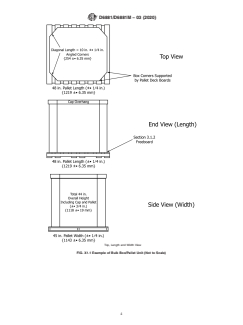
5.3 Total height of box, cap, and pallet (container height)
wise.
equals 44 6 ⁄4-in. (1118 6 19 mm).
3.1.4 plastic resin, n—organic compounds produced by
5.4 Total width of pallet (container footprint width) equals
polymerization that are flowable forms of filled or unfilled 1
45 6 ⁄4-in. (1143 6 6.35 mm).
powder, flake, chips, pellets, or granules originating from
5.5 Total
...