

ASTM F2325-14(2020)
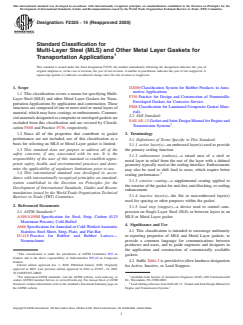
(Classification)Standard Classification for Multi-Layer Steel (MLS) and Other Metal Layer Gaskets for Transportation Applications
General Information
- Abstract
SIGNIFICANCE AND USE
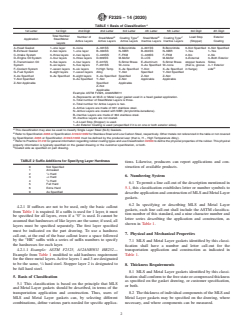
4.1 This classification is intended to encourage uniformity in reporting properties of MLS and Metal Layer gaskets, to provide a common language for communications between producers and users, and to guide engineers and designers in the application and construction of commercially available gaskets. (A) This classification may also be used to classify Single Layer Steel (SLS) Gaskets.(B) Refer to Specification A666 or Specification A109/A109M for Stainless Steel and Low Carbon Steel, respectively. Other metals not referenced in the table or not covered by Specification A666 or Specification A109/A109M must be defined by the producer/user (that is, H – High Temperature Alloy).(C) Refer to Practice D1418 for general information regarding rubber coating types and use Classification D2000 to define the physical properties of the rubber. This physical property information is typically specified on the gasket drawing or the customer specification, or both.(D) Coated side as specified on part drawing.
4.2 Suffix Table 2 is provided to allow hardness designation for Active, Inactive, or Load Stoppers.
4.2.1 If suffixes are not to be used, only the basic callout from Table 1 is required. If a suffix is used for 1 layer, it must be specified for all layers, even if a “0” is used. It cannot be assumed that hardnesses of like layers are the same; if used, all layers must be specified separately. The first layer specified must be indicated on the part drawing. To use a hardness call-out, at the end of the base callout leave a space followed by the “HR” suffix with a series of suffix numbers to specify the hardnesses for each layer.
4.2.1.1 Example: ASTM F2325, A32ANBW11 HR252—Example from Table 1 modified to add hardness requirement for the three metal layers. Active layers 1 and 3 are designated to be the same, 1/4 hard steel. Stopper layer 2 is designated to be full hard steel.
SCOPE
1.1 This classification covers a means for specifying Multi-Layer Steel (MLS) and other Metal Layer Gaskets for Transportation Applications by application and construction. These structures are composed of one or more steel or metal layers of material, which may have coatings or embossments. Commercial materials designated as composite or enveloped gaskets are excluded from this classification and are covered by Classification F868 and Practice F336, respectively.
1.2 Since all of the properties that contribute to gasket performance are not included, use of this classification as a basis for selecting an MLS or Metal Layer gasket is limited.
1.3 This standard does not purport to address all of the safety concerns, if any, associated with its use. It is the responsibility of the user of this standard to establish appropriate safety, health, and environmental practices and determine the applicability of regulatory limitations prior to use.
1.4 This international standard was developed in accordance with internationally recognized principles on standardization established in the Decision on Principles for the Development of International Standards, Guides and Recommendations issued by the World Trade Organization Technical Barriers to Trade (TBT) Committee.
- Status
- Published
- Publication Date
- 31-Dec-2019
- Technical Committee
- F03 - Gaskets
- Drafting Committee
- F03.10 - Composite Gaskets


Overview
ASTM F2325-14(2020) is the standard classification established by ASTM International for Multi-Layer Steel (MLS) and other metal layer gaskets used in transportation applications. This standard aims to provide a uniform and consistent framework for specifying and describing the construction and properties of metal gaskets, including those with multiple steel or metal layers and optional coatings or embossments. By standardizing terminology and classification, ASTM F2325 supports improved communication between gasket producers, users, and engineers, guiding the proper application and selection of commercially available gaskets for automotive and transportation systems.
Key Topics
- Scope of Classification: Covers MLS and Metal Layer gaskets designed for transportation, but excludes composite and enveloped gaskets (which are addressed in ASTM F868 and F336 respectively).
- Uniform Reporting: Enables clear and consistent reporting of gasket properties, configurations, and intended applications.
- Layer Designation: Defines how each metal or steel layer (active, inactive, stopper) is to be specified, including optional coatings and hardness levels.
- Hardness Suffix System: Provides an organized system to indicate the specific hardness of each gasket layer, supporting precise gasket specification.
- Compatibility: Offers guidance for referencing other material standards (A666 for stainless steel, A109/A109M for low carbon steel), and for classifying single layer steel gaskets.
- Terminology: Standardizes terms, such as active layer, inactive layer, embossment, exterior coating, and load stop (stopper), to eliminate ambiguity.
Applications
The ASTM F2325 classification is essential for:
- Automotive Engineering: MLS and metal layer gaskets are widely used in critical automotive systems where robust sealing is needed, such as:
- Cylinder head gaskets
- Intake and exhaust systems
- Engine oil system gaskets
- Transmission and coolant system gaskets
- Transportation Equipment Design: Ensures gasket specifications meet the operational demands of various transportation vehicles and machinery.
- Product Specification and Procurement: Engineers and manufacturers use this standard to create clear and verifiable gasket specifications, supporting reliable sourcing and quality assurance.
- Design Drawings and Customer Specifications: The classification system enables incorporation of detailed gasket construction properties, material types, coatings, and physical property requirements directly onto engineering drawings and specifications.
Note: Although ASTM F2325 provides a systematic approach for classifying and describing gaskets, it does not include all performance properties, nor does it serve as the sole basis for gasket selection. User safety, environmental practices, and regulatory compliance must be determined separately.
Related Standards
ASTM F2325 references several companion and related standards, including:
- ASTM F868: Classification for laminated composite gasket materials.
- ASTM F336: Practice for design and construction of nonmetallic enveloped gaskets for corrosive service.
- ASTM A666: Specification for annealed or cold-worked austenitic stainless steel, relevant for MLS construction.
- ASTM A109/A109M: Specification for cold-rolled carbon steel strip, for low carbon steel gasket layers.
- ASTM D1418 and D2000: For rubber and rubber-coated layers, providing additional definitions and physical property classifications.
- SAE AE-13: Gasket and joint design manual for engine and transmission systems.
Practical Value
By adopting ASTM F2325-14(2020), industry stakeholders ensure clear communication, standardized documentation, and reliable specification of MLS and other metal layer gaskets in transportation applications. This helps streamline design, procurement, and quality assurance processes, supports regulatory compliance, and promotes best practices in automotive and transportation engineering.
Keywords: multi-layer steel gasket, MLS gasket, metal layer gasket, transportation gasket standard, ASTM F2325, automotive gasket classification, metal gasket specification, gasket coating, gasket hardness, load stop, gasket terminology, engineering standards.
Relations
- Effective Date
- 01-Jan-2020
- Effective Date
- 01-Mar-2024
- Effective Date
- 01-Nov-2018
- Effective Date
- 01-May-2017
- Effective Date
- 01-Sep-2016
- Effective Date
- 01-Nov-2015
- Effective Date
- 01-May-2014
- Effective Date
- 01-Oct-2013
- Effective Date
- 01-Sep-2010
- Effective Date
- 01-May-2009
- Effective Date
- 01-May-2009
- Effective Date
- 01-Oct-2008
- Effective Date
- 01-Oct-2003
- Effective Date
- 10-Sep-2003
- Effective Date
- 10-Oct-2002
Get Certified
Connect with accredited certification bodies for this standard

BRCGS (Brand Reputation Compliance Global Standards)
Global food safety and quality standards owner.
Sponsored listings
Frequently Asked Questions
ASTM F2325-14(2020) is a standard published by ASTM International. Its full title is "Standard Classification for Multi-Layer Steel (MLS) and Other Metal Layer Gaskets for Transportation Applications". This standard covers: SIGNIFICANCE AND USE 4.1 This classification is intended to encourage uniformity in reporting properties of MLS and Metal Layer gaskets, to provide a common language for communications between producers and users, and to guide engineers and designers in the application and construction of commercially available gaskets. (A) This classification may also be used to classify Single Layer Steel (SLS) Gaskets.(B) Refer to Specification A666 or Specification A109/A109M for Stainless Steel and Low Carbon Steel, respectively. Other metals not referenced in the table or not covered by Specification A666 or Specification A109/A109M must be defined by the producer/user (that is, H – High Temperature Alloy).(C) Refer to Practice D1418 for general information regarding rubber coating types and use Classification D2000 to define the physical properties of the rubber. This physical property information is typically specified on the gasket drawing or the customer specification, or both.(D) Coated side as specified on part drawing. 4.2 Suffix Table 2 is provided to allow hardness designation for Active, Inactive, or Load Stoppers. 4.2.1 If suffixes are not to be used, only the basic callout from Table 1 is required. If a suffix is used for 1 layer, it must be specified for all layers, even if a “0” is used. It cannot be assumed that hardnesses of like layers are the same; if used, all layers must be specified separately. The first layer specified must be indicated on the part drawing. To use a hardness call-out, at the end of the base callout leave a space followed by the “HR” suffix with a series of suffix numbers to specify the hardnesses for each layer. 4.2.1.1 Example: ASTM F2325, A32ANBW11 HR252—Example from Table 1 modified to add hardness requirement for the three metal layers. Active layers 1 and 3 are designated to be the same, 1/4 hard steel. Stopper layer 2 is designated to be full hard steel. SCOPE 1.1 This classification covers a means for specifying Multi-Layer Steel (MLS) and other Metal Layer Gaskets for Transportation Applications by application and construction. These structures are composed of one or more steel or metal layers of material, which may have coatings or embossments. Commercial materials designated as composite or enveloped gaskets are excluded from this classification and are covered by Classification F868 and Practice F336, respectively. 1.2 Since all of the properties that contribute to gasket performance are not included, use of this classification as a basis for selecting an MLS or Metal Layer gasket is limited. 1.3 This standard does not purport to address all of the safety concerns, if any, associated with its use. It is the responsibility of the user of this standard to establish appropriate safety, health, and environmental practices and determine the applicability of regulatory limitations prior to use. 1.4 This international standard was developed in accordance with internationally recognized principles on standardization established in the Decision on Principles for the Development of International Standards, Guides and Recommendations issued by the World Trade Organization Technical Barriers to Trade (TBT) Committee.
SIGNIFICANCE AND USE 4.1 This classification is intended to encourage uniformity in reporting properties of MLS and Metal Layer gaskets, to provide a common language for communications between producers and users, and to guide engineers and designers in the application and construction of commercially available gaskets. (A) This classification may also be used to classify Single Layer Steel (SLS) Gaskets.(B) Refer to Specification A666 or Specification A109/A109M for Stainless Steel and Low Carbon Steel, respectively. Other metals not referenced in the table or not covered by Specification A666 or Specification A109/A109M must be defined by the producer/user (that is, H – High Temperature Alloy).(C) Refer to Practice D1418 for general information regarding rubber coating types and use Classification D2000 to define the physical properties of the rubber. This physical property information is typically specified on the gasket drawing or the customer specification, or both.(D) Coated side as specified on part drawing. 4.2 Suffix Table 2 is provided to allow hardness designation for Active, Inactive, or Load Stoppers. 4.2.1 If suffixes are not to be used, only the basic callout from Table 1 is required. If a suffix is used for 1 layer, it must be specified for all layers, even if a “0” is used. It cannot be assumed that hardnesses of like layers are the same; if used, all layers must be specified separately. The first layer specified must be indicated on the part drawing. To use a hardness call-out, at the end of the base callout leave a space followed by the “HR” suffix with a series of suffix numbers to specify the hardnesses for each layer. 4.2.1.1 Example: ASTM F2325, A32ANBW11 HR252—Example from Table 1 modified to add hardness requirement for the three metal layers. Active layers 1 and 3 are designated to be the same, 1/4 hard steel. Stopper layer 2 is designated to be full hard steel. SCOPE 1.1 This classification covers a means for specifying Multi-Layer Steel (MLS) and other Metal Layer Gaskets for Transportation Applications by application and construction. These structures are composed of one or more steel or metal layers of material, which may have coatings or embossments. Commercial materials designated as composite or enveloped gaskets are excluded from this classification and are covered by Classification F868 and Practice F336, respectively. 1.2 Since all of the properties that contribute to gasket performance are not included, use of this classification as a basis for selecting an MLS or Metal Layer gasket is limited. 1.3 This standard does not purport to address all of the safety concerns, if any, associated with its use. It is the responsibility of the user of this standard to establish appropriate safety, health, and environmental practices and determine the applicability of regulatory limitations prior to use. 1.4 This international standard was developed in accordance with internationally recognized principles on standardization established in the Decision on Principles for the Development of International Standards, Guides and Recommendations issued by the World Trade Organization Technical Barriers to Trade (TBT) Committee.
ASTM F2325-14(2020) is classified under the following ICS (International Classification for Standards) categories: 55.180.99 - Other standards related to freight distribution of goods. The ICS classification helps identify the subject area and facilitates finding related standards.
ASTM F2325-14(2020) has the following relationships with other standards: It is inter standard links to ASTM F2325-14, ASTM A109/A109M-24, ASTM A109/A109M-16(2018), ASTM F868-17, ASTM A109/A109M-16, ASTM A109/A109M-15, ASTM A109/A109M-14, ASTM A109/A109M-13, ASTM A666-10, ASTM F336-02(2009), ASTM F868-02(2009), ASTM A109/A109M-08, ASTM A666-03, ASTM A109/A109M-03, ASTM F336-02. Understanding these relationships helps ensure you are using the most current and applicable version of the standard.
ASTM F2325-14(2020) is available in PDF format for immediate download after purchase. The document can be added to your cart and obtained through the secure checkout process. Digital delivery ensures instant access to the complete standard document.
Standards Content (Sample)
This international standard was developed in accordance with internationally recognized principles on standardization established in the Decision on Principles for the
Development of International Standards, Guides and Recommendations issued by the World Trade Organization Technical Barriers to Trade (TBT) Committee.
Designation:F2325 −14 (Reapproved 2020)
Standard Classification for
Multi-Layer Steel (MLS) and Other Metal Layer Gaskets for
Transportation Applications
This standard is issued under the fixed designation F2325; the number immediately following the designation indicates the year of
original adoption or, in the case of revision, the year of last revision. A number in parentheses indicates the year of last reapproval. A
superscript epsilon (´) indicates an editorial change since the last revision or reapproval.
1. Scope D2000 Classification System for Rubber Products in Auto-
motive Applications
1.1 This classification covers a means for specifying Multi-
F336 Practice for Design and Construction of Nonmetallic
Layer Steel (MLS) and other Metal Layer Gaskets for Trans-
Enveloped Gaskets for Corrosive Service
portation Applications by application and construction. These
F868 Classification for Laminated Composite Gasket Mate-
structures are composed of one or more steel or metal layers of
rials
material, which may have coatings or embossments. Commer-
2.2 SAE Standard:
cialmaterialsdesignatedascompositeorenvelopedgasketsare
SAEAE-13 Gasket and Joint Design Manual for Engine and
excluded from this classification and are covered by Classifi-
Transmission Systems
cation F868 and Practice F336, respectively.
1.2 Since all of the properties that contribute to gasket 3. Terminology
performance are not included, use of this classification as a
3.1 Definitions of Terms Specific to This Standard:
basis for selecting an MLS or Metal Layer gasket is limited.
3.1.1 active layer(s)—an embossed layer(s) used to provide
1.3 This standard does not purport to address all of the the primary sealing function.
safety concerns, if any, associated with its use. It is the
3.1.2 embossment (emboss)—a raised area of a steel or
responsibility of the user of this standard to establish appro-
metal layer in relief from the rest of the layer with a defined
priate safety, health, and environmental practices and deter-
geometry typically used at the sealing interface. Embossments
mine the applicability of regulatory limitations prior to use.
may also be used to shift load to areas, which require better
1.4 This international standard was developed in accor-
sealing performance.
dance with internationally recognized principles on standard-
3.1.3 exterior coating—a supplemental coating applied to
ization established in the Decision on Principles for the
the exterior of the gasket for anti-fret, anti-blocking, or sealing
Development of International Standards, Guides and Recom-
enhancement.
mendations issued by the World Trade Organization Technical
3.1.4 inactive layer(s)—the flat or non-embossed layer(s)
Barriers to Trade (TBT) Committee.
used for spacing or other purposes within the gasket.
2. Referenced Documents
3.1.5 load stop (stopper)—a device used to control com-
pression on Single Layer Steel (SLS) or between layers in an
2.1 ASTM Standards:
MLS or Metal Layer gasket.
A109/A109M Specification for Steel, Strip, Carbon (0.25
Maximum Percent), Cold-Rolled
4. Significance and Use
A666 Specification forAnnealed or Cold-WorkedAustenitic
4.1 This classification is intended to encourage uniformity
Stainless Steel Sheet, Strip, Plate, and Flat Bar
in reporting properties of MLS and Metal Layer gaskets, to
D1418 Practice for Rubber and Rubber Latices—
provide a common language for communications between
Nomenclature
producers and users, and to guide engineers and designers in
the application and construction of commercially available
This classification is under the jurisdiction of ASTM Committee F03 on
gaskets.
Gaskets and is the direct responsibility of Subcommittee F03.10 on Composite
4.2 Suffix Table 2 is provided to allow hardness designation
Gaskets.
Current edition approved Jan. 1, 2020. Published January 2020. Originally
for Active, Inactive, or Load Stoppers.
approved in 2003. Last previous edition approved in 2014 as F2325 – 14. DOI:
10.1520/F2325-14R20.
2 3
For referenced ASTM standards, visit the ASTM website, www.astm.org, or Available from Society of Automotive Engineers (SAE), 400 Commonwealth
contact ASTM Customer Service at service@astm.org. For Annual Book of ASTM Dr., Warrendale, PA 15096-0001.
Standards volume information, refer to the standard’s Document Summary page on Load shifting reference from SAEAE-13, “Gasket and Joint Design Manual for
the ASTM website. Engine and Transmission Systems.”
Copyright © ASTM International, 100 Barr Harbor Drive, PO Box C700, West Conshohocken, PA 19428-2959. United States
F2325−14 (2020)
A
TABLE 1 Basis of Classification
1st Letter 1st Digit 2nd Digit 2nd Letter 3rd Letter 4th Letter 5th Letter 3rd Digit 4th Digit
Total Number
B C B C
Number of Load Stop Exterior
Steel/Metal Coating Type Steel/Metal Coating Type
Application Steel/Metal
Active Layers Active Layers Inactive Layers Inactive Layers
Active Layers (Stopper) Coating
Layers
A–Head Gasket 1–one layer 0–none A–301SS B-Boronitride A–301SS B-Boronitride 0–Not Specified 0–Not Specified
B–Exhaust Gasket 2–two layers 1–one layer B–304SS N–NBR B–304SS N–NBR 1–Yes 1–Yes
C–Intake System 3–three layers 2–two layers C–420SS F–FKM C–420SS F–FKM 2–No 2–No
D–Engine Oil System 4–four layers 3–three layers D-309SS M-MoS2 D–LCS M-MoS2 3–External 3–Both Exterior
E–Transmission Oil 5–five layers 4–four layers E-441SS S-Sinter Brass E–Aluminum S-Sinter Brass stopper feature Sides
System 6–six layers 5–five layers F–201SS W–none X–As Specified W–none (that is, groove 4–1 Exterior
D
F–Coolant System 7–seven layers 6–six layers H-High Temp X–As Specified Y–
...