


ASTM D7387-20
(Test Method)Standard Test Method for Vibration Testing of Intermediate Bulk Containers (IBCs) Used for Shipping Liquid Hazardous Materials (Dangerous Goods)
Standard Test Method for Vibration Testing of Intermediate Bulk Containers (IBCs) Used for Shipping Liquid Hazardous Materials (Dangerous Goods)
SIGNIFICANCE AND USE
4.1 Shipping containers are exposed to complex dynamic stresses when subjected to vibration present in transportation vehicles. Approximating the actual damage, or lack of damage, experienced in shipping may require subjecting the container(s) and contents to vibration inputs.
4.2 Resonant responses during shipment can be severe and may lead to failure of the container and spillage or leakage of contents. Identification of critical frequencies and the nature of package stresses can aid in minimizing the effect of these occurrences.
4.3 This vibration test method is used for the qualification of IBCs in CFR 49 and has demonstrated successful use in transportation.
4.4 Exposure to vibration can affect the shipping container, its means of closure, and its contents. This test method allows analysis of the interaction of these components. Design modification to one or more of these components may be utilized to achieve optimum performance in the shipping environment.
4.5 This test method is suitable for individual filled containers that are transported unrestrained on the bed of a vehicle.
4.6 This test method is not intended for testing intermediate bulk containers at a frequency that causes the container to go into resonance.
SCOPE
1.1 This test method covers vibration testing of filled intermediate bulk containers (IBCs) intended to contain liquid hazardous materials (dangerous goods) and is suitable for testing IBCs of any design or material type. This test method is required as part of the qualification of IBCs in accordance with the United States Department of Transportation Title 49 Code of Federal Regulations (CFR) and the United Nations Recommendations on the Transport of Dangerous Goods (UN).
1.2 This test method is appropriate for testing IBCs ranging from 450 to 3000 L (119 to 793 gal). Packagings of smaller sizes should be tested using Test Method D999 or other applicable methods.
1.3 The ISO 2247 standard may not meet the requirements for this test method.
1.4 This test method is based on the current information contained in 49 CFR, §178.819.
1.5 This test method is used to determine that the IBC maintains integrity and to prevent leakage or spillage of contents during shipping. This test method may also be used as a screening tool or as a design qualification test. Other vibration methods are available to more closely simulate vibration experienced in actual transportation.
1.6 When testing packaging designs intended for hazardous materials (dangerous goods), the user of this test method shall be trained in accordance with 49 CFR §172.700 and other applicable hazardous materials regulations such as the ICAO Technical Instructions, IMDG Code, and carrier rules such as the IATA Dangerous Goods Regulations.
1.7 The values stated in SI units are to be regarded as standard. The values given in parentheses are for information only.
1.8 This standard does not purport to address all of the safety concerns, if any, associated with its use. It is the responsibility of the user of this standard to establish appropriate safety, health, and environmental practices and determine the applicability of regulatory limitations prior to use. Specific precautionary statements are given in Section 6.
1.9 This international standard was developed in accordance with internationally recognized principles on standardization established in the Decision on Principles for the Development of International Standards, Guides and Recommendations issued by the World Trade Organization Technical Barriers to Trade (TBT) Committee.
General Information
- Status
- Published
- Publication Date
- 31-Mar-2020
- Technical Committee
- D10 - Packaging
- Drafting Committee
- D10.22 - Hazardous Materials
Relations
- Effective Date
- 01-Dec-2023
- Refers
ASTM D4169-23e1 - Standard Practice for Performance Testing of Shipping Containers and Systems - Effective Date
- 01-Dec-2023
- Effective Date
- 01-Dec-2023
- Effective Date
- 01-Oct-2015
- Effective Date
- 01-Nov-2014
- Effective Date
- 01-Oct-2013
- Effective Date
- 15-Mar-2013
- Effective Date
- 01-Dec-2010
- Effective Date
- 01-Nov-2009
- Effective Date
- 01-Oct-2008
- Effective Date
- 01-Aug-2008
- Effective Date
- 01-Aug-2008
- Effective Date
- 01-Oct-2007
- Effective Date
- 01-Nov-2006
- Effective Date
- 01-Oct-2005
Overview
ASTM D7387-20 is the Standard Test Method for Vibration Testing of Intermediate Bulk Containers (IBCs) Used for Shipping Liquid Hazardous Materials (Dangerous Goods). Published by ASTM International, this standard provides a consistent method for evaluating the ability of filled IBCs to withstand dynamic stresses caused by vibration during transportation. This test is vital for qualifying IBC designs as required by the US Department of Transportation 49 CFR and the United Nations Recommendations on the Transport of Dangerous Goods (UN Orange Book).
Ensuring that intermediate bulk containers remain secure under realistic transport conditions is critical to preventing leaks or spills of hazardous liquids. This method is applicable to IBCs of any design or material type with capacities ranging from 450 to 3000 liters.
Key Topics
- Vibration Exposure Simulation: The test method approximates the impact of complex vibrations encountered during shipment on road, rail, sea, or air freight. It replicates operational stresses to closely reflect real-world scenarios.
- Resonance Avoidance: Special attention is given to prevent testing at resonance frequencies, which could cause excessive, unrealistic damage.
- Container and Closure Analysis: The method enables assessment of the interaction between the IBC, its closures, and the contents, supporting design optimization for improved safety and performance.
- Qualification Testing: Satisfies the requirements for IBC qualification per 49 CFR §178.819 and international regulatory frameworks including the IMDG Code, ICAO Technical Instructions, and IATA Dangerous Goods Regulations.
- Test Applicability: Designed for filled IBCs transported unrestrained on vehicle beds, the method helps determine if the container can maintain integrity under typical transportation conditions.
- Safety and Regulation Compliance: Emphasizes the need for operator training and adherence to relevant hazardous materials regulations.
Applications
The vibration test defined in ASTM D7387-20 finds widespread use in several sectors where safe transport of hazardous liquids is essential:
- Hazardous Materials Logistics: Shippers, logistics providers, and manufacturers use this standard to qualify IBCs for transporting flammable, toxic, or reactive liquids.
- Product Development and Quality Assurance: IBC designers and manufacturers rely on this test to evaluate and optimize container design, closures, and material choices for regulatory compliance.
- Regulatory Certification: Mandatory for IBC type approval as required by agencies enforcing 49 CFR and international dangerous goods transport rules.
- Supply Chain Safety: Mitigates the risk of environmental contamination or personnel exposure during vehicle transit by ensuring container robustness.
- Engineering Testing Labs: Used as a benchmark in third-party labs for performance and regulatory qualification testing of IBCs worldwide.
Related Standards
For comprehensive packaging and transport testing of dangerous goods, users may also refer to:
- ASTM D999: Test Methods for Vibration Testing of Shipping Containers (recommended for smaller containers).
- ASTM D996: Terminology for Packaging and Distribution Environments.
- ASTM D4169: Practice for Performance Testing of Shipping Containers and Systems.
- ASTM D4332: Practice for Conditioning Containers, Packages, or Packaging Components for Testing.
- ASTM D4919 and D7887: Guides for Testing and Evaluation of Dangerous Goods Packaging.
- ISO 2247: Packaging-Complete, Filled Transport Packages-Vibration Test at Fixed Low Frequency (note: may not meet all requirements of D7387-20).
- 49 CFR §178.819: U.S. Department of Transportation regulatory requirements for IBC testing.
- UN Recommendations (Orange Book): Model regulations for the transport of dangerous goods.
- IMDG Code, ICAO Technical Instructions, IATA Dangerous Goods Regulations: International standards governing air and maritime transport of hazardous materials.
Conclusion
ASTM D7387-20 is a critical standard for ensuring the safe and compliant shipment of dangerous liquids in IBCs. By providing clear guidelines for vibration testing, it supports global supply chain safety, regulatory compliance, and best practice in packaging design and evaluation for hazardous materials.
Buy Documents
ASTM D7387-20 - Standard Test Method for Vibration Testing of Intermediate Bulk Containers (IBCs) Used for Shipping Liquid Hazardous Materials (Dangerous Goods)
REDLINE ASTM D7387-20 - Standard Test Method for Vibration Testing of Intermediate Bulk Containers (IBCs) Used for Shipping Liquid Hazardous Materials (Dangerous Goods)
Get Certified
Connect with accredited certification bodies for this standard

BRCGS (Brand Reputation Compliance Global Standards)
Global food safety and quality standards owner.
Sponsored listings
Frequently Asked Questions
ASTM D7387-20 is a standard published by ASTM International. Its full title is "Standard Test Method for Vibration Testing of Intermediate Bulk Containers (IBCs) Used for Shipping Liquid Hazardous Materials (Dangerous Goods)". This standard covers: SIGNIFICANCE AND USE 4.1 Shipping containers are exposed to complex dynamic stresses when subjected to vibration present in transportation vehicles. Approximating the actual damage, or lack of damage, experienced in shipping may require subjecting the container(s) and contents to vibration inputs. 4.2 Resonant responses during shipment can be severe and may lead to failure of the container and spillage or leakage of contents. Identification of critical frequencies and the nature of package stresses can aid in minimizing the effect of these occurrences. 4.3 This vibration test method is used for the qualification of IBCs in CFR 49 and has demonstrated successful use in transportation. 4.4 Exposure to vibration can affect the shipping container, its means of closure, and its contents. This test method allows analysis of the interaction of these components. Design modification to one or more of these components may be utilized to achieve optimum performance in the shipping environment. 4.5 This test method is suitable for individual filled containers that are transported unrestrained on the bed of a vehicle. 4.6 This test method is not intended for testing intermediate bulk containers at a frequency that causes the container to go into resonance. SCOPE 1.1 This test method covers vibration testing of filled intermediate bulk containers (IBCs) intended to contain liquid hazardous materials (dangerous goods) and is suitable for testing IBCs of any design or material type. This test method is required as part of the qualification of IBCs in accordance with the United States Department of Transportation Title 49 Code of Federal Regulations (CFR) and the United Nations Recommendations on the Transport of Dangerous Goods (UN). 1.2 This test method is appropriate for testing IBCs ranging from 450 to 3000 L (119 to 793 gal). Packagings of smaller sizes should be tested using Test Method D999 or other applicable methods. 1.3 The ISO 2247 standard may not meet the requirements for this test method. 1.4 This test method is based on the current information contained in 49 CFR, §178.819. 1.5 This test method is used to determine that the IBC maintains integrity and to prevent leakage or spillage of contents during shipping. This test method may also be used as a screening tool or as a design qualification test. Other vibration methods are available to more closely simulate vibration experienced in actual transportation. 1.6 When testing packaging designs intended for hazardous materials (dangerous goods), the user of this test method shall be trained in accordance with 49 CFR §172.700 and other applicable hazardous materials regulations such as the ICAO Technical Instructions, IMDG Code, and carrier rules such as the IATA Dangerous Goods Regulations. 1.7 The values stated in SI units are to be regarded as standard. The values given in parentheses are for information only. 1.8 This standard does not purport to address all of the safety concerns, if any, associated with its use. It is the responsibility of the user of this standard to establish appropriate safety, health, and environmental practices and determine the applicability of regulatory limitations prior to use. Specific precautionary statements are given in Section 6. 1.9 This international standard was developed in accordance with internationally recognized principles on standardization established in the Decision on Principles for the Development of International Standards, Guides and Recommendations issued by the World Trade Organization Technical Barriers to Trade (TBT) Committee.
SIGNIFICANCE AND USE 4.1 Shipping containers are exposed to complex dynamic stresses when subjected to vibration present in transportation vehicles. Approximating the actual damage, or lack of damage, experienced in shipping may require subjecting the container(s) and contents to vibration inputs. 4.2 Resonant responses during shipment can be severe and may lead to failure of the container and spillage or leakage of contents. Identification of critical frequencies and the nature of package stresses can aid in minimizing the effect of these occurrences. 4.3 This vibration test method is used for the qualification of IBCs in CFR 49 and has demonstrated successful use in transportation. 4.4 Exposure to vibration can affect the shipping container, its means of closure, and its contents. This test method allows analysis of the interaction of these components. Design modification to one or more of these components may be utilized to achieve optimum performance in the shipping environment. 4.5 This test method is suitable for individual filled containers that are transported unrestrained on the bed of a vehicle. 4.6 This test method is not intended for testing intermediate bulk containers at a frequency that causes the container to go into resonance. SCOPE 1.1 This test method covers vibration testing of filled intermediate bulk containers (IBCs) intended to contain liquid hazardous materials (dangerous goods) and is suitable for testing IBCs of any design or material type. This test method is required as part of the qualification of IBCs in accordance with the United States Department of Transportation Title 49 Code of Federal Regulations (CFR) and the United Nations Recommendations on the Transport of Dangerous Goods (UN). 1.2 This test method is appropriate for testing IBCs ranging from 450 to 3000 L (119 to 793 gal). Packagings of smaller sizes should be tested using Test Method D999 or other applicable methods. 1.3 The ISO 2247 standard may not meet the requirements for this test method. 1.4 This test method is based on the current information contained in 49 CFR, §178.819. 1.5 This test method is used to determine that the IBC maintains integrity and to prevent leakage or spillage of contents during shipping. This test method may also be used as a screening tool or as a design qualification test. Other vibration methods are available to more closely simulate vibration experienced in actual transportation. 1.6 When testing packaging designs intended for hazardous materials (dangerous goods), the user of this test method shall be trained in accordance with 49 CFR §172.700 and other applicable hazardous materials regulations such as the ICAO Technical Instructions, IMDG Code, and carrier rules such as the IATA Dangerous Goods Regulations. 1.7 The values stated in SI units are to be regarded as standard. The values given in parentheses are for information only. 1.8 This standard does not purport to address all of the safety concerns, if any, associated with its use. It is the responsibility of the user of this standard to establish appropriate safety, health, and environmental practices and determine the applicability of regulatory limitations prior to use. Specific precautionary statements are given in Section 6. 1.9 This international standard was developed in accordance with internationally recognized principles on standardization established in the Decision on Principles for the Development of International Standards, Guides and Recommendations issued by the World Trade Organization Technical Barriers to Trade (TBT) Committee.
ASTM D7387-20 is classified under the following ICS (International Classification for Standards) categories: 55.180.99 - Other standards related to freight distribution of goods. The ICS classification helps identify the subject area and facilitates finding related standards.
ASTM D7387-20 has the following relationships with other standards: It is inter standard links to ASTM D999-08(2023), ASTM D4169-23e1, ASTM D4169-23, ASTM D999-08(2015), ASTM D4169-14, ASTM D7887-13, ASTM D4332-13, ASTM D996-10a, ASTM D4169-09, ASTM D4919-03(2008), ASTM D999-08, ASTM D4169-08, ASTM D999-07, ASTM D4332-01(2006), ASTM D4169-05. Understanding these relationships helps ensure you are using the most current and applicable version of the standard.
ASTM D7387-20 is available in PDF format for immediate download after purchase. The document can be added to your cart and obtained through the secure checkout process. Digital delivery ensures instant access to the complete standard document.
Standards Content (Sample)
This international standard was developed in accordance with internationally recognized principles on standardization established in the Decision on Principles for the
Development of International Standards, Guides and Recommendations issued by the World Trade Organization Technical Barriers to Trade (TBT) Committee.
Designation: D7387 − 20
Standard Test Method for
Vibration Testing of Intermediate Bulk Containers (IBCs)
Used for Shipping Liquid Hazardous Materials (Dangerous
Goods)
This standard is issued under the fixed designation D7387; the number immediately following the designation indicates the year of
original adoption or, in the case of revision, the year of last revision. A number in parentheses indicates the year of last reapproval. A
superscript epsilon (´) indicates an editorial change since the last revision or reapproval.
1. Scope* 1.8 This standard does not purport to address all of the
safety concerns, if any, associated with its use. It is the
1.1 This test method covers vibration testing of filled
responsibility of the user of this standard to establish appro-
intermediate bulk containers (IBCs) intended to contain liquid
priate safety, health, and environmental practices and deter-
hazardous materials (dangerous goods) and is suitable for
mine the applicability of regulatory limitations prior to use.
testing IBCs of any design or material type. This test method is
Specific precautionary statements are given in Section 6.
required as part of the qualification of IBCs in accordance with
the United States Department of Transportation Title 49 Code
1.9 This international standard was developed in accor-
of Federal Regulations (CFR) and the United Nations Recom-
dance with internationally recognized principles on standard-
mendations on the Transport of Dangerous Goods (UN).
ization established in the Decision on Principles for the
1.2 This test method is appropriate for testing IBCs ranging Development of International Standards, Guides and Recom-
from 450 to 3000 L (119 to 793 gal). Packagings of smaller mendations issued by the World Trade Organization Technical
sizes should be tested using Test Method D999 or other
Barriers to Trade (TBT) Committee.
applicable methods.
2. Referenced Documents
1.3 The ISO 2247 standard may not meet the requirements
for this test method. 2
2.1 ASTM Standards:
1.4 This test method is based on the current information
D996 Terminology of Packaging and Distribution Environ-
contained in 49 CFR, §178.819.
ments
D999 Test Methods for Vibration Testing of Shipping Con-
1.5 This test method is used to determine that the IBC
tainers
maintains integrity and to prevent leakage or spillage of
D4169 Practice for Performance Testing of Shipping Con-
contents during shipping. This test method may also be used as
a screening tool or as a design qualification test. Other tainers and Systems
vibration methods are available to more closely simulate D4332 Practice for Conditioning Containers, Packages, or
vibration experienced in actual transportation.
Packaging Components for Testing
D4919 Guide for Testing of Hazardous Materials (Danger-
1.6 When testing packaging designs intended for hazardous
ous Goods) Packagings
materials (dangerous goods), the user of this test method shall
D7887 Guide for Selection of Substitute, Non-hazardous,
be trained in accordance with 49 CFR §172.700 and other
Liquid Filling Substances for Packagings Subjected to the
applicable hazardous materials regulations such as the ICAO
United Nations Performance Tests
Technical Instructions, IMDG Code, and carrier rules such as
the IATA Dangerous Goods Regulations.
2.2 Federal Standard:
U.S. Department of Transportation Code of Federal Regu-
1.7 The values stated in SI units are to be regarded as
standard. The values given in parentheses are for information lations Title 49, Transportation (49 CFR) Parts 100-185
only.
For referenced ASTM standards, visit the ASTM website, www.astm.org, or
This test method is under the jurisdiction of ASTM Committee D10 on contact ASTM Customer Service at service@astm.org. For Annual Book of ASTM
Packaging and is the direct responsibility of Subcommittee D10.22 on Hazardous Standards volume information, refer to the standard’s Document Summary page on
Materials. the ASTM website.
Current edition approved April 1, 2020. Published June 2020. Originally Available from Superintendent of Documents, U.S. Government Printing
approved in 2007. Last previous edition approved in 2013 as D7387–13. DOI: Office, Washington, DC 20402-9371 (website: https://www.phmsa.dot.gov/phmsa-
10.1520/D7387-20. regulations).
*A Summary of Changes section appears at the end of this standard
Copyright © ASTM International, 100 Barr Harbor Drive, PO Box C700, West Conshohocken, PA 19428-2959. United States
D7387 − 20
2.3 UN Standard: contents. Identification of critical frequencies and the nature of
UN United Nations Recommendations on the Transport of package stresses can aid in minimizing the effect of these
Dangerous Goods, Model Regulations (UN Orange Book) occurrences.
2.4 IATA Standard:
4.3 This vibration test method is used for the qualification of
IATA International Air Transport Association (IATA) Dan-
IBCs in CFR 49 and has demonstrated successful use in
gerous Goods Regulations
transportation.
2.5 ICAO Standard:
4.4 Exposure to vibration can affect the shipping container,
ICAO Technical Instructions for the Safe Transport of
its means of closure, and its contents. This test method allows
Dangerous Goods by Air
analysis of the interaction of these components. Design modi-
2.6 IMGD Standard:
fication to one or more of these components may be utilized to
International Maritime Dangerous Goods Code (IMDG
achieve optimum performance in the shipping environment.
Code)
4.5 This test method is suitable for individual filled contain-
2.7 ISO Standard:
ers that are transported unrestrained on the bed of a vehicle.
ISO 2247 Packaging—Complete, Filled Transport
Packages—Vibration Test at Fixed Low Frequency
4.6 This test method is not intended for testing intermediate
bulk containers at a frequency that causes the container to go
3. Terminology
into resonance.
3.1 For definitions of terms used in these test methods, see
Terminology D996. 5. Apparatus
3.2 Definitions of Terms Specific to This Standard:
5.1 Vertical Motion Vibration Machine—This test is to be
3.2.1 double amplitude, n—the maximum value of a sinu- conducted with vibration test equipment that provides vertical
soidal quantity (peak-to-peak).
vibration, and is capable of producing frequencies in the range
of 2 to at least 5 Hz, with a fixed double amplitude displace-
3.2.2 repetitive shock, n—impacts of a package on a test
ment of 25 mm (1 in.) 6 1 mm. The test machine shall have a
platform which occur cyclically from input oscillatory motion.
platform with a known mass and with a horizontal surface of
3.2.3 resonance, n— a condition during a vibration test,
sufficient strength and rigidity so that all points of the surface
when the forcing (input) frequency of the table equals the
will follow the vertical motion of the supporting structure when
resonant frequency of the IBC and will produce the highest
loaded with the IBC. The test surface shall protrude beyond the
transmissibility level.
IBC on all sides and shall have hardness adequate for its
NOTE 1—Testing close to or at the resonant frequency of the IBC may
intended use (recommend at least equal to oak wood) firmly
cause excessive, violent, and uncontrollable movement of the IBC. For
attached to a mild steel structure. The platform shall be
this method, testing at or near the resonant frequency is overly severe and
supported by a mechanism that moves the platform so the
may cause damage or failure to the container not likely to be experienced
motion is a vertical sinusoidal input. (A rotary motion of the
in transportation.
platform is not recommended for testing IBCs due to increase
NOTE 2—Additional packaging terms and definitions specific to the
regulations are located in 49 CFR Section 171.8 and the UN Orange Book,
stresses, such as impacts with the backstop.) The vibration test
Section 1.2.1.
machine shall be equipped with fences, barricades, or other
restraints to keep the IBC from falling off the platform without
4. Significance and Use
restricting its vertical motion.
4.1 Shipping containers are exposed to complex dynamic
5.1.1 Shim—A metal shim with the following specification
stresses when subjected to vibration present in transportation
is used in determining when the shipping container is leaving
vehicles. Approximating the actual damage, or lack of damage,
the testing platform by a sufficient amount:
experienced in shipping may require subjecting the contain-
5.1.1.1 Width—50 mm (2.0 in.) minimum.
er(s) and contents to vibration inputs.
5.1.1.2 Thickness—1.6 mm ( ⁄16 in.).
4.2 Resonant responses during shipment can be severe and 5.1.1.3 Length—254 mm (10 in.) minimum.
may lead to failure of the container and spillage or leakage of
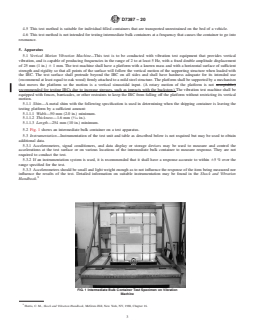
5.2 Fig. 1 shows an intermediate bulk container on a test
apparatus.
Available from the UN Economic Commission for Europe, Information
5.3 Instrumentation—Instrumentation of the test unit and
Service, Palais des Nations, CH-1211 Geneva 10 Switzerland (website: http://
table as described below is not required but may be used to
www.unece.org/trans/danger/danger.htm).
obtain additional data.
Available from the International Air Transport Association (IATA), 800 Place
Victoria PO Box 113 Montreal - H4Z 1M1 Quebec - Canada (website: http:// 5.3.1 Accelerometers, signal conditioners, and data display
www.iata.org).
or storage devices may be used to measure and control the
Available from the International Civil Aviation Organization, (ICAO) 999
accelerations at the test surface or on various locations of the
University Street, Montréal, Quebec H3C 5H7, Canada (website: http://
intermediate bulk container to measure response. They are not
www.icao.org/).
Available from the International Marine Organization (IMO, 4 Albert
required to conduct the test.
Embankment, London, SE1 7SR United Kingdom (website: http://www.imo.org/).
5.3.2 If an instrumentation system is used, it is recom-
Available from International Organization for Standardization (ISO), ISO
mended that it shall have a response accurate to within 65 %
Central Secretariat, BIBC II, Chemin de Blandonnet 8, CP 401, 1214 Vernier,
Geneva, Swi
...
This document is not an ASTM standard and is intended only to provide the user of an ASTM standard an indication of what changes have been made to the previous version. Because
it may not be technically possible to adequately depict all changes accurately, ASTM recommends that users consult prior editions as appropriate. In all cases only the current version
of the standard as published by ASTM is to be considered the official document.
Designation: D7387 − 13 D7387 − 20
Standard Test Method for
Vibration Testing of Intermediate Bulk Containers (IBCs)
Used for Shipping Liquid Hazardous Materials (Dangerous
Goods)
This standard is issued under the fixed designation D7387; the number immediately following the designation indicates the year of
original adoption or, in the case of revision, the year of last revision. A number in parentheses indicates the year of last reapproval. A
superscript epsilon (´) indicates an editorial change since the last revision or reapproval.
1. Scope Scope*
1.1 This test method covers vibration testing of filled intermediate bulk containers (IBCs) intended to contain liquid hazardous
materials (dangerous goods) and is suitable for testing IBCs of any design or material type. This test method is required as part
of the qualification of IBCs in accordance with the United States Department of Transportation Title 49 Code of Federal
Regulations (CFR) and the United Nations Recommendations on the Transport of Dangerous Goods (UN).
1.2 This test method is appropriate for testing IBCs ranging from 450 to 3000 L (119 to 793 gal). Packagings of smaller sizes
should be tested using Test Method D999 or other applicable methods.
1.3 The ISO 2247 standard may not meet the requirements for this test method.
1.4 This test method is based on the current information contained in 49 CFR, §178.819.
1.5 This test method covers vibration testing of filled intermediate bulk containers (IBCs) intended to contain liquid hazardous
materials (dangerous goods) and is suitable for testing IBCs of any design or material with any means of closure. This test method
has been used by the United States Department of Transportation (DOT) to test and qualify IBCs for shipping hazardous materials.
The test method is used to is used to determine that the IBCs maintainIBC maintains integrity and to prevent leakage or spillage
of contents during shipping. This test method should may also be used as a screening tool or as a design qualification test. Other
vibration methods are available to more closely simulate vibration experienced in actual transportation.
1.6 This test method is appropriate for testing IBCs ranging from 450 to 3000 L (119 to 793 gal). Packagings of smaller sizes
should be tested using Test MethodsWhen testing packaging designs intended for hazardous materials (dangerous goods), the user
of this test method shall be trained in accordance with 49 CFR §172.700 and other applicable hazardous materials regulations such
as the ICAO Technical Instructions, IMDG Code, and carrier D999 or other applicable methods. rules such as the IATA Dangerous
Goods Regulations.
1.3 The ISO 2247 standard may not meet the requirements for this test method.
1.7 The values stated in SI units are to be regarded as standard. The values given in parentheses are for information only.
1.8 This standard does not purport to address all of the safety concerns, if any, associated with its use. It is the responsibility
of the user of this standard to establish appropriate safety safety, health, and healthenvironmental practices and determine the
applicability of regulatory limitations prior to use. Specific precautionary statements are given in Section 6.
1.9 This international standard was developed in accordance with internationally recognized principles on standardization
established in the Decision on Principles for the Development of International Standards, Guides and Recommendations issued
by the World Trade Organization Technical Barriers to Trade (TBT) Committee.
2. Referenced Documents
2.1 ASTM Standards:
D996 Terminology of Packaging and Distribution Environments
D999 Test Methods for Vibration Testing of Shipping Containers
This test method is under the jurisdiction of ASTM Committee D10 on Packaging and is the direct responsibility of Subcommittee D10.22 on Hazardous Materials.
Current edition approved Feb. 1, 2013April 1, 2020. Published April 2013June 2020. Originally approved in 2007. Last previous edition approved in 20072013 as
D7387–07.–13. DOI: 10.1520/D7387-13.10.1520/D7387-20.
For referenced ASTM standards, visit the ASTM website, www.astm.org, or contact ASTM Customer Service at service@astm.org. For Annual Book of ASTM Standards
volume information, refer to the standard’s Document Summary page on the ASTM website.
*A Summary of Changes section appears at the end of this standard
Copyright © ASTM International, 100 Barr Harbor Drive, PO Box C700, West Conshohocken, PA 19428-2959. United States
D7387 − 20
D4169 Practice for Performance Testing of Shipping Containers and Systems
D4332 Practice for Conditioning Containers, Packages, or Packaging Components for Testing
D4919 Guide for Testing of Hazardous Materials (Dangerous Goods) Packagings
D7887
2.2 ISO Standards:
ISO 2247 Packaging—Complete, Filled Transport Packages—Vibration Test at Fixed Low Frequency
2.2 Regulatory Documents: Federal Standard:
CFR 49 United States U.S. Department of Transportation Code of Federal Regulations Title 49, Transportation, Parts
100–199Transportation (49 CFR) Parts 100-185
2.3 United Nations Document:UN Standard:
United Nations UN United Nations Recommendations on the Transport of Dangerous Goods—Model RegulationsGoods, Model
Regulations (UN Orange Book)
2.4 IATA Standard:
IATA International Air Transport Association (IATA) Dangerous Goods Regulations
2.5 ICAO Standard:
ICAO Technical Instructions for the Safe Transport of Dangerous Goods by Air
2.6 IMGD Standard:
International Maritime Dangerous Goods Code (IMDG Code)
2.7 ISO Standard:
ISO 2247 Packaging—Complete, Filled Transport Packages—Vibration Test at Fixed Low Frequency
3. Terminology
3.1 For definitions of terms used in these test methods, see Terminology D996.
3.2 Definitions of Terms Specific to This Standard:
3.2.1 double amplitude, n—the maximum value of a sinusoidal quantity (peak-to-peak).
3.2.2 repetitive shock, n—impacts of a package on a test platform which occur cyclically from input oscillatory motion.
3.2.3 resonance, n— a condition during a vibration test, when the forcing (input) frequency of the table equals the resonant
frequency of the IBC and will produce the highest transmissibility level.
NOTE 1—Testing close to or at the resonant frequency of the IBC may cause excessive, violent, and uncontrollable movement of the IBC. For this
method, testing at or near the resonant frequency is overly severe and may cause damage or failure to the container not likely to be experienced in
transportation.
NOTE 2—Additional packaging terms and definitions specific to the regulations are located in 49 CFR Section 171.8 and the UN Orange Book, Section
1.2.1.
4. Significance and Use
4.1 Shipping containers are exposed to complex dynamic stresses when subjected to vibration present in transportation vehicles.
Approximating the actual damage, or lack of damage, experienced in shipping may require subjecting the container(s) and contents
to vibration inputs.
4.2 Resonant responses during shipment can be severe and may lead to failure of the container and spillage or leakage of
contents. Identification of critical frequencies and the nature of package stresses can aid in minimizing the effect of these
occurrences.
4.3 This vibration test is based on methods currently method is used for the qualification of IBCs in CFR 49 and has
demonstrated successful use in transportation.
4.4 Exposure to vibration can affect the shipping container, its means of closure, and its contents. This test method allows
analysis of the interaction of these components. Design modification to one or more of these components may be utilized to achieve
optimum performance in the shipping environment.
Available from International Organization for Standardization (ISO), ISO Central Secretariat, BIBC II, Chemin de Blandonnet 8, CP 401, 1214 Vernier, Geneva,
Switzerland, http://www.iso.org.
Available from American National Standards Institute (ANSI), 25 W. 43rd St., 4th Floor, New York, NY 10036, http://www.ansi.org.Superintendent of Documents, U.S.
Government Printing Office, Washington, DC 20402-9371 (website: https://www.phmsa.dot.gov/phmsa-regulations).
Available from U.S. Government Printing Office Superintendent of Documents, 732 N. Capitol St., NW, Mail Stop: SDE, Washington, DC 20401, http://
www.access.gpo.gov. the UN Economic Commission for Europe, Information Service, Palais des Nations, CH-1211 Geneva 10 Switzerland (website: http://
www.unece.org/trans/danger/danger.htm).
Available from United Nations, 866 United Nations Plaza, New York, NY 10017.the International Air Transport Association (IATA), 800 Place Victoria PO Box 113
Montreal - H4Z 1M1 Quebec - Canada (website: http:// www.iata.org).
Available from the International Civil Aviation Organization, (ICAO) 999 University Street, Montréal, Quebec H3C 5H7, Canada (website: http:// www.icao.org/).
Available from the International Marine Organization (IMO, 4 Albert Embankment, London, SE1 7SR United Kingdom (website: http://www.imo.org/).
D7387 − 20
4.5 This test method is suitable for individual filled containers that are transported unrestrained on the bed of a vehicle.
4.6 This test method is not intended for testing intermediate bulk containers at a frequency that causes the container to go into
resonance.
5. Apparatus
5.1 Vertical Motion Vibration Machine—This test is to be conducted with vibration test equipment that provides vertical
vibration, and is capable of producing frequencies in the range of 2 to at least 5 Hz, with a fixed double amplitude displacement
of 25 mm (1 in.) 6 1 mm. The test machine shall have a platform with a known mass and with a horizontal surface of sufficient
strength and rigidity so that all points of the surface will follow the vertical motion of the supporting structure when loaded with
the IBC. The test surface shall protrude beyond the IBC on all sides and shall have hardness adequate for its intended use
(recommend at least equal to oak wood) firmly attached to a mild steel structure. The platform shall be supported by a mechanism
that moves the platform so the motion is a vertical sinusoidal input. (A rotary motion of the platform is not acceptable.)
recommended for testing IBCs due to increase stresses, such as impacts with the backstop.) The vibration test machine shall be
equipped with fences, barricades, or other restraints to keep the IBC from falling off the platform without restricting its vertical
motion.
5.1.1 Shim—A metal shim with the following specification is used in determining when the shipping container is leaving the
testing platform by a
...
Questions, Comments and Discussion
Ask us and Technical Secretary will try to provide an answer. You can facilitate discussion about the standard in here.
Loading comments...