

ASTM D1761-20
(Test Method)Standard Test Methods for Mechanical Fasteners in Wood and Wood-Based Materials
General Information
- Abstract
SIGNIFICANCE AND USE
5.1 The resistance of a species of wood or a wood-based product to withdrawal of nails, staples, or screws is a measure of its ability to hold or be held to an adjoining object by means of such fasteners. Factors that affect this withdrawal resistance include the physical and mechanical properties of the wood; the size, shape, and surface condition of the fasteners; the speed of withdrawal; physical changes to wood or fasteners between time of driving and time of withdrawal; orientation of the fastener relative to the fiber axis; and the occurrence and nature of pre-bored lead holes.
5.2 By using consistent sizes and types of nails, staples, and screws, withdrawal resistance of a wood species or wood product can be determined, and such values for two or more wood species or wood products can be compared. Similarly, comparative performances of different sizes or types of nails, staples, or screws can be determined by using a standard procedure with a particular wood or wood-based product, which eliminates the wood or the wood-based product as a variable. Since differences in test methods can have considerable influence on results, it is important that a standard procedure be specified and adhered to if test values are to be related to other test results.
SCOPE
1.1 These test methods provide a basic procedure for evaluating the withdrawal and lateral resistance of fasteners installed in wood and wood-based materials. Spikes are included as nails in this standard.
1.2 The tests also provide a basis for determining comparable performance of different types and sizes of fasteners installed in wood and wood-based materials.
1.3 The values stated in inch-pound units are to be regarded as standard. The values given in parentheses are mathematical conversions to SI units that are provided for information only and are not considered standard.
1.4 This standard does not purport to address all of the safety concerns, if any, associated with its use. It is the responsibility of the user of this standard to establish appropriate safety, health, and environmental practices and determine the applicability of regulatory limitations prior to use.
1.5 This international standard was developed in accordance with internationally recognized principles on standardization established in the Decision on Principles for the Development of International Standards, Guides and Recommendations issued by the World Trade Organization Technical Barriers to Trade (TBT) Committee.
- Status
- Published
- Publication Date
- 14-Apr-2020
- Technical Committee
- D07 - Wood
- Drafting Committee
- D07.05 - Wood Assemblies
Buy Documents
ASTM D1761-20 - Standard Test Methods for Mechanical Fasteners in Wood and Wood-Based Materials
REDLINE ASTM D1761-20 - Standard Test Methods for Mechanical Fasteners in Wood and Wood-Based Materials
Overview
ASTM D1761-20: Standard Test Methods for Mechanical Fasteners in Wood and Wood-Based Materials provides comprehensive procedures to evaluate the mechanical properties of fasteners-such as nails, staples, screws, bolts, and timber connectors-installed in wood and wood-based products. Issued by ASTM International, this standard supports manufacturers, designers, and quality control professionals by delivering consistent methodologies for testing fastener withdrawal and lateral resistance. The test methods are crucial for determining the holding capacities of various fastener types and for comparing the performance of wood species or wood-based materials in building and manufacturing applications.
Key Topics
- Withdrawal Resistance: Measures the force required to extract fasteners (nails, staples, or screws) from wood, providing valuable data on secure connections.
- Lateral Resistance: Evaluates a fastener’s ability to withstand forces applied parallel to the wood fibers, which simulates real-world conditions where structural loads are often multi-directional.
- Testing Apparatus and Procedures: Details for specimen preparation, testing machine operation, and data collection ensure reproducibility and accuracy across labs and institutions.
- Species and Fastener Comparison: By controlling for fastener size and type or the wood species, users can directly compare material performance or fastener effectiveness.
- Supplementary Measures: Considerations include the impact of wood and fastener conditioning, such as moisture content and surface finishes, as well as installation orientation and pre-bored holes.
- Reporting Requirements: Documentation of results, specimen descriptions, and deviations is emphasized for transparency and optimal data utility.
Applications
- Structural Design and Engineering: ASTM D1761 is invaluable for engineers designing wood structures, as it enables accurate prediction of joint strength and connection reliability under various loads.
- Product Development and Manufacturing: Manufacturers of wood fasteners, engineered lumber, and composite panels rely on these test methods to validate product claims, meet regulatory requirements, and guide innovation.
- Material Comparison and Quality Control: The standard allows direct comparison of different wood species or products and is essential for quality control in both manufacturing and construction.
- Research and Standards Development: Academic and industrial researchers use these methods to develop new wood products or fastener types and to inform updates in building codes and standards.
- Compliance and Certification: Following ASTM D1761 helps organizations comply with international best practices, support claims in product literature, and access new markets that require adherence to recognized testing protocols.
Related Standards
For holistic assessment of wood fasteners and assemblies, the following ASTM standards are frequently referenced alongside ASTM D1761-20:
- ASTM D9: Terminology Relating to Wood and Wood-Based Products
- ASTM D143: Test Methods for Small Clear Specimens of Timber
- ASTM D2395: Test Methods for Density and Specific Gravity (Relative Density) of Wood and Wood-Based Materials
- ASTM D2915: Practice for Sampling and Data-Analysis for Structural Wood and Wood-Based Products
- ASTM D4442: Test Methods for Direct Moisture Content Measurement of Wood and Wood-Based Materials
- ASTM F547: Terminology of Nails for Use with Wood and Wood-Base Materials
- ASTM F1667: Specification for Driven Fasteners: Nails, Spikes, and Staples
Adherence to ASTM D1761-20 ensures that mechanical fasteners in wood and wood-based materials are assessed reliably and consistently. Professionals in wood construction, product development, and quality assurance benefit from enhanced safety, performance comparability, and international recognition.
Keywords: ASTM D1761, mechanical fasteners, withdrawal resistance, lateral resistance, wood fastener testing, wood-based materials, nail testing, screw withdrawal, staple performance, timber connectors, structural wood standards.
Relations
- Effective Date
- 15-Apr-2020
- Effective Date
- 15-Nov-2023
- Effective Date
- 01-Mar-2020
- Effective Date
- 01-Sep-2018
- Effective Date
- 01-Mar-2017
- Effective Date
- 15-Nov-2016
- Effective Date
- 01-Sep-2015
- Effective Date
- 01-Jun-2015
- Effective Date
- 01-Jun-2014
- Effective Date
- 01-May-2014
- Effective Date
- 01-May-2014
- Effective Date
- 01-Dec-2013
- Effective Date
- 15-Oct-2012
- Effective Date
- 01-Apr-2012
- Effective Date
- 01-Nov-2011
Buy Documents
ASTM D1761-20 - Standard Test Methods for Mechanical Fasteners in Wood and Wood-Based Materials
REDLINE ASTM D1761-20 - Standard Test Methods for Mechanical Fasteners in Wood and Wood-Based Materials
Get Certified
Connect with accredited certification bodies for this standard

DIN CERTCO
DIN Group product certification.

Smithers Quality Assessments
US management systems and product certification.
Sponsored listings
Frequently Asked Questions
ASTM D1761-20 is a standard published by ASTM International. Its full title is "Standard Test Methods for Mechanical Fasteners in Wood and Wood-Based Materials". This standard covers: SIGNIFICANCE AND USE 5.1 The resistance of a species of wood or a wood-based product to withdrawal of nails, staples, or screws is a measure of its ability to hold or be held to an adjoining object by means of such fasteners. Factors that affect this withdrawal resistance include the physical and mechanical properties of the wood; the size, shape, and surface condition of the fasteners; the speed of withdrawal; physical changes to wood or fasteners between time of driving and time of withdrawal; orientation of the fastener relative to the fiber axis; and the occurrence and nature of pre-bored lead holes. 5.2 By using consistent sizes and types of nails, staples, and screws, withdrawal resistance of a wood species or wood product can be determined, and such values for two or more wood species or wood products can be compared. Similarly, comparative performances of different sizes or types of nails, staples, or screws can be determined by using a standard procedure with a particular wood or wood-based product, which eliminates the wood or the wood-based product as a variable. Since differences in test methods can have considerable influence on results, it is important that a standard procedure be specified and adhered to if test values are to be related to other test results. SCOPE 1.1 These test methods provide a basic procedure for evaluating the withdrawal and lateral resistance of fasteners installed in wood and wood-based materials. Spikes are included as nails in this standard. 1.2 The tests also provide a basis for determining comparable performance of different types and sizes of fasteners installed in wood and wood-based materials. 1.3 The values stated in inch-pound units are to be regarded as standard. The values given in parentheses are mathematical conversions to SI units that are provided for information only and are not considered standard. 1.4 This standard does not purport to address all of the safety concerns, if any, associated with its use. It is the responsibility of the user of this standard to establish appropriate safety, health, and environmental practices and determine the applicability of regulatory limitations prior to use. 1.5 This international standard was developed in accordance with internationally recognized principles on standardization established in the Decision on Principles for the Development of International Standards, Guides and Recommendations issued by the World Trade Organization Technical Barriers to Trade (TBT) Committee.
SIGNIFICANCE AND USE 5.1 The resistance of a species of wood or a wood-based product to withdrawal of nails, staples, or screws is a measure of its ability to hold or be held to an adjoining object by means of such fasteners. Factors that affect this withdrawal resistance include the physical and mechanical properties of the wood; the size, shape, and surface condition of the fasteners; the speed of withdrawal; physical changes to wood or fasteners between time of driving and time of withdrawal; orientation of the fastener relative to the fiber axis; and the occurrence and nature of pre-bored lead holes. 5.2 By using consistent sizes and types of nails, staples, and screws, withdrawal resistance of a wood species or wood product can be determined, and such values for two or more wood species or wood products can be compared. Similarly, comparative performances of different sizes or types of nails, staples, or screws can be determined by using a standard procedure with a particular wood or wood-based product, which eliminates the wood or the wood-based product as a variable. Since differences in test methods can have considerable influence on results, it is important that a standard procedure be specified and adhered to if test values are to be related to other test results. SCOPE 1.1 These test methods provide a basic procedure for evaluating the withdrawal and lateral resistance of fasteners installed in wood and wood-based materials. Spikes are included as nails in this standard. 1.2 The tests also provide a basis for determining comparable performance of different types and sizes of fasteners installed in wood and wood-based materials. 1.3 The values stated in inch-pound units are to be regarded as standard. The values given in parentheses are mathematical conversions to SI units that are provided for information only and are not considered standard. 1.4 This standard does not purport to address all of the safety concerns, if any, associated with its use. It is the responsibility of the user of this standard to establish appropriate safety, health, and environmental practices and determine the applicability of regulatory limitations prior to use. 1.5 This international standard was developed in accordance with internationally recognized principles on standardization established in the Decision on Principles for the Development of International Standards, Guides and Recommendations issued by the World Trade Organization Technical Barriers to Trade (TBT) Committee.
ASTM D1761-20 is classified under the following ICS (International Classification for Standards) categories: 83.120 - Reinforced plastics. The ICS classification helps identify the subject area and facilitates finding related standards.
ASTM D1761-20 has the following relationships with other standards: It is inter standard links to ASTM D1761-12, ASTM D143-23, ASTM D4442-20, ASTM F1667-18, ASTM F1667-17, ASTM D4442-16, ASTM F1667-15, ASTM D4442-15, ASTM E4-14, ASTM D2395-14e1, ASTM D2395-14, ASTM F1667-13, ASTM D9-12, ASTM F547-06(2012), ASTM F1667-11a. Understanding these relationships helps ensure you are using the most current and applicable version of the standard.
ASTM D1761-20 is available in PDF format for immediate download after purchase. The document can be added to your cart and obtained through the secure checkout process. Digital delivery ensures instant access to the complete standard document.
Standards Content (Sample)
This international standard was developed in accordance with internationally recognized principles on standardization established in the Decision on Principles for the
Development of International Standards, Guides and Recommendations issued by the World Trade Organization Technical Barriers to Trade (TBT) Committee.
Designation: D1761 − 20
Standard Test Methods for
Mechanical Fasteners in Wood and Wood-Based Materials
This standard is issued under the fixed designation D1761; the number immediately following the designation indicates the year of
original adoption or, in the case of revision, the year of last revision. A number in parentheses indicates the year of last reapproval. A
superscript epsilon (´) indicates an editorial change since the last revision or reapproval.
This standard has been approved for use by agencies of the U.S. Department of Defense.
INTRODUCTION
The use of wood and wood-based materials in many structural and other applications often involves
the use of mechanical fasteners, such as nails, screws, bolts, lag screws, and timber connectors. Data
on the resistance and performance of such fasteners are frequently needed for design and for
comparative purposes. Presented are methods of conducting tests for nail, staple, and screw (except
machine screws) withdrawal resistance and lateral load transmission by nail, staple, screw, bolt, and
timber connector.The use of standard methods for these tests is recommended as a means of obtaining
comparable data and of eliminating variables in test results because of variations in testing methods.
The tests appear in the following order:
Sections
Nail, staple, or screw withdrawal test 4 to 13
Nail, staple, or screw lateral resistance test 14 to 21
Bolted or timber connector joint test 22 to 30
Keywords 31
1. Scope ization established in the Decision on Principles for the
Development of International Standards, Guides and Recom-
1.1 These test methods provide a basic procedure for
mendations issued by the World Trade Organization Technical
evaluating the withdrawal and lateral resistance of fasteners
Barriers to Trade (TBT) Committee.
installed in wood and wood-based materials. Spikes are in-
cluded as nails in this standard.
2. Referenced Documents
1.2 The tests also provide a basis for determining compa-
2.1 ASTM Standards:
rable performance of different types and sizes of fasteners
D9 Terminology Relating to Wood and Wood-Based Prod-
installed in wood and wood-based materials.
ucts
1.3 The values stated in inch-pound units are to be regarded
D143 Test Methods for Small Clear Specimens of Timber
as standard. The values given in parentheses are mathematical
D2395 TestMethodsforDensityandSpecificGravity(Rela-
conversions to SI units that are provided for information only
tive Density) of Wood and Wood-Based Materials
and are not considered standard.
D2915 Practice for Sampling and Data-Analysis for Struc-
tural Wood and Wood-Based Products
1.4 This standard does not purport to address all of the
safety concerns, if any, associated with its use. It is the D4442 Test Methods for Direct Moisture Content Measure-
ment of Wood and Wood-Based Materials
responsibility of the user of this standard to establish appro-
priate safety, health, and environmental practices and deter- E4 Practices for Force Verification of Testing Machines
F547 Terminology of Nails for Use with Wood and Wood-
mine the applicability of regulatory limitations prior to use.
Base Materials
1.5 This international standard was developed in accor-
F1667 Specification for Driven Fasteners: Nails, Spikes, and
dance with internationally recognized principles on standard-
Staples
These test methods are under the jurisdiction of ASTM Committee D07 on
Wood and are the direct responsibility of Subcommittee D07.05 on Wood Assem-
blies. For referenced ASTM standards, visit the ASTM website, www.astm.org, or
Current edition approved April 15, 2020. Published July 2020. Originally contact ASTM Customer Service at service@astm.org. For Annual Book of ASTM
approved in 1960. Last previous edition approved in 2012 as D1761 – 12. DOI: Standards volume information, refer to the standard’s Document Summary page on
10.1520/D1761-20. the ASTM website.
Copyright © ASTM International, 100 Barr Harbor Drive, PO Box C700, West Conshohocken, PA 19428-2959. United States
D1761 − 20
2.2 Other Standards: movable head and has an accuracy of 61 % when calibrated in
ASME B18.6.1 Wood Screws (Inch Series) accordance with Practices E4.
Federal Specification FF-W-92 for Washers, Metal, Flat
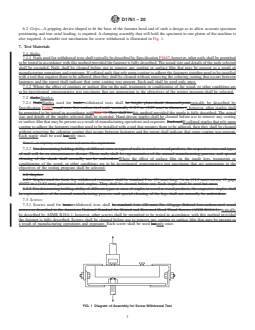
6.2 Grips—A gripping device shaped to fit the base of the
(Plain)
fastener head and of such a design as to allow accurate
specimen positioning and true axial loading, is required. A
3. Terminology
clamping assembly that will hold the specimen to one platen of
3.1 Definitions:
the machine is also required. A suitable test mechanism for
3.1.1 For general definitions of terms related to wood, refer
screw withdrawal is illustrated in Fig. 1.
to Terminologies D9 and F547.
7. Test Materials
NAIL, STAPLE, OR SCREW WITHDRAWAL TEST
7.1 Nails:
7.1.1 Nails used for withdrawal tests shall typically be
4. Summary of Test Method
describedbySpecificationF1667;however,othernailsshallbe
4.1 These test methods provide a basic procedure for
permitted to be tested in accordance with this method provided
evaluating the resistance of wood and wood-based materials to
thefastenerisfullydescribed.Theactualsizeanddetailsofthe
withdrawal of nails, staples, and screws. The tests also provide
nails selected shall be recorded. Nails shall be cleaned before
a basis for determining comparable performance of different
use to remove any coating or surface film that may be present
types and sizes of nails, staples, and screws in withdrawal from
as a result of manufacturing operations and exposure. If
wood and wood-based materials.
collated nails that rely upon coating to adhere the fasteners
together need to be installed with a tool that requires them to
4.2 Specimensconsistofwoodmembers(prismsofwoodor
be adhered, then they shall be cleaned without removing the
wood-basedproducts),withnails,staples,orscrewsinstalledat
cohering coating that occurs between fasteners and the report
right angles to one or more faces. The fasteners are withdrawn
shall indicate that some coating was present. Each nail shall be
at a uniform rate of speed by means of a testing machine, and
used only once.
the maximum load is recorded. Supplementary physical prop-
7.1.2 Where the effect of coatings or surface film on the
erties of the wood or wood-based product are also determined.
nail, treatments or conditioning of the wood, or other condi-
5. Significance and Use
tions are to be investigated, representative test specimens that
5.1 The resistance of a species of wood or a wood-based are appropriate to the objectives of the testing program shall be
selected.
product to withdrawal of nails, staples, or screws is a measure
of its ability to hold or be held to an adjoining object by means
7.2 Staples:
of such fasteners. Factors that affect this withdrawal resistance
7.2.1 Staples used for withdrawal tests shall typically be
include the physical and mechanical properties of the wood;
described by Specification F1667; however, other staples shall
the size, shape, and surface condition of the fasteners; the
be permitted to be tested in accordance with this method
speed of withdrawal; physical changes to wood or fasteners
provided the staple is fully described. The actual size and
between time of driving and time of withdrawal; orientation of
details of the staples selected shall be recorded. Hand-driven
the fastener relative to the fiber axis; and the occurrence and
staples shall be cleaned before use to remove any coating or
nature of pre-bored lead holes.
surface film that may be present as a result of manufacturing
operations and exposure. If collated staples that rely upon
5.2 By using consistent sizes and types of nails, staples, and
screws, withdrawal resistance of a wood species or wood coating to adhere the fasteners together need to be installed
with a tool that requires them to be adhered, then they shall be
product can be determined, and such values for two or more
wood species or wood products can be compared. Similarly, cleaned without removing the cohering coating that occurs
comparative performances of different sizes or types of nails,
staples, or screws can be determined by using a standard
procedure with a particular wood or wood-based product,
which eliminates the wood or the wood-based product as a
variable. Since differences in test methods can have consider-
able influence on results, it is important that a standard
procedure be specified and adhered to if test values are to be
related to other test results.
6. Apparatus
6.1 Testing Machine—Any suitable testing machine that is
capable of operation at a constant rate of motion of the
Available from American Society of Mechanical Engineers (ASME), ASME
International Headquarters, Two Park Ave., New York, NY 10016-5990, http://
www.asme.org.
Available from DLA Document Services, Building 4/D, 700 Robbins Ave.,
Philadelphia, PA 19111-5094, http://quicksearch.dla.mil. FIG. 1 Diagram of Assembly for Screw Withdrawal Test
D1761 − 20
NOTE 2—As in 9.1 these specimens should attain the desired moisture
between fasteners and the report shall indicate that some
equilibriuminacontrolledatmospheretoensureuniformmoisturecontent
coating was present. Each staple shall be used only once.
at the time of test. Soaking in water will produce and maintain an
7.2.2 Where the effect of surface film on the staple legs,
unseasoned condition of the wood, but it may result in an extremely high
treatments or conditioning of the wood, or other conditions are
moisture content, particularly at the surface, and undesirable and non-
to be investigated, representative test specimens that are
representative corrosion of the fasteners near the wood surface.
appropriate to the objectives of the testing program shall be
10. Test Specimen
selected.
10.1 Nail and Staple Withdrawal:
7.3 Screws:
10.1.1 Nails and staples shall be driven into the wood
7.3.1 Screws used for withdrawal tests shall typically be
memberatarightangletothefaceofthewoodmember.Where
described by ASME B18.6.1; however, other screws shall be
the specimen includes only the single wood member, the
permitted to be tested in accordance with this method provided
fastener shall be driven assuring enough of the nail shank or
the fastener is fully described. Screws shall be cleaned before
staple legs remains above the surface to allow the test
use to remove any coating or surface film that may be present
apparatus to grip the fastener. Where the specimen includes a
as a result of manufacturing operations and exposure. Each
holding member and one or more members attached thereto,
screw shall be used only once.
the fastener shall be driven as expected in use. For staples, the
7.3.2 Where the effect of coatings or surface film on the
crown shall be oriented parallel to the grain of the holding
screw, treatments or conditioning of the wood, or other
member,butifthereisnodiscerniblegraindirection,thestaple
conditions are to be investigated, representative test specimens
crown shall be oriented at a 45° (610°) angle to the long
that are appropriate to the objectives of the testing program
dimension of the wood member.
shall be selected.
10.1.2 The wood member shall be of convenient size to
7.4 Wood Members (Wood and Wood-Based Products)—
accommodate the quantity of fasteners to be tested in each
Wood members shall be cut accurately and square to the
specimen, without exceeding the edge and end distances and
required dimensions and have a smooth surface to ensure
spacings necessary to avoid splitting. Fasteners shall be driven
proper fastener penetration measurement. The wood fibers
to penetrate the holding member at least 9 times the nail
shallbealignedwiththelongitudinalaxisofthewoodmember.
diameter or staple leg thickness (penetration measurement
The wood member shall have a specific gravity that is
includes the nail or staple tip length). In thin wood products
representative of the assigned specific gravity of the species of
where the minimum thickness is less than 9 times the nail
wood,freeofdefectsandgrowthirregularities,andofspecified
diameter or staple leg thickness, the fastener shall be driven
moisture content.
completely through the thickness and the penetration shall be
reported as the thickness of the thin wood product.
8. Sampling
10.1.3 The fasteners shall be driven by the method intended
8.1 Sampling shall provide for selection of representative
to be used in practice, that is, either manually with a hammer,
wood or wood-based material on an objective and unbiased
or with an applicator or appropriate tool if this is the normal
basis, covering an appropriate range in density (specific grav-
method. Power-driven fasteners shall be installed either manu-
ity) and properties as circumstances suggest.
ally or with an appropriate tool.
8.2 The specific objectives of the test program shall be used
NOTE 3—Power-driven fasteners are permitted to be installed manually
to determine the required precision and number of tests in
as a means to reliably control the depth of penetration and as an option to
accordance with Practice D2915. test without coatings or collating adhesion materials.
10.1.4 If the withdrawal resistance is influenced by the
NOTE 1—General experience indicates that the coefficient of variation
for fastener tests ranges from 15 % to 30 %. A precision of 5 % to 10 % attached member through which the fastener is to be driven,
with 75 % or 95 % confidence are typical expectations for data.
such as a metal plate with no holes, the fastener shall be driven
through the attached member and into the holding member to
9. Conditioning
be evaluated as it would be used.
9.1 Except for special tests evaluating the effect of moisture
10.2 Screw Withdrawal:
content of wood on withdrawal resistance, the tests shall be
10.2.1 Screws shall be installed into the wood member at a
made on seasoned material. The wood or wood-based product,
right angle to the face of the wood member. Where the
whether kiln-dried, air-dried, or as received from the
specimen includes only the single wood member, the screw
manufacturer, shall be stored in a room having a controlled
shall be installed assuring enough of the screw shank remains
temperature of 20 6 3°C (68 6 6°F) and a controlled relative
above the surface to allow the test apparatus to grip the
humidity of 65 6 3 % for a period sufficiently long to bring it
fastener. The minimum penetration of the screw into the
toapproximatemoistureequilibrium.Thefastenersshallnotbe
holding member shall be 9 times the screw diameter (penetra-
installedinthewoodmembersuntilthemoistureequilibriumis
tion measurement includes the screw tip). Screws shall be
attained.
installed into the wood member for the length of the threaded
9.2 Where required, withdrawal tests may be made on drier, portion of the shank or at least two thirds of the shank length
partially seasoned or unseasoned material. It is sometimes if it is threaded throughout. In thin wood products where the
desired to apply the fasteners to unseasoned material and allow minimum thickness is less than 9 times the screw diameter, the
the completed specimen to season prior to withdrawal. screw shall be screwed completely through the thickness and
D1761 − 20
the penetration shall be reported as the thickness of the thin this can be accomplished with standard apparatus such as the
wood product. The screws shall be permitted to be coated with U.S. FPL toughness testing machine suitably modified to hold
paraffin wax or other similar lubricant when necessary to and grip the specimen. The latter test may require the use of a
facilitate installing and its use shall be reported. cycling or pulsating loading head. The resulting data are based
10.2.2 The wood member shall be of convenient size to on the displacement angle of the pendulum and the forces
accommodate the quantity of screws to be tested in each resulting from the setting of the repetitive loading mechanism,
specimen, without exceeding the edge and end distances and respectively, required to withdraw the fastener from the wood
spacings necessary to avoid splitting. The size of lead hole, if or wood-based product. Disregard test values resulting from
one is to be drilled, shall be 70 % of the root diameter of the any failure of the fastener in the evaluation of the performance
screw for a distance of one half of the screw length unless of wood and wood-based materials but report if desired;
otherwise specified by the screw manufacturer or required for consider such failures in the evaluation of the performance of
the purpose of the test program. The size of the lead hole shall different types and sizes of fasteners. In such cases, additional
be documented. replication are desirable.
10.2.3 If the withdrawal resistance can be influenced by the
11.4 Speed of Testing:
attachedmaterialthroughwhichthescrewistobeinstalled,the
11.4.1 Forthebasicloadingmethodforfastenerwithdrawal,
screw shall be screwed through the attached material and into
apply the load throughout the test at a uniform rate of platen
the holding member.The length of penetration into the holding
separation of 0.10 in. (2.54 mm)/min 6 25 %.
member shall be reported.
11.4.2 For special loading methods, special rates of with-
drawal may be required. Record the rate used and the reasons
11. Procedure
for choosing it in the report.
11.1 General—Withdraw fasteners as soon as practical after
NOTE 4—The rate of platen separation shall mean the free-running, or
installation,andwithin1h.Iflongerdelaysarerequiredforthe
no-load, crosshead speed for testing machines of the mechanical drive
purposes of the test program, then the time elapsed between
type, and the loaded crosshead speed for testing machines of the hydraulic
installation of the fastener and the test shall be reported.
loading type.
11.2 Basic Loading Method:
11.5 Supplementary Tests—If information on the actual
11.2.1 Where the specimen includes only the holding mem-
withdrawal during load application is desired or may be of
ber and the fasteners, withdraw the fasteners by means of a
influence on the interpretation of the withdrawal resistance of
tensileforceappliedatauniformrateofwithdrawal.Attachthe
a given fastener, measure and record such withdrawal, in
wood member to one platen of the testing machine.Attach the
inches (millimetres), at given withdrawal loads or at the
fastener head (for headed fasteners) or staple legs to a suitably
ultimate withdrawal resistance to three significant numbers.
designed grip which is fastened to the other platen through a
Under given conditions, it may be expeditious to obtain an
universal joint. Apply the load by separation of the platens of
automatic plot of withdrawal load versus withdrawal distance
the testing machine at a uniform rate of withdrawal (see 11.4).
in order to determine the stiffness of the joint and the work
Read the maximum load required to withdraw the fastener to
involved up to a given point of withdrawal of the fastener
three significant figures. Disregard test values resulting from
under construction.
any failure of the fastener in the evaluation of the performance
11.6 Minor Tests—For all tested specimens, determine the
of wood and wood-based materials but report them; consider
oven-dry specific gravity and moisture content of each wood
such failures in the evaluation of the performance of different
member at the time of testing using Test Methods D2395 and
types and sizes of fasteners. In such cases, additional replica-
D4442, respectively. For wood-based members, determine the
tions are desirable.
density and moisture content at the time of testing using Test
11.2.2 Where the specimen consists of a holding member
Methods D2395 and D4442, respectively.
plus one or more attached members fastened thereto with a
fastener, two test procedures are possible:
12. Report
(1) The attached member can be grasped and pushed or
pulled away from the holding member in the axial direction of
12.1 The report shall include the following:
the fastener, whereby the fastener head exerts a force on the
12.1.1 Failure loads for individual fasteners, average test
attachedmember.Underthisprocedure,iftheattachedmember
values, and statistical evaluation of the test data, if justified;
exerts less resistance to the passage of the fastener head than
12.1.2 A complete description of the test method and
the holding member exerts on fastener, head pull-through can
loading procedure used;
occur. In such a case, the fastener head pull-through resistance
12.1.3 A description of the specimen, including the dimen-
of the attached member material will be indicated, but shall not
sions of the wood or wood-based product components, size of
be recorded as the fastener withdrawal from the holding
fastener, fastener penetration, end and edge distances, and
member and an additional specimen shall be tested.
spacings;
(2) The attached member can be split off and the fastener
12.1.4 Number of tests;
withdrawn as in 11.2.1.
12.1.5 Specific gravity and moisture content of wood
11.3 Special Loading Methods—It may sometimes be nec- components,;
essary to determine the resistance to withdrawal as a result of 12.1.6 Details of any deviations from the prescribed or
animpactforceorbyrepetitiveloads.Inthecaseoftheformer, recommended methods as outlined in the standard; and
D1761 − 20
12.1.7 Details of any factors not included above that might 15.3 Screws used for lateral tests shall typically be de-
have a bearing on results. scribed by ASME B18.6.1; however, other screws shall be
permitted to be tested in accordance with this method provided
13. Precision and Bias
the fastener is fully described. Screws shall be cleaned before
use to remove any coating or surface film that may be present
13.1 Precision—It is not possible to specify the precision of
asaresultofmanufacturingoperationsandexposureunlessthe
the withdrawal test procedure in Test Method D1761 for
effects of any coatings or surface film are to be evaluated. Each
measuring fastener withdrawal because the data is not avail-
screw shall be used only once. The screws shall be selected to
able.
be representative of the type chosen for test.
13.2 Bias—No information can be presented on the bias of
the withdrawal test procedure in Test Method D1761 for
16. Sampling
measuring fastener withdrawal because no fastener withdrawal
16.1 Tests shall be made using clear, straight-grained rep-
having an accepted reference value is available.
resentativematerial.Thespecificobjectivesofthetestprogram
shallbeusedtodeterminetherequiredprecisionandnumberof
NAIL, STAPLE, OR SCREW LATERAL tests in accordance with Practice D2915.
RESISTANCE TEST
NOTE 5—General experience indicates that the coefficient of variation
for fastener tests ranges from 15 % to 30 %. A precision of 5 % to 10 %
14. Summary of Test Method
with 75 % or 95 % confidence are typical expectations for data.
14.1 This test method covers the determination of the
17. Conditioning
resistance to lateral movement offered by a single nail, staple,
or screw in wood members.The test provides comparative data
17.1 The material shall be conditioned in accordance with
for various species of wood. This general test method can also
Section 9.
be used for evaluating other types and sizes of fasteners either
18. Test Specimen
in wood or wood-based building materials such as plywood,
hardboard, etc., or combinations of materials. Furthermore,
18.1 The dimension of the wood member that receives the
where required for specific purposes, the general method can
point of the fastener (main member) shall be at least six times
be used for evaluating the lateral resistance of nails, staples,
the fastener diameter or thickness. The dimensio
...
This document is not an ASTM standard and is intended only to provide the user of an ASTM standard an indication of what changes have been made to the previous version. Because
it may not be technically possible to adequately depict all changes accurately, ASTM recommends that users consult prior editions as appropriate. In all cases only the current version
of the standard as published by ASTM is to be considered the official document.
Designation: D1761 − 12 D1761 − 20
Standard Test Methods for
Mechanical Fasteners in Wood and Wood-Based Materials
This standard is issued under the fixed designation D1761; the number immediately following the designation indicates the year of
original adoption or, in the case of revision, the year of last revision. A number in parentheses indicates the year of last reapproval. A
superscript epsilon (´) indicates an editorial change since the last revision or reapproval.
This standard has been approved for use by agencies of the U.S. Department of Defense.
INTRODUCTION
The use of wood and wood-basewood-based materials in many structural and other applications
often involves the use of mechanical fasteners, such as nails, screws, bolts, lag screws, and timber
connectors. Data on the strengthresistance and performance of such fasteners are frequently needed for
design and for comparative purposes. Tests of mechanical fasteners (except nail withdrawal) have
been generally regarded as special tests and have not been included in the standard methods already
established for evaluating the properties of wood. Many such special tests have been extensively used
over a considerable period but have not previously been established as standards. Presented herewith
Presented are methods of conducting tests for nail, staple, and screw (except machine screws)
withdrawal resistance; resistance and lateral load transmission by nail, staple, screw, bolt, and timber
connector; and load transmission by nail plates. connector. The use of standard methods for these tests
is recommended as a means of obtaining comparable data and of eliminating variables in test results
because of variations in testing methods.
The tests appear in the following order:
Sections
Nail, Staple, or Screw Withdrawal Test 1 to 12
Nail, staple, or screw withdrawal test 4 to 13
Lateral Nail, 13 to 20
Staple, or Screw
Resistance Test
Nail, staple, or screw lateral resistance test 14 to 21
Testing Bolted and Timber Connector Joints 21 to 30
Bolted or timber connector joint test 22 to 30
Keywords 31
NAIL, STAPLE, OR SCREW WITHDRAWAL TEST
1. Scope
1.1 These test methods provide a basic procedure for evaluating the withdrawal and lateral resistance of wood and wood-base
materials to direct withdrawal of nails, staples, and screws. fasteners installed in wood and wood-based materials. Spikes are
included as nails in this standard.
1.2 The tests also provide a basis for determining comparable performance of different types and sizes of nails, staples, and
screws in direct withdrawal from wood and wood-basefasteners installed in wood and wood-based materials.
1.3 The values stated in inch-pound units are to be regarded as standard. The values given in parentheses are mathematical
conversions to SI units that are provided for information only and are not considered standard.
1.4 This standard does not purport to address all of the safety problems,concerns, if any, associated with its use. It is the
responsibility of the user of this standard to establish appropriate safety safety, health, and healthenvironmental practices and
determine the applicability of regulatory limitations prior to use.
These test methods are under the jurisdiction of ASTM Committee D07 on Wood and are the direct responsibility of Subcommittee D07.05 on Wood Assemblies.
Current edition approved Nov. 1, 2012April 15, 2020. Published November 2012July 2020. Originally approved in 1960. Last previous edition approved in 20062012 as
D1761 – 06.D1761 – 12. DOI: 10.1520/D1761-12.10.1520/D1761-20.
Copyright © ASTM International, 100 Barr Harbor Drive, PO Box C700, West Conshohocken, PA 19428-2959. United States
D1761 − 20
1.5 This international standard was developed in accordance with internationally recognized principles on standardization
established in the Decision on Principles for the Development of International Standards, Guides and Recommendations issued
by the World Trade Organization Technical Barriers to Trade (TBT) Committee.
2. Referenced Documents
2.1 ASTM Standards:
D9 Terminology Relating to Wood and Wood-Based Products
D143 Test Methods for Small Clear Specimens of Timber
D2395 Test Methods for Density and Specific Gravity (Relative Density) of Wood and Wood-Based Materials
D2915 Practice for Sampling and Data-Analysis for Structural Wood and Wood-Based Products
D4442 Test Methods for Direct Moisture Content Measurement of Wood and Wood-Based Materials
E4 Practices for Force Verification of Testing Machines
F547 Terminology of Nails for Use with Wood and Wood-Base Materials
F1667 Specification for Driven Fasteners: Nails, Spikes, and Staples
2.2 Other Standards:
ASME B18.6.1 Wood Screws (Inch Series)
Federal Specification FF-W-92 for Washers, Metal, Flat (Plain)
ANSI B18.6.1 American National Standard for Slotted and Recessed Head Wood Screws
3. Terminology
3.1 Definitions:
3.1.1 For general definitions of terms related to wood, refer to Terminologies D9 and F547.
NAIL, STAPLE, OR SCREW WITHDRAWAL TEST
4. Summary of Test Method
4.1 These test methods provide a basic procedure for evaluating the resistance of wood and wood-based materials to withdrawal
of nails, staples, and screws. The tests also provide a basis for determining comparable performance of different types and sizes
of nails, staples, and screws in withdrawal from wood and wood-based materials.
4.2 Specimens consist of prisms wood members (prisms of wood or wood-base products,wood-based products), with nails,
staples, or screws driveninstalled at right angles to one or more faces. The fasteners are withdrawn at a uniform rate of speed by
means of a testing machine, and the maximum load is recorded. Supplementary physical properties of the wood or
wood-basewood-based product are also determined.
5. Significance and Use
5.1 The resistance of a species of wood or a wood-basewood-based product to direct withdrawal of nails, staples, or screws is
a measure of its ability to hold or be held to an adjoining object by means of such fasteners. Factors that affect this withdrawal
resistance include the physical and mechanical properties of the wood; the size, shape, and surface condition of the fasteners; the
speed of withdrawal; physical changes to wood or fasteners between time of driving and time of withdrawal; orientation of the
fastener relative to the fiber axis; and the occurrence and nature of preboredpre-bored lead holes.
5.2 By using a standard size and type of nail, staple, or screw,consistent sizes and types of nails, staples, and screws, withdrawal
resistance of a wood species or wood product can be determined, and such values for two or more wood species or wood products
can be compared. Throughout the method this is referred to as the basic withdrawal test. Similarly, comparative performances of
different sizes or types of nail, staple,nails, staples, or screwscrews can be determined by using a standard procedure with a
particular wood or woodwood-based product, which eliminates the wood or the woodwood-based product as a variable. Since
differences in test methods can have considerable influence on results, it is important that a standard procedure be specified and
adhered to,to if test values are to be related to other test results.
6. Apparatus
6.1 Testing Machine—Any suitable testing machine that is capable of operation at a constant rate of motion of the movable head
and has an accuracy of 61 % when calibrated in accordance with Practices E4.
For referenced ASTM standards, visit the ASTM website, www.astm.org, or contact ASTM Customer Service at service@astm.org. For Annual Book of ASTM Standards
volume information, refer to the standard’sstandard’s Document Summary page on the ASTM website.
Available from Standardization Documents Order Desk, DODSSP, Bldg. 4, Section D, 700 Robbins Ave., Philadelphia, PA 19111-5098.American Society of Mechanical
Engineers (ASME), ASME International Headquarters, Two Park Ave., New York, NY 10016-5990, http://www.asme.org.
Available from American National Standards Institute (ANSI), 25 W. 43rd St., 4th Floor, New York, NY 10036.DLA Document Services, Building 4/D, 700 Robbins
Ave., Philadelphia, PA 19111-5094, http://quicksearch.dla.mil.
D1761 − 20
6.2 Grips—A gripping device shaped to fit the base of the fastener head and of such a design as to allow accurate specimen
positioning and true axial loading, is required. A clamping assembly that will hold the specimen to one platen of the machine is
also required. A suitable test mechanism for screw withdrawal is illustrated in Fig. 1.
7. Test Materials
7.1 Nails:
7.1.1 Nails used for withdrawal tests shall typically be described by Specification F1667; however, other nails shall be permitted
to be tested in accordance with this method provided the fastener is fully described. The actual size and details of the nails selected
shall be recorded. Nails shall be cleaned before use to remove any coating or surface film that may be present as a result of
manufacturing operations and exposure. If collated nails that rely upon coating to adhere the fasteners together need to be installed
with a tool that requires them to be adhered, then they shall be cleaned without removing the cohering coating that occurs between
fasteners and the report shall indicate that some coating was present. Each nail shall be used only once.
7.1.2 Where the effect of coatings or surface film on the nail, treatments or conditioning of the wood, or other conditions are
to be investigated, representative test specimens that are appropriate to the objectives of the testing program shall be selected.
7.2 Nails:Staples:
7.2.1 NailsStaples used for basic withdrawal tests shall be bright plain-shank diamond-pointtypically be described by
Specification F1667round-wire, low-carbon-steel nails nominally 0.113 in. (2.87 mm) in diameter (; however, other staples shall
be permitted to be tested in accordance withNote 1). They shall be this method provided the staple is fully described. The actual
size and details of the staples selected shall be recorded. Hand-driven staples shall be cleaned before use to remove any coating
or surface film that may be present as a result of manufacturing operations and exposure. Each nailIf collated staples that rely upon
coating to adhere the fasteners together need to be installed with a tool that requires them to be adhered, then they shall be cleaned
without removing the cohering coating that occurs between fasteners and the report shall indicate that some coating was present.
Each staple shall be used butonly once.
NOTE 1—A sixpenny common wire nail meets this requirement.
7.2.2 For determining holding ability of different sizes or types of nails in wood or wood products, the respective sizes and types
of nail will be as circumstances dictate. These nails shall be representative of the normal manufacturing process, and special
cleaning of the shank shall normally not be undertaken.Where the effect of surface film on the staple legs, treatments or
conditioning of the wood, or other conditions are to be investigated, representative test specimens that are appropriate to the
objectives of the testing program shall be selected.
6.2 Staples:
6.2.1 Staples used for basic leg withdrawal resistance shall be standard 2 in. (51 mm) long, ⁄16 in. (11.1 mm) crown, 15 gage
(0.072 in.) (1.83 mm) galvanized steel staples. They shall be cleaned before use. Each staple shall be used but once.
6.2.2 For determining holding ability of different types or sizes of staples in wood or wood products, the respective staples shall
be representative of the normal manufacturing process, and special cleaning of the legs shall not normally be undertaken.
7.3 Screws:
7.3.1 Screws used for basic withdrawal tests shall be standard 1-in. (25 mm) No. 10-gage flathead low-carbon-steel wood
screws as described in the American National Standard for Slotted and Recessed Head Wood Screws (ANSI B18.6.1). typically
be described by ASME B18.6.1; however, other screws shall be permitted to be tested in accordance with this method provided
the fastener is fully described. Screws shall be cleaned before use to remove any coating or surface film that may be present as
a result of manufacturing operations and exposure. Each screw shall be used butonly once.
FIG. 1 Diagram of Assembly for Screw Withdrawal Test
D1761 − 20
7.3.2 For determining holding ability of different sizes and types of screws in wood or wood products, the respective size and
types of screw will be as circumstances dictate. These screws shall be representative of the normal manufacturing process.Where
the effect of coatings or surface film on the screw, treatments or conditioning of the wood, or other conditions are to be investigated,
representative test specimens that are appropriate to the objectives of the testing program shall be selected.
7.4 Wood and Wood Products—Members (Wood and Wood-Based Products)—Prisms Wood members shall be cut accurately and
square to the required dimensions, and be planned smooth. They shall be of representative density, dimensions and have a smooth
surface to ensure proper fastener penetration measurement. The wood fibers shall be aligned with the longitudinal axis of the wood
member. The wood member shall have a specific gravity that is representative of the assigned specific gravity of the species of
wood, free of defects and growth irregularities, and of specified moisture content.
8. Sampling
8.1 Sampling shouldshall provide for selection of representative test wood or wood-based material on an objective and unbiased
basis, covering an appropriate range in density (specific gravity) and properties as circumstances suggest.
8.2 The tests should be sufficiently extensive to provide reliable results. Where analysis by statistical procedures is
contemplated, experience and sometimes advance estimates can be used to establish the scope of testing and type of
samplingspecific objectives of the test program shall be used to determine the required precision and number of tests in accordance
with Practice D2915needed to achieve the expected reliability.
NOTE 1—The precision required, and thus the manner of sampling and number of tests, will depend upon specific objectives. No specific criteria
therefore can be established. General experience indicates that the coefficient of variation from tests of fasteners for fastener tests ranges from about 15
15 % to 30 %. When such is the case, A precision of 55 % to 10 %,10 % with 95 % confidence (an often accepted general measure of reliability for testing
wood) cannot be achieved without making a rather large number of tests. The present recommendation is to make at least 10 replications for each variable
as a minimum requirement.75 % or 95 % confidence are typical expectations for data.
9. Conditioning
9.1 Except for special tests evaluating the effect of moisture content of wood on withdrawal resistance, the tests shall be made
on seasoned material. The wood or wood-based product, whether kiln-dried, air-dried, or as received from the manufacturer, shall
be stored in a room having a controlled temperature of 20 6 3°C (68 6 6°F) and a controlled relative humidity of 65 6 3 % for
a period sufficiently long to bring it to approximate moisture equilibrium. The fasteners shall not be installed in the wood members
until the moisture equilibrium is attained.
9.2 Where required, withdrawal tests may be made on drier, partially seasoned or unseasoned material. It is sometimes desired
to apply the fasteners to unseasoned material and allow the completed specimen to season prior to withdrawal.
NOTE 2—As in 9.1 these specimens should attain the desired moisture equilibrium in a controlled atmosphere to ensure uniform moisture content at
the time of test. Soaking in water will produce and maintain an unseasoned condition of the wood, but it may result in an extremely high moisture content,
particularly at the surface, and undesirable and non-representative corrosion of the fasteners near the wood surface.
10. Test Specimen
10.1 Nail and Staple Withdrawal:
8.1.1 For basic withdrawal tests from wood, the wood prism shall be 2 by 2 by 6 in. (51 by 51 by 152 mm). Nails of the type
outlined in 6.1.1 and staples of the type outlined in 6.2.1 shall be driven at right angles to the face of the specimen to a total
penetration of 1 ⁄4 in. (32 mm). Two fasteners shall be driven into a tangential surface, two into a radial surface, and one into each
end. End and edge distances shall be sufficient to avoid splitting. In general, edge distances should not be less than ⁄4 in. (19 mm),
end distances not less than 1 ⁄2 in. (38 mm) and two fasteners shall not be driven in line with each other or less than 2 in. (51 mm)
apart on radial or tangential faces. Nails shall be driven manually with a hammer. Staples shall be inserted with an appropriate tool,
as nearly as possible perpendicular to the specimen surface, with the staple crown at a 45° (610°) angle to the grain direction of
the prism.
10.1.1 For basic withdrawal tests from wood products, the test prism shall be a single thickness of convenient size not smaller
than 3 in. (76 mm) wide and 6 in. (152 mm) long. Nails of the type outlined inNails and staples shall be driven into the wood
member at 6.1.1 and staples of the type outlined ina right angle to the face of the wood member. Where 6.2.1the specimen includes
only the single wood member, the fastener shall be driven through the wood product at right angles to the face, permitting at
leastassuring enough of the nail shank or staple legs remains above the surface ⁄2 in. (13 mm) of the shank portion to remain above
the surface. Nails to allow the test apparatus to grip the fastener. Where the specimen includes a holding member and one or more
members attached thereto, the fastener shall be driven manually by means of a hammer. Staples shall be inserted with an
appropriate tool as inas expected in use. For staples, the crown shall be oriented parallel to the grain of the 8.1.1, holding member,
but if there is no discernible grain direction in the wood product, the direction, the staple crown shall be oriented at a 45° (610°)
angle to the length long dimension of the prism.wood member.
10.1.2 For determining the withdrawal resistance of particular sizes and shapes of nails or staples in wood or wood products,
the specimen The wood member shall be of convenient size to accommodate the quantity of fasteners to be tested in each specimen,
without exceeding the edge and end distances and spacings necessary to avoid splitting. In wood, fasteners should Fasteners shall
D1761 − 20
be driven to 70 % of their length; in thin panel wood products they should penetrate the holding member at least 9 times the nail
diameter or staple leg thickness (penetration measurement includes the nail or staple tip length). In thin wood products where the
minimum thickness is less than 9 times the nail diameter or staple leg thickness, the fastener shall be driven completely through
the thickness with at least and ⁄2 in. (13 mm) of the shank portion remaining above the surface. The fasteners shall be driven by
the method intended to be used in practice, that is, either manually with a hammer, or with an applicator or appropriate tool if this
is the normal method.the penetration shall be reported as the thickness of the thin wood product.
8.1.3.1 If the withdrawal resistance may be influenced by the material through which the fastener is to be driven, the fastener
shall be driven through the fastened member (cleat) into the fastening member.
10.1.3 The fasteners shall be driven by the method intended to be used in practice, that is, either manually with a hammer, or
with an applicator or appropriate tool if this is the normal method. Power-driven fasteners shall be installed either manually or with
an appropriate tool.
NOTE 3—Power-driven fasteners are permitted to be installed manually as a means to reliably control the depth of penetration and as an option to test
without coatings or collating adhesion materials.
10.1.4 If the withdrawal resistance is influenced by the attached member through which the fastener is to be driven, such as a
metal plate with no holes, the fastener shall be driven through the attached member and into the holding member to be evaluated
as it would be used.
10.2 Screw Withdrawal:
8.2.1 For basic withdrawal tests from wood, the specimen shall be 2 in. (51 mm) wide, 6 in. (152 mm) long, with depth at least
equal to the length of the screw. Two screws of the type outlined in 6.2.1 shall be threaded into lead holes at right angles to the
tangential face, to a total penetration equal to the length of the threaded portion. End and edge distance shall be sufficient to avoid
3 1
splitting, which in general will be at least ⁄4 in. (19 mm) from the edge and 1 ⁄2 in. (38 mm) from the end, and spacing will be
at least 2 ⁄2 in. (63 mm). The size of the lead hole shall be 70 % of the root diameter of the screw for softwoods and hardwoods
and shall extend ⁄2 in. (13 mm) into the face of the specimen. The screws may be coated with paraffin wax or other similar lubricant
when necessary to facilitate driving.
10.2.1 For basic withdrawal tests from wood products, the specimen shall be 3 in. (76 mm) in width, and 6 in. (152 mm) in
length. The depth of the specimen shall be at least equal to the Screws shall be installed into the wood member at a right angle
to the face of the wood member. Where the specimen includes only the single wood member, the screw shall be installed assuring
enough of the screw shank remains above the surface to allow the test apparatus to grip the fastener. The minimum penetration
of the screw into the holding member shall be 9 times the screw diameter (penetration measurement includes the screw tip). Screws
shall be installed into the wood member for the length of the screw, and it may be necessary to glue together two or more
thicknesses of material to provide the required depth. Screws of the type outlined inthreaded portion of the shank or at least two
thirds of the shank length if 6.2.1 shall be threaded into the specimen a distance ofit is threaded throughout. In thin wood products
where the minimum thickness is less ⁄3 in. (17 mm) at midwidth, at least 2 in. (51 mm) from the end of the specimen. The size
of lead hole shall be 70 % of the root diameter of the screw and it shall extend than 9 times the screw diameter, the screw shall
be screwed completely through the thickness and the penetration shall be reported as the thickness of the thin wood product. ⁄2
in. (13 mm) into the face of the specimen. The screws may be The screws shall be permitted to be coated with paraffin wax or
other similar lubricant when necessary to facilitate driving.installing and its use shall be reported.
10.2.2 For determining the withdrawal resistance of particular sizes and types of screws in wood or wood products, the
specimen The wood member shall be of convenient size to accommodate the quantity of screws to be tested in each specimen,
without exceeding the edge and end distances and spacings necessary to avoid splitting. Screws shall be threaded into the specimen
for the length of the threaded portion of the shank or two thirds of the shank length if it is threaded throughout. The size of lead
hole, if one is to be drilled, shall be 70 % of the root diameter of the screw for a distance of one half of the screw length.length
unless otherwise specified by the screw manufacturer or required for the purpose of the test program. The size of the lead hole shall
be documented.
8.2.3.1 If the withdrawal resistance may be influenced by the material through which the screw is to be threaded the screw shall
be threaded through a held member into the holding member.
10.2.3 If the withdrawal resistance can be influenced by the attached material through which the screw is to be installed, the
screw shall be screwed through the attached material and into the holding member. The length of penetration into the holding
member shall be reported.
9. Conditioning
9.1 Nail, staple, and screw withdrawal tests are normally made on seasoned material. The wood or wood product, whether kiln
dried or air-dried, shall be stored in a room having a controlled temperature of 206 3°C (68 6 6°F) and a controlled relative
humidity of 65 6 3 % for a period sufficiently long to bring it to approximate equilibrium. The fasteners shall not be driven until
equilibrium is attained in the wood component.
9.2 Where required, withdrawal tests may be made on drier, partially seasoned or unseasoned material. It may sometimes be
desired to apply the fasteners to unseasoned material and allow the completed specimen to season prior to withdrawal. As in 9.1
D1761 − 20
these specimens should attain the desired moisture equilibrium in a controlled atmosphere to ensure uniform moisture content at
the time of test. Soaking in water will produce and maintain an unseasoned condition of the wood, but it may result in an extremely
high moisture content, particularly at the surface, and undesirable and nonrepresentative corrosion of the fasteners near the wood
surface.
11. Procedure
11.1 General—Except for special circumstances requiring delayed withdrawal, withdraw fasteners as quicklyWithdraw
fasteners as soon as practical after driving, and in all cases installation, and within 1 h. If longer delays are required for the purposes
of the test program, then the time elapsed between installation of the fastener and the test shall be reported.
11.2 Basic Loading Method:
11.2.1 Where the specimen consists of includes only the fastening prismholding member and the fasteners, withdraw the
fasteners by means of a tensile force applied at a uniform rate of withdrawal. Attach the specimen wood member to one platen
of the testing machine. Attach the fastener head (for headed fasteners) or staple legs to a suitably designed grip which is fastened
to the other platen through a universal joint. Apply the load by separation of the platens of the testing machine at a uniform rate
of withdrawal. withdrawal (see 11.4). Read the maximum load required to withdraw the fastener from the wood or wood product
to three significant figures. Disregard test values resulting from any failure of the fastener in the evaluation of the performance of
wood and wood-basewood-based materials but report them; consider such failures in the evaluation of the performance of different
types and sizes of fasteners. In such cases, an additional replication isreplications are desirable.
11.2.2 Where the specimen consists of a fastening prismholding member plus one or more (cleats) attached members fastened
thereto with a fastener, two test procedures are possible: (a) The fastened member can be grasped and pushed or pulled away from
the fastening prism in the axial direction of the fastener, whereby the fastener head exerts a force on the fastened member. Under
this procedure, if the fastened member exerts less resistance to the passage of the fastener head than the fastening member exerts
on fastener withdrawal head pull-through can occur. In such a case, the pull-through resistance of the fastened material will be
indicated. (b) The fastened member can be split off and the fastener withdrawn as in 10.2.1.
(1) The attached member can be grasped and pushed or pulled away from the holding member in the axial direction of the
fastener, whereby the fastener head exerts a force on the attached member. Under this procedure, if the attached member exerts
less resistance to the passage of the fastener head than the holding member exerts on fastener, head pull-through can occur. In such
a case, the fastener head pull-through resistance of the attached member material will be indicated, but shall not be recorded as
the fastener withdrawal from the holding member and an additional specimen shall be tested.
(2) The attached member can be split off and the fastener withdrawn as in 11.2.1.
11.3 Special Loading Methods—It may sometimes be necessary to determine the resistance to withdrawal as a result of an
impact force or by repetitive loads. In the case of the former, this can be accomplished with standard apparatus such as the U.S.
FPL toughness testing machine suitably modified to hold and grip the withdrawal specimen. The latter test may require the use
of a cycling or pulsating loading head. The resulting data are based on the displacement angle of the pendulum and the forces
resulting from the setting of the repetitive loading mechanism, respectively, required to withdraw the fastener from the wood or
woodwood-based product. Disregard test values resulting from any failure of the fastener in the evaluation of the performance of
wood and wood-basewood-based materials but report if desired; consider such failures in the evaluation of the performance of
different types and sizes of fasteners. In such cases, an additional replication isare desirable.
11.4 Speed of Testing:
11.4.1 For the basic loading method for fastener withdrawal, apply the load throughout the test at a uniform rate of platen
separation of 0.10 in. (2.54 mm)/min 6 25 %.
11.4.2 For special loading methods, special rates of withdrawal may be required. Record the rate used and the reasons for
choosing it in the report.
NOTE 4—The rate of platen separation shall mean the free-running, or no-load, crosshead speed for testing machines of the mechanical drive type, and
the loaded crosshead speed for testing machines of the hydraulic loading type.
11.5 Supplementary Tests—If information on the actual withdrawal during load application is desired or may be of influence on
the interpretation of the withdrawal resistance of a given fastener, measure and record such withdrawal, in inches, inches
(millimetres), at given withdrawal loads or at the ultimate withdrawal resistance, in pounds, resistance to three significant numbers.
Under given conditions, it may be expeditious to obtain an automatic plot of withdrawal load versus withdrawal distance in order
to determine the stiffness of the joint and the work involved up to a given point of withdrawal of the fastener under construction.
11.6 Minor Tests—Determine the ovendryFor all tested specimens, determine the oven-dry specific gravity and moisture content
of the wood or wood products, both during drivingeach wood member at the time of testing using Test Methods D2395 and
D4442withdrawal of the fastener. Procedures for determining these properties are given in , respectively. For wood-based
members, determine the density and moisture content at the time of testing using Test Methods D2016D2395 and D2395D4442.,
respectively.
D1761 − 20
12. Report
12.1 The report shall include the following:
12.1.1 Failure loads for individual fasteners, average test values, and statistical evaluation of the test data, if justified,justified;
12.1.2 A complete description of the test method and loading procedure used,used;
12.1.3 A description of the specimen, including the dimensions of the wood or wood-product wood-based product components,
size of fastener, fastener penetration, end and edge distances, and spacings,spacings;
12.1.4 Number of tests,tests;
12.1.5 Specific gravity and moisture content of wood components,components,;
12.1.6 Details of any deviations from the prescribed or recommended methods as outlined in the standard,standard; and
12.1.7 Details of any factors not included above that might have a bearing on results.
13. Precision and Bias
13.1 Precision—It is not possible to specify the precision of the withdrawal test procedure in Test Method D1761 for measuring
fastener withdrawal because the data is not available.
13.2 Bias—The precision and bias of this test method have not yet beenNo information can be presented on the bias of the
withdrawal test procedure in Test Method D1761 determined.for measuring fastener withdrawal because no fastener withdrawal
having an accepted reference value is available.
LATERAL
NAIL, STAPLE, OR SCREW RESISTANCE TESTNAIL, STAPLE, OR SCREW LATERAL RESISTANCE TEST
13. Scope
13.1 This test method covers the determination of the resistance to lateral movement offered by a single nail, staple, or screw
in wood members. The test provides comparative data for various species of wood. This general test method can also be used for
evaluating other types and sizes of fastenings either in wood or other building materials such as plywood, hardboard, etc., or
combinations of materials. Furthermore, where required for specific purposes, the general method can be used for evaluating the
lateral resistance of sizes of nails, staples, and screws other than those specified, and joints employing two or more fasteners. It
is recommended that when such tests are made, the specified procedure be followed as closely as possible and all deviations be
completely described.
14. Summary of Test Method
14.1 This test method covers the determination of the resistance to lateral movement offered by a single nail, staple, or screw
in wood members. The test provides comparative data for various species of wood. This general test method can also be used for
evaluating other types and sizes of fasteners either in wood or wood-based building materials such as plywood, hardboard, etc.,
or combinations of materials. Furthermore, where required for specific purposes, the general method can be used for evaluating
the lateral resistance of nails, staples, and screws other than those specified in Section 15, and joints employing two or more
fasteners. It is recommended that when such tests are made, the specified procedure be followed as closely as possible and all
deviations be completely described.
15. Test Nails, Staples, or Screws
15.1 Nails used shall be bright plain-shanked mediumfor lateral tests shall typically be described by Specification
F1667diamond-point steel nails nominally 0.131 in. (3.33 mm) in diameter and 2; however, other nails shall be permitted to be
1 9
tested in accordance ⁄2 in. (63 mm) in length, with a headwith this method ⁄32 in. (7.14 mm) in diameter. The nails provided the
fastener is fully described. Nails selected for test shall be representative of the product. Nails shall be cleaned before use to remove
any coating or surface film that may be present as a result of manufacturing operations and exposure unless the effects of any
coatings or surface film are to be evaluated. Each nail shall be used only once. The actual size and details of the nails selected shall
be recorded, including data on the properties of the metal.
NOTE 4—An eightpenny common wire nail meets this requirement.
15.2 Staples used shall be standard 2 in.for lateral tests shall typically be described by Specification F1667(51 mm) long;
however, other ⁄16 in. (11.1 mm) crown, 15 gage (0.072 in.) (1.83 mm) galvanized steel staples. They shall be staples shall be
permitted to be tested in accordance with this method provided the fastener is fully described. Staples shall be representative of
the product. Hand-driven staples shall be cleaned before use to remove any coatings or surface film that may be present unless the
effects of coatings or surface film are to be evaluated. If collated staples that rely upon coating to adhere the fasteners together need
to be driven with a tool that requires them to be adhered, then they shall be cleaned without removing the cohering coating that
occurs between fasteners and the report shall indicate that some coating was present. Each staple shall be used butonly once. Actual
size and details of the staple used shall be recorded.
D1761 − 20
15.3 Screws used shall be standard 2for lateral tests shall typically be described by ⁄2-in. (63 mm) No. 10-gage flathead steel
wood screws as described in American National Standard for Slotted and Recessed Head Wood Screws (ANSI B18.6.1). ASME
B18.6.1; however, other screws shall be permitted to be tested in accordance with this method provided the fastener is fully
described. Screws shall be cleaned before use to remove any coating or surface film that may be present as a result of
manufacturing operations and exposure unless the effects of any coatings or surface film are to be evaluated. Each screw shall be
used only once. The screws shall be selected to be representative of the type chosen for test.
15. Sampling
15.1 Tests shall be made using clear, straight-grained representative material. The two pieces of wood used for test (cleat and
prism) shall be of end- or side-matched flatsawn material. Whenever possible, the sampling shall be on a statistical basis, and the
tests shall be sufficient in number to permit a statistical analysis.
NOTE 5—The precision required and thus the manner of sampling and the number of tests will depend upon the specific objective of the investigation.
No general criteria, therefore, can be established. However, experience has indicated that at least five specimens per variable are required as a minimum
to give generally acceptable results. A larger number is desirable.
16. Sampling
16.1 Tests shall be made using clear, straight-grained representative material. The specific objectives of the test program shall
be used to determine the required precision and number of tests in accordance with Practice D2915.
NOTE 5—General experience indicates that the coefficient of variation for fastener tests ranges from 15 % to 30 %. A precision of 5 % to 10 % with
75 % or 95 % confidence are typical expectations for data.
16. Test Specimen
16.1 The size of the specimen that receives the point of the fastener (prism) shall be 2 in. (51 mm) thick, 2 in. (51 mm) wide,
and 12 in. (300 mm) long. The size of the specimen through which the fastener is driven (cleat) shall be ⁄32 in. (20 mm) thick,
2 in. (51 mm) wide, and 12 in. (300 mm) long. The actual dimension of each piece shall be determined.
16.2 The test specimen shall be assembled by overlapping the ends of the 2-in. (50 mm) wide cleat and prism members by a
distance of 4 in. (100 mm), thus forming a test specimen with a total length of 20 in. (500 mm). The test fastener shall be inserted
at the center of the width of the cleat and the prism and 2 in. (50 mm) from the overlapping end of each. The prism shall be oriented
to permit the insertion of the test fastener into a tangential face. A bolt hole ⁄4 in. (19 mm) in diameter shall be bored at the center
of the width and 2 in. (50 mm) from each end of the specimen to accommodate the loading fixtures.
16.3 When testing with a nail, the top of the nailhead shall be driven flush with the surface. The nail shall be driven as nearly
perpendicular to the specimen surface as possible.
16.4 When testing with a staple it shall be inserted with an appropriate tool as nearly as possible perpendicular to the specimen
surface with the staple crown at a 45° (610°) angle to the grain direction of the fastened and fastening wood members. When
evaluating wood products, if there is no discernible grain direction in the wood product, the staple crown shall be oriented at a
45° (610°) angle to the length of the fastening member. All staples shall be driven flush or slightly ( ⁄16 in.) (1.6 mm) countersunk.
Collated staples shall not be cleaned.
16.5 When testing with a screw, the screw shall be inserted with a screw driver through prebored lead holes, which are as nearly
perpendicular to the specimen surface as possible. The lead hole in the cleat shall equal the shank diameter of the screw for
hardwoods and 90 % of the shank diameter for softwoods. The lead hole in the prism shall have a diameter of 90 % of the root
diameter for hardwoods and 70 % of the root diameter for softwoods and shall be 1 ⁄8 in. (41 mm) deep. The top of the lead hole
in the cleat shall be countersunk and the top of the screw inserted flush with the surface.
17. Conditioning
17.1 The material shall be conditioned in accordance with Section 9.
18. Test Specimen
18.1 The dimension of the wood member that receives the point of the fastener (main member) shall be at least six times the
fastener diameter or thickness. The dimension of the wood member through which the fastener is installed (side member) shall be
appropriate to the objectives of the test. The width of the wood members shall be of sufficient width to accommodate the load
fixture. The actual dimension of each piece shall be determined and reported.
18.2 The test specimen shall be assembled by overlapping the ends of the side and main members by a distance of at least 4
in. (100 mm). The test fastener shall be installed at the center of the width of the side and main members and 2 in. (50 mm) from
the overlapping end of each. The main member shall be oriented to permit the installation of the test fastener into a tangential face.
NOTE 6—The description of the grain and growth-ring orientations of the main and side members are for a standard test. The test objectives may make
it necessary to arrange the grain and growth-ring orientations of the main and side members in an alternate manner.
D1761 − 20
18.3 When testing with a nail, the top of the nail head shall be driven flush with the surface. The nail shall be driven as nearly
perpendicular to the wood member surface as possible.
18.4 When testing with a staple, the staple shall be installed with an appropriate tool as nearly as possible perpendicular to the
wood member surface with the staple crown oriented parallel to grain, but if there is no discernible grain direction in the wood
product, the staple crown shall be oriented at a 45° (610°) angle to the length of the main member. All staples shall be driven flush
or slightly ( ⁄16 in.) (1.6 mm) countersunk.
18.5 When testing with a screw, the screw shall be installed through prebored lead holes unless self-drilling screws are to be
tested where a lead hole would not be used. Lead holes shall be perpendicular to the wood member surface. The lead hole in the
side member shall equal the shank diameter of the screw for hardwoods and 90 % of the shank diameter for softwoods. The lead
hole in the main member shall have a diameter of 90 % of the root diameter for hardwoods and 70 % of the root diameter for
softwoods. The top of the lead hole in the side member shall be countersunk and the top of the screw installed flush with the
surface.
19. Procedure
19.1 As quickly as possible after assembly, but in all cases within 1 h, test each specimen by tensile loading in a testing machine
of suitable capacity. If longer delays are required for the purposes of the test program, then the time elapsed between installation
of the fastener and the test shall be reported. Fig. 2 and Fig. 3 show a lateral resistance nail test specimen ready for test. Use the
same procedure for evaluating the lateral resistance of staples and screws. The end fixtures shall be such as to provide freedom
of alignment. Since the load applied to the specimen is eccentric, use an alignment support such as the roller bearing shown. Fig.
2 and Fig. 3 illustrate one method of measuring the differential movement between the two members under load by means of a
dial gage.gauge. Other methods may be used, including automatic recording. Measure the movement to the nearest 0.001 in. (0.025
mm). Obtain simultaneous values of differential movement and load at movements of 0.01, 0.015, 0.05, 0.1, 0.2, and 0.3 in. (0.25,
0.38, 1.27, 2.54, 5.08, and 7.62 mm), and at maximum load. Record the first drop in load.
19.2 Speed of Testing—Apply the load in accordance with 10.411.4.
19.3 Weight and Moisture Content—Minor Tests—Weigh the two wood members of each specimen before assembly and before
the loading holes are drilled, and after the testFor all tested specimens, determine the oven-dry specific gravity and moisture
content of each wood member at the time of testing using Test Methods D2395 cutand D4442a moisture section approximately
1 in. (25 mm) in length from the body of each member. Determine the specific gravity, respectively. For wood-based members,
FIG. 2
...