

ASTM F3443-20
(Practice)Standard Practice for Load Handling When Using an Exoskeleton
General Information
- Abstract
SIGNIFICANCE AND USE
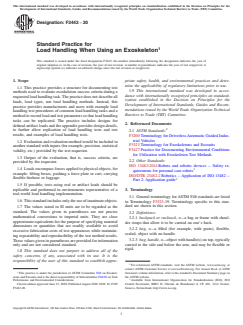
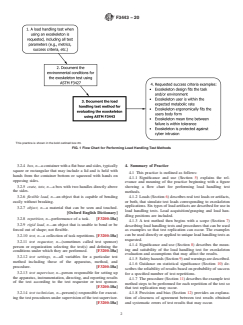
5.1 This practice guides the user through selection of loads and example load handling tests and procedures for use in evaluating exoskeletons worn by the user. The practice is designed to allow replication of loads and tests. Fig. 1 shows a flow chart for performing load handling test methods. Initially, the load handling test is requested by a manufacturer, user/potential user, etc. as in box 1. The environment in which the test is to be performed is documented using Practice F3427 as in box 2. This practice is shown in box 3 where documentation of the load and test results occurs. Evaluation of results occurs after the test has been completed as in box 4.
FIG. 1 Flow Chart for Performing Load Handling Test Methods
This practice is shown in the bold outlined box #3.
5.2 It is expected that this practice provides test guidance for many, although not all, load handling activities using exoskeletons that may occur. However, the test method provides examples to be used directly or as guidance for developing additional load artifacts and load handling tests.
SCOPE
1.1 This practice provides a structure for documenting test methods used to evaluate exoskeleton success criteria during a requested load handling task. The practice does not describe all loads, load types, nor load handling methods. Instead, this practice provides manufacturers and users with example load handling test procedures of common load handling tasks and a method to record load and test parameters so that load handling tasks can be replicated. The practice includes designs for defined artifact loads and the appendix provides design details, to further allow replication of load handling tests and test results, and examples of load handling tests.
1.2 Evaluation and evaluation method would be included in another standard with inputs (for example, precision, statistical validity, etc.) provided by the test requestor.
1.3 Output of the evaluation, that is, success criteria, are provided by the requestor.
1.4 Loads encompass forces applied to physical objects, for example: lifting boxes, pushing a force plate or cart, carrying flexible firehose or luggage.
1.5 If possible, tests using real or artifact loads should be replicable and performed in environments representative of a real-world load handling implementation.
1.6 This standard includes only the use of inanimate objects.
1.7 The values stated in SI units are to be regarded as the standard. The values given in parentheses are not precise mathematical conversions to imperial units. They are close approximate equivalents for the purpose of specifying material dimensions or quantities that are readily available to avoid excessive fabrication costs of test apparatuses while maintaining repeatability and reproducibility of the test method results. These values given in parentheses are provided for information only and are not considered standard.
1.8 This standard does not purport to address all of the safety concerns, if any, associated with its use. It is the responsibility of the user of this standard to establish appropriate safety, health, and environmental practices and determine the applicability of regulatory limitations prior to use.
1.9 This international standard was developed in accordance with internationally recognized principles on standardization established in the Decision on Principles for the Development of International Standards, Guides and Recommendations issued by the World Trade Organization Technical Barriers to Trade (TBT) Committee.
- Status
- Published
- Publication Date
- 14-Jun-2020
- Technical Committee
- F48 - Exoskeletons and Exosuits
- Drafting Committee
- F48.03 - Task Performance and Environmental Considerations
Overview
ASTM F3443-20: Standard Practice for Load Handling When Using an Exoskeleton provides a structured approach for testing, documenting, and replicating load handling scenarios involving exoskeleton devices. Developed by ASTM International, this standard is instrumental for manufacturers, researchers, and end-users seeking to evaluate exoskeletons' effectiveness in supporting typical load handling tasks.
Focusing on systematic procedures and documentation, ASTM F3443-20 enables consistent testing of exoskeleton-assisted load handling activities. It facilitates the comparison of results across different devices and scenarios by offering guidance on test planning, load selection, and reporting, ensuring users can replicate and assess real-world tasks under controlled conditions.
Key Topics
- Test Methodology: Outlines step-by-step procedures for conducting load handling tests with exoskeletons, including test planning, defining success criteria, and capturing relevant details.
- Load Selection: Addresses both real and simulated (artifact) loads to ensure that tests are flexible, repeatable, and reflective of common industrial, medical, and commercial tasks.
- Documentation: Emphasizes rigorous documentation of test environments, load characteristics, and exoskeleton configurations, supporting reliable data collection and replication.
- Replicability: Specifies methods for recording test parameters so that other organizations can reproduce the same load handling tests, vital for standardization and benchmarking.
- Safety Considerations: Highlights the importance of adherence to safety, health, and regulatory practices when conducting exoskeleton load handling tests.
Applications
ASTM F3443-20 is widely applicable across various sectors where exoskeletons are used for manual material handling. Its practical value includes:
- Industrial Ergonomics: Supports factories and warehouses in evaluating exoskeletons for tasks such as lifting, carrying, pushing carts, or handling flexible materials like hoses and luggage.
- Medical and Rehabilitation: Facilitates controlled testing environments to assess exoskeleton efficacy during repetitive load movement, crucial for patient and caregiver safety.
- Military and Emergency Response: Enables testing of exoskeleton performance when transporting equipment or supplies in simulated field conditions, aiding in device selection and deployment planning.
- Research and Development: Assists product developers and testing labs in generating consistent data for exoskeleton design improvements and performance validation.
- Procurement and Purchasing: Equips organizations with standardized procedures to compare exoskeleton models and choose the best solution for their unique load handling requirements.
Related Standards
Adhering to best practices in exoskeleton testing, ASTM F3443-20 references and intersects with several standards to enhance its practical utility:
- ASTM F3323: Terminology for Exoskeletons and Exosuits - vocabulary supporting clear communication in testing documentation.
- ASTM F3427: Practice for Documenting Environmental Conditions for Utilization with Exoskeleton Test Methods - for ensuring environmental consistency.
- ISO 13482:2014: Robots and Robotic Devices - Safety requirements, ensuring safety in personal care robot applications.
- ISO/DTR 23482-2: Robotics - Application guide related to the implementation of ISO 13482 standards.
By aligning with these and other relevant standards, ASTM F3443-20 helps create a comprehensive framework for safe, repeatable, and practical exoskeleton load handling assessments.
Keywords: ASTM F3443-20, exoskeleton load handling, exoskeleton testing, load handling standard, exoskeleton safety, load replication, industrial exoskeletons, exoskeleton applications, load artifact, standardized exoskeleton evaluation
Relations
- Effective Date
- 01-Dec-2023
- Effective Date
- 01-Mar-2020
- Effective Date
- 15-Nov-2019
- Effective Date
- 01-Oct-2019
- Effective Date
- 01-Apr-2019
- Effective Date
- 01-Sep-2018
- Effective Date
- 01-Apr-2018
- Effective Date
- 01-Feb-2018
- Effective Date
- 15-Aug-2017
- Effective Date
- 01-Jun-2017
- Effective Date
- 15-May-2017
- Effective Date
- 15-Oct-2016
- Effective Date
- 15-Jun-2020
- Referred By
ASTM F3578-22 - Standard Test Method for Evaluating Exoskeleton Fall Risk due to Stumbling - Effective Date
- 15-Jun-2020
- Effective Date
- 15-Jun-2020
Frequently Asked Questions
ASTM F3443-20 is a standard published by ASTM International. Its full title is "Standard Practice for Load Handling When Using an Exoskeleton". This standard covers: SIGNIFICANCE AND USE 5.1 This practice guides the user through selection of loads and example load handling tests and procedures for use in evaluating exoskeletons worn by the user. The practice is designed to allow replication of loads and tests. Fig. 1 shows a flow chart for performing load handling test methods. Initially, the load handling test is requested by a manufacturer, user/potential user, etc. as in box 1. The environment in which the test is to be performed is documented using Practice F3427 as in box 2. This practice is shown in box 3 where documentation of the load and test results occurs. Evaluation of results occurs after the test has been completed as in box 4. FIG. 1 Flow Chart for Performing Load Handling Test Methods This practice is shown in the bold outlined box #3. 5.2 It is expected that this practice provides test guidance for many, although not all, load handling activities using exoskeletons that may occur. However, the test method provides examples to be used directly or as guidance for developing additional load artifacts and load handling tests. SCOPE 1.1 This practice provides a structure for documenting test methods used to evaluate exoskeleton success criteria during a requested load handling task. The practice does not describe all loads, load types, nor load handling methods. Instead, this practice provides manufacturers and users with example load handling test procedures of common load handling tasks and a method to record load and test parameters so that load handling tasks can be replicated. The practice includes designs for defined artifact loads and the appendix provides design details, to further allow replication of load handling tests and test results, and examples of load handling tests. 1.2 Evaluation and evaluation method would be included in another standard with inputs (for example, precision, statistical validity, etc.) provided by the test requestor. 1.3 Output of the evaluation, that is, success criteria, are provided by the requestor. 1.4 Loads encompass forces applied to physical objects, for example: lifting boxes, pushing a force plate or cart, carrying flexible firehose or luggage. 1.5 If possible, tests using real or artifact loads should be replicable and performed in environments representative of a real-world load handling implementation. 1.6 This standard includes only the use of inanimate objects. 1.7 The values stated in SI units are to be regarded as the standard. The values given in parentheses are not precise mathematical conversions to imperial units. They are close approximate equivalents for the purpose of specifying material dimensions or quantities that are readily available to avoid excessive fabrication costs of test apparatuses while maintaining repeatability and reproducibility of the test method results. These values given in parentheses are provided for information only and are not considered standard. 1.8 This standard does not purport to address all of the safety concerns, if any, associated with its use. It is the responsibility of the user of this standard to establish appropriate safety, health, and environmental practices and determine the applicability of regulatory limitations prior to use. 1.9 This international standard was developed in accordance with internationally recognized principles on standardization established in the Decision on Principles for the Development of International Standards, Guides and Recommendations issued by the World Trade Organization Technical Barriers to Trade (TBT) Committee.
SIGNIFICANCE AND USE 5.1 This practice guides the user through selection of loads and example load handling tests and procedures for use in evaluating exoskeletons worn by the user. The practice is designed to allow replication of loads and tests. Fig. 1 shows a flow chart for performing load handling test methods. Initially, the load handling test is requested by a manufacturer, user/potential user, etc. as in box 1. The environment in which the test is to be performed is documented using Practice F3427 as in box 2. This practice is shown in box 3 where documentation of the load and test results occurs. Evaluation of results occurs after the test has been completed as in box 4. FIG. 1 Flow Chart for Performing Load Handling Test Methods This practice is shown in the bold outlined box #3. 5.2 It is expected that this practice provides test guidance for many, although not all, load handling activities using exoskeletons that may occur. However, the test method provides examples to be used directly or as guidance for developing additional load artifacts and load handling tests. SCOPE 1.1 This practice provides a structure for documenting test methods used to evaluate exoskeleton success criteria during a requested load handling task. The practice does not describe all loads, load types, nor load handling methods. Instead, this practice provides manufacturers and users with example load handling test procedures of common load handling tasks and a method to record load and test parameters so that load handling tasks can be replicated. The practice includes designs for defined artifact loads and the appendix provides design details, to further allow replication of load handling tests and test results, and examples of load handling tests. 1.2 Evaluation and evaluation method would be included in another standard with inputs (for example, precision, statistical validity, etc.) provided by the test requestor. 1.3 Output of the evaluation, that is, success criteria, are provided by the requestor. 1.4 Loads encompass forces applied to physical objects, for example: lifting boxes, pushing a force plate or cart, carrying flexible firehose or luggage. 1.5 If possible, tests using real or artifact loads should be replicable and performed in environments representative of a real-world load handling implementation. 1.6 This standard includes only the use of inanimate objects. 1.7 The values stated in SI units are to be regarded as the standard. The values given in parentheses are not precise mathematical conversions to imperial units. They are close approximate equivalents for the purpose of specifying material dimensions or quantities that are readily available to avoid excessive fabrication costs of test apparatuses while maintaining repeatability and reproducibility of the test method results. These values given in parentheses are provided for information only and are not considered standard. 1.8 This standard does not purport to address all of the safety concerns, if any, associated with its use. It is the responsibility of the user of this standard to establish appropriate safety, health, and environmental practices and determine the applicability of regulatory limitations prior to use. 1.9 This international standard was developed in accordance with internationally recognized principles on standardization established in the Decision on Principles for the Development of International Standards, Guides and Recommendations issued by the World Trade Organization Technical Barriers to Trade (TBT) Committee.
ASTM F3443-20 is classified under the following ICS (International Classification for Standards) categories: 53.020.99 - Other lifting equipment. The ICS classification helps identify the subject area and facilitates finding related standards.
ASTM F3443-20 has the following relationships with other standards: It is inter standard links to ASTM F3200-23, ASTM F3427-20, ASTM F3200-19, ASTM F3323-19a, ASTM F3323-19, ASTM F3323-18, ASTM F3200-18a, ASTM F3200-18, ASTM F3200-17b, ASTM F3200-17a, ASTM F3200-17, ASTM F3200-16, ASTM F3582-22, ASTM F3578-22, ASTM F3528-21. Understanding these relationships helps ensure you are using the most current and applicable version of the standard.
ASTM F3443-20 is available in PDF format for immediate download after purchase. The document can be added to your cart and obtained through the secure checkout process. Digital delivery ensures instant access to the complete standard document.
Standards Content (Sample)
This international standard was developed in accordance with internationally recognized principles on standardization established in the Decision on Principles for the
Development of International Standards, Guides and Recommendations issued by the World Trade Organization Technical Barriers to Trade (TBT) Committee.
Designation: F3443 − 20
Standard Practice for
Load Handling When Using an Exoskeleton
This standard is issued under the fixed designation F3443; the number immediately following the designation indicates the year of
original adoption or, in the case of revision, the year of last revision.Anumber in parentheses indicates the year of last reapproval.A
superscript epsilon (´) indicates an editorial change since the last revision or reapproval.
1. Scope priate safety, health, and environmental practices and deter-
mine the applicability of regulatory limitations prior to use.
1.1 This practice provides a structure for documenting test
1.9 This international standard was developed in accor-
methods used to evaluate exoskeleton success criteria during a
dance with internationally recognized principles on standard-
requestedloadhandlingtask.Thepracticedoesnotdescribeall
ization established in the Decision on Principles for the
loads, load types, nor load handling methods. Instead, this
Development of International Standards, Guides and Recom-
practice provides manufacturers and users with example load
mendations issued by the World Trade Organization Technical
handling test procedures of common load handling tasks and a
Barriers to Trade (TBT) Committee.
methodtorecordloadandtestparameterssothatloadhandling
tasks can be replicated. The practice includes designs for
2. Referenced Documents
definedartifactloadsandtheappendixprovidesdesigndetails,
to further allow replication of load handling tests and test
2.1 ASTM Standards:
results, and examples of load handling tests.
F3200Terminology for DriverlessAutomatic Guided Indus-
trial Vehicles
1.2 Evaluation and evaluation method would be included in
F3323Terminology for Exoskeletons and Exosuits
anotherstandardwithinputs(forexample,precision,statistical
F3427Practice for Documenting Environmental Conditions
validity, etc.) provided by the test requestor.
for Utilization with Exoskeleton Test Methods
1.3 Output of the evaluation, that is, success criteria, are
2.2 Other Standards:
provided by the requestor.
ISO 13482:2014Robots and robotic devices -- Safety re-
1.4 Loads encompass forces applied to physical objects, for
quirements for personal care robots
example: lifting boxes, pushing a force plate or cart, carrying
ISO/DTR 23482-2Robotics -- Application of ISO 13482 --
flexible firehose or luggage.
Part 2: Application guide
1.5 If possible, tests using real or artifact loads should be
replicable and performed in environments representative of a
3. Terminology
real-world load handling implementation.
3.1 General terminology forASTM F48 standards are listed
1.6 Thisstandardincludesonlytheuseofinanimateobjects.
in Terminology F3323-19. Terminology specific to this stan-
dard are shown in this section.
1.7 The values stated in SI units are to be regarded as the
standard. The values given in parentheses are not precise
3.2 Definitions:
mathematical conversions to imperial units. They are close
3.2.1 backpack or rucksack, n—a bag or frame with shoul-
approximateequivalentsforthepurposeofspecifyingmaterial
der straps that allow it to be carried on one’s back.
dimensions or quantities that are readily available to avoid
3.2.2 bag, n—a filled (for example, with grain), flexible,
excessive fabrication costs of test apparatuses while maintain-
sealed, object with no handle.
ing repeatability and reproducibility of the test method results.
3.2.3 bag, handle, n—objectwithhandle(s)ontop,typically
Thesevaluesgiveninparenthesesareprovidedforinformation
carried to the side and below the arm, and may be flexible or
only and are not considered standard.
rigid.
1.8 This standard does not purport to address all of the
safety concerns, if any, associated with its use. It is the
responsibility of the user of this standard to establish appro-
For referenced ASTM standards, visit the ASTM website, www.astm.org, or
contact ASTM Customer Service at service@astm.org. For Annual Book of ASTM
This practice is under the jurisdiction of ASTM Committee F48 on Exoskel- Standards volume information, refer to the standard’s Document Summary page on
etons and Exosuits and is the direct responsibility of Subcommittee F48.03 on Task the ASTM website.
Performance and Environmental Considerations. Available from International Organization for Standardization (ISO), ISO
Current edition approved June 15, 2020. Published August 2020. DOI: 10.1520/ Central Secretariat, BIBC II, Chemin de Blandonnet 8, CP 401, 1214 Vernier,
F3443-20. Geneva, Switzerland, http://www.iso.org.
Copyright © ASTM International, 100 Barr Harbor Drive, PO Box C700, West Conshohocken, PA 19428-2959. United States
F3443 − 20
This practice is shown in the bold outlined box #3.
FIG. 1 Flow Chart for Performing Load Handling Test Methods
3.2.4 box,n—acontainerwithaflatbaseandsides,typically 4. Summary of Practice
square or rectangular that may include a lid and is held with
4.1 This practice is outlined as follows:
hands from the container bottom or squeezed with hands on
4.1.1 Significance and use (Section 5) explains the rel-
opposing sides.
evance and meaning of the practice beginning with a figure
3.2.5 crate, tote, n—a box with two handles directly above
showing a flow chart for performing load handling test
the sides.
methods.
4.1.2 Loads (Section 6) describes real test loads or artifacts,
3.2.6 flexible load, n—an object that is capable of bending
or both, that simulate test loads corresponding to exoskeleton
easily without breaking.
applications.Sixtypesofloadartifactsaredescribedforusein
3.2.7 object, n—a material that can be seen and touched.
load handling tests. Load acquisition/grasping and load han-
[Oxford English Dictionary]
dling positions are included.
3.2.8 repetition, n—performance of a task. [F3200-18a]
4.1.3 A test method then begins with a scope (Section 7)
3.2.9 rigid load, n—an object that is unable to bend or be
describing load handling tests and procedures that can be used
forced out of shape; not flexible.
as examples so that test replication can occur. The examples
can be used directly or applied to unique load handling tests as
3.2.10 test, n—a collection of task repetitions. [F3200-18a]
requested.
3.2.11 test requestor, n—(sometimes called test sponsor)
4.1.4 Significance and use (Section 8) describes the mean-
person or organization selecting the test(s) and defining the
ing and suitability of the load handling test for exoskeleton
conditions under which they are performed. [F3200-18a]
evaluation and assumptions that may affect the results.
3.2.12 test settings, n—all variables for a particular test
4.1.5 Safetyhazards(Section9)andwarningsaredescribed.
method including those of the apparatus, method, and
4.1.6 Guidance on statistical significance (Section 10) de-
procedure. [F3200-18a]
scribes the reliability of results based on probability of success
3.2.13 test supervisor, n—person responsible for setting up
for a specified number of test repetitions.
the apparatus, instrumentation, directing, and reporting results
4.1.7 The procedure (Section 11) describes the example test
of the test according to the test requestor or test sponsor.
method steps to be performed for each repetition of the test so
[F3200-18a]
that test replication may occur.
3.2.14 test technician, n—person(s) responsible for execut- 4.1.8 Precision and bias (Section 12) provides an explana-
ingthetestproceduresundersupervisionofthetestsupervisor. tion of closeness of agreement between test results obtained
[F3200-18a] and systematic errors of test results that may occur.
F3443 − 20
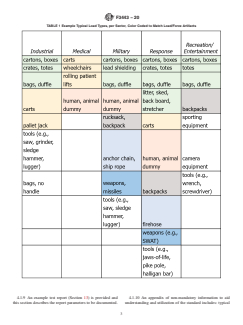
TABLE 1 Example Typical Load Types, per Sector, Color Coded to Match Load/Force Artifacts
4.1.9 An example test report (Section 13) is provided and 4.1.10 An appendix of non-mandatory information to aid
this section describes the report parameters to be documented. understanding and utilization of the standard includes: typical
F3443 − 20
TABLE 2 Artifact Types that Address Loads shown in Table 1
ColorsinboxescorrespondtoTable1exampletypicalloads.ThewhiteboxlabeledvaryingartifactscorrespondstoTable1whiteboxesthataretoobroadtocategorize
with a single artifact.
load handling tasks by sector, example load handling test 6. Loads
apparatus designs, example load artifact and load artifact
6.1 The actual (real) load can be used for the load handling
holder designs, and example load handling test reports.
test. For test replication, use the exact model number of the
load or use an artifact that simulates the load as described in
5. Significance and Use
6.3.
5.1 This practice guides the user through selection of loads
6.2 Examples of typical loads from various sectors that use
and example load handling tests and procedures for use in
exoskeletons are shown in Table 1. Color coding of typical
evaluating exoskeletons worn by the user. The practice is
loads equate to Table 2 Artifacts that simulate typical loads.
designed to allow replication of loads and tests. Fig. 1 shows a
flow chart for performing load handling test methods. Initially,
6.3 Load Artifacts
the load handling test is requested by a manufacturer, user/
6.3.1 Load Box Artifact:
potential user, etc. as in box 1. The environment in which the
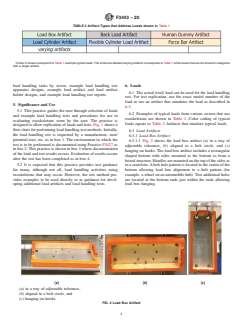
6.3.1.1 Fig. 2 shows the load box artifact (a) in a tray of
test is to be performed is documented using Practice F3427 as
adjustable tolerance, (b) aligned to a bolt circle, and (c)
inbox2.Thispracticeisshowninbox3wheredocumentation
hanging on hooks.The load box artifact includes a rectangular
of the load and test results occurs. Evaluation of results occurs
shaped bottom with sides mounted to the bottom to form a
after the test has been completed as in box 4.
boxedstructure.Handlesaremountedonthetopofthesidesas
5.2 It is expected that this practice provides test guidance inacrate/tote.Aboltholepatternislocatedinthecenterofthe
for many, although not all, load handling activities using bottom allowing load box alignment to a bolt pattern (for
exoskeletons that may occur. However, the test method pro- example,awheelonanautomobilehub).Twoadditionalholes
vides examples to be used directly or as guidance for devel- are located at the bottom ends just within the ends allowing
oping additional load artifacts and load handling tests.
load box hanging.
(a)in a tray of adjustable tolerance,
(b)aligned to a bolt circle, and
(c)hanging on hooks.
FIG. 2 Load Box Artifact
F3443 − 20
FIG. 3 (a) Load Cylinder Artifact
Static Configuration
FIG. 3 (b) Load Cylinder Artifact
Dynamic Configuration (continued)
6.3.1.2 TheloadboxartifactdetaileddesignisshowninFig. 6.3.2.1 Fig. 3 shows the load cylinder artifact. The load
X3.1. cylinder artifact includes a smooth split-cylinder and includes
6.3.1.3 Theloadboxartifactweightcanvarywithconstruc- smooth circular ends. For the static configuration, shown in
tion materials or by adding weight to the box (or both) inside Fig. 3(a), a handle is located on one end of the artifact to carry
using a center bottom tapped hole and weight fastening screw. the load as a handle bag. A threaded rod is attached to the
6.3.2 Load Cylinder: handle and screws through the cylinder artifact to the opposite
F3443 − 20
end plate allowing additional weights to be added and fixtured 6.3.3.2 The back load artifact weight can vary with con-
to any location within the artifact. struction materials or by adding and fixturing weight, or both.
6.3.2.2 The load cylinder artifact weight can vary with
6.3.4 Flexible Cylinder Load Artifact:
construction materials, or by adding and fixturing weight
6.3.4.1 Fig. 5 shows the flexible cylinder artifact. The
within the cylinder using wingnuts screwed onto the center
artifact includes one or more cylindrical components (Fig.
threaded rod, or both.
5(a)) that can be attached to one another with a single screw
6.3.2.3 The smooth cylinder allows artifact carry, for ex-
allowing a hinged joint between components.The components
ample on shoulders or on arms. A cover can complete the
are smooth cylinders and when assembled form a long rigid
cylinder.
cylinder (Fig. 5(b), for example, a charged firehose) if the
6.3.2.4 Fig. 3(b) shows the load cylinder in a dynamic
connecting screws are tightened or a long flexible cylinder
configuration where the red sphere is a weight that can move
(Fig. 5(c), for example, an uncharged firehose) if the connect-
within the cylinder housing and creating a dynamic load
ing screws are loose.
controlled by the exoskeleton user.
6.3.4.2 The flexible cylinder load artifact weight can vary
6.3.2.5 Theloadcylinderartifactdetaileddesignisshownin
with construction materials or by adding weight (for example,
Appendix X2, Fig. X2.7.
water, sand, steel balls) within each component and capped, or
6.3.3 Back Load:
both.
6.3.3.1 Fig. 4 shows an example back load artifact. The
6.3.4.3 The smooth cylinder allows artifact carry, for ex-
artifact is a frame worn on the user’s back as a backpack/
ample on shoulders or on arms.
rucksack. The back load artifact can be an off-the-shelf item,
6.3.4.4 The flexible cylinder load artifact detailed design is
although the specific model number of the item is required for
shown in Appendix X2, Fig. X2.8.
test method replication. The frame allows additional items,
such as weights, other artifacts, or actual loads (for example, 6.3.4.5 Cylinderscanbecoveredwithasheath/skin,oneach
military communication box, tent) to be attached. component(forexample,rubber)oroveraportionoftheentire
FIG. 4 Back Load Artifact
F3443 − 20
(a)hollow component with cap,
(b)several components assembled and flexed, and
(c)several components aligned.
FIG. 5 Flexible Cylinder Artifact
artifact to, for example, simulate a hose. The sheathing must Additional weight can also be added to the human dummy
also be documented in the report to allow replication of the artifactbyaddingloadswithexactmodelnumbersprovidedor
artifact and test. throughuseofadditionalartifacts,orboth(forexample,aback
6.3.5 Human Dummy: load artifact or box load artifact, or both).
6.3.5.1 Fig. 6 shows example human dummy artifacts. 6.3.6 Force Bar:
These artifacts are flexible and provide a three-dimensional 6.3.6.1 Fig. 7 shows the force bar artifact. The artifact
human profile that can be carried or dragged during load includes a bar connected to two load cells and spaced from the
handling tests. The human dummy artifact can be an off-the- supporting wall or structure using connecting bars and support
shelf item, although the specific model number of the item is braces. The load cells are each electrically connected to
required for test method replication. displays showing the push or pull force applied to the bar.
6.3.5.2 The human dummy artifact can be purchased in Lights provide the exoskeleton user and test administrators an
varying weights and sizes (for example, child through adult). indicationthattherequestedforcewasreachedforeachorboth
F3443 − 20
See References section (1-6).
FIG. 6 Examples of Human Dummy Artifacts
FIG. 7 Force Bar Artifact
load cells.Additionally, push/pull handles are connected to the 6.3.6.3 The force bar artifact load is determined by the
bar that simulate wheelchair or similar handle locations. requestor.Forexample,twotypesofloadscanbemeasuredby
6.3.6.2 The force bar artifact can be mounted at any height the artifact: stiction loads (force to begin moving a wheeled
and distance from the supporting wall or structure. Ideally, the load)androllingload(forcetomaintainmotionofthewheeled
artifact is mounted at cart or wheelchair height that is repre- load). These two loads and their durations should be deter-
sentative of the real implementation. The user grip location on mined by the requestor.
thebarshouldalsobesimilartotherealworldimplementation. 6.3.7 Force Plates:
F3443 − 20
6.3.7.1 Off-the-shelfforceplates,asshowninFig.8,arenot 6.3.7.3 Artifacts can be combined within a test method. For
consideredartifacts,butinsteadatoolformeasuringloads.For example,aloadboxartifactoraloadcylinderartifact,orboth,
tests that include the user holding or working with, for in/attached to a back load artifact as depicted in Fig. 9.
example, tools or an artifact, the exoskeleton user is instead
6.4 Load Acquire/Grasp:
usingtheheldobjectandalsoapplyingforces.Forceplatesare
6.4.1 Loads can be acquired or grasped by the exoskeleton
therefore used to measure applied forces directly from the
user using one or more of the following methods:
exoskeleton user or from a tool(s) held by the user, along the
6.4.1.1 Beneath the Load—For example, box.
requested force vector, at the requested location, and for a
6.4.1.2 Using Handles on Top of the Load—For example, a
requestedduration.Forexample,forcesmaybeappliedfroma
device with handles, handle bag.
grinderheldbyanexoskeletonuserinadownward,forward,or
6.4.1.3 Using Handles in Front—For example, a cart.
upward direction and at the floor, wall, or ceiling for a period
6.4.1.4 Using Handles on the Sides of the Load—For
of 30 s each.Another example, torques may be applied from a
example, crate/tote.
screwdriverbyanexoskeletonuserinadownward,forward,or
6.4.1.5 Squeezing the Load—For example, box, tire/wheel.
upward direction and at the floor, wall, or ceiling for a period
6.4.1.6 Shoulder Support of the Load—For example,
of 30 s each.
missile, bag.
6.3.7.2 Applied forces or torques can be variable, as set by
6.4.1.7 Back Support of the Load—For example, military
the requestor, or with variable duration, or both. The requestor
rucksack.
should define the exact profile of force or torque and time to
ensure repeatability. 6.5 Load Handling Position:
FIG. 8 Force Plates Mounted on the (1) Floor, (2) Low Wall, (3) High Wall, and (4) Ceiling
F3443 − 20
FIG. 9 Combination of Artifacts
6.5.1 Loadscanbepickedup,held,carried,orpositioned,or 6.5.1.2 Side—The load is accessed and held using one hand
combinationsthereof,inoneormoreofthefollowinglocations belowthearmandbesidethebody(forexample,ahandlebag)
relative to the exoskeleton user:
or one hand raised to the side (for example, weight lift).
6.5.1.1 Front—(1) the load is accessed and held using one
6.5.1.3 On Back—The load is held on the users back.
hand in front of the body and at a measured distance; or (2)
6.5.1.4 On Shoulder—The load is held on the users shoul-
accessed and held with two hands in front of the body and at
der(s).
a measured distance with the hands having narrow or wide
separation with respect to one another; or (3) pushed/pulled as
with a cart.
TEST METHOD
7. Scope
7.1 This test method, as part of this Standard Practice for 7.3.1.2 The user is instructed to grip the load using the
Load Handling When Using an Exoskeleton, describes the handles.
procedure outlined in Fig. 1, and other relevant information to
7.3.1.3 The user is instructed to hold/carry the load at torso
perform load handling tests using real world loads or the
levelwiththecasetouchingtheirstomachorchest,orboth.No
artifacts described in Section 6.
instructions are given on how specifically to lift up or place
down the load.
7.2 As there are an infinite number of load handling tasks
thatcanbeperformedintherealworldusingexoskeletons,this 7.3.1.4 The user starts by standing 31 cm (1 ft) in front of a
102-cmwide×122-cmdeep×17-cmtall(40-in.wide×48-in.
test method provides a series of test method examples for
guidance on developing and performing repeatable load han- deep × 6.5-in. tall) pallet with the load on top.The user begins
in a comfortable standing posture, facing the load with feet
dling tests by exoskeleton users and manufacturers.
side-by-side and approximately shoulder width apart.
7.3 Test Method Examples—The following are examples
7.3.1.5 The load begins on the center of the pallet.The load
that can be used as a guide for developing and implementing
is oriented so that handles are located on left and right sides
loadhandlingtestswhenusingexoskeletons.Thestandarduser
relative to person facing the load.
should detail the test performed similar to these examples.
7.3.1.6 Theuserisinstructedtolifttheload,turn180°,then
7.3.1 Example 1—Load box artifact (or a real case of beer
carryit305cm(10ft)inastraightlinetoa76-cmhigh(30-in.
load).
high) table, and place the load on the table. There are no other
7.3.1.1 The load is a 24-case of glass beer bottles that
obstacles in the environment.
measures 46-cm long × 31-cm wide × 23-cm high (18-in. long
× 12-in. wide × 9-in. high), with cut-out handles as shown in 7.3.1.7 Theloadistobeplacedsothatitisfullyonthetable
Fig. 10(a). It weighs 18 kg (40 lbs), and the weight is equally (not overhanging edge), near the front edge. On the table the
distributed.Alternatively,aloadboxartifactweightedthesame load should be oriented so that handles are located on left and
as the real load can be used as the load as shown in Fig. 10(b). right sides relative to the user facing the load.
F3443 − 20
FIG. 10 (a) Real Load and (b) Artifact Load (with Added Weight to Match the Real Load) used for Example 1
7.3.1.8 The user should then return to a comfortable stand- wheelsonaflatsteelfloorandistobepushedatapproximately
ingposture,facingtheloadwithfeetside-by-sideandapproxi- 3 mph (4.4 fps). The total allowed time to move the cart from
mately shoulder-width apart. start to goal is 7 s.
7.3.1.9 No additional or special instructions are given to 7.3.3.2 The cart can be returned to the start position or use
users. the goal as the next start position to repeat the test in the
7.3.1.10 Relevant photos of the environment, task, and load opposite direction.
shall be attached. 7.3.3.3 Alternatively, a load bar artifact, as shown in Fig.
7.3.1.11 Metrics are documented for the repetition. 11(b), can be used in place of the cart. Similar loads and times
7.3.1.12 The test is repeated 29 times (or as instructed by as in step (1) are applied.The total forces are estimated at (see
the test requestor). calculation formula in Appendix X4): rolling force = (0.047 ×
7.3.2 Example 1 with Obstacle Avoidance: 500/4 = 5.9 lbs per wheel×4=) 23.5 lbs; starting force =
7.3.2.1 The user performs the test in Example 1, although rolling force × 2.5 = 58.8 lbs. Therefore, the test includes the
step 7.3.1.6 is changed to have the user maneuver around an followingforces: (a)beginpushing(startingforce)withaforce
obstacle placed in the path between the pallet and table. The of 58.8 lbs; (b) then apply a force of 23.5 lbs to roll the cart;
obstacle location is measured from the pallet and table and and (c) then apply an opposing force (that is, pull) to stop the
shown on the layout drawing of the test space. cart at the goal with a force of 58.8 lbs.
7.3.3 Example 2—Force Bar Artifact (or a Real Cart): 7.3.3.4 Metrics are documented for the repetition.
7.3.3.1 The user is instructed to push a cart, similar to the 7.3.3.5 The test is repeated 29 times (or as instructed by the
one shown in Fig. 11(a), that has been loaded with 1000 lbs. test requestor).
Theuserbeginspushingatastartlocationonastraightpath20 7.3.4 Example 2 with Turns:
ft and stops the cart at the goal location using both hands 7.3.4.1 Example 2 test is instead performed while maneu-
placed 36 in. apart measured between right and left index vering the cart around two obstacles in a “figure 8 pattern”
fingers. The cart has four 8-in. diameter polyurethane 85A where the cart must be rotated left and right to avoid the
FIG. 11 (a) Real Cart Load and (b) Force Bar Artifact used for Example 2
F3443 − 20
obstacles. Time to rotate the cart, the number and direction of 7.3.6.1 The user performs the test in Example 3, the user is
cart turns, and other pertinent information about the test shall instructed to maneuver around an obstacle placed in the path
be recorded. If a force bar artifact is instead used as the load, between the start and goal locations. The obstacle location is
right and left pull/push forces are to be instructed of and measured from the start and goal locations and shown on the
performed by the user using the artifact. layout drawing of the test space.
7.3.5 Example 3—Flexible Load Artifact (or a Real, 7.3.7 Example 4—Tool Use:
Charged Hose): 7.3.7.1 A series of five ⁄2-in. – 13 × 1-in. long bolts are
7.3.5.1 A charged (filled with water), 4-in. diameter, fire- started into threaded holes spaced 2 in. apart in a metal plate
hose section, as shown in Fig. 12(a) is used as the load. (see Fig. 13) mounted at shoulder height to the user. Note, the
7.3.5.2 Alternatively, a flexible load artifact, as shown in boltheightsthereforevaryfromusertouserdependingontheir
Fig. 12(b) can be used in place of a real load. The artifact is shoulder heights.
configured with all links tightened to one another so th
...