

ASTM D7845-20
(Test Method)Standard Test Method for Determination of Chemical Species in Marine Fuel Oil by Multidimensional Gas Chromatography/Mass Spectrometry
General Information
- Abstract
SIGNIFICANCE AND USE
5.1 The test method allows the quantitation of chemical species at low levels in marine fuel oils and cutter stocks. A great many types and concentrations of chemical species are found in marine fuel oils. A root cause relationship between the presence of such species or their concentration in fuels and any failure modes allegedly induced by the use of these fuels has not been established. This test method is necessary to establish test conditions required for future ISO 8217:2010 as defined in section 5.5 and Annex B item (d). Additional compounds may be determined by using the same conditions and by selecting required mass spectral selected ions, accordingly.
SCOPE
1.1 This test method covers the quantitative determination of a variety of chemical species in marine fuel oil (bunker fuel oil) by gas chromatography/mass spectrometry. By using the same conditions and by selecting required mass spectral selected ions, the test method may be used for the determination of other species than those for which precision statements and limits of detection have been established.
1.2 An example list of chemical species for which a limit of quantification has been determined by means of this test method is given in Table 1.
1.3 Other refinery hydrocarbon fractions and their mixtures may be tested using the same test method conditions. However, the precision of this test method reflects the compounds in Table 1.
1.4 Results are reported to the nearest 1.0 mg/kg.
1.5 The values stated in SI units are to be regarded as standard.
1.5.1 Exception—Non-SI values are given for psig.
1.6 This standard does not purport to address all of the safety concerns, if any, associated with its use. It is the responsibility of the user of this standard to establish appropriate safety, health, and environmental practices and determine the applicability of regulatory limitations prior to use.
1.7 This international standard was developed in accordance with internationally recognized principles on standardization established in the Decision on Principles for the Development of International Standards, Guides and Recommendations issued by the World Trade Organization Technical Barriers to Trade (TBT) Committee.
- Status
- Published
- Publication Date
- 14-Jun-2020
- Technical Committee
- D02 - Petroleum Products, Liquid Fuels, and Lubricants
- Drafting Committee
- D02.04.0M - Mass Spectrometry
Buy Documents
ASTM D7845-20 - Standard Test Method for Determination of Chemical Species in Marine Fuel Oil by Multidimensional Gas Chromatography/Mass Spectrometry
REDLINE ASTM D7845-20 - Standard Test Method for Determination of Chemical Species in Marine Fuel Oil by Multidimensional Gas Chromatography/Mass Spectrometry
Overview
ASTM D7845-20 establishes a standard test method for the quantitative determination of chemical species in marine fuel oil (commonly referred to as bunker fuel oil) and cutter stocks by using multidimensional gas chromatography/mass spectrometry (GC/MS). Developed by ASTM International, this standard supports the detection and quantification of various chemical components at low concentrations, helping to ensure fuel quality and compliance with future requirements such as those outlined in ISO 8217.
The method is particularly valuable given the diversity of marine fuel compositions and enables measurement of species that may impact fuel performance or regulatory compliance. While specific root-cause relationships between detected species and fuel issues are not established, this method provides repeatable procedures for measuring numerous compounds, thereby supporting quality control and research in the marine fuels sector.
Key Topics
Scope of Measurement: Covers a broad range of chemical species in marine fuels, including alcohols, ethers, aromatic hydrocarbons (like styrene and its derivatives), and phenolic compounds. The standard also allows detection of additional species using the same analytical conditions and targeted ions.
Analytical Approach: Utilizes multidimensional GC/MS with selective ion monitoring and defined retention times for accurate identification and quantitation. The approach minimizes matrix interference by separating light and heavy hydrocarbon fractions.
Quantification and Reporting: Results are reported to the nearest 1.0 mg/kg, ensuring precise quantification at low concentration levels.
Quality Assurance: Incorporates rigorous calibration, internal standards (such as ethylbenzene-d10), and quality control practices as set out in referenced ASTM standards.
Repeatability and Precision: The standard provides repeatability data for key compounds, emphasizing the importance of validated analytical procedures and ongoing quality control.
Applications
Marine Fuel Quality Control: Used by fuel suppliers, refineries, and shipping companies to assess the chemical composition of marine fuel oils, ensuring consistency and compliance with international specifications.
Regulatory Compliance: Supports adherence to upcoming ISO 8217 petroleum fuel requirements and helps demonstrate due diligence in fuel testing per international maritime regulation.
Root Cause Analysis: Assists in identifying and quantifying trace-level chemical species in fuel samples that may be linked to operational or environmental performance issues.
Research and Development: Enables laboratories and research teams to study the presence and effects of various chemical compounds in different bunker fuel blends and refinery fractions.
Blending and Product Certification: Supports the precise determination of component concentrations in cutter stocks and other refinery products intended for marine use.
Related Standards
ASTM D4307 - Practice for Preparation of Liquid Blends for Use as Analytical Standards: Provides procedures for preparing calibration and check standards for GC/MS analysis.
ASTM D6299 - Practice for Applying Statistical Quality Assurance and Control Charting Techniques: Guides laboratories in monitoring analytical system performance and data reliability.
ISO 8217:2010 - Petroleum Products-Fuels (Class F)-Specifications of Marine Fuels: International specification referenced for quality requirements in marine fuels.
Practical Value
Implementing ASTM D7845-20 enables organizations involved in the marine fuel supply chain to conduct robust, trace-level analyses that safeguard fuel quality and support operational integrity. The adoption of this test method provides confidence in marine fuel composition, meets growing regulatory demands, and underpins continuous improvement in marine fuel standards and industry best practices.
Keywords: marine fuel oil analysis, GC/MS, chemical species determination, ASTM D7845-20, bunker fuel testing, mass spectrometry, petroleum quality control, ISO 8217 compliance, phenols, styrene, hydrocarbons, analytical standards.
Relations
- Effective Date
- 01-Dec-2023
- Effective Date
- 15-Dec-2017
- Effective Date
- 15-Nov-2017
- Effective Date
- 01-Jan-2017
- Effective Date
- 01-Oct-2015
- Effective Date
- 01-Oct-2013
- Effective Date
- 01-May-2010
- Effective Date
- 01-Mar-2010
- Effective Date
- 01-Mar-2010
- Effective Date
- 01-Nov-2009
- Effective Date
- 15-Oct-2008
- Effective Date
- 01-Nov-2007
- Effective Date
- 01-Nov-2007
- Effective Date
- 01-May-2004
- Effective Date
- 10-Jun-2002
Buy Documents
ASTM D7845-20 - Standard Test Method for Determination of Chemical Species in Marine Fuel Oil by Multidimensional Gas Chromatography/Mass Spectrometry
REDLINE ASTM D7845-20 - Standard Test Method for Determination of Chemical Species in Marine Fuel Oil by Multidimensional Gas Chromatography/Mass Spectrometry
Get Certified
Connect with accredited certification bodies for this standard

DNV
DNV is an independent assurance and risk management provider.

Lloyd's Register
Lloyd's Register is a global professional services organisation specialising in engineering and technology.

Element Materials Technology
Materials testing and product certification.
Sponsored listings
Frequently Asked Questions
ASTM D7845-20 is a standard published by ASTM International. Its full title is "Standard Test Method for Determination of Chemical Species in Marine Fuel Oil by Multidimensional Gas Chromatography/Mass Spectrometry". This standard covers: SIGNIFICANCE AND USE 5.1 The test method allows the quantitation of chemical species at low levels in marine fuel oils and cutter stocks. A great many types and concentrations of chemical species are found in marine fuel oils. A root cause relationship between the presence of such species or their concentration in fuels and any failure modes allegedly induced by the use of these fuels has not been established. This test method is necessary to establish test conditions required for future ISO 8217:2010 as defined in section 5.5 and Annex B item (d). Additional compounds may be determined by using the same conditions and by selecting required mass spectral selected ions, accordingly. SCOPE 1.1 This test method covers the quantitative determination of a variety of chemical species in marine fuel oil (bunker fuel oil) by gas chromatography/mass spectrometry. By using the same conditions and by selecting required mass spectral selected ions, the test method may be used for the determination of other species than those for which precision statements and limits of detection have been established. 1.2 An example list of chemical species for which a limit of quantification has been determined by means of this test method is given in Table 1. 1.3 Other refinery hydrocarbon fractions and their mixtures may be tested using the same test method conditions. However, the precision of this test method reflects the compounds in Table 1. 1.4 Results are reported to the nearest 1.0 mg/kg. 1.5 The values stated in SI units are to be regarded as standard. 1.5.1 Exception—Non-SI values are given for psig. 1.6 This standard does not purport to address all of the safety concerns, if any, associated with its use. It is the responsibility of the user of this standard to establish appropriate safety, health, and environmental practices and determine the applicability of regulatory limitations prior to use. 1.7 This international standard was developed in accordance with internationally recognized principles on standardization established in the Decision on Principles for the Development of International Standards, Guides and Recommendations issued by the World Trade Organization Technical Barriers to Trade (TBT) Committee.
SIGNIFICANCE AND USE 5.1 The test method allows the quantitation of chemical species at low levels in marine fuel oils and cutter stocks. A great many types and concentrations of chemical species are found in marine fuel oils. A root cause relationship between the presence of such species or their concentration in fuels and any failure modes allegedly induced by the use of these fuels has not been established. This test method is necessary to establish test conditions required for future ISO 8217:2010 as defined in section 5.5 and Annex B item (d). Additional compounds may be determined by using the same conditions and by selecting required mass spectral selected ions, accordingly. SCOPE 1.1 This test method covers the quantitative determination of a variety of chemical species in marine fuel oil (bunker fuel oil) by gas chromatography/mass spectrometry. By using the same conditions and by selecting required mass spectral selected ions, the test method may be used for the determination of other species than those for which precision statements and limits of detection have been established. 1.2 An example list of chemical species for which a limit of quantification has been determined by means of this test method is given in Table 1. 1.3 Other refinery hydrocarbon fractions and their mixtures may be tested using the same test method conditions. However, the precision of this test method reflects the compounds in Table 1. 1.4 Results are reported to the nearest 1.0 mg/kg. 1.5 The values stated in SI units are to be regarded as standard. 1.5.1 Exception—Non-SI values are given for psig. 1.6 This standard does not purport to address all of the safety concerns, if any, associated with its use. It is the responsibility of the user of this standard to establish appropriate safety, health, and environmental practices and determine the applicability of regulatory limitations prior to use. 1.7 This international standard was developed in accordance with internationally recognized principles on standardization established in the Decision on Principles for the Development of International Standards, Guides and Recommendations issued by the World Trade Organization Technical Barriers to Trade (TBT) Committee.
ASTM D7845-20 is classified under the following ICS (International Classification for Standards) categories: 47.020.20 - Marine engines and propulsion systems; 75.160.20 - Liquid fuels. The ICS classification helps identify the subject area and facilitates finding related standards.
ASTM D7845-20 has the following relationships with other standards: It is inter standard links to ASTM D6299-23a, ASTM D6299-17b, ASTM D6299-17a, ASTM D6299-17, ASTM D4307-99(2015), ASTM D6299-13e1, ASTM D4307-99(2010), ASTM D6299-10e2, ASTM D6299-10, ASTM D6299-09, ASTM D6299-08, ASTM D6299-07e1, ASTM D6299-07, ASTM D4307-99(2004), ASTM D6299-02. Understanding these relationships helps ensure you are using the most current and applicable version of the standard.
ASTM D7845-20 is available in PDF format for immediate download after purchase. The document can be added to your cart and obtained through the secure checkout process. Digital delivery ensures instant access to the complete standard document.
Standards Content (Sample)
This international standard was developed in accordance with internationally recognized principles on standardization established in the Decision on Principles for the
Development of International Standards, Guides and Recommendations issued by the World Trade Organization Technical Barriers to Trade (TBT) Committee.
Designation: D7845 − 20
Standard Test Method for
Determination of Chemical Species in Marine Fuel Oil by
Multidimensional Gas Chromatography/Mass Spectrometry
This standard is issued under the fixed designation D7845; the number immediately following the designation indicates the year of
original adoption or, in the case of revision, the year of last revision. A number in parentheses indicates the year of last reapproval. A
superscript epsilon (´) indicates an editorial change since the last revision or reapproval.
1. Scope* 2. Referenced Documents
1.1 This test method covers the quantitative determination
2.1 ASTM Standards:
of a variety of chemical species in marine fuel oil (bunker fuel
D4307 Practice for Preparation of Liquid Blends for Use as
oil) by gas chromatography/mass spectrometry. By using the
Analytical Standards
same conditions and by selecting required mass spectral
D6299 Practice for Applying Statistical Quality Assurance
selected ions, the test method may be used for the determina-
and Control Charting Techniques to Evaluate Analytical
tion of other species than those for which precision statements
Measurement System Performance
and limits of detection have been established.
2.2 Other Standards:
1.2 An example list of chemical species for which a limit of ISO 8217:2010 Petroleum Products—Fuels (Class F)—
quantification has been determined by means of this test
Specifications of Marine Fuels
method is given in Table 1.
3. Terminology
1.3 Other refinery hydrocarbon fractions and their mixtures
maybetestedusingthesametestmethodconditions.However, 3.1 Definitions:
the precision of this test method reflects the compounds in
3.1.1 direct or open split interface, n—anyGC/MSinterface
Table 1.
used to maintain atmospheric pressure at capillary column
outlet.
1.4 Results are reported to the nearest 1.0 mg⁄kg.
3.1.2 reconstructed ion chromatogram (RIC), n—a limited
1.5 The values stated in SI units are to be regarded as
mass chromatogram representing the intensities of ion mass
standard.
spectrometric currents for only those ions having particular
1.5.1 Exception—Non-SI values are given for psig.
mass to charge ratios used in this test method to selectively
1.6 This standard does not purport to address all of the
extract and identify components in the presence of a complex
safety concerns, if any, associated with its use. It is the
hydrocarbon matrix.
responsibility of the user of this standard to establish appro-
3.1.3 total ion chromatogram (TIC), n—mass spectrometer
priate safety, health, and environmental practices and deter-
computer output representing either the summed intensities of
mine the applicability of regulatory limitations prior to use.
all scanned ion currents or a sample of the current in the ion
1.7 This international standard was developed in accor-
beam for each spectrum scan plotted against the corresponding
dance with internationally recognized principles on standard-
spectrum number.
ization established in the Decision on Principles for the
Development of International Standards, Guides and Recom- 3.1.4 wall coated open tubular (WCOT), n—a type of
mendations issued by the World Trade Organization Technical capillary column prepared by coating or bonding the inside
Barriers to Trade (TBT) Committee. wall of the capillary with a thin film of stationary phase.
1 2
This test method is under the jurisdiction of ASTM Committee D02 on For referenced ASTM standards, visit the ASTM website, www.astm.org, or
Petroleum Products, Liquid Fuels, and Lubricants and is the direct responsibility of contact ASTM Customer Service at service@astm.org. For Annual Book of ASTM
Subcommittee D02.04.0M on Mass Spectrometry. Standards volume information, refer to the standard’s Document Summary page on
Current edition approved June 15, 2020. Published July 2020. Originally the ASTM website.
approved in 2013. Last previous edition approved in 2017 as D7845 – 17. DOI: Available fromAmerican National Standards Institute (ANSI), 25 W. 43rd St.,
10.1520/D7845-20. 4th Floor, New York, NY 10036, http://www.ansi.org.
*A Summary of Changes section appears at the end of this standard
Copyright © ASTM International, 100 Barr Harbor Drive, PO Box C700, West Conshohocken, PA 19428-2959. United States
D7845 − 20
TABLE 1 Component Table
6.1.1 Gas Chromatograph—Any gas chromatograph
Limit of Quantitation equipped with a flame ionization detector (FID) and having
mg/kg
sensitivity of 0.01 mg⁄kg. The gas chromatograph must be
n-butyl alcohol 10
capable of linear temperature control from 50 °C to 320 °C for
Cyclohexanol 10
n-butyl ether 10 the capillary column oven. The gas chromatograph must be
n-butyl acrylate 10
capable of controlling multiple valve events. Carrier gas flow
Styrene 10
controllers and or electronic pressure control modules shall be
alpha-pinene 10
Phenol 20
capable of precise control where the required flow rates are
alpha-methyl styrene 10
low. Pressure control devices and gauges shall be capable of
beta-pinene 10
precise control for the typical pressures required.The tempera-
4-methyl styrene 10
trans-B-methyl styrene 10
ture program rate must repeat to within 0.1 °C and provide
3-methyl styrene 10
retention time repeatability of 0.05 min throughout the tem-
2-methyl styrene 10
perature program.
Dicyclopentadiene 10
Limonene 10
6.1.2 Pre-Column Column—WCOT Column, 25 m long by
Indene 20
0.53 mm inside diameter fused silica WCOT column with a
1-phenyl ethanol 20
1.0 micron film thickness of polydimethyl siloxane or any
para, alpha-Dimethyl styrene 20
2,5 dimethyl styrene 20
column with suitable chromatographic resolution.
2,4 dimethyl styrene 20
6.1.3 Analytical Column—WCOT Column, 100 m by
2-phenyl ethanol (phenylethanol) 20
0.25 mm inside diameter fused silica WCOT column with a
2-Ethyl Phenol 50
2,4 Dimethyl Phenol 20
0.5 micron film thickness of polydimethyl siloxane or any
4-Ethyl Phenol (co elutes with 3-ethylphenol) 20
column with suitable chromatographic resolution.
2-Phenoxy-1-propanol 50
6.1.4 Purged Packed Injector—Aninjectionportthatallows
2-Phenoxy ethanol 50
4-isopropylphenol 50
controlled injection of the sample at a temperature sufficient to
1-Phenoxy-2-Propanol 20
pass the high boiling point fraction to the pre-column or any
Styrene Glycol 50
gas chromatographic injector system to perform the same
function.
6.1.4.1 The injection port liner shall be replaced to remove
4. Summary of Test Method
non-volatile materials.
4.1 Asuitable internal standard, ethylbenzene d-10 is added
6.1.5 Electronic Pressure Control—Electronic pneumatic
to the sample, which is then introduced into a gas chromato-
control of carrier gas flows. It can be flow or pressure
graph equipped with two columns configured with a Deans
programmed to speed up elution of components.
switching system between the two columns. The sample first
6.1.6 Low-Volume Connector and Tees—A special union or
passes through the polydimethylsiloxane (WCOT) pre-column
tee for connecting two lengths of tubing 1.6 mm inside
which then performs a separation of the light hydrocarbon
diameter and smaller; sometimes referred to as a zero dead-
fractionandeliminatesthehighboilinghydrocarbonfractionto
volume union, tee, or an active splitting device.
vent. The compounds of interest and internal standard are
6.1.7 Pre-Column—ApolydimethylsiloxaneWCOTcolumn
transferred to the high resolution polydimethylsiloxane
used to isolate the light hydrocarbons to include methane to
(WCOT) analytical column for chromatographic separation.
n-hexadecane from the higher boiling portion of the sample for
An auxiliary carrier gas is used to elute higher boiling
transfer to the analytical column for further separation and
hydrocarbons from the pre-column in back flush mode in order
quantification.
to prepare for the next analysis cycle. The resulting chromato- 4
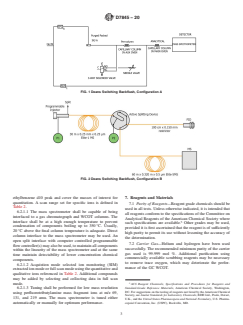
6.1.8 Deans Switching Backflush Configuration (Fig.
gram is then processed by mass spectral analysis based on
1)—Acolumn backflush configuration utilizing dynamic pres-
selected or extracted ion monitoring.
sure differential which provides suitable means to remove the
heavier hydrocarbon fraction from the pre-column or any
5. Significance and Use
similar configuration that allows for controlled chromato-
5.1 The test method allows the quantitation of chemical
graphic separation of components of interest and heavier
species at low levels in marine fuel oils and cutter stocks. A
hydrocarbon fraction. An alternative Deans switching back-
great many types and concentrations of chemical species are
flush configuration is shown on Fig. 2.
foundinmarinefueloils.Arootcauserelationshipbetweenthe
6.2 Mass Spectrometry:
presence of such species or their concentration in fuels and any
6.2.1 Mass Spectrometer, capable of producing electron
failure modes allegedly induced by the use of these fuels has
ionization spectra at 70 electron volts or higher, and capable of
not been established. This test method is necessary to establish
scanning the range of the specified quantitation masses or
test conditions required for future ISO 8217:2010 as defined in
(m/e). The mass scan range shall cover the masses of interest
section 5.5 andAnnex B item (d).Additional compounds may
for quantitation and should yield at least 5 scans across the
be determined by using the same conditions and by selecting
peak width at half peak width for a 1 mg⁄kg to 3 mg/kg
required mass spectral selected ions, accordingly.
6. Apparatus
6.1 Gas Chromatography: Deans, D. R., Chromatographia, Vol 1, 18-22, 1968.
D7845 − 20
FIG. 1 Deans Switching Backflush, Configuration A
FIG. 2 Deans Switching Backflush, Configuration B
ethylbenzene d10 peak and cover the masses of interest for 7. Reagents and Materials
quantitation. A scan range set for specific ions is defined in
7.1 Purity of Reagents—Reagent grade chemicals should be
Table 2.
used in all tests. Unless otherwise indicated, it is intended that
6.2.1.1 The mass spectrometer shall be capable of being
all reagents conform to the specifications of the Committee on
interfaced to a gas chromatograph and WCOT columns. The
Analytical Reagents of the American Chemical Society where
interface shall be at a high enough temperature to prevent 5
such specifications are available. Other grades may be used,
condensation of components boiling up to 350 °C. Usually,
provided it is first ascertained that the reagent is of sufficiently
20 °C above the final column temperature is adequate. Direct
high purity to permit its use without lessening the accuracy of
column interface to the mass spectrometer may be used. An
the determination.
open split interface with computer controlled programmable
7.2 Carrier Gas—Helium and hydrogen have been used
flowcontroller(s)mayalsobeused,tomaintainallcomponents
successfully. The recommended minimum purity of the carrier
within the linearity of the mass spectrometer and at the same
gas used is 99.999 mol %. Additional purification using
time maintain detectability of lower concentration chemical
commercially available scrubbing reagents may be necessary
components.
to remove trace oxygen, which may deteriorate the perfor-
6.2.1.2 Acquistion mode selected ion monitoring (SIM)
mance of the GC WCOT.
extractedionmodeorfullscanmodeusingthequantitativeand
qualitative ions referenced in Table 2. Additional compounds
may be added by selecting and collecting data in full scan
mode.
ACS Reagent Chemicals, Specifications and Procedures for Reagents and
Standard-Grade Reference Materials, American Chemical Society, Washington,
6.2.1.3 Tuning shall be performed for low mass resolution
DC. For suggestions on the testing of reagents not listed by theAmerican Chemical
using perfluorotributylamine mass fragment ions at m/z 69,
Society, see Analar Standards for Laboratory Chemicals, BDH Ltd., Poole, Dorset,
131, and 219 amu. The mass spectrometer is tuned either
U.K., and the United States Pharmacopeia and National Formulary, U.S. Pharma-
automatically or manually for optimum performance. copeial Convention, Inc. (USPC), Rockville, MD.
D7845 − 20
TABLE 2 Mass Spectrometer Compound Quantitation Ions (Retention Time Data Based on Configuration A)
Retention Compound CAS # Quantifying Qualifier 1 Qualifier 2 Qualifier 3
Time
21.55 Ethylbenzene-d10 25837-05-2 116 115
13.55 n-butyl alcohol 71-36-3 56 74
22.58 Cyclohexanol 108-93-0 82 100 44
22.61 n-butyl ether 142-96-1 87 101 130
22.78 n-butyl acrylate 141-32-2 55 127 73
23.23 Styrene 100-42-5 104
26.03 alpha-pinene 80-56-8 93 136 121
26.66 Phenol 108-95-2 94 66
27.79 alpha-methyl styrene 98-83-9 118 103
28.21 beta-pinene 19902-08-0 93 136 121
28.46 4-methyl styrene 622-97-9 117 118 116 103
28.57 trans-B-methyl styrene 873-66-5 117 118 103 77
28.66 3-methyl styrene 100-80-1 117 118 116 103
29.95 2-methyl styrene 611-15-4 117 118 103 77
30.11 Dicyclopentadiene 77-73-6 66 132
30.43 Limonene 5989-27-5 68 93 136 121
31.11 Indene 95-13-6 116 115 63 89
31.16 1-phenyl ethanol 98-85-1 107 122 79
32.93 para, alpha-Dimethyl styrene 1195-32-0 132 117 102
33.29 2,5 dimethyl styrene 2039-89-6 132 117 77
33.47 2,4 dimethyl styrene 2234-20-0 132 117 77
33.57 2-phenyl ethanol (phenylethanol) 60-12-8 122 103 77
34.05 2-Ethyl Phenol 90-00-6 107 122 77
34.55 2,4 Dimethyl Phenol 105-67-9 122 107 77
35.13 4-Ethyl Phenol (co elutes with 3-ethylphenol) 123-07-9 107 122 77
3-ethylphenol (co elution) 620-17-7
35.86 2-Phenoxy-1-propanol 4169-04-4 94 152 121
37.43 2-Phenoxy ethanol 122-99-6 94 138 77
37.51 4-isopropylphenol 99-89-8 121 136 94 77
38.53 1-Phenoxy-2-Propanol 770-35-4 94 152 108 77
40.53 Styrene Glycol 93-56-1 107 138 79
7.3 Calibration Standard—This standard shall be prepared volumeconnectorsandinertnarrowboretubing.Itisimportant
by adding the chemicals to include those in Table 1 prepared to minimize the volume of the chromatographic system that
from high (99+ %) purity reagent grade materials. comes in contact with the sample; otherwise, peak broadening
will occur.
7.4 Standards for Calibration and Identification—Chemical
compounds used to prepare standards should be 99 % or
8.2 This section provides details to establish the configura-
greater purity (see Table 1). If reagents of high purity are not
tions described in Fig. 1. For other column configurations,
available, an accurate assay of the reagent shall be performed
adjust backflush and or cut times, accordingly.
using a properly calibrated GC or other techniques. The
8.3 It is essential that the appropriate backflush time be
concentration of the impurities that overlap the other calibra-
determined to prevent heavy contaminants from reaching the
tion components shall be known and used to correct the
analytical column and potentially interfering with the determi-
concentration of the calibration components. The use of only
nation of compounds of interest.
high purity reagents is strongly recommended because of the
8.4 Setting the Backflush Time for Configuration A—The
error that may be introduced from impurity corrections. Stan-
pre-column connected to the analytical column and the mass
dards are used for calibration as well as for establishing the
spectrometer as shown in Fig. 1 inject the calibration standard
identification by retention time in conjunction with mass
spectral match. andrecordthechromatogram.Identifythepeaks.Theretention
time data are used to set the valve on time to assure the
7.5 n-hexadecane—99+ % purity or better.
compound peaks are not backflushed. The retention times
7.6 Dilution Solvents—Reagent grade toluene, 99.9 % (or
should be incorporated into the software timed events before
suitable dilution solvent).
continuing with sample analysis. Assure all of the compounds
of interest are present and high boiling hydrocarbons are
7.7 Internal Standards—Deuteratedanalogofethylbenzene,
backflushed consistently. Assure the retention time data is
as specified, shall be used as internal standard because of the
repeatable. If retention time shifts are encountered check for
similar chromatographic characteristics as the components
leakstoincludereplacingseptumandthatallcolumnandvalve
analyzed.
connections are leak free.
8. Preparation of Apparatus
8.4.1 The procedure used is as follows:
8.4.1.1 Prepare a timing standard containing all of the
8.1 Assembly—Configure the GC system in a multidimen-
compounds of interest.
sional configuration as described in Table 3 and Table 4.
Connect the WCOT columns to the chromatographic system, 8.4.1.2 Inject the timing standard into the GC in the fore-
including the multidimensional switching device, using low flush position with no backflush.
D7845 − 20
TABLE 3 Operating Conditions Configuration A
Gas Chromatograph:
Inlet Type: Purged Packed
Inlet Temperature: 325 °C
Oven temperature program: 70 °C for 2 min
then 2.5 °C ⁄min to 100 °C for 0 min
then 4.5 °C ⁄min to 185 °C for 0 min
then 65 °C ⁄min to 322 °C for 20 min
Run Time: 54.997 min
Columns: 25 m, 0.53 mm ID, 1.0 µm film polydimethylsiloxane (pre-column); 100 m, 0.25 mm ID, 0.5 µm film polydimethylsiloxane
(analytical column)
Carrier gas: Helium
Carrier gas: Purged Packed Inlet Pre-column: 38 psi (262 kPa)
Carrier gas: Analytical Column - Auxiliary Pressure Module 1 set at 37 psi (255.1 kPa)
Auxiliary Oven Temperature: 325 °C
Valve 1 Timing: Valve on at 3.5 min
Needle Valve 1 Flow Setting: 7 mL/min
GC-MS Interface: Direct or open split interface
GC-MS Interface Temperature: 350 °C
Mass Spectrometer:
Detector: Quadrupole mass spectrometer
MS Data Acquisition Mode: Selected Ion Mode
Ionization Voltage: (eV) 70, fixed operating condition
Mass Scan Range: m/z 35-200
Scan Rate (scan/s): >1
Resolution Setting: Low
Ions/Dwell In Group (Mass, Dwell) (Mass, Dwell) (Mass, Dwell)
(41.00, 50) (44.00, 50) (51.00, 50)
(55.00, 50) (56.00, 50) (63.00, 50)
(66.00, 50) (68.00, 50) (73.00, 50)
(74.00, 50) (77.00, 50) (79.00, 50)
(82.00, 50) (87.00, 50) (89.00, 50)
(91.00, 50) (93.00, 50) (94.00, 50)
(98.00, 50) (100.00, 50) (101.00, 50)
(103.00, 50) (104.00, 50) (105.00, 50)
(107.00, 50) (108.00, 50) (116.00, 50)
(117.00, 50) (118.00, 50) (121.00, 50)
(122.00, 50) (128.00, 50) (130.00, 50)
(132.00, 50) (136.00, 50) (138.00, 50)
(152.00, 50)
MS Source Temperature: 250 °C
MS Quad Temperature: 200 °C
TABLE 4 Operating Conditions Configuration B
Gas Chromatograph:
Inlet Type: Programmab
...
This document is not an ASTM standard and is intended only to provide the user of an ASTM standard an indication of what changes have been made to the previous version. Because
it may not be technically possible to adequately depict all changes accurately, ASTM recommends that users consult prior editions as appropriate. In all cases only the current version
of the standard as published by ASTM is to be considered the official document.
Designation: D7845 − 17 D7845 − 20
Standard Test Method for
Determination of Chemical Species in Marine Fuel Oil by
Multidimensional Gas Chromatography/Mass Spectrometry
This standard is issued under the fixed designation D7845; the number immediately following the designation indicates the year of
original adoption or, in the case of revision, the year of last revision. A number in parentheses indicates the year of last reapproval. A
superscript epsilon (´) indicates an editorial change since the last revision or reapproval.
1. Scope*
1.1 This test method covers the quantitative determination of a variety of chemical species in marine fuel oil (bunker fuel oil)
by gas chromatography/mass spectrometry. By using the same conditions and by selecting required mass spectral selected ions,
the test method may be used for the determination of other species than those for which precision statements and limits of detection
have been established.
1.2 An example list of chemical species for which a limit of quantification has been determined by means of this test method
is given in Table 1.
1.3 Other refinery hydrocarbon fractions and their mixtures may be tested using the same test method conditions. However, the
precision of this test method reflects the compounds in Table 1.
1.4 Results are reported to the nearest 1.0 mg ⁄kg.
1.5 The values stated in SI units are to be regarded as standard.
1.5.1 Exception—Non-SI values are given for psig.
1.6 This standard does not purport to address all of the safety concerns, if any, associated with its use. It is the responsibility
of the user of this standard to establish appropriate safety safety, health, and healthenvironmental practices and determine the
applicability of regulatory limitations prior to use.
1.7 This international standard was developed in accordance with internationally recognized principles on standardization
established in the Decision on Principles for the Development of International Standards, Guides and Recommendations issued
by the World Trade Organization Technical Barriers to Trade (TBT) Committee.
2. Referenced Documents
2.1 ASTM Standards:
D4307 Practice for Preparation of Liquid Blends for Use as Analytical Standards
This test method is under the jurisdiction of ASTM Committee D02 on Petroleum Products, Liquid Fuels, and Lubricants and is the direct responsibility of Subcommittee
D02.04.0M on Mass SpectroscopySpectrometry.
Current edition approved Jan. 15, 2017June 15, 2020. Published February 2017July 2020. Originally approved in 2013. Last previous edition approved in 20162017 as
D7845 – 16.D7845 – 17. DOI: 10.1520/D7845-17.10.1520/D7845-20.
For referenced ASTM standards, visit the ASTM website, www.astm.org, or contact ASTM Customer Service at service@astm.org. For Annual Book of ASTM Standards
volume information, refer to the standard’s Document Summary page on the ASTM website.
*A Summary of Changes section appears at the end of this standard
Copyright © ASTM International, 100 Barr Harbor Drive, PO Box C700, West Conshohocken, PA 19428-2959. United States
D7845 − 20
TABLE 1 Component Table
Limit of Quantitation
mg/kg
n-butyl alcohol 10
Cyclohexanol 10
n-butyl ether 10
n-butyl acrylate 10
Styrene 10
alpha-pinene 10
Phenol 20
alpha-methyl styrene 10
beta-pinene 10
4-methyl styrene 10
trans-B-methyl styrene 10
3-methyl styrene 10
2-methyl styrene 10
Dicyclopentadiene 10
Limonene 10
Indene 20
1-phenyl ethanol 20
para, alpha-Dimethyl styrene 20
2,5 dimethyl styrene 20
2,4 dimethyl styrene 20
2-phenyl ethanol (phenylethanol) 20
2-Ethyl Phenol 50
2,4 Dimethyl Phenol 20
4-Ethyl Phenol (co elutes with 3-ethylphenol) 20
2-Phenoxy-1-propanol 50
2-Phenoxy ethanol 50
4-isopropylphenol 50
1-Phenoxy-2-Propanol 20
Styrene Glycol 50
D6299 Practice for Applying Statistical Quality Assurance and Control Charting Techniques to Evaluate Analytical Measure-
ment System Performance
2.2 Other Standards:
ISO 8217:2010 Petroleum Products—Fuels (Class F)—Specifications of Marine Fuels
3. Terminology
3.1 Definitions:
3.1.1 direct or open split interface, n—any GC/MS interface used to maintain atmospheric pressure at capillary column outlet.
3.1.2 reconstructed ion chromatogram (RIC), n—a limited mass chromatogram representing the intensities of ion mass
spectrometric currents for only those ions having particular mass to charge ratios used in this test method to selectively extract and
identify components in the presence of a complex hydrocarbon matrix.
3.1.3 total ion chromatogram (TIC), n—mass spectrometer computer output representing either the summed intensities of all
scanned ion currents or a sample of the current in the ion beam for each spectrum scan plotted against the corresponding spectrum
number.
3.1.4 wall coated open tubular (WCOT), n—a type of capillary column prepared by coating or bonding the inside wall of the
capillary with a thin film of stationary phase.
4. Summary of Test Method
4.1 A suitable internal standard, ethylbenzene d-10 is added to the sample, which is then introduced into a gas chromatograph
equipped with two columns configured with a Deans switching system between the two columns. The sample first passes through
the polydimethylsiloxane (WCOT) pre-column which then performs a separation of the light hydrocarbon fraction and eliminates
the high boiling hydrocarbon fraction to vent. The compounds of interest and internal standard are transferred to the high resolution
polydimethylsiloxane (WCOT) analytical column for chromatographic separation. An auxiliary carrier gas is used to elute higher
boiling hydrocarbons from the pre-column in back flush mode in order to prepare for the next analysis cycle. The resulting
chromatogram is then processed by mass spectral analysis based on selected or extracted ion monitoring.
5. Significance and Use
5.1 The test method allows the quantitation of chemical species at low levels in marine fuel oils and cutter stocks. A great many
types and concentrations of chemical species are found in marine fuel oils. A root cause relationship between the presence of such
Available from American National Standards Institute (ANSI), 25 W. 43rd St., 4th Floor, New York, NY 10036, http://www.ansi.org.
D7845 − 20
species or their concentration in fuels and any failure modes allegedly induced by the use of these fuels has not been established.
This test method is necessary to establish test conditions required for future ISO 8217:2010 as defined in section 5.5 and Annex
B item (d). Additional compounds may be determined by using the same conditions and by selecting required mass spectral
selected ions, accordingly.
6. Apparatus
6.1 Gas Chromatography:
6.1.1 Gas Chromatograph—Any gas chromatograph equipped with a flame ionization detector (FID) and having sensitivity of
0.01 mg ⁄kg. The gas chromatograph must be capable of linear temperature control from 50 °C to 320 °C for the capillary column
oven. The gas chromatograph must be capable of controlling multiple valve events. Carrier gas flow controllers and or electronic
pressure control modules shall be capable of precise control where the required flow rates are low. Pressure control devices and
gauges shall be capable of precise control for the typical pressures required. The temperature program rate must repeat to within
0.1 °C and provide retention time repeatability of 0.05 min throughout the temperature program.
6.1.2 Pre-Column Column—WCOT Column, 25 m long by 0.53 mm inside diameter fused silica WCOT column with a
1.0 micron film thickness of polydimethyl siloxane or any column with suitable chromatographic resolution.
6.1.3 Analytical Column—WCOT Column, 100 m by 0.25 mm inside diameter fused silica WCOT column with a 0.5 micron
film thickness of polydimethyl siloxane or any column with suitable chromatographic resolution.
6.1.4 Purged Packed Injector—An injection port that allows controlled injection of the sample at a temperature sufficient to pass
the high boiling point fraction to the pre-column or any gas chromatographic injector system to perform the same function.
6.1.4.1 The injection port liner shall be replaced to remove non-volatile materials.
6.1.5 Electronic Pressure Control—Electronic pneumatic control of carrier gas flows. It can be flow or pressure programmed
to speed up elution of components.
6.1.6 Low-Volume Connector and Tees—A special union or tee for connecting two lengths of tubing 1.6 mm inside diameter and
smaller; sometimes referred to as a zero dead-volume union, tee, or an active splitting device.
6.1.7 Pre-Column—A polydimethylsiloxane WCOT column used to isolate the light hydrocarbons to include methane to
n-hexadecane from the higher boiling portion of the sample for transfer to the analytical column for further separation and
quantification.
6.1.8 Deans Switching Backflush Configuration (Fig. 1)—A column backflush configuration utilizing dynamic pressure
differential which provides suitable means to remove the heavier hydrocarbon fraction from the pre-column or any similar
configuration that allows for controlled chromatographic separation of components of interest and heavier hydrocarbon fraction.
An alternative Deans switching backflush configuration is shown on Fig. 2.
6.2 Mass Spectrometry:
6.2.1 Mass Spectrometer, capable of producing electron ionization spectra at 70 electron volts or higher, and capable of scanning
the range of the specified quantitation masses or (m/e). The mass scan range shall cover the masses of interest for quantitation and
should yield at least 5 scans across the peak width at half peak width for a 1 mg ⁄kg to 3 mg/kg ethylbenzene d10 peak and cover
the masses of interest for quantitation. A scan range set for specific ions is defined in Table 2.
6.2.1.1 The mass spectrometer shall be capable of being interfaced to a gas chromatograph and WCOT columns. The interface
shall be at a high enough temperature to prevent condensation of components boiling up to 350 °C. Usually, 20 °C above the final
column temperature is adequate. Direct column interface to the mass spectrometer may be used. An open split interface with
FIG. 1 Deans Switching Backflush, Configuration A
Deans, D. R., Chromatographia, Vol 1, 18-22, 1968.
D7845 − 20
FIG. 2 Deans Switching Backflush, Configuration B
TABLE 2 Mass Spectrometer Compound Quantitation Ions (Retention Time Data Based on Configuration A)
Retention Compound CAS # Quantifying Qualifier 1 Qualifier 2 Qualifier 3
Time
21.55 Ethylbenzene-d10 25837-05-2 116 115
13.55 n-butyl alcohol 71-36-3 56 74
22.58 Cyclohexanol 108-93-0 82 100 44
22.61 n-butyl ether 142-96-1 87 101 130
22.78 n-butyl acrylate 141-32-2 55 128 73
22.78 n-butyl acrylate 141-32-2 55 127 73
23.23 Styrene 100-42-5 104
26.03 alpha-pinene 80-56-8 93 136 121
26.66 Phenol 108-95-2 94 66
27.79 alpha-methyl styrene 98-83-9 118 103
28.21 beta-pinene 19902-08-0 93 136 121
28.46 4-methyl styrene 622-97-9 117 118 116 103
28.57 trans-B-methyl styrene 873-66-5 117 118 103 77
28.66 3-methyl styrene 100-80-1 117 118 116 103
29.95 2-methyl styrene 611-15-4 117 118 103 77
30.11 Dicyclopentadiene 77-73-6 66 132
30.43 Limonene 5989-27-5 68 93 136 121
31.11 Indene 95-13-6 116 115 63 89
31.16 1-phenyl ethanol 98-85-1 107 122 79
32.93 para, alpha-Dimethyl styrene 1195-32-0 132 117 102
33.29 2,5 dimethyl styrene 2039-89-6 132 117 77
33.47 2,4 dimethyl styrene 2234-20-0 132 117 77
33.57 2-phenyl ethanol (phenylethanol) 60-12-8 122 103 77
34.05 2-Ethyl Phenol 90-00-6 107 122 77
34.55 2,4 Dimethyl Phenol 105-67-9 122 107 77
35.13 4-Ethyl Phenol (co elutes with 3-ethylphenol) 123-07-9 107 122 77
3-ethylphenol (co elution) 620-17-7
35.86 2-Phenoxy-1-propanol 4169-04-4 94 152 121
37.43 2-Phenoxy ethanol 122-99-6 94 138 77
37.51 4-isopropylphenol 99-89-8 121 136 94 77
38.53 1-Phenoxy-2-Propanol 770-35-4 94 152 108 77
40.53 Styrene Glycol 93-56-1 107 138 79
computer controlled programmable flow controller(s) may also be used, to maintain all components within the linearity of the mass
spectrometer and at the same time maintain detectability of lower concentration chemical components.
6.2.1.2 Acquistion mode selected ion monitoring (SIM) extracted ion mode or full scan mode using the quantitative and
qualitative ions referenced in Table 2. Additional compounds may be added by selecting and collecting data in full scan mode.
6.2.1.3 Tuning shall be performed for low mass resolution using perfluorotributylamine mass fragment ions at m/z 69, 131, and
219 amu. The mass spectrometer is tuned either automatically or manually for optimum performance.
7. Reagents and Materials
7.1 Purity of Reagents—Reagent grade chemicals should be used in all tests. Unless otherwise indicated, it is intended that all
reagents conform to the specifications of the Committee on Analytical Reagents of the American Chemical Society where such
D7845 − 20
specifications are available. Other grades may be used, provided it is first ascertained that the reagent is of sufficiently high purity
to permit its use without lessening the accuracy of the determination.
7.2 Carrier Gas—Helium and hydrogen have been used successfully. The recommended minimum purity of the carrier gas used
is 99.999 mol %. Additional purification using commercially available scrubbing reagents may be necessary to remove trace
oxygen, which may deteriorate the performance of the GC WCOT.
7.3 Calibration Standard—This standard shall be prepared by adding the chemicals to include those in Table 1 prepared from
high (99+ %) purity reagent grade materials.
7.4 Standards for Calibration and Identification—Chemical compounds used to prepare standards should be 99 % or greater
purity (see Table 1). If reagents of high purity are not available, an accurate assay of the reagent shall be performed using a properly
calibrated GC or other techniques. The concentration of the impurities that overlap the other calibration components shall be
known and used to correct the concentration of the calibration components. The use of only high purity reagents is strongly
recommended because of the error that may be introduced from impurity corrections. Standards are used for calibration as well
as for establishing the identification by retention time in conjunction with mass spectral match.
7.5 n-hexadecane—99+ % purity or better.
7.6 Dilution Solvents—Reagent grade toluene, 99.9 % (or suitable dilution solvent).
7.7 Internal Standards—Deuterated analog of ethylbenzene, as specified, shall be used as internal standard because of the
similar chromatographic characteristics as the components analyzed.
TABLE 3 Operating Conditions Configuration A
Gas Chromatograph:
Inlet Type: Purged Packed
Inlet Temperature: 325 °C
Oven temperature program: 70 °C for 2 min
then 2.5 °C ⁄min to 100 °C for 0 min
then 4.5 °C ⁄min to 185 °C for 0 min
then 65 °C ⁄min to 322 °C for 20 min
Run Time: 54.997 min
Columns: 25 m, 0.53 mm ID, 1.0 μm film polydimethylsiloxane (pre-column); 100 m, 0.25 mm ID, 0.5 μm film polydimethylsiloxane
(analytical column)
Carrier gas: Helium
Carrier gas: Purged Packed Inlet Pre-column: 38 psi (262 kPa)
Carrier gas: Analytical Column - Auxiliary Pressure Module 1 set at 37 psi (255.1 kPa)
Auxiliary Oven Temperature: 325 °C
Valve 1 Timing: Valve on at 3.5 min
Needle Valve 1 Flow Setting: 7 mL/min
GC-MS Interface: Direct or open split interface
GC-MS Interface Temperature: 350 °C
Mass Spectrometer:
Detector: Quadrupole mass spectrometer
MS Data Acquisition Mode: Selected Ion Mode
Ionization Voltage: (eV) 70, fixed operating condition
Mass Scan Range: m/z 35-200
Scan Rate (scan/s): > 1
Resolution Setting: Low
Ions/Dwell In Group (Mass, Dwell) (Mass, Dwell) (Mass, Dwell)
(41.00, 50) (44.00, 50) (51.00, 50)
(55.00, 50) (56.00, 50) (63.00, 50)
(66.00, 50) (68.00, 50) (73.00, 50)
(74.00, 50) (77.00, 50) (79.00, 50)
(82.00, 50) (87.00, 50) (89.00, 50)
(91.00, 50) (93.00, 50) (94.00, 50)
(98.00, 50) (100.00, 50) (101.00, 50)
(103.00, 50) (104.00, 50) (105.00, 50)
(107.00, 50) (108.00, 50) (116.00, 50)
(117.00, 50) (118.00, 50) (121.00, 50)
(122.00, 50) (128.00, 50) (130.00, 50)
(132.00, 50) (136.00, 50) (138.00, 50)
(152.00, 50)
MS Source Temperature: 250 °C
MS Quad Temperature: 200 °C
ACS Reagent Chemicals, Specifications and Procedures for Reagents and Standard-Grade Reference Materials, American Chemical Society, Washington, DC. For
suggestions on the testing of reagents not listed by the American Chemical Society, see Analar Standards for Laboratory Chemicals, BDH Ltd., Poole, Dorset, U.K., and
the United States Pharmacopeia and National Formulary, U.S. Pharmacopeial Convention, Inc. (USPC), Rockville, MD.
D7845 − 20
8. Preparation of Apparatus
8.1 Assembly—Configure the GC system in a multidimensional configuration as described in Table 3 and Table 4. Connect the
WCOT columns to the chromatographic system, including the multidimensional switching device, using low volume connectors
and inert narrow bore tubing. It is important to minimize the volume of the chromatographic system that comes in contact with
the sample; otherwise, peak broadening will occur.
8.2 This section provides details to establish the configurations described in Fig. 1. For other column configurations, adjust
backflush and or cut times, accordingly.
8.3 It is essential that the appropriate backflush time be determined to prevent heavy contaminants from reaching the analytical
column and potentially interfering with the determination of compounds of interest.
8.4 Setting the Backflush Time for Configuration A—The pre-column connected to the analytical column and the mass
spectrometer as shown in Fig. 1 inject the calibration standard and record the chromatogram. Identify the peaks. The retention time
data are used to set the valve on time to assure the compound peaks are not backflushed. The retention times should be incorporated
into the software timed events before continuing with sample analysis. Assure all of the compounds of interest are present and high
boiling hydrocarbons are backflushed consistently. Assure the retention time data is repeatable. If retention time shifts are
encountered check for leaks to include replacing septum and that all column and valve connections are leak free.
8.4.1 The procedure used is as follows:
8.4.1.1 Prepare a timing standard containing all of the compounds of interest.
8.4.1.2 Inject the timing standard into the GC in the foreflush position with no backflush.
8.4.1.3 Analyze the resulting chromatogram and determine the retention time of each of the compound peaks. See Figs. 3-5.
...