

ASTM F3243-21
(Practice)Standard Practice for Implementing Communications Impairments on A-UGV Systems
General Information
- Abstract
SIGNIFICANCE AND USE
4.1 A-UGVs operate in a wide range of indoor and outdoor applications that include many communications challenges that can affect A-UGV control and monitoring. An A-UGV system or A-UGVS as defined in Terminology F3200 includes the A-UGV and all associated components, equipment, software, and communications necessary to make a fully functional system. Communications impairments can cause: (1) changes in A-UGV operation, (2) changes in behavior in system components such as control and scheduling, or (3) changes in operation or timing of infrastructure equipment coordination. This practice is intended to record the task performance of an A-UGV while communications are impaired in a specified and repeatable manner (for example, standard test method).
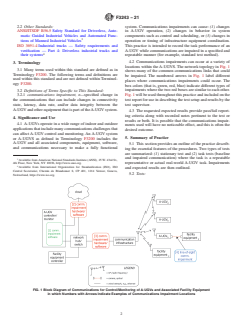
4.2 Communications impairments can occur at a variety of locations within the A-UGVS. The network topology in Fig. 1 shows many of the common communications links that could be impaired. The numbered arrows in Fig. 1 label different places where communications impairments could occur. The box colors (that is, green, red, blue) indicate different types of impairments where the two red boxes are similar to each other. Fig. 1 will be used throughout this practice and included on the test report for use in describing the test setup and results by the test supervisor.
FIG. 1 Block Diagram of Communications for Control/Monitoring of A-UGVs and Associated Facility Equipment in which Numbers with Arrows Indicate Examples of Communications Impairment Locations
4.3 The requested expected results provide pass/fail reporting criteria along with recorded notes pertinent to the test or results or both. It is possible that the communications impairments used will have no noticeable effect, and this is often the desired outcome.
SCOPE
1.1 This practice considers impairments of communications within an automatic, automated, or autonomous unmanned ground vehicle (AUGV) system during task execution. An A-UGV system typically uses communications between an A-UGV and fixed system components and resources, such as off-board control, job and fleet scheduling, infrastructure equipment interactions, or cloud-computing programs for tasks. Communications impairments can cause an A-UGV operation to change in various ways that can include delays or failure to complete the task.
1.2 This practice is designed for applying known communications impairments to an A-UGV system in conjunction with A-UGV task testing. It is designed to create similar changes in communications that can possibly cause task performance limiting effects that are often experienced by an A-UGV system in different environments.
1.3 This practice is intended to simulate impairments that may be present during the operation of an A-UGV system. This practice can be used, for example, by a manufacturer to indicate that system performance was tested to be robust against specific test communications impairments. The tests are not intended to test situations that should be eliminated during system installation, for example, a duplicate internet protocol (IP) address on the network.
1.4 This practice only describes communications impairments. It does not specify an A-UGV task. The A-UGV task should be a defined ASTM International test method or task description in similar detail.
1.5 This practice defines methods to record communications impairment types and extents while the A-UGV is stationary or performs a task. Temporal or spatial extents in which communications impairments occur include the timing, duration, location within the task, or other triggered events. Examples for implementing common communications impairments are provided.
1.6 This practice is not intended for:
1.6.1 Communications impairments between onboard components of an A-UGV, for example, onboard sensors-to-onboard computers.
1.6.2 Communications or measurement impairments directly affecting external reference or p...
- Status
- Published
- Publication Date
- 31-Jan-2021
- Technical Committee
- F45 - Robotics, Automation, and Autonomous Systems
- Drafting Committee
- F45.04 - System Communication and Interoperability
Overview
ASTM F3243-21: Standard Practice for Implementing Communications Impairments on A-UGV Systems, developed by ASTM International, provides a method for simulating and documenting the effects of communications impairments on Automatic, Automated, or Autonomous Unmanned Ground Vehicle (A-UGV) systems. This standard covers procedures for introducing known communication issues-such as interruptions, latency, data loss, or rate limitations-within an A-UGV system, ensuring that these conditions are applied in a repeatable and controlled manner during test execution. The practice targets communication links between the A-UGV and its associated infrastructure, off-board controllers, scheduling systems, and facility equipment, maximizing the relevance for real-world environments.
Key Topics
- Scope of Application: Covers interventions only on communications between the A-UGV and external system components, not internal onboard components.
- Types of Impairments:
- Communication Interruptions: Temporary loss of connectivity, simulating real-world network failures.
- Packet Loss (Lossy Communication): Simulates partial data transmission typically caused by unstable wireless links.
- Rate Limitation: Artificially throttling data rates to mirror scenarios such as weak signal strength.
- Latency Introduction: Adding delays in data transmission to test response under slower network conditions.
- Testing Methodologies:
- Stationary Tests: Conducted with the A-UGV stationary to verify system readiness and establish baselines.
- Task-Based Tests: Performance of defined tasks under both normal and impaired communication conditions to assess impact.
- Documentation and Validation:
- Comprehensive test reports, with recorded conditions, criteria for pass/fail, and notes on system behavior.
- Repeatable measurement of impairment extent, including time, location, and nature of communication degradation.
Applications
ASTM F3243-21 is valuable in numerous contexts within the automated guided vehicle (AGV) and A-UGV sector:
- Manufacturers: Demonstrate robustness of A-UGV systems against communication disruptions by validating system performance under controlled impairments.
- System Integrators and Facility Planners: Simulate operational network challenges before deployment in warehouses, manufacturing floors, or logistics centers, ensuring reliable integration.
- Safety and Compliance Testing: Stress-test A-UGV operations against communication failures as part of risk assessments or compliance routines.
- R&D and Product Validation: Use the standard in product development cycles to benchmark system resilience, minimize unexpected downtime, and improve user safety.
- Documentation and Traceability: Provide clear test records for regulatory purposes or customer assurance.
Related Standards
For comprehensive A-UGV and AGV communication and safety management, ASTM F3243-21 is best used alongside these standards:
- ASTM F3200: Terminology for Driverless Automatic Guided Industrial Vehicles.
- ASTM F3218: Practice for Documenting Environmental Conditions for Utilization with A-UGV Test Methods.
- ASTM F3244: Test Method for Navigation in Defined Areas.
- ASTM F3265: Test Method for Grid-Video Obstacle Measurement.
- ASTM F3327: Practice for Recording the A-UGV Test Configuration.
- ANSI/ITSDF B56.5: Safety Standard for Driverless, Automatic Guided Industrial Vehicles.
- ISO 3691-4: Safety requirements and verification for driverless industrial trucks and their systems.
Practical Value
By following ASTM F3243-21, stakeholders in robotics, material handling, and smart logistics can verify that their A-UGV systems maintain effective performance even with impaired communications. This practice standard supports higher system reliability, operational safety, and trust in automated ground vehicles operating in complex, networked environments.
Keywords: A-UGV, AGV, communications impairment, unmanned ground vehicle, automated guided vehicle, mobile robotics, network reliability, industrial automation, ASTM F3243-21.
Relations
- Effective Date
- 01-Dec-2023
- Effective Date
- 01-Dec-2023
- Effective Date
- 01-Dec-2023
- Effective Date
- 15-Nov-2019
- Effective Date
- 01-Sep-2019
- Effective Date
- 01-Jul-2018
- Effective Date
- 01-Apr-2018
- Effective Date
- 01-Feb-2018
- Effective Date
- 15-Aug-2017
- Effective Date
- 15-Jul-2017
- Effective Date
- 01-Jul-2017
- Effective Date
- 01-Jun-2017
- Effective Date
- 15-May-2017
- Effective Date
- 15-Oct-2016
Get Certified
Connect with accredited certification bodies for this standard

BSI Group
BSI (British Standards Institution) is the business standards company that helps organizations make excellence a habit.

NYCE
Mexican standards and certification body.
Sponsored listings
Frequently Asked Questions
ASTM F3243-21 is a standard published by ASTM International. Its full title is "Standard Practice for Implementing Communications Impairments on A-UGV Systems". This standard covers: SIGNIFICANCE AND USE 4.1 A-UGVs operate in a wide range of indoor and outdoor applications that include many communications challenges that can affect A-UGV control and monitoring. An A-UGV system or A-UGVS as defined in Terminology F3200 includes the A-UGV and all associated components, equipment, software, and communications necessary to make a fully functional system. Communications impairments can cause: (1) changes in A-UGV operation, (2) changes in behavior in system components such as control and scheduling, or (3) changes in operation or timing of infrastructure equipment coordination. This practice is intended to record the task performance of an A-UGV while communications are impaired in a specified and repeatable manner (for example, standard test method). 4.2 Communications impairments can occur at a variety of locations within the A-UGVS. The network topology in Fig. 1 shows many of the common communications links that could be impaired. The numbered arrows in Fig. 1 label different places where communications impairments could occur. The box colors (that is, green, red, blue) indicate different types of impairments where the two red boxes are similar to each other. Fig. 1 will be used throughout this practice and included on the test report for use in describing the test setup and results by the test supervisor. FIG. 1 Block Diagram of Communications for Control/Monitoring of A-UGVs and Associated Facility Equipment in which Numbers with Arrows Indicate Examples of Communications Impairment Locations 4.3 The requested expected results provide pass/fail reporting criteria along with recorded notes pertinent to the test or results or both. It is possible that the communications impairments used will have no noticeable effect, and this is often the desired outcome. SCOPE 1.1 This practice considers impairments of communications within an automatic, automated, or autonomous unmanned ground vehicle (AUGV) system during task execution. An A-UGV system typically uses communications between an A-UGV and fixed system components and resources, such as off-board control, job and fleet scheduling, infrastructure equipment interactions, or cloud-computing programs for tasks. Communications impairments can cause an A-UGV operation to change in various ways that can include delays or failure to complete the task. 1.2 This practice is designed for applying known communications impairments to an A-UGV system in conjunction with A-UGV task testing. It is designed to create similar changes in communications that can possibly cause task performance limiting effects that are often experienced by an A-UGV system in different environments. 1.3 This practice is intended to simulate impairments that may be present during the operation of an A-UGV system. This practice can be used, for example, by a manufacturer to indicate that system performance was tested to be robust against specific test communications impairments. The tests are not intended to test situations that should be eliminated during system installation, for example, a duplicate internet protocol (IP) address on the network. 1.4 This practice only describes communications impairments. It does not specify an A-UGV task. The A-UGV task should be a defined ASTM International test method or task description in similar detail. 1.5 This practice defines methods to record communications impairment types and extents while the A-UGV is stationary or performs a task. Temporal or spatial extents in which communications impairments occur include the timing, duration, location within the task, or other triggered events. Examples for implementing common communications impairments are provided. 1.6 This practice is not intended for: 1.6.1 Communications impairments between onboard components of an A-UGV, for example, onboard sensors-to-onboard computers. 1.6.2 Communications or measurement impairments directly affecting external reference or p...
SIGNIFICANCE AND USE 4.1 A-UGVs operate in a wide range of indoor and outdoor applications that include many communications challenges that can affect A-UGV control and monitoring. An A-UGV system or A-UGVS as defined in Terminology F3200 includes the A-UGV and all associated components, equipment, software, and communications necessary to make a fully functional system. Communications impairments can cause: (1) changes in A-UGV operation, (2) changes in behavior in system components such as control and scheduling, or (3) changes in operation or timing of infrastructure equipment coordination. This practice is intended to record the task performance of an A-UGV while communications are impaired in a specified and repeatable manner (for example, standard test method). 4.2 Communications impairments can occur at a variety of locations within the A-UGVS. The network topology in Fig. 1 shows many of the common communications links that could be impaired. The numbered arrows in Fig. 1 label different places where communications impairments could occur. The box colors (that is, green, red, blue) indicate different types of impairments where the two red boxes are similar to each other. Fig. 1 will be used throughout this practice and included on the test report for use in describing the test setup and results by the test supervisor. FIG. 1 Block Diagram of Communications for Control/Monitoring of A-UGVs and Associated Facility Equipment in which Numbers with Arrows Indicate Examples of Communications Impairment Locations 4.3 The requested expected results provide pass/fail reporting criteria along with recorded notes pertinent to the test or results or both. It is possible that the communications impairments used will have no noticeable effect, and this is often the desired outcome. SCOPE 1.1 This practice considers impairments of communications within an automatic, automated, or autonomous unmanned ground vehicle (AUGV) system during task execution. An A-UGV system typically uses communications between an A-UGV and fixed system components and resources, such as off-board control, job and fleet scheduling, infrastructure equipment interactions, or cloud-computing programs for tasks. Communications impairments can cause an A-UGV operation to change in various ways that can include delays or failure to complete the task. 1.2 This practice is designed for applying known communications impairments to an A-UGV system in conjunction with A-UGV task testing. It is designed to create similar changes in communications that can possibly cause task performance limiting effects that are often experienced by an A-UGV system in different environments. 1.3 This practice is intended to simulate impairments that may be present during the operation of an A-UGV system. This practice can be used, for example, by a manufacturer to indicate that system performance was tested to be robust against specific test communications impairments. The tests are not intended to test situations that should be eliminated during system installation, for example, a duplicate internet protocol (IP) address on the network. 1.4 This practice only describes communications impairments. It does not specify an A-UGV task. The A-UGV task should be a defined ASTM International test method or task description in similar detail. 1.5 This practice defines methods to record communications impairment types and extents while the A-UGV is stationary or performs a task. Temporal or spatial extents in which communications impairments occur include the timing, duration, location within the task, or other triggered events. Examples for implementing common communications impairments are provided. 1.6 This practice is not intended for: 1.6.1 Communications impairments between onboard components of an A-UGV, for example, onboard sensors-to-onboard computers. 1.6.2 Communications or measurement impairments directly affecting external reference or p...
ASTM F3243-21 is classified under the following ICS (International Classification for Standards) categories: 35.240.50 - IT applications in industry; 53.060 - Industrial trucks. The ICS classification helps identify the subject area and facilitates finding related standards.
ASTM F3243-21 has the following relationships with other standards: It is inter standard links to ASTM F3200-23, ASTM F3327-23, ASTM F3265-17(2023), ASTM F3200-19, ASTM F3218-19, ASTM F3327-18, ASTM F3200-18a, ASTM F3200-18, ASTM F3200-17b, ASTM F3265-17, ASTM F3218-17, ASTM F3200-17a, ASTM F3200-17, ASTM F3200-16. Understanding these relationships helps ensure you are using the most current and applicable version of the standard.
ASTM F3243-21 is available in PDF format for immediate download after purchase. The document can be added to your cart and obtained through the secure checkout process. Digital delivery ensures instant access to the complete standard document.
Standards Content (Sample)
This international standard was developed in accordance with internationally recognized principles on standardization established in the Decision on Principles for the
Development of International Standards, Guides and Recommendations issued by the World Trade Organization Technical Barriers to Trade (TBT) Committee.
Designation: F3243 − 21
Standard Practice for
Implementing Communications Impairments on A-UGV
Systems
This standard is issued under the fixed designation F3243; the number immediately following the designation indicates the year of
original adoption or, in the case of revision, the year of last revision. A number in parentheses indicates the year of last reapproval. A
superscript epsilon (´) indicates an editorial change since the last revision or reapproval.
1. Scope 1.6 This practice is not intended for:
1.6.1 Communications impairments between onboard com-
1.1 This practice considers impairments of communications
ponents of an A-UGV, for example, onboard sensors-to-
within an automatic, automated, or autonomous unmanned
ground vehicle (A-UGV) system during task execution. An onboard computers.
A-UGV system typically uses communications between an
1.6.2 Communications or measurement impairments di-
A-UGV and fixed system components and resources, such as
rectly affecting external reference or positioning systems, for
off-board control, job and fleet scheduling, infrastructure
example, global positioning system (GPS) used for navigation
equipment interactions, or cloud-computing programs for
and range/azimuth sensor-to-wall reflectors.
tasks. Communications impairments can cause an A-UGV
1.7 The values stated in SI units are to be regarded as the
operation to change in various ways that can include delays or
standard. No other units of measurement are included in this
failure to complete the task.
standard.
1.2 This practice is designed for applying known commu-
nications impairments to an A-UGV system in conjunction 1.8 This standard does not purport to address all of the
with A-UGV task testing. It is designed to create similar
safety concerns, if any, associated with its use. It is the
changes in communications that can possibly cause task
responsibility of the user of this standard to establish appro-
performance limiting effects that are often experienced by an
priate safety, health, and environmental practices and deter-
A-UGV system in different environments.
mine the applicability of regulatory limitations prior to use.
Safety standards for A-UGVs (for example, ITSDF B56.5, ISO
1.3 This practice is intended to simulate impairments that
3691-4) should be followed.
maybepresentduringtheoperationofanA-UGVsystem.This
practice can be used, for example, by a manufacturer to
1.9 This international standard was developed in accor-
indicate that system performance was tested to be robust
dance with internationally recognized principles on standard-
against specific test communications impairments. The tests
ization established in the Decision on Principles for the
are not intended to test situations that should be eliminated
Development of International Standards, Guides and Recom-
during system installation, for example, a duplicate internet
mendations issued by the World Trade Organization Technical
protocol (IP) address on the network.
Barriers to Trade (TBT) Committee.
1.4 This practice only describes communications impair-
ments. It does not specify an A-UGV task. The A-UGV task 2. Referenced Documents
should be a defined ASTM International test method or task
2.1 ASTM Standards:
description in similar detail.
F3200 Terminology for DriverlessAutomatic Guided Indus-
1.5 Thispracticedefinesmethodstorecordcommunications
trial Vehicles
impairment types and extents while theA-UGVis stationary or
F3218 Practice for Documenting Environmental Conditions
performs a task. Temporal or spatial extents in which commu-
for Utilization with A-UGV Test Methods
nications impairments occur include the timing, duration,
F3244 Test Method for Navigation: Defined Area
location within the task, or other triggered events. Examples
F3265 Test Method for Grid-Video Obstacle Measurement
for implementing common communications impairments are
F3327 PracticeforRecordingtheA-UGVTestConfiguration
provided.
This practice is under the jurisdiction of ASTM Committee F45 on Driverless
Automatic Guided Industrial Vehicles and is the direct responsibility of Subcom- For referenced ASTM standards, visit the ASTM website, www.astm.org, or
mittee F45.04 on Communication and Integration. contact ASTM Customer Service at service@astm.org. For Annual Book of ASTM
Current edition approved Feb. 1, 2021. Published March 2021. DOI: 10.1520/ Standards volume information, refer to the standard’s Document Summary page on
F3243-21. the ASTM website.
Copyright © ASTM International, 100 Barr Harbor Drive, PO Box C700, West Conshohocken, PA 19428-2959. United States
F3243 − 21
2.2 Other Standards: system. Communications impairments can cause: (1) changes
ANSI/ITSDF B56.5 Safety Standard for Driverless, Auto- in A-UGV operation, (2) changes in behavior in system
matic Guided Industrial Vehicles and Automated Func- components such as control and scheduling, or (3) changes in
tions of Manned Industrial Vehicles operation or timing of infrastructure equipment coordination.
ISO 3691-4 Industrial trucks — Safety requirements and This practice is intended to record the task performance of an
verification — Part 4: Driverless industrial trucks and A-UGV while communications are impaired in a specified and
their systems repeatable manner (for example, standard test method).
4.2 Communications impairments can occur at a variety of
3. Terminology
locations within theA-UGVS. The network topology in Fig. 1
3.1 Many terms used within this standard are defined as in
shows many of the common communications links that could
Terminology F3200. The following terms and definitions are
be impaired. The numbered arrows in Fig. 1 label different
used within this standard and are not defined within Terminol-
places where communications impairments could occur. The
ogy F3200.
box colors (that is, green, red, blue) indicate different types of
3.2 Definitions of Terms Specific to This Standard: impairments where the two red boxes are similar to each other.
3.2.1 communications impairment, n—specified change in Fig. 1 will be used throughout this practice and included on the
test report for use in describing the test setup and results by the
the communications that can include changes in connectivity
state, latency, data rate, and/or data integrity between the test supervisor.
A-UGVandotherequipmentthatispartoftheA-UGVsystem.
4.3 The requested expected results provide pass/fail report-
ing criteria along with recorded notes pertinent to the test or
4. Significance and Use
results or both. It is possible that the communications impair-
4.1 A-UGVs operate in a wide range of indoor and outdoor
ments used will have no noticeable effect, and this is often the
applicationsthatincludemanycommunicationschallengesthat
desired outcome.
can affect A-UGV control and monitoring. An A-UGV system
5. Summary of Practice
or A-UGVS as defined in Terminology F3200 includes the
A-UGV and all associated components, equipment, software,
5.1 This section provides an outline of the practice describ-
and communications necessary to make a fully functional
ing the essential features of the procedures. Two types of tests
are summarized: (1) stationary test and (2) task tests (baseline
3 and impaired communication) where the task is a repeatable
Available from American National Standards Institute (ANSI), 25 W. 43rd St.,
4th Floor, New York, NY 10036, http://www.ansi.org. representative or actual real-world A-UGV task. Impairments
Available from International Organization for Standardization (ISO), ISO
and expected results are then outlined.
Central Secretariat, Chemin de Blandonnet 8, CP 401, 1214 Vernier, Geneva,
Switzerland, https://www.iso.org. 5.2 Tests:
FIG. 1 Block Diagram of Communications for Control/Monitoring of A-UGVs and Associated Facility Equipment
in which Numbers with Arrows Indicate Examples of Communications Impairment Locations
F3243 − 21
5.2.1 Stationary Test—A stationary test is recommended to 5.4.3 Rate Limited Communication—Wireless communica-
ensure expected A-UGV operation prior without potentially tions technologies typically reduce bitrate with weakening
unsafe A-UGV motion caused by communications impair- signalstrength.Increasingdistancebetweenthetransmitterand
ments.ItrequiresthattheA-UGVremainstationarywhileinan receiver, as happens when an A-UGV moves around, is the
activestate.ThistestmethodisdescribedinSections7through simplest example of a cause of a weakening signal. In the
11. testing environment, traffic control software can mimic these
5.2.2 Standard ASTM Test Method Test—ASTM A-UGV types of rate limitations in a more repeatable manner without
test methods clearly define tasks on which this practice can be using hard-to-control and potentially unknown RF conditions.
applied including, for example: navigation tasks (Test Method 5.4.4 Communications Latency—Wireless technologies can
F3244),dockingtasks ,andstoppinginresponsetoanobstacle become saturated or use multi-hop strategies and cause com-
introduced within theA-UGV stop zone (Test Method F3265). munications delays. Wired communications to servers, espe-
cially offsite (“in the cloud”), can cause communications
5.3 Baseline and Impairment Implementation:
delays. Computer-controlled wired methods can simulate com-
5.3.1 Baseline—Establishing a baseline by completing the
munications latency in a repeatable way.
taskwithnocommunicationsimpairmentswilldetermineifthe
task is expected to succeed under nominal communications 5.5 Impairment Extents—The extents of the communica-
conditions. Care should be taken to ensure consistent configu- tions impairment(s), including some, or all, of:
ration of the A-UGV between tests. 5.5.1 Time-Based Impairment—All start, end times, or
5.3.2 Impairment Implementation—A repeatable communi- durations, or both, for each impairment;
cations impairment method will be used for the test repetitions. 5.5.2 Location-Based Impairment—Locations of the
Controlling over-the-air radio frequency (RF) communications A-UGV within the test apparatus for the start/end of each
impairments in an accurate and repeatable way can be difficult, impairment; and
hardtocalibrate,andexpensive.Trafficcontrolsoftwarecanbe 5.5.3 Quantify each Impairment—The amount of the
used to implement communications impairments of A-UGVS impairment(s), for example, amount of latency introduced, bit
data in a wired segment of the network topology. Different rate limitations, or data loss percentage.
configurations of the traffic control software can be used to
5.6 Impairment Combinations—Test impairments can be
create repeatable communications impairments similar to im-
introduced individually, sequentially, or in combination.
pairments typical of wireless and wired communications (see
example in Appendix X1).
6. Apparatus
5.4 Impairment Types—Many impairments can be imple-
6.1 Additional apparatus is required beyond the A-UGVS
mented with wired connections and traffic control software.
that can repeatably provide controlled communications impair-
Basic impairment types include:
ments. The test apparatus for controlling communications
5.4.1 Interruption of Communications for a Limited Time—
impairments should be easily fabricated to facilitate self-
Communication, wireless and wired, can stop for many
evaluation by A-UGV manufacturers, installers, and users. An
reasons,includinginterference,lossofsignalstrength,network
example is shown in Appendix X1.
traffic, and equipment failure. There are two things that
NOTE 1—It is suggested to consult the A-UGVS manufacturer before
typically happen when communications are interrupted: the
implementing communications impairments as incorrectly applied impair-
data may be queued and sent later when the connection
ments (for example, antenna removal) may cause damage to A-UGVS
resumes or the data sent during the interruption may be lost.
components.
Either condition may occur based on the A-UGV system
6.2 The communications impairments apparatus is intended
network hardware and protocols.
to be constructed with one or more of the following scenarios:
5.4.1.1 Use traffic control software in a wired, Ethernet, or
6.2.1 Traffic control software to impair communications
othersimilarsystemconnectionmethodinwhichthroughputof
programmatically,
information can be computer controlled to simulate communi-
6.2.2 Unplugged cabled communication, and
cations interruptions.
6.2.3 Blocked optical communications.
5.4.1.2 Alternatively, a wired communications link may be
6.3 Wired, computer-controlled communications impair-
disconnected for a specified duration to create a communica-
ments using traffic control software are ideal for repeatable
tions interruption.
testing.Anexamplemethodforinterruptingcommunicationsis
5.4.1.3 Other types of communications can be interrupted,
shown in Appendix X1.
for example, a near-field optical link with the A-UGV may be
blocked by using an opaque material to interrupt communica-
7. Procedure
tion in one or both directions.
5.4.2 Lossy Communications that Discard a Fraction of the
7.1 Characterize the Impairment:
Ongoing Communications Traffıc—Partial communications
7.1.1 The test requestor shall define and describe each
impairment is also evident in wireless. This can similarly be
communications impairment implementation, type, location,
simulated using a computer controlled, wired method.
and extent to be tested.
7.1.2 A method to verify the effect of the communications
impairments shall be used and the results documented. For
Test Method for Docking A-UGVs is an unpublished ASTM standard in
development. example, network connectivity tools such as, “ping” or, “iperf”
F3243 − 21
can be used to verify the effect of the imposed communication 8.3 The test method(s) chosen shall be appropriate to the
impairments. A best practice is to use the stationary test application and environment where the A-UGV will be used.
described in 5.2.1 and 9.4 for the verification.
8.4 As noted in 1.8, safety standards for A-UGVs (for
7.2 Perform A-UGV Tests: example, ITSDF B56.5, ISO 3691-4) should be followed.
7.2.1 The test requestor shall define a task to be performed
Inducing communications impairments to the A-UGVS may
by the A-UGV. have unexpected results of which the test administrator,
7.2.2 Baseline Test—A baseline should be established. The
A-UGVoperator, and other associated test personnel should be
baseline task should be initially performed without communi- aware.
cations impairments and results documented according to the
test method used. 9. Test Method Procedure
7.2.2.1 Run one or more task repetitions with unimpaired
9.1 Pre-Test Information Collection—For data traceability
communications to validate that the chosen task can be
and organization purposes, the test supervisor shall obtain and
performed as requested. The baseline test is to be performed in
record the pre-test information first using the form shown in
the same space as the impaired tests to be performed. Docu-
Fig. 2. Section 11 will assist the test supervisor in completing
ment the baseline test results (for example, pass/fail, time to
this form.
completion, stopping distance) to verify that the A-UGV
9.1.1 Date—The testing date. Some test methods, when
system can complete the task as intended.
explicitly specified, can allow the repetitions to be distributed
7.2.2.2 If it is intended to compare baseline test results with
into multiple days. The time-of-day information may also be
impaired test results, a full test as defined in the test method
included.
shall be completed.
9.1.2 Facility—Nameofthefacilityinwhichthetestoccurs.
7.2.3 Test with Impairments:
9.1.3 Location—Names of campus, city, and state in which
7.2.3.1 The test requestor shall define and document the
the facility is located.
expected A-UGV actions when communications impairments
9.1.4 Event—If there is an event associated with the test,
are implemented. Examples of A-UGV actions allowable by
provide the event name.
the requestor are: stop and resume without human intervention,
9.1.5 Environment—Fill out the test report described in
stop requiring human intervention to restart, hesitation, change
Practice F3218.
in planned navigation path, and change in indicator lighting or
9.1.6 A-UGV Make—The name of the manufacturer or
sounds. Example expected A-UGV performance can be as
developer of the A-UGV and their contact information.
follows:
9.1.7 A-UGVModel—Thespecificnameandmodelnumber,
7.2.3.2 A-UGV performance will meet the intended out-
including any extension or remark to identify the particular
come specified in the task being performed.
configuration fully of the A-UGV as tested.
7.2.3.3 A-UGV performance will not meet the intended
9.1.8 A-UGV Configuration—Fill out the test report de-
outcome specified in the task being performed.
scribed in Practice F3327.
7.3 Describe the expected behavior relative to a baseline
9.1.9 A-UGV Operator—Give the name, organization, and
result.
contact information.
7.4 Perform the task as described in Section 8 with com-
9.1.10 A-UGV User Organization—The name and contact
municationsimpairments
...