

ASTM F3499-21
(Test Method)Standard Test Method for Confirming the Docking Performance of A-UGVs
General Information
- Abstract
SIGNIFICANCE AND USE
7.1 A-UGVs operate in a wide range of applications such as manufacturing facilities and warehouses. The testing results of the candidate A-UGV shall describe, in a statistically significant way, the ability of the A-UGV to position itself at a fixed location or relative to a dock. This test method defines tests for use by manufacturers and users of A-UGVs to measure and record the docking performance. The test applies to different types of A-UGV, applications and test apparatus.
7.2 Navigation—The test applies to all types of navigation. The capabilities of the A-UGV to apply its navigation method to a given environment will be objectively determined by its performance in the test.
7.3 Vehicle—The test results of the candidate A-UGV will confirm, in a statistically significant way, how reliably an A-UGV arrives at a dock from one or more start locations. Refer to Test Method F3244 for typical vehicle configurations.
7.4 Apparatus—The test method is scalable, using similar apparatus to interface to different A-UGVs.
7.5 Defining a Successful Test—The probability that a repetition will be successful (R) and the confidence (C) in that probability are used to identify how many sequential successful repetitions are required to pass a test. The test requestor shall define these values and record them on the test report (see Appendix X1 Table X1.1).
SCOPE
1.1 This test method defines standard tests that demonstrate and confirm positioning of an A-UGV. Positioning, the repeatability of A-UGV location when stationary after completing maneuvers to a stop location, may be defined globally or locally relative to local infrastructure. The latter has become known as docking. See Terminology F3200-18a for terminology definitions. The test also includes a method to confirm the repeatability of height control of load transfer equipment, for example an A-UGV with fork tines.
1.2 This test method is intended for use by A-UGV manufacturers, installers, and users to quantitatively confirm the maneuverability and repeatability of an A-UGV’s positioning or docking. Positioning and docking are similar operations and the tests described are applicable to either. The term docking will be used throughout this test method to include both global positioning and local docking. The tests facilitate comparative trials across a set of A-UGVs or multiple trials over a period of time.
1.3 The tests can be carried out by many vehicles using different methods of location measurement and control to achieve the demanded performance. Vehicle configurations and vehicle components include:
1.3.1 Vehicle load type (for example, fork lift, roller deck, trailer, flat deck);
1.3.2 Vehicle drive mechanics (for example, steered tricycle, two-wheel differential, steered omni-directional or ‘mecanum wheel’ drives);
1.3.3 Navigation sensors (for example, scanning laser, local beacons, floor marking, environmental features);
1.3.4 Docking sensors (sensors, for example, camera, line detector, and laser scanner, which are used primarily for local measurement at the dock).
1.4 The A-UGV may include roller tables, fork tines, robot arm(s) or other mechanisms to transfer the load or interact with the dock (for example, perform assembly). The standard test can be applied to A-UGVs with any of these load transfer mechanisms. The repeatability along each measured axis is measured and compared to a defined repeatability margin. The set of repeatability margins comprises the complete task performance margin (TPM).
1.5 This test method shall be performed in a testing laboratory or the location where the specified apparatus and environmental conditions are implemented. Environmental conditions shall be recorded as specified in Practice F3218-17.
1.6 Standard test apparatus is specified to be easily fabricated, facilitating self-evaluation by A-UGV developers and users, and providing practice for A-UGV developers, u...
- Status
- Published
- Publication Date
- 31-Dec-2020
- Technical Committee
- F45 - Robotics, Automation, and Autonomous Systems
- Drafting Committee
- F45.02 - A-UGV Docking and Navigation
Overview
ASTM F3499-21: Standard Test Method for Confirming the Docking Performance of A-UGVs provides a comprehensive framework for evaluating the precision and repeatability of Automated, Automated, or Autonomous Unmanned Ground Vehicles (A-UGVs) when docking in industrial environments. Developed by ASTM, this international standard supports manufacturers, installers, and users in quantitatively validating the positioning accuracy and maneuverability of A-UGVs relative to fixed locations or docking stations.
Ensuring reliable docking is crucial for the integration and operation of A-UGVs across diverse applications, including warehouses, manufacturing plants, and logistics centers. The standard establishes uniform procedures for assessing A-UGV performance, regardless of vehicle type, navigation method, or load transfer mechanism.
Key Topics
- Docking Performance Measurement: The method assesses how consistently an A-UGV can position itself at a predefined dock using various navigation and control systems. Repeatability across multiple runs is statistically validated.
- Applicability to Vehicle Types: Covers a range of A-UGV designs, including forklifts, roller decks, trailers, flat decks, and more, with different drive mechanics (e.g., steered tricycle, differential, or omni-directional drives).
- Sensor Integration: The test method accommodates vehicles using scanning lasers, cameras, line detectors, local beacons, floor marking, or other environmental feature-based navigation and docking sensors.
- Load Transfer Mechanisms: Supports A-UGVs equipped with fork tines, roller tables, robot arms, or other equipment for load transfer or interaction at the dock.
- Objective Evaluation Criteria: Determines successful docking by measuring the repeatability margins of the vehicle’s final location and orientation after maneuvers. Metrics such as distance and angular errors are compared to predefined task performance margins (TPM).
- Scalable Test Apparatus: The apparatus can be easily fabricated and adapted to different vehicle platforms, supporting both development and user-based self-evaluation.
- Environmental Considerations: Test locations and environmental conditions must be clearly recorded, ensuring tests are repeatable and results are comparable.
Applications
The ASTM F3499-21 standard is essential for:
- A-UGV Manufacturers: Provides a benchmark test to demonstrate product performance and reliability in precise positioning and docking scenarios.
- System Integrators and Installers: Enables confirmation that deployed A-UGVs meet operational requirements for repeatability and accuracy in site-specific environments.
- Warehouse and Manufacturing Operations: Assesses and compares a fleet of A-UGVs or individual units, supporting quality assurance, process optimization, and safety compliance.
- Research and Development: Supports comparative trials across different A-UGV models, navigation methods, or docking technologies over time.
- Quality Assurance: Offers a repeatable method for validating docking capability after system updates or changes in environmental conditions.
Related Standards
For comprehensive evaluation of A-UGV systems, the following related standards are referenced or recommended:
- ASTM F3200: Terminology for Driverless Automatic Guided Industrial Vehicles - provides essential definitions.
- ASTM F3218: Practice for Documenting Environmental Conditions for Utilization with A-UGV Test Methods.
- ASTM F3244: Test Method for Navigation: Defined Area - addresses navigation and area-related test practices.
- ANSI/ITSDF B56.5-2019: Safety Standard for Driverless, Automatic Guided Industrial Vehicles.
- ANSI/RIA 15.08: Industrial Mobile Robot Safety.
- BS EN 1525: Safety of Industrial Trucks - Driverless Trucks and Their Systems.
- ISO 18646-2: Robotics - Performance criteria and related test methods for service robots - Part 2: Navigation.
Practical Value
Implementing ASTM F3499-21 enables consistent, objective assessment of A-UGV docking performance, promoting interoperability, adoption, and safe integration of autonomous vehicles in industrial settings. Adherence to this standard supports informed decision-making, enhances operational reliability, and drives continual improvement in A-UGV technology and deployment.
Relations
- Effective Date
- 01-Dec-2023
- Effective Date
- 01-Dec-2023
- Effective Date
- 15-Nov-2019
- Effective Date
- 01-Sep-2019
- Effective Date
- 01-Jul-2018
- Effective Date
- 01-Apr-2018
- Effective Date
- 01-Feb-2018
- Effective Date
- 15-Aug-2017
- Effective Date
- 01-Jul-2017
- Effective Date
- 01-Jun-2017
- Effective Date
- 15-May-2017
- Effective Date
- 15-Oct-2016
Get Certified
Connect with accredited certification bodies for this standard

BSI Group
BSI (British Standards Institution) is the business standards company that helps organizations make excellence a habit.

NYCE
Mexican standards and certification body.
Sponsored listings
Frequently Asked Questions
ASTM F3499-21 is a standard published by ASTM International. Its full title is "Standard Test Method for Confirming the Docking Performance of A-UGVs". This standard covers: SIGNIFICANCE AND USE 7.1 A-UGVs operate in a wide range of applications such as manufacturing facilities and warehouses. The testing results of the candidate A-UGV shall describe, in a statistically significant way, the ability of the A-UGV to position itself at a fixed location or relative to a dock. This test method defines tests for use by manufacturers and users of A-UGVs to measure and record the docking performance. The test applies to different types of A-UGV, applications and test apparatus. 7.2 Navigation—The test applies to all types of navigation. The capabilities of the A-UGV to apply its navigation method to a given environment will be objectively determined by its performance in the test. 7.3 Vehicle—The test results of the candidate A-UGV will confirm, in a statistically significant way, how reliably an A-UGV arrives at a dock from one or more start locations. Refer to Test Method F3244 for typical vehicle configurations. 7.4 Apparatus—The test method is scalable, using similar apparatus to interface to different A-UGVs. 7.5 Defining a Successful Test—The probability that a repetition will be successful (R) and the confidence (C) in that probability are used to identify how many sequential successful repetitions are required to pass a test. The test requestor shall define these values and record them on the test report (see Appendix X1 Table X1.1). SCOPE 1.1 This test method defines standard tests that demonstrate and confirm positioning of an A-UGV. Positioning, the repeatability of A-UGV location when stationary after completing maneuvers to a stop location, may be defined globally or locally relative to local infrastructure. The latter has become known as docking. See Terminology F3200-18a for terminology definitions. The test also includes a method to confirm the repeatability of height control of load transfer equipment, for example an A-UGV with fork tines. 1.2 This test method is intended for use by A-UGV manufacturers, installers, and users to quantitatively confirm the maneuverability and repeatability of an A-UGV’s positioning or docking. Positioning and docking are similar operations and the tests described are applicable to either. The term docking will be used throughout this test method to include both global positioning and local docking. The tests facilitate comparative trials across a set of A-UGVs or multiple trials over a period of time. 1.3 The tests can be carried out by many vehicles using different methods of location measurement and control to achieve the demanded performance. Vehicle configurations and vehicle components include: 1.3.1 Vehicle load type (for example, fork lift, roller deck, trailer, flat deck); 1.3.2 Vehicle drive mechanics (for example, steered tricycle, two-wheel differential, steered omni-directional or ‘mecanum wheel’ drives); 1.3.3 Navigation sensors (for example, scanning laser, local beacons, floor marking, environmental features); 1.3.4 Docking sensors (sensors, for example, camera, line detector, and laser scanner, which are used primarily for local measurement at the dock). 1.4 The A-UGV may include roller tables, fork tines, robot arm(s) or other mechanisms to transfer the load or interact with the dock (for example, perform assembly). The standard test can be applied to A-UGVs with any of these load transfer mechanisms. The repeatability along each measured axis is measured and compared to a defined repeatability margin. The set of repeatability margins comprises the complete task performance margin (TPM). 1.5 This test method shall be performed in a testing laboratory or the location where the specified apparatus and environmental conditions are implemented. Environmental conditions shall be recorded as specified in Practice F3218-17. 1.6 Standard test apparatus is specified to be easily fabricated, facilitating self-evaluation by A-UGV developers and users, and providing practice for A-UGV developers, u...
SIGNIFICANCE AND USE 7.1 A-UGVs operate in a wide range of applications such as manufacturing facilities and warehouses. The testing results of the candidate A-UGV shall describe, in a statistically significant way, the ability of the A-UGV to position itself at a fixed location or relative to a dock. This test method defines tests for use by manufacturers and users of A-UGVs to measure and record the docking performance. The test applies to different types of A-UGV, applications and test apparatus. 7.2 Navigation—The test applies to all types of navigation. The capabilities of the A-UGV to apply its navigation method to a given environment will be objectively determined by its performance in the test. 7.3 Vehicle—The test results of the candidate A-UGV will confirm, in a statistically significant way, how reliably an A-UGV arrives at a dock from one or more start locations. Refer to Test Method F3244 for typical vehicle configurations. 7.4 Apparatus—The test method is scalable, using similar apparatus to interface to different A-UGVs. 7.5 Defining a Successful Test—The probability that a repetition will be successful (R) and the confidence (C) in that probability are used to identify how many sequential successful repetitions are required to pass a test. The test requestor shall define these values and record them on the test report (see Appendix X1 Table X1.1). SCOPE 1.1 This test method defines standard tests that demonstrate and confirm positioning of an A-UGV. Positioning, the repeatability of A-UGV location when stationary after completing maneuvers to a stop location, may be defined globally or locally relative to local infrastructure. The latter has become known as docking. See Terminology F3200-18a for terminology definitions. The test also includes a method to confirm the repeatability of height control of load transfer equipment, for example an A-UGV with fork tines. 1.2 This test method is intended for use by A-UGV manufacturers, installers, and users to quantitatively confirm the maneuverability and repeatability of an A-UGV’s positioning or docking. Positioning and docking are similar operations and the tests described are applicable to either. The term docking will be used throughout this test method to include both global positioning and local docking. The tests facilitate comparative trials across a set of A-UGVs or multiple trials over a period of time. 1.3 The tests can be carried out by many vehicles using different methods of location measurement and control to achieve the demanded performance. Vehicle configurations and vehicle components include: 1.3.1 Vehicle load type (for example, fork lift, roller deck, trailer, flat deck); 1.3.2 Vehicle drive mechanics (for example, steered tricycle, two-wheel differential, steered omni-directional or ‘mecanum wheel’ drives); 1.3.3 Navigation sensors (for example, scanning laser, local beacons, floor marking, environmental features); 1.3.4 Docking sensors (sensors, for example, camera, line detector, and laser scanner, which are used primarily for local measurement at the dock). 1.4 The A-UGV may include roller tables, fork tines, robot arm(s) or other mechanisms to transfer the load or interact with the dock (for example, perform assembly). The standard test can be applied to A-UGVs with any of these load transfer mechanisms. The repeatability along each measured axis is measured and compared to a defined repeatability margin. The set of repeatability margins comprises the complete task performance margin (TPM). 1.5 This test method shall be performed in a testing laboratory or the location where the specified apparatus and environmental conditions are implemented. Environmental conditions shall be recorded as specified in Practice F3218-17. 1.6 Standard test apparatus is specified to be easily fabricated, facilitating self-evaluation by A-UGV developers and users, and providing practice for A-UGV developers, u...
ASTM F3499-21 is classified under the following ICS (International Classification for Standards) categories: 35.240.50 - IT applications in industry; 53.060 - Industrial trucks. The ICS classification helps identify the subject area and facilitates finding related standards.
ASTM F3499-21 has the following relationships with other standards: It is inter standard links to ASTM F3200-23, ASTM F3327-23, ASTM F3200-19, ASTM F3218-19, ASTM F3327-18, ASTM F3200-18a, ASTM F3200-18, ASTM F3200-17b, ASTM F3218-17, ASTM F3200-17a, ASTM F3200-17, ASTM F3200-16. Understanding these relationships helps ensure you are using the most current and applicable version of the standard.
ASTM F3499-21 is available in PDF format for immediate download after purchase. The document can be added to your cart and obtained through the secure checkout process. Digital delivery ensures instant access to the complete standard document.
Standards Content (Sample)
This international standard was developed in accordance with internationally recognized principles on standardization established in the Decision on Principles for the
Development of International Standards, Guides and Recommendations issued by the World Trade Organization Technical Barriers to Trade (TBT) Committee.
Designation:F3499 −21
Standard Test Method for
Confirming the Docking Performance of A-UGVs
This standard is issued under the fixed designation F3499; the number immediately following the designation indicates the year of
original adoption or, in the case of revision, the year of last revision. A number in parentheses indicates the year of last reapproval. A
superscript epsilon (´) indicates an editorial change since the last revision or reapproval.
INTRODUCTION
Defined, repeatable control of the location and trajectory of automatic, automated, or autonomous
- unmanned ground vehicles (A-UGVs) is crucial to the installation and operation of such vehicles in
industrial environments. A test specification that confirms the repeatability with which an A-UGV is
able to move to and align with a dock, from different approach trajectories, is an essential tool for the
design of both the A-UGV system layout and the mechanical and electronic interfaces required at
typical docking infrastructures. The methods in this standard describe tests forA-UGV manufacturers
and users that will demonstrate and confirm vehicle operational repeatability when aligning with a
docking location. The confidence of such repeatability is gained by performing a large number of
repetitions between start and goal. A minimum of 29 successful, consecutive repetitions are required
to complete the test. A test is successful if there are no failures.
1. Scope 1.3.2 Vehicle drive mechanics (for example, steered
tricycle, two-wheel differential, steered omni-directional or
1.1 This test method defines standard tests that demonstrate
‘mecanum wheel’ drives);
and confirm positioning of anA-UGV. Positioning, the repeat-
1.3.3 Navigation sensors (for example, scanning laser, local
ability of A-UGV location when stationary after completing
beacons, floor marking, environmental features);
maneuvers to a stop location, may be defined globally or
locally relative to local infrastructure. The latter has become 1.3.4 Docking sensors (sensors, for example, camera, line
known as docking. See Terminology F3200-18a for terminol- detector, and laser scanner, which are used primarily for local
ogy definitions. The test also includes a method to confirm the measurement at the dock).
repeatability of height control of load transfer equipment, for
1.4 The A-UGV may include roller tables, fork tines, robot
example an A-UGV with fork tines.
arm(s)orothermechanismstotransfertheloadorinteractwith
1.2 This test method is intended for use by A-UGV
the dock (for example, perform assembly). The standard test
manufacturers, installers, and users to quantitatively confirm
can be applied to A-UGVs with any of these load transfer
the maneuverability and repeatability of anA-UGV’s position-
mechanisms. The repeatability along each measured axis is
ing or docking. Positioning and docking are similar operations
measured and compared to a defined repeatability margin. The
and the tests described are applicable to either. The term
set of repeatability margins comprises the complete task
docking will be used throughout this test method to include
performance margin (TPM).
both global positioning and local docking. The tests facilitate
1.5 This test method shall be performed in a testing labo-
comparative trials across a set of A-UGVs or multiple trials
ratory or the location where the specified apparatus and
over a period of time.
environmental conditions are implemented. Environmental
1.3 The tests can be carried out by many vehicles using
conditions shall be recorded as specified in Practice F3218-17.
different methods of location measurement and control to
1.6 Standard test apparatus is specified to be easily
achievethedemandedperformance.Vehicleconfigurationsand
fabricated, facilitating self-evaluation by A-UGV developers
vehicle components include:
and users, and providing practice for A-UGV developers,
1.3.1 Vehicle load type (for example, fork lift, roller deck,
users, and potential users that exercise A-UGV actuators,
trailer, flat deck);
sensors, and controls.
This test method is under the jurisdiction of ASTM Committee F45 on
1.7 The values stated in SI units are to be regarded as the
Driverless Automatic Guided Industrial Vehicles and is the direct responsibility of
standard. Where shown, the values in parentheses are approxi-
Subcommittee F45.02 on Docking and Navigation.
mate mathematical conversions to inch-pound units given for
Current edition approved Jan. 1, 2021. Published January 2021. DOI: 10.1520/
F3499-21. the purpose of specifying material dimensions or quantities.
Copyright © ASTM International, 100 Barr Harbor Drive, PO Box C700, West Conshohocken, PA 19428-2959. United States
F3499−21
The values in parentheses are provided for information only ISO TC299 18646-2 Robotics — Performance criteria and
and are not considered standard. related test methods for service robots — Part 2: Naviga-
tion
1.8 This standard does not purport to address all of the
safety concerns, if any, associated with its use. It is the
3. Terminology
responsibility of the user of this standard to establish appro-
3.1 Terminology F3200 lists definitions relevant to this
priate safety, health, and environmental practices and deter-
standard. Further definitions that apply solely to this test
mine the applicability of regulatory limitations prior to use.
method are included in this section.
ANSI/ITSDF B56.5-2019 provides safety standards which
must be adhered to during these A-UGV tests.
3.2 Definitions:
1.9 This international standard was developed in accor-
3.2.1 dock, n—target location where the A-UGV interacts
dance with internationally recognized principles on standard-
with another object. F3200
ization established in the Decision on Principles for the
3.2.1.1 Discussion—There may be little or no equipment
Development of International Standards, Guides and Recom-
where there is only positioning, but the location will remain
mendations issued by the World Trade Organization Technical
referred to as the dock.
Barriers to Trade (TBT) Committee.
3.2.2 dock or end location, n—the set of goal points and
repeatability margins within which the A-UGV fiducial mark-
2. Referenced Documents
ers must reside at the end of a repetition for that repetition to
2.1 ASTM Standards:
be successful.
F3200 Terminology for DriverlessAutomatic Guided Indus-
3.2.3 Dr, n—distance measured between the goal point and
trial Vehicles
the single fiducial mark used for trailer hitch docking.
F3218 Practice for Documenting Environmental Conditions
3.2.4 Droll, n—the angular difference between the orienta-
for Utilization with A-UGV Test Methods
tion of the line joining the two goal points in the vertical plane,
F3244 Test Method for Navigation: Defined Area
and the orientation of the line joining the two corresponding
F3327 PracticeforRecordingtheA-UGVTestConfiguration
fiducial markers projected onto that plane.
2.2 Other Standards:
3.2.4.1 Discussion—In many circumstances orientation of
ANSI/ITSDF B56.5-2019 Safety Standard for Driverless,
the line joining fiducial markers can be measured using heights
Automatic Guided Industrial Vehicles and Automated
of each fiducial marker from the ground plane.
Functions of Manned Industrial Vehicles
3.2.5 DΘ,n—angular difference between the line joining
ANSI/RIA 15.08 Industrial Mobile Robot Safety
two goal points and the line joining the two corresponding
BS EN 1525 Safety of Industrial Trucks - Driverless Trucks
fiducial markers.
and Their Systems
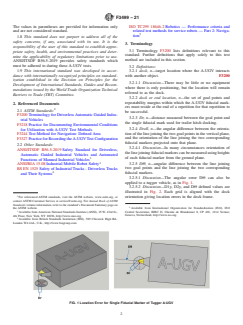
3.2.5.1 Discussion—The angular error DΘ can also be
applied to a tugger vehicle, as in Fig. 1.
3.2.5.2 Discussion—D1y, D2y, and DΘ defined values are
illustrated in Fig. 2. Each grid is aligned with the dock
For referenced ASTM standards, visit the ASTM website, www.astm.org, or orientation giving location errors in the dock frame.
contact ASTM Customer Service at service@astm.org. For Annual Book of ASTM
Standards volume information, refer to the standard’s Document Summary page on
Available from International Organization for Standardization (ISO), ISO
the ASTM website.
Central Secretariat, BIBC II, Chemin de Blandonnet 8, CP 401, 1214 Vernier,
Available fromAmerican National Standards Institute (ANSI), 25 W. 43rd St.,
Geneva, Switzerland, http://www.iso.org.
4th Floor, New York, NY 10036, http://www.ansi.org.
Available from British Standards Institution (BSI), 389 Chiswick High Rd.,
London W4 4AL, U.K., http://www.bsigroup.com.
FIG. 1Location Error for Single Fiducial Marker of Tugger A-UGV
F3499−21
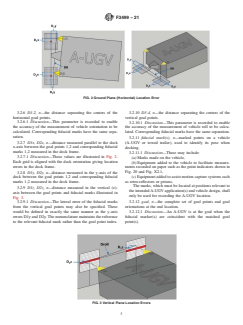
FIG. 2Ground Plane (Horizontal) Location Error
3.2.6 D1-2, n—the distance separating the centers of the 3.2.10 D3-4, n—the distance separating the centers of the
horizontal goal points. vertical goal points.
3.2.6.1 Discussion—This parameter is recorded to enable
3.2.10.1 Discussion—This parameter is recorded to enable
the accuracy of the measurement of vehicle orientation to be the accuracy of the measurement of vehicle roll to be calcu-
calculated. Corresponding fiducial marks have the same sepa-
lated. Corresponding fiducial marks have the same separation.
ration.
3.2.11 fiducial mark(s), n—marked points on a vehicle
3.2.7 D1x, D2x, n—distance measured parallel to the dock
(A-UGV or towed trailer), used to identify its pose when
x-axis between the goal points 1,2 and corresponding fiducial
docking.
marks 1,2 measured in the dock frame.
3.2.11.1 Discussion—These may include:
3.2.7.1 Discussion—These values are illustrated in Fig. 2.
(a) Marks made on the vehicle,
Each grid is aligned with the dock orientation giving location
(b) Equipment added to the vehicle to facilitate measure-
errors in the dock frame.
ments recorded on paper such as the point indicators shown in
Fig. 20 and Fig. X2.1,
3.2.8 D1y, D2y, n—distance measured in the y-axis of the
(c) Equipment added to assist motion capture systems such
dock between the goal points 1,2 and corresponding fiducial
as retro-reflectors or prisms.
marks 1,2 measured in the dock frame.
The marks, which must be located at positions relevant to
3.2.9 D1z, D2z, n—distance measured in the vertical (z)-
the intendedA-UGV application(s) and vehicle design, shall
axis between the goal points and fiducial marks illustrated in
only be used for recording the A-UGV location.
Fig. 3.
3.2.12 goal, n—the complete set of goal points and goal
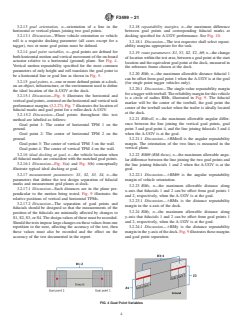
3.2.9.1 Discussion—The lateral error of the fiducial marks
from the vertical goal points may also be specified. These orientations at the end location.
would be defined in exactly the same manner as the y-axis 3.2.12.1 Discussion—An A-UGV is at the goal when the
errors D1y and D2y.The nomenclature maintains the reference fiducial marker(s) are coincident with the matched goal
to the relevant fiducial mark rather than the goal point index. point(s).
FIG. 3Vertical Plane Location Errors
F3499−21
3.2.13 goal orientation, n—orientation of a line in the 3.2.18 repeatability margins, n—the maximum difference
horizontal or vertical planes joining two goal points. between goal points and corresponding fiducial marks at
3.2.13.1 Discussion—Where vehicle orientation or vehicle docking specified for A-UGV performance. See Fig. 10.
roll is a requisite docking parameter (all cases except for a
3.2.18.1 Discussion—The test requestor shall select repeat-
tugger), two or more goal points must be defined.
ability margins appropriate for the task.
3.2.14 goal point variables, n—goal points are defined for
3.2.19 route parameters: X1, Y1, X2, Y2,∆Θ,n—the change
both horizontal motion and vertical movement of the on-board
oflocationwithinthetestarea,betweenagoalpointatthestart
actuator relative to a horizontal (ground) plane. See Fig. 4.
location and the equivalent goal point at the dock, measured in
Vertical motion repeatability specified for the most common
the reference frame chosen at the dock.
parameters of only height and roll translates the goal point to
3.2.20 RMr, n—the maximum allowable distance fiducial 1
be a horizontal line or goal line as shown in Fig. 5.
can be offset from goal point 1 when theA-UGV is at the goal
3.2.15 goal points, n—one or more defined points at a dock,
(for single point tugger vehicles only).
on an object, infrastructure, or the environment used to define
3.2.20.1 Discussion—The single-value repeatability margin
the ideal location of the A-UGV at the dock.
foratuggerwithtowball.Thereliabilitymarginforthisvehicle
3.2.15.1 Discussion—Fig. 6 illustrates the horizontal and
is a circle of radius RMr, illustrated in Fig. 9. The fiducial
verticalgoalpoints,centeredonthehorizontalandverticaltask
marker will be the center of the towball, the goal point the
performance margins (3.2.27). Fig. 7 illustrates the location of
center of the towball socket when the trailer is ideally located
fiducial marks and goal point for a roller-deck A-UGV.
at the dock.
3.2.15.2 Discussion—Goal points throughout this test
3.2.21 RMroll, n—the maximum allowable angular differ-
method are labelled as follows:
ence between the line joining the vertical goal points, goal
Goal point 1: The center of horizontal TPM 1 on the
point 3 and goal point 4, and the line joining fiducials 3 and 4
ground.
when the A-UGV is at the goal.
Goal point 2: The center of horizontal TPM 2 on the
ground. 3.2.21.1 Discussion—6RMroll is the angular repeatability
Goal point 3: The center of vertical TPM 3 on the wall. margin. The orientation of the two lines is measured in the
Goal point 4: The center of vertical TPM 4 on the wall. vertical plane.
3.2.16 ideal docking at goal, n—the vehicle location when
3.2.22 RMΘ (RM-theta), n—the maximum allowable angu-
all fiducial marks are coincident with the matched goal points.
lar difference between the line joining the two goal points and
3.2.16.1 Discussion—Fig. 8(a) and Fig. 8(b) conceptually
the line joining fiducials 1 and 2 when the A-UGV is at the
illustrate typical ideal docking at goal.
goal.
3.2.22.1 Discussion—6RMΘ is the angular repeatability
3.2.17 measurement parameters: S1, S2, S3, S4, n—the
parameters that define the test design separation of fiducial margin of vehicle orientation.
marks and measurement grid planes at dock.
3.2.23 RMx, n—the maximum allowable distance along
3.2.17.1 Discussion—Such distances are in the plane per-
x-axis that fiducials 1 and 2 can be offset from goal points 1
pendicular to the motion being tested. Fig. 9 illustrates the
and 2, respectively, when the A-UGV is at the goal.
relative positions of vertical and horizontal TPMs.
3.2.23.1 Discussion—6RMx is the distance repeatability
3.2.17.2 Discussion—The separation of goal points and
margin in the x-axis of the dock.
fiducials should be designed so that the measurements of the
3.2.24 RMy, n—the maximum allowable distance along
position of the fiducials are minimally affected by changes to
y-axis that fiducials 1 and 2 can be offset from goal points 1
S1, S2, S3, or S4.The design values of these must be recorded.
and 2, respectively, when the A-UGV is at the goal.
Shouldthetestsimposelargechangesonthesevaluesfromone
repetition to the next, affecting the accuracy of the test, then 3.2.24.1 Discussion—6RMy is the distance repeatability
these values must also be recorded and the effect on the margininthey-axisofthedock.Fig.9illustratesthesemargins
accuracy of the test documented in the report. and goal point separation.
FIG. 4Goal Point Variables
F3499−21
FIG. 5Vertical Plane Goal Points and Corresponding Goal Lines of TPM
FIG. 6Horizontal and Vertical Goal Points
3.2.25 RMz, n—the maximum allowable distance along 3.2.27.1 Discussion—Each test will require the vehicle to
z-axis that fiducials 3 and 4 may be offset from goal points 3 approach the dock in one direction with margins defined for
and 4, respectively, when the A-UGV is at the goal.
this. The TPM defined for each test is a subset of RMx, RMy,
3.2.25.1 Discussion—6RMz is the vertical distance repeat-
RMΘ, RMz, RMr, and RMroll, appropriate to the test. The
ability margin of the A-UGV actuator mechanism(s) at each
value of Tmax is also included in the TPM. The test report
goal point in the z-axis. The positions of the goal points in the
providesreferencediagramsforrecordingTPMvalues.ATPM
vertical plane may be at different heights, illustrated as Z and
comprising a subset of repeatability margins for an A-UGV
Z in Fig. 9. Only horizontal grids are needed to measure the
with fork tines is illustrated in Fig. 11.
vertical error.
3.2.28 task time, n—the time measured from the moment
3.2.26 start location, n—the set of goal points and repeat-
A-UGV (vehicle or actuator) movement begins at the start to
abilitymarginswithinwhichtheA-UGVfiducialmarkersmust
movement completion at the dock.
reside before a repetition begins.
3.2.29 Tmax, n—the maximum time allowed for a success-
3.2.27 task performance margin (TPM), n—the set of re-
ful repetition.
peatability margins selected for an A-UGV test.
F3499−21
FIG. 7Goal points, Fiducial Marks of Roller-deck A-UGV
FIG. 8(a) A-UGV Ideally Located at Horizontal and Vertical Goals
FIG. 8(b) Single Goal Point and Fiducial Mark for Tugger A-UGV Ideally Located at Dock Goal Point (continued)
F3499−21
S1 = Vertical distance between fiducial 1 and goal point 1 when the A-UGV is at the goal.
S2 = Vertical distance between fiducial 2 and goal point 2 when the A-UGV is at the goal.
S3 = Horizontal distance between fiducial 3 and goal point 3 when the A-UGV is at the goal.
S4 = Horizontal distance between fiducial 4 and goal point 4 when the A-UGV is at the goal.
FIG. 9Relative Positions of Measurement Plane and Fiducial
FIG. 10 Repeatability Margins (Grids) and Goal Points (Red Dots) in the Horizontal and (Red Bars) in the Vertical Planes
3.2.30 Z3, Z4, n—theverticalheightofagoalpointfromthe 4.1.1 The location and motion of a rigid body in space is
(ground) plane of A-UGV motion. described by three mutually perpendicular axes of translation
3.2.30.1 Discussion—Where a test is to confirm repeatabil-
and angular rotation about each axis. Fig. 12 illustrates such
ity in the vertical plane, the dock includes goal points in the
directions. This test method adopts an axis convention that the
vertical plane.
forward motion of the A-UGV is the positive x-axis. Lateral
movement to the left or right of this x-axis (shown in Fig. 12),
4. Location Conventions
and the y-axis, with left side positive. The ‘up’ direction
4.1 A-UGV Motion:
F3499−21
FIG. 11Repeatability Margins for Docking of an A-UGV with Fork-lift Tines
FIG. 126-Degree of Freedom Movement of a Rigid Body
perpendicular to the XY plane is the positive z-axis. Angular
movement is positive in the counter-clockwise direction.
4.1.2 Applied to an A-UGV, turning to the left (yaw) is a
positiveangularrotation.Fig.13illustratestheconvention.For
side-to-side roll of the vehicle, counter-clockwise (z-axis to
y-axis) roll being positive will see the positive y-axis move
downwards. This convention will be used throughout this test
method, but interchanging phrases forward and lateral for x
and y where this improves document clarity.
4.2 Dock Frame:
4.2.1 The same 6-degrees of freedom (DoF) convention
connects the dock to the A-UGV. Fig. 14 illustrates vehicle
movement from a start location to the end (goal) location.
Throughout this test method the actual route taken by the
vehicle to reach the dock is unspecified. Any route between
start and dock is described by the distances X1, Y1, X2, and
FIG. 13A-UGV Coordinate Frame
Y2,
F3499−21
ments at the dock are defined in the local coordinate frame. In
tests there will be differences, generally small, between the
ideal A-UGV location and the actual. Fig. 15 illustrates this
condition. Measurement of these differences, commonly re-
ferred to as docking errors, made in the dock frame, is the core
of the test. Limits to such errors, which may also include those
of orientation, actuator height, and roll comprise the task
performance margin or TPM.An example as a grid showing x
and y limits is included in Fig. 14.Throughout this test method
goal points are drawn in red, fiducial markers in yellow.
5. Procedure
5.1 This test method addresses A-UGV performance re-
quirements expressed by A-UGV manufacturers, installers,
users, and potential A-UGV users. The performance data are
indicative of the capabilities of the A-UGV in the application
FIG. 14Movement ofA-UGV from Start to Dock
represented by the test.
A test comprises multiple task repetitions of recording the
locationoffiducialmarksattheendofadockingmaneuverand
where:
confirming that these are within the task performance margin.
X1 = Distance along the dock frame x-axis from start 1 to
The test enables comparison of area requirements, vehicle
goal point 1,
repeatability, speed of operation, and maneuverability between
Y1 = Distance along the dock frame y-axis from start 1 to
different vehicles when docking. Docking may include move-
goal point 1,
ment of on-board equipment as well as the A-UGV. Detailed
X2 = Distance along the dock frame x-axis from start 1 to
recording of space, time, route, vehicle, location system,
goal point 2, and
fiducial marks, and the selected repeatability performance
Y2 = Distance along the dock frame y-axis from start 1 to
margins are required.
goal point 2.
Defined in Fig. 14, specified in the dock frame (Xd,Yd): 5.2 Repetitions:
5.2.1 Arepetition, defined in Terminology F3200 as perfor-
∆Θ = Angulardifferenceofthelinejoiningstartpoints1and
mance of a task, is the movement of an A-UGV and any
2 and the line joining goal points 1 and 2.
required on-board equipment, from a start location to dock or
4.2.2 The route shown begins with the A-UGV fiducial position at an end location. The route to be taken by the
markers within the margins defined in the start frame (Xs,Ys). A-UGV between start and end is not specified but shall be
TheA-UGVisideallylocatedatthedockwhenthetwofiducial recorded. A repetition is successful if the A-UGV docks at the
markers are perfectly aligned with the left and right goal points end location with all variations from the goal measured, using
(goal 1, goal 2) defined in the dock frame. All test measure- the fiducial marks, to be within the TPM.
FIG. 15Possible Errors at a Dock between Goal and Vehicle
F3499−21
5.2.2 A complete test comprises multiple consecutive rep- 5.3.2.1 Vertical differences D1z, D2z, and Droll can be
etitions. The test requestor shall specify the statistical reliabil- measured in the same manner using grids mounted in the
ity and confidence levels required of the A-UGV docking vertical plane, illustrated in Fig. 18. Although only horizontal
control within the repeatability margins. This dictates the lines are necessary (Fig. 9, Fig. 10, and Fig. 3), generally a 2D
number of successful, sequential repetitions that are required grid as shown will be used.
for a test to be successfully completed. Refer to Table X1.1. 5.3.2.2 Alternatively, distances D1z and D2z may be mea-
This number must be specified prior to beginning the test.
sured directly. Fig. 18 shows a goal height of goal points 1 and
5.2.3 Returning to the start location should be done auto- 2 of 100 mm from the floor. The TPMs measure 650 mm by
matically if possible. In the event that automatic return cannot
640 mm and the fiducials are shown with vertical differences
be achieved, theA-UGV may be returned manually to start the of 0 mm and 18 mm. With D1-2 set to 500 mm, Droll is 36
next repetition. mrad (~2°).
5.3.2.3 Such heights are typical of load collection close to
5.3 Measurements:
the floor. Z1 and Z2 values will be determined by the
5.3.1 Horizontal Plane:
application, typically 0.8 m to 1.5 m for flat and roller deck
5.3.1.1 The goal points and TPMs may be defined using
vehicles and up to 8 m for forklift A-UGVs. In all cases the
grids, capable of recording the position of the fiducial marks
goal height shall be set at the operating height.
and their variation from the goal points at each repetition. Fig.
5.3.3 Sensitivity of Error Measurements to Separation of
16 illustrates horizontal goals with RMx and RMy values of
Fiducials and the TPM Grid:
650 mm and 640 mm, with a goal point separation, D1-2 of
5.3.3.1 For measurements in a horizontal plane, the vertical
500 mm, derived from the measurement grids as shown in Fig.
distance between grid and fiducials (S1 and S2 of Fig. 9)
1.
should be as small as possible to minimize ‘parallax’ errors.
5.3.1.2 ApossiblelocationoftheA-UGV,wheretheapexof
5.3.3.2 Horizontal location measurements with fiducials far
each yellow cone, 1 and 2, is the position identified as the
from the ground should be avoided. Vehicle pitch or roll of 1
fiducialmarkisshowninFig.3.Theseparationfromeachgoal
degree will cause errors of 17 mm in horizontal measurement
point can be measured in the forward (X) and lateral (Y)
if the fiducial marks are 1 m above the grid. Due to this
directions, giving D1x, D2x, D1y, D2y. Combining these with
sensitivityitisrecommendedthatalltests(forbothverticaland
the goal separation, D of 500 mm enables the orientation error
horizontal planes) are designed to minimize the separation
to be calculated.
betweenfiducialmarkandmeasurementgridatgoal.Whenthe
5.3.1.3 LocationofasinglefiducialmarkerusedforA-UGV
vertical reference heights z1 and z2 are significant (above 100
tugger location is previously illustrated in Fig. 1. The corre-
mm), horizontal location tests may be requested at the z1/z2
spondingTPM,acircleofradiusRMrisshown,nowincluding
height and in addition to those at the ground plane. Fig. 9
a circular error grid. The fiducial is shown directly above the
illustrates separate fiducial pairs for vertical and horizontal
single goal, with Dr = 0. The positioning error Dr is recorded
measurements.
asthedistancebetweenthegoalpointandtowballcenter,using
the grid.
5.4 Start and Dock Locations—Both start and dock loca-
5.3.1.4 AtowballcouplingcannotbemadewiththeA-UGV
tions are given repeatability margins which shall be recorded.
in any orientation due to physical restrictions. However,
Start location margins need not be those of the dock location.
orientation accuracy requirements may be significantly less
EachrouteshallbeginwiththeA-UGVlocatedwithitsfiducial
than with other vehicles such as those with roller decks or fork
marks within the corresponding repeatability margins of the
tines. If the accuracy of measuring orientation error using two
start location.
separate fiducial marks is unnecessary, a simple orientation
5.5 Movement—Movement may include forward or reverse
error DΘ measurement can be made by extending the vehicle
motion, lateral translation in any direction, rotation without
center-line as shown in Fig. 17.
linear movement, or other combinations.
The test may also include a single height parameter Z with
a single vertical control error D1z. 5.6 Defined Area—The area, in which the repetitions that
5.3.2 Vertical Plane: comprisethecompletetestaretobecarriedout,shallbeclearly
FIG. 16Example Repeatability Margins for Two Goal Points
F3499−21
FIG. 17Diagram showing Distances Between Goal Points and Fiducial Markers when the A-UGV is Stationary at Dock
FIG. 18 Illustration of Measurement of Fiducial Locations in the Vertical Plane, Fiducials close to Ground Plane
defined in the test space and recorded. Start and dock locations the operating environment that are used for docking shall be
shall be recorded. Fig. 14 shows an example where the
recorded, typically by an annotated picture where possible.
boundary shown specifies the defined area. The area need not
5.8.5 TheA-UGVtechnician shall record relevant manufac-
be rectangular. The outline shall be drawn in the test report to
turers’instructions and site requirements to enable a future test
enableanotherrequestortorepeatthetestinanalmostidentical
requestor to repeat the test in a manner as close as possible to
space. Refer to Test Method F3244.
the original.
5.7 Timing—The duration of each repetition and task time
5.9 Equipment at a Dock—The dock used for the test may
shall be recorded.
be actual equipment or an equivalent model. Refer to Test
5.8 A-UGV Docking Method:
Method F3244 for methods of measuring the navigation
5.8.1 The A-UGV docking method shall be recorded for
performanceoftheapproachpathtothedockinglocationifthis
example:
parameter is required.
Line-following,
Laser scanner with retroreflectors, 5.10 TestMeasurementsusingOtherIndependentDevices—
2D/3D laser scanner using natural features, Using cameras or other sensing methods to record the position
Camera(s), possibly using natural features, or
of fiducial markers at the docking infrastructure can give
Multi-sensor combinations.
simpler recording of multiple tests. The system configuration
5.8.2 Terminology F3200 provides the definitions of natural
must ensure that all such additional equipment is not used for
features of an environment which must be followed.
navigation. When using independent sensor systems, for ex-
5.8.3 Any objects added to the environment that are in-
ampleacamera,caremustbetakentoeliminateorcompensate
stalled to assist A-UGV docking such as floor codes or
for errors such as misalignment or parallax.
retroreflectors, shall be recorded, including their approximate
5.11 Test Apparatus—If the docking infrastructure, in part
location within, or relative to, the defined area.
or whole and whether actual or a model, is used for A-UGV
5.8.4 Important necessary features not specifically installed
navigation, this shall be stated in the report. The A-UGV
to assist A-UGV docking, shall also be recorded, for example
technician shall record which parts are used, preferably with a
the type and location of ceiling lights if these are used for
camera image, to enable others to repeat the test as closely as
navigation,orthestructureandlocationofsurroundingwallsat
the height of a scanning 2D laser.All such key features within possible.
F3499−21
5.12 Measurement Equipment—The equipment used to use by manufacturers and users of A-UGVs to measure and
measure the position of the fiducial marks at the dock shall not record the docking performance. The test applies to different
be part of the A-UGV docking method. types of A-UGV, applications and test apparatus.
7.2 Navigation—The test applies to all types of navigation.
6. Test Metrics
The capabilities of the A-UGV to apply its navigation method
6.1 Routes from Start to Dock—The goal location of the to a given environment will be objectively determined by its
A-UGV at the dock (or docking location), the A-UG
...