

ASTM F3218-19
(Practice)Standard Practice for Documenting Environmental Conditions for Utilization with A-UGV Test Methods
General Information
- Abstract
SIGNIFICANCE AND USE
4.1 This section provides a description of the environmental conditions listed in Section 1 and describes the sub-conditions within each condition. Examples provided for many of the conditions and sub-conditions are provided as guidance only. Each of the conditions described should be evaluated and documented as set forth in Sections 5, 6, and 7.
4.2 Environmental Consistency: Static, Dynamic, Transitional:
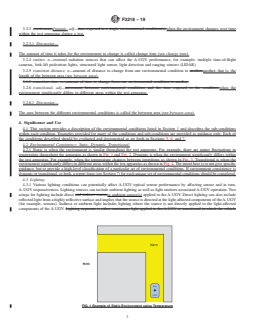
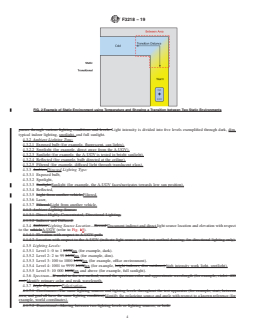
4.2.1 Static is when the environment is similar throughout the test apparatus. For example, there are minor fluctuations in temperature throughout the apparatus as shown in Fig. 1 and Fig. 2. Dynamic is when the environment significantly differs within the test apparatus. For example, when the temperature changes between repetitions as shown in Fig. 3. Transitional is when the environment significantly differs in different areas within the test apparatus as shown in Fig. 4. The intent here is to not give specific guidance, but to provide a high-level classification of a particular set of environmental conditions. If environment consistency is dynamic or transitional, or both, a report form (see Section 7) for each unique set of environmental conditions should be completed.
FIG. 1 Example of Static Environment using Temperature
FIG. 2 Example of Static Environment using Temperature and Showing a Transition between Two Static Environments
FIG. 3 Example of Dynamic Environment using Temperature and Showing that the Environment Changed during the Test
FIG. 4 Example of Transitional Environment using Temperature; Portions of the Environment May Remain Static or May Be Dynamic (for example, Cold to Colder)
4.3 Lighting:
4.3.1 Various lighting conditions can potentially affect A-UGV optical sensor performance by affecting sensor and in turn, A-UGV responsiveness. Lighting sources can include ambient lighting as well as light emitters associated A-UGV operation. Two setups for lighting include direct or ambient source(s) applied to the A-UGV. Direct...
SCOPE
1.1 When conducting test methods, it is important to consider the role that the environmental conditions play in the Automatic through Autonomous – Unmanned Ground Vehicle (A-UGV) performance. Various A-UGVs are designed to be operated both indoors and outdoors under conditions specified by the manufacturer. Likewise, end users of the A-UGV will be operating these vehicles in a variety of environmental conditions. When conducting and replicating F45 test methods by vehicle manufacturers and users, it is important to specify and document the environmental conditions under which the A-UGV is to be tested as there will be variations in vehicle performance caused by the conditions, especially when comparing and replicating sets of test results. It is also important to consider changes in environmental conditions during the course of operations (for example, transitions between conditions). As such, environmental conditions specified in this practice are static, dynamic, or transitional, or combinations thereof; with the A-UGV stationary or in motion. This practice provides brief introduction to the following list of environmental conditions that can affect performance of the A-UGV: Lighting, External sensor emission, Temperature, Humidity, Electrical Interference, Air quality, Ground Surface, and Boundaries. This practice then breaks down each condition into sub-categories so that the user can document the various aspects associated with the category prior to A-UGV tests defined in ASTM F45 Test Methods (for example, F3244). It is recommended that salient environment conditions be documented when conducting F45 test methods.
1.2 The environmental conditions listed in 1.1 to be documented for A-UGV(s) being tested are described and parameterized in Section 4 and allow a basis for performance comparison in test methods. The approach is to divide the list of environmental conditions into sub-conditions that represent the var...
- Status
- Published
- Publication Date
- 31-Aug-2019
- Technical Committee
- F45 - Robotics, Automation, and Autonomous Systems
- Drafting Committee
- F45.01 - Environmental Conditions and Effects
Buy Documents
ASTM F3218-19 - Standard Practice for Documenting Environmental Conditions for Utilization with A-UGV Test Methods
REDLINE ASTM F3218-19 - Standard Practice for Documenting Environmental Conditions for Utilization with A-UGV Test Methods
Overview
ASTM F3218-19: Standard Practice for Documenting Environmental Conditions for Utilization with A-UGV Test Methods provides a comprehensive framework for recording environmental variables during test methods involving Automatic through Autonomous – Unmanned Ground Vehicles (A-UGVs). Developed by ASTM Committee F45, this standard enhances the repeatability, comparability, and reliability of A-UGV test results by ensuring critical environmental factors are consistently documented. Achieving reproducible and transparent A-UGV testing is essential due to the diverse operational environments-indoor and outdoor-in which these vehicles are deployed.
Key Topics
Environmental Conditions
ASTM F3218-19 identifies the following primary environmental conditions that can affect A-UGV performance and must be documented during test procedures:
- Lighting: Ambient, direct, indirect, reflected, filtered; intensity levels; spectrum.
- External Sensor Emission: Influence of external emitters like LIDAR, structured light sources, and their proximity.
- Temperature: Ranges from freezing to extreme heat, including transitions and fluctuations.
- Humidity: Impact of high and low relative humidity, and dew point temperature on electronics and corrosion.
- Electrical Interference: Potential electromagnetic interference and effects on A-UGV electronics or communications.
- Ground Surface: Consistency (smooth, rough), deformability, friction, grade (ramp/undulation), and presence of particulates or anomalies.
- Air Quality: Particle density (dust, fog), air velocity, and their potential to affect sensor performance.
- Boundaries: Physical and virtual barriers, including walls, obstacles, floor markings, and moving boundaries.
Environmental Consistency
Environmental conditions are classified as:
- Static: Homogeneous environment throughout the apparatus
- Dynamic: Environmental parameters changing during the test
- Transitional: Significant differences in environmental conditions across locations
Documentation Practices
To facilitate valid comparisons across different tests and environments, ASTM F3218-19 recommends:
- Detailed reporting of environmental parameters and their locations
- Drawings showing A-UGV paths and environmental effectors
- Recording of transition time and distance between conditions
- Marking unknowns and “other” relevant environmental factors as needed
Applications
ASTM F3218-19 is integral to A-UGV manufacturers, system integrators, and end users conducting qualification or performance testing in:
- Warehouses and industrial settings
- Outdoor facilities or public spaces
- Environments with varying lighting, temperature, humidity, or complex ground surfaces
The standard is critical when executing ASTM F45 test methods, such as navigation tests (e.g., ASTM F3244), ensuring environmental conditions are reproducibly documented and enabling valid cross-comparisons of A-UGV performance.
- Supports regulatory compliance by providing a structured approach to environmental documentation
- Enhances product development by revealing environment-driven performance degradation
- Enables robust validation of safety, navigation, and operational reliability for A-UGVs
Related Standards
ASTM F3218-19 is used in conjunction with several key industry standards, including:
- ASTM F45.02: Test Methods for Navigation
- ASTM F3244: Test Method for Navigation in a Defined Area
- ASTM F3200: Terminology for Driverless Automatic Guided Industrial Vehicles
- ASTM E1155M: Floor Flatness and Levelness
- ASTM E1274: Pavement Roughness
- ISO 14644-1: Air Cleanliness Classification
- UL 3100: Outline Investigation for AGVs
- ANSI/ITSDF B56.5: AGV Safety
- BS EN 12895, MIL-STD-462, IEC 61000: Electromagnetic Compatibility
Conclusion
Implementing ASTM F3218-19 for documenting environmental conditions is indispensable for stakeholders involved in A-UGV testing and validation. By providing structured, repeatable documentation, the standard supports performance benchmarking, test method consistency, and adherence to global best practices in autonomous vehicle evaluation. Utilizing this standard strengthens the reliability and comparability of A-UGV performance across varying environments.
Relations
- Effective Date
- 01-Sep-2019
- Effective Date
- 01-Dec-2023
- Effective Date
- 15-Nov-2019
- Effective Date
- 01-Apr-2018
- Effective Date
- 01-Feb-2018
- Effective Date
- 15-Aug-2017
- Effective Date
- 01-Jun-2017
- Effective Date
- 15-May-2017
- Effective Date
- 15-Oct-2016
- Effective Date
- 15-Jan-2008
- Effective Date
- 01-Jan-2001
- Effective Date
- 01-Jan-2001
- Effective Date
- 01-Sep-2019
- Effective Date
- 01-Sep-2019
- Effective Date
- 01-Sep-2019
Buy Documents
ASTM F3218-19 - Standard Practice for Documenting Environmental Conditions for Utilization with A-UGV Test Methods
REDLINE ASTM F3218-19 - Standard Practice for Documenting Environmental Conditions for Utilization with A-UGV Test Methods
Get Certified
Connect with accredited certification bodies for this standard

BSI Group
BSI (British Standards Institution) is the business standards company that helps organizations make excellence a habit.

TÜV Rheinland
TÜV Rheinland is a leading international provider of technical services.

TÜV SÜD
TÜV SÜD is a trusted partner of choice for safety, security and sustainability solutions.
Sponsored listings
Frequently Asked Questions
ASTM F3218-19 is a standard published by ASTM International. Its full title is "Standard Practice for Documenting Environmental Conditions for Utilization with A-UGV Test Methods". This standard covers: SIGNIFICANCE AND USE 4.1 This section provides a description of the environmental conditions listed in Section 1 and describes the sub-conditions within each condition. Examples provided for many of the conditions and sub-conditions are provided as guidance only. Each of the conditions described should be evaluated and documented as set forth in Sections 5, 6, and 7. 4.2 Environmental Consistency: Static, Dynamic, Transitional: 4.2.1 Static is when the environment is similar throughout the test apparatus. For example, there are minor fluctuations in temperature throughout the apparatus as shown in Fig. 1 and Fig. 2. Dynamic is when the environment significantly differs within the test apparatus. For example, when the temperature changes between repetitions as shown in Fig. 3. Transitional is when the environment significantly differs in different areas within the test apparatus as shown in Fig. 4. The intent here is to not give specific guidance, but to provide a high-level classification of a particular set of environmental conditions. If environment consistency is dynamic or transitional, or both, a report form (see Section 7) for each unique set of environmental conditions should be completed. FIG. 1 Example of Static Environment using Temperature FIG. 2 Example of Static Environment using Temperature and Showing a Transition between Two Static Environments FIG. 3 Example of Dynamic Environment using Temperature and Showing that the Environment Changed during the Test FIG. 4 Example of Transitional Environment using Temperature; Portions of the Environment May Remain Static or May Be Dynamic (for example, Cold to Colder) 4.3 Lighting: 4.3.1 Various lighting conditions can potentially affect A-UGV optical sensor performance by affecting sensor and in turn, A-UGV responsiveness. Lighting sources can include ambient lighting as well as light emitters associated A-UGV operation. Two setups for lighting include direct or ambient source(s) applied to the A-UGV. Direct... SCOPE 1.1 When conducting test methods, it is important to consider the role that the environmental conditions play in the Automatic through Autonomous – Unmanned Ground Vehicle (A-UGV) performance. Various A-UGVs are designed to be operated both indoors and outdoors under conditions specified by the manufacturer. Likewise, end users of the A-UGV will be operating these vehicles in a variety of environmental conditions. When conducting and replicating F45 test methods by vehicle manufacturers and users, it is important to specify and document the environmental conditions under which the A-UGV is to be tested as there will be variations in vehicle performance caused by the conditions, especially when comparing and replicating sets of test results. It is also important to consider changes in environmental conditions during the course of operations (for example, transitions between conditions). As such, environmental conditions specified in this practice are static, dynamic, or transitional, or combinations thereof; with the A-UGV stationary or in motion. This practice provides brief introduction to the following list of environmental conditions that can affect performance of the A-UGV: Lighting, External sensor emission, Temperature, Humidity, Electrical Interference, Air quality, Ground Surface, and Boundaries. This practice then breaks down each condition into sub-categories so that the user can document the various aspects associated with the category prior to A-UGV tests defined in ASTM F45 Test Methods (for example, F3244). It is recommended that salient environment conditions be documented when conducting F45 test methods. 1.2 The environmental conditions listed in 1.1 to be documented for A-UGV(s) being tested are described and parameterized in Section 4 and allow a basis for performance comparison in test methods. The approach is to divide the list of environmental conditions into sub-conditions that represent the var...
SIGNIFICANCE AND USE 4.1 This section provides a description of the environmental conditions listed in Section 1 and describes the sub-conditions within each condition. Examples provided for many of the conditions and sub-conditions are provided as guidance only. Each of the conditions described should be evaluated and documented as set forth in Sections 5, 6, and 7. 4.2 Environmental Consistency: Static, Dynamic, Transitional: 4.2.1 Static is when the environment is similar throughout the test apparatus. For example, there are minor fluctuations in temperature throughout the apparatus as shown in Fig. 1 and Fig. 2. Dynamic is when the environment significantly differs within the test apparatus. For example, when the temperature changes between repetitions as shown in Fig. 3. Transitional is when the environment significantly differs in different areas within the test apparatus as shown in Fig. 4. The intent here is to not give specific guidance, but to provide a high-level classification of a particular set of environmental conditions. If environment consistency is dynamic or transitional, or both, a report form (see Section 7) for each unique set of environmental conditions should be completed. FIG. 1 Example of Static Environment using Temperature FIG. 2 Example of Static Environment using Temperature and Showing a Transition between Two Static Environments FIG. 3 Example of Dynamic Environment using Temperature and Showing that the Environment Changed during the Test FIG. 4 Example of Transitional Environment using Temperature; Portions of the Environment May Remain Static or May Be Dynamic (for example, Cold to Colder) 4.3 Lighting: 4.3.1 Various lighting conditions can potentially affect A-UGV optical sensor performance by affecting sensor and in turn, A-UGV responsiveness. Lighting sources can include ambient lighting as well as light emitters associated A-UGV operation. Two setups for lighting include direct or ambient source(s) applied to the A-UGV. Direct... SCOPE 1.1 When conducting test methods, it is important to consider the role that the environmental conditions play in the Automatic through Autonomous – Unmanned Ground Vehicle (A-UGV) performance. Various A-UGVs are designed to be operated both indoors and outdoors under conditions specified by the manufacturer. Likewise, end users of the A-UGV will be operating these vehicles in a variety of environmental conditions. When conducting and replicating F45 test methods by vehicle manufacturers and users, it is important to specify and document the environmental conditions under which the A-UGV is to be tested as there will be variations in vehicle performance caused by the conditions, especially when comparing and replicating sets of test results. It is also important to consider changes in environmental conditions during the course of operations (for example, transitions between conditions). As such, environmental conditions specified in this practice are static, dynamic, or transitional, or combinations thereof; with the A-UGV stationary or in motion. This practice provides brief introduction to the following list of environmental conditions that can affect performance of the A-UGV: Lighting, External sensor emission, Temperature, Humidity, Electrical Interference, Air quality, Ground Surface, and Boundaries. This practice then breaks down each condition into sub-categories so that the user can document the various aspects associated with the category prior to A-UGV tests defined in ASTM F45 Test Methods (for example, F3244). It is recommended that salient environment conditions be documented when conducting F45 test methods. 1.2 The environmental conditions listed in 1.1 to be documented for A-UGV(s) being tested are described and parameterized in Section 4 and allow a basis for performance comparison in test methods. The approach is to divide the list of environmental conditions into sub-conditions that represent the var...
ASTM F3218-19 is classified under the following ICS (International Classification for Standards) categories: 35.240.60 - IT applications in transport; 43.020 - Road vehicles in general. The ICS classification helps identify the subject area and facilitates finding related standards.
ASTM F3218-19 has the following relationships with other standards: It is inter standard links to ASTM F3218-17, ASTM F3200-23, ASTM F3200-19, ASTM F3200-18a, ASTM F3200-18, ASTM F3200-17b, ASTM F3200-17a, ASTM F3200-17, ASTM F3200-16, ASTM E1155M-96(2008), ASTM E1155M-96, ASTM E1155M-96(2001), ASTM F3470-20, ASTM F3265-17, ASTM F3244-21. Understanding these relationships helps ensure you are using the most current and applicable version of the standard.
ASTM F3218-19 is available in PDF format for immediate download after purchase. The document can be added to your cart and obtained through the secure checkout process. Digital delivery ensures instant access to the complete standard document.
Standards Content (Sample)
This international standard was developed in accordance with internationally recognized principles on standardization established in the Decision on Principles for the
Development of International Standards, Guides and Recommendations issued by the World Trade Organization Technical Barriers to Trade (TBT) Committee.
Designation: F3218 − 19
Standard Practice for
Documenting Environmental Conditions for Utilization with
A-UGV Test Methods
This standard is issued under the fixed designation F3218; the number immediately following the designation indicates the year of
original adoption or, in the case of revision, the year of last revision. A number in parentheses indicates the year of last reapproval. A
superscript epsilon (´) indicates an editorial change since the last revision or reapproval.
1. Scope sunlight within ambient lighting). Where necessary, this prac-
tice also provides guidelines (for example, lighting direction)
1.1 When conducting test methods, it is important to con-
to document environmental conditions in an existing environ-
sider the role that the environmental conditions play in the
ment.
Automatic through Autonomous – Unmanned Ground Vehicle
(A-UGV) performance. Various A-UGVs are designed to be
1.3 The values stated in SI units are to be regarded as the
operated both indoors and outdoors under conditions specified
standard. The values given in parentheses are not precise
bythemanufacturer.Likewise,endusersoftheA-UGVwillbe
mathematical conversion to imperial units. They are close
operating these vehicles in a variety of environmental condi-
approximate equivalents for the purpose of specifying material
tions. When conducting and replicating F45 test methods by
dimensions or quantities that are readily available to avoid
vehicle manufacturers and users, it is important to specify and
excessive fabrication costs of test apparatuses while maintain-
document the environmental conditions under which the
ing repeatability and reproducibility of the test method results.
A-UGV is to be tested as there will be variations in vehicle
These values given in parentheses are provided for information
performance caused by the conditions, especially when com-
only and are not considered standard.
paring and replicating sets of test results. It is also important to
consider changes in environmental conditions during the
1.4 This standard does not purport to address all of the
course of operations (for example, transitions between condi-
safety concerns, if any, associated with its use. It is the
tions). As such, environmental conditions specified in this
responsibility of the user of this standard to establish appro-
practice are static, dynamic, or transitional, or combinations
priate safety, health, and environmental practices and deter-
thereof; with theA-UGV stationary or in motion. This practice
mine the applicability of regulatory limitations prior to use.
providesbriefintroductiontothefollowinglistofenvironmen-
1.5 This international standard was developed in accor-
tal conditions that can affect performance of the A-UGV:
dance with internationally recognized principles on standard-
Lighting, External sensor emission, Temperature, Humidity,
ization established in the Decision on Principles for the
Electrical Interference, Air quality, Ground Surface, and
Development of International Standards, Guides and Recom-
Boundaries. This practice then breaks down each condition
mendations issued by the World Trade Organization Technical
into sub-categories so that the user can document the various
Barriers to Trade (TBT) Committee.
aspects associated with the category prior to A-UGV tests
defined inASTM F45Test Methods (for example, F3244). It is
recommended that salient environment conditions be docu- 2. Referenced Documents
mented when conducting F45 test methods.
2.1 ASTM Standards:
1.2 The environmental conditions listed in 1.1 to be docu-
E1155M TestMethodforDetermining F FloorFlatnessand
F
mented for A-UGV(s) being tested are described and param-
F Floor Levelness Numbers (Metric)
L
eterized in Section 4 and allow a basis for performance
E1274 Test Method for Measuring Pavement Roughness
comparison in test methods. The approach is to divide the list
Using a Profilograph
of environmental conditions into sub-conditions that represent
F3200 Terminology for DriverlessAutomatic Guided Indus-
the various aspects of the major category (for example,
trial Vehicles
F3244 Test Method for Navigation: Defined Area
This practice is under the jurisdiction of ASTM Committee F45 on Driverless
Automatic Guided Industrial Vehicles and is the direct responsibility of Subcom-
mittee F45.01 on Environmental Effects. For referenced ASTM standards, visit the ASTM website, www.astm.org, or
Current edition approved Sept. 1, 2019. Published October 2019. Originally contact ASTM Customer Service at service@astm.org. For Annual Book of ASTM
approved in 2017. Last previous edition approved in 2017 as F3218 – 17. DOI: Standards volume information, refer to the standard’s Document Summary page on
10.1520/F3218-19. the ASTM website.
Copyright © ASTM International, 100 Barr Harbor Drive, PO Box C700, West Conshohocken, PA 19428-2959. United States
F3218 − 19
2.2 Other Standards: cameras, fork-lift pedestrian lights, structured light sensor,
ANSI/ITSDF B56.5 Safety Standard for Driverless, Auto- light detection and ranging sensors (LIDAR).
matic Guided Industrial Vehicles and Automated Func-
3.2.5 transition distance, n—amount of distance to change
tions of Manned Industrial Vehicles – section 8.11.2 de-
fromoneenvironmentalconditiontoanother,thatis,thelength
scribes Hazardous Zones
of the between area (see between area).
ANSI B101.3 Test Method for Measuring Wet DCOF of
3.2.6 transitional, adj—when the environment significantly
Common Hard-Surface Floor Materials – specifies use of
differs in different areas within the test apparatus.
a BOT-3000 drag-sled meter
3.2.6.1 Discussion—Theareabetweenthedifferentenviron-
ISO 14644-1 Cleanrooms and Associated Controlled Envi-
mental conditions is called the between area (see between
ronments – Part 1: Classification of Air Cleanliness by
area).
Particle Concentration
BS 667 Illuminance Meters – Requirements and Test Meth-
4. Significance and Use
ods
4.1 This section provides a description of the environmental
BS EN 12895 Electromagnetic Compatibility – Emissions
conditions listed in Section 1 and describes the sub-conditions
and Immunity
6 within each condition. Examples provided for many of the
MIL-STD-462 EMI Emissions and Susceptibility
conditions and sub-conditions are provided as guidance only.
ISO 15469 Spatial distribution of daylight – CIE standard
Each of the conditions described should be evaluated and
general sky – defines a set of outdoor daylight conditions
documented as set forth in Sections 5, 6, and 7.
linking sunlight and skylight for theoretical and practical
4.2 Environmental Consistency: Static, Dynamic, Transi-
purposes
tional:
IEC61000-4-1 ElectromagneticCompatibility(EMC) – Part
4.2.1 Static is when the environment is similar throughout
4-1: Testing and Measurement Techniques – Overview of
the test apparatus. For example, there are minor fluctuations in
Immunity Tests
temperature throughout the apparatus as shown in Fig. 1 and
IEC 61000–6 Emission Standards for Industrial Environ-
Fig. 2. Dynamic is when the environment significantly differs
ments
within the test apparatus. For example, when the temperature
UL 3100 Outline Investigation for Automated Guided Ve-
changes between repetitions as shown in Fig. 3. Transitional is
hicles (AGVs)
when the environment significantly differs in different areas
3. Terminology
within the test apparatus as shown in Fig. 4. The intent here is
to not give specific guidance, but to provide a high-level
3.1 Generic terminology for this practice are referenced in
classification of a particular set of environmental conditions. If
Terminology F3200.
environment consistency is dynamic or transitional, or both, a
3.2 Definitions of Terms Specific to This Standard:
report form (see Section 7) for each unique set of environmen-
3.2.1 between area, n—the area of the apparatus that is
tal conditions should be completed.
between different environmental conditions in a transitional
4.3 Lighting:
environment (see transitional).
4.3.1 Various lighting conditions can potentially affect
3.2.2 change time, n—amount of time to change from one
A-UGV optical sensor performance by affecting sensor and in
environmental condition to another (only applies to dynamic
turn, A-UGV responsiveness. Lighting sources can include
environments).
ambient lighting as well as light emitters associated A-UGV
3.2.3 dynamic, adj—when the environment changes over
operation. Two setups for lighting include direct or ambient
time within the test apparatus during a test.
3.2.3.1 Discussion—The amount of time it takes for the
environmenttochangeiscalledchangetime(see change time).
3.2.4 emitter, n—external radiation sources that can affect
the A-UGV performance, for example: multiple time-of-flight
Available fromAmerican National Standards Institute (ANSI), 25 W. 43rd St.,
4th Floor, New York, NY 10036, http://www.ansi.org.
Available from International Organization for Standardization (ISO), ISO
Central Secretariat, BIBC II, Chemin de Blandonnet 8, CP 401, 1214 Vernier,
Geneva, Switzerland, http://www.iso.org.
Available from British Standards Institution (BSI), 389 Chiswick High Rd.,
London W4 4AL, U.K., http://www.bsigroup.com.
Available from U.S. Government Printing Office, Superintendent of
Documents, 732 N. Capitol St., NW, Washington, DC 20401-0001, http://
www.access.gpo.gov.
Available from International Electrotechnical Commission (IEC), 3, rue de
Varembé, 1st Floor, P.O. Box 131, CH-1211, Geneva 20, Switzerland, http://
www.iec.ch.
Available from Underwriters Laboratories (UL), 2600 N.W. Lake Rd., Camas,
WA 98607-8542, http://www.ul.com. FIG. 1 Example of Static Environment using Temperature
F3218 − 19
4.3.5.5 Level 5: 10 000 lux and above (for example, full
sunlight).
4.3.6 Spectrum—Identify primary color and peak wave-
length.
4.3.7 Polarization—Identifythepolarizingsourceandangle
with respect to a known reference (for example, world coor-
dinates).
4.3.8 If more specificity of measurement is required, the
following documents and standards may be used: “Recom-
mended Light Levels” from the National Optical Astronomy
Observatory and ISO 15469.
4.4 External Emission:
4.4.1 When emitters are outside of the A-UGV (for
example, from another A-UGV, the environment) that can
potentially interfere with the A-UGV sensor system. External
radiation sources can affect the A-UGV performance, for
example: multiple time-of-flight cameras, fork-lift pedestrian
FIG. 2 Example of Static Environment using Temperature and
lights, 3D structured light sensors, light detection and ranging
Showing a Transition between Two Static Environments
sensors (LIDAR).
4.4.2 External Emitter Configuration:
4.4.2.1 Type of emitter(s).
source(s) applied to the A-UGV. Direct lighting can also
4.4.2.2 Quantity of emitter(s).
include reflected light from a highly reflective surface and
4.4.3 External Emitter Source Location—Document emitter
implies that the source is directed at the light-affected compo-
source location and elevation with respect to theA-UGV(refer
nentsoftheA-UGV(forexample,sensors).Indirectorambient
to Fig. 5); add an external emitter symbol on the test method
light includes lighting where the source is not directly applied
drawing in the appropriate location.
to the light-affected components of theA-UGV. Light intensity
4.4.4 Spectrum—Identify primary color and peak wave-
is divided into five levels exemplified through dark, dim,
length.
typical indoor lighting, spotlight, and full sunlight.
4.3.2 Ambient Lighting Type:
4.5 Temperature:
4.3.2.1 Exposed bulb (for example, fluorescent, can lights),
4.5.1 Temperature variability and extremes can affect the
4.3.2.2 Spotlight (for example, direct away from the
A-UGV performance. Temperature ranges span from low to
A-UGV),
high extremes expressed in five levels. Temperature variations
4.3.2.3 Sunlight (for example, theA-UGVis tested in bright
can affect onboard electronics, create condensation, cause
sunlight),
hydraulic fluid viscosity, reduce battery life and recharge rate.
4.3.2.4 Reflected (for example, bulb directed at the ceiling),
4.5.2 Temperature Levels (in °C):
4.3.2.5 Filtered (for example, diffused light through trans-
4.5.2.1 Level 1: below 0°C to 0°C (for example, freezer).
lucent glass).
4.5.2.2 Level 2: 0°C to 15°C (for example, perishable
4.3.3 Directed Lighting Type:
storage).
4.3.3.1 Exposed bulb,
4.5.2.3 Level 3: 16°C to 26°C (for example, office, ware-
4.3.3.2 Spotlight,
house).
4.3.3.3 Sunlight (for example, the A-UGV faces/navigates
4.5.2.4 Level 4: 27°C to 49°C (for example, warehouse).
towards low sun position),
4.5.2.5 Level 5: above 49°C (for example, foundries,
4.3.3.4 Reflected,
forges).
4.3.3.5 Filtered,
4.6 Humidity:
4.3.3.6 Laser,
4.6.1 Humidity refers to the amount of water vapor con-
4.3.3.7 Light from another vehicle.
tained in the air around the vehicle. High humidity combined
4.3.4 Lighting Source Location—Document indirect and
with dew point temperature causes condensation that can short
direct light source location and elevation with respect to the
electronics and affect lenses and other A-UGV components.
A-UGV (refer to Fig. 5).
Greater than 60 % humidity causes a large increase in corro-
4.3.5 Lighting Levels:
sion of metallic parts. Low humidity, on the other hand, will
4.3.5.1 Level 1: 0 to 1 lux (for example, dark).
see a dramatic rise in static electricity and the need for
4.3.5.2 Level 2: 2 to 99 lux (for example, dim).
adequate discharge.
4.3.5.3 Level 3: 100 to 1000 lux (for example, office
environment).
“Recommended Light Levels”, National Optical Astronomy Observatory,
4.3.5.4 Level 4: 1001 to 9999 lux (for example, high
https://www.noao.edu/, accessed April 20, 2018 – includes common ⁄recommended
intensity work light, spotlight). indoor/outdoor light levels.
F3218 − 19
FIG. 3 Example of Dynamic Environment using Temperature
and Showing that the Environment Changed during the Test
FIG. 4 Example of Transitional Environment using Temperature;
Portions of the Environment May Remain Static
or May Be Dynamic (for example, Cold to Colder)
F3218 − 19
FIG. 5 Lighting Direction (a) Top View and (b) Side View and (c) Elevation View with Respect to the A-UGV
F3218 − 19
4.6.2 Relative Humidity Level: 4.9.1 A-UGV mobility is affected by ground surface condi-
4.6.2.1 Low – less than 30 %. tions including: surface texture/roughness, deformability,
sloped (ramp) or undulation (lack of flatness). Ground surface
4.6.2.2 Moderately Low –
...
This document is not an ASTM standard and is intended only to provide the user of an ASTM standard an indication of what changes have been made to the previous version. Because
it may not be technically possible to adequately depict all changes accurately, ASTM recommends that users consult prior editions as appropriate. In all cases only the current version
of the standard as published by ASTM is to be considered the official document.
Designation: F3218 − 17 F3218 − 19
Standard Practice for
RecordingDocumenting Environmental EffectsConditions for
Utilization with A-UGV Test Methods
This standard is issued under the fixed designation F3218; the number immediately following the designation indicates the year of
original adoption or, in the case of revision, the year of last revision. A number in parentheses indicates the year of last reapproval. A
superscript epsilon (´) indicates an editorial change since the last revision or reapproval.
INTRODUCTION
When conducting test methods, it is important to consider the role that the environmental conditions
play in the A-UGV performance. Various A-UGVs are designed to be operated both indoors and
outdoors under conditions specified by the manufacturer. Likewise, end users of the A-UGV will be
operating these vehicles in a variety of environmental conditions. When conducting and replicating
Committee F45 test methods by vehicle manufacturers and users, it is important to specify and record
the environmental conditions under which the A-UGV is tested as there will be variations in vehicle
performance caused by the conditions, especially when comparing and replicating sets of test results.
It is also important to consider changes in environmental conditions during the course of operations
(for example, transitions between conditions). As such, environmental conditions specified in this
practice are both continuous and transitional; with the A-UGV stationary or in motion. This practice
provides brief introduction to the following list of environmental conditions that can affect
performance of the A-UGV: lighting, external sensor emission, temperature, humidity, electrical
interference, ground surface, air quality.
This practice then breaks down each condition into sub-categories so that the user can record the
various aspects associated with the category when conducting A-UGV tests defined in Committee F45
Test Methods , , those listed in the Related Materials section, and Terminology F3200. It is
recommended that salient environment conditions be recorded when conducting Committee F45 test
methods, but is not required.
1. Scope
1.1 This practice describes a means to record the following When conducting test methods, it is important to consider the role
that the environmental conditions play in the Automatic through Autonomous – Unmanned Ground Vehicle (A-UGV) perfor-
mance. Various A-UGVs are designed to be operated both indoors and outdoors under conditions specified by the manufacturer.
Likewise, end users of the A-UGV will be operating these vehicles in a variety of environmental conditions. When conducting and
replicating F45 test methods by vehicle manufacturers and users, it is important to specify and document the environmental
conditions under which the A-UGV is to be tested as there will be variations in vehicle performance caused by the conditions,
especially when comparing and replicating sets of test results. It is also important to consider changes in environmental conditions
during the course of operations (for example, transitions between conditions). As such, environmental conditions specified in this
practice are static, dynamic, or transitional, or combinations thereof; with the A-UGV stationary or in motion. This practice
provides brief introduction to the following list of environmental conditions that maycan affect the performance of A-UGVs:
lighting, external sensor emission, temperature, ground surface, air quality, humidity, and electrical interference.the A-UGV:
Lighting, External sensor emission, Temperature, Humidity, Electrical Interference, Air quality, Ground Surface, and Boundaries.
This practice then breaks down each condition into sub-categories so that the user can document the various aspects associated with
the category prior to A-UGV tests defined in ASTM F45 Test Methods (for example, F3244). It is recommended that salient
environment conditions be documented when conducting F45 test methods.
This practice is under the jurisdiction of ASTM Committee F45 on Driverless Automatic Guided Industrial Vehicles and is the direct responsibility of Subcommittee
F45.01 on Environmental Effects.
Current edition approved July 1, 2017Sept. 1, 2019. Published October 2017October 2019. Originally approved in 2017. Last previous edition approved in 2017 as
F3218 – 17. DOI: 10.1520/F3218-17.10.1520/F3218-19.
Copyright © ASTM International, 100 Barr Harbor Drive, PO Box C700, West Conshohocken, PA 19428-2959. United States
F3218 − 19
1.2 The A-UGV operating ranges for eachenvironmental conditions listed in 1.1 of the conditions listed into be documented for
A-UGV(s) 1.1being tested are described and parameterized in Section 4 and allow a basis for performance comparison in test
methods. The approach is to divide the list of environmental conditions into sub-conditions that represent the various aspects of
the major category (for example, sunlight within ambient lighting). Where necessary, this practice also provides guidelines (for
example, lighting direction) to recorddocument environmental conditions in an existing environment.
1.3 The values stated in SI units are to be regarded as the standard. The values given in parentheses are not precise mathematical
conversion to imperial units. They are close approximate equivalents for the purpose of specifying material dimensions or
quantities that are readily available to avoid excessive fabrication costs of test apparatuses while maintaining repeatability and
reproducibility of the test method results. These values given in parentheses are provided for information only and are not
considered standard.
1.4 This standard does not purport to address all of the safety concerns, if any, associated with its use. It is the responsibility
of the user of this standard to establish appropriate safety, health, and environmental practices and determine the applicability of
regulatory limitations prior to use.
1.5 This international standard was developed in accordance with internationally recognized principles on standardization
established in the Decision on Principles for the Development of International Standards, Guides and Recommendations issued
by the World Trade Organization Technical Barriers to Trade (TBT) Committee.
2. Referenced Documents
2.1 ASTM Standards:
E1155M Test Method for Determining F Floor Flatness and F Floor Levelness Numbers (Metric)
F L
E1274 Test Method for Measuring Pavement Roughness Using a Profilograph
F3200 Terminology for Driverless Automatic Guided Industrial Vehicles
F3244 Test Method for Navigation: Defined Area
F3265 Test Method for Grid-Video Obstacle Measurement
2.2 Other Standards:
ANSI/ITSDF B56.5 Safety Standard for Driverless, Automatic Guided Industrial Vehicles and Automated Functions of Manned
Industrial Vehicles – section 8.11.2 describes Hazardous Zones
ANSI B101.3 Test Method for Measuring Wet DCOF of Common Hard-Surface Floor Materials – specifies use of a BOT-3000
drag-sled meter
ISO 14644-1 Cleanrooms and Associated Controlled Environments – Part 1: Classification of Air Cleanliness by Particle
Concentration
BS 667 Illuminance Meters – Requirements and Test Methods
BS EN 12895 Electromagnetic Compatibility – Emissions and Immunity
MIL-STD-462 EMI Emissions and Susceptibility
ISO 15469 Spatial distribution of daylight – CIE standard general sky – defines a set of outdoor daylight conditions linking
sunlight and skylight for theoretical and practical purposes
IEC 61000-4-1 Electromagnetic Compatibility (EMC) – Part 4-1: Testing and Measurement Techniques – Overview of
Immunity Tests
IEC 61000–6 Emission Standards for Industrial Environments
UL 3100 Outline Investigation for Automated Guided Vehicles (AGVs)
3. Terminology
3.1 Generic terminology for this practice are referenced in Terminology F3200.
3.2 Definitions of Terms Specific to This Standard:
3.2.1 between area, n—anthe area of the apparatus that is between the start and goal locations within each testdifferent
environmental conditions in a transitional environment (see apparatus transitionalas defined by the test method.).
3.2.2 change time, n—amount of time to change from one environmental condition to another (only applies to dynamic
environments).
For referenced ASTM standards, visit the ASTM website, www.astm.org, or contact ASTM Customer Service at service@astm.org. For Annual Book of ASTM Standards
volume information, refer to the standard’s Document Summary page on the ASTM website.
Available from American National Standards Institute (ANSI), 25 W. 43rd St., 4th Floor, New York, NY 10036, http://www.ansi.org.
Available from International Organization for Standardization (ISO), ISO Central Secretariat, BIBC II, Chemin de Blandonnet 8, CP 401, 1214 Vernier, Geneva,
Switzerland, http://www.iso.org.
Available from British Standards Institution (BSI), 389 Chiswick High Rd., London W4 4AL, U.K., http://www.bsigroup.com.
Available from U.S. Government Printing Office, Superintendent of Documents, 732 N. Capitol St., NW, Washington, DC 20401-0001, http://www.access.gpo.gov.
Available from International Electrotechnical Commission (IEC), 3, rue de Varembé, 1st Floor, P.O. Box 131, CH-1211, Geneva 20, Switzerland, http://www.iec.ch.
Health Aspect of Air Pollution with Particulate Matter, Ozone and Nitrogen Dioxide, Report on a WHO Working Group, Bonn, Germany, 13–15 January 2003.Available
from Underwriters Laboratories (UL), 2600 N.W. Lake Rd., Camas, WA 98607-8542, http://www.ul.com.
F3218 − 19
3.2.3 continuous,dynamic, adj—time exposed to a single environmental condition(s).when the environment changes over time
within the test apparatus during a test.
3.2.3.1 Discussion—
The amount of time it takes for the environment to change is called change time (see change time).
3.2.4 emitter, n—external radiation sources that can affect the A-UGV performance, for example: multiple time-of-flight
cameras, fork-lift pedestrian lights, structured light sensor, light detection and ranging sensors (LIDAR).
3.2.5 transition distance, n—amount of distance to change from one environmental condition to another.another, that is, the
length of the between area (see between area).
3.1.5 transition time, n—amount of time to change from one environmental condition to another.
3.2.6 transitional, adj—movement between environmental conditions and the time exposed to the condition.when the
environment significantly differs in different areas within the test apparatus.
3.2.6.1 Discussion—
The area between the different environmental conditions is called the between area (see between area).
4. Significance and Use
4.1 This section provides a description of the environmental conditions listed in Section 1 and describes the sub-conditions
within each condition. Examples provided for many of the conditions and sub-conditions are provided as guidance only. Each of
the conditions described should be evaluated and documented as set forth in Sections 5, 6, and 7.
4.2 Environmental Consistency: Static, Dynamic, Transitional:
4.2.1 Static is when the environment is similar throughout the test apparatus. For example, there are minor fluctuations in
temperature throughout the apparatus as shown in Fig. 1 and Fig. 2. Dynamic is when the environment significantly differs within
the test apparatus. For example, when the temperature changes between repetitions as shown in Fig. 3. Transitional is when the
environment significantly differs in different areas within the test apparatus as shown in Fig. 4. The intent here is to not give specific
guidance, but to provide a high-level classification of a particular set of environmental conditions. If environment consistency is
dynamic or transitional, or both, a report form (see Section 7) for each unique set of environmental conditions should be completed.
4.3 Lighting:
4.3.1 Various lighting conditions can potentially affect A-UGV optical sensor performance by affecting sensor and in turn,
A-UGV responsiveness. Lighting sources can include ambient lighting as well as light emitters associated A-UGV operation. Two
setups for lighting include direct and indirect sourceor ambient source(s) applied to the A-UGV. Direct lighting can also include
reflected light from a highly reflective surface and implies that the source is directed at the light-affected components of the A-UGV
(for example, sensors). Indirect or ambient light includes lighting where the source is not directly applied to the light-affected
components of the A-UGV. Lighting exposure is either continuous light applied to the A-UGV or transitional in which the vehicle
FIG. 1 Example of Static Environment using Temperature
F3218 − 19
FIG. 2 Example of Static Environment using Temperature and Showing a Transition between Two Static Environments
passes through various lighting conditions and levels. Light intensity is divided into five levels exemplified through dark, dim,
typical indoor lighting, spotlight, and full sunlight.
4.3.2 Ambient Lighting Type:
4.3.2.1 Exposed bulb (for example, fluorescent, can lights),
4.3.2.2 Spotlight (for example, direct away from the A-UGV),
4.3.2.3 Sunlight (for example, the A-UGV is tested in bright sunlight),
4.3.2.4 Reflected (for example, bulb directed at the ceiling),
4.3.2.5 Filtered (for example, diffused light through translucent glass).
4.3.3 AmbientDirected Lighting Type:
4.3.3.1 Exposed bulb,
4.3.3.2 Spotlight,
4.3.3.3 Sunlight,Sunlight (for example, the A-UGV faces/navigates towards low sun position),
4.3.3.4 Reflected,
4.3.3.5 Light from another vehicle,Filtered,
4.3.3.6 Laser,
4.3.3.7 Filtered.Light from another vehicle.
4.1.3 Ambient Lighting Source:
4.1.3.1 Direct Highly-Concentrated, Directional Lighting,
4.1.3.2 Indirect and Diffused.
4.3.4 Ambient Lighting Source Location—Record Document indirect and direct light source location and elevation with respect
to the vehicleA-UGV (refer to Fig. 15).
4.1.4.1 Elevation with respect to A-UGV path.
4.1.4.2 Location with respect to the A-UGV (indicate light source on the test method drawing; for directional lighting only).
4.3.5 Lighting Levels:
4.3.5.1 Level 1: 0 to 1 LUXlux (for example, dark).
4.3.5.2 Level 2: 2 to 99 LUXlux (for example, dim).
4.3.5.3 Level 3: 100 to 1000 LUXlux (for example, office environment).
4.3.5.4 Level 4: 1001 to 9999 LUXlux (for example, bright indoors, dim outdoors).high intensity work light, spotlight).
4.3.5.5 Level 5: 10 000 LUXlux and above (for example, full sunlight).
4.3.6 Spectrum—If useful to the test method, record the spectrum color and approximate wavelength (for example, violet: 400
nm).Identify primary color and peak wavelength.
4.3.7 Light Exposure: Polarization—
4.1.7.1 Continuous—The same lighting sources and lighting levels throughout the test apparatus (for example, start, between
area, and goal all have the same lighting condition).Identify the polarizing source and angle with respect to a known reference (for
example, world coordinates).
4.1.7.2 Transitional—Moving between two lighting levels or lighting sources, or both.
F3218 − 19
FIG. 3 Example of Dynamic Environment using Temperature
and Showing that the Environment Changed during the Test
FIG. 4 Example of Transitional Environment using Temperature;
Portions of the Environment May Remain Static
or May Be Dynamic (for example, Cold to Colder)
F3218 − 19
FIG. 15 Lighting and Air Velocity (see 4.7.4) Direction (a) Top View and (b) Side View and (c) Light Source Elevation Side View with Re-
spect to the A-UGV; The “front” of the A-UGV is defined by vehicle manufacturerA-UGV
F3218 − 19
4.3.8 If more specificity of measurement is required, the following documents and standards may be used: “Recommended
Light Levels” from the National Optical Astronomy Observatory and ISO 15469.
4.4 External Sensor Emission:
4.4.1 When emitters are outside of the A-UGV (for example, from another A-UGV, the environment) that can potentially
interfere with the A-UGV sensor system. External, unnatural External radiation sources can affect the A-UGV performance, for
example: multiple time-of-flight cameras, fork-lift pedestrian lights, 3D structured light sensors, light detection and ranging sensors
(LIDAR).
4.4.2 External Emitter Configuration:
4.4.2.1 Type of emitter(s).
4.4.2.2 NumberQuantity of emitter(s).
4.4.3 External Emitter Source Location—RecordDocument emitter source location and elevation with respect to the
vehicleA-UGV (refer to Fig. 15).); add an external emitter symbol on the test method drawing in the appropriate location.
4.2.3.1 Elevation with respect to A-UGV path.
4.2.3.2 Location with respect to the A-UGV.
4.4.4 Spectrum—Identify primary color and peak wavelength.
4.5 Temperature:
4.5.1 Temperature variability and extremes can affect the A-UGV performance. The temperature exposure on the A-UGV can
be continuous or transitional while the vehicle is stationary or moving. Temperature ranges span from low to high extremes
expressed in five categories.levels. Temperature variations can affect onboard electronics, create condensation, cause hydraulic
fluid viscosity, reduce battery life and recharge rate.
4.3.2 Temperature Exposure:
4.3.2.1 Continuous—A single temperature for a period of time.
4.3.2.2 Transitional—Moving between two continuous temperature levels.
4.5.2 Temperature Levels (in °C):
4.5.2.1 Level 1: below 00°C to 0°C (for example, freezing conditions).freezer).
4.5.2.2 Level 2: 00°C to 15°C (for example, perishable storage).
4.5.2.3 Level 3: 1616°C to 26°C (for example, office, warehouse).
4.5.2.4 Level 4: 2727°C to 49°C (for example, warehouse).
4.5.2.5 Level 5: above 49°C (for example, foundries, forges).
4.6 Humidity:
4.6.1 Humidity refers to the amount of water vapor contained in the air around the vehicle. High humidity combined with dew
point temperature causes condensation that can short electronics and affect lenses and other A-UGV components. Greater than
60 % humidity causes a large increase in corrosion of metallic parts. Low humidity, on the other hand, will see a dramatic rise in
static electricity and the need for adequate discharge.
For referenced ASTM standards, visit the ASTM website, www.astm.org, or contact ASTM Customer Service at service@astm.org. For “Recommended Light Levels”,
National Optical Astronomy Observatory, https://www.noao.edu/, accessed April 20, 2018 – includes common Annual Book of ASTM Standards⁄recommended indoor/
outdoor light levels. volume information, refer to the standard’s Document Summary page on the ASTM website.
...