

ASTM F3381-19
(Practice)Standard Practice for Describing Stationary Obstacles Utilized within A-UGV Test Methods
General Information
- Abstract
SIGNIFICANCE AND USE
4.1 This section lists and explains the characteristics that are used to describe a stationary obstacle.
4.2 It is essential that sufficient information about the obstacle is recorded using this practice so that the obstacle can be replicated. This will allow comparisons to be made between test method performances that use obstacles with similar characteristics.
4.3 Class:
4.3.1 When describing an obstacle to be utilized in ASTM Committee F45 test methods, two classes are defined:
4.3.1.1 Genuine—The obstacle being described is an existing real world object (for example, a chair, table, machinery, or equipment). Any identifying information, such as make, model, SKU, etc., should be recorded.
4.3.1.2 Artifact—The obstacle being described has been constructed according to the characteristics outlined in this section. Obstacles of this class are intended to be replicable.
4.4 Parts of the Obstacle:
4.4.1 Each characteristic can be used to describe a property of the entire obstacle or a part of the obstacle. All parts of the obstacle must be uniquely named and identified in the test report described in Section 6.
4.5 Shape:
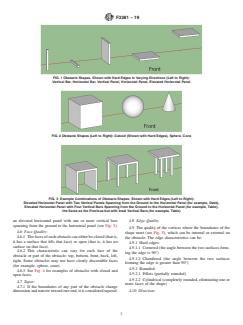
4.5.1 The shape refers to the relationships between the external, physical boundaries of the obstacle. All shapes can be in contact with the ground or elevated above the ground (see Fig. 1, Fig. 2, and Fig. 3). The unique obstacle shapes are:
4.5.1.1 Bar (for example, column)
4.5.1.2 Panel (for example, sign, pallet, shelf)
4.5.1.3 Cuboid
4.5.1.4 Sphere
4.5.1.5 Cone
4.5.1.6 Other—Obstacle shapes that do not fall into one of the above categories (for example, a pile of fabric). An obstacle can use a single shape to describe its overall volume or multiple shapes to describe parts of the obstacle. For example, the shape of a desk could be described as an elevated horizontal panel with two vertical panels spanning from the ground to the horizontal panel or the shape of a table could be described as an elevated hori...
SCOPE
1.1 This practice specifies physical characteristics that can be used to describe obstacles utilized within ASTM Committee F45 test methods. The obstacle characteristics specified in this practice are not described with respect to the manner in which they will be sensed or detected by an A-UGV. Rather, the obstacles are described according to their real world characteristics. For example, the real world characteristics of a wooden box that is flat black on one side can be described according to its actual dimensions, material, and color. An A-UGV with a lidar sensor may have difficulty detecting the side of the box that is flat black, which could make the obstacle appear smaller to the A-UGV compared to its actual dimensions in the real world. However, this may not be the case for other A-UGVs due to the wide variety of sensors used to detect obstacles, so the actual, real world characteristics are used to describe it instead.
1.2 Real world, existing objects can be used as obstacles and described using this practice. The characteristics specified herein can also be used to construct test artifacts to use as representative obstacles that are intended to have similar characteristics to that of real world obstacles. The obstacles that can be described using this practice may be found in indoor and outdoor environments.
1.3 This practice does not purport to cover all relevant obstacle characteristics that may have an effect on A-UGV performance. The characteristics specified in this practice are limited to the physical properties which are considered to be the most salient in terms of the effects they can have on A-UGV performance. As such, the user of this standard may select the level of detail to use in order to describe the characteristics of an obstacle in such a way. The characteristics are also limited to those which are more easily measurable and replicable when comparing test method results that use similar o...
- Status
- Published
- Publication Date
- 30-Nov-2019
- Technical Committee
- F45 - Robotics, Automation, and Autonomous Systems
- Drafting Committee
- F45.03 - A-UGV Object Detection and Protection
Overview
ASTM F3381-19 is the Standard Practice for Describing Stationary Obstacles Utilized within Automated Unmanned Ground Vehicle (A-UGV) Test Methods. Published by ASTM International, this standard provides a systematic approach to characterizing stationary obstacles for use in testing autonomous and automated guided vehicles. By specifying the physical characteristics of obstacles, ASTM F3381-19 enhances the replicability and comparability of test results within ASTM Committee F45 test methods. This practice is essential for both genuine obstacles (real-world objects) and fabricated artifact obstacles used in controlled test environments.
Key Topics
Obstacle Classification:
- Genuine obstacle: An existing real-world object, such as a chair or pallet. Relevant identifying information (make, model, SKU, etc.) should be recorded.
- Artifact obstacle: A constructed item made according to specified characteristics. Designed for replicability and consistent test conditions.
Obstacle Characterization:
- Parts of the Obstacle: All obstacle parts must be uniquely named and listed in the test report.
- Shape: Categories include bar, panel, cuboid, sphere, cone, and others. Obstacles may be described by one or multiple shapes.
- Face and Edge Quality: Faces can be open or closed; edges may be cornered, chamfered, filleted, or cylindrical.
- Dimensions: Includes width, length, height, elevation, taper, and radius or setback of edges. All measurements must specify units and accuracy.
- Material: Type of material (metal, wood, plastic, etc.) and relevant properties (e.g., density, reflectivity).
- Surface Characteristics: Color, reflectivity, opacity, porosity, and surface uniformity or variability.
- Direction: Orientation of the obstacle, relevant for positioning in the test environment.
Reporting and Replicability:
- Thorough documentation, including photographs and technical drawings, is recommended. This ensures that obstacles can be identically recreated for future tests, enabling reliable performance comparisons.
Applications
ASTM F3381-19 is particularly valuable for:
- A-UGV and mobile robot testing: Ensures that obstacle descriptions are comprehensive and consistent across different testing scenarios.
- Test method development: Facilitates the creation of standardized tests for obstacle detection, avoidance, navigation, and path planning in both indoor and outdoor environments.
- Product validation: Provides a reliable framework for evaluating the obstacle detection and navigation capabilities of driverless industrial vehicles.
- Research and development: Assists in benchmarking sensor technologies by using obstacles with controlled, well-documented attributes.
This standard is widely applied in industries developing automated guided vehicles, robotics navigation systems, and sensor validation platforms.
Related Standards
ASTM F3381-19 references several complementary standards to support a comprehensive testing approach:
- ASTM F3200 - Terminology for Driverless Automatic Guided Industrial Vehicles
- ASTM F3218 - Practice for Documenting Environmental Conditions for A-UGV Test Methods
- ASTM F3244 - Test Method for Navigation: Defined Area
- ANSI/ITSDF B56.5 - Safety Standard for Rough Terrain Forklift Trucks
- IEC 61496-1 - Safety of Machinery – Electro-sensitive Protective Equipment
- ISO 20471 - High Visibility Clothing – Test Methods and Requirements
These related standards cover terminology, environmental factors, navigation testing, and safety aspects, complementing ASTM F3381-19’s focus on physical obstacle specification.
By standardizing obstacle descriptions, ASTM F3381-19 plays a pivotal role in advancing the reliability and repeatability of automated vehicle testing, supporting innovation and safety in robotics and industrial automation.
Relations
- Effective Date
- 01-Dec-2023
- Effective Date
- 15-Nov-2019
- Effective Date
- 01-Sep-2019
- Effective Date
- 01-Apr-2018
- Effective Date
- 01-Feb-2018
- Effective Date
- 15-Aug-2017
- Effective Date
- 01-Jul-2017
- Effective Date
- 01-Jun-2017
- Effective Date
- 15-May-2017
- Effective Date
- 15-Oct-2016
- Effective Date
- 01-Dec-2019
- Effective Date
- 01-Dec-2019
- Effective Date
- 01-Dec-2019
Get Certified
Connect with accredited certification bodies for this standard

BSI Group
BSI (British Standards Institution) is the business standards company that helps organizations make excellence a habit.

TÜV Rheinland
TÜV Rheinland is a leading international provider of technical services.

TÜV SÜD
TÜV SÜD is a trusted partner of choice for safety, security and sustainability solutions.
Sponsored listings
Frequently Asked Questions
ASTM F3381-19 is a standard published by ASTM International. Its full title is "Standard Practice for Describing Stationary Obstacles Utilized within A-UGV Test Methods". This standard covers: SIGNIFICANCE AND USE 4.1 This section lists and explains the characteristics that are used to describe a stationary obstacle. 4.2 It is essential that sufficient information about the obstacle is recorded using this practice so that the obstacle can be replicated. This will allow comparisons to be made between test method performances that use obstacles with similar characteristics. 4.3 Class: 4.3.1 When describing an obstacle to be utilized in ASTM Committee F45 test methods, two classes are defined: 4.3.1.1 Genuine—The obstacle being described is an existing real world object (for example, a chair, table, machinery, or equipment). Any identifying information, such as make, model, SKU, etc., should be recorded. 4.3.1.2 Artifact—The obstacle being described has been constructed according to the characteristics outlined in this section. Obstacles of this class are intended to be replicable. 4.4 Parts of the Obstacle: 4.4.1 Each characteristic can be used to describe a property of the entire obstacle or a part of the obstacle. All parts of the obstacle must be uniquely named and identified in the test report described in Section 6. 4.5 Shape: 4.5.1 The shape refers to the relationships between the external, physical boundaries of the obstacle. All shapes can be in contact with the ground or elevated above the ground (see Fig. 1, Fig. 2, and Fig. 3). The unique obstacle shapes are: 4.5.1.1 Bar (for example, column) 4.5.1.2 Panel (for example, sign, pallet, shelf) 4.5.1.3 Cuboid 4.5.1.4 Sphere 4.5.1.5 Cone 4.5.1.6 Other—Obstacle shapes that do not fall into one of the above categories (for example, a pile of fabric). An obstacle can use a single shape to describe its overall volume or multiple shapes to describe parts of the obstacle. For example, the shape of a desk could be described as an elevated horizontal panel with two vertical panels spanning from the ground to the horizontal panel or the shape of a table could be described as an elevated hori... SCOPE 1.1 This practice specifies physical characteristics that can be used to describe obstacles utilized within ASTM Committee F45 test methods. The obstacle characteristics specified in this practice are not described with respect to the manner in which they will be sensed or detected by an A-UGV. Rather, the obstacles are described according to their real world characteristics. For example, the real world characteristics of a wooden box that is flat black on one side can be described according to its actual dimensions, material, and color. An A-UGV with a lidar sensor may have difficulty detecting the side of the box that is flat black, which could make the obstacle appear smaller to the A-UGV compared to its actual dimensions in the real world. However, this may not be the case for other A-UGVs due to the wide variety of sensors used to detect obstacles, so the actual, real world characteristics are used to describe it instead. 1.2 Real world, existing objects can be used as obstacles and described using this practice. The characteristics specified herein can also be used to construct test artifacts to use as representative obstacles that are intended to have similar characteristics to that of real world obstacles. The obstacles that can be described using this practice may be found in indoor and outdoor environments. 1.3 This practice does not purport to cover all relevant obstacle characteristics that may have an effect on A-UGV performance. The characteristics specified in this practice are limited to the physical properties which are considered to be the most salient in terms of the effects they can have on A-UGV performance. As such, the user of this standard may select the level of detail to use in order to describe the characteristics of an obstacle in such a way. The characteristics are also limited to those which are more easily measurable and replicable when comparing test method results that use similar o...
SIGNIFICANCE AND USE 4.1 This section lists and explains the characteristics that are used to describe a stationary obstacle. 4.2 It is essential that sufficient information about the obstacle is recorded using this practice so that the obstacle can be replicated. This will allow comparisons to be made between test method performances that use obstacles with similar characteristics. 4.3 Class: 4.3.1 When describing an obstacle to be utilized in ASTM Committee F45 test methods, two classes are defined: 4.3.1.1 Genuine—The obstacle being described is an existing real world object (for example, a chair, table, machinery, or equipment). Any identifying information, such as make, model, SKU, etc., should be recorded. 4.3.1.2 Artifact—The obstacle being described has been constructed according to the characteristics outlined in this section. Obstacles of this class are intended to be replicable. 4.4 Parts of the Obstacle: 4.4.1 Each characteristic can be used to describe a property of the entire obstacle or a part of the obstacle. All parts of the obstacle must be uniquely named and identified in the test report described in Section 6. 4.5 Shape: 4.5.1 The shape refers to the relationships between the external, physical boundaries of the obstacle. All shapes can be in contact with the ground or elevated above the ground (see Fig. 1, Fig. 2, and Fig. 3). The unique obstacle shapes are: 4.5.1.1 Bar (for example, column) 4.5.1.2 Panel (for example, sign, pallet, shelf) 4.5.1.3 Cuboid 4.5.1.4 Sphere 4.5.1.5 Cone 4.5.1.6 Other—Obstacle shapes that do not fall into one of the above categories (for example, a pile of fabric). An obstacle can use a single shape to describe its overall volume or multiple shapes to describe parts of the obstacle. For example, the shape of a desk could be described as an elevated horizontal panel with two vertical panels spanning from the ground to the horizontal panel or the shape of a table could be described as an elevated hori... SCOPE 1.1 This practice specifies physical characteristics that can be used to describe obstacles utilized within ASTM Committee F45 test methods. The obstacle characteristics specified in this practice are not described with respect to the manner in which they will be sensed or detected by an A-UGV. Rather, the obstacles are described according to their real world characteristics. For example, the real world characteristics of a wooden box that is flat black on one side can be described according to its actual dimensions, material, and color. An A-UGV with a lidar sensor may have difficulty detecting the side of the box that is flat black, which could make the obstacle appear smaller to the A-UGV compared to its actual dimensions in the real world. However, this may not be the case for other A-UGVs due to the wide variety of sensors used to detect obstacles, so the actual, real world characteristics are used to describe it instead. 1.2 Real world, existing objects can be used as obstacles and described using this practice. The characteristics specified herein can also be used to construct test artifacts to use as representative obstacles that are intended to have similar characteristics to that of real world obstacles. The obstacles that can be described using this practice may be found in indoor and outdoor environments. 1.3 This practice does not purport to cover all relevant obstacle characteristics that may have an effect on A-UGV performance. The characteristics specified in this practice are limited to the physical properties which are considered to be the most salient in terms of the effects they can have on A-UGV performance. As such, the user of this standard may select the level of detail to use in order to describe the characteristics of an obstacle in such a way. The characteristics are also limited to those which are more easily measurable and replicable when comparing test method results that use similar o...
ASTM F3381-19 is classified under the following ICS (International Classification for Standards) categories: 35.240.60 - IT applications in transport; 43.020 - Road vehicles in general. The ICS classification helps identify the subject area and facilitates finding related standards.
ASTM F3381-19 has the following relationships with other standards: It is inter standard links to ASTM F3200-23, ASTM F3200-19, ASTM F3218-19, ASTM F3200-18a, ASTM F3200-18, ASTM F3200-17b, ASTM F3218-17, ASTM F3200-17a, ASTM F3200-17, ASTM F3200-16, ASTM F3244-21, ASTM F3588-22, ASTM F3470-20. Understanding these relationships helps ensure you are using the most current and applicable version of the standard.
ASTM F3381-19 is available in PDF format for immediate download after purchase. The document can be added to your cart and obtained through the secure checkout process. Digital delivery ensures instant access to the complete standard document.
Standards Content (Sample)
This international standard was developed in accordance with internationally recognized principles on standardization established in the Decision on Principles for the
Development of International Standards, Guides and Recommendations issued by the World Trade Organization Technical Barriers to Trade (TBT) Committee.
Designation: F3381 − 19
Standard Practice for
Describing Stationary Obstacles Utilized within A-UGV Test
Methods
This standard is issued under the fixed designation F3381; the number immediately following the designation indicates the year of
original adoption or, in the case of revision, the year of last revision. A number in parentheses indicates the year of last reapproval. A
superscript epsilon (´) indicates an editorial change since the last revision or reapproval.
INTRODUCTION
Automatic, automated, or autonomous unmanned ground vehicles (A-UGVs) in many scenarios
encounter obstacles or objects that obstruct or impair their intended movement. This practice is used
to describe stationary objects that serve as obstacles inASTM Committee F45 test methods, both for
existing, real world obstacles and for test artifacts that can be constructed to serve as representative
obstacles.ExamplesofusingobstaclesintestmethodsincludeaddinganobstacleintotheTestMethod
F3244 – 17 apparatus or verifying a sensor’s ability to detect an obstacle. Several physical
characteristics of stationary obstacles are defined in this standard, such as geometry, surface, and
configuration. The characteristics specified herein can be used to describe common, real world
obstacles that A-UGVs typically interact with, such as pallets on the ground, desks and tables, and
otherA-UGVs. This practice only covers obstacles or objects that exist on or above the ground plane
and remain stationary while the A-UGV is performing its task.
1. Scope characteristics to that of real world obstacles. The obstacles
that can be described using this practice may be found in
1.1 This practice specifies physical characteristics that can
indoor and outdoor environments.
be used to describe obstacles utilized withinASTM Committee
F45 test methods. The obstacle characteristics specified in this
1.3 This practice does not purport to cover all relevant
practice are not described with respect to the manner in which obstacle characteristics that may have an effect on A-UGV
they will be sensed or detected by an A-UGV. Rather, the
performance. The characteristics specified in this practice are
obstacles are described according to their real world charac- limited to the physical properties which are considered to be
teristics. For example, the real world characteristics of a
the most salient in terms of the effects they can have on
wooden box that is flat black on one side can be described A-UGV performance. As such, the user of this standard may
according to its actual dimensions, material, and color. An
select the level of detail to use in order to describe the
A-UGV with a lidar sensor may have difficulty detecting the characteristics of an obstacle in such a way.The characteristics
sideoftheboxthatisflatblack,whichcouldmaketheobstacle
are also limited to those which are more easily measurable and
appear smaller to the A-UGV compared to its actual dimen- replicable when comparing test method results that use similar
sions in the real world. However, this may not be the case for
obstacles.
otherA-UGVs due to the wide variety of sensors used to detect
1.4 This practice only covers obstacles that exist on or
obstacles, so the actual, real world characteristics are used to
above the ground, sometimes referred to as positive obstacles,
describe it instead.
and remain stationary while the A-UGV is performing tasks.
1.2 Realworld,existingobjectscanbeusedasobstaclesand
Stationary real world obstacles of this type include pallets on
described using this practice. The characteristics specified
the ground, desks and tables, and otherA-UGVs. This practice
herein can also be used to construct test artifacts to use as
does not include obstacles that exist below the ground (for
representative obstacles that are intended to have similar
example, holes), sometimes referred to as negative obstacles.
This practice does not cover boundaries or features in an
environment that are unchanging and known prior to an
This test method is under the jurisdiction of ASTM Committee F45 on
Driverless Automatic Guided Industrial Vehicles and is the direct responsibility of A-UGV task, such as walls, racks, or other infrastructure.
Subcommittee F45.03 on Object Detection and Protection.
1.5 This practice specifies a variety of physical characteris-
Current edition approved Dec. 1, 2019. Published December 2019. DOI:
10.1520/F3381-19. tics of an obstacle, including shapes, dimensions, and surface
Copyright © ASTM International, 100 Barr Harbor Drive, PO Box C700, West Conshohocken, PA 19428-2959. United States
F3381 − 19
qualities. This practice does not specify the location properties F3218 Practice for Documenting Environmental Conditions
of an obstacle within a test method apparatus aside from for Utilization with A-UGV Test Methods
measurements in reference to the ground plane of the environ- F3244 Test Method for Navigation: Defined Area
ment.
2.2 Other Standards:
1.6 When constructing a test artifact as an obstacle repre- ANSI/ITSDF B56.5 2016, Safety Standard for Rough Ter-
sentative of a genuine obstacle (see 4.1), a combination of rain Forklift Trucks
characteristics can be selected and used to guide fabrication. IEC 61496-1:2012 Safety of machinery - Electro-sensitive
The use of similar genuine obstacles (that is, real world protective equipment
objects) may decrease reproducibility of testing conditions ISO 20471:2013 High visibility clothing - Test methods and
compared to using artifact obstacles (that is, those that are requirements
fabricated for the purposes of testing), unless the same real
world object is used between multiple tests. 3. Terminology
1.7 This practice does not specify A-UGV performance in
3.1 For this practice, the term obstacle refers to stationary
thepresenceofobstacles.Theintentofthispracticeistoenable
objects that exist on or above the ground (see Terminology
comparisons between tests that use obstacles with similar
F3200–18).
characteristics.
4. Significance and Use
1.8 This practice does not require that certain obstacle
characteristics be used as part of a test method. The test
4.1 Thissectionlistsandexplainsthecharacteristicsthatare
requestor can elect specific obstacle characteristics to be used
used to describe a stationary obstacle.
as part of a test method.
4.2 It is essential that sufficient information about the
1.9 Obstaclesdescribedusingthispracticecanbeutilizedin
obstacle is recorded using this practice so that the obstacle can
test methods specified by other ASTM Committee F45
be replicated.This will allow comparisons to be made between
standards, such as Test Method F3244 – 17. In the appendix, a
test method performances that use obstacles with similar
baseline test is described that can be used to determine if an
characteristics.
obstacle is able to be detected by anA-UGV’s sensors prior to
4.3 Class:
utilizing the obstacle in another ASTM Committee F45 test
4.3.1 When describing an obstacle to be utilized in ASTM
method (see X1.2).
Committee F45 test methods, two classes are defined:
1.10 The values stated in SI units are to be regarded as the
4.3.1.1 Genuine—The obstacle being described is an exist-
standard. The values given in parentheses are not precise
ing real world object (for example, a chair, table, machinery, or
mathematical conversions to imperial units. They are close
equipment).Anyidentifyinginformation,suchasmake,model,
approximate equivalents for the purpose of specifying material
SKU, etc., should be recorded.
dimensions or quantities that are readily available to avoid
4.3.1.2 Artifact—The obstacle being described has been
excessive fabrication costs of test apparatuses while maintain-
constructed according to the characteristics outlined in this
ing repeatability and reproducibility of the test method results.
section. Obstacles of this class are intended to be replicable.
These values given in parentheses are provided for information
4.4 Parts of the Obstacle:
only and are not considered standard.
4.4.1 Each characteristic can be used to describe a property
1.11 This standard does not purport to address all of the
of the entire obstacle or a part of the obstacle. All parts of the
safety concerns, if any, associated with its use. It is the
obstacle must be uniquely named and identified in the test
responsibility of the user of this standard to establish appro-
report described in Section 6.
priate safety, health, and environmental practices and deter-
4.5 Shape:
mine the applicability of regulatory limitations prior to use.
4.5.1 The shape refers to the relationships between the
1.12 This international standard was developed in accor-
external, physical boundaries of the obstacle.All shapes can be
dance with internationally recognized principles on standard-
in contact with the ground or elevated above the ground (see
ization established in the Decision on Principles for the
Fig. 1, Fig. 2, and Fig. 3). The unique obstacle shapes are:
Development of International Standards, Guides and Recom-
4.5.1.1 Bar (for example, column)
mendations issued by the World Trade Organization Technical
4.5.1.2 Panel (for example, sign, pallet, shelf)
Barriers to Trade (TBT) Committee.
4.5.1.3 Cuboid
2. Referenced Documents
4.5.1.4 Sphere
4.5.1.5 Cone
2.1 ASTM Standards:
4.5.1.6 Other—Obstacle shapes that do not fall into one of
F3200 Terminology for DriverlessAutomatic Guided Indus-
theabovecategories(forexample,apileoffabric).Anobstacle
trial Vehicles
can use a single shape to describe its overall volume or
multiple shapes to describe parts of the obstacle. For example,
For referenced ASTM standards, visit the ASTM website, www.astm.org, or
theshapeofadeskcouldbedescribedasanelevatedhorizontal
contact ASTM Customer Service at service@astm.org. For Annual Book of ASTM
panel with two vertical panels spanning from the ground to the
Standards volume information, refer to the standard’s Document Summary page on
the ASTM website. horizontal panel or the shape of a table could be described as
F3381 − 19
FIG. 1 Obstacle Shapes, Shown with Hard Edges in Varying Directions (Left to Right):
Vertical Bar, Horizontal Bar, Vertical Panel, Horizontal Panel, Elevated Horizontal Panel
FIG. 2 Obstacle Shapes (Left to Right): Cuboid (Shown with Hard Edges), Sphere, Cone
FIG. 3 Example Combinations of Obstacle Shapes, Shown with Hard Edges (Left to Right):
Elevated Horizontal Panel with Two Vertical Panels Spanning from the Ground to the Horizontal Panel (for example, Desk),
Elevated Horizontal Panel with Four Vertical Bars Spanning from the Ground to the Horizontal Panel (for example, Table),
the Same as the Previous but with Inset Vertical Bars (for example, Table)
an elevated horizontal panel with one or more vertical bars 4.8 Edge Quality.
spanning from the ground to the horizontal panel (see Fig. 3).
4.9 The quality of the vertices where the boundaries of the
4.6 Face Quality:
shape meet (see Fig. 5), which can be internal or external on
4.6.1 Thefacesofeachobstaclecaneitherbeclosed(thatis,
the obstacle. The edge characteristics can be:
it has a surface that fills that face) or open (that is, it h
...