

ASTM F3244-21
(Test Method)Standard Test Method for Navigation: Defined Area
General Information
- Abstract
SIGNIFICANCE AND USE
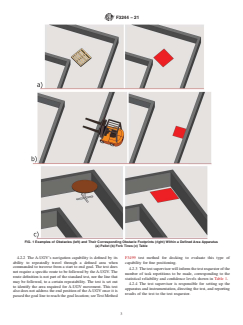
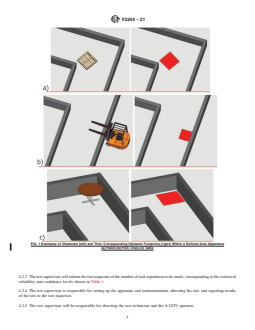
5.1 A-UGVs operate in a wide range of applications such as manufacturing facilities and warehouses. Fig. 1 shows three example A-UGV types and test apparatus sizes to test A-UGVs intended for different vehicle tasks, types, sizes, and capabilities. Such sites can have both defined and undefined areas that are structured and unstructured. The testing results of the candidate A-UGV shall describe, in a statistically significant way, the ability of the A-UGV to navigate through a defined area with or without impairments. Whether or not an A-UGV is able to deviate from its path, or uses features of the local environment as input to its navigation method or both, should not result in a different test method. Rather, the capabilities of the A-UGV to adapt its navigation method in a given environment will be objectively determined by its performance in the test method.
5.2 Three different manners in which a test method apparatus can be rendered are specified for use: physical boundaries, virtual boundaries, and floor markings (see Section 6 for apparatus specifics). Two types of impairments are specified that can be utilized as the defined area as part of a navigation test: obstacles and communication impairments (see Section 7 for more detail). The apparatuses and impairments chosen shall be appropriate to the application and environment in which the A-UGV will be used.
5.3 These test methods address A-UGV performance requirements expressed by A-UGV manufacturers and potential A-UGV users. The performance data captured by these test methods are indicative of the capabilities of the A-UGV and the application represented by the test.
5.4 The test apparatuses are scalable to constrain A-UGV sizes in defined areas to meet current and advanced next generation manufacturing and distribution facility operations.
5.5 The standard apparatuses are specified to be easily fabricated to facilitate self-evaluation by A-UGV developers and users and provide practice tasks for...
SCOPE
1.1 Purpose:
1.1.1 The purpose of this test method is to evaluate an automatic, automated, or autonomous-unmanned ground vehicle’s (A-UGV) capability of traversing through a defined space with limited A-UGV clearance. This test method is intended for use by A-UGV manufacturers, installers, and users. This test method defines a set of generic 2D area shapes representative of user applications and for different A-UGV types.
1.1.2 A-UGVs shall possess a certain set of navigation capabilities appropriate to A-UGV operations. Two examples of such capabilities include A-UGV movement between structures that define the vehicle path or obstacle avoidance. A navigation system is the monitoring and controlling functions of the A-UGV, providing frequent A-UGV updates of vehicle movement from one place to another. A-UGV environments often include various constraints to A-UGV mobility, such as boundaries and obstacles. In this test method, apparatuses, impairments, procedures, tasks, and metrics are specified that apply constraints and thereby, standard test methods for determining an A-UGV’s navigation capabilities are defined.
1.1.3 This test method is scalable to provide a range of dimensions to constrain the A-UGV mobility during task performance.
1.1.4 A-UGVs shall be able to handle many types of open and defined area complexities with appropriate precision and accuracy to perform a particular task.
1.1.5 The required mobility capabilities include either preprogrammed movement, autonomous movement, or a combination of both, from a start location to an end location. Further mobility requirements may include: sustained speeds, vehicle reconfiguration to pass through defined spaces, payload, A-UGV movement within constrained volumes, A-UGV avoidance of obstacles while navigating, or other vehicle capabilities, or combinations thereof. This test method is designed such that a candidate A-UGV can be evaluated as to whe...
- Status
- Published
- Publication Date
- 30-Jun-2021
- Technical Committee
- F45 - Robotics, Automation, and Autonomous Systems
- Drafting Committee
- F45.02 - A-UGV Docking and Navigation
Overview
ASTM F3244-21 is a vital standard published by ASTM International that specifies a structured test method to evaluate the navigation capabilities of automatic, automated, or autonomous-unmanned ground vehicles (A-UGVs) within defined areas. This standard applies to a broad range of A-UGVs, such as those used in manufacturing facilities and warehouses, where navigation through both structured and unstructured, physically or virtually bounded spaces is critical. The primary objective of ASTM F3244-21 is to provide a consistent, scalable framework for assessing how effectively an A-UGV can traverse defined spaces with various operational constraints and impairments.
Key Topics
- Defined Area Navigation: The standard evaluates an A-UGV's ability to move accurately and efficiently from a specified start location to a defined end goal within a bounded area.
- Boundaries and Constraints: Test areas may be delineated by physical barriers, virtual boundaries (such as laser beams), or marked lines (floor markers), simulating real-world navigation challenges.
- Impairments: Two types of impairments can be introduced-physical obstacles and communication impairments-to assess adaptive navigation capabilities.
- Task Parameters:
- Range of area shapes and complexity levels can be tested.
- Variations include straight aisles, intersections, and areas with chamfered corners.
- Performance Metrics: Metrics such as completion time, path length, traversal speed, and success rate without collisions are used to quantify performance.
- Repeatability & Statistical Significance: The test method requires multiple repetitions for reliable measurement, supporting robust, evidence-based evaluation.
Applications
ASTM F3244-21 has practical value for a range of stakeholders in the automation and robotics fields:
- A-UGV Manufacturers: Enables objective benchmark testing of new vehicle designs against industry-standard performance criteria before deployment.
- Facility Operators and Integrators: Assists in acceptance testing and selection of A-UGVs suited to specific operational environments, including both current and next-generation manufacturing or warehouse layouts.
- A-UGV Users: Provides a means to validate vehicle capabilities in self-evaluation, training, and maintenance scenarios.
- Developers and Researchers: Offers a controlled testbed for developing and evaluating navigation algorithms, including capabilities for path following, obstacle avoidance, and adaptation to communication losses.
- Mobile Manipulators and Automated Mobility Equipment: While designed for A-UGVs, the standard is broadly applicable to other mobile robotics platforms requiring precise navigation in constrained settings.
Related Standards
For a comprehensive approach to A-UGV system evaluation and safety, ASTM F3244-21 should be used in combination with the following related standards:
- ASTM F3200: Terminology for Driverless Automatic Guided Industrial Vehicles
- ASTM F3218: Practice for Documenting Environmental Conditions for Use with A-UGV Test Methods
- ASTM F3243: Practice for Implementing Communication Impairments on A-UGV Systems
- ASTM F3327: Practice for Recording the A-UGV Test Configuration
- ASTM F3381: Practice for Describing Stationary Obstacles Used within A-UGV Test Methods
- ASTM F3499: Test Method for Confirming the Docking Performance of A-UGVs
- ANSI/ITSDF B56.5: Safety Standard for Driverless, Automatic Guided Industrial Vehicles
- ISO 3691-4:2020: Safety of Industrial Trucks - Driverless Industrial Trucks and their Systems
Conclusion
ASTM F3244-21 provides a rigorous, repeatable test method for evaluating the navigation performance of A-UGVs in defined areas, supporting safety, efficiency, and interoperability in automated operations. By adhering to this standard, stakeholders can ensure that A-UGVs meet critical navigation requirements, enhancing reliability in industrial and commercial environments. For comprehensive results, this standard should be integrated with related safety and performance documentation.
Relations
- Effective Date
- 01-Dec-2023
- Effective Date
- 01-Dec-2023
- Effective Date
- 01-Dec-2019
- Effective Date
- 15-Nov-2019
- Effective Date
- 01-Sep-2019
- Effective Date
- 01-Jul-2018
- Effective Date
- 01-Apr-2018
- Effective Date
- 01-Feb-2018
- Effective Date
- 15-Aug-2017
- Effective Date
- 01-Jul-2017
- Effective Date
- 01-Jun-2017
- Effective Date
- 15-May-2017
- Effective Date
- 15-Oct-2016
Get Certified
Connect with accredited certification bodies for this standard

BSI Group
BSI (British Standards Institution) is the business standards company that helps organizations make excellence a habit.

TÜV Rheinland
TÜV Rheinland is a leading international provider of technical services.

TÜV SÜD
TÜV SÜD is a trusted partner of choice for safety, security and sustainability solutions.
Sponsored listings
Frequently Asked Questions
ASTM F3244-21 is a standard published by ASTM International. Its full title is "Standard Test Method for Navigation: Defined Area". This standard covers: SIGNIFICANCE AND USE 5.1 A-UGVs operate in a wide range of applications such as manufacturing facilities and warehouses. Fig. 1 shows three example A-UGV types and test apparatus sizes to test A-UGVs intended for different vehicle tasks, types, sizes, and capabilities. Such sites can have both defined and undefined areas that are structured and unstructured. The testing results of the candidate A-UGV shall describe, in a statistically significant way, the ability of the A-UGV to navigate through a defined area with or without impairments. Whether or not an A-UGV is able to deviate from its path, or uses features of the local environment as input to its navigation method or both, should not result in a different test method. Rather, the capabilities of the A-UGV to adapt its navigation method in a given environment will be objectively determined by its performance in the test method. 5.2 Three different manners in which a test method apparatus can be rendered are specified for use: physical boundaries, virtual boundaries, and floor markings (see Section 6 for apparatus specifics). Two types of impairments are specified that can be utilized as the defined area as part of a navigation test: obstacles and communication impairments (see Section 7 for more detail). The apparatuses and impairments chosen shall be appropriate to the application and environment in which the A-UGV will be used. 5.3 These test methods address A-UGV performance requirements expressed by A-UGV manufacturers and potential A-UGV users. The performance data captured by these test methods are indicative of the capabilities of the A-UGV and the application represented by the test. 5.4 The test apparatuses are scalable to constrain A-UGV sizes in defined areas to meet current and advanced next generation manufacturing and distribution facility operations. 5.5 The standard apparatuses are specified to be easily fabricated to facilitate self-evaluation by A-UGV developers and users and provide practice tasks for... SCOPE 1.1 Purpose: 1.1.1 The purpose of this test method is to evaluate an automatic, automated, or autonomous-unmanned ground vehicle’s (A-UGV) capability of traversing through a defined space with limited A-UGV clearance. This test method is intended for use by A-UGV manufacturers, installers, and users. This test method defines a set of generic 2D area shapes representative of user applications and for different A-UGV types. 1.1.2 A-UGVs shall possess a certain set of navigation capabilities appropriate to A-UGV operations. Two examples of such capabilities include A-UGV movement between structures that define the vehicle path or obstacle avoidance. A navigation system is the monitoring and controlling functions of the A-UGV, providing frequent A-UGV updates of vehicle movement from one place to another. A-UGV environments often include various constraints to A-UGV mobility, such as boundaries and obstacles. In this test method, apparatuses, impairments, procedures, tasks, and metrics are specified that apply constraints and thereby, standard test methods for determining an A-UGV’s navigation capabilities are defined. 1.1.3 This test method is scalable to provide a range of dimensions to constrain the A-UGV mobility during task performance. 1.1.4 A-UGVs shall be able to handle many types of open and defined area complexities with appropriate precision and accuracy to perform a particular task. 1.1.5 The required mobility capabilities include either preprogrammed movement, autonomous movement, or a combination of both, from a start location to an end location. Further mobility requirements may include: sustained speeds, vehicle reconfiguration to pass through defined spaces, payload, A-UGV movement within constrained volumes, A-UGV avoidance of obstacles while navigating, or other vehicle capabilities, or combinations thereof. This test method is designed such that a candidate A-UGV can be evaluated as to whe...
SIGNIFICANCE AND USE 5.1 A-UGVs operate in a wide range of applications such as manufacturing facilities and warehouses. Fig. 1 shows three example A-UGV types and test apparatus sizes to test A-UGVs intended for different vehicle tasks, types, sizes, and capabilities. Such sites can have both defined and undefined areas that are structured and unstructured. The testing results of the candidate A-UGV shall describe, in a statistically significant way, the ability of the A-UGV to navigate through a defined area with or without impairments. Whether or not an A-UGV is able to deviate from its path, or uses features of the local environment as input to its navigation method or both, should not result in a different test method. Rather, the capabilities of the A-UGV to adapt its navigation method in a given environment will be objectively determined by its performance in the test method. 5.2 Three different manners in which a test method apparatus can be rendered are specified for use: physical boundaries, virtual boundaries, and floor markings (see Section 6 for apparatus specifics). Two types of impairments are specified that can be utilized as the defined area as part of a navigation test: obstacles and communication impairments (see Section 7 for more detail). The apparatuses and impairments chosen shall be appropriate to the application and environment in which the A-UGV will be used. 5.3 These test methods address A-UGV performance requirements expressed by A-UGV manufacturers and potential A-UGV users. The performance data captured by these test methods are indicative of the capabilities of the A-UGV and the application represented by the test. 5.4 The test apparatuses are scalable to constrain A-UGV sizes in defined areas to meet current and advanced next generation manufacturing and distribution facility operations. 5.5 The standard apparatuses are specified to be easily fabricated to facilitate self-evaluation by A-UGV developers and users and provide practice tasks for... SCOPE 1.1 Purpose: 1.1.1 The purpose of this test method is to evaluate an automatic, automated, or autonomous-unmanned ground vehicle’s (A-UGV) capability of traversing through a defined space with limited A-UGV clearance. This test method is intended for use by A-UGV manufacturers, installers, and users. This test method defines a set of generic 2D area shapes representative of user applications and for different A-UGV types. 1.1.2 A-UGVs shall possess a certain set of navigation capabilities appropriate to A-UGV operations. Two examples of such capabilities include A-UGV movement between structures that define the vehicle path or obstacle avoidance. A navigation system is the monitoring and controlling functions of the A-UGV, providing frequent A-UGV updates of vehicle movement from one place to another. A-UGV environments often include various constraints to A-UGV mobility, such as boundaries and obstacles. In this test method, apparatuses, impairments, procedures, tasks, and metrics are specified that apply constraints and thereby, standard test methods for determining an A-UGV’s navigation capabilities are defined. 1.1.3 This test method is scalable to provide a range of dimensions to constrain the A-UGV mobility during task performance. 1.1.4 A-UGVs shall be able to handle many types of open and defined area complexities with appropriate precision and accuracy to perform a particular task. 1.1.5 The required mobility capabilities include either preprogrammed movement, autonomous movement, or a combination of both, from a start location to an end location. Further mobility requirements may include: sustained speeds, vehicle reconfiguration to pass through defined spaces, payload, A-UGV movement within constrained volumes, A-UGV avoidance of obstacles while navigating, or other vehicle capabilities, or combinations thereof. This test method is designed such that a candidate A-UGV can be evaluated as to whe...
ASTM F3244-21 is classified under the following ICS (International Classification for Standards) categories: 35.240.60 - IT applications in transport; 43.020 - Road vehicles in general. The ICS classification helps identify the subject area and facilitates finding related standards.
ASTM F3244-21 has the following relationships with other standards: It is inter standard links to ASTM F3200-23, ASTM F3327-23, ASTM F3381-19, ASTM F3200-19, ASTM F3218-19, ASTM F3327-18, ASTM F3200-18a, ASTM F3200-18, ASTM F3200-17b, ASTM F3218-17, ASTM F3200-17a, ASTM F3200-17, ASTM F3200-16. Understanding these relationships helps ensure you are using the most current and applicable version of the standard.
ASTM F3244-21 is available in PDF format for immediate download after purchase. The document can be added to your cart and obtained through the secure checkout process. Digital delivery ensures instant access to the complete standard document.
Standards Content (Sample)
This international standard was developed in accordance with internationally recognized principles on standardization established in the Decision on Principles for the
Development of International Standards, Guides and Recommendations issued by the World Trade Organization Technical Barriers to Trade (TBT) Committee.
Designation:F3244 −21
Standard Test Method for
Navigation: Defined Area
This standard is issued under the fixed designation F3244; the number immediately following the designation indicates the year of
original adoption or, in the case of revision, the year of last revision. A number in parentheses indicates the year of last reapproval. A
superscript epsilon (´) indicates an editorial change since the last revision or reapproval.
1. Scope 1.1.6 This test method is used to evaluate the capabilities of
a single A-UGV operating with commands and data provided
1.1 Purpose:
to it by an operator (for example, locations of goal points, map
1.1.1 The purpose of this test method is to evaluate an
of the environment), as well as those derived from its own
automatic, automated, or autonomous-unmanned ground vehi-
sensors (for example, locations of obstacles in the
cle’s (A-UGV) capability of traversing through a defined space
environment), as opposed to information provided to it from
withlimitedA-UGVclearance.Thistestmethodisintendedfor
another A-UGV or fleet controller. There may be future
use by A-UGV manufacturers, installers, and users. This test
standardsthataddressthecapabilitiesofmultipleA-UGVs–or
method defines a set of generic 2D area shapes representative
fleets – that work together.
of user applications and for different A-UGV types.
1.1.7 Thistestmethoddoesnotconsidertheactofacquiring
1.1.2 A-UGVs shall possess a certain set of navigation
or removing payloads, such as picking up/dropping off a pallet
capabilities appropriate to A-UGV operations. Two examples
or connecting to/disconnecting from a trailer, during naviga-
of such capabilities include A-UGV movement between struc-
tion. The A-UGV may have a payload as part of its configu-
tures that define the vehicle path or obstacle avoidance. A
ration (see Practice F3327) that will be unchanged during the
navigation system is the monitoring and controlling functions
test. A future standard may address these types of capabilities
of the A-UGV, providing frequent A-UGV updates of vehicle
during navigation.
movement from one place to another. A-UGV environments
1.1.8 Performing Location—This test method shall be per-
often include various constraints to A-UGV mobility, such as
formed in a location where the apparatus and environmental
boundaries and obstacles. In this test method, apparatuses,
test conditions can be fully implemented. Environmental con-
impairments, procedures, tasks, and metrics are specified that
ditions are specified and recorded (see Practice F3218).
apply constraints and thereby, standard test methods for deter-
mining an A-UGV’s navigation capabilities are defined. 1.1.9 Additional test methods within Committee F45 are
1.1.3 This test method is scalable to provide a range of anticipated to be developed to address additional or advanced
dimensions to constrain the A-UGV mobility during task mobility capability requirements, such as a fleet of A-UGVs
performance. coordinating their movement through a facility.
1.1.4 A-UGVs shall be able to handle many types of open
1.2 Units—The values stated in SI units are to be regarded
and defined area complexities with appropriate precision and
as the standard.The values given in parentheses are not precise
accuracy to perform a particular task.
mathematical conversions to inch-pound units. They are close
1.1.5 The required mobility capabilities include either pre-
approximate equivalents for the purpose of specifying material
programmed movement, autonomous movement, or a combi-
dimensions or quantities that are readily available to avoid
nation of both, from a start location to an end location. Further
excessive fabrication costs of test apparatuses while maintain-
mobility requirements may include: sustained speeds, vehicle
ing repeatability and reproducibility of the test method results.
reconfiguration to pass through defined spaces, payload,
These values given in parentheses are provided for information
A-UGV movement within constrained volumes, A-UGV
only and are not considered standard.
avoidance of obstacles while navigating, or other vehicle
1.3 This standard does not purport to address all of the
capabilities, or combinations thereof. This test method is
safety concerns, if any, associated with its use. Safety standards
designed such that a candidate A-UGV can be evaluated as to
such as ANSI/ITSDF B56.5, ISO 3691-4:2020, or other safety
whether it meets a set of user application requirements.
standards should be followed. It is the responsibility of the user
of this standard to establish appropriate safety, health, and
1 environmental practices and determine the applicability of
This test method is under the jurisdiction of ASTM Committee F45 on
Robotics, Automation, and Autonomous Systems and is the direct responsibility of regulatory limitations prior to use.
Subcommittee F45.02 on Docking and Navigation.
1.4 This international standard was developed in accor-
Current edition approved July 1, 2021. Published August 2021. Originally
dance with internationally recognized principles on standard-
approved in 2017. Last previous edition approved in 2017 as F3244 – 17. DOI:
10.1520/F3244-21. ization established in the Decision on Principles for the
Copyright © ASTM International, 100 Barr Harbor Drive, PO Box C700, West Conshohocken, PA 19428-2959. United States
F3244−21
Development of International Standards, Guides and Recom- matchingthatofthetop-downcontourareaoftheobstacle(that
mendations issued by the World Trade Organization Technical is,itsoutermosthorizontaledges),usedtodescribetheposition
Barriers to Trade (TBT) Committee. and orientation of the obstacle in the environment relative to
the boundaries.
2. Referenced Documents
3.2.6.1 Discussion—See Fig. 1 for examples of obstacle
footprints for different types of obstacles.
2.1 ASTM Standards:
F3200 Terminology for DriverlessAutomatic Guided Indus-
3.2.7 start, n—location at which the A-UGV will begin the
trial Vehicles
test and is defined by a line perpendicular to vehicle move-
F3218 Practice for Documenting Environmental Conditions
ment.
for Utilization with A-UGV Test Methods
3.2.8 task, n—sequence of movements and measurements
F3243 Practice for Implementing Communications Impair-
that comprise one repetition within a test. F3200
ments on A-UGV Systems
3.2.8.1 Discussion—Forthistestmethod,onetaskisdefined
F3327 PracticeforRecordingtheA-UGVTestConfiguration
as when the A-UGV moves from the specified start location
F3381 Practice for Describing Stationary Obstacles Utilized
(PointA) to the goal location (Point B or C), as shown in Figs.
within A-UGV Test Methods
2-8, traversing in a specified direction (forward or reverse).
F3499 Test Method for Confirming the Docking Perfor-
Wherepossible,theA-UGVshouldreturntothestartlineusing
mance of A-UGVs
autonomous control without operator intervention.
2.2 ANSI/ITSDF Standard:
ANSI/ITSDF B56.5 Safety Standard for Driverless, Auto- 4. Summary of Test Method
matic Guided Industrial Vehicles and Automated Func-
4.1 Area Definition—This test method consists of traversing
tions of Manned Industrial Vehicles
multiple repetitions of a single task within a specified naviga-
2.3 ISO Standard:
tion area defined by physical barriers, virtual barriers, floor
ISO 3691-4:2020 Industrial Trucks - Safety Requirements
markings, or combinations thereof. Further details are given in
AndVerification-Part4:DriverlessIndustrialTrucksAnd
Section 6. Figs. 2-8 show possible defined area navigation
Their Systems
constraints and references to locations within the apparatus (A,
B, and C) and start and goal lines. Using these shapes, the test
3. Terminology
method can be used to determine an A-UGV’s capability at
3.1 Definitions—Terminology F3200 defines terms that may
traversing through an area of specified dimensions. The test
be used throughout this standard.
method could also be used to determine the minimum space in
which the A-UGV is able to traverse.
3.2 Definitions of Terms Specific to This Standard:
3.2.1 end goal, n—location at which a task will be com-
4.2 Navigation Test Method:
pleted and is defined by a line perpendicular to vehicle
4.2.1 The A-UGV drives through the apparatus (examples
movement.
are shown in Fig. 9 and Fig. 10). The apparatus layout is
defined by physical boundaries, virtual boundaries, or floor
3.2.2 goal(s), n—location(s) the vehicle will pass through as
markings around the area where the A-UGV will drive. Start
a task is progressed.
and goal lines are positioned to define a start location (A) and
3.2.3 impairment(s), n—an object, feature, or quality of the
goal locations (B or C). The completion of one task repetition
situation/environment that is utilized to disrupt intended
is when the A-UGV traverses from the start location and its
A-UGV operation, such as the inclusion of obstacles or
performance satisfies the intended behavior set by the test
communication failures during task performance. F3200
requestor, which generally is set as crossing the goal line and
3.2.3.1 Discussion—For this test method,A-UGV operation
reaching the goal location without colliding with the environ-
refers to the A-UGV navigating from the start to the goal.
ment. If the test requestor selects obstacles or communication
3.2.4 intended behavior, n—A-UGV state or activity, set by
impairments to be used in the defined area during navigation,
the test requestor, that defines success criteria for the comple-
then the intended behavior for the A-UGV may be set to stop
tion of a task repetition.
and cease navigation once the impairment is encountered. The
3.2.5 obstacle, n—static or moving object or feature that
A-UGV shall not make contact with any boundary or obstacle
obstructs the intended movement. F3200
(unless with only a contact-sensing device that is used to
navigate) nor deviate from the defined area during a task. If the
3.2.6 obstacle footprint, n—a rectangular area of space that
A-UGV makes contact with any barrier or crosses a virtual
will be occupied by an obstacle during testing with dimensions
barrier during a repetition, the result is a test failure. The test
requestorhastheauthoritytoselectdefinedareawidth(s)(x or
a
For referenced ASTM standards, visit the ASTM website, www.astm.org, or
y , or both, in Figs. 2-8) for the test, in addition to several other
a
contact ASTM Customer Service at service@astm.org. For Annual Book of ASTM
variables related to the boundaries (for example, height,
Standards volume information, refer to the standard’s Document Summary page on
chamfers) and impairments (for example, obstacle dimensions,
the ASTM website.
Available from Industrial Truck Standards Development Foundation (ITSDF),
position in the apparatus). The defined area width may be
1750 K St. NW, Suite 460, Washington, DC 20006.
altered by the test requestor prior to a test with the aim of
Available from International Organization for Standardization (ISO), ISO
identifying the minimum space that can be traversed by the
Central Secretariat, Chemin de Blandonnet 8, CP 401, 1214 Vernier, Geneva,
Switzerland, https://www.iso.org. A-UGV, if desired.
F3244−21
FIG. 1Examples of Obstacles (left) and Their Corresponding Obstacle Footprints (right) Within a Defined Area Apparatus
(a) Pallet (b) Fork Tines (c) Table
4.2.2 The A-UGV’s navigation capability is defined by its F3499 test method for docking to evaluate this type of
ability to repeatedly travel through a defined area when capability for fine positioning.
commanded to traverse from a start to end goal. The test does
4.2.3 Thetestsupervisorwillinformthetestrequestorofthe
not require a specific route to be followed by theA-UGV. The
number of task repetitions to be made, corresponding to the
route definition is not part of the standard test, nor the line that
statistical reliability and confidence levels shown in Table 1.
may be followed, to a certain repeatability. The test is set out
4.2.4 The test supervisor is responsible for setting up the
to identify the area required for A-UGV movement. This test
apparatus and instrumentation, directing the test, and reporting
also does not address the end position of theA-UGV once it is
results of the test to the test requestor.
passed the goal line to reach the goal location; seeTest Method
F3244−21
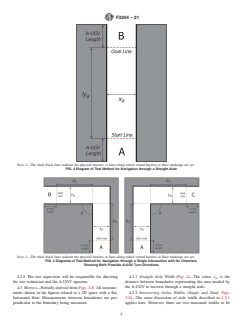
NOTE 1—The thick black lines indicate the physical barriers or lines along which virtual barriers or floor markings are set.
FIG. 2Diagram of Test Method for Navigation through a Straight Aisle
NOTE 1—The thick black lines indicate the physical barriers or lines along which virtual barriers or floor markings are set.
FIG. 3Diagrams of Test Method for Navigation through a Single Intersection with No Chamfers,
Showing Both Possible A-UGV Turn Directions
4.2.5 The test supervisor will be responsible for directing 4.3.1 Straight Aisle Width (Fig. 2)—The value, x,isthe
a
the test technician and the A-UGV operator.
distance between boundaries representing the area needed by
the A-UGV to traverse through a straight aisle.
4.3 Metrics—Partially derived from Figs. 2-8. All measure-
4.3.2 Intersecting Aisles Widths (Single and Dual, Figs.
ments shown in the figures related to a 2D space with a flat,
3-8)—The same discussion of aisle width described in 4.3.1
horizontal floor. Measurements between boundaries are per-
pendicular to the boundary being measured. applies here. However, there are two measured widths to be
F3244−21
NOTE 1—The thick black lines indicate the physical barriers or lines along which virtual barriers or floor markings are set.
FIG. 4Diagrams of Test Method for Navigation through a Single Intersection, Showing Interior Chamfer
Defined by d and d and Exterior Chamfer Defined by d and d , Showing Both Possible A-UGV Turn Directions
1 2 3 4
NOTE 1—The thick black lines indicate the physical barriers or lines along which virtual barriers or floor markings are set.
FIG. 5Diagrams of Test Method for Navigation through a Single Intersection with Interior Chamfer Only,
Defined by d and d , Showing Both Possible A-UGV Turn Directions
1 2
determined: the initial aisle width, x , and the final aisle width, 4.3.4 Obstacle Inclusion—Obstacles (o1, o2, etc.) may be
a
y . The combination of these metrics describes the dimensions
included inside of the defined area to impair A-UGV naviga-
a
of traversable 2D space by an A-UGV through an intersection
tion. Practice F3381 can be used to describe the characteristics
of θ degrees. The default value of θ is 90° for a perpendicular
of the obstacles used. The locations and orientations of the
intersection, but angles other than 90° may be selected by the
obstacle footprints are recorded (|x |, |y |, θ ,|x |, |y |, θ ,
o1 o1 o1 o2 o2 o2
test requestor.
etc.) with respect to an obstacle origin point (p , p , etc.) and
o1 o2
4.3.3 Chamfered Corners—These enable the test requestor
a boundary in the apparatus (see Fig. 10). There is no limit on
to further specify the shape of the corners of an area. Chamfers
thenumberofobstaclesthatcanbeincluded.Obstaclesmaybe
are defined by setback distances for the interior chamfer (d
positioned in such a way that the A-UGV is not able to reach
and d ) see Fig. 5 and the exterior chamfer (d and d ), see Fig.
2 3 4
the goal, which would require that the intended behavior be set
6. The setback distance is that distance between the virtual
accordingly (see 4.3.8).
corner and the start of the chamfer identifying the interior
4.3.4.1 Dynamic/Moving Objects—A future standard will
space. The interior chamfer enables the width of the aisle
provide the means to describe a moving object, similar to what
intersection to be increased from that identified in the single
is done for stationary obstacles in Practice F3381.Itis
intersection (see Fig. 5) or dual intersection (see Fig. 8). The
expected that this standard test method will later be revised to
exterior chamfer enables the width of the aisle intersection to
accommodatetoinclusionofmovingobjectsasobstacles,such
be decreased from that identified in the single intersection (see
asdefiningthestartandendlocationoftheobstacle’strajectory
Fig. 6). Both interior and exterior chamfers can be used in the
single intersection (see Fig. 4). as it moves in the defined area.
F3244−21
NOTE 1—The thick black lines indicate the physical barriers or lines along which virtual barriers or floor markings are set.
FIG. 6Diagram of Test Method for Navigation through a Single Intersection with Exterior Chamfer Only,
Defined by d and d , Showing Both Possible A-UGV Turn Directions
3 4
NOTE 1—The thick black lines indicate the physical barriers or lines along which virtual barriers or floor markings are set.
FIG. 7Diagram of Test Method for Navigation through a Dual Intersection with No Chamfers
4.3.5 Completion Time—The start time of a task is consid- aisleswhereθisnot90°,asimilarcalculationusingthedefined
eredthemomenttheentirebodyoftheA-UGVcrossesthestart area’s center line should be made.
line, exiting the start location (A). The end time of a task is 4.3.6.3 For larger, more complex areas, the path length is
considered the moment the entire body of the A-UGV crosses measured by recording the approximate route taken by the
the goal line entering the end goal location (B or C) (see Figs. A-UGV through the apparatus, calculated using the center line
2-8).Taskcompletiontimeisrecordedtoanaccuracyof1sfor of the defined area encompassed.
each repetition, and test completion time is recorded as an 4.3.7 Traversal Speed—The speed, measured in meters per
average of all completed task repetitions. second, determined by dividing the path length by the comple-
4.3.6 Path Length—The path length is defined for its use in tion time for a single repetition. Average traversal speed is
the calculation of the average traversal speed. It is the calculated by dividing the path length by the average time,
measurement of a path down the center of the defined area, not where average time is the total duration for n repetitions,
the actual path traversed by the A-UGV. Curved traversal divided by n.
distances are not measured. 4.3.8 Intended Behavior—The test requestor can set success
4.3.6.1 For the straight aisle, path length is ly (see Fig. 2). criteria for each test, such as passing the goal line to reach the
a
4.3.6.2 Fortheintersectingaisleswhereθis90°,pathlength goal location without colliding with the boundaries or stopping
is (ly – y /2) + (lx – x /2) (see Figs. 3-8). For intersecting inplacewhenanimpairmentisencounteredthatdoesnotallow
a a a a
F3244−21
NOTE 1—The thick black lines indicate the physical barriers or lines along which virtual barriers or floor markings are set.
FIG. 8Diagram of Test Method for Navigation through a Dual Intersection with Interior Chamfers Defined by d and d
1 2
FIG. 9Example: Dual Intersection with Interior Chamfers Apparatus with Physical Barriers
the A-UGV to reach the goal. There are two dimensions of (3) The A-UGV performed the navigation task without
intended behavior to be defined: human intervention; for example, the A-UGV continues task
4.3.8.1 Goal Reaching Effıcacy—Success criteria to define performance on its own.
whether or not the A-UGV must reach the goal location to (4) TheA-UGV performed the navigation task with human
signify a complete repetition. The test requestor may require intervention; for example, theA-UGV was helped to remove a
the A-UGV to not reach the goal after an impairment is stop by a test technician or other person as expected.
encountered, such as a communication drop out. 4.3.9 A-UGV Aisle Heading/Direction—In straight aisles,
4.3.8.2 Maximum Task Time—The maximum allowed the A-UGV may be commanded to use a particular heading
completion time for a successful repetition. This is an optional movingforwardorinreverse.Theheadinganddirectionthatis
success criteria that can be set by the test requestor as part of used by the A-UGV will be recorded for each test.
the intended behavior of the A-UGV, but is not required. 4.3.10 A-UGV Turn Direction—In turning between inter-
4.3.8.3 Additional Success Criteria—Thetestrequestormay sectingaisles(seeFigs.3-8),theA-UGVcanbecommandedto
set additional success criteria that requires particular observ- traverse between the start line (A) and either of the two
able responses from the A-UGV, such as: possible goal lines (B or C), each of which result in a different
(1) TheA-UGVperformed the navigation task while main- route. The test requestor can test both routes with both vehicle
tainingaspecifiedtaskpace;forexample,withoutinterruption, orientations to determine the symmetry of A-UGV operation,
not at a slower pace, or not delayed. which would encompass two separate tests.
(2) The A-UGV performed the navigation task with an 4.3.11 Test Flexibility—Under some circumstances, a test
acceptable amount of task delay; for example, the A-UGV requestor may request a test be carried out using the intersec-
stops in route to the goal for too long (for example, 2 s) when tion shape described in 4.3.2 but with different intersection
no obstacle is the cause for stop. angle at a value other than 90°. Such a test is allowed when
F3244−21
FIG. 10Example of A-UGV Navigation within (a) Physical Barriers, (b) Virtual Barriers, (c) Floor Markings
F3244−21
TABLE 1 Number of Repetitions Required to Achieve Different
are structured and unstructured. The testing results of the
Confidence Measured Against the Probability of Success
candidate A-UGV shall describe, in a statistically significant
Threshold with Zero Failures
way, the ability of the A-UGV to navigate through a defined
Probability of Success Threshold
area with or without impairments. Whether or not an A-UGV
0.99 0.95 0.9
is able to deviate from its path, or uses features of the local
0.99 459 90 44
0.95 299 59 29
environment as input to its navigation method or both, should
Confidence 0.9 230 45 22
not result in a different test method. Rather, the capabilities of
0.85 189 37 19
theA-UGV to adapt its navigation method in a given environ-
0.8 161 32 16
ment will be objectively determined by its performance in the
test method.
requested by the test requestor prior to beginning a test,
5.2 Three different manners in which a test method appara-
although with the provision that the area definition and test
tus can be rendered are specified for use: physical boundaries,
completion follow the methods set out in 4.3.
virtual boundaries, and floor markings (see Section 6 for
4.3.12 Increasing Complexity of Navigation Areas—Areas
apparatus specifics). Two types of impairments are specified
larger than the single and dual intersection aisles shown in
that can be utilized as the defined area as part of a navigation
Figs. 2-8 can also be used as defined areas for navigation
test: obstacles and communication impairments (see Section 7
evaluation. Dimensions shall be recorded for every segment of
formoredetail).Theapparatusesandimpairmentschosenshall
the defined area in a diagram provided on the test report. An
be appropriate to the application and environment in which the
exampleofalargerdefinedareaisshowninFig.11.Thelength
A-UGV will be used.
of all aisles must adhere to the minimum course dimensions
5.3 These test methods address A-UGV performance re-
described in 6.5 (that is, aisle lengths must be at least four
quirements expressed by A-UGV manufacturers and potential
times theA-UGV length and not less than 4 m). Multiple start
A-UGV users. The performance data captured by these test
and goal lines can be specified if multiple routes are available
methods are indicative of the capabilities of the A-UGV and
to exit the start location or enter the goal location, as shown in
the application represented by the test.
Fig. 11.
4.3.13 A-UGV Positioning Data—The position of the
5.4 The test apparatuses are scalable to constrain A-UGV
A-UGV throughout the defined area test apparatus should be
sizes in defined areas to meet current and advanced next
recorded throughout the test using methods such as video
generation manufacturing and distribution facility operations.
recording, motion capture, or self-reported location informa-
5.5 The standard apparatuses are specified to be easily
tion from the A-UGV, or combinations thereof. The type of
fabricated to facilitate self-evaluation by A-UGV developers
recording method should be noted on the report form.
and users and provide practice tasks for A-UGV developers,
users, and potential users that exercise A-UGV actuators,
5. Significance and Use
sensors, and controls.
5.1 A-UGVs operate in a wide range of applications such as
manufacturing facilities and warehouses. Fig. 1 shows three 5.6 Although the test methods were developed first for
exampleA-UGVtypes and test apparatus sizes to testA-UGVs A-UGVs, they may also be applicable to mobile manipulators
intended for different vehicle tasks, types, sizes, and capabili- and other types of industrial automated mobility equipment, as
ties. Such sites can have both defined and undefined areas that well as in other domains.
FIG. 11Example Diagram of Test Method for Navigation through a Larger, More Complex Defined Area
F3244−21
6. Apparatus hangingdownfromthebarshoulddefinetheextentofthelaser
NOTE 1—Boundaries for the test methods can be created physically, by
safety zone and be of sufficient length to interrupt the laser
virtual lines, or with floor markers.
beamscreatingthevirtualboundariesofthedefinedarea.Other
6.1 Physical Boundaries—All test methods can be imple-
prominent points on the A-UGV such as the fork tines tips
mented as physical boundaries. Fig. 9 shows an example. The
should also have similar bars and targets connected to ensure
environment can be constructed from flat, bendable materials
movement of any part of the A-UGV outside the defined area
such as thin wood panels, which, when coated uniformly, can
such that any part of the A-UGV, including safety sensors
be reliably detected by theA-UGV being tested and bound the
fields, crossing the floor markings that bound the defined area
defined area such that any part of the vehicle crossing the
will be detected and the test will then fail. The height of the
boundary will be detected. The height of the physical bound-
laser beams (lb1, lb2, etc.) from the ground to the beam is
aries (b1, b2, etc.) from the ground to the top of the wall/panel
recorded (h , h , etc.) and marked in the diagram (see Fig.
lb1 lb2
is recorded (h ,h , etc.) and marked in the diagram (see Fig.
b1 b2
14). Multiple heights of each segment of laser beams can be
12). Multiple heights of each segment of boundaries can be
specified as needed.
specified as needed.
6.3 Floor Markings—Boundaries of the Defined Area may
6.2 Virtual Boundaries (Laser Beams)—Boundaries of the
be set out by floor markings (for example tape or painted lines)
environment may be defined by several laser beam sensors,
as exemplified in Fig. 10. When using such markings, devices
each having a laser transceiver at one end and a reflector on the
must be added to the vehicle which show the motion of the
opposite end as exemplified in Fig. 10(b). The lasers are set up
vehicle outline on the floor and enable movement of any part
to bound the defined area such that no part of the A-UGV can
of the vehicle outside the defined Area to be detected. Laser
cross the boundary without breaking the beam(s). The laser
pointers, marking pens, or other easily detected floor marking
shall provide electrical connection to an indicator light or
devices should be attached to the vehicle, as shown in Fig. 13,
computer to inform the test supervisor if the laser beam has
with the laser pointing vertically to the floor or the marker
been interrupted. The laser beam height should be above the
mounted vertically and touching the floor. Similar to 6.2, the
beam height of the vehicle’s laser safety sensor to remove the
outermostedgeofthelasersafetyzoneofthevehiclemustalso
possibility of interference between the two different sensors.
be defined by bars holding a floor pen or laser pointer at their
When a vehicle laser safety sensor is installed, the vehicle will
end. These markers on the vehicle record the motion of the
stop when its beam is reflected by a physical boundary inside
vehicle outline such that any part of the A-UGV, including
the stop zone. This is a test failure. However, for the virtual
sensor fields, crossing the floor markings that bound the
boundary, intersection of the defined area and the safety stop
DefinedArea will be detected and the test will then fail. When
zoneneedsadditionalhardwaretodefinethestopzoneinaway
laser pointers are used a means to adequately record the tracks
that enables detection by the laser beam boundary. Two or
more flat, non-reflective targets should be attached to the of vehicle motion, video camera(s), should be considered to
vehicle, as shown in Fig. 13 using simple bars. The target assist in recording and post processing the test results.
FIG. 12Single Intersection Defined Area Apparatus with Four Example Boundary Heights
F3244−21
FIG. 13(a) On-vehicle Target Apparatus for Virtual Barrier Tests and (b) On-vehicle Apparatus for Floor Marking Tests
FIG. 14Single Aisle Defined Area Apparatus with Two Example Laser Beam Heights
6.4 A-UGV Navigation Aid—Any physical or virtual aug- an obstacle is positioned to block part of the defined area such
mentations required to specify the A-UGV route taken (for that theA-UGV is not able to reach the goal, then the intended
example, magnetic tape or virtual map generation), goal behavior may be set for the A-UGV to stop, cease operations,
locations (for example, QR codes or virtual coordinates), or and request intervention assistance. See 4.3.8 for more infor-
other requirements needed to allow A-UGV navigation should mation.
be applied and recorded on the test report prior to the test.Any
7.2 Obstacles—Obstacles (o1, o2, etc.) may be utilized in
augmentations to the defined area should be added to the
the defined area of the apparatus. The characteristics of the
diagram on the test report.
obstacles should be recorded using Practice F3381 or recorded
6.5 Course Dimensions—The course dimensions shall be as an object from the Standard Guide for Set of Objects Used
independent of any environ
...
This document is not an ASTM standard and is intended only to provide the user of an ASTM standard an indication of what changes have been made to the previous version. Because
it may not be technically possible to adequately depict all changes accurately, ASTM recommends that users consult prior editions as appropriate. In all cases only the current version
of the standard as published by ASTM is to be considered the official document.
Designation: F3244 − 17 F3244 − 21
Standard Test Method for
Navigation: Defined Area
This standard is issued under the fixed designation F3244; the number immediately following the designation indicates the year of
original adoption or, in the case of revision, the year of last revision. A number in parentheses indicates the year of last reapproval. A
superscript epsilon (´) indicates an editorial change since the last revision or reapproval.
1. Scope
1.1 Purpose:
1.1.1 The purpose of this test method is to evaluate an A-unmanned automatic, automated, or autonomous-unmanned ground
vehicle’s (A-UGV) capability of traversing through a defined space with limited A-UGV clearance. This test method is intended
for use by A-UGV manufacturers, installers, and users. This test method defines a set of generic 2D area shapes representative of
user applications and for different A-UGV types.
1.1.2 A-UGVs shall possess a certain set of navigation capabilities appropriate to A-UGV operations such as operations. Two
examples of such capabilities include A-UGV movement between structures that define the vehicle path. path or obstacle
avoidance. A navigation system is the monitoring and controlling functions of the A-UGV, providing frequent A-UGV updates of
vehicle movement from one place to another. A-UGV environments often include various constraints to A-UGV mobility. mobility,
such as boundaries and obstacles. In this test method, apparatuses, impairments, procedures, tasks, and metrics are specified that
apply constraints and thereby, standard test methods for determining an A-UGV’s navigation capabilities are defined.
1.1.3 This test method is scalable to provide a range of dimensions to constrain the A-UGV mobility during task performance.
1.1.4 A-UGVs shall be able to handle many types of open and defined area complexities with appropriate precision and accuracy
to perform a particular task.
1.1.5 The required mobility capabilities include preprogrammed or autonomous movement or botheither preprogrammed
movement, autonomous movement, or a combination of both, from a start pointlocation to an end point.location. Further mobility
requirements may include: sustained speeds, vehicle reconfiguration to pass through defined spaces, payload, A-UGV movement
within constrained volumes, A-UGV avoidance of obstacles while navigating, or other vehicle capabilities, or combinations
thereof. This test method is designed such that a candidate A-UGV can be evaluated as to whether or not it meets a set of user
application requirements.
1.1.6 This test method is used to evaluate the capabilities of a single A-UGV operating with commands and data provided to it
by an operator (for example, locations of goal points, map of the environment), as well as those derived from its own sensors (for
example, locations of obstacles in the environment), as opposed to information provided to it from another A-UGV or fleet
controller. There may be future standards that address the capabilities of multiple A-UGVs – or fleets – that work together.
1.1.7 This test method does not consider the act of acquiring or removing payloads, such as picking up/dropping off a pallet or
connecting to/disconnecting from a trailer, during navigation. The A-UGV may have a payload as part of its configuration (see
Practice F3327) that will be unchanged during the test. A future standard may address these types of capabilities during navigation.
This test method is under the jurisdiction of ASTM Committee F45 on Driverless Automatic Guided Industrial VehiclesRobotics, Automation, and Autonomous Systems
and is the direct responsibility of Subcommittee F45.02 on Docking and Navigation.
Current edition approved July 1, 2017July 1, 2021. Published October 2017August 2021. Originally approved in 2017. Last previous edition approved in 2017 as
F3244 – 17. DOI: 10.1520/F3244-17.10.1520/F3244-21.
Copyright © ASTM International, 100 Barr Harbor Drive, PO Box C700, West Conshohocken, PA 19428-2959. United States
F3244 − 21
1.1.8 Performing Location—This test method shall be performed in a location where the apparatus and environmental test
conditions can be fully implemented. Environmental conditions are specified and recorded.recorded (see Practice F3218).
1.1.9 Additional test methods within Committee F45 are anticipated to be developed to address additional or advanced mobility
capability requirements.requirements, such as a fleet of A-UGVs coordinating their movement through a facility.
1.2 Units—The values stated in SI units are to be regarded as the standard. The values given in parentheses are not precise
mathematical conversions to inch-pound units. They are close approximate equivalents for the purpose of specifying material
dimensions or quantities that are readily available to avoid excessive fabrication costs of test apparatuses while maintaining
repeatability and reproducibility of the test method results. These values given in parentheses are provided for information only
and are not considered standard.
1.3 This standard does not purport to address all of the safety concerns, if any, associated with its use. Safety standards such
as ANSI/ITSDF B56.5, BS EN 1525, ISO 3691-4:2020, or other safety standards should be followed. It is the responsibility of the
user of this standard to establish appropriate safety, health, and environmental practices and determine the applicability of
regulatory limitations prior to use.
1.4 This international standard was developed in accordance with internationally recognized principles on standardization
established in the Decision on Principles for the Development of International Standards, Guides and Recommendations issued
by the World Trade Organization Technical Barriers to Trade (TBT) Committee.
2. Referenced Documents
2.1 ASTM Standards:
F3200 Terminology for Driverless Automatic Guided Industrial Vehicles
F3218 Practice for RecordingDocumenting Environmental EffectsConditions for Utilization with A-UGV Test Methods
F3243 Practice for Implementing Communications Impairments on A-UGV Systems
F3327 Practice for Recording the A-UGV Test Configuration
F3381 Practice for Describing Stationary Obstacles Utilized within A-UGV Test Methods
F3499 Test Method for Confirming the Docking Performance of A-UGVs
2.2 ANSI/ITSDF Standard:
ANSI/ITSDF B56.5 Safety Standard for Driverless, Automatic Guided Industrial Vehicles and Automated Functions of Manned
Industrial Vehicles
2.3 BSISO Standard:
BS EN 1525 ISO 3691-4:2020 Safety of Industrial Trucks. Driverless Trucks andIndustrial Trucks - Safety Requirements And
Verification - Part 4: Driverless Industrial Trucks And Their Systems
3. Terminology
3.1 Definitions—In Terminology F3200, additional definitions relevant to this test method are given. defines terms that may be
used throughout this standard.
3.2 Definitions of Terms Specific to This Standard:
3.2.1 end goal, n—location at which a task will be completed and is defined by a line perpendicular to vehicle movement.
3.2.2 goal(s), n—location(s) the vehicle will pass through as a task is progressed.
3.2.3 impairment(s), n—an object, feature, or quality of the situation/environment that is utilized to disrupt intended A-UGV
operation, such as the inclusion of obstacles or communication failures during task performance. F3200
3.2.3.1 Discussion—
For this test method, A-UGV operation refers to the A-UGV navigating from the start to the goal.
For referenced ASTM standards, visit the ASTM website, www.astm.org, or contact ASTM Customer Service at service@astm.org. For Annual Book of ASTM Standards
volume information, refer to the standard’s Document Summary page on the ASTM website.
Available from Industrial Truck Standards Development Foundation (ITSDF), 1750 K St. NW, Suite 460, Washington, DC 20006.
Available from British Standards Institution (BSI), 389 Chiswick High Rd., London W4 4AL, U.K., http://www.bsigroup.com.International Organization for
Standardization (ISO), ISO Central Secretariat, Chemin de Blandonnet 8, CP 401, 1214 Vernier, Geneva, Switzerland, https://www.iso.org.
F3244 − 21
3.2.4 intended behavior, n—A-UGV state or activity, set by the test requestor, that defines success criteria for the completion of
a task repetition.
3.2.5 obstacle, n—static or moving object or feature that obstructs the intended movement. F3200
3.2.6 obstacle footprint, n—a rectangular area of space that will be occupied by an obstacle during testing with dimensions
matching that of the top-down contour area of the obstacle (that is, its outermost horizontal edges), used to describe the position
and orientation of the obstacle in the environment relative to the boundaries.
3.2.6.1 Discussion—
See Fig. 1 for examples of obstacle footprints for different types of obstacles.
3.2.7 start, n—location at which the A-UGV will begin the test and is defined by a line perpendicular to vehicle movement.
3.2.8 task, n—see Terminologysequence of F3200 definition.movements and measurements that comprise one repetition within a
test. F3200
3.2.8.1 Discussion—
For this test method, one task is defined as when the A-UGV moves from the specified start location (Point A) to the goal location
(Point B or C), as shown in Figs. 1-2-78, traversing in a specified direction (forward or reverse). Where possible, the A-UGV
should return to the start line using autonomous control without operator intervention.
4. Summary of Test Method
4.1 Area Definition—This test method consists of traversing multiple repetitions of a single task within a specified navigation area
defined by physical barriers, virtual barriers, or floor markings, or combinations thereof. Further details are given in Section 6. Figs.
1-2-78 show possible defined area navigation constraints and references to locations within the apparatus (A, B, and C) and start
and goal lines. Using these shapes, the test method can be used to determine an A-UGV’s capability at traversing through an area
of specified dimensions. The test method could also be used to determine the minimum space in which the A-UGV is able to
traverse.
4.2 Navigation Test Method:
4.2.1 The A-UGV shall drive drives through the apparatus (examples are shown in Fig. 9 and Fig. 10). The apparatus layout is
defined by physical boundaries, virtual boundaries, or floor markings around the area where the A-UGV will drive. Start and goal
lines are positioned to define a start location (A) and goal locations (B or C). The completion of one of the repetitions task
repetition is when the A-UGV traverses from the specified start location (A) across an end goal line (B or C). start location and
its performance satisfies the intended behavior set by the test requestor, which generally is set as crossing the goal line and reaching
the goal location without colliding with the environment. If the test requestor selects obstacles or communication impairments to
be used in the defined area during navigation, then the intended behavior for the A-UGV may be set to stop and cease navigation
once the impairment is encountered. The A-UGV shall not make contact with any barrier boundary or obstacle (unless with only
a contact-sensing device that is used to navigate) nor deviate from the defined area during a task. If the A-UGV makes contact with
any barrier or crosses a virtual barrier during a repetition, the result is a test failure. The test requestor has the authority to select
defined patharea width(s) (x or y,y , or both, in Figs. 1-2-78) for the test event. The defined pathtest, in addition to several other
a a
variables related to the boundaries (for example, height, chamfers) and impairments (for example, obstacle dimensions, position
in the apparatus). The defined area width may be altered by the test requestor prior to a test with the aim of identifying the
minimum space that can be traversed by the A-UGV, if desired.
4.2.2 A task is successfully completed when the entire A-UGV crosses the specified start line at the start location (A), traverses
within the defined area, and crosses the specified goal line at the end goal (B or C) without crossing or impacting the physical
barriers, virtual barriers, or floor markers.
4.2.2 The A-UGV’s navigation capability is defined by its ability to repeatedly travel through a defined area from when
commanded to traverse from a start to end goal. The test does not require a specific route to be followed by the A-UGV. The route
definition is not part of the standard test, nor the line that may be followed, to a certain repeatability. The test is set out to identify
the area required for A-UGV movement. This test also does not address the end position of the A-UGV once it is passed the goal
line to reach the goal location; see Test Method F3499 test method for docking to evaluate this type of capability for fine
positioning.
F3244 − 21
FIG. 1 Examples of Obstacles (left) and Their Corresponding Obstacle Footprints (right) Within a Defined Area Apparatus
(a) Pallet (b) Fork Tines (c) Table
4.2.3 The test supervisor will inform the test requestor of the number of task repetitions to be made, corresponding to the statistical
reliability and confidence levels shown in Table 1.
4.2.4 The test supervisor is responsible for setting up the apparatus and instrumentation, directing the test, and reporting results
of the test to the test requestor.
4.2.5 The test supervisor will be responsible for directing the test technician and the A-UGV operator.
F3244 − 21
NOTE 1—The thick black lines indicate the physical barriers or lines along which virtual barriers or floor markings are set.
FIG. 12 Diagram of Test Method for Navigation through a Straight Aisle
NOTE 1—The thick black lines indicate the physical barriers or lines along which virtual barriers or floor markings are set.
FIG. 23 Diagrams of Test Method for Navigation through a Single Intersection with No Chamfers,
Showing Both Possible A-UGV Turn Directions
4.3 Metrics—Derived Partially derived from Figs. 1-2-78. All measurements shown in the figures related to a 2D space with a flat,
horizontal floor. Measurements between boundaries are perpendicular to the boundary being measured.
4.3.1 Straight Aisle Width (Fig. 12)—The value, x,x , is the distance between boundaries representing the area needed by the
a
A-UGV to traverse through a straight aisle.
F3244 − 21
NOTE 1—The thick black lines indicate the physical barriers or lines along which virtual barriers or floor markings are set.
FIG. 34 Diagrams of Test Method for Navigation through a Single Intersection, Showing Interior Chamfer
Defined by d and d and Exterior Chamfer Defined by d and d , Showing Both Possible A-UGV Turn Directions
1 2 3 4
NOTE 1—The thick black lines indicate the physical barriers or lines along which virtual barriers or floor markings are set.
FIG. 45 Diagrams of Test Method for Navigation through a Single Intersection with Interior Chamfer Only,
Defined by d and d , Showing Both Possible A-UGV Turn Directions
1 2
4.3.2 Intersecting Aisles Widths (Single and Dual, Figs. 2-3-78)—The same discussion of aisle width described in 4.3.1 applies
here. However, there are two measured widths to be determined: the initial aisle width, x,x , and the final aisle width, y.y . The
a a
combination of these metrics describes the dimensions of traversable 2D space by an A-UGV through an intersection of θ degrees.
The default value of θ is 90° for a perpendicular intersection, but angles other than 90° may be selected by the test requestor.
4.3.3 Chamfered Corners—These enable the test requestor to further specify the shape of the corners of an area. Chamfers are
defined by setback distances for the interior chamfer (d(d and d ) see Fig. 45 and the exterior chamfer (d(d and d ), see Fig. 56.
1 2 3 4
The setback distance is that distance between the virtual corner and the start of the chamfer identifying the interior space. The
interior chamfer enables the width of the aisle intersection to be increased from that identified in the single intersection (see Fig.
45) or dual intersection (see Fig. 78). The exterior chamfer enables the width of the aisle intersection to be decreased from that
identified in the single intersection (see Fig. 56). Both interior and exterior chamfers can be used in the single intersection (see Fig.
34).
4.3.4 Obstacle Inclusion—Obstacles (o1,o2, etc.) may be included inside of the defined area to impair A-UGV navigation. Practice
F3381 can be used to describe the characteristics of the obstacles used. The locations and orientations of the obstacle footprints
are recorded (|x |, |y |, θ , |x |, |y |, θ , etc.) with respect to an obstacle origin point (p ,p , etc.) and a boundary in the
o1 o1 o1 o2 o2 o2 o1 o2
apparatus (see Fig. 10). There is no limit on the number of obstacles that can be included. Obstacles may be positioned in such
a way that the A-UGV is not able to reach the goal, which would require that the intended behavior be set accordingly (see 4.3.8).
F3244 − 21
NOTE 1—The thick black lines indicate the physical barriers or lines along which virtual barriers or floor markings are set.
FIG. 56 Diagram of Test Method for Navigation through a Single Intersection with Exterior Chamfer Only,
Defined by d and d , Showing Both Possible A-UGV Turn Directions
3 4
NOTE 1—The thick black lines indicate the physical barriers or lines along which virtual barriers or floor markings are set.
FIG. 67 Diagram of Test Method for Navigation through a Dual Intersection with No Chamfers
4.3.4.1 Dynamic/Moving Objects—A future standard will provide the means to describe a moving object, similar to what is done
for stationary obstacles in Practice F3381. It is expected that this standard test method will later be revised to accommodate to
inclusion of moving objects as obstacles, such as defining the start and end location of the obstacle’s trajectory as it moves in the
defined area.
4.3.5 Completion Time—The start time of a task is considered the moment the entire body of the A-UGV crosses the start line,
exiting the start location (A). The end time of a task is considered the moment the entire body of the A-UGV crosses the goal line
entering the end goal location (B or C) (see Figs. 1-2-78). Task completion time is recorded to an accuracy of 1 s for each repetition,
and test completion time is recorded as an average of all completed task repetitions.
4.3.6 Path Length—The path length is defined for its use in the calculation of the Average Traversal Speed.average traversal speed.
It is the measurement of a path down the center of the defined area. area, not the actual path traversed by the A-UGV. Curved
traversal distances are not measured.
4.3.6.1 For the Straight Aisle, Path Lengthstraight aisle, path length is zly (see Fig. 12).
ya
F3244 − 21
NOTE 1—The thick black lines indicate the physical barriers or lines along which virtual barriers or floor markings are set.
FIG. 78 Diagram of Test Method for Navigation through a Dual Intersection with Interior Chamfers Defined by d and d
1 2
FIG. 9 Example: Dual Intersection with Interior Chamfers Apparatus with Physical Barriers
4.3.6.2 For the Intersecting Aislesintersecting aisles where θ is 90°, Path Lengthpath length is (zly – y /2) + (zlx – x /2) (see
ya a xa a
Figs. 2-3-78). For intersecting aisles where θ is not 90°, a similar calculation using the defined area’s center line should be made.
4.3.6.3 For larger, more complex areas, the path length is measured by recording the approximate route taken by the A-UGV
through the apparatus, calculated using the center line of the defined area encompassed.
4.3.7 Traversal Speed—The speed, measured in meters per second, determined by dividing the Path Lengthpath length by the
completion time for a single repetition. Average Traversal Speedtraversal speed is calculated by dividing the Path Lengthpath
length by the Average Time,average time, where average time is the Total Durationtotal duration for n repetitions, divided by n.
4.3.8 Intended Behavior—The test requestor can set success criteria for each test, such as passing the goal line to reach the goal
location without colliding with the boundaries or stopping in place when an impairment is encountered that does not allow the
A-UGV to reach the goal. There are two dimensions of intended behavior to be defined:
4.3.8.1 Goal Reaching Effıcacy—Success criteria to define whether or not the A-UGV must reach the goal location to signify a
complete repetition. The test requestor may require the A-UGV to not reach the goal after an impairment is encountered, such as
a communication drop out.
4.3.8.2 Maximum Task Time—The maximum allowed completion time for a successful repetition. This is an optional success
criteria that can be set by the test requestor as part of the intended behavior of the A-UGV, but is not required.
F3244 − 21
F3244 − 21
FIG. 10 Example of A-UGV Navigation within (a) Physical Barriers, (b) Virtual Barriers, (c) Floor Markings
TABLE 1 Number of Repetitions Required to Achieve Different
Confidence Measured Against the Probability of Success
Threshold with Zero Failures
Probability of Success Threshold
0.99 0.95 0.9
0.99 459 90 44
0.95 299 59 29
Confidence 0.9 230 45 22
0.85 189 37 19
0.8 161 32 16
4.3.8.3 Additional Success Criteria—The test requestor may set additional success criteria that requires particular observable
responses from the A-UGV, such as:
(1) The A-UGV performed the navigation task while maintaining a specified task pace; for example, without interruption, not
at a slower pace, or not delayed.
(2) The A-UGV performed the navigation task with an acceptable amount of task delay; for example, the A-UGV stops in route
to the goal for too long (for example, 2 s) when no obstacle is the cause for stop.
(3) The A-UGV performed the navigation task without human intervention; for example, the A-UGV continues task
performance on its own.
(4) The A-UGV performed the navigation task with human intervention; for example, the A-UGV was helped to remove a stop
by a test technician or other person as expected.
4.3.9 A-UGV Aisle Heading/Direction—In straight aisles, the A-UGV may be commanded to use a particular heading moving
forward or in reverse. The heading and direction that is used by the A-UGV will be recorded for each test.
4.3.10 A-UGV Turn Direction—In turning between intersecting aisles (see Figs. 2-3-78), the A-UGV can be commanded to
traverse between the start line (A) and either of the two possible goal lines (B or C), each of which result in a different route. The
test requestor can test both routes with both vehicle orientations to determine the symmetry of A-UGV operation, which would
encompass two separate tests.
4.3.11 Test Flexibility—Under some circumstances, a test requestor may request a test be carried out using the intersection shape
described in 4.3.2 but with different intersection angle at a value other than 90°. Such a test is allowed when requested by the test
requestor prior to beginning a test, although with the provision that the area definition and test completion follow the methods set
out in 4.3.
4.3.12 Increasing Complexity of Navigation Areas—Areas larger than the single and dual intersection aisles shown in Figs. 2-8
can also be used as defined areas for navigation evaluation. Dimensions shall be recorded for every segment of the defined area
in a diagram provided on the test report. An example of a larger defined area is shown in Fig. 11. The length of all aisles must
adhere to the minimum course dimensions described in 6.5 (that is, aisle lengths must be at least four times the A-UGV length and
not less than 4 m). Multiple start and goal lines can be specified if multiple routes are available to exit the start location or enter
the goal location, as shown in Fig. 11.
4.3.13 Multiple Areas—A-UGV Positioning Data—The tests described in this test method anticipate only a single area route will
be chosen for the test. Future standard test methods may be developed that combine multiple areas or apparatuses to define more
complex areas and routes.position of the A-UGV throughout the defined area test apparatus should be recorded throughout the test
using methods such as video recording, motion capture, or self-reported location information from the A-UGV, or combinations
thereof. The type of recording method should be noted on the report form.
5. Significance and Use
5.1 A-UGVs operate in a wide range of applications such as manufacturing facilities and warehouses. Fig. 81 shows three example
A-UGV types and test apparatus sizes to test A-UGVs intended for different vehicle tasks, types, sizes, and capabilities. Such sites
can have both defined and undefined areas that are structured and unstructured. The testing results of the candidate A-UGV shall
describe, in a statistically significant way, the ability of the A-UGV to traverse the commanded path. navigate through a defined
area with or without impairments. Whether or not an A-UGV is able to deviate from its path, or uses features of the local
F3244 − 21
FIG. 11 Example Diagram of Test Method for Navigation through a Larger, More Complex Defined Area
environment as input to its navigation method or both, should not result in a different test method. Rather, the capabilities of the
A-UGV to adapt its navigation method in a given environment will be objectively determined by its performance in the test
method.
5.2 Three different manners in which a test method apparatus can be rendered are specified for use: physical boundaries, virtual
boundaries, and floor markings (see Section 6 for apparatus specifics). Two types of impairments are specified that can be utilized
as the defined area as part of a navigation test: obstacles and communication impairments (see Section 7The test method(s) for
more detail). The apparatuses and impairments chosen shall be appropriate to the application and environment in which the A-UGV
will be used.
5.3 These test methods address A-UGV performance requirements expressed by A-UGV manufacturers and potential A-UGV
users. The performance data captured by these test methods are indicative of the capabilities of the A-UGV and the application
represented by the test.
5.4 The test apparatuses are scalable to constrain A-UGV sizes in defined areas to meet current and advanced next generation
manufacturing and distribution facility operations.
5.5 The standard apparatuses are specified to be easily fabricated to facilitate self-evaluation by A-UGV developers and users and
provide practice tasks for A-UGV developers, users, and potential users that exercise A-UGV actuators, sensors, and controls.
5.6 Although the test methods were developed first for A-UGVs, they may also be applicable to mobile manipulators and other
types of industrial automated mobility equipment, as well as in other domains.
6. Apparatus
NOTE 1—Boundaries for the test methods can be created physically, by virtual lines, or with floor markers.
6.1 Physical Boundaries—All test methods can be implemented as physical boundaries. Fig. 9 shows an example. The
environment can be constructed from flat, bendable materials such as thin wood panels, which, when coated uniformly, can be
reliably detected by the A-UGV being tested and bound the Defined Areadefined area such that any part of the vehicle crossing
the boundary will be detected. The height of the physical boundaries (b1,b2, etc.) from the ground to the top of the wall/panel is
recorded (h , h , etc.) and marked in the diagram (see Fig. 12). Multiple heights of each segment of boundaries can be specified
b1 b2
as needed.
6.2 Virtual Boundaries (Laser Beams)—Boundaries of the environment may be defined by several laser beam sensors, each having
a laser transceiver at one end and a reflector on the opposite end as exemplified in Fig. 10(b). The lasers are set up to bound the
F3244 − 21
FIG. 12 Single Intersection Defined Area Apparatus with Four Example Boundary Heights
Defined Areadefined area such that no part of the A-UGV can cross the boundary without breaking the beam(s). The laser shall
provide electrical connection to an indicator light or computer to inform the test supervisor if the laser beam has been interrupted.
The laser beam height should be above the beam height of the vehicle’s laser safety sensor to remove the possibility of interference
between the two different sensors. When a vehicle laser safety sensor is installed, the vehicle will stop when its beam is reflected
by a physical boundary inside the stop zone. This is a test failure. However, for the virtual boundary, intersection of the defined
area and the safety stop zone needs additional hardware to define the stop zone in a way that enables detection by the laser beam
boundary. Two or more flat, non-reflective targets should be attached to the vehicle, as shown in Fig. 1113 using simple bars. The
target hanging down from the bar should define the extent of the laser safety zone and be of sufficient length to interrupt the laser
beams creating the virtual boundaries of the defined area. Other prominent points on the A-UGV such as the fork tines tips should
also have similar bars and targets connected to ensure movement of any part of the A-UGV outside the defined area such that any
part of the A-UGV, including safety sensors fields, crossing the floor markings that bound the Defined Areadefined area will be
detected and the Testtest will then fail. The height of the laser beams (lb1,lb2, etc.) from the ground to the beam is recorded
(h ,h , etc.) and marked in the diagram (see Fig. 14). Multiple heights of each segment of laser beams can be specified as
lb1 lb2
needed.
6.3 Floor Markings—Boundaries of the Defined Area may be set out by floor markings (for example tape or painted lines) as
exemplified in Fig. 10. When using such markings, devices must be added to the vehicle which show the motion of the vehicle
outline on the floor and enable movement of any part of the vehicle outside the defined Area to be detected. Laser pointers, marking
pens, or other easily detected floor marking devices should be attached to the vehicle, as shown in Fig. 1113, with the laser pointing
vertically to the floor or the marker mounted vertically and touching the floor. Similar to 6.2, the outermost edge of the laser safety
zone of the vehicle must also be defined by bars holding a floor pen or laser pointer at their end. These markers on the vehicle
record the motion of the vehicle outline such that any part of the A-UGV, including sensor fields, crossing the floor markings that
bound the Defined Area will be detected and the test will then fail. When laser pointers are used a means to adequately record the
tracks of vehicle motion, video camera(s), should be considered to assist in recording and post processing the test results.
FIG. 1113 (a) On-vehicle Target Apparatus for Virtual Barrier Tests and (b) On-vehicle Apparatus for Floor Marking Tests
F3244 − 21
FIG. 14 Single Aisle Defined Area Apparatus with Two Example Laser Beam Heights
6.4 A-UGV Path—Navigation Aid—Any physical or virtual augmentations required by the A-UGV to specify the A-UGV route
taken by the vehicle (for example, magnetic tape or virtual map generation) or generation), goal locations (for example, QR codes
or virtual coordinates) coordinates), or other requirements needed to allow A-UGV navigation should be applied and recorded as
part of the system configuration data.on the test report prior to the test. Any augmentations to the defined area should
...