

ASTM E349-06(2019)e1
(Terminology)Standard Terminology Relating to Space Simulation
General Information
- Abstract
- Status
- Published
- Publication Date
- 30-Sep-2019
- Technical Committee
- E21 - Space Simulation and Applications of Space Technology
- Drafting Committee
- E21.04 - Space Simulation Test Methods
Overview
ASTM E349-06(2019)e1 – Standard Terminology Relating to Space Simulation is an internationally recognized terminology standard developed by ASTM International. Its primary purpose is to provide precise and consistent definitions for key concepts, terms, and quantities used in space simulation technology and testing. The terminology standard promotes clear communication, interoperability, and accuracy across industries and research environments concerned with the simulation of space conditions, including radiation, vacuum, and thermal environments.
Key Topics
This standard covers terminology in several critical areas:
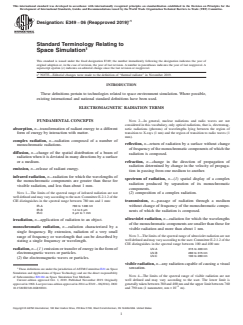
- Electromagnetic Radiation Terms: Definitions for concepts such as absorption, emission, reflection, transmission, wavelength, frequency, and various forms of radiation (infrared, ultraviolet, visible).
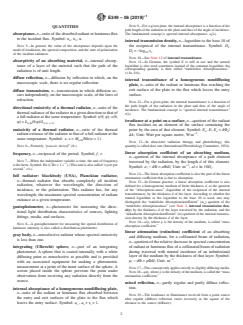
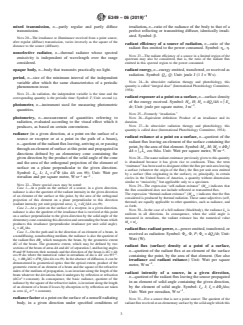
- Radiometric Quantities and Measurements: Terms including radiance, irradiance, radiant flux, radiant energy, luminous flux, and related measurement units and instruments (e.g., photometer, radiometer, spectroradiometer).
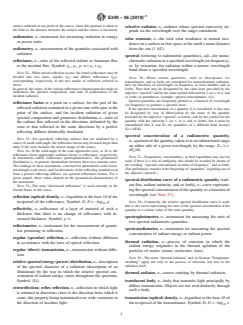
- Surface and Material Properties: Definitions surrounding reflectance, absorptance, emissivity, transmittance, and related factors important in materials testing under space conditions.
- Vacuum Technology: Key terms related to vacuum measurement devices, such as ionization gages, molecular flux, partial pressure, response time, and background effects. These support precise measurement and control of space-like vacuums.
- Thermal and Optical Properties: Clarification of terms like blackbody, gray body, nonselective radiator, and selective radiator, as well as mechanisms of thermal emission such as thermal radiation and ablation.
Applications
The terminology defined in ASTM E349-06(2019)e1 is essential for:
- Spacecraft and Instrumentation Testing: Ensuring accurate simulation of space environments for satellites, probes, and their components to validate performance and reliability before launch.
- Materials Science: Supporting the development and assessment of coatings, insulation, and structural materials exposed to radiation, extreme temperatures, and vacuum.
- Vacuum System Design and Operation: Assisting vacuum engineers and researchers in designing, operating, and interpreting results from vacuum chambers and measurement devices.
- Calibration and Measurement Consistency: Establishing common ground for the calibration of instruments such as radiometers, photometers, and ionization gages used in both laboratory and industrial settings.
- Research and Development: Facilitating cross-disciplinary R&D in astrophysics, photonics, optics, and thermal management through well-defined terminology.
- Quality Assurance and Compliance: Enabling organizations to meet regulatory and contractual obligations by referencing standardized terms in specifications, procedures, and documentation.
Related Standards
Professionals referring to ASTM E349 may also find value in the following standards:
- ASTM E294 – Test Method for Solar Simulation and Space Environment Testing
- ASTM E295 – Test Method (withdrawn) related to vacuum technology terminology
- ASTM E296 – Practice for Space Simulation Chamber Performance
- ASTM E297 – Method concerning vacuum measurement and control
- Glossary of Terms Used in Vacuum Technology (American Vacuum Society) – Additional vacuum terms and definitions
- ASTM E21 Series – Space Simulation and Applications of Space Technology Standards
These related documents complement E349 by providing further detail on procedures, measurement techniques, and broader context for space simulation terminology.
By standardizing vocabulary, ASTM E349-06(2019)e1 ensures technical accuracy, efficient communication, and interoperability in the design, testing, and evaluation of materials and systems destined for space or space-like environments. This enhances collaboration across international projects and supports the advancement of aerospace, defense, and scientific research sectors.
Relations
- Effective Date
- 01-Oct-2019
- Referred By
ASTM E307-72(2019) - Standard Test Method for Normal Spectral Emittance at Elevated Temperatures - Effective Date
- 01-Oct-2019
- Effective Date
- 01-Oct-2019
- Effective Date
- 01-Oct-2019
- Effective Date
- 01-Oct-2019
- Effective Date
- 01-Oct-2019
- Effective Date
- 01-Oct-2019
- Effective Date
- 01-Oct-2019
- Effective Date
- 01-Oct-2019
Get Certified
Connect with accredited certification bodies for this standard

BUREAU VERITAS Certification Germany
Bureau Veritas certification in Germany.

Element Materials Technology
Materials testing and product certification.

AQMS Ltd.
AQMS provides ISO certification to SMEs across the UK.
Sponsored listings
Frequently Asked Questions
ASTM E349-06(2019)e1 is a standard published by ASTM International. Its full title is "Standard Terminology Relating to Space Simulation". This standard covers: Standard Terminology Relating to Space Simulation
Standard Terminology Relating to Space Simulation
ASTM E349-06(2019)e1 is classified under the following ICS (International Classification for Standards) categories: 01.040.49 - Aircraft and space vehicle engineering (Vocabularies); 49.140 - Space systems and operations. The ICS classification helps identify the subject area and facilitates finding related standards.
ASTM E349-06(2019)e1 has the following relationships with other standards: It is inter standard links to ASTM E349-06(2014), ASTM E307-72(2019), ASTM E772-15(2021), ASTM C1483/C1483M-17(2022), ASTM E434-10(2020), ASTM E512-94(2020), ASTM E284-22, ASTM E423-71(2019), ASTM E491-73(2020). Understanding these relationships helps ensure you are using the most current and applicable version of the standard.
ASTM E349-06(2019)e1 is available in PDF format for immediate download after purchase. The document can be added to your cart and obtained through the secure checkout process. Digital delivery ensures instant access to the complete standard document.
Standards Content (Sample)
This international standard was developed in accordance with internationally recognized principles on standardization established in the Decision on Principles for the
Development of International Standards, Guides and Recommendations issued by the World Trade Organization Technical Barriers to Trade (TBT) Committee.
ϵ1
Designation: E349 − 06 (Reapproved 2019)
Standard Terminology Relating to
Space Simulation
This standard is issued under the fixed designation E349; the number immediately following the designation indicates the year of
original adoption or, in the case of revision, the year of last revision.Anumber in parentheses indicates the year of last reapproval.A
superscript epsilon (´) indicates an editorial change since the last revision or reapproval.
ε NOTE—Editorial changes were made to the definition of “thermal radiator” in November 2019.
INTRODUCTION
These definitions pertain to technologies related to space environment simulation. Where possible,
existing international and national standard definitions have been used.
ELECTROMAGNETIC RADIATION TERMS
NOTE 2—In general, nuclear radiations and radio waves are not
FUNDAMENTAL CONCEPTS
considered in this vocabulary, only optical radiations, that is, electromag-
absorption, n—transformation of radiant energy to a different
netic radiations (photons) of wavelengths lying between the region of
transition to X-rays (1 nm) and the region of transition to radio waves (1
form of energy by interaction with matter.
mm).
complex radiation, n—radiation composed of a number of
reflection, n—return of radiation by a surface without change
monochromatic radiations.
offrequencyofthemonochromaticcomponentsofwhichthe
diffusion, n—change of the spatial distribution of a beam of
radiation is composed.
radiation when it is deviated in many directions by a surface
refraction, n—change in the direction of propagation of
or a medium.
radiation determined by change in the velocity of propaga-
emission, n—release of radiant energy.
tion in passing from one medium to another.
infrared radiation, n—radiation for which the wavelengths of
spectrum of radiation, n—(1) spatial display of a complex
the monochromatic components are greater than those for
radiation produced by separation of its monochromatic
vissible radiation, and less than about 1 mm.
components.
NOTE 1—The limits of the spectral range of infrared radiation are not
(2) composition of a complex radiation.
welldefinedandmayvaryaccordingtotheuser.CommitteeE-2.1.2ofthe
CIE distinguishes in the spectral range between 780 nm and 1 mm:
transmission, n—passage of radiation through a medium
IR-A 780 to 1400 nm without change of frequency of the monochromatic compo-
IR-B 1.4to3µm
nents of which the radiation is composed.
IR-C 3µmto1mm
ultraviolet radiation, n—radiation for which the wavelengths
irradiation, n—application of radiation to an object.
ofthemonochromaticcomponentsaresmallerthanthosefor
monochromatic radiation, n—radiation characterized by a
visible radiation and more than about 1 nm.
single frequency. By extension, radiation of a very small
NOTE3—Thelimitsofthespectralrangeofultravioletradiationarenot
range of frequency or wavelength that can be described by
welldefinedandmayvaryaccordingtotheuser.CommitteeE-2.1.2ofthe
stating a single frequency or wavelength.
CIE distinguishes in the spectral range between 100 and 400 nm:
radiation, n—(1)emissionortransferofenergyintheformof
UV-A 315 to 400 nm
UV-B 280 to 315 nm
electromagnetic waves or particles.
UV-C 100 to 280 nm
(2) the electromagnetic waves or particles.
visible radiation, n—any radiation capable of causing a visual
1 sensation.
These definitions are under the jurisdiction ofASTM Committee E21 on Space
Simulation and Applications of Space Technology and are the direct responsibility
NOTE 4—The limits of the spectral range of visible radiation are not
of Subcommittee E21.04 on Space Simulation Test Methods.
well defined and may vary according to the user. The lower limit is
Current edition approved Oct. 1, 2019. Published November 2019. Originally
approvedin1968.Lastpreviouseditionapprovedin2014asE349–06(2014).DOI: generallytakenbetween380and400nmandtheupperlimitbetween760
−9
10.1520/E0349-06R19E01. and 790 nm (1 nanometer, nm=10 m).
Copyright © ASTM International, 100 Barr Harbor Drive, PO Box C700, West Conshohocken, PA 19428-2959. United States
ϵ1
E349 − 06 (2019)
NOTE 9—For a given plate, the internal absorptance is a function of the
QUANTITIES
path length of the radiation in the plate and thus of the angle of incidence.
absorptance, n—ratiooftheabsorbedradiantorluminousflux The fundamental concept is spectral internal absorptance. a(λ).
i
to the incident flux. Symbol: α , α , α.
e v
internal transmission density, n—logarithm to the base 10 of
NOTE 5—In general, the value of the absorptance depends upon the the reciprocal of the internal transmittance. Symbol: D,
i
modeofirradiation,thespectralcomposition,andthestateofpolarization
D =−log τ.
i 10 i
of the incident radiation.
NOTE 10—See Note 12 of internal transmittance.
absorptivity of an absorbing material, n—internal absorp-
NOTE 11—In German, the symbol E is still in use and the natural
logarithm is also used sometimes instead of the common logarithm; the
tance of a layer of the material such that the path of the
corresponding quantity is then called “natürliches Absorptionsmass.”
radiation is of unit length.
(=In 1/τi).
diffuse reflection, n—diffusion by reflection in which, on the
internal transmittance of a homogeneous nondiffusing
macroscopic scale, there is no regular reflection.
plate, n—ratio of the radiant or luminous flux reaching the
exit surface of the plate to the flux which leaves the entry
diffuse transmission, n—transmission in which diffusion oc-
surface.
curs independently, on the macroscopic scale, of the laws of
refraction.
NOTE 12—For a given plate, the internal transmittance is a function of
the path length of the radiation in the plate and thus of the angle of
directional emissivity of a thermal radiator, n—ratio of the
incidence. The fundamental concept is “spectral internal transmittance”
thermalradianceoftheradiatorinagivendirectiontothatof
τ(λ).
a full radiator at the same temperature. Symbol: ε(θ, φ); ε(θ,
irradiance at a point on a surface, n—quotient of the radiant
φ)= L (θ,φ)/L .
e,th e(ε=1)
flux incident on an element of the surface containing the
emissivity of a thermal radiator, n—ratio of the thermal
point by the area of that element. Symbol: E , E; E =dΦ /
e e e
−2
radiantexitanceoftheradiatortothatofafullradiatoratthe
dA; Unit: Watt per square metre, W·m .
same temperature. Symbol: ε, ε= M /Me(ε=1).
e,th
NOTE 13—In ultraviolet radiation therapy and photobiology, this
quantityiscalleddoserate(InternationalPhotobiologyCommittee,1954).
NOTE 6—Formerly “pouvoir émissif” (fr.).
linear absorption coefficient of an absorbing medium,
frequency, n—reciprocal of the period. Symbol; f, ν.
n—quotient of the internal absorptance of a path element
NOTE 7—When the independent variable is time, the unit of frequency
traversed by the radiation, by the length d of this element.
−1
isthehertz.Symbol:Hz(1Hz=1s ).(Thisunitisalsocalled“cycleper
−1
Symbol: a;−dΦ= aΦdl; Unit: m ; al=ln10D.
i
second,” c/s.)
NOTE 14—The linear absorption coefficient is also the part of the linear
full radiator: blackbody (USA), Planckian radiator,
attenuation coefficient that is due to absorption.
n—thermal radiator that absorbs completely all incident
NOTE 15—In German practice, a linear absorption coefficient is also
radiation, whatever the wavelength, the direction of
defined for a homogeneous medium of finite thickness d, as the quotient
incidence, or the polarization. This radiator has, for any of the “Absorptions-mass” (logarithm of the reciprocal of the internal
transmittance), by the thickness d of the layer. According to whether the
wavelength, the maximum spectral concentration of radiant
natural logarithm or the logarithm to the base 10 is used, one may
exitance at a given temperature.
distinguish the “natürliche Absorptionskoeffizient” (m ) quotient of the
n
“natürliche Absorptionsmass” (see Note 2, internal transmission den-
goniophotometer, n—photometer for measuring the direc-
sity) by the thickness d of the layer traversed by the radiation, and the
tional light distribution characteristics of sources, lighting
“dekadischeAbsorptionskoeffizient”(m)quotientoftheinternaltransmis-
fittings, media, and surfaces.
sion density by the thickness d of the layer.
NOTE 16—a/ρ, where ρ is the density of the medium, is called “mass
NOTE 8—A goniophotometer for measuring the spatial distribution of
absorption coefficient.”
luminous intensity is also called a distribution photometer.
linear attenuation (extinction) coefficient of an absorbing
gray body, n—nonselective radiator whose spectral emissivity
and diffusing medium, for a collimated beam of radiation,
is less than one.
n—quotientoftherelativedecreaseinspectralconcentration
ofradiantorluminousfluxofacollimatedbeamofradiation
integrating (Ulbrecht) sphere, n—part of an integrating
during traversal with normal incidence of an infinitesimal
photometer. A sphere that is coated internally with a white
layer of the medium by the thickness of that layer. Symbol:
diffusing paint as nonselective as possible and is provided
−1
µ;−dΦ=µΦdl; Unit: m .
with an associated equipment for making a photometric
measurement at a point of the inner surface of the sphere.A
NOTE17—Thisconceptonlyappliesstrictlytoslightlydiffusingmedia.
screen placed inside the sphere prevents the point under
NOTE18—µ/ρ,whereρisthedensityofthemedium,iscalledthe“mass
observation from receiving any radiation directly from the attenuation coefficient.”
source.
mixed reflection, n—partly regular and partly diffuse reflec-
tion.
internal absorptance of a homogeneous nondiffusing plate,
n—ratio of the radiant or luminous flux absorbed between
NOTE 19—The irradiance or illuminance received from a point source
the entry and exit surfaces of the plate to the flux which
after regular (diffuse) reflection varies inversely as the square of the
leaves the entry surface. Symbol: a , a +τ =1. distance to the source (diffuser).
i i i
ϵ1
E349 − 06 (2019)
mixed transmission, n—partly regular and partly diffuse irradiation, n—ratio of the radiance of the body to that of a
transmission. perfect reflecting or transmitting diffuser, identically irradi-
ated. Symbol: β.
NOTE 20—The irradiance or illuminance received from a point source,
after regular (diffuse) transmission, varies inversely as the square of the
radiant efficiency of a source of radiation, n—ratio of the
distance to the source (diffuser).
radiant flux emitted to the power consumed. Symbol: η , η.
e
nonselective radiator, n—thermal radiator whose spectral
NOTE 23—The radiant efficiency of a source in a limited region of the
emissivity is independent of wavelength over the range
spectrum may also be considered, that is, the ratio of the radiant flux
considered.
emitted in this spectral region to the power consumed.
opaque body, n—body that transmits practically no light.
radiant energy, n—energy emitted, transferred, or received as
radiation. Symbol: Q , Q; Unit: joule J (1 J=W·s).
e
period, n—size of the minimum interval of the independent
NOTE 24—In ultraviolet radiation therapy and photobiology, this
variable after which the same characteristics of a periodic
quantity is called “integral dose” (International Photobiology Committee,
phenomenon recur.
1954).
NOTE 21—In radiation, the independent variable is the time and the
radiant exposure at a point on a surface, n—surface density
corresponding quantity is the periodic time: Symbol: T; Unit: second (s).
of the energy received. Symbol: H , H; H =dQ /dA=∫ E
e e e e
photometer, n—instrument used for measuring photometric −2
dt; Unit: joule per square metre, J·m .
quantities.
NOTE 25—Formerly “irradiation.”
photometry, n—measurement of quantities referring to
NOTE 26—Equivalent definition: Product of an irradiance and its
duration.
radiation, evaluated according to the visual effect which it
NOTE 27—In ultraviolet radiation therapy and photobiology, this
produces, as based on certain conventions.
quantity is called dose (International Photobiology Committee, 1954).
radiance (in a given direction, at a point on the surface of a
radiant exitance at a point on a surface, n—quotient of the
source or receptor or at a point in the path of a beam),
radiant flux leaving an element of the surface containing the
n—quotientoftheradiantfluxleaving,arrivingat,orpassing
point,bytheareaofthatelement.Symbol: M , M; M =dΦ /
e e e
throughanelementofsurfaceatthispointandpropagatedin
−2
dA=∫ L cos θdω. Unit: Watt per square metre, W·m .
2 e
directions defined by an elementary cone containing the
given direction by the product of the solid angle of the cone NOTE28—Thenameradiantemittancepreviouslygiventothisquantity
is abandoned because it has given rise to confusion. Thus, the term
and the area of the orthogonal projection of the element of
“emittance”hasbeenusedtodesignateeitherthefluxperunitarealeaving
surface on a plane perpendicular to the given direction.
a surface (whatever the origin of the flux), the flux per unit area emitted
Symbol: L , L; L =d Φ (dω dA cos Θ); Unit: Watt per
e e
by a surface (flux originating in the surface), or, principally, in certain
−1 −2
steradian and per square metre, W·sr m .
circles in the United States of America, a quantity without dimensions
similar to “emissivity,” but applicable only to a specimen.
NOTE 22—Three special cases may be noted:
NOTE 29—The expression “self-radiant exitance” (M ) indicates that
e,s
Case 1—At a point on the surface of a source, in a given direction,
the flux considered does not include reflected or transmitted flux.
radiance is also the quotient of the radiant intensity in the given direction
The expression “thermal-radiant exitance” (M ) indicates that the flux
e,th
of an element of the surface at this point, by the area of the orthogonal
considered is produced by thermal radiation. These same adjectives (self,
projection of this element on a plane perpendicular to this direction
thermal) are equally applicable to other quantities, such as radiance, and
(radiant intensity per unit projected area). L =dI /(dA cos Θ).
e e
so forth.
Case 2—At a point on the surface of a receptor, in a given direction,
NOTE 30—In the case of a full radiator (blackbody), the radiance L is
e
radiance is also the quotient of the irradiance that is received at this point
uniform in all directions. In consequence, when the solid angle is
on a surface perpendicular to the given direction by the solid angle of the
measured in steradians, the radiant exitance has the numerical value
elementaryconecontainingthisdirectionandsurroundingthebeamwhich
M =πl .
e e
produces this irradiance (perpendicular irradiance per unit solid angle).
L =dE /dω.
e e
radiant flux: radiant power, n—poweremitted,transferred,or
Case 3—On the path and in the direction of an element of a beam, in
received as radiation: Symbol: Φ , Φ, P; Φ =dQ /dt; Unit:
e e e
a nondiffusing, nonabsorbing medium, the radiance is also the quotient of
Watt (W).
the radiant flux dΦ which transports the beam, by the geometric extent
e
dG of the beam. The geometric extent, which may be defined by two
radiant flux (surface) density at a point of a surface,
sectionsofthebeamofareasdAanddA'ofseparation l,andhavingangles
n—quotient of the radiant flux at an element of the surface
Θ and Θ' between their normals and the direction of the beam is dG=dA
−2
cos Θ dω where the numerical value in steradians of dω is dA' cos Θ'l .
containing the point, by the area of that element. (See also
L =dΦ /dG=d Φ /(dω dA cos Θ). In the absence of diffusion, it can be
0 0 e irradiance and radiant exitance.) Unit: Watt per square
demonstrated in geometrical optics that the optical extent, product of the −2
metre, W·m .
geometric extent of an element of a beam and the square of the refractive
indexofthemediumofpropagation,isaninvariantalongthelengthofthe
radiant intensity of a source, in a given direction,
beam whatever the deviations that it undergoes by reflection or refraction
n—quotientoftheradiantfluxleavingthesourcepropagated
(dG·n =constant). In consequence, the basic radiance, quotient of the
in an element of solid angle containing the given direction,
radiancebythesquareoftherefractiveindex,isinvariantalongthelength
of an element of a beam if losses by absorption or by reflection are taken by the element of solid angle. Symbol: I , I; I =dΦ /dω;
e e e
−2
−1
as zero (L ·n =constant).
Unit: Watt per steradian, W·sr .
e
radiance factoratapointonthesurfaceofanonself-radiating
NOTE 31—For a source that is not a point source: The quotient of the
body, in a given direction under specified conditions of radiantfluxrece
...