

ASTM F3377-23
(Terminology)Standard Terminology Relating to Commercial Spaceflight
General Information
- Abstract
SCOPE
1.1 This terminology standard is a compilation of definitions of terms used by ASTM Committee F47 on Commercial Spaceflight.
1.2 This standard does not purport to address all of the safety concerns, if any, associated with its use. It is the responsibility of the user of this standard to establish appropriate safety, health, and environmental practices and determine the applicability of regulatory limitations prior to use.
1.3 This international standard was developed in accordance with internationally recognized principles on standardization established in the Decision on Principles for the Development of International Standards, Guides and Recommendations issued by the World Trade Organization Technical Barriers to Trade (TBT) Committee.
- Status
- Published
- Publication Date
- 31-Jul-2023
- Technical Committee
- F47 - Commercial Spaceflight
- Drafting Committee
- F47.91 - Terminology




Overview
ASTM F3377-23: Standard Terminology Relating to Commercial Spaceflight is an internationally recognized terminology standard developed by ASTM Committee F47. This document establishes a foundational glossary for terms frequently encountered in the rapidly evolving field of commercial spaceflight. By standardizing definitions such as "docking," "orbital vehicle," and "spaceport," the standard facilitates clear communication and consistent understanding among stakeholders, including industry professionals, regulators, and researchers.
ASTM F3377-23 is built upon globally accepted principles of standardization, ensuring compatibility and compliance with international best practices. It supports safety, health, and environmental considerations, with users responsible for the appropriate application and adherence to regulatory limitations.
Key Topics
The standard compiles essential definitions relating to:
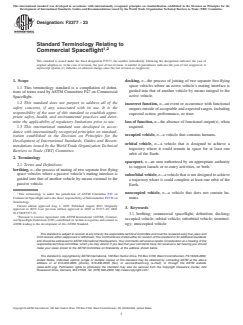
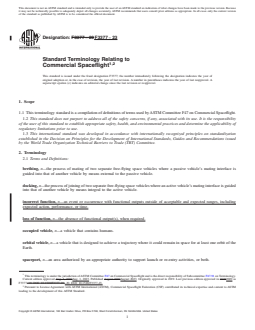
- Docking: The process of joining two separate, free-flying space vehicles where the active vehicle's mating interface is guided into another vehicle.
- Berthing: The mating process where a passive space vehicle’s interface is guided externally to complete the connection.
- Occupied and Unoccupied Vehicle: Differentiating vehicles based on human presence.
- Orbital and Suborbital Vehicle: Vehicles classified by their designed trajectory-whether they achieve at least one Earth orbit or not.
- Spaceport: Areas authorized for launch and re-entry operations.
- Loss of Function and Incorrect Function: Terms defining system failures or performance deviations within commercial spaceflight activities.
By providing these definitions, ASTM F3377-23 removes ambiguity in technical, operational, and regulatory discussions in the commercial spaceflight industry.
Applications
ASTM F3377-23 is an essential reference for:
- Aerospace Engineers and Designers: Ensuring technical documents, manuals, and proposals use standardized, internationally recognized terminology.
- Regulatory Authorities: Facilitating effective oversight, certification, and communication within the commercial spaceflight sector.
- Spaceport Operators and Commercial Launch Providers: Supporting internal training, safety protocols, and external communications by using consistent language.
- Academic and Research Institutions: Assisting in curriculum development and research publications to align with globally accepted definitions.
- International Collaboration: Enabling cross-border projects, joint ventures, and regulatory harmonization in commercial space travel.
Adoption of ASTM F3377-23 helps reduce misunderstandings, improves safety analysis, and promotes interoperability across commercial spaceflight activities.
Related Standards
To comprehensively address commercial spaceflight terminology and best practices, organizations should also consider related ASTM and international standards, including:
- ASTM F47 Series: Standards covering different aspects of commercial spaceflight, such as safety, operations, and materials.
- International Standards: Documents following the WTO Technical Barriers to Trade (TBT) Committee’s principles for the development of consistent global terminology and procedures in spaceflight.
- Regulatory Guidance: Supplemental national or regional regulations and guidelines for space vehicle operations and spaceports.
Integrating ASTM F3377-23 with related standards ensures a robust, cohesive framework for terminology in the commercial spaceflight domain.
Keywords: ASTM F3377-23, commercial spaceflight terminology, spaceport, docking, berthing, orbital vehicle, suborbital vehicle, aerospace standards, F47 Committee, spaceflight definitions, international standards.
Get Certified
Connect with accredited certification bodies for this standard

BUREAU VERITAS Certification Germany
Bureau Veritas certification in Germany.

Element Materials Technology
Materials testing and product certification.

AQMS Ltd.
AQMS provides ISO certification to SMEs across the UK.
Sponsored listings
Frequently Asked Questions
ASTM F3377-23 is a standard published by ASTM International. Its full title is "Standard Terminology Relating to Commercial Spaceflight". This standard covers: SCOPE 1.1 This terminology standard is a compilation of definitions of terms used by ASTM Committee F47 on Commercial Spaceflight. 1.2 This standard does not purport to address all of the safety concerns, if any, associated with its use. It is the responsibility of the user of this standard to establish appropriate safety, health, and environmental practices and determine the applicability of regulatory limitations prior to use. 1.3 This international standard was developed in accordance with internationally recognized principles on standardization established in the Decision on Principles for the Development of International Standards, Guides and Recommendations issued by the World Trade Organization Technical Barriers to Trade (TBT) Committee.
SCOPE 1.1 This terminology standard is a compilation of definitions of terms used by ASTM Committee F47 on Commercial Spaceflight. 1.2 This standard does not purport to address all of the safety concerns, if any, associated with its use. It is the responsibility of the user of this standard to establish appropriate safety, health, and environmental practices and determine the applicability of regulatory limitations prior to use. 1.3 This international standard was developed in accordance with internationally recognized principles on standardization established in the Decision on Principles for the Development of International Standards, Guides and Recommendations issued by the World Trade Organization Technical Barriers to Trade (TBT) Committee.
ASTM F3377-23 is classified under the following ICS (International Classification for Standards) categories: 01.040.49 - Aircraft and space vehicle engineering (Vocabularies); 49.140 - Space systems and operations. The ICS classification helps identify the subject area and facilitates finding related standards.
ASTM F3377-23 is available in PDF format for immediate download after purchase. The document can be added to your cart and obtained through the secure checkout process. Digital delivery ensures instant access to the complete standard document.
Standards Content (Sample)
This international standard was developed in accordance with internationally recognized principles on standardization established in the Decision on Principles for the
Development of International Standards, Guides and Recommendations issued by the World Trade Organization Technical Barriers to Trade (TBT) Committee.
Designation: F3377 − 23
Standard Terminology Relating to
1,2
Commercial Spaceflight
This standard is issued under the fixed designation F3377; the number immediately following the designation indicates the year of
original adoption or, in the case of revision, the year of last revision. A number in parentheses indicates the year of last reapproval. A
superscript epsilon (´) indicates an editorial change since the last revision or reapproval.
1. Scope docking, n—the process of joining of two separate free-flying
space vehicles where an active vehicle’s mating interface is
1.1 This terminology standard is a compilation of defini-
guided into that of another vehicle by means integral to the
tions of terms used by ASTM Committee F47 on Commercial
active vehicle.
Spaceflight.
1.2 This standard does not purport to address all of the
incorrect function, n—an event or occurrence with functional
safety concerns, if any, associated with its use. It is the
outputs outside of acceptable and expected ranges, including
responsibility of the user of this standard to establish appro-
expected action, performance, or time.
priate safety, health, and environmental practices and deter-
mine the applicability of regulatory limitations prior to use. loss of function, n—the absence of functional output(s), when
1.3 This international standard was developed in accor-
required.
dance with internationally recognized principles on standard-
occupied vehicle, n—a vehicle that contains humans.
ization established in the Decision on Principles for the
Development of International Standards, Guides and Recom-
orbital vehicle, n—a vehicle that is designed to achieve a
mendations issued by the World Trade Organization Technical
trajectory where it could remain in space for at least one
Barriers to Trade (TBT) Committee.
orbit of the Earth.
2. Terminology
spaceport, n—an area authorized by an appropriate authority
2.1 Terms and Definitions:
to support launch or re-entry activities, or both.
berthing, n—the process of mating of two separate free-flying
space vehic
...
This document is not an ASTM standard and is intended only to provide the user of an ASTM standard an indication of what changes have been made to the previous version. Because
it may not be technically possible to adequately depict all changes accurately, ASTM recommends that users consult prior editions as appropriate. In all cases only the current version
of the standard as published by ASTM is to be considered the official document.
Designation: F3377 − 20 F3377 − 23
Standard Terminology Relating to
1,2
Commercial Spaceflight
This standard is issued under the fixed designation F3377; the number immediately following the designation indicates the year of
original adoption or, in the case of revision, the year of last revision. A number in parentheses indicates the year of last reapproval. A
superscript epsilon (´) indicates an editorial change since the last revision or reapproval.
1. Scope
1.1 This terminology standard is a compilation of definitions of terms used by ASTM Committee F47 on Commercial Spaceflight.
1.2 This standard does not purport to address all of the safety concerns, if any, associated with its use. It is the responsibility
of the user of this standard to establish appropriate safety, health, and environmental practices and determine the applicability of
regulatory limitations prior to use.
1.3 This international standard was developed in accordance with internationally recognized principles on standardization
established in the Decision on Principles for the Development of International Standards, Guides and Recommendations issued
by the World Trade Organization Technical Barriers to Trade (TBT) Committee.
2. Terminology
2.1 Terms and Definitions:
berthing, n—the process of mating of two separate free-flying space vehicles where a passive vehicle’s mating interface is
guided into that of another vehicle by means external to the passive vehicle.
docking, n—the process of joining of two separate free-flying space vehicles where an active vehicle’s mating interface is guided
into that of another vehicle by means integral to the active vehicle.
incorrect function, n—an event or occurrence with functional outputs outside of acceptable and expected ranges, including
expected action, performance, or time.
loss of function, n—the absence of functional output(s), when required.
occupied vehicle, n—a vehicle that contains humans.
orbital vehicle, n—a vehicle that is designed to achieve a trajectory where it could remain in space for at least one or
...